


Chargeback management solutions are your secret weapon for fighting and preventing customer payment disputes. Instead of drowning in manual paperwork for every single case, these platforms automate the entire process, from gathering the right evidence to submitting winning responses. The goal? To win back lost revenue and save you a massive amount of time.
What Are Chargeback Management Solutions?
Let’s paint a picture you might know all too well. A customer buys a product from your online store. A week later, they call their bank, claim they never made the purchase, and boom—the payment is yanked from your account. Just like that, you're out the sale, the product, and you've been slapped with a penalty fee. This is a chargeback, and it's a huge headache for any business selling online.
For a long time, merchants had to fight these disputes by hand. That meant an employee had to drop everything to dig through CRM records, find shipping confirmations, pull up customer emails, and locate transaction details. They’d piece it all together and send it off to the bank, pretty much just crossing their fingers. It was slow, costly, and honestly, didn't work very well.
Shifting from Manual Hassle to Automated Defense
This is where chargeback management solutions change the game. Think of them as an automated defense system protecting your revenue. Instead of a person manually slogging through each dispute, the software does all the heavy lifting.
When a chargeback hits your account, the solution instantly gets to work:
- It pulls all the relevant transaction data from your payment processor.
- It gathers compelling evidence like IP logs, AVS results, delivery confirmations, and customer interaction history.
- It builds a powerful, evidence-based rebuttal that’s perfectly tailored to the specific reason for the dispute.
- It submits the complete case file to the bank on your behalf, always within the strict deadlines.
This is a massive leap from a manual chore to a smart, automated workflow. And the problem is only getting bigger. Projections show the global financial impact of chargebacks is set to grow from $33.79 billion in 2025 to $41.69 billion by 2028. When you consider merchants only win about 45% of disputes they fight manually, automation stops being a nice-to-have and becomes a must-have.
The Clear Advantage of an Automated Approach
Let’s be clear: the difference between handling this in-house versus using a dedicated tool is night and day. But before we get into that, remember that a good defense starts with a good offense. A helpful resource from Wand Websites explains how to create a a secure website to protect against some fraudulent transactions from the get-go.
Still, you can't prevent every chargeback. The table below breaks down just how different the two approaches are.
Manual vs Automated Chargeback Management
Here's a quick comparison showing the differences between handling chargebacks manually and using an automated solution.
As you can see, automation isn't just about saving time; it's about getting better results and protecting your business as it grows.
An automated solution acts like a dedicated expert working 24/7, ensuring no dispute falls through the cracks and every response is optimized to win. It removes human error and emotional decision-making from a process that demands precision and speed.
Ultimately, these tools are built to protect your bottom line by boosting your win rate, recovering lost funds, and freeing up your team to focus on what they do best: growing your business. For a deeper dive into the fundamentals, check out our guide on what is chargeback management and how it all works.
How AI Helps You Win More Chargeback Disputes
Think about what it would take to fight chargebacks manually. You'd need a legal expert to build your case and a private detective to sniff out fraud, both working for you 24/7. That's exactly what modern chargeback management solutions bring to the table. AI transforms what used to be a frustrating, manual chore into an intelligent, automated defense system for your business.
Let's break down how.
Your Automated Legal Expert: AI-Powered Representment
First, you have the legal expert side of things: AI-powered representment. The moment a dispute hits your account, the AI springs into action. There's no waiting around for someone on your team to start digging for files. It instantly gathers every critical piece of evidence linked to that specific transaction.
This isn't just a simple file pull. The AI knows precisely what to look for:
- Shipping confirmations and delivery tracking numbers.
- IP logs that place the customer at the location of the purchase.
- Customer service emails, chat transcripts, or support tickets.
- AVS (Address Verification Service) and CVV match results from the payment gateway.
It then assembles all this proof into a compelling, coherent case that directly addresses the chargeback's reason code. Because the AI understands the different requirements of each bank and card network, it submits the strongest possible argument on your behalf, seriously boosting your chances of winning.
Your Digital Detective: Intelligent Fraud Detection
The other half of this powerhouse is the detective work—intelligent fraud detection. This is where AI algorithms get proactive, analyzing transaction patterns to spot red flags long before they escalate into a full-blown chargeback. The system quickly learns what a "normal" transaction looks like for your store and instantly flags anything that deviates from that baseline.
This is absolutely crucial for tackling "friendly fraud," which happens when a legitimate customer disputes a charge, claiming they never made the purchase or received the item. Friendly fraud and blatant refund abuse are fueling a massive surge in chargebacks. In fact, recent data showed that retail e-commerce chargebacks shot up by a staggering 233% between the first and third quarters of 2025. Even more concerning, about one in five consumers admitted to filing false claims after watching "refund hack" videos on social media, often blaming economic pressure. You can get more details on this alarming trend over at Payscout.com.
Every single chargeback stings, and this is what that damage looks like up close.
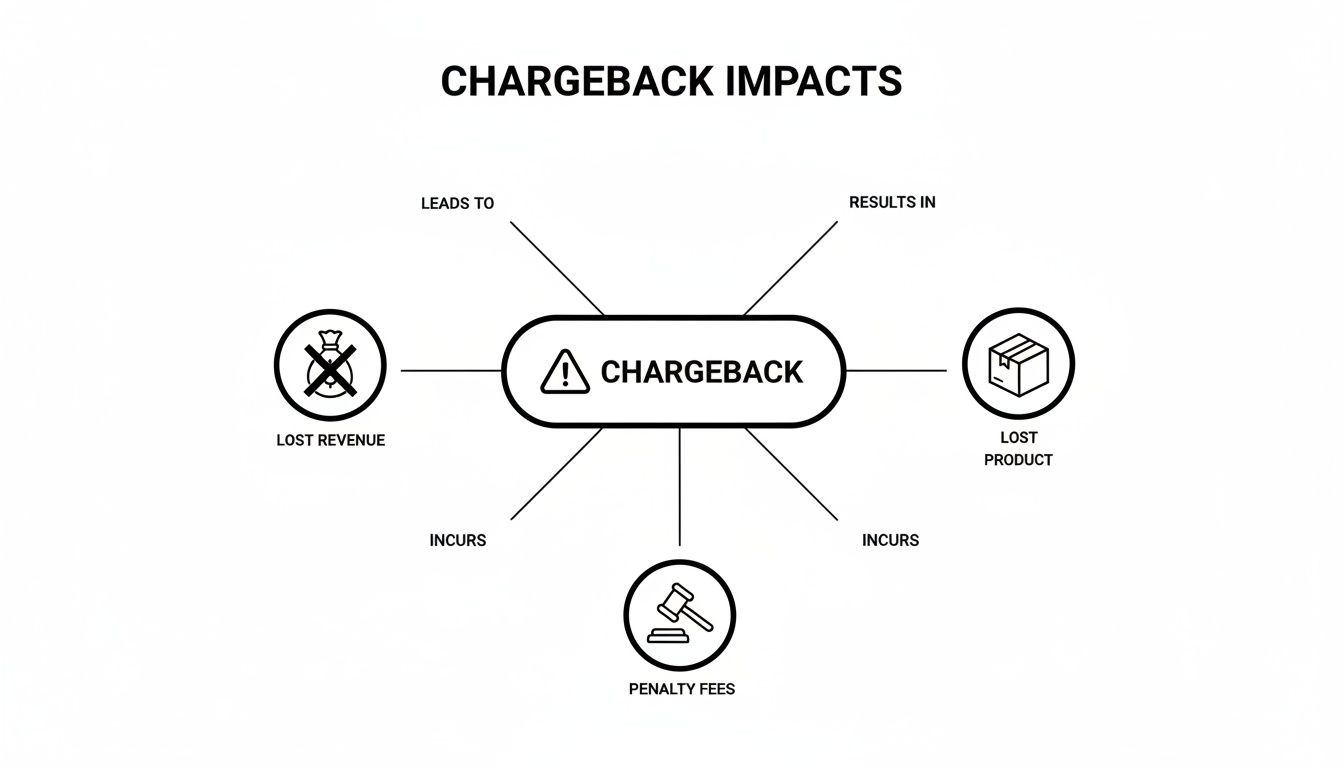
As you can see, it's a triple hit: you lose the revenue from the sale, you lose the product you shipped, and you get slapped with penalty fees from the bank.
How AI Connects the Dots to Protect Your Bottom Line
AI-powered chargeback management solutions don't just react; they anticipate. By analyzing thousands of data points in real time, the technology spots patterns a human analyst could easily miss.
For instance, it might flag a customer who has a history of filing disputes with other online stores, or it could catch an order where the shipping address and the IP address are on opposite sides of the country. This level of intelligence helps you clearly distinguish between genuine customer service issues, actual fraud, and the kind of deceptive refund abuse that drains your profits.
By automating evidence collection and identifying high-risk patterns, AI frees your team from manual investigation and empowers them with the data needed to fight and win disputes effectively. It turns the tide from a defensive scramble into a proactive strategy.
This automation is what allows your defense to scale right alongside your business. Instead of hiring more people just to keep up with a growing number of disputes, the software handles the volume effortlessly. This helps you keep your chargeback ratio low, protect your merchant accounts, and, most importantly, recover revenue that would have otherwise vanished.
To see the full picture of what this technology can do for you, take a look at our complete guide to automated chargeback and dispute management using AI.
Key Metrics for Measuring Your Success
Putting a chargeback management solution in place is a great first move, but how do you actually know if it's working? You can't just "feel" like it's helping; you need to look at the numbers.
Tracking the right key performance indicators (KPIs) is the only way to measure your success, prove your return on investment, and make smart decisions to protect your revenue. Think of these metrics as the dashboard in your car. They tell you how fast you're going and if any warning lights are on. Without them, you're just driving blind.
Let's break down the essential numbers you need to be watching.
Your Chargeback Win Rate
This is the most straightforward metric of them all. Your chargeback win rate is the percentage of chargeback disputes you actually win. It's a direct reflection of how effective your representment process has become.
To calculate it, you simply divide the number of chargebacks you won by the total number of chargebacks you fought, then multiply by 100 to get a percentage. So, if you fought 50 disputes in a month and won 40 of them, your win rate would be a solid 80%.
A high win rate is a clear sign that your evidence is compelling and your responses are hitting the mark. This is often the first and most dramatic improvement you'll see with a quality chargeback management tool.
A rising win rate is proof that your automated system is building stronger, more evidence-backed cases than your manual efforts ever could. It’s the difference between showing up to a fight with a messy folder of papers versus a perfectly prepared legal brief.
The All-Important Revenue Recovery Rate
While winning is great, what really matters is the money you get back. Your revenue recovery rate tells you exactly that—the percentage of the disputed dollar amount you successfully clawed back. This is the metric that connects your dispute efforts directly to your bottom line.
For example, if you faced $10,000 in disputes and recovered $7,500, your revenue recovery rate is 75%.
This KPI is crucial because it quantifies the direct financial impact of your solution. It helps answer the big question from your finance team: "How much money is this tool actually saving us?" Keeping a close eye on this number helps you understand the real ROI.
Monitoring Your Chargeback Ratio
Your chargeback ratio is a critical health indicator for your merchant account. Payment processors like Visa and Mastercard watch this number very, very closely. It’s calculated by dividing your total number of chargebacks in a given month by your total number of transactions in that same month.
If you had 100 chargebacks and 10,000 transactions, your ratio would be 1%. While that sounds small, most processors want to see this number stay well below that 1% mark.
Why is this so important?
- Account Health: A high ratio flags you as a high-risk merchant, which can lead to higher processing fees or even getting your account terminated.
- Brand Reputation: It can signal underlying problems with your products, customer service, or fulfillment that you need to fix.
- Financial Penalties: Exceeding certain thresholds can trigger hefty fines from the card networks. Nobody wants that.
An effective chargeback solution helps keep this ratio low not just by winning disputes, but by giving you the insights to understand why they’re happening in the first place. For merchants curious about success rates, our article on how often merchants win chargeback disputes offers some valuable benchmarks.
By tracking these three key metrics, you move from guessing to knowing, turning your chargeback process into a measurable and optimizable part of your business strategy.
Choosing the Right Chargeback Management Solution
Picking the right partner to handle your chargebacks isn't a decision to take lightly. With so many options out there, it’s easy to feel overwhelmed. Think of this process like hiring a crucial team member—you need to find the right fit for your business's specific needs, budget, and goals.
Jumping into a partnership without asking the right questions can lead to headaches later on, like discovering hidden fees or realizing the tool doesn't play nice with your e-commerce platform. A little due diligence now will save you a whole lot of time and money down the road.
Start with Seamless Integration
First things first: integration. A powerful chargeback management solution is useless if it can't talk to your existing systems. It should feel like a natural extension of your store, not a clunky add-on that requires constant manual attention.
Look for a solution that offers one-click integrations with major e-commerce platforms and payment gateways.
- Shopify: Does it connect directly to your Shopify store to pull order and customer data automatically?
- Stripe: Can it sync with your Stripe account to receive dispute notifications in real time?
- PayPal & Braintree: Does it work smoothly with PayPal's unique dispute resolution process?
The easier the setup, the faster you can start protecting your revenue. A smooth integration means the system can immediately access the evidence it needs to fight on your behalf without you lifting a finger.
Understand the Pricing Model
Next up is the money talk. Pricing for chargeback management solutions typically falls into a few different buckets, and it's essential to understand which one works best for your business. Don't just look at the price tag; consider the value you're getting in return.
Common models include:
- Pay-Per-Dispute: You’re charged a fee for each chargeback the service fights for you. This can be cost-effective if you only see a few disputes here and there.
- Subscription Fee: You pay a flat monthly or annual fee, no matter how many disputes you have. This offers predictable costs for businesses with higher chargeback volumes.
- Success-Based Fee: This is often the most appealing model. You only pay a percentage of the revenue the solution successfully recovers for you. If they don't win, you don't pay.
Be wary of long-term contracts with hefty setup fees. A transparent, success-based pricing model aligns the provider's goals with yours—they only make money when you do, which is a powerful incentive for them to perform well.
Evaluate Automation and Reporting Quality
Not all automation is created equal. You need a solution that offers a high degree of intelligence, not just basic robotic responses. Ask potential vendors about the sophistication of their AI. Does it customize responses based on the chargeback reason code and your specific evidence?
Beyond the automation itself, check out the quality of the reporting dashboard. A good solution provides clear, actionable insights into your performance. You should be able to instantly track your win rate, revenue recovery rate, and overall chargeback ratio. These analytics are what help you spot trends and fix the underlying issues in your business.
To make your evaluation process a bit easier, use this simple checklist.
Vendor Evaluation Checklist
Thinking through these key areas will help you cut through the marketing noise and find a solution that genuinely meets your needs.
Choosing the right chargeback management solution is a strategic business decision. By focusing on these key areas—integration, pricing, automation, and reporting—you can find a partner that not only recovers lost revenue but also frees up your team to focus on growth.
If you’d like to see how an integrated approach can work for your business, you can explore the various chargeback management solutions designed for different platforms.
Integrating a Solution with Your E-commerce Store
Getting a new tool up and running can sometimes feel like a massive undertaking, but plugging in a modern chargeback management solution is surprisingly simple. You can forget about needing a team of developers or wrestling with complex code. These days, connecting a solution to your e-commerce store is designed to be quick and almost effortless.
Most top-tier solutions are built for one-click integrations with the platforms you're already using. That means you can link the system directly to your Shopify store, Stripe account, or PayPal gateway in just a couple of minutes. The whole process is built for busy merchants, not tech wizards.
How Does It Work?
The magic behind this simplicity is the API (Application Programming Interface). Think of an API as a secure messenger that lets your e-commerce platform and the chargeback tool talk to each other in real-time. When you set up the integration, you’re basically just giving the solution a key to access your transaction and dispute data through this secure channel.

A Quick Step-by-Step Integration Example
Let's walk through what this actually looks like for a typical Shopify store owner. The steps are pretty much the same no matter which platform you're on.
- Find the App: You'll start by heading to the solution provider’s website or your platform's app marketplace (like the Shopify App Store) and finding their application.
- Authorize Access: Next, you just click "Install" or "Connect." This will pop up a window asking you to log into your Shopify account and grant the app permission to see data like orders, customers, and disputes. This is the API handshake in action.
- Automatic Syncing Begins: Once you've clicked authorize, the system immediately starts syncing your historical and real-time transaction data. It automatically pulls in any open disputes and starts watching for new ones 24/7.
And that’s it. Seriously. From that moment on, the system just hums along quietly in the background. When a new chargeback is filed, the tool is instantly notified, gathers all the necessary evidence from your store, and starts building a response without you lifting a finger. Proper planning for payment gateway integration and maintenance is always smart, as these systems are the source of the transaction data that chargebacks are all about.
The whole point of a modern integration is to make the setup process disappear. Once connected, the solution should feel like a natural part of your business, handling disputes automatically so you can get back to growing your brand.
What Happens After You Connect?
Connecting your store is just the start. A well-integrated solution doesn’t just pull data once; it creates a continuous, automated workflow that keeps running.
This seamless connection ensures that:
- No disputes fall through the cracks: Real-time notifications from your payment processor flow directly into the management platform.
- Evidence is always complete and ready: The system can instantly grab order details, shipping information, and customer messages needed for a strong rebuttal.
- You get countless hours back: The entire process—from spotting the chargeback to submitting the evidence—is handled for you, cutting out all that painful manual work.
This hands-off approach makes adopting a chargeback solution a no-brainer. It’s a set-it-and-forget-it tool that starts paying for itself from day one, turning a complex, frustrating problem into a solved one. For those running on Shopify, digging into the specifics of Shopify chargeback protection can offer even more tailored insights.
Real-World Examples of Revenue Recovery
Theory is one thing, but seeing chargeback management solutions in action is what really drives home their value. Let's walk through a few real-world stories that show how different businesses have clawed back revenue that would have otherwise been lost for good.

These examples aren't just hypotheticals; they represent common, frustrating challenges that merchants face every single day. By seeing how others tackled these problems head-on, you can get a clearer picture of what’s possible for your own business.
The Subscription Service Automating Recurring Disputes
Imagine a monthly subscription box service constantly getting hit with "unrecognized transaction" chargebacks. Every month, a handful of customers would forget about their recurring payment, see the charge on their statement, and immediately call their bank to dispute it.
Manually, the team was drowning. For every single case, they had to prove the customer had actually signed up for a recurring plan, which meant digging through old sign-up forms and transaction histories. It was a nightmare.
After integrating an automated solution, the software started doing the heavy lifting instantly. The system would automatically pull three key pieces of evidence for each dispute:
- The customer’s initial sign-up confirmation, including the terms of service they agreed to.
- The IP address and timestamp from the original order.
- A complete history of successful past payments from that same card.
The results were immediate and dramatic. In their very first month, they recovered over $5,000 in disputed revenue and saw their win rate for this specific type of chargeback jump by 60%.
The Online Retailer Fighting 'Item Not Received' Claims
An e-commerce store selling high-end electronics had a different, but equally maddening, problem. They were losing thousands to customers who would receive their orders and then file a chargeback claiming the package never arrived.
Their new chargeback management tool integrated directly with their shipping carrier's API. When a dispute for "item not received" landed, the system automatically compiled a rock-solid evidence packet. This included the order confirmation, the customer's shipping address, and the crown jewel: delivery confirmation with a tracking number, timestamp, and sometimes even a photo of the package on the customer's doorstep.
By presenting irrefutable proof of delivery, the retailer was able to systematically dismantle these false claims. This automation not only recovered revenue but also sent a clear message that fraudulent claims would be challenged with hard evidence.
This targeted approach led to a 40% increase in their overall win rate and protected their bottom line from opportunistic fraud.
The Digital Goods Seller Defeating Friendly Fraud
Finally, think about a business selling digital products like software or online courses. They were a prime target for friendly fraud, where customers would use the product and then claim the charge was unauthorized just to get it for free.
By using an intelligent solution, they could automatically submit evidence unique to digital sales. This included customer account login history, IP logs showing the product was accessed multiple times from the same device, and records of customer support chats or emails.
This level of detailed proof made it incredibly difficult for customers to falsely claim they didn't authorize the purchase. The business successfully reduced their friendly fraud losses by 70% within three months, turning a major revenue drain into a manageable issue.
Got Questions? We’ve Got Answers.
Jumping into a new solution, even one that promises to save you money, always comes with a few questions. That's completely normal. Let's walk through some of the most common things merchants ask us, so you can get a clear picture of how this all works in the real world.
Our goal here is to clear up any lingering doubts and help you feel confident about finding the right fit for your business.
How Quickly Will I Actually See a Difference?
This is one of the best parts—automated systems don't waste any time. Most merchants start to see a real, measurable jump in their chargeback win rate within the first 30 to 60 days after getting set up.
The moment the solution is connected to your store, it gets to work fighting any new disputes that come in. As those first few cases get resolved in your favor, you'll see the impact directly on your revenue recovery, often within your very first billing cycle.
Does This Replace My Current Fraud Prevention Tools?
Nope, they actually work together like a one-two punch. Think of your existing fraud prevention tools—like AVS checks or CVV verification—as your first line of defense. Their job is to try and stop a fraudulent transaction before it ever goes through.
A chargeback management solution is your second line of defense. It’s the specialist you call in after a chargeback has already been filed to fight and win that money back.
The Bottom Line: Fraud prevention is proactive; it's all about blocking bad actors at the checkout. Chargeback management is reactive; it's designed to recover your money after a dispute has already happened. Using both gives you a much stronger, more complete security strategy.
What’s the Typical Pricing Structure?
Pricing models can vary, but many of the top-tier solutions run on a success-based fee. What this means is simple: you only pay a small percentage of the revenue they successfully recover for you.
This is a great model because the provider's goals are perfectly aligned with yours—they only make money when you do. You might also see flat monthly subscription fees or a fixed price per dispute. Whatever the model, always look for transparent pricing without sneaky setup fees or long-term contracts.
Can a Solution Actually Help Lower My Chargeback Ratio?
Absolutely. While the main job is to win disputes, these tools also give you a goldmine of data. By digging into the analytics behind your chargebacks, you can finally see the root causes. Maybe it's a confusing product description, unexpected shipping delays, or a specific pattern of friendly fraud.
Once you know what's causing the problem, you can fix it. Addressing these core issues helps prevent future disputes from ever happening in the first place. That directly helps keep your chargeback ratio low and ensures you stay in good standing with processors like Visa and Mastercard. It’s a huge long-term benefit.
Ready to stop bleeding revenue from chargebacks? ChargePay uses AI to automate the entire dispute process, recovering up to 80% of your lost funds without you lifting a finger. Protect your business today.


.svg)



.svg)


.svg)
.svg)
.svg)