

Think of a rebuttal letter as your official, evidence-backed response when you need to challenge a claim. It's your opportunity to set the record straight. A good rebuttal is direct, professional, and built on solid proof—not emotion. This single document is your most critical tool for turning a negative outcome in your favor.
What Is a Rebuttal Letter and When Do You Need One?
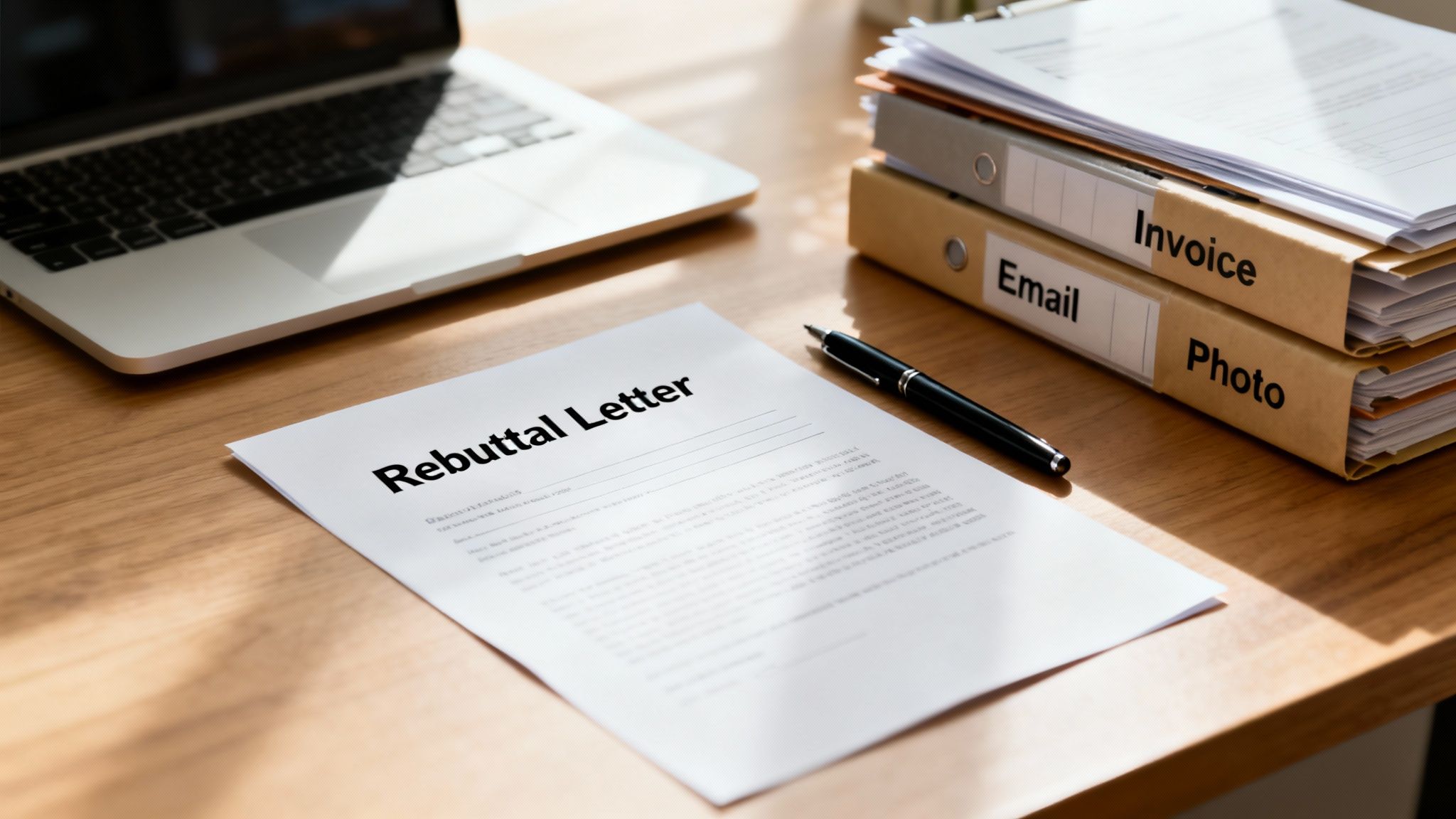
At its core, a rebuttal letter is a formal document you write to dispute a claim, accusation, or decision by presenting counter-evidence. It’s not just a simple disagreement; it's a structured argument designed to persuade an authority figure—like a bank, an employer, or an editor—to see things your way and reconsider their position.
The power of a well-written rebuttal letter is often underestimated. Take academic publishing, for example. Manuscripts facing major revisions see their acceptance rates jump to 40-50% when the author submits a point-by-point rebuttal. Without one, the initial rejection rate is a staggering 85%. That shows just how much a formal, evidence-based response can change the game.
Common Situations That Demand a Rebuttal Letter
While the specific scenarios can vary wildly, the goal is always the same: correct the record with facts. You absolutely need to get comfortable writing a rebuttal letter when you're facing situations like these:
- E-commerce Chargebacks: As a merchant, this is your primary defense against customer disputes. Whether the claim is "product not received" or "transaction not authorized," a rebuttal letter packed with compelling evidence is non-negotiable. It’s your best shot at winning a credit card dispute and getting your money back.
- Workplace Issues: If you get hit with an inaccurate performance review, a disciplinary notice, or even a wrongful termination, a rebuttal letter allows you to formally document your side of the story for HR records. It creates an official paper trail.
- Academic or Professional Rejections: This applies to rejected journal submissions, grant proposals, or even job applications where you genuinely believe the decision was based on a misunderstanding of your work or qualifications.
A strong rebuttal doesn’t just argue—it demonstrates. By systematically dismantling the original claim with clear, organized proof, you transform a defensive reaction into a proactive and credible case.
Letting an unfair claim go unanswered can have serious consequences. For an e-commerce business, it means lost revenue and a higher chargeback ratio. In a professional setting, it can damage your reputation and career progression. A rebuttal letter is your tool to prevent that from happening.
The Key Components of a Persuasive Rebuttal
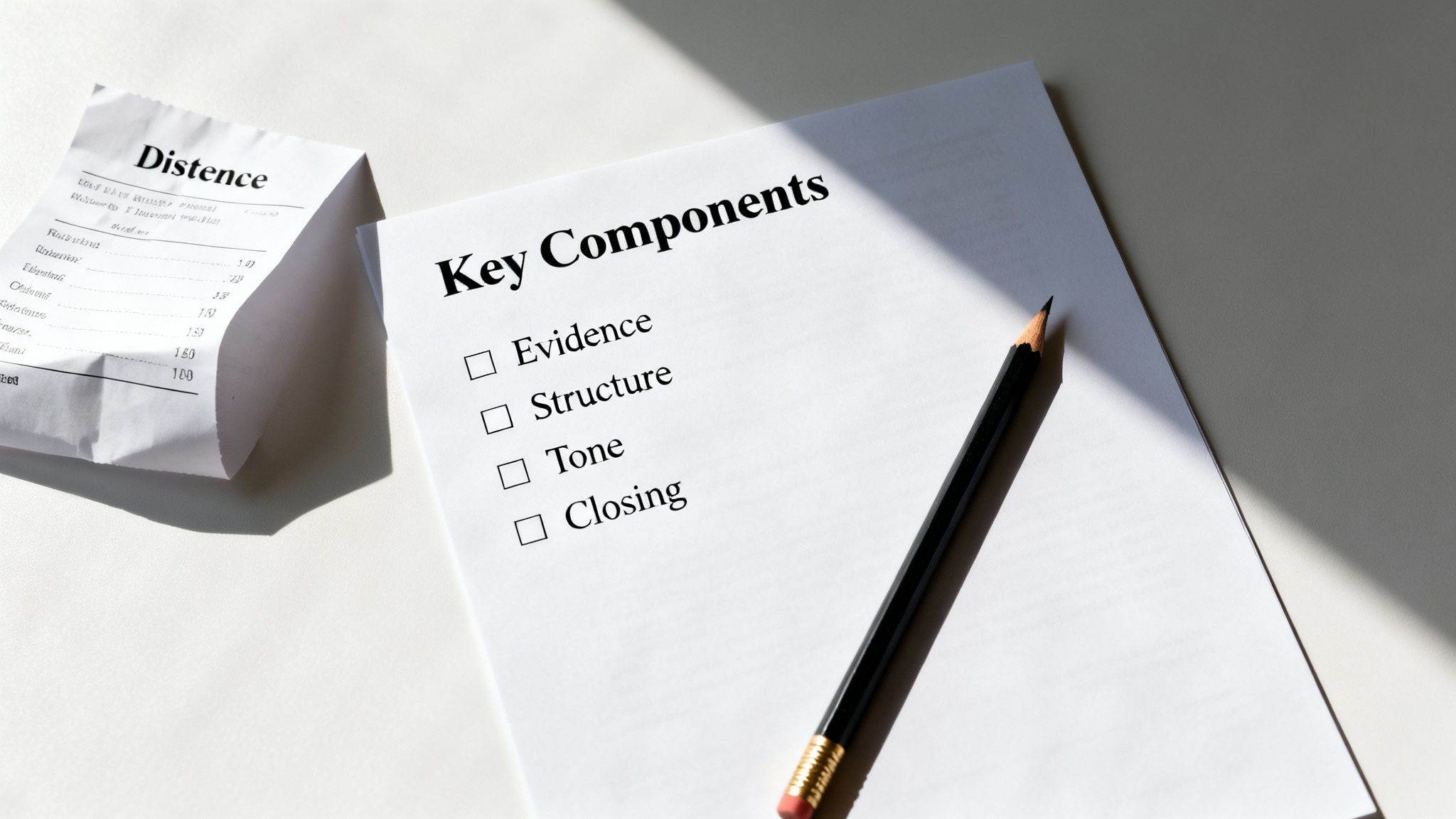
Before you even think about writing, you need a game plan. A powerful rebuttal isn’t just a frustrated email—it’s a structured, logical argument built on a foundation of cold, hard evidence. You have to approach it with a cool head.
Think of it less like a confrontation and more like a presentation of undeniable facts. The very first move is to gather your proof.
Gather Your Evidence First
Your evidence is the absolute backbone of your case. Without it, your letter is just a bunch of unsupported claims, and it will fail. The goal here is to create a paper trail so clear and convincing that it leaves no room for doubt.
Start pulling together documents like:
- Order and Transaction Details: This means invoices, receipts, and any transaction records that show the purchase date, amount, and exactly what was bought.
- Customer Communications: Dig up every email, chat log, or support ticket. These conversations can be a goldmine of information that validates your side of the story.
- Shipping and Delivery Proof: Don't just stop at tracking numbers. You need delivery confirmation receipts, especially those with a customer's signature. This is often the knockout punch.
- Product Information: Screenshots of the product page from around the time of the purchase can instantly shut down claims that an item was "not as described."
Once your evidence is organized, you can start building the letter. Each piece of proof should directly counter a specific point the customer is making.
A persuasive rebuttal is 80% evidence and 20% writing. If your proof is strong and organized, the letter practically writes itself. The words are just there to guide the reviewer through your documentation.
The Anatomy of a Winning Rebuttal
Every effective rebuttal letter follows a clear, logical structure. This isn't just for show—it makes it incredibly easy for the reviewer at the bank or payment processor to quickly grasp your argument and the proof you’ve provided.
Here’s a quick-reference table outlining the must-have components.
Essential Components of a Strong Rebuttal Letter
This structure ensures your argument is airtight and easy to follow.
To make your letter truly land, a basic understanding of persuasive writing techniques is a massive advantage. Remember, a calm, objective tone signals credibility and professionalism. For a structured guide to get you started, our letter of rebuttal template can help you organize these components effectively: https://www.chargepay.ai/blog/letter-of-rebuttal-template.
How to Structure Your Point-by-Point Argument

This is where the rubber meets the road. A winning rebuttal letter is built on a calm, methodical, point-by-point takedown of every single claim the customer made. Leave emotion at the door; your entire case needs to be built on pure logic and cold, hard proof.
The strategy is actually pretty simple: isolate each accusation, tackle it head-on, and then immediately squash it with a specific piece of evidence. This structured approach keeps the reviewer on track and shows them you have a clear, organized, and confident defense.
Isolate and Address Each Claim Separately
Whatever you do, don't lump multiple claims together into one giant paragraph. It's a surprisingly common mistake, and all it does is create confusion and dilute the power of your argument. Instead, think of each claim as its own mini-case that you need to solve and close.
Start by clearly stating the specific claim you’re about to dismantle. This helps the person reviewing the case follow your train of thought from start to finish. Using clear, direct language makes your letter feel professional and much easier to scan.
A few good starter phrases I’ve seen work well include:
- "Regarding the customer's statement that the item was never received..."
- "In response to the concern that the product was not as described..."
- "The claim alleges an unauthorized transaction; however..."
This approach forces you to stay laser-focused and makes it impossible for the reviewer to gloss over any part of your argument. When you dissect their case piece by piece, you’re the one in control.
Match Every Counter-Argument with Direct Evidence
This is non-negotiable. For every single point you make, you must immediately back it up with supporting evidence. Your words alone mean very little; the proof is what wins the dispute. This "claim, response, evidence" cycle is the engine that drives a powerful rebuttal.
Let's walk through a classic e-commerce scenario. A customer files a chargeback claiming "Merchandise Not Received." Here’s how you structure your response:
- Isolate the Claim: "The customer claims the order was not delivered."
- Provide the Counter-Argument: "Our records confirm the package was successfully delivered to the customer's verified address on October 26, 2023."
- Present the Proof: "This is confirmed by the attached signed delivery receipt from FedEx (see Attachment A) and the tracking history showing the 'Delivered' status (see Attachment B)."
This simple, three-part structure is incredibly effective. It leaves zero room for interpretation and leads the reviewer to the exact conclusion you want them to reach. For a deeper dive into how this fits into the complete document, check out this helpful guide on the proper format for a rebuttal letter that puts all these pieces together.
The goal is to create a direct line from the customer’s claim to your contradictory evidence. When the proof is undeniable—like a signature on a delivery slip—the dispute often resolves in your favor almost immediately.
This point-by-point method doesn't just build a rock-solid case; it also shows respect for the reviewer's time. Think about it: bank employees sift through countless disputes every single day. A letter that’s disorganized or makes them hunt for information is far more likely to get denied.
Make their job easier, and you’ll seriously increase your chances of winning.
Seeing Rebuttal Letters in Action

Theory is one thing, but seeing how a real-world rebuttal letter comes together is where it all starts to make sense. The right tone, the structure, the way the evidence slots into the argument—it’s much easier to grasp with a solid example in front of you.
Let’s walk through a few common situations. Think of these as blueprints you can pull apart and adapt. I’ll break down why certain phrases are used and how the evidence is woven directly into the narrative to build a rock-solid case.
E-Commerce Chargeback: "Product Not As Described"
This is a classic headache for anyone selling online. A customer gets their order, maybe even uses it, and then claims it doesn't match what they saw on your website. To win this, your rebuttal has to be sharp, factual, and packed with proof.
Here’s how you could tackle it:
To Whom It May Concern,
Subject: Rebuttal for Chargeback Case #987654321
Transaction Details: Order #554433, $149.99, January 15, 2024We are writing to formally dispute the chargeback filed under the reason code "Product Not as Described." The customer purchased one (1) "Artisan Leather Tote Bag" and now claims it did not match the product listing.
Our evidence confirms the product was accurately represented online and delivered as advertised.
Product Representation: The customer’s claim is directly contradicted by the product page they used to make the purchase. We have attached a screenshot of the listing as it appeared on the purchase date (see Attachment A). The photos and detailed description clearly outline the bag's dimensions, genuine leather material, and color.
Customer Communication: We have a record of the customer contacting our support team on January 25, 2024, claiming the bag was "smaller than expected." Our agent responded within two hours, referencing the exact dimensions listed on the product page and pointing to our 30-day return policy (see Attachment B). The customer never replied or attempted to start a return.
Terms of Service: Our return policy, which the customer accepted at checkout, allows for returns for any reason within 30 days of delivery (see Attachment C). Instead of using this straightforward option, the customer waited 45 days after delivery to file this chargeback.
Based on the attached evidence, the product was described accurately, and the customer chose not to use our accessible and clearly stated return process. We respectfully request that you reverse this chargeback.
Sincerely,
[Your Name/Store Name]
See how that works? It’s not emotional or defensive. It’s just a clean, point-by-point takedown of the customer's claim, with every point backed by labeled evidence. If you want more inspiration, checking out other rebuttal letter examples for different scenarios can give you a much broader toolkit to work with.
Employee Response to an Unfair Performance Review
Getting a performance review that feels off the mark is tough. A rebuttal letter is your opportunity to professionally set the record straight and get your side of the story into your official HR file. The goal here is to be constructive, not combative.
- Be hyper-specific. Don't just say, "That's not true." Pinpoint the exact comments you disagree with.
- Bring receipts. If the review claims you "lack initiative," counter it with a concrete example of a project you spearheaded or a process you streamlined.
- Keep it professional. No emotional language. You're correcting the record, not picking a fight.
Here’s a quick look at how you could phrase it:
Example Snippet:
"In response to the comment that my 'communication with the design team is infrequent,' I'd like to provide more context. For the Q4 'Phoenix Project,' I established weekly check-in meetings and a dedicated Slack channel, which led to a 15% reduction in revision requests. I’ve attached the project wrap-up email from the design lead, where she praised the collaborative workflow (see Attachment 1)."
This approach doesn’t just deny the criticism—it flips it by using a positive, data-backed example.
Consumer Dispute for a Billing Error
Finally, let’s look at a common issue from the consumer side: getting overcharged. Whether it's for a subscription or a service, your rebuttal needs to be direct and clear about the error and the fix you want.
- Get straight to the point. "I am writing to dispute a charge of $250 on my most recent invoice (Account #12345)."
- Explain the why. "My service agreement, signed on [Date], states a monthly fee of $200. I have not authorized any additional services or charges."
- Show your proof. Always attach a copy of your service agreement or past bills that show the correct, lower amount.
A letter for this kind of dispute is usually shorter, but it’s just as dependent on solid evidence. By sticking to the facts and laying them out logically, you build a compelling case that’s hard for any company to ignore.
Polishing Your Letter and Avoiding Common Mistakes
You’ve got your draft done and your evidence lined up. Before you hit send, take a breath. This final once-over is where you turn a good rebuttal into a slam-dunk case. The smallest slip-ups now can unravel all your hard work.
First things first: proofread it like your revenue depends on it—because it does. Typos, bad grammar, and clunky sentences make you look unprofessional. They distract the reviewer from the facts and weaken your credibility before they even get to the evidence.
A great trick I’ve picked up is to read your letter out loud. You'll catch awkward phrasing and mistakes your eyes would otherwise skim right over.
Keep It Professional
Your tone is every bit as important as your evidence. It's so easy to let frustration creep in, especially when you know you're in the right. But trust me, an emotional or angry letter will get you absolutely nowhere.
The goal is to be firm, factual, and respectful from start to finish. You want the reviewer to see you as a credible, professional business owner, not an angry individual. A calm demeanor signals confidence in your evidence.
Think about how high-stakes situations are handled elsewhere. In the US Air Force, for instance, rebuttal letters are career-defining. The most successful ones—with a 71% win rate—are always civil and stick to the official format. That’s because commanders review them for promotions, and an unprofessional tone can have lasting consequences. It’s a powerful lesson in just how much professionalism matters.
Your Final Pre-Submission Checklist
Run through this list of common pitfalls right before you submit your letter. Catching these mistakes now can be the difference between winning and losing the dispute.
- Vague Claims: Avoid generic statements like "the customer is wrong." Get specific and back it up with proof. Instead, say something like, "The customer's claim of non-delivery is incorrect, as confirmed by the signed FedEx receipt in Attachment A."
- Admitting Partial Fault: Never say things like, "While our shipping was a bit slow, the item did arrive." This gives the bank an opening to side with the customer. Stick strictly to the facts that prove your case.
- Forgetting Attachments: It sounds painfully obvious, but it happens more than you’d think. Double-check that every single piece of evidence you mentioned in the letter is actually attached and clearly labeled.
- Missing a Signature: A signature adds that final, crucial touch of authenticity. A digital signature is perfectly fine and standard practice. If you're not sure, it's easy to learn how to create a digital signature before you finalize the document.
Answering Your Questions About Rebuttal Letters
Even with a solid plan, questions always pop up when you're preparing a rebuttal. It’s completely normal to want a little extra clarity before you submit something so important. Here are some quick, straightforward answers to the most common questions we see.
How Long Should My Rebuttal Letter Be?
Keep your letter focused and concise. For most situations, one to two pages is the sweet spot. The goal is to clearly address every point with evidence, not to write a novel.
Use attachments for your lengthy documentation. This keeps the letter itself clean and easy for the reviewer to follow. A powerful, single-page letter of rebuttal example is always more effective than a five-page ramble.
What Is the Most Powerful Type of Evidence?
Objective, third-party proof is king. Documents that are factual and difficult to dispute carry the most weight in any situation.
Think about things like:
- Dated emails or chat logs
- Signed contracts or terms of service agreements
- Shipping confirmations with tracking numbers and delivery photos
- Invoices and clear, time-stamped photos or videos
While statements from witnesses can be helpful, always lead with your strongest, most objective proof.
The right evidence doesn't just support your claim—it makes your claim undeniable. It shifts the argument from "he said, she said" to a matter of documented fact.
Are There Deadlines for Sending a Rebuttal?
Yes, and they are almost always non-negotiable. Missing a deadline usually means you automatically lose the dispute, no matter how strong your case is.
The timeframe really depends on the context. For e-commerce merchants, the process of chargeback representment might give you a few weeks. In contrast, a workplace issue could require a response in just a few days. Check the official notice you received for the exact deadline and submit your letter early if you can.
Should I Hire Someone to Write My Letter?
It really depends on the stakes. For a minor consumer dispute or a small chargeback, you can absolutely write an excellent letter yourself using the examples and tips in this guide.
However, the power of a professional rebuttal is statistically significant in high-stakes arenas. For example, in US national security clearance cases, rebuttal letters overturn 48% of proposed denials. That success rate jumps to 67% when professional elements like character references are included. Learn more about these findings on National Security Law Firm.
When your career or a lot of money is on the line, investing in a lawyer is a smart move.
Stop losing revenue to confusing chargeback rules. ChargePay uses AI to automatically generate and submit winning rebuttal letters for you, recovering up to 80% of your lost funds without any manual work. Protect your business and get started with ChargePay today.


.svg)



.svg)


.svg)
.svg)
.svg)