

When an R10 return code lands in your lap, it can feel a bit jarring. But let's cut through the jargon. It means one simple thing: a customer called their bank and said they did not authorize an ACH payment from their account.
Think of it as the ACH network's version of a credit card chargeback. It’s a direct alert that something’s off between you and your customer about a particular transaction, and you need to pay attention.
Cracking the R10 Return Code
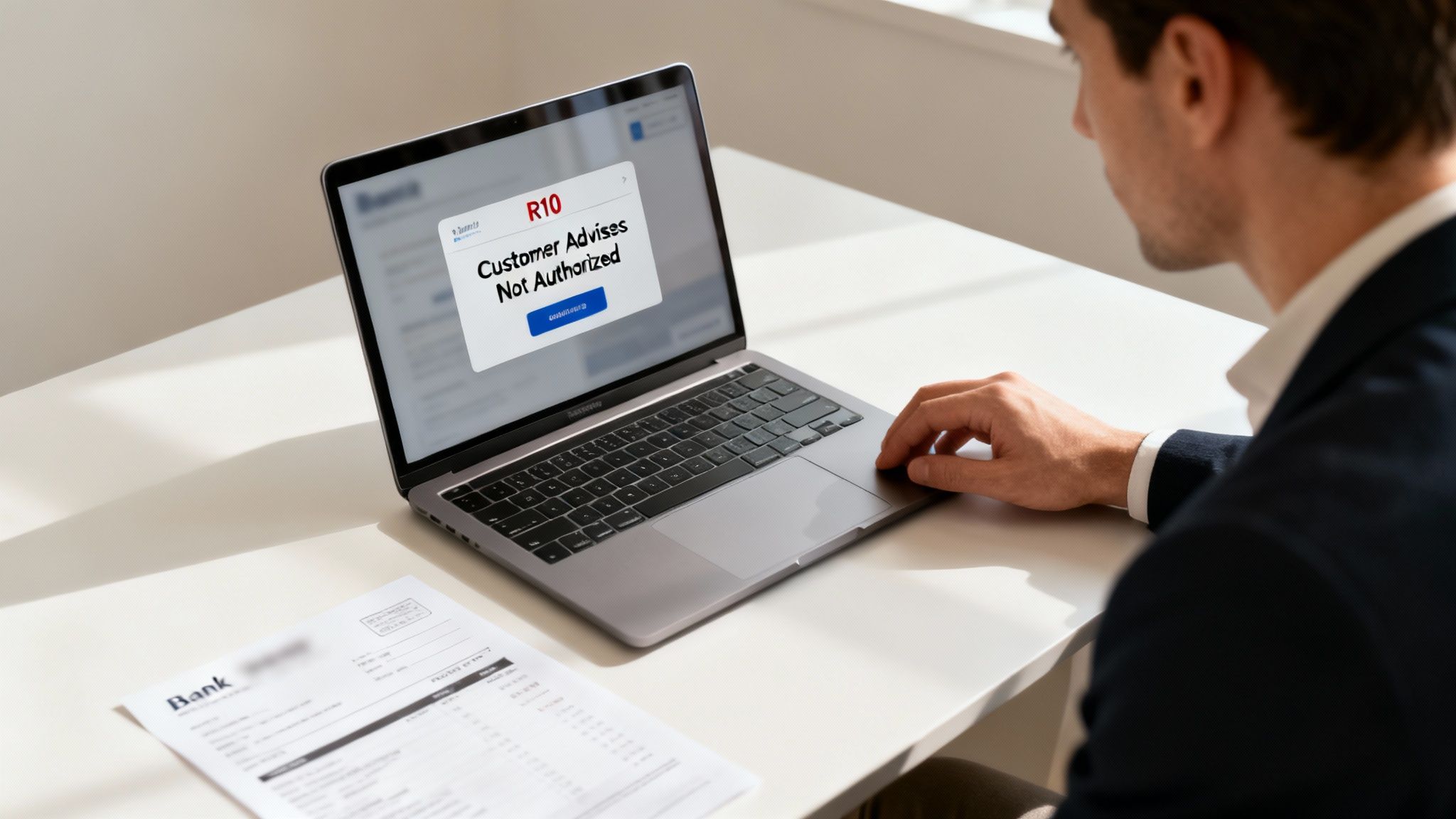
Seeing "R10 Customer Advises Not Authorized" might make you jump to conclusions, like blatant fraud. While that's sometimes the case, the real reason is often something much simpler. This code is really a catch-all for any time a customer questions whether a charge was legitimate.
So, what could that actually mean for you?
- Genuine Fraud: Someone could have gotten ahold of the customer’s account details and used them without permission. This is the classic, straightforward case.
- Customer Confusion: The customer might just not recognize your business name on their bank statement. An unclear or generic billing descriptor is a classic culprit here.
- Forgotten Subscriptions: We’ve all been there. A customer signs up for a recurring payment, forgets about it, and then disputes the charge when it pops up months later.
No matter the root cause, an R10 is a serious issue. These kinds of disputes can snowball quickly if they aren't handled right. Just check out this real-world example of an Amazon item takedown to see how bad compliance problems can get.
Why You Can't Ignore This Code
An R10 return isn’t just a failed payment; it’s a formal dispute that directly affects your business's health and reputation. It’s a close cousin to other payment disputes, a topic we dive into deeper in our guide on what is a return item chargeback.
Because these returns point to a potential problem with authorization, payment networks watch them like a hawk.
What is R10? In plain English, the R10 ACH Return Code means the customer is claiming a transaction was unauthorized, improper, or part of a transaction they never completed.
The tolerance for these types of returns is razor-thin. NACHA, the organization that runs the ACH network, recently slashed the acceptable rate for unauthorized returns from 1.0% down to just 0.5%. This was a deliberate move to clamp down on improper debits.
Going over that tiny threshold is a fast track to penalties, account reviews, or even losing your ability to process ACH payments entirely.
The R10 Return Code at a Glance
To put it all together, here’s a quick summary of what the R10 return code means for your business day-to-day.
Ultimately, seeing an R10 code is your cue to act fast. It's a problem you need to investigate and resolve, not just for the single transaction, but for the overall health of your payment processing.
The Top 5 Reasons You Received an R10 Return
To really get a handle on an R10 return, you first have to understand why it happened. The official reason is always the same: “Customer Advises Not Authorized.” But what's really going on is usually a lot more complicated.
Let's move past the technical code and dig into the five most common scenarios that trigger an R10. These situations can be anything from clear-cut fraud to simple, everyday mix-ups. Pinpointing the real cause is your first step to making sure it doesn't happen again.
1. Genuine Fraudulent Activity
This is the most straightforward cause. It happens when a fraudster gets their hands on a legitimate customer's bank account and routing numbers and uses them to make a purchase from your store.
When the real account holder spots the transaction, they’ll rightfully report it to their bank. The bank then immediately flags it as unauthorized, triggering an R10 return. This is true fraud, and unfortunately, your business was just caught in the middle.
2. Confusing Billing Descriptors
This one is incredibly common and, thankfully, easy to prevent. Your billing descriptor is the little piece of text that shows up next to a charge on a customer's bank statement. If your business is "Creative Solutions LLC" but your descriptor is a cryptic "CSLLC WEB PYMT," your customer is going to be confused.
Most people don't hesitate. They'll assume the worst, think it's fraud, and dispute it. It's not malicious—they're just protecting their account from what looks like a totally random debit.
A vague billing descriptor is one of the fastest ways to get a legitimate transaction disputed. Customers who don't recognize your name will assume the worst and contact their bank.
3. Forgotten Recurring Subscriptions
The "set it and forget it" model of subscriptions can be a double-edged sword. A customer signs up for your monthly service, enjoys it for a while, and then life happens—they completely forget about it. Six months later, they’re scrolling through their statement, see your charge, and have no memory of authorizing it.
They aren't trying to pull a fast one; they genuinely don't remember agreeing to a recurring plan. This scenario is one of the most common reasons for a chargeback and usually stems from a simple memory lapse, not actual dissatisfaction with your product.
4. Debit on an Unexpected Date or for an Incorrect Amount
When a customer authorizes a payment, they’re agreeing to specific terms. Any deviation from those terms can, in their eyes, invalidate the whole agreement. Imagine a customer agrees to be debited $25 on the 15th of each month.
- Charging them on the 12th instead of the 15th? That could be seen as unauthorized.
- Debiting $25.99 instead of the agreed-upon $25? That can also trigger a dispute.
Even a tiny discrepancy can make a customer feel like the transaction wasn't what they signed up for, leading them straight to their bank to file a dispute that results in an R10.
5. Canceled Authorization Was Ignored
This one's a tough look. A customer takes the proper steps to cancel their subscription or revoke their payment authorization, but the charge goes through anyway. This can be caused by anything from a system glitch to a simple human error in processing the cancellation.
From the customer's point of view, they did everything right to stop the payments. When a debit shows up after they’ve already canceled, they will immediately—and correctly—dispute it as an unauthorized transaction.
How to Respond to an R10 Return Step by Step
Getting hit with an R10 notice can feel like a punch to the gut, but it doesn't automatically mean you've lost that money for good. If you're confident the charge was legitimate and you have the records to prove it, you absolutely have a fighting chance. Think of it as building your case—you just need a solid, organized game plan.
This guide will walk you through the whole process, from the moment you get that notification to submitting your evidence. The goal is to give you a clear strategy to defend valid sales and protect your hard-earned revenue.
Step 1: Immediately Stop Future Payments
First things first: stop any and all future recurring payments for that customer. Trying to debit their account again after an R10 is a major no-no and a direct violation of NACHA rules. The customer has officially disputed the authorization, and you have to respect that.
Continuing to charge the account won't just fail; it could land you in hot water with your payment processor. Taking this immediate step shows you're playing by the rules and handling the dispute responsibly.
Step 2: Gather Your Authorization Evidence
Now it's time to put on your detective hat. Your most crucial task is to dig up concrete proof that the customer actually authorized the transaction. And you need to move fast—you typically only have a few business days to get your response in.
Start combing through your records for compelling evidence. You're looking for things like:
- Signed Authorization Forms: A digital or physical document where the customer clearly agreed to the ACH debit.
- Checkout Page Screenshots: Images of your payment page showing the exact terms the customer accepted.
- Welcome Emails: Confirmation messages that lay out the payment schedule and terms.
- IP Logs and Timestamps: The technical data showing when and where the authorization was given.
- Customer Communications: Any emails, chat logs, or support tickets where the customer talks about their purchase or subscription.
This evidence is the foundation of your entire case. Strong, undeniable proof of authorization is your best weapon against an R10 return code.
Step 3: Analyze the Situation
With all your evidence laid out, take a breath and review everything. Do you have a rock-solid, undeniable record of authorization? Or are there some weak spots? Sometimes, you might discover the customer had a point—maybe their cancellation request got lost in the shuffle, or an incorrect amount was charged by mistake.
This is where you need to be honest with yourself.
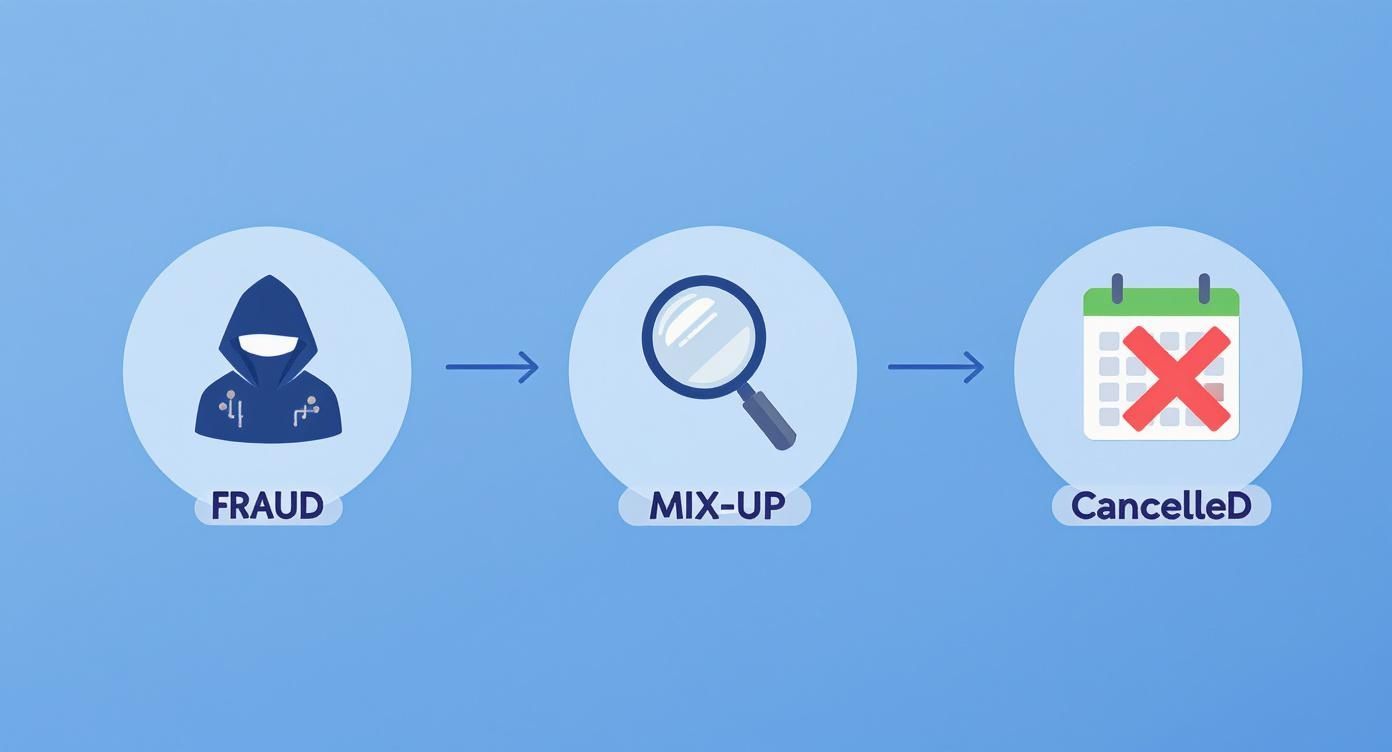
Understanding if the return was caused by real fraud, a simple mix-up, or a valid cancellation will help you decide what to do next.
If your evidence is flimsy or points to a mistake on your end, it’s usually better to just accept the return and focus on fixing your internal processes. But if your proof is solid? It's time to build your response.
Step 4: Prepare Your Representment Case
A winning response, officially called a representment, is more than just a folder of documents. It's a clear, concise story that proves the transaction was legitimate. The whole point is to show the bank that their customer’s claim is bogus. For a deeper dive, check out our complete guide to chargeback representment.
Your submission package should include all the evidence you gathered, paired with a professional rebuttal letter. This letter should quickly summarize your case, point to each piece of evidence, and explain exactly why the charge was authorized.
Remember, an R10 return kicks off an investigation, and banks need this kind of documentation to close the loop. A merchant with 10,000 monthly transactions might see around 50 or fewer unauthorized returns, which keeps them safely under the 0.5% threshold. Go over that, and you could face penalties from NACHA.
Get your completed case submitted to your payment processor well before the deadline. From there, the banks will review everything and make the final call.
Building a Winning Case Against an R1O Return
When you get hit with an R10 return and decide to fight back, your success boils down to one simple thing: the quality of your evidence. A successful representment isn't about arguing your point; it's about proving the customer's claim is flat-out wrong with a mountain of irrefutable proof.
Think of it like building a case for a judge. Every piece of documentation you provide strengthens your position and makes it much harder for the bank to just side with their customer. This isn't the time for a quick, casual response. You need to lay out a clear, logical story backed by solid evidence that shows the transaction was authorized from the very beginning.
Essential Evidence for Contesting an R10 Return
To build a compelling case, you’ll need to gather specific documents that prove the customer knew exactly what they were agreeing to. The more thorough you are, the better your chances of winning. Start by collecting everything you have related to that specific transaction.
Here’s a look at the most important pieces of proof you'll need to pull together.
The goal here is to leave no room for doubt. Strong, timestamped evidence paints a clear picture for the bank, showing that the customer knew exactly what they were signing up for and when they did it.
Crafting a Professional Rebuttal Letter
Once you have all your evidence organized, you need to present it effectively. This is where a professional rebuttal letter comes into play. Think of this letter as the cover sheet for your evidence package; it guides the bank's review team through your documentation and clearly explains why the charge is valid.
Your letter should be concise, professional, and stick to the facts. Don't get emotional—just state your case, reference each piece of evidence you've included, and explain how it proves the transaction was authorized.
For example, you could write something like, "As shown in Exhibit A, the customer completed our ACH authorization form on [Date] at [Time], explicitly agreeing to the recurring monthly charge of [Amount]."
Writing these can feel a bit daunting, but using a structured format makes a huge difference. If you need a hand getting the structure right, this letter of rebuttal template is a great starting point. A well-written letter, backed by solid proof, dramatically increases your odds of winning the dispute and getting your money back.
Proactive Strategies to Prevent R10 Returns
Fighting an R10 return after it happens is one thing, but preventing it in the first place is a much smarter game to play. If you shift your energy from reacting to disputes to proactively stopping them, you'll do more than just save a sale—you'll protect your revenue and keep your payment processing account in good standing.
It all boils down to one thing: crystal-clear communication. When a customer knows exactly what they're being charged for and when, there’s simply no reason for them to claim a transaction was unauthorized. A few simple tweaks can build that trust and wipe out confusion right from the get-go.
Use Crystal-Clear Billing Descriptors
This is probably the easiest and most powerful change you can make. Your billing descriptor is the little line of text that shows up on a customer's bank statement, and it absolutely has to be recognizable.
Think about it. If a customer sees a weird, cryptic charge like "CSLLC WEB PYMT," their first instinct is to panic and call their bank. Instead, make it obvious. Use something like "CHARGEPAY.AI SUBSCRIPTION" or "YOURBRAND Monthly Box*." This simple fix connects the dots between their purchase and their statement, eliminating that moment of confusion that leads to a dispute.
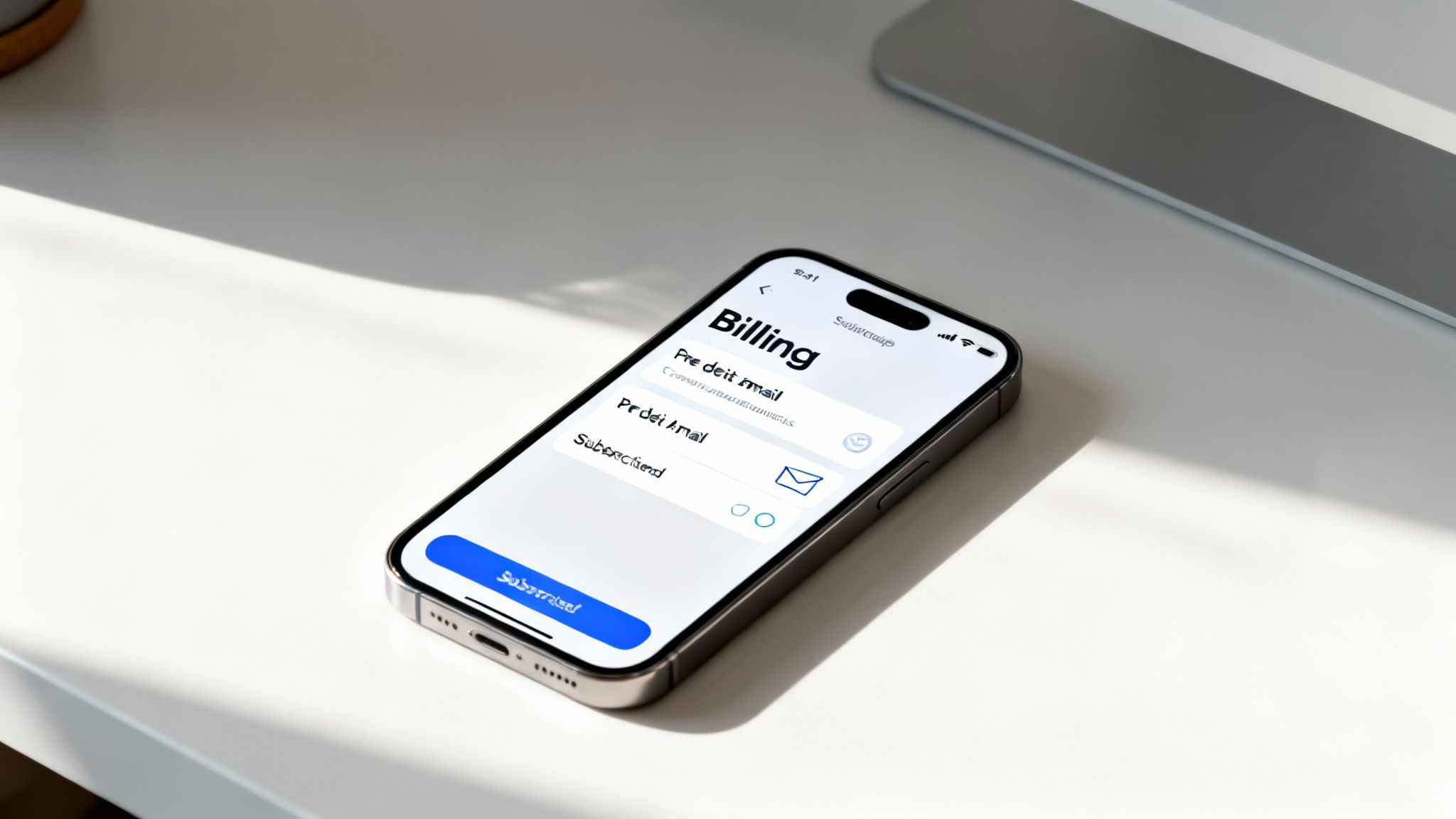
Send Pre-Debit Notifications
Nobody likes a surprise charge, especially for a recurring payment. It's easy for customers to forget about a subscription they signed up for months ago. That's why sending a simple, automated email a few days before you process the payment is a game-changer.
A friendly heads-up gives them time to make sure they have the funds available. It also gives them a chance to update their payment details or cancel the service if they no longer need it—all without initiating an R10 return.
According to NACHA data, unauthorized return codes like R10 have always been a focus for keeping the network sound. While the average unauthorized return rate was low, businesses with a return rate over 0.5% were flagged, highlighting how crucial it is to manage these disputes. Discover more insights about NACHA's risk management rules on nacha.org.
Make Cancellation Easy and Accessible
Trying to reduce churn by hiding the cancellation button is a classic mistake. It might seem clever, but it almost always backfires by creating frustrated customers who see a chargeback as their only way out. When someone can't easily end their subscription, their next stop is their bank.
Give customers control. Provide a simple, one-click cancellation process right in their account dashboard. This not only prevents a ton of R10 returns but also builds goodwill and leaves the door open for them to return in the future.
These steps are a fantastic start, but they're just one part of building a rock-solid defense. To truly protect your business, you'll want to explore a full range of proactive measures. You can dive deeper in our complete guide to chargeback prevention strategies.
Common Questions About R10 Return Codes
Jumping into the world of payment returns can definitely feel like learning a new language. To make things a little clearer, we've put together answers to some of the questions we hear most often from merchants about the R10 return code. Think of this as your quick-reference guide.
What Is the Difference Between an R10 Return and a Credit Card Chargeback?
This is a big one. While they both sting the wallet and feel pretty similar from a merchant's perspective, an R10 return and a credit card chargeback live in two completely different worlds. It’s like comparing a direct bank wire to swiping a credit card—same outcome, totally different mechanics.
An R10 return is strictly an ACH network issue. That’s the system handling direct bank-to-bank transfers. With these, a customer has a hard 60-day window to file a dispute. Credit card chargebacks, on the other hand, run on networks like Visa or Mastercard. These give cardholders a much longer leash, typically 120 days or even more, to dispute a charge. The rules, the evidence needed, and how you fight them are completely separate for each.
Can I Simply Resubmit a Charge After an R10 Return?
In a word: no. Trying to rerun the same transaction after getting hit with an R10 is a major red flag and a direct violation of NACHA rules. The R10 code is the customer’s official statement that the original authorization is no good anymore.
If you want to charge that customer again, you have to go back to square one. You'll need to reach out to them, figure out what went wrong, and get a brand-new, fully documented authorization. Only after you have that fresh approval can you legally process a new payment.
How Long Do I Have to Respond to an R10 Return?
The clock starts ticking fast on these. While the customer gets a generous 60 days to file their claim, your window to fight back is incredibly narrow.
Once your payment processor sends you the notification, you usually have just 2 to 5 business days to pull together all your evidence and submit your case. This tight deadline is exactly why you have to act the moment you see an R10 alert.
What Happens If My R10 Return Rate Is Too High?
Letting your R10 rate creep up is asking for trouble. NACHA, the organization that governs the ACH network, is very strict about this. They have a clear threshold for unauthorized returns: your rate absolutely must stay below 0.5% of your total transactions.
Go over that number, and things get serious pretty quickly. Your account could be put under review, which often leads to higher processing fees or having your funds frozen. In the worst-case scenario, you could lose your ability to process ACH payments altogether. Keeping that rate low isn’t just good business—it’s critical for survival.
Don't let R10 returns drain your revenue. ChargePay uses AI to automatically fight and win chargebacks on your behalf, recovering up to 80% of lost funds without you lifting a finger. Reclaim your revenue effortlessly.


.svg)



.svg)


.svg)
.svg)
.svg)