

Fighting a chargeback can feel like a losing battle. You made the sale, shipped the product, and did everything right, but a customer's claim puts your hard-earned money at risk. The secret to winning isn't just about having evidence; it's about presenting that evidence perfectly. A well-written rebuttal letter can be the difference between getting your money back and writing it off as a loss.
This guide is your playbook. We're breaking down 8 essential rebuttal sample letters for the most common chargeback situations that e-commerce merchants run into. From claims of "unauthorized transaction" to "product not received," we've got you covered.
But we're giving you more than just templates. For each sample, we will provide:
- A full, customizable letter you can adapt and use right away.
- A detailed evidence checklist so you know exactly what to include.
- Strategic insights explaining why the letter is structured the way it is.
- Actionable tips to strengthen your case and improve your win rate.
Think of this as a complete toolkit for handling disputes. You'll learn how to talk clearly and professionally with banks, present your proof in a compelling way, and build a stronger defense against future claims. Forget the frustration and uncertainty. Let's get your money back where it belongs.
1. Unauthorized Transaction Rebuttal Letter
The "Unauthorized Transaction" claim is one of the most common reasons for a chargeback, especially in e-commerce. This happens when a cardholder says they didn't authorize or take part in a transaction. While this can be a case of actual fraud, it's often an instance of "friendly fraud," where the customer did make the purchase but is now trying to get their money back dishonestly. This rebuttal sample letter is your go-to tool for fighting back with solid proof.
This letter works by systematically taking apart the "unauthorized" claim. It presents a logical case to the issuing bank, proving the real cardholder was involved in the transaction. By connecting the dots between the customer's digital footprint and the purchase itself, you build a strong argument that the charge was valid.
Strategic Breakdown
The main strategy is to prove a direct link between the person who owns the credit card and the person who placed the order. You're not just saying the order happened; you are proving who made it happen.
- IP Address Matching: Show that the IP address used to place the order matches the customer's billing or shipping address location.
- AVS and CVV Confirmation: Point out that the Address Verification System (AVS) and Card Verification Value (CVV) codes were successfully checked during checkout. This is strong proof that the physical card was present or the card details were known.
- Prior Order History: Include proof of previous, undisputed transactions from the same customer account, IP address, or shipping address. This shows a pattern of legitimate buying behavior.
Key Tactic: Your goal is to give the bank so many irrefutable data points they can't ignore them. A single piece of evidence might be dismissed, but a collection of connected data creates a powerful story that the cardholder was definitely involved.
Actionable Tips for Success
- Document Everything: At the point of sale, automatically log IP addresses, device IDs, and browser information. Tools like ChargePay can automate this evidence collection and organization for you.
- Cross-Reference Data: A Shopify merchant successfully won a dispute by showing the customer logged into their store account from the same IP address just minutes before placing the order.
- Show Communication: Include any emails, chat logs, or support tickets where the customer talked about the order or product. This proves they were aware of the purchase.
- Use Timestamps: Make sure all your evidence, from order placement to customer communication, is clearly timestamped to create a clear, chronological story of the transaction.
For an in-depth guide on handling these specific disputes, especially on platforms like PayPal, you can learn more about handling PayPal unauthorized transaction claims.
2. Product Not Received Rebuttal Letter
The "Product Not Received" chargeback is a common headache for e-commerce merchants. This claim happens when a customer insists they never got the item they paid for. While real shipping problems can happen, this is also a common trick for friendly fraud, where the customer has the product but wants their money back. A strong rebuttal letter is your primary defense against this claim.
This type of rebuttal works by providing undeniable proof of delivery to the customer's verified address. The goal is to present a clear, documented timeline from shipment to successful delivery, making it impossible for the bank to side with the customer's claim. By using concrete shipping evidence, you shift the burden of proof back to the cardholder.
Strategic Breakdown
The main strategy is to prove that the item physically arrived at the correct location. You must counter the customer's claim with official documents from a third-party shipping carrier, which banks see as an impartial source of truth.
- Tracking Information: Provide the complete tracking number and a link to the carrier’s tracking page showing the full transit history and the final "Delivered" status.
- Delivery Confirmation Details: Include the exact date and time of delivery. If available, add GPS data or a delivery photo showing the package at the customer's address, as this is incredibly compelling.
- Proof of Address Match: Show that the shipping address on the carrier’s receipt matches the address provided by the customer during checkout and verified by the AVS.
Key Tactic: Your evidence should create an unbreakable chain of custody. By showing the item left your facility, was tracked by a reputable carrier, and was confirmed delivered to the customer’s specified address, you build a case that is difficult to dispute.
Actionable Tips for Success
- Use Tracked Shipping: Always use shipping methods that provide tracking, especially for high-value orders where signature confirmation is a must.
- Integrate Your Systems: Platforms like ChargePay can integrate your Shopify store with shipping carriers, automatically pulling and organizing delivery evidence when a dispute arises.
- Document Everything: For digital goods or services, provide logs showing account creation, IP address of login, and records of service usage. This proves the "delivery" and consumption of the digital product.
- Communicate Proactively: Send automated shipping and delivery confirmation emails to customers. Including these communications in your rebuttal shows you kept the customer informed.
For more specific guidance on disputes on platforms like PayPal, you can get more details on how to handle 'item not received' claims.
3. Duplicate Charge Rebuttal Letter
The "Duplicate Charge" claim comes up when a customer believes they were billed multiple times for a single purchase. This is a common issue for subscription-based businesses (like SaaS) or merchants where customers make several quick purchases. While sometimes it's a genuine system glitch, it often comes from customer confusion over subscription renewals, separate orders, or temporary authorization holds. This rebuttal sample letter is designed to clear up the situation and prove each charge was legitimate and separate.
This letter works by providing a clear, chronological paper trail that justifies each transaction. Instead of just denying a duplicate charge happened, you present evidence that shows two separate and valid billing events. The goal is to educate the issuing bank and prove that what the customer saw as an error was actually a legitimate, agreed-upon charge.

Strategic Breakdown
The main strategy here is to prove that each charge corresponds to a unique product, service period, or order. You must clearly differentiate the transactions to show they are not for the same item.
- Distinct Transaction IDs: Provide unique transaction or invoice IDs for each charge. This is fundamental proof that your payment processor logged them as separate events.
- Subscription Agreements: For recurring charges, submit the customer's subscription agreement showing the renewal date that matches the disputed charge date.
- Order Details: If the customer placed multiple orders, provide receipts for each one, highlighting the different items purchased or separate order timestamps.
Key Tactic: Your evidence must tell a story of separation. Frame your response to show "Charge A was for Item A" and "Charge B was for Item B," leaving no room for the bank to think they were a single, duplicated event.
Actionable Tips for Success
- Send Renewal Reminders: Proactively email customers 7-14 days before a subscription renewal. Including these email notifications in your evidence shows transparency and customer awareness.
- Use Clear Billing Descriptors: Make sure your billing descriptor (what appears on their credit card statement) is easy to recognize and not generic. Something like "YOURBRAND*SUBSCRIPTION" is better than a generic company name.
- Document Everything: A gaming platform won a dispute by showing two charges made minutes apart had unique transaction IDs corresponding to two different in-game items the user had activated.
- Provide Invoices: Attach detailed invoices or receipts for each transaction that clearly itemize what was purchased and when.
For a deeper dive into dispute resolution, you can learn more about how to win a credit card dispute.
4. Service Quality/Not As Described Rebuttal Letter
The "Not as Described" or "Service Quality" chargeback is a common and often subjective claim from customers. This happens when a cardholder argues that the product or service they received didn't match the online description or meet their quality expectations. For merchants selling digital goods, SaaS subscriptions, or services, these claims can be especially tough to disprove.
This rebuttal sample letter is designed to counter subjective complaints with objective, factual evidence. It works by systematically proving that what was delivered precisely matched what was advertised. By presenting clear product specifications, documented service terms, and proof of fulfillment, you shift the argument from the customer's opinion to verifiable facts, building a strong case for the issuing bank.
Strategic Breakdown
The main strategy here is to get rid of the subjectivity and prove that you delivered exactly what you promised. You need to create an undeniable link between your product listing and the item or service the customer received, showing there was no misrepresentation on your part.
- Objective Specifications: Provide detailed product descriptions, spec sheets, or a syllabus for a digital course that matches the item delivered. This moves the discussion from "I didn't like it" to "Here is what was promised, and here is proof it was delivered."
- Proof of Use/Access: For digital goods or SaaS, show evidence that the customer accessed or used the service. This can include login timestamps, module completion rates, or feature usage data. This proves they engaged with the product as described.
- Pre-Sale Transparency: Highlight that the customer agreed to your Terms of Service and refund policy at checkout. This shows they were aware of the terms before completing the purchase.
Key Tactic: Your goal is to build a case file that leaves no room for interpretation. By focusing on hard data and documents that the customer saw and agreed to before the sale, you invalidate claims based on personal dissatisfaction rather than real discrepancies.
Actionable Tips for Success
- Be Hyper-Specific in Listings: Instead of using vague terms like "high-quality," use measurable features and objective specifications in your product descriptions.
- Document Everything: A SaaS merchant successfully defended a chargeback by presenting server logs showing the user had logged in multiple times and used the exact features they later claimed were "not as described."
- Leverage Customer Interactions: Include support emails or chat logs where you offered help or clarification to the customer. This shows you made good-faith efforts to ensure customer satisfaction.
- Use Visuals: For physical products, include a side-by-side comparison of the product photo from your listing and a photo of the actual item from your inventory to prove they are identical.
For a deeper dive into defending against these types of claims, you can get more information on handling "product unacceptable" chargebacks.
5. Refund Already Issued Rebuttal Letter
A "Refund Already Issued" chargeback happens when a customer files a dispute for a transaction after you have already processed their refund. This frustrating situation, often called a double-refund, essentially means the customer is trying to get paid twice. It's common in e-commerce where a customer might file a chargeback out of impatience while their bank is still processing the refund you sent. This rebuttal sample letter is your direct tool to prove the debt has already been settled.
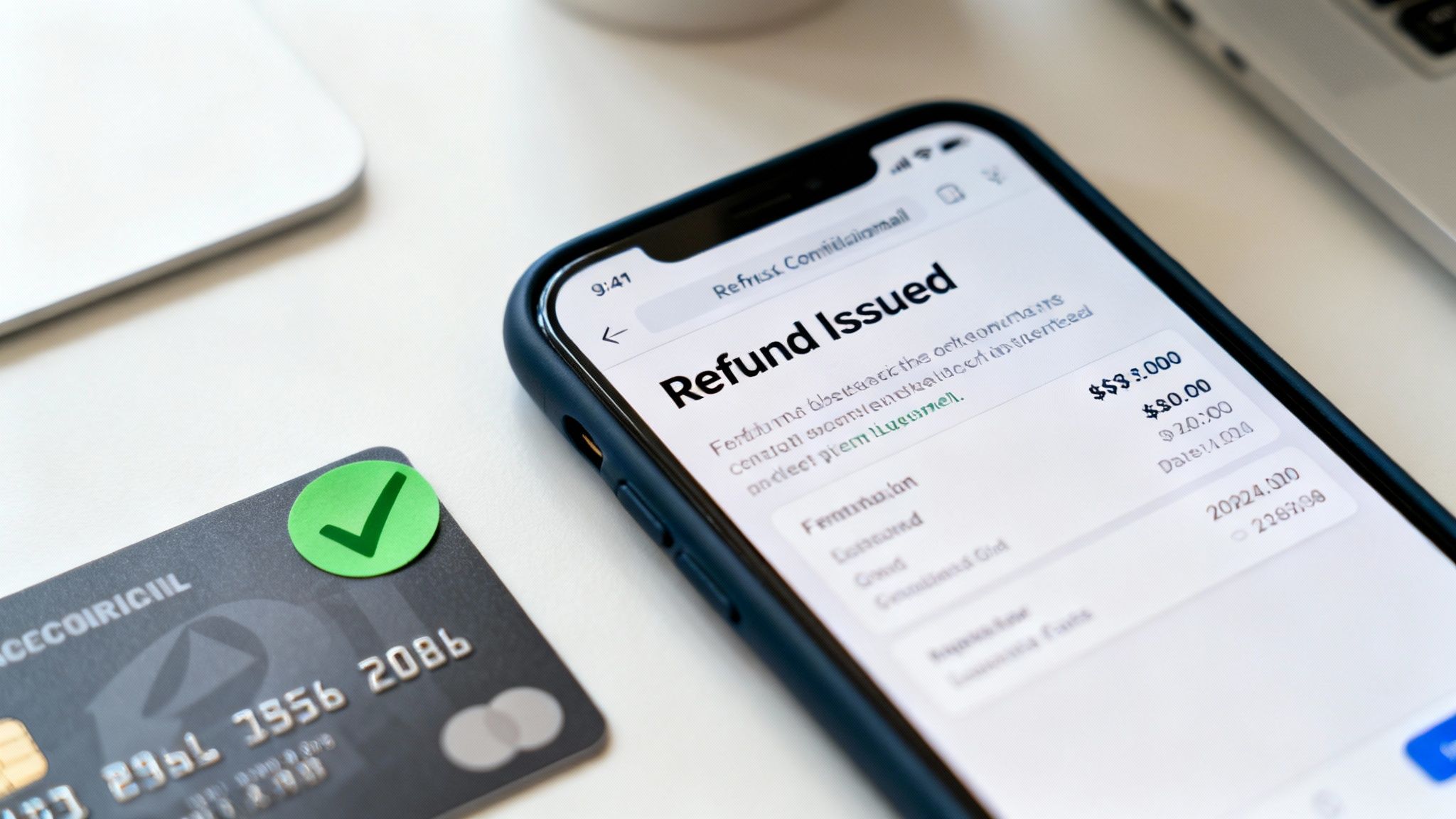
This letter works by presenting a clear, chronological sequence of events to the bank. It shows that you resolved the customer's issue and returned their money before they initiated the chargeback. By providing undeniable proof of the refund, you show the bank that the chargeback is invalid and represents an attempt at double-dipping, whether intentional or not.
Strategic Breakdown
The main strategy here is to provide airtight proof that the customer has already been made whole. The argument isn't about the product or service quality; it's purely about the timeline of the financial transactions.
- Provide Refund Documentation: Submit screenshots or transaction logs from your payment processor (like Stripe, PayPal, or Shopify Payments) showing the exact date, time, and amount of the refund.
- Show Customer Communication: Include any email or chat conversations where the customer requested a refund and you confirmed it was being processed. This proves you acted on their request in good faith.
- Highlight the Timeline: Explicitly point out the date the refund was issued versus the date the chargeback was filed. A clear "before and after" narrative is incredibly effective.
Key Tactic: Frame your evidence around the simple fact that the refund was completed before the dispute was opened. Use a timeline to make your case easy for the bank's representative to understand in seconds. The clearer your evidence, the faster the dispute is closed in your favor.
Actionable Tips for Success
- Send Immediate Confirmations: As soon as you process a refund, send the customer an automated confirmation email. This email is a crucial piece of evidence.
- Include Processing Times: In your refund confirmation, state the typical bank processing time (e.g., "Please allow 5-10 business days for the refund to appear on your statement"). This manages customer expectations and can prevent premature chargebacks.
- Keep Meticulous Records: Maintain a clear ledger of all issued refunds with transaction IDs, dates, and amounts. Services like ChargePay can help automate this and flag disputes that match previous refunds.
- Reference Refund IDs: In your rebuttal, always include the Acquirer Reference Number (ARN) or a unique transaction ID for the refund. This allows the bank to trace the funds easily.
For a deeper dive into preventing and fighting these specific types of disputes, you can get more information on handling double-refund-chargebacks.
6. Billing Descriptor Confusion Rebuttal Letter
A chargeback due to "Billing Descriptor Confusion" happens when a customer looks at their credit card statement and doesn't recognize the merchant's name listed for a charge. This is common for businesses that use a parent company name, a shortened name, or a generic processor ID as their billing descriptor. The customer, genuinely confused, reports the transaction as fraudulent. This rebuttal letter aims to clear up that confusion by directly connecting your store with the name on their statement.
This letter works by methodically explaining the discrepancy. It educates the issuing bank and the customer on why the descriptor appeared as it did, then provides irrefutable proof that the customer knowingly made a purchase from your brand. It re-establishes the legitimacy of the charge by bridging the information gap between your brand name and your official billing name.
Strategic Breakdown
The strategy is to prove the charge is legitimate by clarifying your business's identity and its connection to the billing descriptor the customer saw. You are not just defending a transaction; you are validating your business's billing practices and proving the customer interacted with your brand, regardless of the name on their statement.
- Clarify Business Names: Explicitly state your customer-facing brand name and the legal or "Doing Business As" (DBA) name that appears on statements. Provide documentation if necessary.
- Link to Order Confirmation: Reference the order confirmation email the customer received, which should prominently feature your brand name and the items purchased. This confirms their awareness of the transaction.
- Show Customer Interaction: Provide evidence of the customer using your product or service, such as digital download logs, account login history, or tracking information showing a successful delivery.
Key Tactic: The core of your argument is education and connection. First, educate the bank about your business structure (e.g., "XYZ Store is the brand name for our legal entity, ABC Holdings Inc."). Then, connect the customer directly to that transaction with order details they cannot deny.
Actionable Tips for Success
- Proactive Communication: Send a branded order confirmation email immediately after purchase that clearly states, "Your card will be charged by [Billing Descriptor Name]."
- Descriptor Optimization: Use a clear, recognizable business name in your billing descriptor. Many payment processors allow you to include a phone number, which can further reduce confusion.
- Document Everything: Keep records of your business name registrations and any DBAs. A SaaS company won a dispute by showing their incorporation documents which linked their well-known product name to the lesser-known parent company name on the statement.
- Regularly Audit: Check your billing descriptors periodically to ensure they are clear and effective. What made sense a year ago might be confusing for new customers today.
For merchants looking to prevent these issues at the source, a great resource is understanding how to set up and optimize your payment details on platforms like Shopify. You can often learn more about customizing your checkout and payment settings directly from their help center.
7. Subscription Cancellation/Non-Cancellation Rebuttal Letter
Subscription-based businesses often face chargebacks where customers claim they cancelled before a billing cycle but were still charged. This can happen due to misunderstandings about cancellation deadlines, a failure to follow the correct cancellation procedure, or simply "friendly fraud." This type of rebuttal sample letter is crucial for proving the charge was valid according to the agreed-upon subscription terms.
This letter works by presenting clear, undeniable proof of your subscription policy and the customer's interaction (or lack thereof) with your cancellation process. The goal is to show the issuing bank that the customer was fully informed of the terms they agreed to at signup and that your business acted correctly according to that agreement. By providing a clear timeline and policy documentation, you counter the customer’s claim with facts.
Strategic Breakdown
The main strategy is to prove the customer either did not cancel according to the stated policy or was billed correctly within the terms they accepted. You must demonstrate transparency and that you followed your own rules.
- Proof of Agreement: Show evidence that the customer explicitly agreed to your subscription terms, including the cancellation policy, during the initial signup. A timestamped log or a screenshot of the checkout page with the "I agree to the terms" checkbox is powerful.
- Clear Cancellation Policy: Provide a copy of the cancellation policy itself, highlighting the specific clauses related to billing cycles, notice periods, or cancellation methods.
- Communication Records: Include any email confirmations sent to the customer upon signup or cancellation. If they claim they cancelled but you have no record, state this clearly and provide evidence of the official cancellation channel they failed to use.
Key Tactic: Your argument is built on the foundation of the initial agreement. Frame the entire dispute around the terms the customer accepted. The charge isn't random; it's a scheduled payment they authorized as part of an ongoing service agreement.
Actionable Tips for Success
- Send Confirmation Emails: Always send an automated email immediately after a customer successfully cancels. This email is a critical piece of evidence if they later claim they cancelled at a different time.
- Log Everything: Document the exact date and time a customer agrees to your terms. To proactively manage recurring charges and avoid common disputes like billing descriptor confusion, exploring options for the right best subscription management software for automating billing can be a game-changer.
- Make Policies Accessible: Clearly display your cancellation policy on your website and link to it from the signup and account management pages. The easier it is to find, the stronger your case.
- Use Timestamps: A SaaS company won a dispute by showing the customer’s cancellation request came in one day after the billing cutoff date, as stated in the terms they agreed to via a timestamped checkbox confirmation.
8. Currency Conversion/Foreign Transaction Rebuttal Letter
This chargeback reason comes up when international customers are surprised by the final amount charged to their card. The difference is usually due to currency conversion rates or foreign transaction fees applied by their bank, which they mistakenly blame on the merchant. This rebuttal sample letter is designed to clarify that you, the merchant, charged the correct, advertised price in your store's base currency.
This letter works by proving transparency and accuracy during the transaction. It shows the issuing bank that the customer was informed of the transaction currency and that the amount you processed was correct. By clearly documenting the price and currency at checkout, you can effectively dispute claims of being overcharged.
Strategic Breakdown
The strategy here is to prove that the customer agreed to a specific price in a specific currency. The focus is on showing what happened on your end, separating your correct transaction from any later fees or conversion rates applied by the customer's own bank.
- Checkout Transparency: Provide screenshots or logs of the checkout page showing the final price and currency symbol (e.g., $, €, £) displayed to the customer before they completed the purchase.
- Order Confirmation Evidence: Supply copies of the order confirmation email and invoice sent to the customer, which clearly state the transaction amount and currency.
- Terms of Service: Highlight clauses in your Terms of Service or on your FAQ page that explain your store’s base currency and mention that the customer’s bank may apply additional conversion or transaction fees.
Key Tactic: The goal is to create a clear separation between the amount you billed and the final amount on the customer's statement. You are proving you did your part correctly and that any difference is a matter between the cardholder and their issuing bank.
Actionable Tips for Success
- Display Currencies Clearly: Use a currency converter app or setting on your site, but ensure the final checkout page explicitly states the processing currency (e.g., "Total: €92.50 / Processed as $100.00 USD").
- Document the Rate Source: If you show estimated local prices, document the real-time exchange rate source you used at the moment of the transaction. A crypto exchange could prove its conversion matched market rates at that specific time.
- Communicate Proactively: Send order confirmation emails that reiterate the transaction amount and the currency in which it was processed. This reinforces what the customer agreed to.
- Use Dynamic Pricing: For high-volume international sales, consider using a payment gateway that supports local currency processing. This eliminates the root cause of these disputes altogether.
For merchants dealing with a global customer base, managing these disputes is crucial. Using a tool like ChargePay can help automatically gather the necessary proof, like timestamps and checkout logs, to build these rebuttal sample letters quickly and effectively.
8 Rebuttal Letter Comparison
From Manual Rebuttals to Automated Wins
Throughout this guide, we've walked through eight common dispute scenarios, equipping you with a collection of powerful rebuttal sample letters. Each template is more than just a pre-written response; it's a strategic framework designed to help you present your case with clarity, confidence, and compelling evidence. We've broken down why certain phrases work, which pieces of evidence are non-negotiable, and how to structure your argument to align with the specific reason code cited by the cardholder's bank.
The core lesson is this: winning a chargeback isn't about arguing with a customer. It's about systematically disproving a claim with factual, verifiable data. From IP address logs proving a digital purchase to delivery confirmations with a signature, your evidence tells the real story of the transaction.
Key Takeaways: From Theory to Action
Mastering the art of the rebuttal letter means internalizing a few key principles that apply across all dispute types. Think of these as your chargeback-fighting commandments:
- Be Specific, Not Emotional: Stick to the facts. The bank doesn't care about your frustration; they care about data. Reference order numbers, transaction dates, AVS/CVV results, and tracking numbers.
- Match Evidence to the Claim: A rebuttal for "Product Not Received" needs different proof than one for "Unauthorized Transaction." Always tailor your evidence packet to directly counter the cardholder's specific claim.
- Clarity is King: Use clear headings, bullet points, and concise language. A dispute analyst is reviewing dozens, if not hundreds, of cases a day. Make your rebuttal easy to scan and even easier to approve.
- Leverage Your Tools: Your e-commerce platform (like Shopify or PayPal), your CRM, and your shipping provider are goldmines of evidence. Know where to find IP logs, customer service chat transcripts, delivery metadata, and previous order history.
The rebuttal sample letters provided in this article serve as your launchpad. They give you the structure and the language, but the winning ingredient is the specific, compelling evidence you gather for each unique case.
The Inevitable Limits of Manual Rebuttal
While having the perfect template is a huge advantage, you've likely noticed a recurring theme: the evidence-gathering process is incredibly time-consuming. For every single dispute, you or your team must manually:
- Log into your e-commerce dashboard.
- Search for the customer's order details.
- Cross-reference transaction IDs in your payment gateway.
- Pull up shipping information from your carrier's portal.
- Comb through customer service emails or chat logs.
- Piece it all together into a coherent, well-formatted document.
- Submit it before the deadline.
This manual process is not just a drain on your time; it's a bottleneck that limits your ability to fight every dispute effectively. As your business grows, so does the volume of chargebacks, and the manual approach quickly becomes unsustainable. This is where automation becomes a necessity, not a luxury.
As you explore moving from manual processes to automated wins, understanding the importance of Explainable AI and Responsible AI in the financial compliance industry becomes critical for effective and transparent dispute resolution. This ensures that the automated systems making decisions are fair, understandable, and compliant with industry standards. By embracing intelligent automation, you can transition from a reactive, time-intensive defense to a proactive, data-driven strategy. You free up your team to focus on what truly matters: growing your business and serving your legitimate customers.
Tired of manually piecing together evidence and writing rebuttal letters? ChargePay uses AI to automatically generate winning rebuttals with all the necessary proof, fighting and winning your disputes for you. Stop losing revenue to tedious manual processes and see how our platform can transform your chargeback management today.


.svg)



.svg)


.svg)
.svg)
.svg)