

When you win a chargeback dispute, the moment the bank claws back the temporary funds they gave the customer is what we call a reverse provisional credit. It's the final, satisfying step where the money comes back to you because you proved the transaction was legitimate.
Understanding Provisional Credit from a Merchant's View
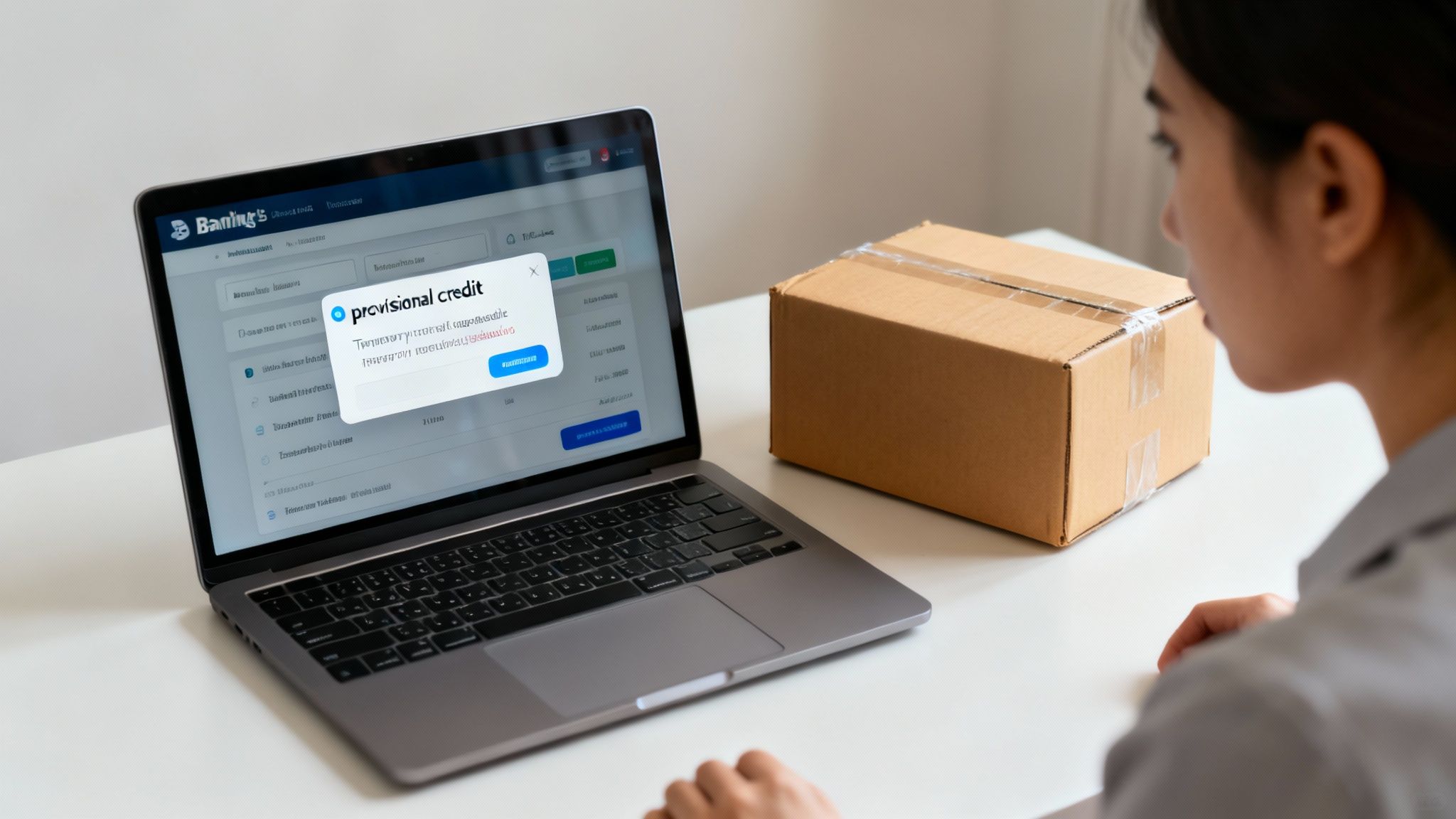
We've all been there. A customer files a chargeback, and in what feels like a blink of an eye, the money is gone from your account. That instant refund the customer gets is called provisional credit. It’s just a standard, albeit frustrating, part of the dispute game.
Why so fast? Banks are bound by consumer protection laws, like the U.S. Electronic Fund Transfer Act, designed to protect cardholders from being out-of-pocket while a claim is investigated. For merchants, though, it feels like you're presumed guilty until proven innocent.
Why Provisional Credit Isn't a Permanent Loss
Here's the good news: that credit is just a temporary hold. It's not the final verdict. Think of it as the starting pistol for the dispute process—this is your cue to build your case and fight back.
Provisional credit is basically the bank’s way of keeping the customer happy while they sort things out. For example, if a customer claims a package never showed up, their bank might credit them immediately. This doesn't close the case. It just starts the clock on your window to respond. It’s crucial to understand this isn't the same as a refund or a final reversal; you can learn more about the key differences between a chargeback, refund, and reversal in our detailed guide: https://www.chargepay.ai/blog/chargeback-vs-refund-vs-reversal.
Provisional credit is a temporary placeholder. The funds are held in limbo while the investigation is active. The bank's final decision determines whether that credit gets reversed or becomes a permanent loss for you.
To help you see the difference clearly, here's a quick breakdown:
Provisional Credit vs Final Chargeback: A Quick Comparison
This table shows why it's so important to act on that initial notice. The provisional stage is your only chance to turn the tide.
The Journey of a Dispute
The entire system runs on a strict timeline. Once a dispute is filed and provisional credit is issued, the customer's bank pings your acquiring bank. That notification is your call to action. You typically have somewhere between 20-45 days to get your evidence in and state your case.
This is exactly where the reverse provisional credit comes into play. If you provide compelling evidence—think delivery confirmation with a signature, AVS matches, or an email conversation with the customer—you can prove the chargeback is invalid.
When the bank sides with you, they reverse the credit. The money is taken back from the cardholder's account and returned right where it belongs: with you. It’s the outcome every merchant works toward, and it all starts with understanding that the initial credit is just the opening move, not the end of the story.
The Evidence That Triggers a Reversal
Think of a provisional credit as a temporary truce, not a surrender. The bank has given the customer the benefit of the doubt for now, but the fight isn't over. The key to turning that truce into a victory for your business—and securing a reverse provisional credit—is building an undeniable case with rock-solid proof.
Your job is to show the bank that the transaction was completely legitimate and the cardholder's claim simply doesn't hold water. This isn't just about checking a box on a form; it's about telling a compelling story with data. In today's world, a simple tracking number often isn't enough. You need to present a complete picture that leaves zero room for doubt.
Building Your Evidence File
The moment a dispute notice hits your inbox, it's time to go into investigation mode. Your first move should be to gather every single piece of information related to that transaction. Each document you add strengthens your case, making it that much harder for the bank to side with the customer's claim.
Start with the basics, but then be prepared to dig deeper.
- Transaction and Authorization Data: This is foundational. Always include details like AVS (Address Verification Service) and CVV match results. A full match is a powerful signal that the legitimate cardholder was the one who made the purchase.
- Proof of Delivery: Don't just settle for a "delivered" status from the carrier. If you have it, a photo of the package on the customer's doorstep is fantastic. Even better? A signed delivery confirmation. This evidence directly torpedoes any "product not received" claims.
- Customer Communications: Did the customer email you before filing the dispute? A screenshot of a friendly email asking about product features or even praising your service can completely dismantle a claim that the transaction was "unauthorized."
- Digital Footprints: IP address logs that match the customer's billing location are incredibly compelling. Also, if the customer had to log into their account on your site to complete the purchase, make sure you include that detail.
The goal is to build a clear, logical narrative. You want to show the bank that a legitimate customer, from a recognized location, using a verified card, ordered a product and received it exactly as promised.
Tailoring Evidence to the Dispute Reason
The kind of proof you submit needs to directly counter the customer’s specific claim. A one-size-fits-all approach to evidence will get you nowhere. You have to tailor your response. Understanding the specific reasons for a chargeback is the absolute first step in gathering the right ammunition.
For example, your evidence file for a "product not as described" claim should look very different from one for a "not received" claim.
Ultimately, a well-prepared response packed with compelling, targeted evidence is what triggers a reverse provisional credit. It transforms a potential loss into a recovered sale, proving that your diligent efforts—not luck—are what determine the outcome.
Crafting Your Winning Chargeback Response
When that dispute notification lands in your inbox, it’s easy to feel a surge of frustration. But this is your moment to act, not react. How you respond in the first 24 hours can set the stage for successfully getting that provisional credit reversed and the funds returned to you. This isn't just about sending a few documents; it's about building a solid case that leaves no room for doubt.
The clock is ticking, so your first move should be to dive straight into your records. Don't just look for one piece of evidence. Your goal is to gather a complete file that tells the story of the transaction from beginning to end. Think of yourself as a detective building an airtight case for the bank.
This is your game plan for turning that temporary loss into a permanent win.
Organizing Your Evidence for Maximum Impact
Simply having proof isn't enough; how you present it matters. Banks and investigators review thousands of these disputes, so a disorganized, messy file is easy to set aside. Your submission needs to be clean, logical, and directly counter whatever claim the customer made.
Here’s the essential evidence you should be grabbing first:
- Order and Payment Details: Pull screenshots showing that the AVS (Address Verification System) and CVV (Card Verification Value) matched. This is your first line of defense, especially against "unauthorized transaction" claims.
- Proof of Delivery: Go beyond a simple tracking number. A delivery confirmation with a signature is powerful. A photo of the package on the customer's actual doorstep is even better. You want undeniable proof.
- Customer Communications: Pull up any email threads, chat logs, or support tickets. A message from the customer asking about the product or confirming their address can instantly undermine their claim that they never ordered it.
- Digital Footprints: For digital goods, this is huge. Server logs showing an IP address that matches the customer’s billing location can be a knockout punch.
Each piece of evidence builds upon the last, creating a strong, cohesive defense for the transaction.
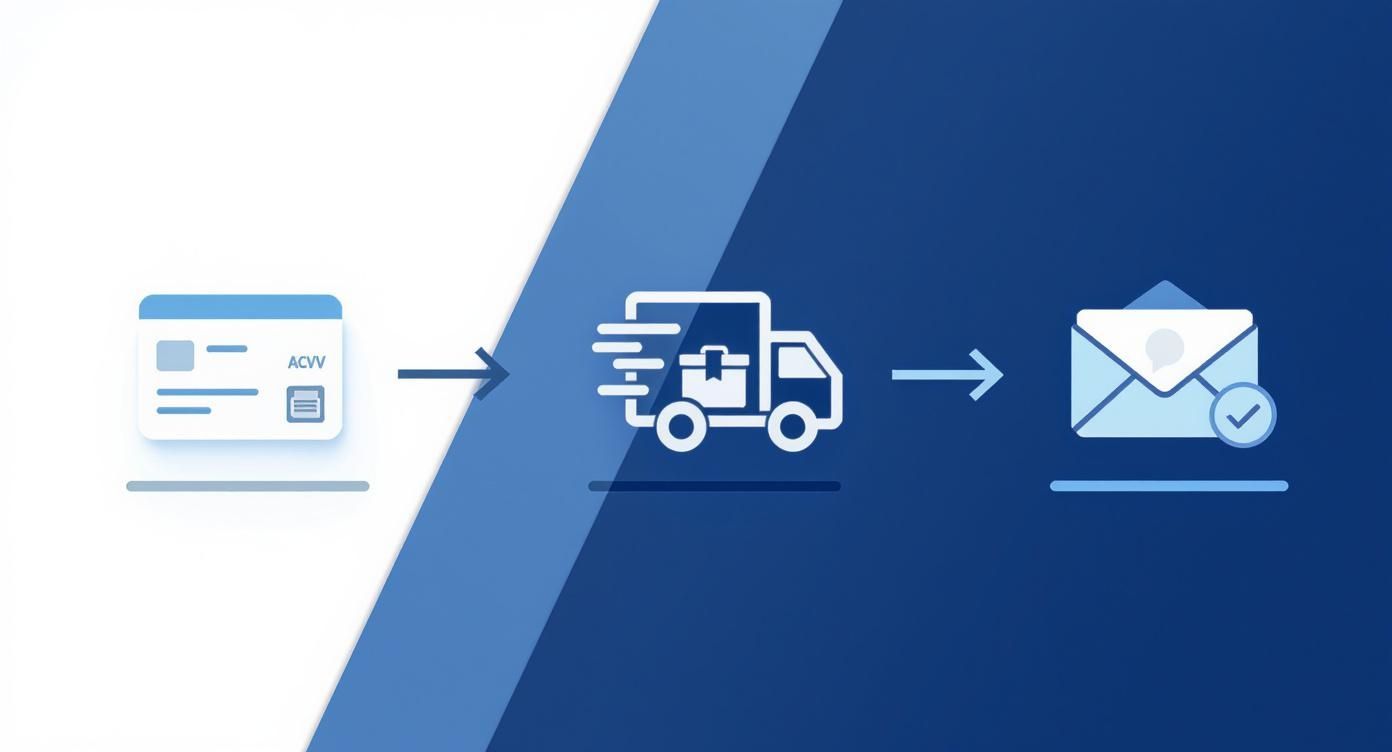
This visual really shows the journey from a secure order to confirmed delivery—the core pillars of a winning response.
Writing a Clear and Professional Rebuttal
Your evidence needs a cover story, and that’s your rebuttal letter. This letter is your chance to connect all the dots for the bank investigator. It should be concise, professional, and get straight to the point. Avoid emotional language and stick to the hard facts you’ve gathered.
Start by clearly stating the reason for the dispute, then systematically walk them through the evidence that proves it's invalid. Use a clear, chronological structure that’s a breeze to follow. For example, you could start with the order confirmation, move to the shipping details, and finish with the delivery proof. You can find excellent guidance by looking at an example of a rebuttal letter to see how to structure your arguments effectively.
Your rebuttal letter isn’t just a summary; it's your closing argument. Use it to guide the investigator through your evidence and lead them to the only logical conclusion: the charge was completely valid.
Statistically, the provisional credit system is a balancing act. Cardholders in the United States dispute roughly 1% to 1.5% of all transactions. While provisional credits are common, a significant portion—around 20% to 40%—are reversed after the bank investigates and finds the merchant’s evidence compelling. You can dig into these trends on the Chase website.
Finalizing Your Submission Before the Deadline
Once you've compiled your evidence and polished your rebuttal letter, the final step is submitting everything through your payment processor’s portal. Deadlines are non-negotiable in the world of chargebacks. Missing one means an automatic loss, turning that provisional credit into a permanent one.
Double-check your processor's specific requirements before you hit send. Some have funky file size limits or require everything to be in a specific format, like a single PDF. A well-organized, timely submission is your best shot at winning this thing and getting that money back where it belongs.
Navigating Disputes on Shopify, Stripe, and PayPal
Every payment platform has its own unique playbook for handling disputes. Knowing the specific rules for each one can honestly be the difference between winning and losing your money back. A strategy that works wonders on one platform might fall completely flat on another.
Let's break down the practical steps for the big three—Shopify, Stripe, and PayPal—so you can feel confident in your fight to secure that reverse provisional credit. This isn't just about uploading a few documents; it’s about knowing how each system thinks and what kind of evidence they actually care about. Getting this right means you can navigate your dashboard like a pro and build a much stronger case every single time.
Mastering Shopify's Dispute Dashboard
Shopify does a great job of simplifying the dispute process by keeping everything you need right in one central dashboard. The moment a chargeback hits your account, you'll get a notification with a clear deadline and the reason code for the dispute. Their system is pretty intuitive and guides you through the process, prompting you to add all your evidence directly to the case file.
The key is to use their structured system to your advantage. Shopify lets you upload multiple files, so don't hold back—use this feature to build a complete narrative that tells your side of the story.
- Got a "not as described" claim? Upload clear screenshots of your product page showing the description and images the customer saw.
- Attach delivery confirmations, especially those with clear signatures or photos of the package on the customer's doorstep.
- Pull any customer emails or chat logs and upload them as separate, easy-to-read files.
Proactively managing customer expectations from the start can also stop many disputes before they even happen. Using one of the best returns platforms for Shopify merchants can streamline the process and keep customers happy, often preventing them from escalating issues into chargebacks.
Building Your Case with Stripe
Stripe's system is practically built to help you assemble a compelling package of evidence. I've always been impressed with how data-rich their dashboard is for each transaction, which is a massive advantage when you're fighting a dispute. They even pre-populate some of the basic transaction data for you, saving you a bit of time.
Here's a glimpse of how Stripe's dispute evidence page is set up to help you organize everything logically.
This layout is fantastic because it clearly separates the evidence into categories, guiding you to provide solid proof of customer identity, their purchase history, and, of course, delivery confirmation.
What Stripe really looks for is corroborating evidence—pieces of data that back each other up. For example, if you have AVS and CVV matches, pair that with an IP address log showing the purchase was made from the customer's known location. Stripe's system makes it simple to submit this kind of layered proof, which significantly strengthens your case for a reverse provisional credit.
Stripe's process absolutely rewards detail-oriented merchants. The more cohesive and data-backed your evidence is, the higher your chances of success. Their system is designed to highlight inconsistencies in a cardholder's claim when you provide the right proof.
Understanding PayPal's Seller Protection
PayPal is a whole different ballgame because it operates within its own closed ecosystem. Their Seller Protection policy is your best friend here, but you have to follow its requirements to the letter. Trust me, vague evidence just won't cut it.
For "Unauthorized Transaction" claims, PayPal is laser-focused on proof of shipment to the exact address listed on the transaction details page. For "Item Not Received" claims, they need online-viewable tracking information from the carrier that clearly shows a "delivered" status.
If you want a deeper dive into their very specific rules, check out our complete guide on how to win PayPal disputes and keep your revenue safe. Success on PayPal really comes down to knowing their rulebook inside and out and giving them precisely what their Seller Protection policy asks for—no more, no less.
Save Time by Automating Your Chargeback Defense

Let's be honest: fighting every single chargeback yourself is a massive time sink. It’s a tedious cycle of digging up evidence, writing rebuttal letters, and racing against deadlines for dozens of disputes. For most merchants, it feels like a full-time job they never signed up for.
This is exactly why automation isn't just a nice-to-have—it's a game-changer.
Instead of getting stuck in the weeds of administrative tasks, smart tools can take the entire process off your plate. This frees you up to do what you actually want to be doing: growing your business, not just defending old sales.
How ChargePay Changes the Game
We designed ChargePay to completely take over the chargeback representment process. It hooks directly into your store and payment gateways, creating a defense system that works for you 24/7, no matter what.
The second a new dispute hits your account, our platform jumps into action. It automatically gathers all the crucial evidence—everything from AVS and CVV matches to delivery confirmations and customer communication logs.
From there, our AI analyzes the chargeback reason code and builds a powerful, customized rebuttal letter. This isn't some generic template; it's a compelling response crafted with the specific evidence needed to win that exact type of dispute. You can get a much deeper look into how this all works in our complete guide to automated chargeback and dispute management using AI.
By automating all the tedious, data-heavy work, you get rid of human error. It ensures every single dispute is fought with the strongest possible case, every single time. That consistency is the secret to seriously improving your win rate.
More Time and More Revenue
The real value of automating your chargeback defense comes down to two things. First, you get countless hours back every week. No more frantic searches for order details or late nights scrambling to write rebuttals before a deadline hits.
Second, and more importantly, you increase your win rate—a lot. A sophisticated system like ChargePay can boost win rates by up to 3.5x, recovering as much as 80% of funds that you would have otherwise lost for good.
This has a direct impact on triggering more successful reverse provisional credit events. Every win means your hard-earned money is clawed back from the cardholder and put right back into your account. Ultimately, automation isn't just about saving time; it's about protecting your bottom line and keeping your revenue where it belongs.
Questions Merchants Ask About Reversing Provisional Credit
Once you dive into the world of disputes, a lot of questions pop up. When it's your money on the line, getting clear answers is everything. Let's walk through some of the most common things merchants wonder about when it comes to the reverse provisional credit process.
Knowing what to expect takes the anxiety out of the equation. You'll be able to handle each step with confidence instead of being caught off guard.
How Long Does This Whole Process Actually Take?
Let's be real: the chargeback world doesn't move at lightning speed. After you've sent in all your compelling evidence, the issuing bank has to do its own digging. Usually, you can expect banks to take anywhere from 30 to 45 days to make their final call on the dispute.
If they side with you, the provisional credit gets pulled back, and the money is returned to your account. Simple enough. But some things can definitely slow it down. More complex cases or disputes involving international banks can stretch the timeline out to 90 days. Your best bet is to keep a close eye on the dispute status right from your payment processor’s dashboard.
What Happens If I Don’t Win the Dispute?
Losing a dispute is a tough pill to swallow, but it’s crucial to understand what that means for your business. When the bank rules in the customer’s favor, that provisional credit they issued becomes permanent. The funds are gone, and for that specific transaction, the dispute process is officially over.
For really high-value disputes, you technically have the option of arbitration. But honestly? It's a costly, complex legal battle that's almost never worth the headache for most merchants. The smart move is always to focus your energy on building a rock-solid case from day one.
A loss also dings your merchant account health. Every lost dispute adds to your chargeback ratio. If that ratio creeps up too high, you could be looking at steeper fees or, in worst-case scenarios, even account termination. It’s another reason why putting up a strong initial defense is so important.
Can a Customer Just Dispute the Charge Again After I’ve Won?
This is a big worry for a lot of merchants, but you can relax—it’s extremely unlikely. Once a provisional credit is reversed and you've won the case, the card network considers the matter closed. The customer can't just turn around and dispute the same transaction for the same reason all over again.
A successful reversal is pretty much the final word. While there are some incredibly rare exceptions—like if a cardholder somehow produces brand-new, game-changing evidence they didn't have before—it’s not something you need to lose sleep over. Once you win, you can generally consider that revenue safe and sound.
Stop losing revenue to tedious, manual chargeback disputes. ChargePay uses AI to automate the entire process, from gathering evidence to writing winning responses, so you can recover funds without lifting a finger. See how ChargePay works.


.svg)



.svg)


.svg)
.svg)
.svg)