

A sample of rebuttal letter is a professionally written document you use to formally dispute a claim, accusation, or decision you believe is unfair or incorrect. Think of it as your official, evidence-backed response when you're facing a customer chargeback, an unfair performance review, or a sketchy vendor invoice.
What Is a Rebuttal Letter and When to Use One

Simply put, a rebuttal letter is your chance to set the record straight. It’s not about venting or getting emotional; it's a strategic tool designed to calmly and professionally present your side of the story, backed by cold, hard proof.
This document essentially acts as the cover letter for all your supporting evidence. It guides the reviewer—whether that’s a bank, your manager, or a business partner—through your counter-argument, step by step. The goal is to persuade them that the original claim was wrong and needs to be overturned.
Key Situations Demanding a Rebuttal
You won't need a rebuttal for every little disagreement, but it becomes incredibly useful when the stakes are high and a formal, documented response is necessary. It's a key skill in business, where a clear and polite argument is far more persuasive than a loud one. In fact, research shows that less than 10% of rebuttal letters fail because of a lack of clarity, which proves that a well-structured response gives you a massive advantage. You can find more insights on this from communities.springernature.com.
You’ll want to draft one in these common scenarios:
- E-commerce Chargebacks: When a customer disputes a charge, your rebuttal letter (often called a representment) is your main tool for recovering that lost revenue. Our complete guide on chargeback representment breaks this down in detail.
- Vendor and Invoice Disputes: If a supplier overcharges you or doesn't deliver what was promised in the contract, a formal letter clearly outlines the discrepancy and what you expect to happen next.
- Unfair Performance Reviews: An employee can use a rebuttal to formally disagree with specific points in a performance review, ensuring their perspective is added to their official HR file.
A great rebuttal letter transforms a simple disagreement into a structured, evidence-based case. It’s your opportunity to take control of the story and lead the reviewer to your desired conclusion by making your argument impossible to ignore.
The Anatomy of a Powerful Rebuttal Letter
Putting together a solid rebuttal letter is all about strategy. It's not just about arguing your point; it’s about presenting an airtight case. Think of yourself as a lawyer in front of a judge—every single piece of your argument has a specific purpose, from the very first sentence to your final sign-off.
The goal is simple: make it incredibly easy for the person reviewing your letter to see things your way and rule in your favor.
A weak letter will ramble, mix up facts with feelings, and bury the details that actually matter. A truly powerful one, however, is a clean, logical roadmap that guides the reader straight to your desired conclusion.
Your Strong Opening Statement
First impressions are everything, and your opening is the most important part of the entire letter. You need to be direct and professional, immediately laying out the "who, what, and why" of your response. This isn't the time for a long-winded backstory or emotional venting.
Instead, get right down to business. Your first paragraph should nail these three things:
- Reference the Dispute: Kick things off by clearly stating the chargeback case number, invoice number, or whatever specific claim you're addressing.
- State Your Purpose: Announce that this letter is your formal rebuttal to the claim. No ambiguity.
- Declare Your Position: Briefly state that you are contesting the claim because you believe it’s invalid.
This no-nonsense approach immediately sets a professional tone. It tells the reviewer you’re organized, serious, and respectful of their time, all within the first few seconds.
The Body: Building a Logical Case
This is where you lay out the cold, hard facts. The body of your letter needs to be a chronological and logical presentation of your evidence, making sure to address every point from the original claim directly. Don’t make broad, unsupported statements. Your proof is your power here.
To really make your case stick, you’ll need to use some powerful persuasive writing techniques. The idea is to build an undeniable case, piece by piece, with your evidence as the foundation.
For example, if a customer claims a product never arrived, you would methodically present the evidence: the order confirmation, the shipping notification with a tracking number, and finally, the delivery confirmation signed by the recipient. You can see exactly how to structure this in our detailed guide on the best https://www.chargepay.ai/blog/rebuttal-letter-format.
The Closing: A Clear Call to Action
Your closing needs to be just as firm and clear as your opening. Don't leave the outcome up for interpretation. Start by briefly summarizing your main point—that the evidence you’ve provided confirms the validity of the transaction or your position.
A well-crafted rebuttal isn’t just a response; it’s a tool of persuasion. Studies in academic settings have shown that of papers that get accepted, an overwhelming 92% had rebuttal letters submitted, proving that a structured argument can dramatically influence outcomes.
Finally, end your letter by explicitly stating the action you expect them to take. This could be the reversal of the chargeback, the dismissal of the complaint, or the payment of an overdue invoice. This last step provides a definitive, confident conclusion to your argument and leaves no doubt about what you want to happen next.
Your Essential Evidence Gathering Checklist
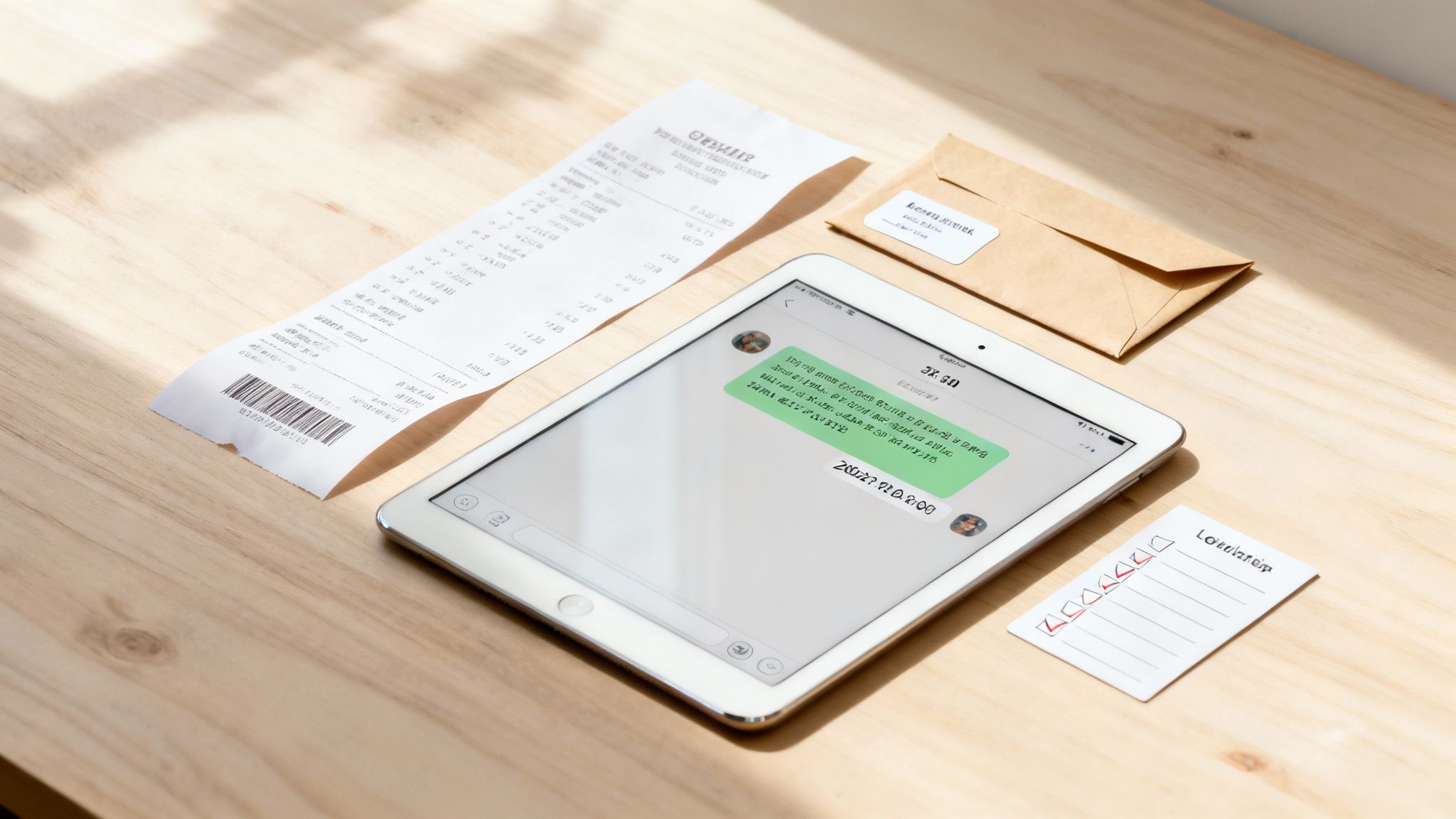
Before you even start drafting a rebuttal letter, you need to gather your proof. Think of it this way: a rebuttal without solid evidence is just an opinion, and opinions rarely win disputes.
Your job is to build an undeniable case. Every document, every email, every screenshot is a piece of the puzzle that proves your side of the story.
The goal is simple: make the reviewer's job incredibly easy. You want them to look at your evidence and immediately see the facts from your perspective. This means organizing everything logically so it’s clear, legible, and directly tied to the claim you’re fighting.
Key Evidence for Common Scenarios
The kind of proof you need really depends on the situation. Let's break down the essentials for the most common disputes you'll likely run into.
When you're dealing with an e-commerce chargeback, your documentation is everything. This is where having the right paperwork can make or break your case. To learn more, check out our deep dive on how to win a credit card dispute.
At a minimum, your checklist should include:
- Order & Transaction Details: The original receipt, invoice, and any order confirmation emails are non-negotiable.
- Proof of Delivery: Shipping confirmation with a tracking number is good; signature confirmation from the carrier is even better.
- Customer Communications: Pull any emails, chat logs, or support tickets where you discussed the order with the customer.
- AVS & CVV Matches: Show that the security checks from the credit card transaction were successful.
For other disputes, like a complaint about a service or an issue with a vendor, your evidence will look a little different. Here, you'll lean more on written correspondence, contracts, and any proof of work you delivered.
Your evidence needs to tell a clear, chronological story. Start with the initial agreement, show the transaction, and finish with proof that you held up your end of the deal. A messy, disorganized pile of documents just makes you look unprepared and weakens your whole argument.
Organizing Your Proof for Maximum Impact
Once you have all your documents, how you present them matters just as much as what they contain. When preparing your rebuttal, exploring efficient methods like automated evidence collection can be a game-changer and save you a ton of time.
It’s crucial that your data is not only accurate but also relevant to the situation. In fact, studies show that nearly 70% of successful rebuttals use numbers and data that directly support their claims, which adds significant credibility. You can get more insights on the effective use of data in these findings on rebuttal writing.
To help you get organized, here’s a quick reference guide for the types of supporting documents you'll need for different scenarios.
Essential Evidence for Common Disputes
Having this documentation ready to go makes building your rebuttal letter much faster and far more effective. It shows you’re organized, professional, and serious about defending your business.
Sample Rebuttal Letter Templates You Can Use Today
Seeing the structure of a rebuttal is one thing, but having a practical, real-world example makes all the difference. Sometimes, the best way to figure out how to write a killer rebuttal is just to see a good one in action.
Below, you’ll find three detailed templates I've put together, each one designed for a common headache you're likely to face as a business owner.
Think of these as your starting point—a solid foundation you can build on. Feel free to adapt the language, swap out the specifics, and make them your own. Each sample also includes a few notes explaining why certain phrases are used and how they pack a bigger punch for your argument.
E-commerce Chargeback Rebuttal Letter Sample
When a customer disputes a charge, your response needs to be fast, professional, and absolutely packed with evidence. The entire goal is to prove the transaction was legitimate and that you held up your end of the deal. This template is built for clarity and impact.
[Your Company Name]
[Your Company Address]
[Date]
To Whom It May Concern,
Regarding Case ID: [Chargeback Case Number]
Transaction Date: [Date of Transaction]
Transaction Amount: [Amount of Transaction]
This letter is our formal rebuttal to the chargeback filed for the transaction referenced above. The customer’s claim, cited as "[Chargeback Reason Code, e.g., 'Product Not Received']", is incorrect. We have compelling evidence that confirms the transaction was legitimate and the order was successfully delivered.
(Pro Tip: Get straight to the point. State the case number and your purpose immediately. It sets a professional tone and helps the reviewer get oriented quickly.)
On [Date of Transaction], the customer, [Customer Name], purchased [Product Name] from our online store. The transaction was successfully authorized with matching AVS (Address Verification System) and CVV security codes, confirming the cardholder’s participation.
(Pro Tip: Calling out security checks like AVS and CVV right away helps undermine potential fraud claims. It shows you’re following best practices.)
The order was shipped on [Shipping Date] via [Carrier Name] with tracking number [Tracking Number]. Carrier records confirm the package was successfully delivered to the customer’s address at [Customer Address] on [Delivery Date].
We have attached the following documents to validate this transaction:
- Attachment A: A copy of the original sales receipt.
- Attachment B: Proof of AVS and CVV match from our payment processor.
- Attachment C: Shipping confirmation with the tracking number.
- Attachment D: Signed delivery confirmation from [Carrier Name].
(Pro Tip: A simple, numbered list of your evidence is a gift to the person reviewing your case. It’s easy to scan, shows you're organized, and makes it obvious you have a strong case.)
Based on the evidence provided, it is clear the transaction was authorized by the cardholder and the merchandise was delivered as promised. We respectfully request that you reverse this chargeback and return the disputed funds to our account.
Sincerely,
[Your Name]
[Your Title]
[Your Company]
Response to a Negative Customer Review
Replying to a bad review in public requires a totally different approach. This isn't a financial dispute; it's about protecting your reputation. The goal here is to show other potential customers that you're a reasonable, professional business that takes problems seriously.
Subject: Regarding your review on [Platform, e.g., Google, Yelp]
Dear [Customer Name],
Thank you for taking the time to share your feedback about your experience with [Your Company Name] on [Date of Review]. We take all customer concerns seriously, and we were disappointed to learn that we didn't meet your expectations this time around.
(Pro Tip: Start with a calm, professional opening. Acknowledge their feedback without immediately jumping on the defensive.)
In your review, you mentioned [briefly and neutrally state the core issue, e.g., "that your order arrived later than expected"]. I’ve looked into your order ([Order Number]) and can confirm it was shipped on [Date] and delivered on [Date]. While this was within our stated shipping window, I completely understand your frustration and apologize for any miscommunication on our end regarding the delivery timeline.
(Pro Tip: Address their specific complaint using facts, but keep an empathetic tone. This shows you've actually done your research instead of just sending a canned response.)
We are committed to making sure every customer has a great experience. I would appreciate the opportunity to discuss this with you and find a way to make things right. Please feel free to contact us directly at [Phone Number] or [Email Address] whenever is convenient for you.
(Pro Tip: Always, always offer a path to an offline solution. Taking the conversation private stops a public back-and-forth and shows you're serious about fixing the problem.)
Sincerely,
[Your Name]
[Your Title/Department]
[Your Company Name]
Vendor Invoice Dispute Letter
When you have to dispute an invoice with a vendor or supplier, the key is to be firm but professional. Your letter needs to clearly spell out the discrepancy, point to the specific terms of your agreement, and propose a clear path forward.
And if you need more inspiration, you can find a whole library of different rebuttal letter templates to guide you through other tricky situations.
[Your Company Name]
[Your Address]
[Date]
[Vendor Company Name]
[Vendor Address]
Subject: Dispute of Invoice # [Invoice Number]
Dear [Vendor Contact Name],
I’m writing to formally notify you of a dispute regarding Invoice #[Invoice Number], dated [Invoice Date], for the amount of [Invoice Amount].
(Pro Tip: Don't beat around the bush. State the invoice number and the reason for your letter in the very first sentence.)
We’ve identified a discrepancy in the charges. Specifically, the line item for [Specific Item or Service] is billed at [Incorrect Amount]. Our signed service agreement from [Date of Agreement] states the rate should be [Correct Amount]. This results in an overcharge of [Difference Amount].
(Pro Tip: Point to the exact error and back it up by referencing a specific document, like a contract. This immediately moves the dispute from a matter of opinion to one of fact.)
I’ve attached a copy of the relevant section of our service agreement for your reference.
We request that you issue a corrected invoice for the adjusted amount of [Correct Total Amount]. We will process the payment promptly as soon as we receive the revised invoice.
Thank you for your immediate attention to this matter.
Sincerely,
[Your Name]
[Your Title]
[Your Company Name]
How to Adapt Your Rebuttal for Different Platforms
Submitting your rebuttal isn’t a simple copy-paste job. Where you fight the dispute—whether it's inside Stripe's dashboard, PayPal's Resolution Center, or a formal email—changes the whole game. Each platform has its own rules, formats, and even character limits.
A brilliant argument can fall completely flat if it’s submitted the wrong way. Trust me, I've seen it happen.
Understanding these platform-specific quirks is a must. Some systems have tiny text boxes that force you to be brutally concise, while others let you attach detailed PDFs. Knowing these differences before you start writing helps you shape your argument into a format the review team expects, which can be the difference between a quick win and a long, drawn-out fight.
Tailoring Your Response for Major Payment Processors
Every payment processor has a slightly different workflow for disputes. This means your approach has to be flexible. What works perfectly for Stripe might not even be an option on PayPal.
Let's break down the big three and what you need to know:
- Stripe: Their dashboard is highly structured. You’ll be guided through a form to submit evidence, uploading documents as you go. Keep your written text brief and to the point—let your evidence do the heavy lifting. Bullet points are your best friend here.
- PayPal: The Resolution Center is where it all goes down. While you can attach files, your written response carries a lot of weight. It's smart to summarize your evidence right in the text box. If you're stuck on a tricky case, our guide to handling PayPal disputes has some platform-specific strategies.
- Shopify Payments: Since this is powered by Stripe, the process is similar but integrated directly into your Shopify admin. The interface is clean and user-friendly, but the core principles are the same as Stripe—focus on clear, concise evidence that directly shuts down the customer's claim.
The single biggest mistake merchants make is writing a generic, wall-of-text rebuttal and trying to jam it into every platform's form. Treat each submission portal like its own unique assignment with its own set of rules.
This flowchart shows some common dispute scenarios you'll run into, and each one requires a tailored approach.
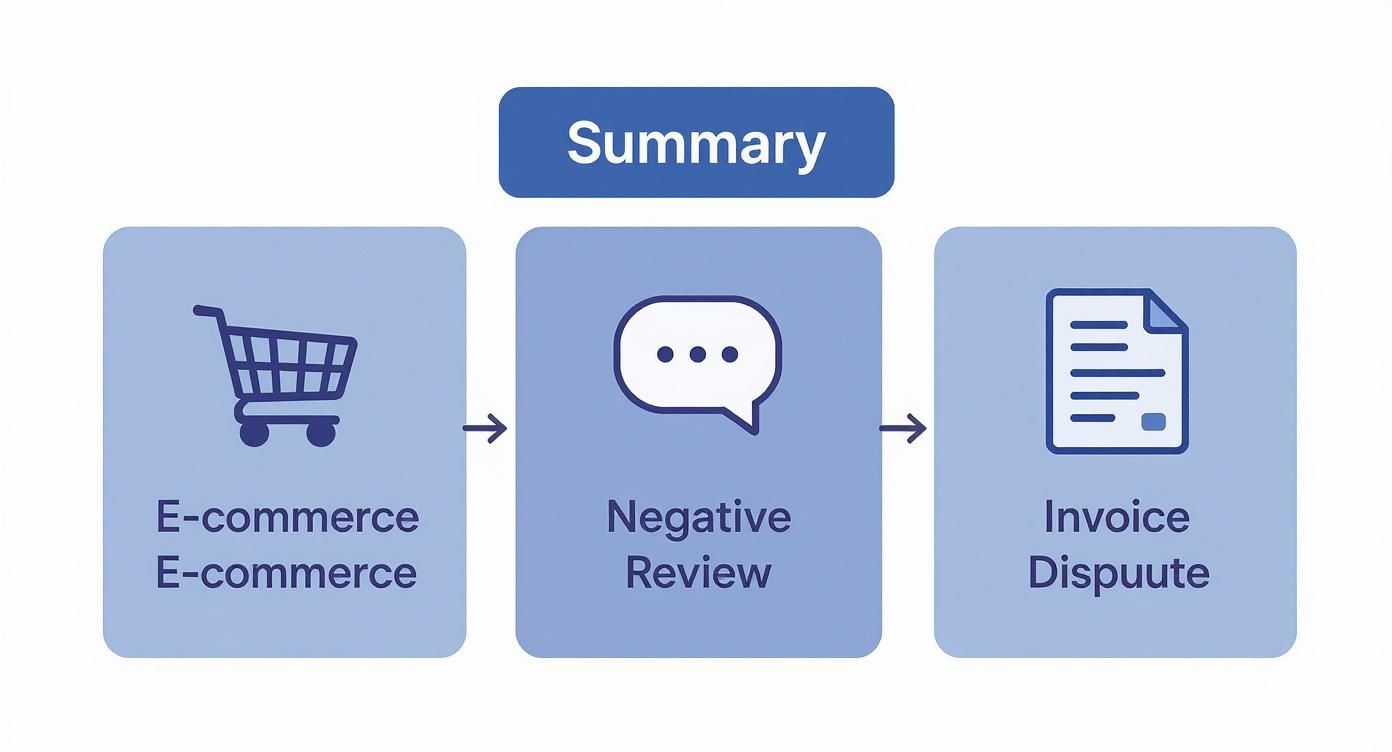
Whether it’s an e-commerce chargeback, a review dispute, or an unpaid invoice, the where and how of your submission matters just as much as the what.
Quick Tips for Platform-Specific Submissions
No matter where you're submitting, a few universal rules will always serve you well. First and foremost, always prioritize clarity over length. The people reviewing these cases look at dozens, if not hundreds, a day. Make their job easy.
Here are a few more tips to keep in mind:
- Check File Type and Size Limits: Before you even start gathering evidence, find out what the platform accepts. Most prefer PDFs and JPGs, and there’s almost always a file size limit. Don't waste time preparing a file you can't even upload.
- Mind the Character Count: If you’re stuck with a tiny text box, write your summary in a separate document first to get it just right. Focus only on the absolute most critical facts.
- Use the Platform's Language: Refer to case numbers, transaction IDs, and reason codes exactly as they appear in the dispute notification. This shows you’re paying attention and helps the reviewer find your info fast.
Of course. Here is the rewritten section, designed to sound natural and human-written, following all the specified requirements.
Common Questions About Writing Rebuttal Letters
Even with the best samples in hand, you're bound to run into questions when you're in the thick of a dispute. We get it. This last section is all about giving you quick, clear answers to some of the most common things we see business owners worry about.
Think of this as your go-to guide for nailing the finer points of your rebuttal.
How Long Should My Rebuttal Letter Be?
The golden rule here is to aim for one page. Seriously. The people reviewing your case are buried in paperwork, and a response that gets straight to the point is always appreciated. A long, rambling letter can actually sink your chances because it buries your best evidence in a wall of text.
That said, don't chop out critical information just to hit an arbitrary page limit. If you have a complex case that requires you to explain multiple pieces of evidence, it's far better to be thorough than to be too brief. Just make sure every single sentence is pulling its weight.
The most effective rebuttal letters are short, factual, and backed by undeniable proof. Your goal isn't to write an essay; it's to present an airtight case that makes the reviewer's decision a no-brainer.
What Is the Biggest Mistake People Make?
Hands down, the single biggest mistake is letting emotion take over. When you feel like you've been wronged—whether it's by a customer, a vendor, or even in a performance review—it's completely natural to be frustrated. But the moment that frustration bleeds into your letter, you start losing credibility.
A professional, calm, and fact-based tone will always be more persuasive than an angry or defensive one. Let the evidence do the talking. Whatever you do, avoid making accusations or emotional statements you can't back up with cold, hard facts.
Can I Use a Simple Template for a Serious Dispute?
Yes, but with one major string attached. A sample of rebuttal letter is an excellent jumping-off point. It gives you a proven framework to structure your argument and helps ensure you don't miss any key components. It keeps you organized and professional.
Here's the catch: you absolutely must customize it with the specific details and evidence from your unique situation. Firing off a generic, copy-paste response without any tailored proof is almost guaranteed to fail. Use templates as a guide, not as a crutch.
What If My Rebuttal Is Rejected?
First off, don't panic. If your rebuttal gets rejected, you still have options, though they can vary depending on what you're dealing with.
- Chargebacks: Most card networks offer a second round to fight the dispute, which is known as arbitration. It’s a more formal process and often your last shot at getting your money back.
- Other Disputes: For vendor or internal issues, you might need to escalate the problem to a higher authority, look into mediation, or, in more serious situations, talk to a legal professional to figure out your next move.
The most important thing is to carefully review the reason for the rejection. It will often point out exactly why your first argument wasn't strong enough, giving you a roadmap for how to build a much stronger case the second time around.
Fighting disputes manually is a massive drain on your time and resources. ChargePay uses AI to automate the entire process, generating winning rebuttal letters in real-time to recover your lost revenue effortlessly. Stop losing money to unfair chargebacks and see how much you can reclaim at https://www.chargepay.ai.


.svg)



.svg)


.svg)
.svg)
.svg)