

Getting a denial notice, a negative review, or a formal complaint can feel like hitting a brick wall. It’s easy to feel frustrated and assume the decision is final. But in most cases, this is just the beginning of a conversation, not the end of it. Your chance to respond effectively is with a well-written and persuasive rebuttal letter. This document is your official opportunity to present your side of the story, correct any mistakes, and provide the evidence needed to turn things around.
But staring at a blank page can be tough. What should you say? What evidence is most important? How do you stay professional when you're feeling anything but calm? That's exactly where this guide comes in. We’re going beyond generic advice to give you a solid game plan for real-world situations.
This article gives you seven distinct sample rebuttal letter templates, each designed for a common but tricky scenario you might run into. We'll cover everything from responding to a journal review and appealing a school decision to disputing an insurance denial or contesting a disciplinary action at work.
For each sample, we will break down:
- The core strategy: Why the letter is set up the way it is.
- Essential evidence: The specific documents you need to attach to make your case solid.
- Critical mistakes to avoid: Common slip-ups that can get your rebuttal dismissed right away.
Our goal is to give you the tools and confidence to write a response that doesn't just get read, but gets results. While these templates provide a strong foundation, understanding the bigger picture is also key. For a deeper look at general strategies for managing and winning disputes, you might check out resources detailing comprehensive dispute resolution strategies. Let’s get started on crafting your winning response.
1. Academic Appeal Rebuttal Letter
An Academic Appeal Rebuttal Letter is a formal document you send to a university or college to challenge a decision you disagree with. This isn't just about being unhappy; it's about presenting a clear argument to have a decision looked at again. This type of sample rebuttal letter is your chance to provide new information or correct a misunderstanding that led to an academic dismissal, a denied admission, or a disciplinary action.
The key to a successful academic appeal is to show that the original decision was based on incomplete or wrong information. You are essentially "rebutting" the school's conclusion by bringing new, compelling facts to the table.
When to Use This Letter
This letter is meant for specific, high-stakes academic situations. You shouldn't use it for minor disagreements like a grade on a single assignment. Save it for decisions that could affect your future.
- Academic Dismissal: You can appeal if you failed a semester because of major issues the committee didn't know about, like a serious, undiagnosed medical condition or a family emergency.
- Admission Rejection: This is less common but can work if there was a clear mistake in your application, like a miscalculated test score, or if you've done something extraordinary since you first applied.
- Disciplinary Action: If you believe a disciplinary ruling was made without all the facts, a rebuttal letter lets you present your side with supporting evidence.
Strategic Breakdown and Actionable Tips
A strong academic rebuttal letter is short, respectful, and based on evidence. It focuses on facts, not feelings.
Core Components:
- A Clear Introduction: State your name, student ID, and the specific decision you are appealing right away.
- Acknowledge the Original Decision: Briefly show that you understand why the school made its initial decision.
- Present New Information: This is the most important part. Clearly explain the new evidence or the circumstances they didn't know about. Use a timeline if it helps make things clear.
- Provide Documentation: Attach all relevant evidence, such as a doctor's note, corrected test scores, or letters of support.
- Propose a Solution: Explain what you want the committee to do. Be specific, for example, "I request reinstatement for the upcoming semester on academic probation."
Strategic Takeaway: Your goal is to show what has changed since the original decision was made. Focus on presenting a case that offers a solution. Instead of just saying "I had a medical issue," say "I had an undiagnosed medical issue which has now been diagnosed and is being treated, as documented by my physician, Dr. Smith."
Avoid blaming professors or making emotional pleas. Keep a professional tone throughout. For more guidance on structuring your arguments effectively, review some best practices for the format for a rebuttal letter, as many of the core principles apply. Always have a trusted advisor or writing center mentor review your draft before you submit it.
2. Journal Reviewer Response (Author Rebuttal)
A Journal Reviewer Response, often called an author rebuttal, is a formal document researchers write to address feedback from peer reviewers on a paper submitted to an academic journal. This isn't a simple "thank you" note; it's a careful, point-by-point response that handles every comment, criticism, and suggestion made by the experts who reviewed your work. This sample rebuttal letter is a key part of academic publishing and often decides whether a paper is accepted, needs more work, or is rejected.
The main purpose of this letter is to show you've taken the peer review process seriously and to convince the journal editor that you have improved your paper based on the reviewers' helpful feedback. You are pushing back against weaknesses they pointed out by either making changes to your paper or providing a well-reasoned, evidence-based counterargument.
When to Use This Letter
This letter is a required step in the academic publishing process whenever a journal editor sends your paper back with reviewer comments and a decision of "revise and resubmit." It's your chance to have a scholarly conversation and defend your research.
- Addressing Methodological Concerns: If a reviewer questions your statistical methods, you can respond by running additional analyses and presenting the results. For example, a biomedical researcher might perform a sensitivity analysis to show their findings are solid.
- Defending a Theoretical Framework: When a reviewer suggests another way to look at your work, you can use the rebuttal to politely disagree, pointing to established research that supports your original approach.
- Clarifying Ambiguities: Use this letter to explain parts of your paper that reviewers found unclear and detail exactly where you have added new text to make it clearer. For example, a psychology researcher might clarify their open data practices to address concerns about others being able to replicate the study.
Strategic Breakdown and Actionable Tips
An effective author rebuttal is organized, respectful, and scholarly. It connects the reviewers' critique to your revised paper, making the editor's job easier.
Core Components:
- Polite and Grateful Opening: Always begin by thanking the editor and the reviewers for their time and helpful feedback.
- Point-by-Point Structure: Copy each reviewer's comment and provide your response directly underneath it. Number them for clarity (e.g., Reviewer 1, Comment 1).
- Acknowledge and Act: For good points, start with phrases like "We agree with the reviewer..." and then explain the specific changes you made, mentioning page and line numbers in the revised paper.
- Respectfully Disagree with Evidence: If you disagree with a comment, state your position professionally and support it with citations or data from your study.
- Summarize Major Changes: Include a brief overview at the beginning of the letter summarizing the most important revisions made to the paper.
Strategic Takeaway: Your main goal is to be a helpful guide for the editor and reviewers. Make it easy for them to see how you've improved the paper. Instead of just saying "We clarified the methodology," say "We thank the reviewer for this suggestion. We have revised the Methods section (Page 5, Lines 110-115) to explicitly state the inclusion and exclusion criteria for our sample."
Always maintain a friendly, professional tone, even when disagreeing. The process is meant to be helpful, not a fight. For a deeper dive into structuring these arguments, you can see another example of a rebuttal letter to understand the universal principles of clear, evidence-based responses. Before submitting, have all co-authors review the rebuttal to make sure everyone agrees and the message is clear.
3. Tenant/Landlord Dispute Rebuttal Letter
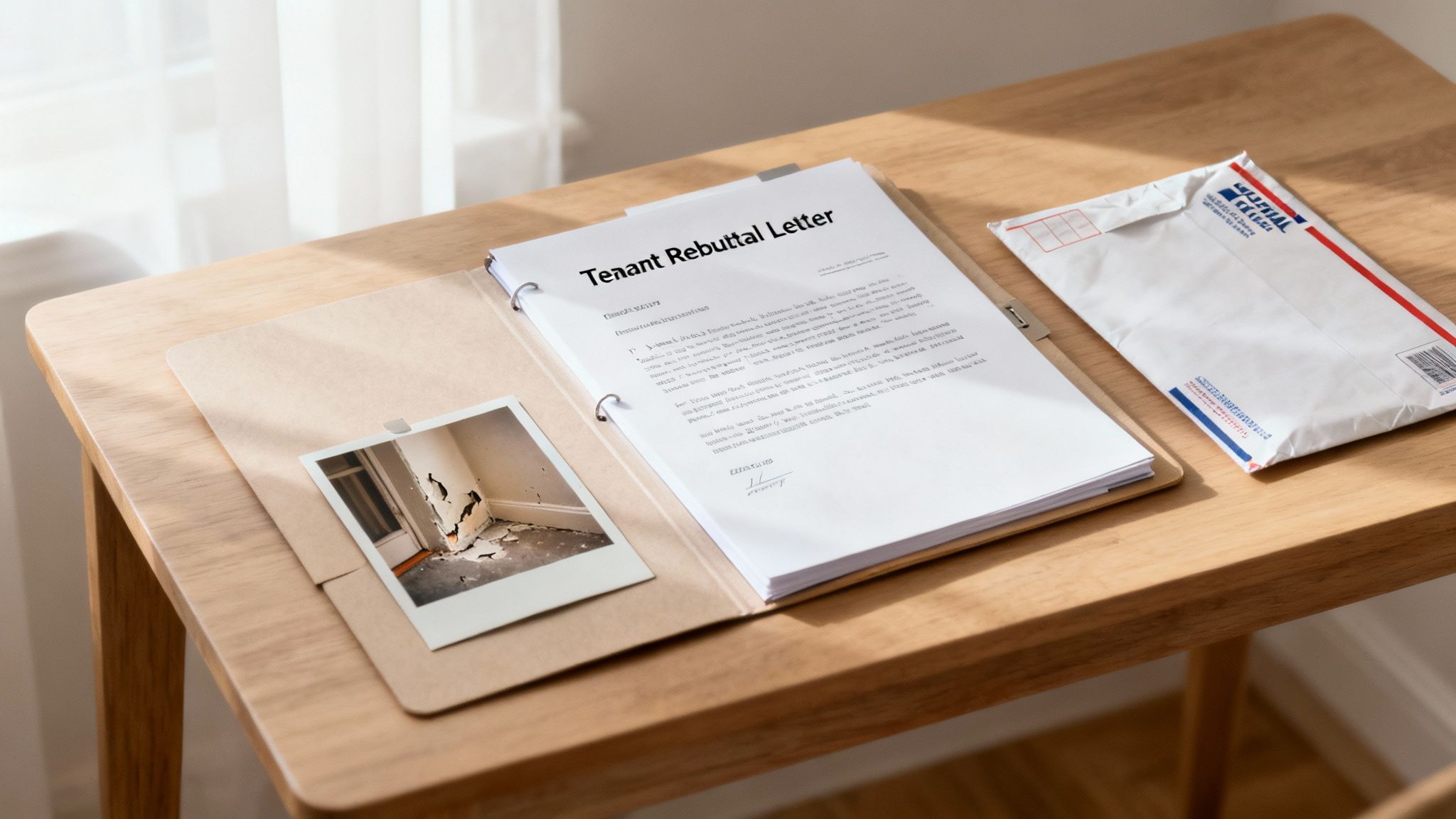
A Tenant/Landlord Dispute Rebuttal Letter is a formal written response used to argue against claims made by the other person in a rental agreement. This isn't just a complaint; it's a structured, evidence-based document designed to set the record straight on issues like security deposit deductions, lease violations, or eviction notices. This type of sample rebuttal letter serves as a key piece of your official communication, creating a paper trail that can be used in housing authority meetings or even small claims court.
The purpose of this letter is to formally "rebut" incorrect claims with facts and proof. Whether you are a tenant fighting an unfair eviction or a landlord explaining a security deposit claim, the letter's power comes from its ability to present a clear, documented counter-argument.
When to Use This Letter
This letter is essential for formally recording your position in serious rental disagreements. It should be used to create a legal record, not for minor annoyances. Save it for disputes that could have financial or legal consequences.
- Eviction Notices: A tenant can use this letter to dispute an eviction notice if they can prove they have followed the lease terms, such as by providing bank statements showing on-time rent payments.
- Security Deposit Disputes: A landlord can use it to push back against a former tenant’s demand for a full security deposit return by providing itemized receipts for repairs and photos of the damages.
- Lease Violation Allegations: If a landlord claims you violated a "no pets" clause, you could rebut with a letter attaching a copy of the lease addendum that gives you permission for your pet.
- Claims of Uninhabitable Conditions: A landlord might use this letter to counter a tenant's claim by providing dated records of maintenance requests and completed work orders.
Strategic Breakdown and Actionable Tips
An effective rebuttal in a tenant-landlord dispute is objective, factual, and free of emotion. It relies on documents, not accusations, to make its point.
Core Components:
- A Direct Introduction: Clearly state your name, the property address, and the specific claim you are disputing (e.g., "the notice to quit dated October 15, 2023").
- Reference Specific Lease Clauses: Refer to the exact section numbers in your lease agreement that back up your position. This shows you have done your homework.
- Present Factual Counter-Evidence: This is the core of your letter. Methodically list your counter-points and reference the evidence for each. Use a clear, chronological order.
- Attach Supporting Documentation: Always include copies (never originals) of all relevant proof: bank statements, photos, emails, rent receipts, or signed lease addendums.
- State Your Desired Outcome: Clearly say what you want to happen next. For example, "I request the withdrawal of the eviction notice" or "Please find enclosed a check for the undisputed portion of the security deposit."
Strategic Takeaway: Your goal is to build an undeniable, documented case. Instead of saying "I always pay rent on time," state "As documented in the attached bank statements, rent payments were electronically transferred on the first of each month, in accordance with section 4A of our lease agreement."
Always send this letter via certified mail with a return receipt requested to prove it was delivered. For a deeper look at different scenarios and wording, you can see more examples in our guide to the Tenant/Landlord Dispute Rebuttal Letter. If the dispute involves a lot of money or a potential eviction, have a lawyer or a local tenant rights organization review your letter before you send it.
4. Insurance Denial Appeal Letter
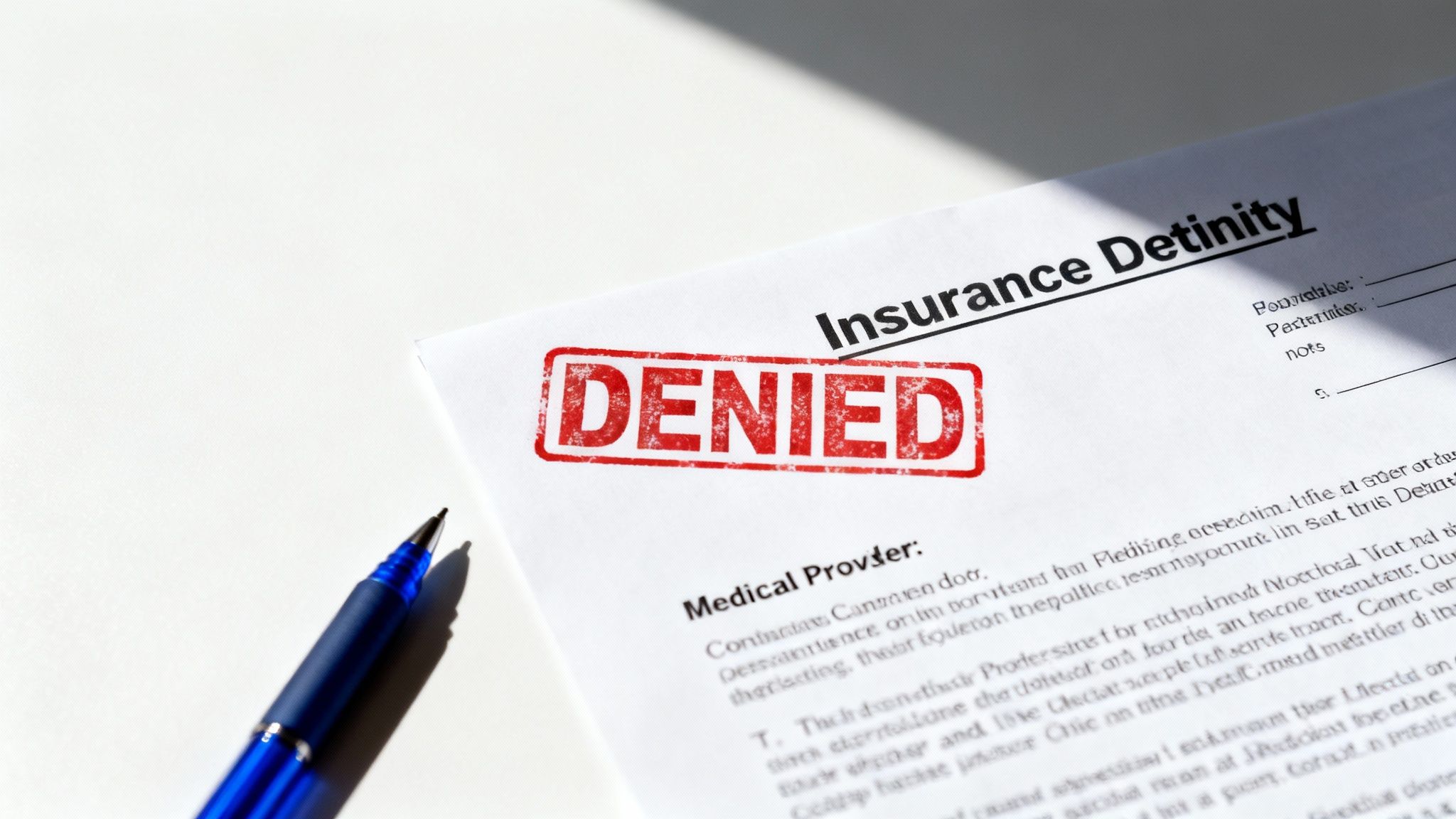
An Insurance Denial Appeal Letter is a formal document you send to your insurance company to dispute their decision to deny coverage for a medical service, treatment, or prescription. This isn't just a complaint; it’s a structured argument aimed at getting the insurer to change its mind. This type of sample rebuttal letter is your chance to present new medical evidence, point to specific policy language, or correct a misunderstanding that led to the denial.
The main purpose of an insurance appeal is to show that the denial was wrong, either based on the facts or your contract. You are "rebutting" the company’s reason by providing solid proof that the service is both medically necessary and covered under your policy.
When to Use This Letter
This letter is vital when an insurance company denies a claim that you and your doctor believe is essential for your health. Don't use it for minor billing issues that a phone call can fix. Save it for major coverage denials.
- Medically Necessary Treatment Denials: If your insurer says a procedure is "not medically necessary," you can appeal with a detailed letter from your physician explaining why it is critical. For example, a physical therapy claim can be overturned with documents showing why it's needed for a specific injury.
- Prescription Medication Rejection: An appeal is a good idea if a prescribed drug is denied because a cheaper alternative exists, but you have a documented allergy or bad reaction to that alternative.
- Out-of-Network Service Denials: You can challenge a denial for an out-of-network provider if you can prove that no in-network provider could offer the required specialized care.
Strategic Breakdown and Actionable Tips
A powerful insurance appeal letter is organized, objective, and full of evidence. It relies on medical facts and policy language, not emotional appeals.
Core Components:
- A Clear Introduction: Start with your name, policy number, and the specific claim number you are appealing.
- State the Reason for Denial: Briefly show that you understand the insurance company's stated reason for the denial.
- Present Counter-Evidence: This is the heart of your letter. Detail why the denial is incorrect, referencing medical records and your doctor’s professional opinion.
- Cite Policy Language: Quote the specific sections of your insurance policy that support coverage for the service in question.
- Attach All Documentation: Include copies of the denial letter, medical records, test results, and a formal letter of medical necessity from your provider. Never send originals.
Strategic Takeaway: Your goal is to build an undeniable case for medical necessity and your contractual right to coverage. Shift the focus from "I need this" to "My doctor has determined this is medically necessary, and my policy covers it." Always send your appeal via certified mail to have a record of its receipt.
Keep your tone professional and persistent. For more guidance on assembling a persuasive argument, you can find a useful letter of rebuttal template that outlines many of the foundational principles. If your first appeal fails, remember that you often have the right to a second-level appeal or an external review.
5. Employment Disciplinary Action Response Letter
An Employment Disciplinary Action Response Letter is a formal document an employee writes to their employer to contest or add context to a disciplinary action. This isn't a simple complaint; it is a structured, fact-based response to a formal warning, a performance improvement plan (PIP), or a suspension. This type of sample rebuttal letter is your chance to correct the record, provide missing context, or push back against specific claims.
The goal of this letter is to show that the disciplinary action was based on a misunderstanding, incomplete information, or factual mistakes. You are professionally "rebutting" the employer's claims with your own evidence and perspective.
When to Use This Letter
This letter is key in formal workplace disputes where your professional reputation and job are on the line. It should not be used for minor, informal feedback but saved for documented disciplinary measures.
- Written Warnings: Use it to contest a warning for attendance issues by providing documents for approved medical leave that was overlooked.
- Poor Performance Reviews: You can respond to a negative evaluation by presenting specific project results, client testimonials, and completed tasks that go against the assessment.
- Accusations of Misconduct: If accused of something like insubordination, this letter lets you clarify a miscommunication about instructions or tasks.
Strategic Breakdown and Actionable Tips
A powerful response to disciplinary action is professional, unemotional, and strictly factual. It aims to solve the issue, not make it worse.
Core Components:
- A Clear Introduction: State your name, position, and the specific disciplinary action and date you are responding to.
- Acknowledge the Action: Briefly state that you have received and understood the disciplinary notice.
- Present Your Rebuttal: Address each point in the disciplinary notice separately. Use facts, dates, and specific examples to counter the claims.
- Provide Supporting Evidence: Attach copies of any relevant documents, such as emails, project files, medical notes, or performance data.
- Propose a Resolution: Clearly state your desired outcome. This could be the removal of the warning from your file, a revision of your performance review, or a meeting to discuss a path forward.
Strategic Takeaway: Your goal is to calm the situation down while defending your position with facts. Frame your response around clarification and resolution. Instead of saying "My manager is wrong," say "There appears to be a misunderstanding regarding the project deadline. My email from May 15th, attached as Exhibit A, confirms the agreed-upon delivery date of May 30th, which was met."
Avoid blaming others or guessing about motives. Stick to the facts. To see more examples and get a deeper understanding, review a detailed guide on how to write a sample letter of rebuttal for professional situations. Always check your employee handbook on how to handle grievances and consider sending your letter via a trackable method.
6. Parking Ticket or Traffic Citation Appeal Letter
A Parking Ticket or Traffic Citation Appeal Letter is a formal document you send to a traffic authority or local court to fight a citation. This isn't an emotional complaint; it's a structured argument designed to prove a ticket was issued by mistake. This type of sample rebuttal letter is your chance to present evidence showing the citation was an error, that specific circumstances made the violation unavoidable, or that the process was flawed.
The goal is to take apart the basis of the citation by introducing factual, verifiable evidence. You are rebutting the officer's claim by showing that their conclusion was based on incomplete information or a procedural mistake.
When to Use This Letter
This letter is a good idea when you have a strong, evidence-based reason to believe a ticket is unfair. It's not for simply being upset about getting a ticket; it's for situations where a clear mistake happened.
- Parking Ticket Appeal: Use this if a "No Parking" sign was missing or completely hidden, if your meter was broken, or if you were parked legally according to the stated rules.
- Traffic Violation Appeal: This is effective if you can prove a factual error, such as a malfunctioning traffic light causing you to run a red light, or if you have evidence that a speed-reading device was not working correctly.
- Procedural Error Challenge: You can appeal if the citation itself has critical mistakes, like the wrong date, location, or vehicle information, which may make it invalid.
Strategic Breakdown and Actionable Tips
A convincing appeal letter is objective, factual, and backed up by solid evidence. It sticks to the facts and avoids placing blame or making emotional arguments.
Core Components:
- A Clear Introduction: Begin by stating your name, address, citation number, and your vehicle's license plate number. Clearly state that you are writing to formally appeal the ticket.
- State the Factual Grounds for Appeal: Briefly explain why the ticket is invalid. For example, "The citation was issued for parking in a no-parking zone, but the required sign was completely blocked by a tree branch."
- Present Your Evidence: This is the core of your rebuttal. Describe the evidence you have collected, referencing each piece clearly.
- Provide Documentation: Attach all supporting proof. This includes clear photographs of the scene (e.g., the hidden sign, the broken meter), witness statements with contact information, or official documents like a mechanic's report.
- Politely Request a Dismissal: Finish by formally requesting that the citation be dismissed based on the evidence provided. Keep a respectful and professional tone.
Strategic Takeaway: Your appeal's success depends on the quality of your evidence. Instead of just saying "the sign was hard to see," provide a time-stamped photo showing the sign is unreadable from a driver's point of view. Focus on undeniable facts, not your personal feelings about the situation.
Always submit your appeal well before the deadline listed on the citation. Look up the specific local rules related to your violation to strengthen your argument. If your area allows for a "trial by written declaration," this letter forms the basis of your entire case, so make it as strong as you can.
7. Grade or Assessment Appeal Letter
A Grade or Assessment Appeal Letter is a formal document a student sends to an instructor, department head, or academic committee to challenge a final grade or a specific test score. This isn't about just being unhappy with a grade; it’s a structured request for another look based on specific, objective reasons like a scoring error or a big difference between the test and the study materials provided. This type of sample rebuttal letter is a tool for making sure academic evaluation is fair and accurate.
The goal of this letter is to rebut the initial grade by pointing out a clear, provable error in the grading process. It's a professional way to ask for a second look, backed by evidence, to ensure the grade you received truly reflects your work according to the rules that were set.

When to Use This Letter
This letter should be used for significant, clear-cut grading issues, not for subjective disagreements over a few points. It’s most effective when you can point to a real mistake.
- Scoring Errors: Use it if you find a math error in how your points were added up or if the grading rubric was applied incorrectly. For example, if points were taken off for a section that was actually done correctly.
- Misaligned Assessments: This is appropriate if the material on an exam was very different from what was outlined in the syllabus or study guide, which kept you from preparing properly.
- Procedural Violations: If an instructor did not follow the grading policies laid out in the course syllabus, a formal appeal is justified. This could include things like not weighting assignments correctly in the final grade calculation.
Strategic Breakdown and Actionable Tips
A successful grade appeal letter is built on objectivity and evidence. Your tone should be respectful and curious, not accusing.
Core Components:
- Clear Subject and Introduction: State your name, student ID, the course name, and the specific assignment or grade you are appealing.
- State Your Purpose: Clearly and politely state that you are writing to request a reconsideration of your grade and briefly mention why (e.g., a potential calculation error).
- Present Factual Evidence: This is the core of your letter. Detail the specific error. For instance, "On question 5, I was marked down for X, but the assignment instructions specified Y." Refer to the syllabus, rubric, or assignment sheet.
- Attach Supporting Documents: Include copies of the graded assignment, the grading rubric, the original instructions, and any relevant communication. Highlight the specific areas in question.
- Propose a Resolution: Politely request a specific action, such as "I would be grateful if you could review the scoring on this section" or "Could we schedule a brief meeting to discuss this discrepancy?"
Strategic Takeaway: Frame your appeal as a request for clarification, not a demand. Focus entirely on objective evidence. Instead of saying, "I think this grade is unfair," say, "I reviewed the grading rubric and noticed a discrepancy in the point calculation for Section B; I've attached a copy with the area highlighted."
Always try to meet with your instructor informally before submitting a formal written appeal. This can often resolve the issue quickly and shows that you are trying to handle the situation respectfully. If that meeting doesn't lead to a resolution, then proceed with the formal sample rebuttal letter through the official channels outlined by your department or institution.
Comparison of 7 Rebuttal Letter Types
Automate Your Defense and Stop Losing Revenue
Throughout this guide, we've broken down how to write a compelling rebuttal letter. We’ve moved beyond generic templates and into the specific strategies that win disputes, whether you're appealing a school decision, responding to a journal reviewer, or fighting an unfair parking ticket. Each situation calls for a unique mix of evidence, tone, and logical structure.
The core lesson is this: a successful rebuttal is never just about stating you’re right. It's about carefully taking apart the other party's claim with undeniable proof, presented in a way that is easy for a decision-maker to understand and accept. Your goal is to make it impossible for them to say no.
Your Key Takeaways for Winning Any Dispute
Let's boil down the most important lessons from the examples we've looked at. Mastering these principles will fundamentally change how you approach any conflict, turning potential losses into definite wins.
- Evidence is Everything: A rebuttal without proof is just an opinion. As we saw in the tenant dispute and insurance denial examples, documents like photos, emails, and official records are your strongest allies. Always lead with your evidence, not your emotions.
- Structure Your Argument: A clear, logical flow is essential. Start by acknowledging the initial claim, state your counter-argument clearly, present your evidence piece by piece, and finish with what you want to happen. This structure, seen in the academic and employment letters, guides the reader to your conclusion.
- Maintain a Professional Tone: Emotion clouds judgment. Even when you are frustrated, as you might be with a traffic ticket or a negative performance review, a calm, respectful, and objective tone gives your argument more credibility. Let the facts do the talking.
Think of each sample rebuttal letter as more than just a template; see it as a strategic blueprint. Each one shows how to assemble facts into a persuasive story that leaves no room for doubt.
From Manual Effort to Strategic Advantage
Writing the perfect rebuttal letter for every single situation can be a huge drain on your time and energy. Gathering documents, finding specific dates, and writing clear arguments takes you away from more important tasks. While our examples give you a powerful starting point, the real secret to winning consistently is speed and accuracy.
This is where you can use technology to get an edge. Manually managing these disputes can be overwhelming, especially when you're dealing with multiple issues at once. For businesses or individuals looking to streamline their defense and maybe even automate parts of the dispute process, AI-driven platforms can offer valuable tools. For instance, Redeemly's AI solutions show how technology can help organize evidence and structure arguments, turning a chaotic process into a manageable one. Using such tools lets you focus on the main issues while the system handles the procedural details.
Ultimately, mastering the art of the rebuttal letter is a powerful life skill. It empowers you to stand up for yourself, defend your position with confidence, and protect your interests in a world full of disputes. By taking these strategies to heart and using the tools available to you, you’re no longer just reacting to problems; you’re proactively managing them. You have the framework and the tactics. Now, go turn your next dispute into a deserved victory.
Tired of manually writing rebuttal letters and losing revenue to chargebacks? ChargePay uses AI to automate the entire dispute process for you, from evidence gathering to submission, so you can win more cases and focus on growing your business. See how ChargePay can recover your revenue today.


.svg)



.svg)


.svg)
.svg)
.svg)