

It's easy to look at a PayPal dispute as a one-off problem—a single lost sale that you just have to write off. But if you've been in ecommerce for any length of time, you know that’s not the whole story. A dispute transaction paypal sets off a chain reaction of hidden costs that quietly eat away at your profits, going far beyond the original price of the product.
The Hidden Costs of a PayPal Dispute
When a customer files a dispute, your first thought is probably the lost revenue. That’s just the tip of the iceberg. The real damage is hiding under the surface in the form of extra fees and a serious drain on your time and resources.
For every single dispute, PayPal charges a non-refundable fee, and here’s the kicker: you pay it whether you win or lose. It's a direct hit to your bottom line, a penalty for simply having to defend a legitimate sale.
The Financial Drain Beyond the Sale Price
Let’s break it down with a real-world example. Imagine a $100 sale on your Shopify store. When that transaction gets disputed, you don't just lose the $100. You also lose what you paid for the product itself (your cost of goods), the money you spent on shipping, and any marketing dollars that went into getting that customer in the first place.
Then, PayPal adds its own fee. All of a sudden, that $100 dispute has cost you much more, flipping a once-profitable sale into a big loss. This is the painful math every merchant has to deal with. To see a full breakdown of these costs, check out our guide on the true cost of a chargeback fee.
In the US, PayPal currently hits you with a standard $20 dispute fee. Now, that might not sound like much on its own, but it adds up with scary speed. A merchant dealing with an average of 679 chargebacks a month could be looking at $13,580 in fees every year—and that’s before you even factor in the lost revenue and product costs.
To paint a clearer picture, here’s a look at how the costs stack up for just one single dispute.
The True Cost of a Single $100 PayPal Dispute
This table illustrates the direct and indirect costs tied to a single $100 dispute, revealing the full financial impact merchants face.
As you can see, the total loss is nearly double the original transaction amount. This is the real financial threat that disputes pose to your business’s health.
The Operational Quicksand
The financial hit is immediate, but the operational costs are the slow burn that can be just as damaging. Every dispute pulls you or your team away from what you should be doing: growing the business.
Instead of focusing on marketing, product development, or customer service, your time gets sucked into a purely reactive, administrative vortex:
- Hunting for Evidence: You're forced to dig through order histories, pull up shipping confirmations, and sift through customer communication logs.
- Crafting Responses: Time is spent carefully writing summaries and organizing all that proof to submit through PayPal's Resolution Center.
- Tracking Deadlines: You're constantly checking the calendar to make sure you don’t miss an important response window and lose the case by default.
This isn’t just a minor hassle. Research shows that merchants can burn an average of 30 hours of staff time every month just investigating these claims. That’s almost a full workweek dedicated to damage control instead of driving growth.
Simply reacting to disputes is a losing game. Ignoring the problem isn't just about losing money today—it's about sacrificing your ability to grow tomorrow.
Having a solid strategy for every dispute transaction PayPal throws at you is essential. It’s about shifting from a defensive crouch to a proactive stance, protecting both your revenue and your most valuable asset: your time.
Why Customers File Disputes in the First Place

To really get a handle on any dispute transaction paypal throws your way, you have to get inside the customer’s head. People don't file disputes in a vacuum. The reasons can be anything from a totally valid problem to straight-up fraud, and your first job is figuring out which is which.
At the end of the day, almost every PayPal dispute boils down to one of two things: ‘Item Not Received’ (INR) or ‘Significantly Not as Described’ (SNAD). The labels are simple, but the real stories behind them? They're often a lot messier.
The "Item Not Received" Dilemma
This is one of the most common—and infuriating—disputes you'll face. An ‘Item Not Received’ claim is exactly what it sounds like: the customer says they paid for something that never showed up.
But the reason it didn't arrive can be all over the place. Maybe you made a mistake, or the shipping carrier dropped the ball. It could even be a porch pirate snagged it after delivery. You’ll see cases where the tracking number proudly says 'Delivered,' but the buyer swears the package is nowhere to be found. That leaves you stuck between the carrier’s word and the customer’s claim.
The secret to fighting an INR dispute isn't just proving you shipped it. It's proving it was delivered to the exact address listed in the transaction details. This is where solid tracking and delivery confirmation become your best friends.
It gets even trickier with digital goods. A customer might dispute a download or service, claiming they never got the link or login info. You can't just show a shipping label here. Your evidence has to shift to things like server logs, download records, or account login history to shut the claim down.
When a Product Misses the Mark
The other big category is ‘Significantly Not as Described’ (SNAD). This one is way more subjective and can be a real headache to fight. The customer isn't saying they got nothing; they're saying what they did get wasn't what you promised.
This can happen for a few reasons:
- Legitimate Errors: You shipped the wrong size, color, or model. It happens to the best of us. In these situations, the fastest route is usually to work it out directly with the customer.
- Misleading Descriptions: If your product photos and descriptions aren't 100% accurate, you're basically inviting a SNAD claim. A slightly different shade of blue or an unmentioned scuff can be all a buyer needs to file.
- Buyer's Remorse: This is a big one. Sometimes a customer just changes their mind but doesn't want to go through your return process. Filing a SNAD claim feels like an easy shortcut to a refund.
For instance, a customer buys a handmade leather wallet you described as "rustic brown." When it arrives, they decide it’s more of a "dark tan" and file a dispute. Your entire defense will depend on having crystal-clear photos from every angle that accurately show what you were selling.
The Growing Problem of Friendly Fraud
Beyond these two buckets lies the murky territory of friendly fraud. This is when a legitimate customer buys something, receives it, and then files a dispute to get their money back. They're essentially trying to get your product for free, and it's a massive problem for online merchants.
Disturbingly, experts estimate that up to 70-75% of all chargebacks could be friendly fraud. PayPal merchants often feel this pain the most, especially when you consider that 84% of customers admit they find it easier to file a chargeback than to ask for a refund.
Understanding these motivations is the key. It helps you quickly figure out what you're dealing with so you can start gathering the right evidence for that specific claim. To get a better sense of all the triggers, check out our guide on the most common reasons for a chargeback.
How to Build a Winning Evidence File
When that dispute transaction paypal notification lands in your inbox, your immediate response is everything. Let's be clear: winning a dispute isn't about arguing back and forth with a customer. It’s about methodically presenting a clear, undeniable case to PayPal's review team, and your evidence file is the foundation of that case.
Think of yourself as a detective building a case file. Your job is to gather every shred of proof that shows you held up your end of the bargain. A simple tracking number often won't cut it, especially when you're dealing with more nuanced claims. You have to go deeper.
Going Beyond the Basics
Your goal is to make it incredibly easy for the PayPal reviewer, who is likely looking at dozens of cases a day, to understand what happened and rule in your favor. This means you need to be organized and professional. Don't just dump a random assortment of files and screenshots into the Resolution Center and hope for the best.
Instead, compile everything into a single, easy-to-scan PDF document. This simple step immediately signals that you're organized and serious. More importantly, it prevents crucial pieces of evidence from getting lost in the shuffle and presents a much more cohesive, stronger case.
Right at the top of your document, lead with a brief, compelling summary. This is your chance to frame the story from the get-go. In just two or three sentences, state the customer's claim and then immediately counter it with a summary of the evidence you’re about to show them. For example: "The customer claims 'Item Not Received,' but the attached proof confirms successful delivery to their verified PayPal address on [Date] at [Time]."
Tailoring Evidence to the Dispute Type
The proof you need to pull together will change depending on why the customer filed the dispute. What works for an "Item Not Received" (INR) case is totally different from what you'll need for a "Significantly Not as Described" (SNAD) claim. One size definitely does not fit all here.
To help you get started, I've put together a quick-reference guide for gathering the right proof for the most common situations you'll face.
Your Essential Evidence Checklist by Dispute Type
Think of this table as your starting point. The more relevant evidence you can provide, the stronger your position becomes.
The Power of Communication Records
Never, ever underestimate the value of your communication logs. Emails, live chat transcripts, and even social media DMs can be your most powerful weapons. Why? Because they provide context that a simple tracking number just can't.
For instance, if a customer files a SNAD claim but had previously emailed you saying how much they loved the product, that's a game-changer. A screenshot of that email included in your evidence file directly undermines their claim and can be a huge red flag for potential friendly fraud.
Your evidence file should tell a clear, chronological story. Start with the order confirmation, show proof of shipment and delivery, and conclude with any relevant customer communications. Guide the reviewer through the facts so they arrive at the only logical conclusion: you held up your end of the deal.
Crafting the Rebuttal Summary
Your evidence is the body of your argument, but your rebuttal summary is the headline. This is the short, written response you'll provide in the Resolution Center, and it's where you connect all the dots for the PayPal agent. It’s not just about listing facts; it's about building a story that your evidence supports.
A well-structured summary, combined with rock-solid proof, is your best shot at winning. For merchants looking to really nail this crucial step, our detailed guide provides an excellent letter of rebuttal template to help you structure your arguments for maximum impact.
When you write your summary, keep it professional and stick to the facts. Avoid emotional language or making accusations against the customer, no matter how frustrated you are. Simply and clearly present your side of the story, referencing the specific evidence you've attached. This approach positions you as a credible, buttoned-up merchant and makes the reviewer's job much easier—which always, always works in your favor.
Managing the PayPal Dispute Timeline
The second you get a notification about a PayPal dispute, the clock is officially ticking. And trust me, these deadlines are not suggestions. Missing one is an automatic loss, plain and simple. The funds are gone, and there's no getting them back. So, getting a handle on this timeline isn't just a good idea—it's absolutely critical to protecting your revenue.
It all kicks off the moment a buyer opens a dispute. From that point, you usually have just 10 days to pull together your evidence and submit it through PayPal's Resolution Center. This is a hard deadline. A fast, organized response has to be your number one priority. For a deeper dive into these critical deadlines, check out our complete guide to the PayPal chargeback time limit.
From Initial Dispute to Escalated Claim
In the beginning, every case is just a "dispute." Think of this as a cooling-off period where PayPal wants you and the buyer to sort things out directly. It’s your best shot at solving the problem—maybe by offering a partial refund, providing updated tracking, or just clearing up a simple misunderstanding—before PayPal has to get formally involved.
If you and the buyer can't reach an agreement within 20 days, either of you can escalate the dispute to a "claim." This is where PayPal puts on its referee hat. They’ll step in to review all the evidence from both sides and make the final call. The moment it becomes a claim, you can no longer talk to the buyer directly through the Resolution Center.
The escalation from a dispute to a claim is a huge turning point. The evidence you submit during the initial dispute phase is your one real chance to make your case. Trying to add new information later is much, much harder.
Here's a quick visual of how a typical PayPal dispute unfolds, from the first alert to the final decision.
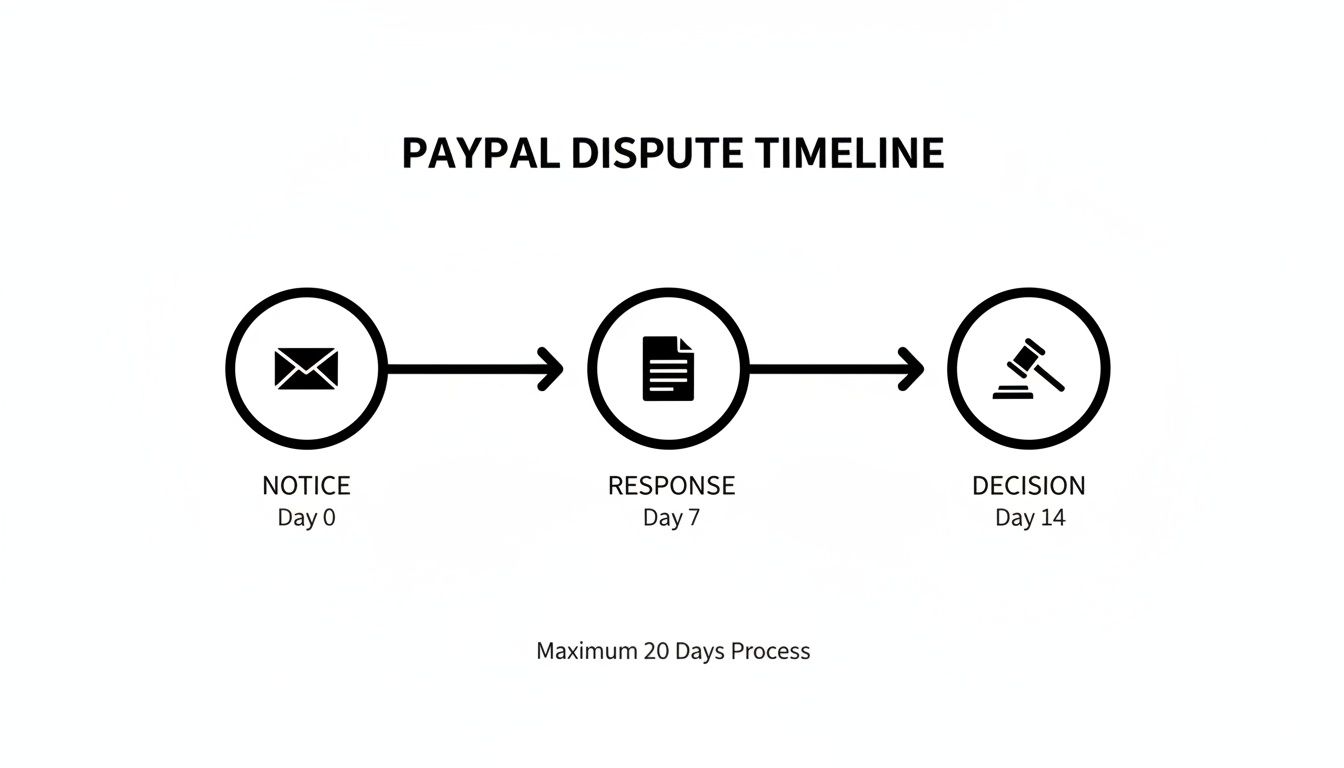
As you can see, that response window is where the action is. It's your moment to step up and defend the sale to avoid an automatic loss.
Navigating the Final Decision and Appeals
Once PayPal has reviewed everything, they'll issue a decision. If they rule in your favor, the case is closed, and the funds are released back to you. But if they side with the buyer, the transaction is reversed. You lose the sale amount and you’re hit with a non-refundable dispute fee.
So what if you get a decision you don't agree with? You might have an option to appeal, but there's a catch: you need new, compelling evidence that you didn't include the first time around. You can’t just resubmit the same documents and hope for a different outcome. An appeal really only makes sense if you’ve uncovered a game-changing piece of proof you didn’t have before, like a delivery confirmation with a signature that just became available.
This structured, time-sensitive process is something merchants need to get used to. We're in the middle of a global chargeback crisis, with worldwide chargeback volume projected to soar from 238 million to 337 million. This is being fueled by customers who are more comfortable than ever with filing disputes, sometimes for clear cases of "friendly fraud." You can find more data on this trend over at Chargeflow.io. In this environment, mastering the dispute timeline is your best line of defense.
Automating Your Dispute Responses for Better Results
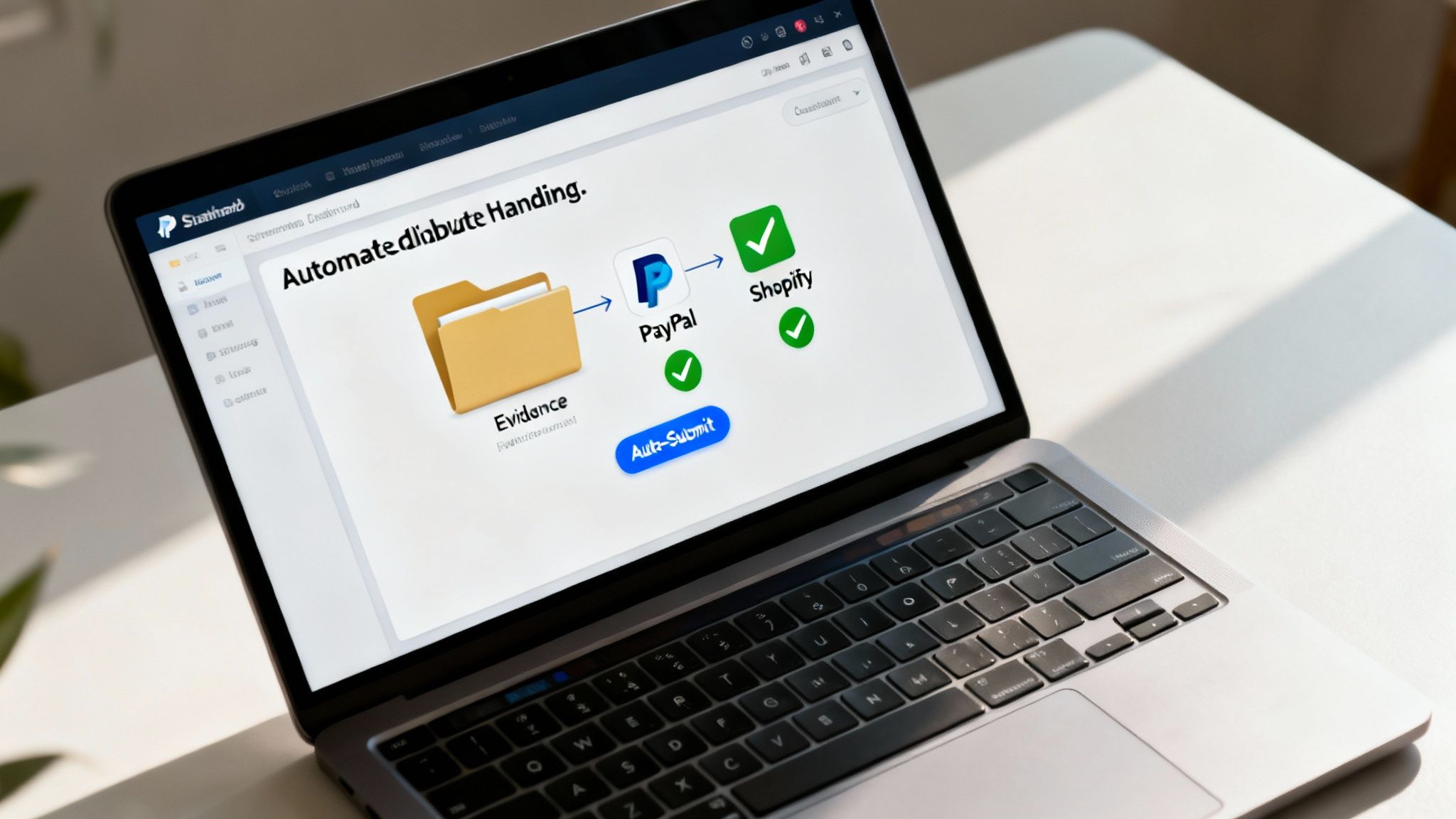
As your business grows, manually fighting every dispute transaction paypal becomes a huge bottleneck. What started as a manageable task can quickly spiral into a full-time job, forcing you to constantly dig through records and race against deadlines.
That manual grind isn't just inefficient; it's unsustainable. When you're stuck handling each case by hand, you're not focusing on what really matters—marketing, product development, or customer experience. At a certain point, automation isn't just a nice-to-have; it's essential for protecting your time and your revenue.
How Automation Changes the Game
Imagine a system that works around the clock, instantly responding to new disputes without you ever having to log in to PayPal's Resolution Center. That's the power of modern dispute automation. Instead of you piecing together an evidence file from scratch, these systems do all the heavy lifting.
Tools like ChargePay are built to take over this entire manual workflow. By connecting directly to your PayPal account and e-commerce platform, the AI springs into action the moment a dispute is filed.
Here’s what it does automatically:
- Gathers Evidence Instantly: The system pulls all the crucial data—order details, shipping confirmations, tracking numbers, and customer communication logs.
- Identifies the Dispute Type: It analyzes the claim to figure out if it's an "Item Not Received," "Significantly Not as Described," or something else.
- Generates a Custom Response: Using this info, the AI crafts a compelling, evidence-backed rebuttal letter tailored to exactly what PayPal needs to see.
- Submits on Your Behalf: The complete evidence package is sent directly to PayPal, well before the deadline, ensuring you never lose a case just because you missed the window.
This shift from manual reaction to automated action allows growing businesses to fight every single dispute effectively, not just the high-value ones. For more on this, you can learn about general marketing automation strategies.
The Clear Benefits of an Automated Approach
Switching to an automated solution for your PayPal disputes delivers results you can see almost immediately. The biggest benefit, of course, is a major boost in your win rate. AI-powered systems are trained on thousands of dispute cases and know precisely what evidence PayPal reviewers look for to rule in your favor.
By leaning on automation, merchants can recover up to 80% of their disputed revenue. This transforms the entire dispute process from a frustrating cost center into a recoverable revenue stream.
But it’s not just about winning more often. It’s about reclaiming your most valuable asset: time. Think about the hours you currently sink into each dispute transaction paypal. Now, imagine reallocating all that time toward activities that actually grow your business. That's the freedom automation gives you.
Making a Smarter, Scalable Choice
At the end of the day, handling disputes manually is a strategy with a ceiling. As your sales grow, so will your disputes. An automated system scales right alongside you, making sure your business is protected no matter how fast you expand. You can learn more about how this technology works in our complete guide to automated chargeback and dispute management using AI.
The choice becomes pretty clear. You can either keep pouring time and resources into a manual process with hit-or-miss results, or you can implement a smart, scalable solution that protects your profits and lets you get back to what you do best.
Common Questions About PayPal Disputes
Even with the best preparation, some situations are just plain confusing. When you're in the thick of a frustrating PayPal dispute, you don't need jargon—you need answers that work. Here are some of the most common questions I hear from merchants, along with straightforward advice from my experience on the front lines.
What Should I Do If I Suspect Friendly Fraud?
When your gut is screaming "friendly fraud," your evidence file is your best friend. Your goal is to build such a solid case that a reviewer has no other choice but to side with you.
First, pull together every piece of data that proves the purchase was legitimate. This means:
- Payment Verification: AVS (Address Verification System) and CVV match results are huge. They're strong proof that the actual cardholder made the purchase.
- Location Data: Show that the IP address used for the order matches the customer's shipping address or general location.
- Delivery Confirmation: This is an absolute must. You need undeniable proof of delivery to the exact address listed on the PayPal transaction. For anything valuable, spring for signature confirmation. It's worth it.
Next, it's time to play detective with your communication logs. Did the customer email you? Use your site's chat? Message you on social media? Look for anything where they acknowledge getting the item, ask for setup help, or even say they like it. A simple screenshot of a customer saying, "Thanks, I got it!" can completely dismantle an "Item Not Received" claim.
When you submit your response, don't be shy. State clearly and professionally that you believe the claim is a case of friendly fraud. Lay out your evidence in a simple, step-by-step story. This not only helps you win but also helps PayPal flag accounts that repeatedly file bogus claims.
Can I Win a Dispute for a Digital Product?
You absolutely can, but you have to think differently about "proof of delivery." You won't have a tracking number, so your job is to prove the customer received and—even better—used the digital goods they purchased.
Your evidence for a digital product dispute will be completely different. Focus on collecting this kind of data:
- Server or Platform Logs: Show a successful download or access from the customer's specific IP address.
- Account Login History: Provide timestamps showing when the customer logged into their account to get their purchase.
- Usage Data: If it's software or a service, can you show they used certain features or spent time on the platform after the purchase?
- Customer Agreement: Always include a screenshot of your Terms of Service that the customer agreed to at checkout, especially the part that covers your no-refund policy for digital goods.
Putting together this digital paper trail is your version of a signed delivery slip. It proves the customer got exactly what they paid for.
How Many Disputes Are Too Many for My Account?
PayPal keeps a very close eye on your dispute rate—that's the percentage of your total transactions that turn into a dispute. While there isn't one single "magic number" that triggers an account review, the general industry benchmark is to stay below a 1% dispute rate.
Going over that 1% threshold consistently is a huge red flag for PayPal. It tells them something might be wrong with your products, shipping, or customer service. A high dispute rate can lead to some pretty serious consequences for your business.
Penalties can start with having a portion of your funds held in a reserve to cover future losses. From there, it can escalate to higher processing fees or, in the worst-case scenario, having your account permanently limited or even shut down entirely. This is exactly why fighting every single winnable dispute is so important for the long-term health of your account.
Is It Worth Fighting a Low-Value Dispute?
I get it. You see a $15 dispute, think about the $20 dispute fee and the time it'll take, and your first instinct is to just let it go. In the short term, that might seem like the smart financial move. But believe me, it's a dangerous long-term habit.
Fighting every dispute, even the small ones, sends a message to fraudsters that you aren't an easy mark. Scammers often test the waters with small purchases before trying to hit you with a big one. If they get a fight on a small charge, they'll likely move on to an easier target.
More importantly, every dispute you lose—no matter how small—dings your overall dispute rate. Letting those little claims slide can slowly but surely push your rate into the danger zone. A lot of questions about PayPal disputes touch on the core financial mechanics. For example, knowing how refunds are processed for cancelled credit cards can give you insight into how payment reversals work in general. This is where an automated solution can be a lifesaver. It fights these battles for you, protecting your account without eating up your valuable time.
Don't let PayPal disputes drain your revenue and time. ChargePay uses AI to automate the entire process, from gathering evidence to submitting winning responses, helping you recover up to 80% of your lost funds. Stop losing money and start winning disputes with ChargePay today.


.svg)



.svg)


.svg)
.svg)
.svg)