

If you’re an online merchant, seeing a dispute notification isn't a matter of if, but when. The whole process kicks off the moment a customer flags an issue with their purchase, opening a case right in PayPal's Resolution Center. Getting to the bottom of why these disputes happen is the absolute first step to protecting your revenue and your hard-earned reputation.
Why PayPal Disputes Really Happen
Every merchant gets that dreaded PayPal dispute email eventually. It can feel like a direct hit to your bottom line because, in many ways, it is. You're not just looking at a lost sale—you're also dealing with non-refundable dispute fees, the time sucked into building a case, and the potential risk to your account's good standing.
The key is to look past generic labels like "unauthorized transaction" and see the real story behind the claim.
At its core, a dispute is just a disagreement that needs sorting out. It could be a simple misunderstanding, a legitimate customer service hiccup, or something more calculated. Knowing the difference is your first line of defense.
Common Triggers Behind the Claims
The reasons customers file disputes are often more tangled than they first appear. A buyer might claim an item never arrived when, in reality, a porch pirate snagged it after delivery. Another might choose "Item Not as Described" because of simple buyer's remorse, not an actual product flaw.
These situations usually fall into a few familiar buckets:
- Legitimate Service Issues: This is when something genuinely goes wrong on your end. Maybe you shipped the wrong size, the item got damaged in transit, or it showed up weeks late. These are often the easiest to resolve with good, clear communication.
- 'Friendly Fraud': This one is a massive headache for merchants. It’s when a customer buys something, receives it, and then files a dispute to get their money back. They essentially get your product for free.
- Outright Scams: These are less common but far more malicious. We're talking stolen credit cards or full-on account takeovers. The transaction was never legitimate to begin with.
The financial toll of these issues is staggering. Merchants around the world face an average of 679 disputes every month. This adds up to an estimated $3.7 million in annual losses per merchant from fraudulent online sales alone. Buyer's remorse is a huge driver, fueling 65.3% of cases, while friendly fraud makes up another 60.9%.
The True Cost of a Dispute
Winning or losing a single case is just one piece of the puzzle. Every dispute filed against you dings your dispute rate—a key metric PayPal uses to gauge your account's risk level. If that rate climbs too high, you could be looking at higher fees or even account limitations.
To really get a handle on what’s driving a dispute and build a stronger defense, you need to understand your own policies inside and out. For instance, mastering contract interpretation principles can help you articulate why your terms of service or product descriptions are crystal clear and binding.
It also helps to understand the different reasons for a chargeback, as they often mirror the motivations behind PayPal disputes. This knowledge is the foundation of a solid strategy, and it’s essential for protecting your business.
Your Game Plan for a New PayPal Dispute
Seeing that "dispute opened" email from PayPal can definitely ruin your morning. But panicking won't help you win. The key is to take a breath and approach it with a clear, strategic plan. Think of this process not as a fight, but as a negotiation where you need to present your side calmly and professionally.
This guide will walk you through the entire workflow, from the moment you get that notification to PayPal's final decision. We'll cover how to use the Resolution Center, understand the critical difference between a "dispute" and a "claim," and show you how to respond effectively before the clock runs out.
The journey from a successful sale to a financial loss can happen fast if you aren't prepared.
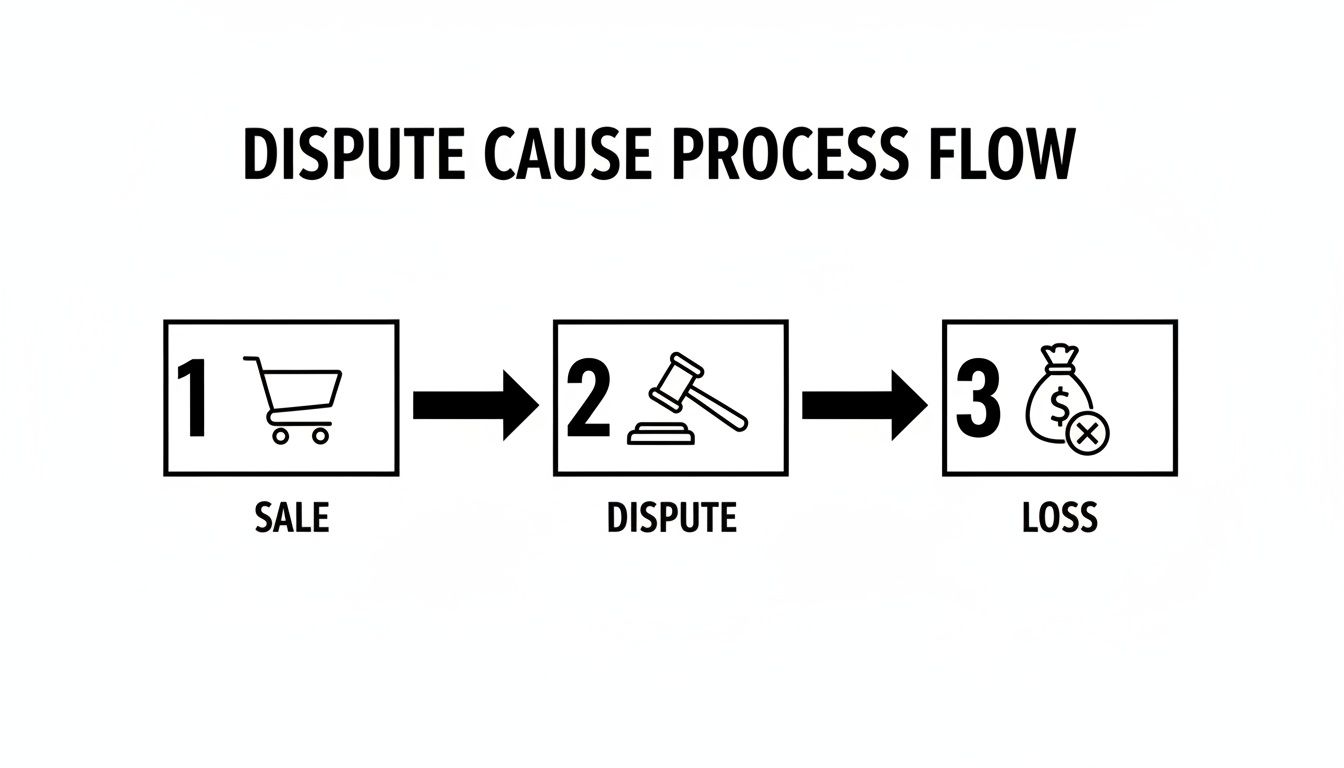
As you can see, a simple dispute can quickly spiral into lost revenue. Your job is to step in and break that chain with a solid, evidence-backed response.
First Moves When a Dispute Hits
Time is not on your side here. PayPal usually gives you just 10 days to respond to the initial dispute. If you miss this deadline, you've pretty much handed the win to the buyer. Acting fast is non-negotiable.
Your first stop should always be the PayPal Resolution Center. This is your command center for managing the entire case, from start to finish. It’s where you’ll communicate with the buyer and, if it comes to it, with PayPal’s review team.
Once you’ve opened the case, you need to quickly figure out what you're up against. Is it an "Item Not Received" (INR) situation? Or is the buyer claiming the product is "Significantly Not as Described" (SNAD)? The buyer's specific reason dictates your entire evidence-gathering strategy.
Pro Tip: Before you do anything else, review the original transaction details. Double-check the shipping address, the item purchased, and any special notes the buyer included. Sometimes, the root of the problem is a simple misunderstanding you can clear up in minutes.
Navigating the Dispute vs. Claim Stages
It’s absolutely crucial to understand the difference between a "dispute" and a "claim." They sound similar, but they represent two very distinct phases of the process.
- The Dispute Phase: This is the first stage. Think of it as an informal negotiation between you and the buyer, moderated through the Resolution Center. A quick message with tracking information or an offer to replace a damaged part can often resolve the issue right here, without PayPal needing to get involved.
- The Claim Phase: This is what happens when you and the buyer can't work it out. Either of you can choose to escalate the dispute to a claim. At this point, PayPal steps in to act as the judge and jury. You'll stop talking to the buyer and start submitting formal evidence directly to PayPal. This is where your case is officially won or lost.
Your primary goal should always be to solve the problem during the dispute phase. It’s faster, less stressful, and it helps you avoid the $15 standard dispute fee (which can be higher for high-volume merchants) that PayPal charges the moment a case becomes an official claim.
Communicating with the Buyer
When you send that first message in the Resolution Center, keep it professional, polite, and stick to the facts. Don't get emotional or accusatory, even if you’re 100% sure you’re dealing with fraud. An angry message will only escalate the situation and could easily work against you if a PayPal agent has to review the case later.
Here’s a solid example of a good first response:
"Hello [Buyer's Name], I’m sorry to hear there was an issue with your order for [Product Name]. I've reviewed your case and see you're concerned about [mention the specific issue]. According to our records, the package was delivered on [Date] via [Carrier] with tracking number [Tracking Number]. Could you please confirm if you've checked with others in your household or your local post office? We're here to help sort this out."
This message hits all the right notes: it’s empathetic, provides immediate evidence, and opens the door for a constructive conversation. To learn more about managing these cases, check out our in-depth guide to the PayPal Dispute Resolution Centre.
By treating the dispute notification as a customer service opportunity rather than an attack, you set a positive tone from the start. This approach not only increases your chances of resolving things amicably but also builds a stronger case for you if it does escalate. Having a clear, proactive game plan is the best defense for your business.
How to Build a Winning Evidence File
Winning a PayPal dispute isn't about who tells the better story—it's about who presents the better facts. When a claim gets escalated, the PayPal review team isn't interested in emotions or long-winded explanations. They want cold, hard evidence.
Frankly, submitting a messy or incomplete evidence file is the fastest way to lose your money, even when you're completely in the right.
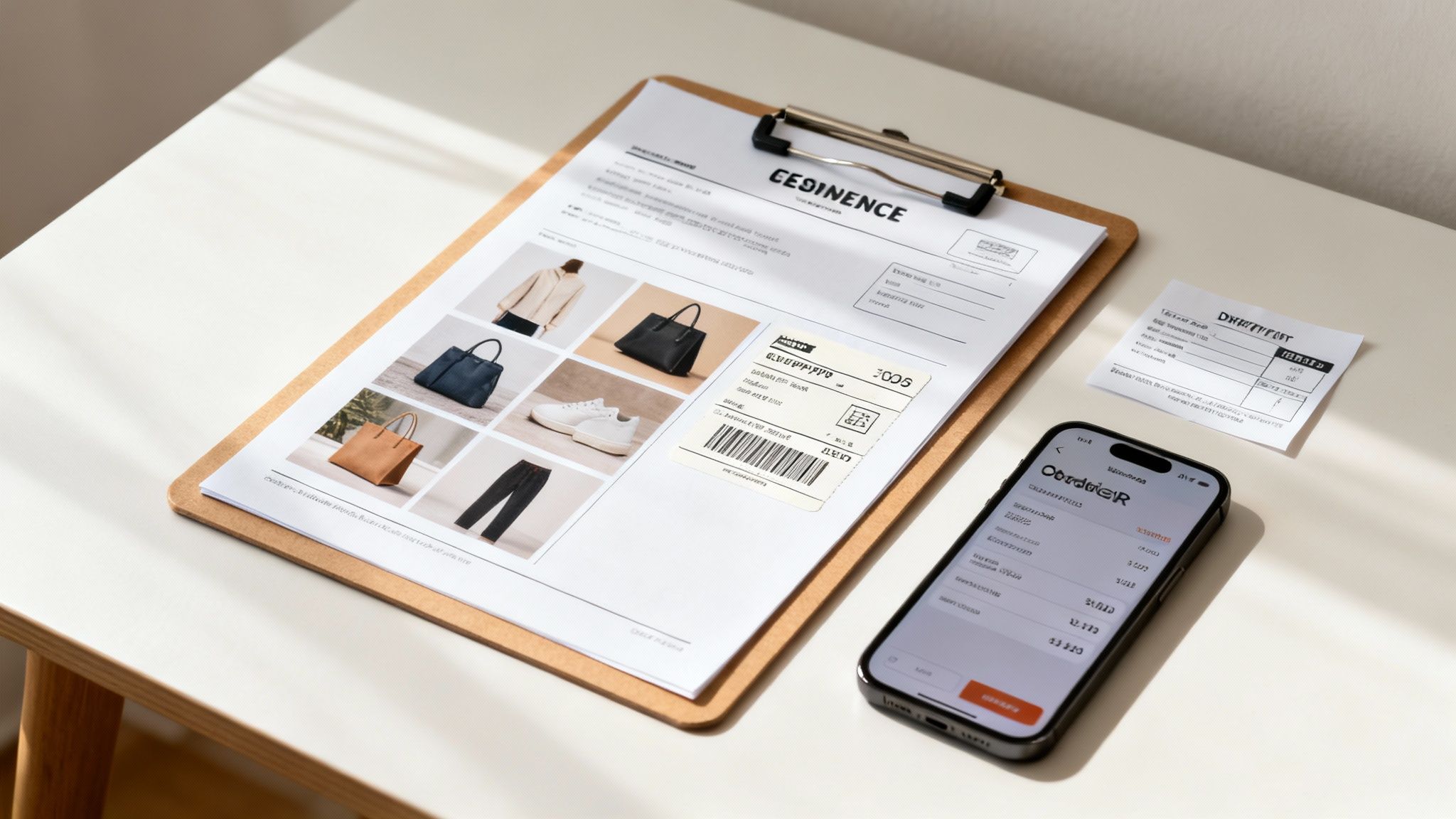
Think of yourself as a detective building a case. Every shipping label, every customer email, every product photo is a piece of the puzzle. Your job is to assemble these pieces into a clear, undeniable narrative that leaves no room for doubt.
Tailoring Evidence to the Dispute Type
A one-size-fits-all approach to evidence is a recipe for disaster. The proof you need for an "Item Not Received" (INR) claim is worlds apart from what you'd gather for a "Significantly Not as Described" (SNAD) case.
For an INR claim, your entire focus is on proving one thing: the item successfully reached the buyer's address. Your shipping documentation is your star witness here.
On the other hand, a SNAD claim is more about perception. You need to prove that the item you sent perfectly matched the product description the customer saw when they clicked "buy." It's a game of demonstrating total transparency.
To make this crystal clear, here’s a quick-reference table outlining the must-have documents for each dispute type.
Evidence Checklist for Common Dispute Types
This checklist should be your starting point. Always think from the perspective of a third-party reviewer—what would you need to see to be convinced?
Your Go-To Checklist for Item Not Received Claims
When a customer claims their package vanished into thin air, you need to show its journey from your warehouse to their front door. Simply dropping a tracking number into the case file isn't enough. You need to paint the full picture.
Here’s what you absolutely must include:
- Proof of Shipment: This means more than just a tracking number. Upload a crisp image of the shipping label showing the buyer's address, ensuring it perfectly matches the address on their PayPal transaction.
- Live Tracking Information: Provide a direct, clickable link to the carrier’s tracking page. A screenshot is okay as a backup, but a live link is always more convincing.
- Proof of Delivery: This is the linchpin of your case. The tracking status must explicitly say "Delivered." If it's still stuck on "In Transit" or "Out for Delivery," your odds of winning plummet.
- Signature Confirmation: For any order over $750, PayPal flat-out requires signature confirmation to qualify for Seller Protection. It’s the ultimate proof that a human being at that address accepted the package.
Key Takeaway: For INR disputes, your evidence must create an unbreakable chain of custody. It needs to show the item was shipped to the correct address and that a trusted third-party carrier confirms it was delivered. Anything less leaves the door wide open for PayPal to side with the buyer.
Building Your Case for Not as Described Claims
SNAD claims can feel personal, often boiling down to the customer's opinion versus your product listing. Your mission here is to prove that you set clear and accurate expectations from the very beginning.
Your SNAD evidence file should be packed with the following:
- High-Quality Product Photos: Include the exact photos from the product listing the buyer viewed. If you happen to have photos of the actual item being packed and shipped, that’s even better.
- The Original Product Description: Don't just copy and paste the text. Provide a screenshot or a PDF of the entire product page. Be sure to highlight the description, dimensions, materials, and any notes about the item's condition (especially for refurbished or used goods).
- Customer Communications: This is a goldmine. If the buyer emailed you with questions before the purchase, include that thread. If they messaged you after delivery—before opening a dispute—that is crucial. Their initial feedback can sometimes contradict the formal claim they file later.
- Proof of Your Policies: A screenshot of your return policy can be a powerful tool. If your policy clearly states, "color may vary slightly from screen to screen," and the buyer's complaint is about a minor color difference, you have a much stronger argument.
The best way to present all this information is with a clear, concise rebuttal letter that walks the reviewer through your evidence. A well-organized summary can make all the difference to a busy PayPal agent.
Handling International Sales and Cross-Border Disputes
Selling your products to customers around the globe is a fantastic way to grow your business, but it definitely adds a few twists when you're disputing a PayPal transaction. What would be a simple domestic shipping issue can quickly become a complex international puzzle involving customs, different carriers, and even language barriers.
Successfully navigating these cross-border disputes means you have to be extra diligent. The rules of the game change once a package leaves the country, and your standard proof of delivery might not be enough to win your case.
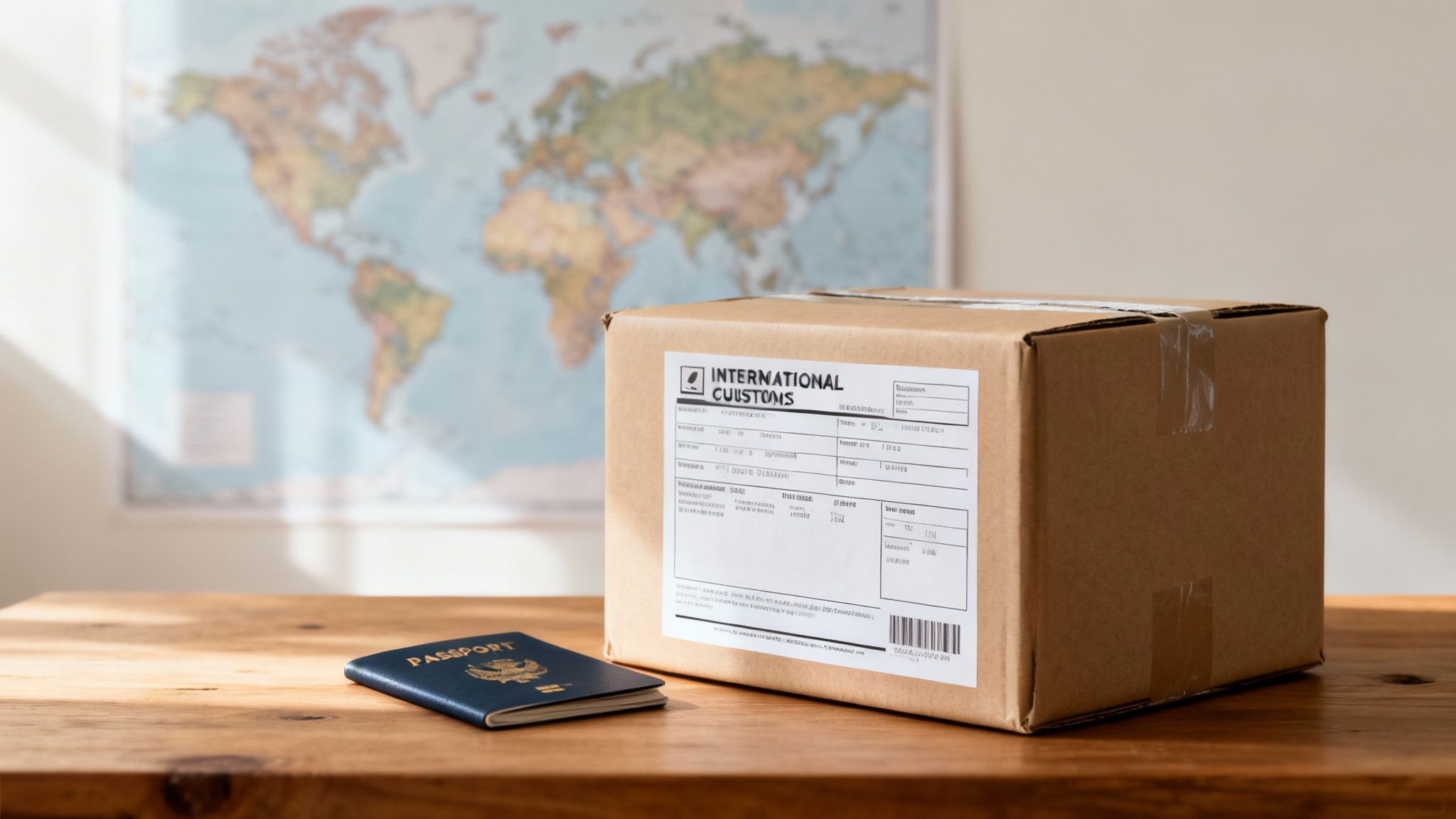
Why International Disputes Get Complicated
When a dispute arises from an international sale, you're not just dealing with the buyer and PayPal anymore. Suddenly, you're at the mercy of multiple shipping companies, customs agencies in two different countries, and potential communication gaps.
It's common for a package to sit in customs for weeks, leading a frustrated buyer to file an "Item Not Received" claim long before it even has a chance to be delivered. This is where your evidence needs to be absolutely ironclad.
These challenges contribute to a much higher rate of payment issues for merchants selling abroad. In fact, across PayPal's network of 200 markets, US merchants with significant overseas sales can see transaction failure rates as high as 11%—a figure that towers over domestic levels. It all comes down to the fact that customer dispute habits and payment systems vary so much from one country to another. You can discover more insights about these PayPal statistics on Paycompass.
Non-Negotiable Tracking and Customs Clarity
For any order heading overseas, basic tracking just doesn't cut it. You need true end-to-end visibility that shows the package's entire journey across borders. A classic pitfall is when your primary carrier hands the package off to a local postal service in the destination country. You absolutely must make sure you have the new, local tracking number.
Here’s what you need for every single international shipment, no exceptions:
- Comprehensive End-to-End Tracking: Only use a shipping service that provides a single tracking number that works all the way to the customer's doorstep.
- Accurate Customs Declarations: Always fill out customs forms accurately and honestly. Declaring a lower value to save the customer a few bucks on duties might seem like a nice gesture, but it can backfire spectacularly in a dispute if the declared value doesn't match the transaction amount.
- Proof of Customs Clearance: If a package gets stuck, providing documentation that shows it has cleared customs in the buyer's country is huge. This proves the delay is out of your hands and shifts the focus to the local delivery service.
Expert Tip: Be proactive with your international buyers. As soon as you ship, send them a quick note explaining that customs can sometimes cause delays. Give them all the relevant tracking and customs information upfront. This small step can prevent a ton of disputes before they even start.
Proactive Strategies to Lower Your Risk
Defending a cross-border dispute is always tougher than a domestic one, so your best strategy is prevention. Being proactive not only reduces your risk but also builds a massive amount of trust with your global customer base.
Start by making your international shipping policies crystal clear. Explicitly state average delivery times for different regions and include a disclaimer about potential customs delays. This helps manage buyer expectations from the moment they click "purchase."
You should also take the time to fully understand the nuances of the PayPal chargeback policy. International transactions can sometimes skip the PayPal dispute process and go straight to a bank-level chargeback, which is a whole different ballgame.
By treating every international order with an extra layer of care and documentation, you can confidently expand your business without letting the fear of complex disputes hold you back.
Proactive Ways to Prevent Future Disputes
Winning a dispute is a relief, but preventing one in the first place is the real victory. While you can't avoid every single PayPal dispute, shifting your focus from reactive defense to proactive prevention will save you countless hours, fees, and headaches down the road.
Think of your business operations as a chain. A weak link anywhere—from your product photos to your shipping updates—can create an opening for a misunderstanding that snowballs into a formal dispute. Your best defense is to strengthen every single link.
Clarity Is Your Best Insurance
Many "Significantly Not as Described" disputes don't come from a faulty product. They come from a gap between what the customer expected and what they received. Your job is to close that gap with extreme clarity.
Write Crystal-Clear Product Descriptions: Go beyond the basics. Include precise dimensions, materials, and any unique quirks. Selling a vintage item? Mention "minor wear consistent with age." For clothing, provide a detailed size chart and specify the fabric blend.
Use High-Quality, Honest Photos: Show your products from every angle you can think of, all in good lighting. If a product has a common variation or a small, known imperfection, get a picture of it. This builds trust and stops buyers from feeling like you pulled a fast one on them.
Set Realistic Shipping Expectations: Be upfront and honest about your shipping timelines. If you know international orders can take up to four weeks, say so. A simple disclaimer can prevent a lot of "Item Not Received" claims that are really just cases of impatience.
Leverage Customer Service as a Shield
Excellent customer service is your most powerful de-escalation tool. A friendly, quick response can solve a small problem long before a customer even thinks about hitting the "dispute" button in their PayPal account.
Get ahead with your communication. Beyond just sending an order confirmation, adhering to transactional email best practices can make a huge difference. Things like automated shipping updates keep buyers in the loop and cut down on their anxiety.
Make your contact info impossible to miss on your site. If a customer can shoot you an email and get a helpful reply in a few hours, they have almost no reason to take the issue to PayPal.
Use PayPal Seller Protection to Your Advantage
PayPal's Seller Protection program is a fantastic safety net, but you have to use it correctly—it isn't automatic. To qualify, you have to nail a specific set of requirements for every single transaction.
There are two golden rules you absolutely must follow:
- Ship to the Right Address: You must ship the item to the exact address shown on the PayPal Transaction Details page. No exceptions, no changes.
- Maintain Proof of Delivery: For physical goods, you need online-viewable tracking from a valid carrier that clearly shows the item was delivered.
Understanding and following these rules is non-negotiable. This program is your built-in defense against two of the most common disputes: "Unauthorized Transaction" and "Item Not Received."
Ultimately, the goal is to build a business that's so transparent and reliable that disputes are a rare event. Automation and AI are helping manage the load—for instance, in 2025, PayPal's AI-powered resolution tools successfully handled over 1.5 million disputes—but prevention is always the best strategy. This is especially true when you consider that merchants can lose nearly 30 hours a month just dealing with disputes manually.
By focusing on clear communication and solid business habits, you can build a more secure and profitable operation. For a deeper dive, you might want to check out our guide on how to prevent chargebacks on PayPal.
Common Questions About PayPal Disputes
Diving into the world of PayPal disputes can feel like learning a whole new language. You've got to get the terminology down, hit your deadlines, and know exactly what your rights are as a merchant.
Let’s clear up some of the most common questions we see from business owners. Getting these fundamentals right is often the difference between getting your money back and writing off a loss.
How Long Do I Have to Respond to a PayPal Dispute?
Time is absolutely critical here. Once a buyer opens a dispute, you generally have just 10 days to respond in the Resolution Center. This is your first—and best—chance to talk directly with the customer and hopefully sort things out before PayPal has to get involved.
If you can't reach an agreement and the buyer escalates the dispute to a formal claim, a new clock starts. PayPal will give you another deadline, usually around 10 days, to submit all your evidence for their official review.
Crucial Reminder: Missing these deadlines is the fastest way to lose a case. If a merchant doesn't respond in time, PayPal often rules in the buyer's favor by default. Treat these timelines as non-negotiable.
What Is the Difference Between a PayPal Dispute and a Chargeback?
This is a huge point of confusion for a lot of merchants, but the distinction is incredibly important.
A PayPal dispute is handled entirely within PayPal’s own system. The buyer kicks things off in the Resolution Center, and PayPal plays the role of mediator and, if it escalates, the judge.
A chargeback, on the other hand, is what happens when the buyer skips PayPal entirely and goes straight to their credit card company or bank to reverse the charge. This process is governed by the card network's rules (think Visa or Mastercard), not PayPal's, and almost always comes with higher fees for you.
To put it simply:
- PayPal Dispute: A case opened and resolved on the PayPal platform.
- Chargeback: A payment reversal started by the buyer's bank or credit card issuer.
From my experience, chargebacks are much tougher for merchants to win. The final say rests with an outside financial institution that has its own evidence requirements and often sides with its cardholder.
Can I Appeal if I Lose a PayPal Claim?
Yes, but the window is small and the requirements are strict. You have 10 days from the day the case is closed to file an appeal, but here's the kicker: you can only appeal if you have new, compelling information that wasn't available during the initial review.
Simply disagreeing with PayPal's decision won’t cut it. You need to bring something new to the table that could genuinely flip the outcome. A great example would be a tracking number that finally updated to "Delivered" after the case was closed, or a new email from the buyer admitting they received the item.
Does PayPal Seller Protection Cover Every Transaction?
Absolutely not, and this is a critical detail to understand. PayPal Seller Protection is a fantastic safety net, but it's not a catch-all. It has very specific rules for what it does and doesn't cover.
Seller Protection primarily has your back for two types of claims:
- Unauthorized Transaction: The buyer claims they never authorized the purchase in the first place.
- Item Not Received (INR): The buyer claims you never shipped their order.
To qualify for protection, you must ship the item to the exact address shown on the Transaction Details page and have valid proof of shipment or delivery.
However, Seller Protection does not cover "Significantly Not as Described" (SNAD) claims. It also usually excludes digital goods, services, and items picked up in person. Always double-check PayPal’s latest policy to make sure your sales are eligible.
Manually fighting PayPal disputes takes you away from what you should be doing: growing your business. ChargePay uses AI to automate the entire representment process, building evidence-packed responses to help you recover revenue effortlessly. Stop letting illegitimate claims eat into your profits. See how ChargePay can protect your revenue today.


.svg)



.svg)


.svg)
.svg)
.svg)