

On the surface, a no refund policy seems simple: once a customer buys something, the sale is final. No returns, no money back. But in the real world of e-commerce, it's never that black and white. These policies are always bumping up against consumer protection laws and the rules set by payment processors, which can often override a merchant's own terms.
Why 'Easy Returns' Are No Longer Easy for Merchants
Remember when "easy, no-questions-asked returns" was the ultimate marketing hook? It was a fantastic way to build trust with online shoppers and get them to click 'buy' without hesitation. Fast forward to today, and that same promise has morphed into a massive financial and logistical nightmare for countless online stores.
This isn't just merchants deciding to be difficult. It's a necessary reaction to how much e-commerce has changed. The truth is, generous return policies are being exploited more and more, and the skyrocketing return rates are squeezing profit margins dry, forcing businesses to rethink everything.
The Growing Problem of Returns and Abuse
For so many store owners, what began as a customer-friendly perk has become a major source of loss. It boils down to two things: the sheer volume of returns and straight-up abuse. We’ve all heard of "wardrobing"—where someone buys an outfit, wears it once, and sends it back. Or customers ordering multiple sizes of the same shoe, knowing full well they'll only keep one. Each of these returns chips away at your bottom line.
Think about the hidden costs:
- Shipping Expenses: If you're covering return shipping, those costs add up shockingly fast.
- Processing and Restocking: Someone on your team has to spend time inspecting the item, repackaging it, and putting it back into inventory.
- Damaged Goods: A depressing number of returned products come back in less-than-perfect condition, meaning they can't be sold as new—if they can be sold at all.
Beyond these typical headaches is the more deliberate problem of refund abuse, where people intentionally game the system for their own gain. To really get a handle on this, you can dig into the common reasons for returns, which range from legitimate product issues to outright fraudulent claims. This constant financial pressure is why a no refund policy has become a strategic necessity for survival, not just a simple preference.
We're seeing a major shift in e-commerce. The era of limitless, free-for-all returns is drawing to a close. It's being replaced by a more realistic, sustainable model where businesses have to protect themselves from losses they simply can't afford.
A Strategic Shift to Protect Your Business
Putting a firm—but fair—policy in place is now a crucial part of running a healthy online business. It acts as a filter, discouraging serial returners and lightening the operational load on your team. It’s a way of saying that while you absolutely value your customers, you also have to value the long-term health and sustainability of your business.
For a wider look at the challenges merchants face with returns and shifting customer attitudes, you can explore more merchant insights and discussions. Ultimately, a well-thought-out no refund policy sets clear expectations right from the start, building a more transparent and stable foundation for you to grow on.
What You Can and Cannot Do with a No Refund Policy
Thinking you can just slap an "All Sales Final" banner on your website and call it a day? It's not quite that simple. A no refund policy isn't some magical shield that makes you immune to consumer laws or the rules of platforms you sell on. It’s more like setting house rules for a game where other players—like governments and payment processors—have their own rulebooks that can trump yours.
The hard truth is that a blanket "no refunds, no exceptions" policy is often unenforceable and can get you into hot water fast. Your policy has to be built on a solid foundation of what’s legally allowed and what your sales platforms demand.
Understanding Your Legal Obligations
First things first: consumer protection laws exist to make sure customers aren't stuck with faulty or misrepresented products. In the United States, for example, there's no federal law forcing businesses to accept returns. However, many states have their own rules you absolutely must follow.
A common thread in states like California, New York, and Florida is transparency. If you have a no refund policy, you’re generally required to post it somewhere obvious. Fail to make your policy clear and easy to find before a customer buys, and the state's default rules often kick in—which typically favor the customer.
This means if a customer can prove they never saw your policy, a court or payment processor might decide it doesn't apply to their purchase. Hiding your terms in the fine print is a recipe for losing disputes.
Bottom line, consumer rights almost always guarantee a fix if a product is:
- Defective or Damaged: The item arrived broken or just doesn't work.
- Not as Described: The customer got something wildly different from what your product page promised.
- Never Delivered: The package never made it to their doorstep.
In these situations, your "final sale" rule is pretty much out the window. You're legally on the hook to make it right, whether that means a replacement, a repair, or a full refund.
The sheer scale of returns shows why these policies are under such a microscope. In 2023, U.S. retailers processed a mind-boggling $743 billion in returned merchandise. To make matters worse, return fraud accounted for $101 billion of that loss. For every $100 in returns, merchants lost $13.70 to scams like "wardrobing" (returning used, non-defective items).
This decision tree can help you visualize when a stricter policy might be the right move for your business.
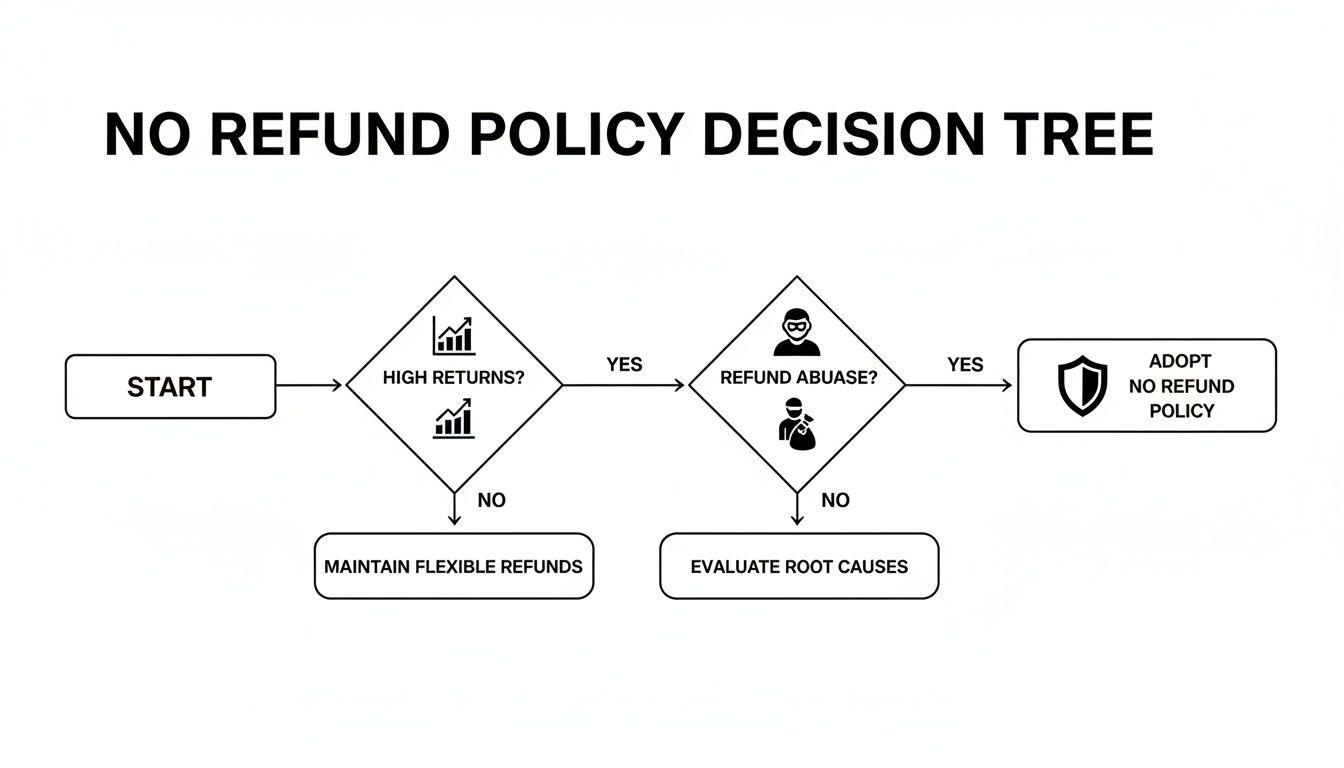
As the flowchart shows, if you're dealing with consistently high return rates or obvious patterns of refund abuse, it's a strong signal that you need a well-defined no refund policy to protect your bottom line.
Navigating Platform-Specific Rules
Beyond the law, you have another set of rules to play by: the ones set by your payment gateways and e-commerce platforms. Companies like Shopify, Stripe, and PayPal have their own buyer protection programs that can, and often do, override your store's policy.
For instance, PayPal's Buyer Protection gives customers up to 180 days to open a dispute if an item is "significantly not as described" or never arrives. Even with a crystal-clear no refund policy on your site, PayPal will likely side with the buyer if their claim is valid under its terms. For a deeper dive, our guide on creating a Shopify refund policy breaks down the platform-specifics.
The same idea applies to credit card chargebacks. A customer who feels they’ve hit a dead end can go straight to their bank to dispute the charge. If you can’t provide compelling evidence that you delivered the product as promised and made your policy clear, you’re very likely to lose that dispute. Your policy is only as strong as the proof you have to back it up.
The Real Risks of a Bad No Refund Policy
Rolling out a strict return policy without a solid game plan can cause more headaches than it solves. While you're trying to protect your bottom line, a poorly handled no refund policy can seriously backfire and end up costing you a whole lot more.
The most immediate and painful hit? A huge spike in chargebacks.
When customers feel like their backs are against the wall—they're unhappy, you've said "no" to a refund—they don't just walk away. They march straight to their bank or credit card company to dispute the charge. And that one move kicks off a process far more damaging than a simple refund ever could be.

From Denied Refund to Costly Chargeback
A chargeback isn’t just a reversed payment. It comes packed with a non-refundable dispute fee, usually somewhere between $20 to $100, which you have to pay whether you win or lose the fight. All of a sudden, the cost of that "final sale" item has doubled or even tripled.
Put yourself in the customer’s shoes for a second. They feel ignored, frustrated, maybe even ripped off. Filing a chargeback becomes their only way out. This is a classic case of friendly fraud, where a real customer disputes a legitimate charge because of a service breakdown, like getting a refund request shot down.
A chargeback is a customer's nuclear option. It's a flashing red light that your customer service process has failed, forcing them to take the fight to a level you can't control.
When you lose the chargeback, you're out the product, the original payment, and the dispute fee. But even if you win, you’ve already sunk precious time and energy into gathering evidence and submitting a response. Multiply that by dozens or hundreds of disputes, and you can see how the financial and operational drain quickly becomes a massive problem.
Let's break down how a simple refund request can spiral into something much more expensive when it becomes a chargeback.
Refund vs Chargeback: The True Cost to Your Business
As you can see, the financial hit from chargebacks is just the tip of the iceberg. The damage to your brand's reputation can be far more severe and stick around for a long time.
The Ripple Effect on Your Reputation
An angry customer who feels they have no other options is a customer who is going to talk. And they won't be saying nice things.
- Negative Reviews: They’ll leave scathing one-star reviews all over your site, Google, Trustpilot, and anywhere else they can, warning other shoppers to stay away.
- Social Media Outrage: A single viral post on TikTok, X (formerly Twitter), or Facebook about their bad experience can reach thousands of potential customers in a matter of hours.
- Damaged Merchant Standing: Payment processors are always watching your chargeback ratio. If it creeps up too high, they can label you a "high-risk" merchant, which means higher processing fees or, in a worst-case scenario, shutting down your account entirely.
Look, refund abuse is a very real problem. The 2025 Global eCommerce Payments and Fraud Report found that 47% of merchants are seeing a rise in refund abuse, with some calling it their number one threat. But a knee-jerk, aggressive policy that just triggers chargebacks and public fury isn't the answer.
A no refund policy has to be a smart piece of your overall customer service strategy, not just a brick wall you put up. The real goal is to find that sweet spot: protecting your business from abuse while keeping your customers happy and preventing disputes from ever happening in the first place.
How to Write a Clear and Fair No Refund Policy
Alright, let's get into the practical side of things. Crafting a no refund policy that actually works is less about sounding like a lawyer and more about crystal-clear communication. A well-written policy is your best defense, protecting your business without making customers feel trapped or tricked. It's all about setting fair expectations right from the start.
Think of your policy as a friendly but firm instruction manual for your customers. If it’s confusing, complicated, or riddled with loopholes, you’re just asking for trouble. The goal here is to be direct, transparent, and leave absolutely no room for misinterpretation.
The Core Components of an Effective Policy
Every solid no refund policy needs to cover a few key areas. Leaving any of these out is like leaving a door unlocked—it just invites problems. Let's break down the essential building blocks you need to include.
First and foremost, your policy has to spell out exactly which sales are final. Ambiguity is your worst enemy here. Be incredibly specific about the types of products or situations where refunds are completely off the table.
Common categories for final sale usually include:
- Custom or Personalized Items: Anything made to a customer’s unique specs is a tough sell to anyone else.
- Digital Products and Downloads: Once someone has the file, there's no real way to "return" it.
- Clearance or Sale Items: These are almost always priced to move quickly, and making them final sale is standard practice.
- Perishable Goods: Obvious, but worth stating. Things like food or flowers can't be sent back.
- Intimate or Sanitary Products: For health and hygiene reasons, items like swimwear, earrings, or beauty products are typically final sale.
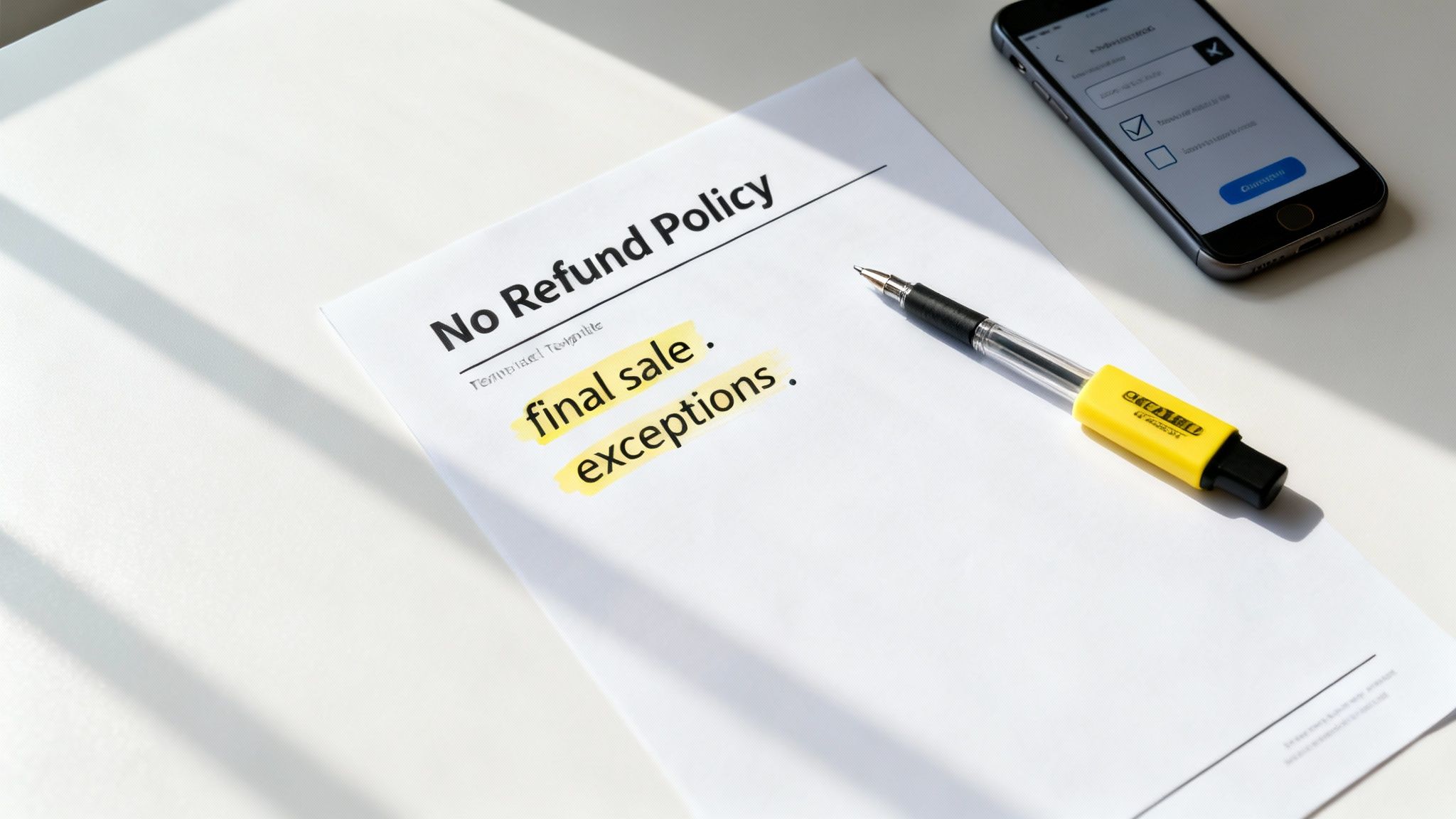
After you've defined what isn't refundable, you absolutely must clarify the exceptions. This is where fairness comes into play. No matter how strict your policy is, consumer protection laws will usually side with the buyer if the mistake is on your end.
A "no refund" policy is for buyer's remorse, not seller's mistakes. Always make it clear that you'll make things right if the fault is yours.
Your policy should promise a clear path to a solution for issues like:
- Damaged or Defective Goods: If an item shows up broken or simply doesn't work as it should.
- Incorrect Shipments: If you sent the wrong size, color, or a completely different product.
- Lost Shipments: If the package never makes it to the customer's doorstep.
For these situations, state exactly what the customer needs to do (e.g., "Contact us within 7 days of delivery with photos of the damage") and what you will offer in return (e.g., a replacement or a full refund). This builds trust and shows you stand behind your business.
Template A: Physical Goods No Refund Policy
Here’s a simple, adaptable template for a business selling physical products. Just remember to swap out the bracketed info with your own details.
Our Final Sale Policy
Thank you for shopping with [Your Company Name]! We believe in being completely transparent about our return policy.
What is Final Sale?All sales on the following items are final and cannot be returned or refunded:
- Custom-made and personalized products
- Items marked as "Clearance" or "Final Sale"
- [Add any other specific categories, e.g., Earrings, Swimwear]
Please take a moment to review your order carefully before checking out. By completing your purchase, you agree to these terms.
Exceptions for Damaged or Incorrect ItemsYour satisfaction is our priority. If your order arrives damaged, defective, or you received the wrong item, please get in touch with us immediately at [Your Support Email] within [# of Days, e.g., 7] days of receiving it.
To help us sort this out for you quickly, please include:
- Your order number
- A photo showing the damaged or incorrect item
- A brief description of the issue
We will arrange for a replacement or issue a full refund for any confirmed issues that were our mistake.
Template B: Digital Products No Refund Policy
Digital goods are a different beast, and your policy needs to reflect that. Here’s a template designed specifically for things like downloads, software, or digital services.
Our Digital Product Refund Policy
Due to the instant-access nature of our digital products, we have a strict no refund policy. Once a digital product is purchased and delivered, it cannot be "returned" in any traditional sense.
Please read all product descriptions carefully before making a purchase to ensure it fits your needs. By purchasing our digital products, you acknowledge and agree to this no refund policy.
ExceptionsWe are committed to our customers and will review issues on a case-by-case basis under these circumstances:
- Duplicate Purchase: If you accidentally bought the same product more than once.
- File Access Issues: If you're unable to download or access the file due to a technical error on our end.
If you run into any of these problems, please contact our support team at [Your Support Email] within [# of Days, e.g., 14] days of your purchase. Include your order details, and we'll work with you to find a solution.
Ultimately, writing a good policy is just one piece of the puzzle. How you communicate it and handle customer questions with care is just as important. For a deeper dive, you might find some great insights in these best practices in customer service to make sure your approach is both protective and customer-focused.
How to Communicate Your Policy to Customers
Having a rock-solid no refund policy is one thing, but how you communicate it is the real game-changer. If a customer only discovers your policy after they've hit the "buy" button, you're setting yourself up for a world of frustration and disputes. Effective communication isn't about hiding the rules in the fine print; it's about being transparent and making your policy impossible to miss.
The trick is to weave your policy into the natural flow of the customer’s shopping journey. You want them to see it, acknowledge it, and understand it before they ever commit. This simple, proactive step shuts down the classic "but I didn't know!" excuse that fuels so many chargebacks.
Make Your Policy Unmissable
To get this right, you need to be strategic. Don't just bury a link in your website's footer and call it a day. Think like a customer: Where do you look for information and reassurance right before making a purchase? That's where your policy needs to be.
Here are the most critical spots to display your no-refund rules:
- On Product Pages: A quick, clear note right under the "Add to Cart" button is incredibly effective. Something as simple as "Please note: This item is final sale and not eligible for a refund" does the job perfectly.
- During Checkout: This is your final, and most important, line of defense. Implement a mandatory checkbox that customers must tick to complete their payment. Pair it with a clear statement like, "I have read and agree to the no refund policy." This creates a digital handshake that can be invaluable if a dispute ever comes up.
- In a Website Banner or Header: Running a store-wide final sale? A bold banner at the very top of every page makes sure the message is front and center for every visitor.
- In Your FAQ Section: Dedicate an entire entry to explaining your policy in plain English. This is your chance to answer common questions before they even pop into a customer's head.
Equipping Your Customer Service Team
Even with crystal-clear communication, you'll still get customers reaching out with questions or complaints. This is where your customer service team becomes your most valuable asset. Their job is to uphold the policy with empathy, not aggression, turning a potentially negative interaction into a manageable one.
The goal here is to de-escalate, inform, and stay firm but fair. Giving your team clear guidelines and even a few simple scripts can empower them to handle these tricky conversations with confidence.
"Our policy is that all custom orders are final sale. While I can't process a refund, I can offer you a 20% discount on your next purchase as a thank you for your understanding. Let me explain why these items are non-refundable..."
This approach acknowledges how the customer feels while gently restating the policy and the logic behind it. It's a crucial skill, especially as return fraud continues to climb. With U.S. retail returns projected to hit a staggering $890 billion in 2024 and 93% of retailers worried about policy abuse, a firm yet fair process isn't just good practice—it's essential for survival. You can find more details about the challenges of retail returns on nrf.com.
Of course, some customers will react poorly no matter what you do, so knowing how to handle an angry customer is a vital skill for any support team. By pairing high visibility with empathetic support, you can make your no refund policy protect your business without burning your brand's reputation.
Protecting Your Policy from Unfair Chargebacks
Your well-written, clearly communicated no refund policy should be your first line of defense. But what happens when a customer ignores it, gets denied a refund, and files a chargeback anyway? This is the moment your policy needs to stop being a simple set of rules and become a powerful tool to protect your revenue.
Fighting these disputes is the critical next step. An illegitimate chargeback, often filed out of frustration, can make you feel completely powerless. The customer bypasses you entirely, going straight to their bank with a claim that might completely ignore the terms they agreed to when they clicked "buy."
The Manual Grind of Fighting Back
Once a dispute lands, the clock starts ticking. Suddenly, you’re on a scavenger hunt for evidence: screenshots of your policy, checkout logs showing the customer ticked the box, proof of delivery, and every email you exchanged. This manual process is a massive time sink, pulling you away from what you should be doing—running your business.
To make matters worse, the odds are often stacked against you. Banks tend to side with their cardholders, and if your manually compiled evidence is even slightly disorganized or incomplete, you're likely to lose. That means you’re out the revenue, the product, and you get slapped with a hefty chargeback fee for your trouble.
Simply having a policy isn't enough. You have to be able to prove the customer saw it, understood it, and agreed to it. This is the evidence that turns a losing battle into a winnable one.
Automating Your Defense for Better Results
This is where an automated solution becomes a game-changer for any business serious about protecting its income. Instead of scrambling to pull together evidence every time a dispute hits, AI-powered tools can plug directly into your store and payment gateways.
The second a chargeback is filed, these systems get to work. They instantly compile a compelling, professionally formatted evidence package tailored specifically to the reason code of the dispute.
This package typically includes things like:
- Proof of Policy Agreement: Hard data showing the customer checked the "I agree to the no refund policy" box at checkout.
- Customer Information: IP logs, shipping details, and order history that confirm the purchase was legitimate.
- Communication Records: Any email or chat transcripts where your policy was discussed or referenced.
By automating this process, you seriously improve your chances of winning. The AI knows exactly what evidence the banks need to see and presents it in the most effective format possible, turning your no refund policy into an actively enforced shield.
For merchants looking to get ahead of this problem, understanding the core strategies for chargeback prevention is a great next step. An automated system doesn't just fight disputes—it helps you build a much stronger defense from the ground up.
Common Questions About No Refund Policies
When you're hammering out the details of a no refund policy, it's easy to get tangled up in the what-ifs. The good news is, most merchants bump into the same handful of questions. Let's clear the air on these common concerns so you can build a policy that protects your business without scaring customers away.
Here are the questions that come up time and time again.
Can My Policy Be 100% No Refunds?
In a word? No. A true, iron-clad "no refunds for any reason, ever" policy is basically a fantasy. In most parts of the world, consumer protection laws give customers the right to a remedy if a product is broken, completely different from its description, or just plain never shows up. A blanket no-refunds rule will get tossed out in those situations.
Instead, think of your policy as covering buyer's remorse scenarios—like when a customer just changes their mind or orders the wrong size. You absolutely must carve out exceptions for situations where the fault is on your end.
Will This Policy Hurt My Sales?
That’s the million-dollar question, isn't it? And it’s a fair one. The real damage isn't from the policy itself, but from surprising people with it. If a customer only discovers your final sale rule right as they're about to click "buy," you can bet it'll kill the conversion.
But if you’re upfront about it from the get-go, shoppers know exactly what they're agreeing to.
Transparency is your best friend here. A clear, upfront policy builds trust. It helps weed out shoppers who aren't a good fit for your terms, which is far better than getting stuck with a messy, expensive return down the road.
Many businesses discover that the money they save by cutting down on returns and friendly fraud easily outweighs any minor dip in sales. Offering alternatives like store credit can also soften the blow and keep customers happy.
The most important thing you can do is make your policy impossible to ignore. Plaster it on product pages, in your FAQ, and—most critically—use a mandatory checkbox at checkout. That little box is the golden ticket, giving you the proof you need to shut down chargebacks from customers who try to claim, "I didn't know."
When a crystal-clear policy and a checkout checkbox aren't enough to fend off a dispute, ChargePay has your back. Our AI-powered system takes over the entire chargeback fight for you, defending your sales and clawing back revenue you thought was gone for good. Stop letting unfair disputes drain your profits. See how ChargePay can protect your bottom line by visiting https://www.chargepay.ai.


.svg)



.svg)


.svg)
.svg)
.svg)