

When you get hit with a chargeback, it’s not just about a lost sale. There’s a silent profit-killer that most Shopify store owners don’t see coming: the chargeback fee. Think of it as a penalty your payment processor tacks on for the hassle of dealing with a customer dispute—and you have to pay it whether you win or lose the case.
At ChargePay, we've handled over 100,000 disputes and recovered more than $2.8 million for Shopify merchants. We see firsthand how these fees stack up, and our mission is to stop them from draining your revenue.
The Real Cost of a Single Chargeback
A single chargeback hurts way more than you think. Losing the original sale price is just the tip of the iceberg. You’re also out the cost of the product you shipped, the money spent on shipping, and all the operational costs tied to that single order. Then, to add insult to injury, your processor slaps on a non-refundable chargeback fee.
This fee, which can be anywhere from $15 to $100, is for the administrative work of moving money and messages back and forth. It doesn't matter if the customer’s claim is completely bogus or if you have an airtight case to win—that fee is almost always coming your way.
The total financial hit from just one dispute is shocking. A single $100 chargeback can end up costing your business more than $460 after you factor in the lost product, operational costs, and the admin fee. This is how a few small disputes can quickly snowball into a major financial problem.
Breaking Down the Hidden Costs
The true cost of a chargeback isn't just addition; it's multiplication. Research shows that for every dollar lost to fraud, U.S. merchants actually lose $4.61 when all the related costs are tallied up. With the average dispute amount hitting $169.13 in 2024, the damage adds up incredibly fast. You can dig deeper into how chargebacks hurt businesses in our detailed guide.
Let’s put this into perspective with a simple table showing how a $100 sale can spiral out of control.
Anatomy of a $100 Chargeback's True Cost
| Cost Component | Example Amount | Description |
|---|---|---|
| Lost Sale Revenue | $100 | The original transaction value that is refunded to the customer. |
| Product Cost | $50 | The wholesale cost of the item you can no longer sell. |
| Operational Expenses | $260 | Includes marketing, labor, and fulfillment costs for the original sale. |
| Chargeback Fee | $50 | A typical non-refundable fee from your payment processor. |
| Total Loss | $460 | The staggering true cost your business absorbs from one dispute. |
This breakdown makes it painfully clear: the chargeback fee and operational bleed turn a small refund into a four-figure problem.
This visualization really drives the point home, breaking down how that simple $100 sale becomes a massive loss.
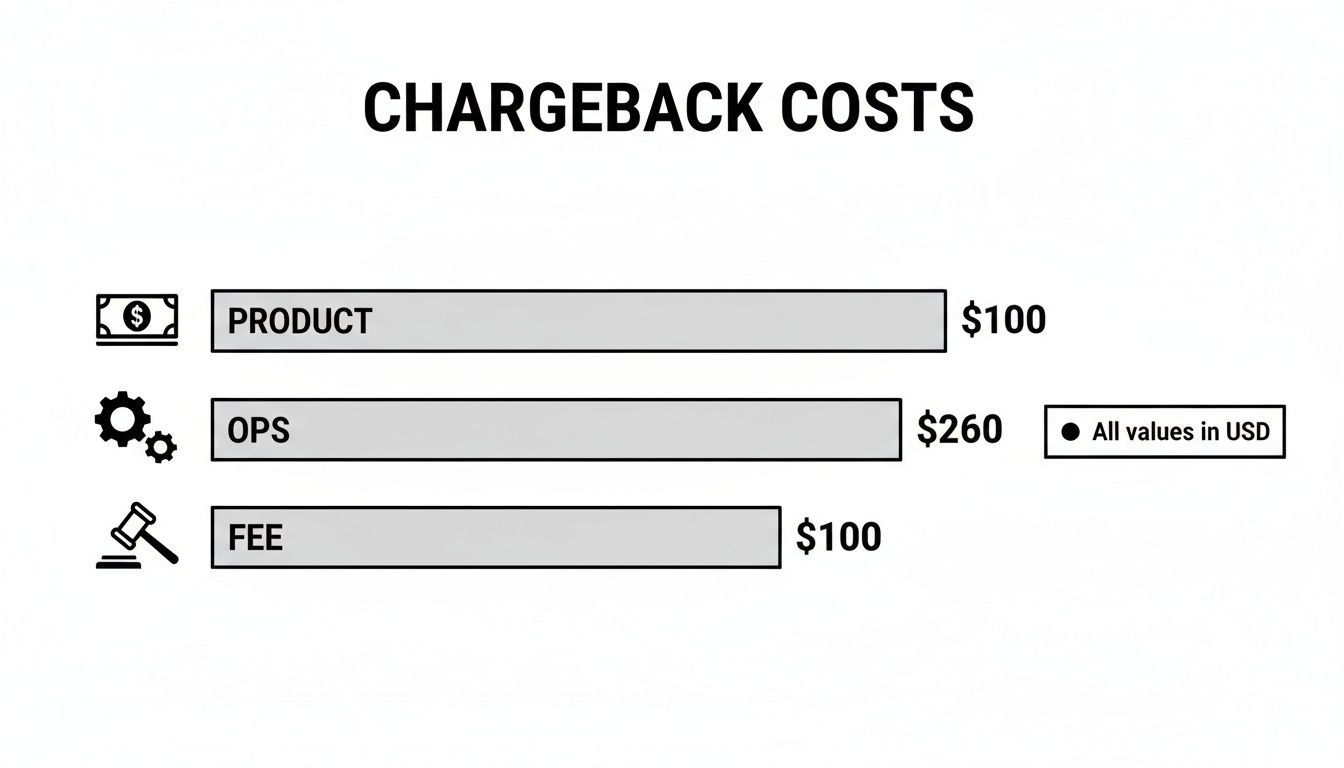
As you can see, the fee and operational costs aren't small change; they dramatically inflate the initial loss. With merchants only winning about 45% of the disputes they fight and recovering a mere 18% of the total value after costs, it’s obvious that just reacting isn't a winning strategy. You can explore more data on these growing chargeback costs.
This is why simply playing defense and reacting to disputes as they come in is a losing game. You need a solid game plan to stop them before they start and a reliable system to fight them effectively when they do.
Who Actually Charges You Chargeback Fees
When a customer disputes a charge, that fee that shows up on your statement can be a nasty surprise. It’s easy to assume the customer's bank is the one billing you, but that’s not quite right. The bill for the chargeback fee actually comes from a lot closer to home: your own payment processor or acquiring bank.
So, why are they the ones charging you? Simple. They're the ones stuck doing all the administrative legwork. When a dispute pops up, they have to cover the operational costs of talking to the card networks (like Visa or Mastercard) and managing the whole back-and-forth process. That fee is just their way of passing the cost—and the risk—down the line to you.
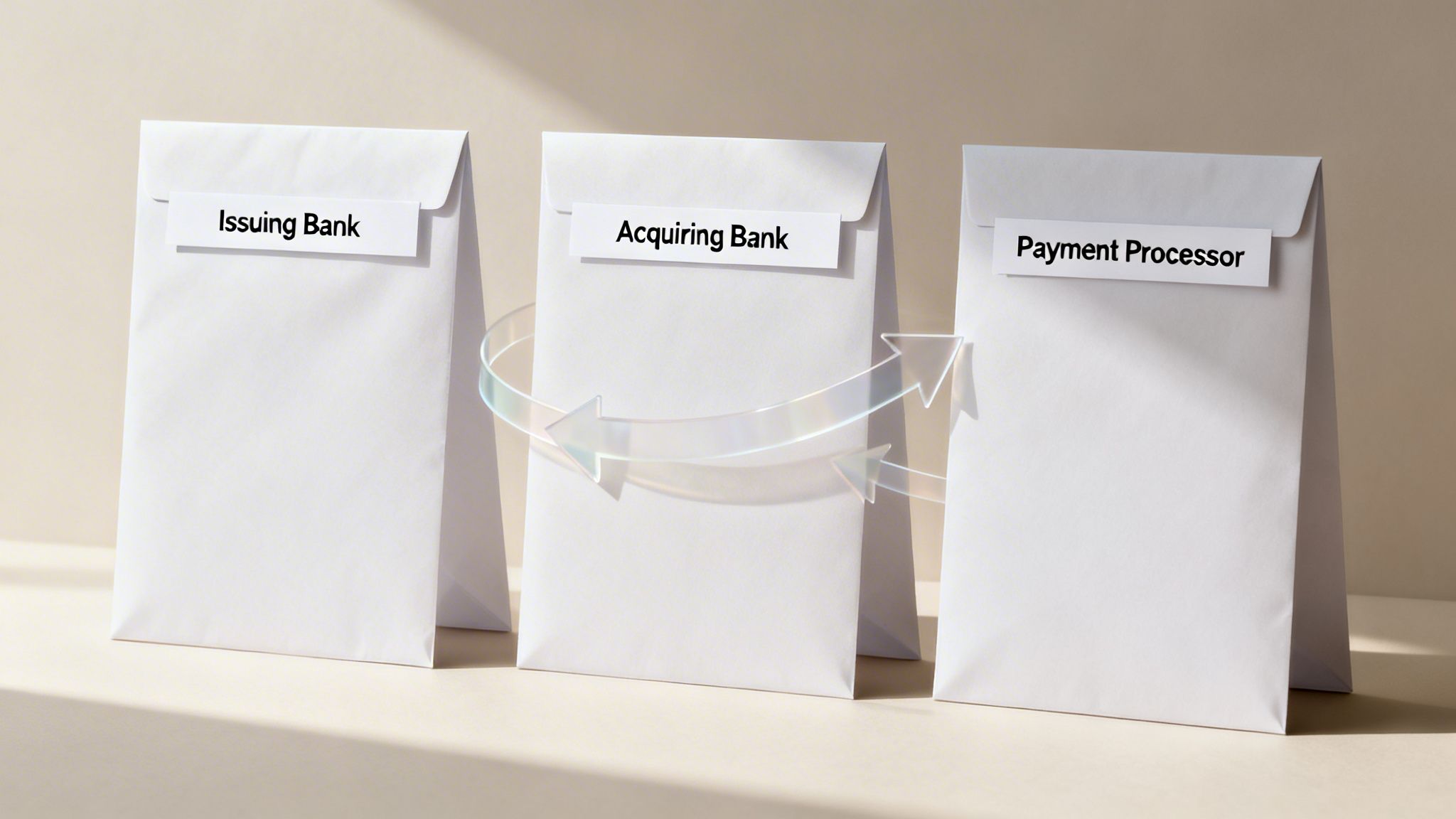
To really get it, you need to understand all the players involved. It helps clear up exactly where that fee is coming from.
Following the Money Trail
Think of a dispute like a message traveling backward through the payment system you use every day. Every stop it makes adds another layer of work and cost, which all gets rolled into the fee you ultimately pay.
Here’s a quick rundown of who’s who in this reverse journey:
- The Issuing Bank: This is your customer's bank (think Chase or Bank of America). They're the ones who kick off the chargeback for their cardholder.
- The Card Network: This is the highway the dispute travels on, like Visa or Mastercard. They create and enforce the rules of the road for the dispute process.
- The Acquiring Bank: This is your bank, the one that processes your store’s card payments. They're on the receiving end of the dispute notice from the card network.
- Your Payment Processor: This is the service you’re using, like Shopify Payments or Stripe. They’re the middleman between your shop and the acquiring bank, and they are the ones who physically deduct the chargeback fee from your account.
They all play a part, but it’s your most direct partner—the payment processor—who actually hits you with the fee.
Why Your Processor Imposes the Fee
Processors aren't just trying to make your life harder. For them, it boils down to one thing: handling disputes costs them time and money. They have to review the case, send messages back and forth between banks, and manage the funds. The chargeback fee is their way of covering those internal administrative costs.
Here’s the painful part: this fee is almost always non-refundable. Even when we help Shopify merchants win back their money—which we do with a 92.4% win rate—the processor usually keeps that fee. This is exactly why preventing disputes is just as vital as fighting them.
You don't just lose the original sale; you also have to pay a penalty just for the privilege of trying to get your money back. Since you can’t get that fee back on a case-by-case basis, the only real winning strategy is to cut down the number of disputes you get in the first place.
For Shopify merchants, this means having a rock-solid plan for both prevention and fighting back. Our experience from handling over 100,000 disputes has shown us time and again that an automated, smart defense is the best way to guard your revenue against these unavoidable fees.
How Much Do Chargeback Fees Cost Your Store
A chargeback fee isn't a single, fixed number. The actual cost you’ll pay shifts based on your payment processor, your store's specific risk profile, and even where you do business. For most e-commerce merchants in the US, this fee typically lands somewhere in the $15–$25 range for every single dispute.
But here's the real kicker: that fee is almost always non-refundable. You get hit with it even when you fight the dispute and win. Think about that for a second. Even when you prove the chargeback was bogus and get your sale money back, you're still out the cost of the fee.
These little penalties might seem small at first, but they add up fast, quietly chipping away at your profits. If your store gets just 10 disputes in a month, you could be shelling out an extra $3,000 a year just in these non-refundable fees. That's before you even account for the actual money lost from the disputed sales themselves. It’s a stark reminder that fees are a standard part of e-commerce, much like the other charges for selling on Amazon.
A Real-World Cost Breakdown
Let’s put this into perspective with a real-world example. Imagine a Shopify store bringing in $50,000 in monthly revenue. If they keep their chargeback rate just below the industry danger zone—let’s say 0.7%—that works out to 35 chargebacks a month, assuming an average order value of $100.
With a standard $25 fee per dispute, the math gets painful, quickly:
35 disputes/month x $25 fee/dispute = $875 per month
$875/month x 12 months = $10,500 per year
That's over $10,000 vanishing straight from your bottom line, just to cover administrative fees. And this doesn't even touch the $42,000 in actual sales revenue lost from those 35 disputes each month. To get a closer look at how these fees work for specific processors, our guide on the Stripe chargeback fee structure breaks it down even further.
How Different Processors Stack Up
While the fees from different processors might look similar on the surface, the devil is always in the details. Some are now tacking on extra penalties if you lose a dispute, essentially doubling down on the financial risk of even trying to fight back.
It pays to know what you’re up against. Here’s a quick comparison of what you can generally expect from the major payment providers.
Typical Chargeback Fee Comparison (2026)
A quick look at the standard chargeback fees from popular payment processors reveals some key differences in their policies.
| Payment Processor | Standard Chargeback Fee (USD) | Refundable if Won? | Notes |
|---|---|---|---|
| Shopify Payments | $15 | No | A flat, non-refundable fee is applied to every single dispute, win or lose. |
| Stripe | $15 | No | An additional fee may be charged if you lose the dispute, adding to the cost. |
| PayPal | $20 | No | The fee can vary by currency, and a high-volume dispute fee may also apply if your rates climb. |
As you can see, winning the dispute doesn't mean you get the fee back. This is exactly why so many merchants turn to ChargePay. Our AI takes on the entire dispute process for you, achieving an incredible 92.4% win rate. We focus on recovering your lost revenue, directly fighting back against the financial drain of these unavoidable fees.
When Fees Snowball into Bigger Problems
That chargeback fee you see on your statement? Think of it as just the tip of the iceberg. The real trouble starts brewing under the surface, where a rising number of chargebacks can trigger a whole cascade of bigger, more painful financial problems for your business.
Payment processors are always keeping an eye on your chargeback-to-transaction ratio. It’s a simple piece of math—your total chargebacks divided by your total monthly sales—but they use it to decide if you’re a “risky” merchant. The second that number creeps over their threshold, the penalties can start to snowball.

The Dreaded Chargeback Ratio
For the big card networks like Visa and Mastercard, the magic number is 0.9%. If your chargeback ratio climbs any higher, you’ll most likely find yourself in a chargeback monitoring program. This isn't just a slap on the wrist; it’s a major red flag that brings intense scrutiny and potentially crippling penalties.
And this problem isn’t going away. In fact, it's getting worse. Global chargeback volumes are set to jump from 238 million in 2023 to an estimated 337 million by 2026. That’s a massive 41% increase. For Shopify merchants, where online sales are 55 times more likely to get disputed than in-person ones, this trend is a serious threat. You can dig into these projections from Mastercard to see for yourself.
When Processors Hit the Brakes on Your Business
Once you’re flagged as high-risk, processors will move to protect themselves. Unfortunately, the measures they take can choke your business's finances and bring your growth to a grinding halt.
These penalties often look like this:
- Higher Fees: That standard $15-$25 chargeback fee? It can get a lot more expensive for merchants who are in monitoring programs.
- Rolling Reserves: Processors might start holding back a chunk of your revenue (say, 10% of your sales for 90 days) to cover any future chargebacks.
- Account Termination: In the worst-case scenario, your processor could just shut down your merchant account entirely, leaving you with no way to accept card payments.
A rolling reserve can be devastating. We worked with a Shopify electronics store owner whose account was slapped with a 10% rolling reserve for 90 days after his chargeback ratio hit 1.1%. This move froze thousands of dollars, making it impossible for him to order new inventory and fulfill his orders.
It’s a perfect example of how a few little disputes can spiral out of control. When they do, they can seriously mess with your ability to improve cash flow in business, leading to even more financial stress.
This is why having an automated system to fight back is so important. At ChargePay, we've helped merchants keep their ratios low by winning 92.4% of their disputes. We've recovered $2.8 million for our users and protected their accounts from these kinds of devastating penalties.
Proven Strategies to Prevent Chargeback Fees
You don't have to just sit back and watch chargeback fees eat into your profits. Treating them as a normal cost of doing business is a recipe for losing money.
The best way to protect your bottom line is to stop disputes before they happen and to win the ones you can't. This isn't about some complicated theory; it’s about taking direct, practical steps to defend your revenue.
The truth is, recent trends are working against merchants. E-commerce saw a shocking 222% jump in disputes from the first quarter of 2023 to the first quarter of 2024. For Shopify merchants, it gets even more specific: 72% have reported a rise in friendly fraud. These aren't just numbers; they're a clear signal that you need a solid game plan.
Stop Disputes Before They Start
Your first and best line of defense is always prevention. You'd be surprised how many disputes you can eliminate just by making a few smart tweaks to your checkout process and customer service.
Here are some of the most effective tactics you can use right now:
- Use Clear Billing Descriptors: Make sure the name on your customer’s credit card statement is one they'll actually recognize. Instead of a generic legal name like "XYZ Holdings," use your store's brand name. This one simple change prevents a ton of "I don't recognize this charge" disputes.
- Provide Excellent, Accessible Support: Make your contact info impossible to miss. When a customer has an issue, they should be able to find you for a refund or exchange faster than they can call their bank. A prominent contact page or a live chat widget can save you from countless chargebacks.
- Implement Fraud Filters: Use the tools you already have. Turning on Shopify's Address Verification System (AVS) and Card Verification Value (CVV) checks is a basic but powerful step. It confirms the person making the purchase has the physical card, stopping simple fraud in its tracks.
For a deeper dive into these methods and more, check out our complete guide on chargeback prevention strategies.
Build an Unbeatable Dispute Case
Even with the best prevention in the world, some disputes are going to slip through. When that happens, your ability to fight back comes down to one thing: the quality of your evidence.
Simply submitting an order summary isn't enough. You need to build a compelling case that tells a clear story and leaves no room for doubt.
A strong representment package proves you held up your end of the deal. It should include proof of delivery with a tracking number, any emails or chat logs with the customer, and order details that perfectly match the billing information.
At ChargePay, we take this whole process off your hands. Our AI automatically gathers all the necessary evidence and builds a powerful, custom response based on the specific dispute reason. It's how we've achieved a 92.4% win rate across more than 100,000 disputes for our merchants.
Automate Your Defense and Stop Losing Money
If you’re a Shopify merchant, you already know that fighting chargebacks by hand is a slow, frustrating battle you often lose. The process is a maze, the rules feel like they're written in another language, and it can feel like the odds are stacked against you from the very beginning.
This is where automation completely changes the game.

When you try to handle disputes yourself, you’re stuck constantly chasing deadlines, digging for the right evidence, and writing responses that might not even meet the card network’s strict requirements. It’s a massive drain on your time and resources—time you should be spending growing your business, not fighting to keep money you already earned.
Turn Chargebacks into a Solved Problem
ChargePay’s AI-powered platform automates the entire dispute process, turning a constant headache for Shopify merchants into a solved problem. The moment a chargeback is filed, our AI gets to work.
It instantly analyzes the reason for the dispute, pulls all the right evidence directly from your store, and generates a custom, evidence-backed response specifically designed to win.
We’ve successfully managed over 100,000 disputes for our merchants, recovering more than $2.8 million in lost revenue. Our 92.4% win rate means you get your money back without lifting a finger.
There’s no manual work, no confusing spreadsheets, and no deadlines for you to track. We handle everything in real-time. For Shopify store owners, this means you stop losing money to both the disputed sales and the endless chargeback fees that come with them. Our guide on automated chargeback and dispute management using AI explains exactly how this technology works behind the scenes.
Ready to stop wasting time and money? You can install ChargePay directly from the Shopify App Store. We're proud to be officially recognized with a ‘Built for Shopify’ badge and have earned a 4.9-star rating from merchants just like you.
Frequently Asked Questions
We get a lot of the same questions from Shopify merchants trying to get a handle on chargebacks. Let's tackle some of the most common ones head-on.
Do I Have to Pay a Chargeback Fee Even if I Win the Dispute?
This is a tough pill to swallow for many merchants, but yes, you almost always have to pay the fee, even if you win the dispute. It’s a frustrating reality of doing business online.
Think of it as an administrative cost. Your payment processor charges this fee simply for the work involved in handling the dispute case, regardless of the outcome. Winning the fight only gets you the original transaction money back—not the fee you paid to enter the ring. This is exactly why preventing chargebacks in the first place is so vital for protecting your bottom line.
What Is Considered a High Chargeback Ratio?
Most of the major card networks, like Visa and Mastercard, flag a chargeback ratio above 0.9% as excessive. Once your account tips over that threshold, you’re on their radar and can be placed into a monitoring program.
These programs aren't fun. They often come with higher fees, much closer scrutiny from your processor, and the risk of even more severe penalties. Keeping your ratio consistently below that 0.9% mark is non-negotiable for the long-term health of your merchant account.
Can My Merchant Account Be Shut Down for Too Many Chargebacks?
Yes, absolutely. This is the worst-case scenario for any e-commerce business. If your chargeback ratio stays in the danger zone for several months in a row, your payment processor has every right to terminate your account to protect themselves from risk.
Losing your merchant account is a massive blow. It makes it incredibly difficult to get approved by another processor, putting your entire ability to sell online in jeopardy. It’s a critical part of the card dispute process that you have to avoid at all costs. This is why having an automated tool that consistently wins disputes to keep your ratio low is so essential.
Stop letting chargeback fees drain your revenue. ChargePay has helped Shopify merchants recover over $2.8 million with a 92.4% win rate. Install ChargePay from the Shopify App Store today and let our AI turn your chargeback problem into a solved one.


.svg)



.svg)


.svg)
.svg)
.svg)