

A lot of Shopify chargebacks start with a boring mistake.
A customer types the wrong apartment number. Autocomplete grabs an old address. Your team ships the order anyway because everything else looks normal. Tracking gets messy, the package stalls or lands somewhere else, and then the customer files a dispute.
You lose the product, the shipping cost, the time spent answering tickets, and then you still have to fight the chargeback.
That's why shipping address verification matters more than most store owners think. It isn't just a checkout polish feature. It's an early control that can prevent delivery problems, flag risky orders before fulfillment, and give you cleaner evidence if a dispute hits anyway.
Why "Item Not Received" Chargebacks Are Costing You Money
The pattern is painfully common. An order comes in, payment clears, your warehouse ships fast, and a few days later a customer says the package never arrived. Sometimes they're telling the truth. Sometimes the address was wrong from the start. Sometimes the order was fine and the dispute is friendly fraud.
Either way, your store pays for the mess.
When an "item not received" claim shows up, the shipping address becomes one of the first things anyone should check. If the address was incomplete, mistyped, or non-deliverable, the dispute often started long before the package left your warehouse. If the address was valid and standardized before shipment, you're in a much stronger position.
Where the leak usually starts
Most merchants focus on the end of the dispute. They pull tracking, look up support emails, and scramble to explain what happened. That's necessary, but it's reactive.
The earlier fix is cleaner. A shipping address check at checkout stops bad data before it turns into a fulfillment problem.
Practical rule: If your team only looks at the address after the package is already moving, you're already paying more than you should.
There's another reason this matters. Not every address problem is fraud, and not every fraud order uses a fake address. But address quality affects both operational losses and dispute losses. That makes it one of the few controls that helps before shipping and after a chargeback lands.
For a closer look at how delivery problems turn into disputes, this guide on shipping chargebacks on Shopify is worth reading.
Why this hits margins fast
A bad address rarely creates just one cost. It creates a chain:
- Fulfillment waste: Your team picks, packs, and ships an order that may never arrive correctly.
- Support load: Someone has to answer “where is my package?” emails and try to fix the order.
- Refund or replacement pressure: Customers don't care whether the problem was a typo or a routing issue. They want the product.
- Dispute risk: If frustration rises, the issue often ends with a chargeback instead of a support resolution.
That's why shipping address verification belongs in your fraud and chargeback playbook, not only in operations.
The Link Between Bad Addresses and Lost Revenue
Shipping address verification is the process of checking a customer's entered shipping address against authoritative postal reference data to confirm that the address exists, is complete enough for delivery, and follows postal standards. That's the practical version merchants need to care about. According to Lob's explanation of address validation and verification, modern systems moved from manual postal matching to real-time and batch software checks, and the business value is tied to reducing failed deliveries, misrouted packages, and avoidable return costs.
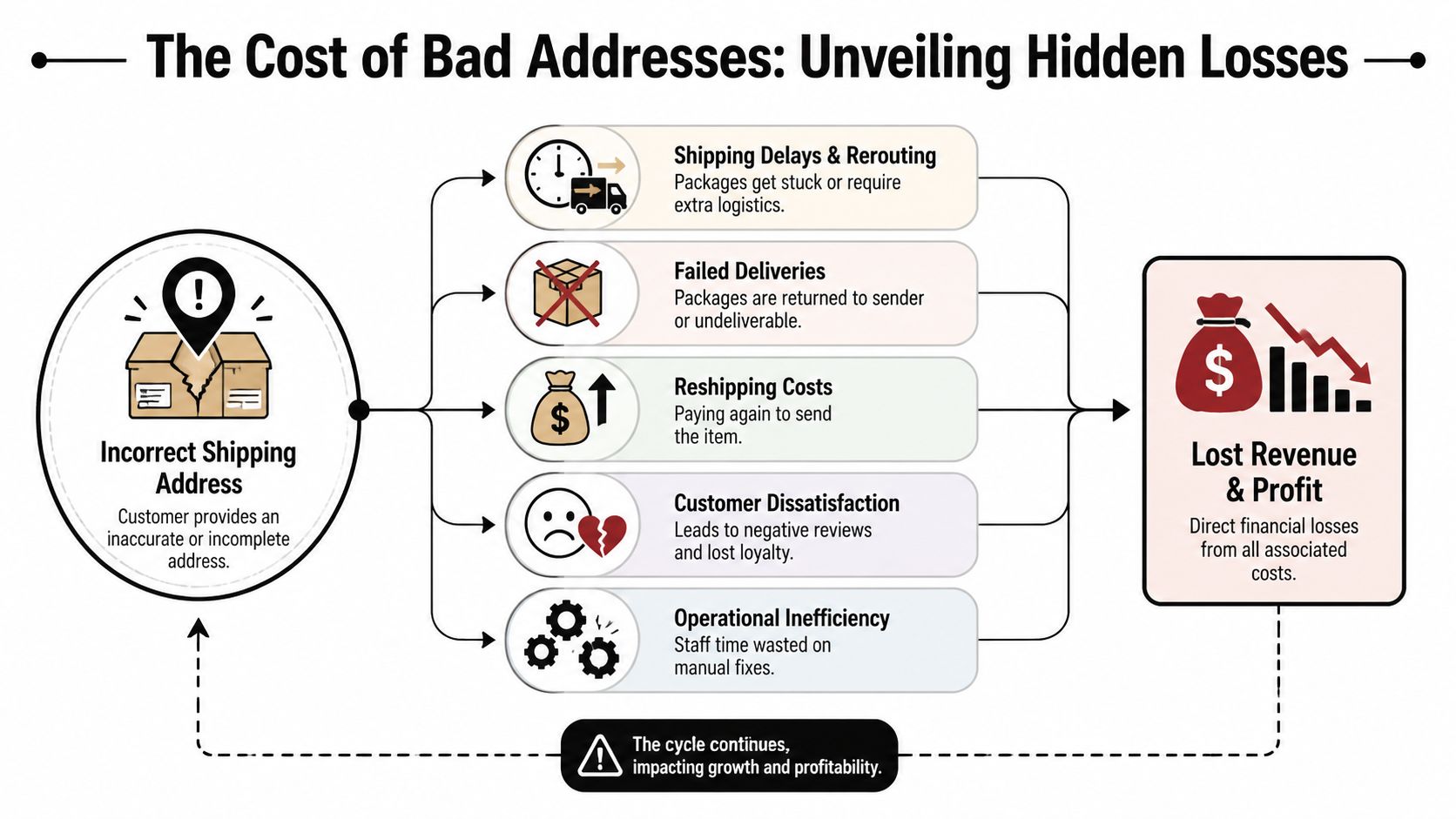
That sounds technical, but the store-level impact is simple. If the address is bad, the order becomes harder and more expensive to fulfill. If the order becomes harder to fulfill, your odds of a complaint, replacement request, or dispute go up.
Two address problems that look similar at first
A typo and a risky order can create the same operational outcome.
One customer accidentally enters the wrong house number. Another customer enters a strange variation of a real address because they don't want the shipment tied cleanly to them. In both cases, your fulfillment team can end up shipping to an address that causes delays, rerouting, or non-delivery.
That's why I don't treat shipping address verification as just “cleanup.” I treat it as a filter.
- Honest errors create preventable shipping problems.
- Suspicious errors create fraud review signals.
- Unresolved errors create the evidence gap that hurts you later.
Here's the key point. A failed delivery doesn't care why the address was wrong. Your margin still takes the hit.
If you want a related view of address checks from the payment side, this breakdown of AVS and address verification helps separate card billing checks from shipping checks.
A quick walkthrough helps clarify the mechanics:
What bad addresses actually do to your store
Bad address data doesn't stay in one place. It spills into several teams and systems.
| Problem | What happens in your store |
|---|---|
| Incomplete address | Labels fail, staff pauses the order, customer support has to reach out |
| Wrong unit or street detail | Carrier attempts fail or delivery goes to the wrong location |
| Unrecognized format | Manual edits slow fulfillment and increase error risk |
| Unresolved mismatch | Customer frustration rises, then refund requests or disputes follow |
A shipping problem that starts as data quality often ends as a financial problem.
That's the core reason merchants should care. Shipping address verification protects the shipment, but it also protects the order from turning into a chargeback story later.
Comparing Address Verification Methods and Tools
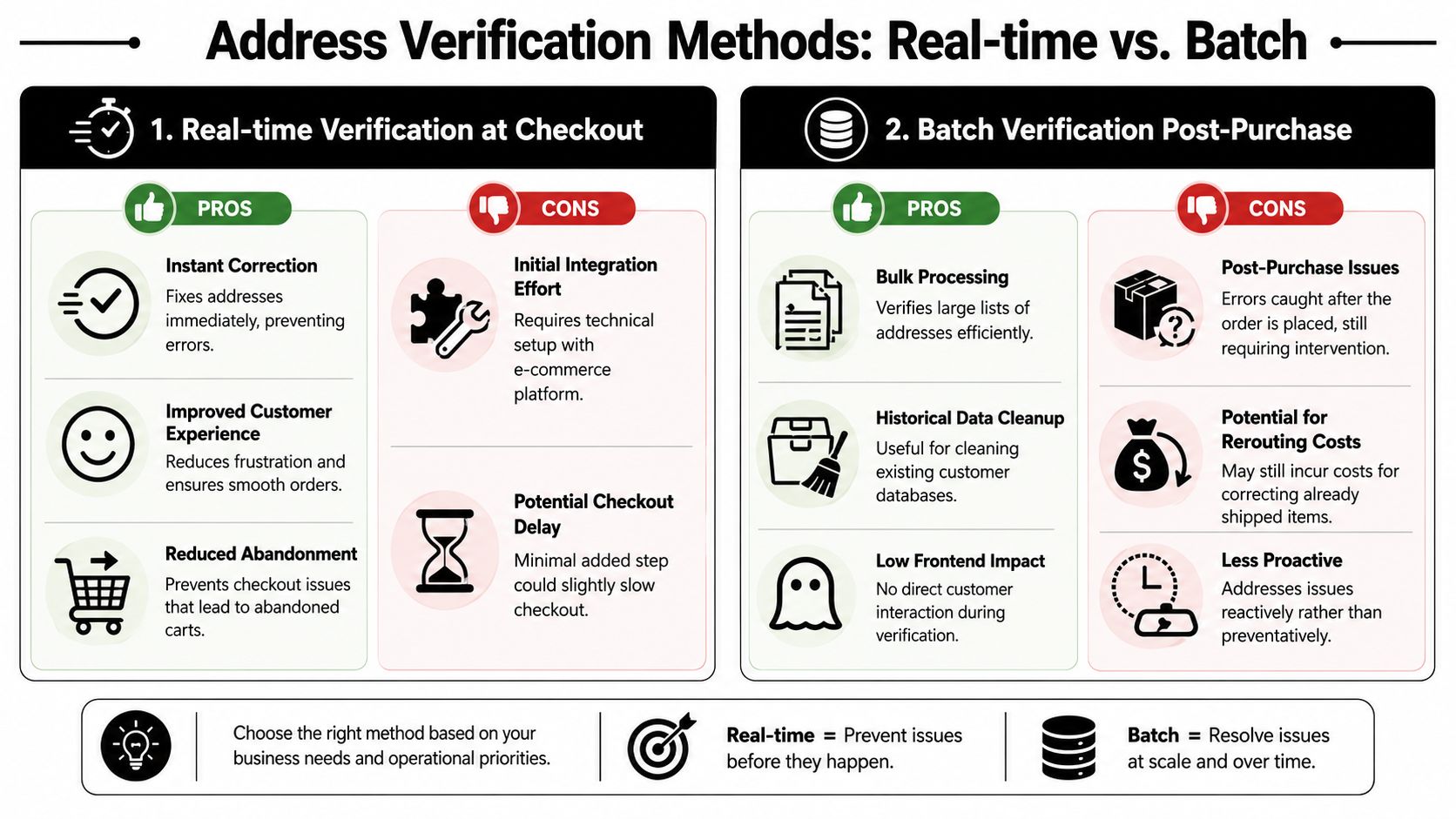
There are two main ways stores handle shipping address verification. They either check the address while the customer is entering it, or they clean up addresses after the order is already in the system.
Those approaches are not equal.
Pitney Bowes notes in its FAQ on address validation that API-based validation can be embedded into websites or applications to validate addresses as they are entered, and that this is materially more effective than post-entry cleanup because it intercepts bad data before it enters order management or label generation.
Real-time at checkout
This is the method that catches mistakes before the order is placed. A customer enters an address, the tool checks it, and then either accepts it, suggests a correction, or asks the customer to fix it.
What works:
- Stopping errors early: The bad address never reaches your fulfillment queue.
- Cleaner downstream data: Labels, routing, and support records are based on the same standardized address.
- Better fraud review: If an address fails cleanly at checkout, you can route the order for manual review before shipping.
What doesn't:
- Overly aggressive blocking: If your tool rejects edge-case addresses too hard, you can lose legitimate orders.
- Poorly designed prompts: If the correction flow is confusing, customers may abandon checkout instead of fixing the address.
Batch after purchase
This method checks addresses after the order is already placed. It's useful when you want to clean a backlog, review existing customer records, or add a review step before fulfillment.
Batch can still help, especially if your team already runs manual risk checks. But it creates a timing problem. The customer is done checking out, expectations are set, and your staff now has to chase corrections.
A simple comparison helps:
| Method | Best for | Main trade-off |
|---|---|---|
| Real-time verification | Preventing bad data at the source | Can add checkout friction if configured poorly |
| Batch verification | Cleaning existing orders or databases | Problems are found later, which means more manual work |
For Shopify stores, I usually favor real-time checks for active orders and batch checks for database cleanup or pre-fulfillment review.
If you can catch the problem before label creation, you avoid the most expensive version of the problem.
Why AVS alone isn't enough
A lot of merchants confuse AVS with shipping address verification. They are related, but they aren't the same thing.
AVS checks whether the billing address entered by the customer matches what the card issuer has on file. Shipping address verification checks whether the shipping destination itself is valid and deliverable. A card can pass AVS while the package is headed to a messy or questionable shipping address.
If you want the fuller distinction, this article on credit card address verification and AVS breaks it down in plain English.
Setting Up Address Verification on Your Shopify Store
Most Shopify merchants don't need a complicated rollout. They need a checkout setup that catches obvious problems, gives good customers an easy way to fix mistakes, and routes questionable orders for review instead of blindly shipping them.
That starts with the data source behind the check. Smarty explains on its single address verification page that authoritative systems compare entered addresses against postal-reference data and, in the U.S., USPS-linked validation can standardize delivery-line and last-line fields, append missing components like city or ZIP+4 when possible, and return enriched metadata such as ZIP+4, latitude/longitude, or county codes.
What to configure first
On Shopify, the practical question isn't only “which app should I install?” It's “what should happen when an address looks wrong?”
You have two broad choices:
- Suggest a correction
- Require the customer to fix the address before checkout completes
The right answer depends on your store.
If you sell low-risk products with repeat buyers, a suggestion flow is often the safer starting point. If you sell items that attract resellers, high-risk first-time orders, or expensive shipments, a stricter rule can make more sense.
A sensible Shopify setup
This is the setup I'd use for most stores:
- Use an app or checkout extension with postal-reference checks: Don't rely only on visual formatting.
- Show suggested corrections first: Give the customer a clean “use recommended address” option.
- Flag unresolved mismatches: Don't auto-ship orders when the customer insists on a clearly problematic address.
- Queue edge cases for review: Apartment-heavy addresses, business suites, and cross-border formats often need a human look.
- Log the verified result: Save the corrected or confirmed address in your order record.
That last point matters more than it gets credit for. If you ever need to reconcile shipping costs, return costs, and customer support time, your finance stack needs clean order data too. If you're tightening up the operational side of the business, this guide to find accounting software for Shopify is a useful companion read.
Suggest versus block
There's no universal setting that fits every brand. The trade-off is simple.
| Checkout behavior | Upside | Downside |
|---|---|---|
| Suggest correction | Lower friction for legitimate shoppers | Some bad addresses still slip through |
| Force correction | Stronger protection before fulfillment | More risk of checkout drop-off on unusual addresses |
Stores usually get into trouble when they pick one rule for every order type. Risk varies. Your settings should too.
For fraud-heavy stores, it also makes sense to combine address verification with order risk tools. That can include rule-based checks, manual review queues, and Shopify fraud apps. If you're evaluating that broader layer, this roundup of Shopify fraud filter app options is a practical place to start.
Using Verification Data to Fight Chargebacks
A verified address is not a magic shield. It won't stop every dispute, and it won't solve friendly fraud by itself. But it does give you something many merchants are missing when a chargeback hits: a clear record that you checked the shipping destination before fulfillment.
Ryder points out in its discussion of address verification in e-commerce that most content explains how to verify an address, but not how to interpret verification failures in a dispute workflow. That gap matters because address checks can improve order hygiene without stopping friendly fraud, and false positives can block legitimate orders.
How verified data helps your case
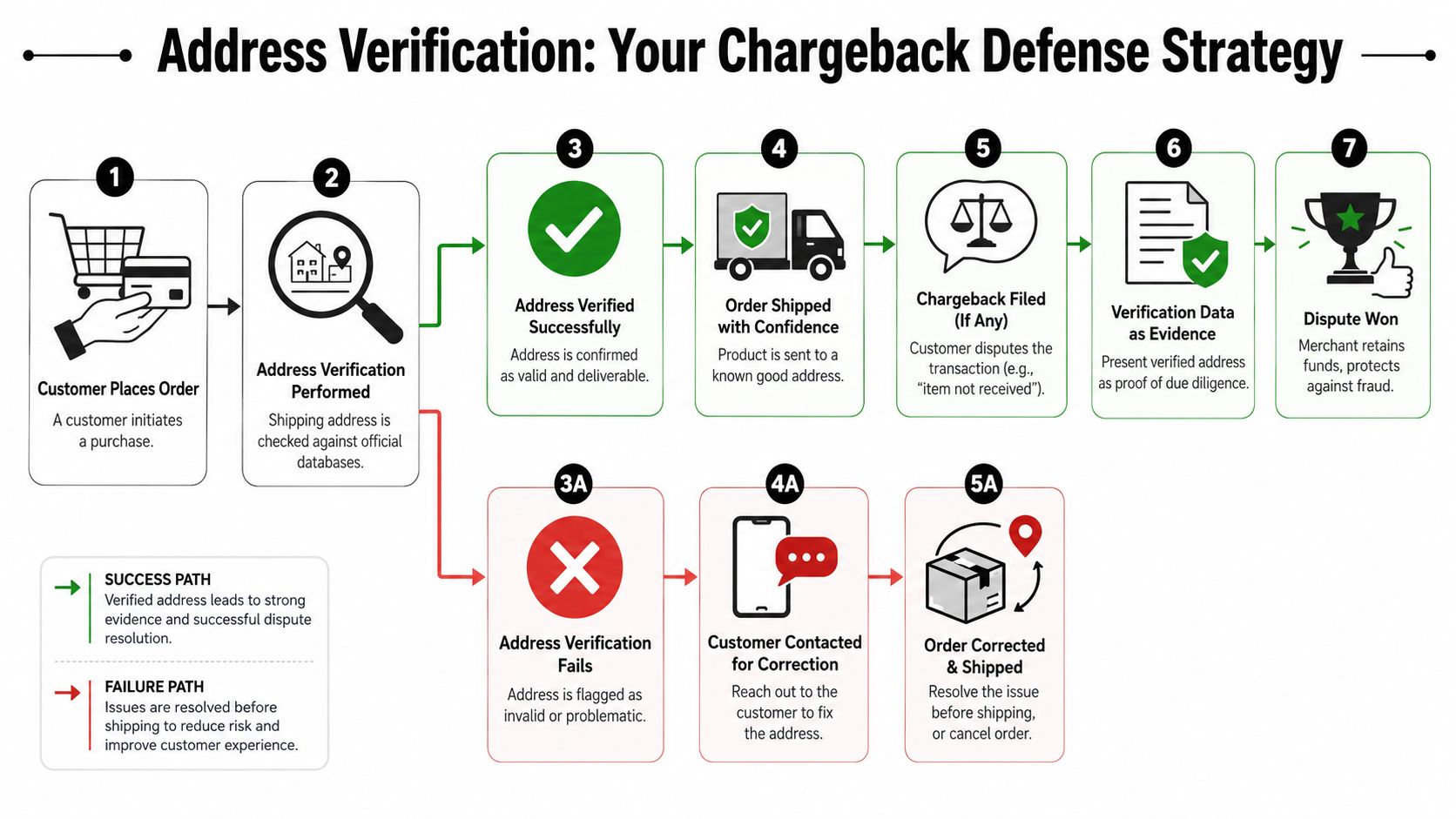
When a customer files an "item not received" claim, your response gets stronger when you can show a sequence like this:
- The customer placed the order.
- Your system verified or standardized the shipping address before shipment.
- The order shipped to that verified destination.
- Tracking and delivery records align with that destination.
- Any customer communication after shipment matches the same address history.
That doesn't guarantee a win. It does show due diligence, and that matters.
Many merchants often fall short. They have tracking, but they don't have a clean address-verification trail attached to the order. Or they have a fraud flag, but no documented action tied to it.
How to use failures the right way
A failed address check should not automatically mean fraud. That creates false positives and blocks good customers.
Use failed verification as a signal, not a verdict.
- Minor formatting issue: Send the correction prompt or fix it during checkout.
- Incomplete but plausible address: Hold fulfillment and contact the customer.
- Repeated mismatch with other risk signals: Escalate for review or cancel the order.
That last category is where address verification becomes part of a bigger risk picture. Billing mismatch, rushed shipping, odd email patterns, and proof-of-delivery gaps all matter more when combined than when viewed alone. For the delivery side of that puzzle, Routelink's delivery management insights are useful if you're tightening how you document final-mile proof.
If you're building dispute responses by hand, document the verification result in the same place you store tracking, support logs, and order metadata. If you're using a representment workflow, make sure address verification is one of the standard evidence fields. This guide to chargeback representment covers that broader response process well.
Good dispute evidence usually isn't one perfect document. It's several records that tell the same story without contradictions.
Stop Losing Money and Automate Your Defense
Shipping address verification is a strong first control. It catches avoidable mistakes, helps your team spot risky orders, and creates better records when a dispute lands.
But it doesn't finish the job.
Someone still has to pull the order timeline, match the shipping record, collect the right evidence, draft the response, and submit it before the deadline. For most Shopify teams, that work gets done late, inconsistently, or not at all.
Where manual dispute work breaks down
The biggest problem with manual workflows isn't effort alone. It's inconsistency.
One team member saves the corrected address. Another only saves tracking. A third person writes a good response, but misses a prior customer message that would have helped. When the evidence package is fragmented, even valid orders become harder to defend.
What an automated workflow should do
A useful chargeback workflow should connect the dots automatically:
- Pull order evidence: Shipping events, customer history, and any address-check records
- Build a clear timeline: From checkout to fulfillment to delivery
- Draft the dispute response: Based on the reason code and available evidence
- Submit on time: Without depending on someone remembering a deadline
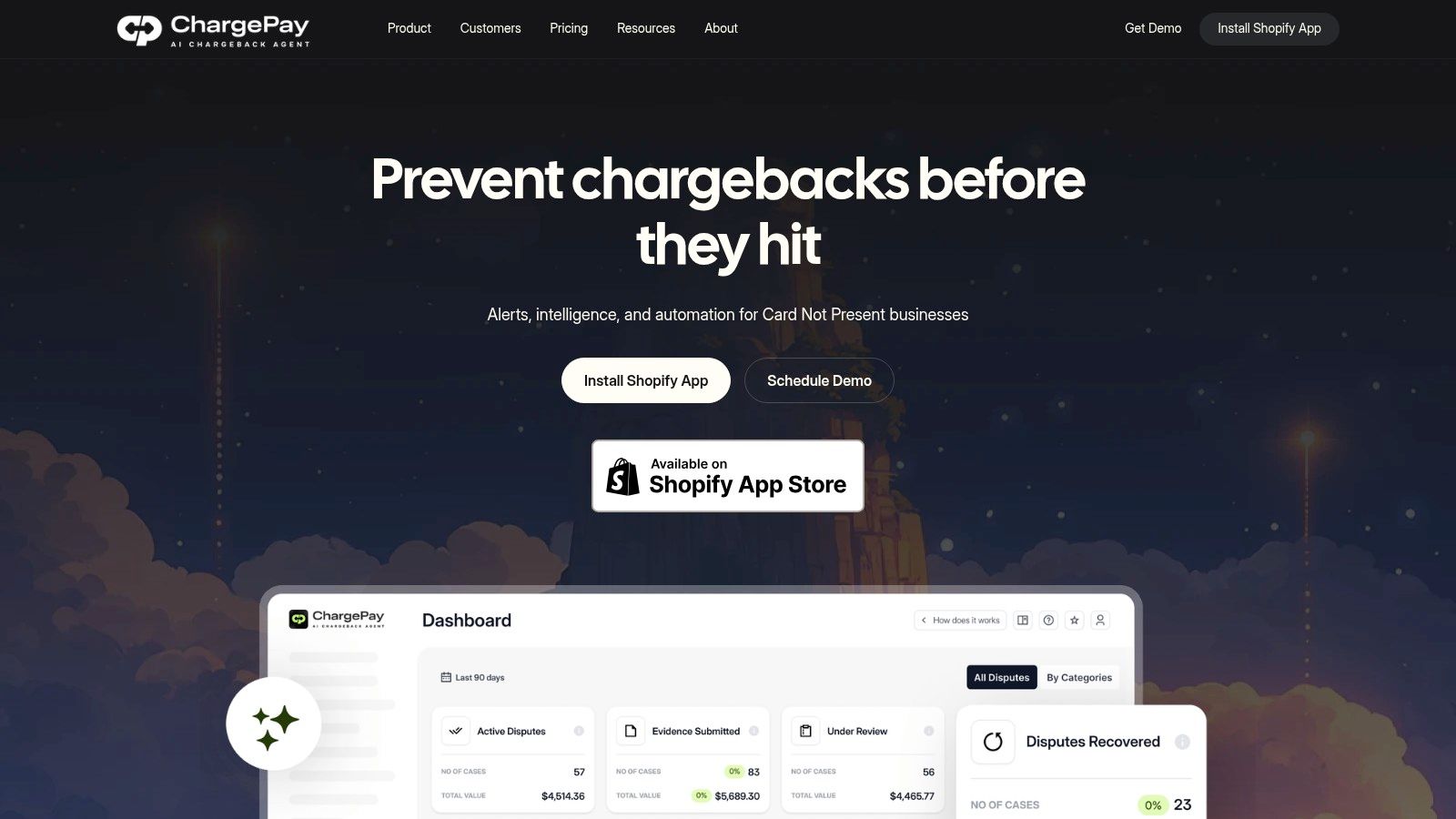
For Shopify merchants, ChargePay fits that role. According to the publisher information provided for this article, it's an AI-powered chargeback management app for Shopify with a 92.4% win rate, 200K+ cases handled, and $10.8M+ recovered for merchants. It also has a 4.9-star rating on the Shopify App Store and a Built for Shopify badge. Those are the numbers that matter if you're deciding whether to keep doing representment by hand or let a system handle it.
Address verification becomes much more valuable when it feeds a complete defense workflow instead of sitting in a disconnected app log.
The practical takeaway
If your store is getting hit with "item not received" disputes, don't treat shipping address verification like a minor checkout enhancement. Treat it like a margin protection tool.
Use it to stop bad addresses before fulfillment. Use it to route questionable orders for review. Use the result as part of your dispute evidence. Then automate the rest, because manual chargeback work usually breaks under volume.
If chargebacks are eating into your Shopify revenue, ChargePay is worth a look. It automates dispute handling, uses your order and shipping data to build representment cases, and only charges on wins. Install it from the Shopify App Store if you want a Built for Shopify app that helps turn chargeback defense into a repeatable process instead of another task on your team's backlog.


.svg)



.svg)


.svg)
.svg)
.svg)