


You're probably seeing the same pattern a lot of Shopify merchants see. A competitor adds local pickup. Customers start expecting it. Shipping costs keep biting into margin, and click and collect starts to look less like a nice extra and more like table stakes.
The appeal is obvious until the first ugly edge case hits. A customer places an order online, your staff packs it, someone walks in and picks it up, and a week later the cardholder says the order never arrived. There's no carrier scan, no doorstep photo, and no clean delivery trail. What looked like a fulfillment upgrade can turn into a payment risk problem fast.
That's the part most click and collect advice misses. The store ops side matters, but so do fraud controls, return handling, and dispute evidence. If you run Shopify, you need both.
Is Click and Collect Right For You
A lot of merchants decide based on pressure, not fit. They see nearby brands offering pickup, customers ask for it, and they switch it on because saying no feels risky. That's understandable, but it's still the wrong way to launch a fulfillment method.
The better question is simpler. Can your team hand off orders quickly, accurately, and with enough recordkeeping to defend the sale later if needed?
The growth in click and collect explains why the pressure is real. The 2020 pandemic was a turning point, and in the UK the service now accounts for approximately 40% of sales for retailers that offer it according to Statista's coverage of click-and-collect in the UK. That's no longer a side feature. It's part of how modern retail works.
When it fits your store
Click and collect usually works well when you have at least one of these conditions:
- Local demand: You already get customers asking whether they can skip shipping and pick up the same day.
- Fast-moving inventory: Your stock turns often enough that pickup saves time and keeps sales from slipping away during shipping delays.
- A physical handoff point: You have a real store, showroom, warehouse counter, or partner location that can handle orderly pickups.
- Staff discipline: Your team can follow repeatable pickup steps instead of treating each order like a one-off exception.
Merchants dealing with off-premise fulfillment changes can get useful context from OrderOut's off-premise insights, especially if pickup is becoming part of a broader mix that includes delivery and in-person handoff.
When it becomes a margin trap
Click and collect goes bad when the checkout option gets ahead of store operations. If inventory is even slightly messy, if pickup orders sit in random places, or if staff release items without basic verification, you create friction for honest customers and an opening for dishonest ones.
Practical rule: If you can't prove what happened at handoff, don't assume the bank will take your side later.
That's why pickup should be evaluated as both a sales tool and a risk channel. If you're weighing whether the extra convenience will increase revenue, this guide on how to increase Shopify sales is a useful companion because it helps frame click and collect as one growth lever among several, not an automatic win.
Why Customers and Your Bottom Line Love Click and Collect
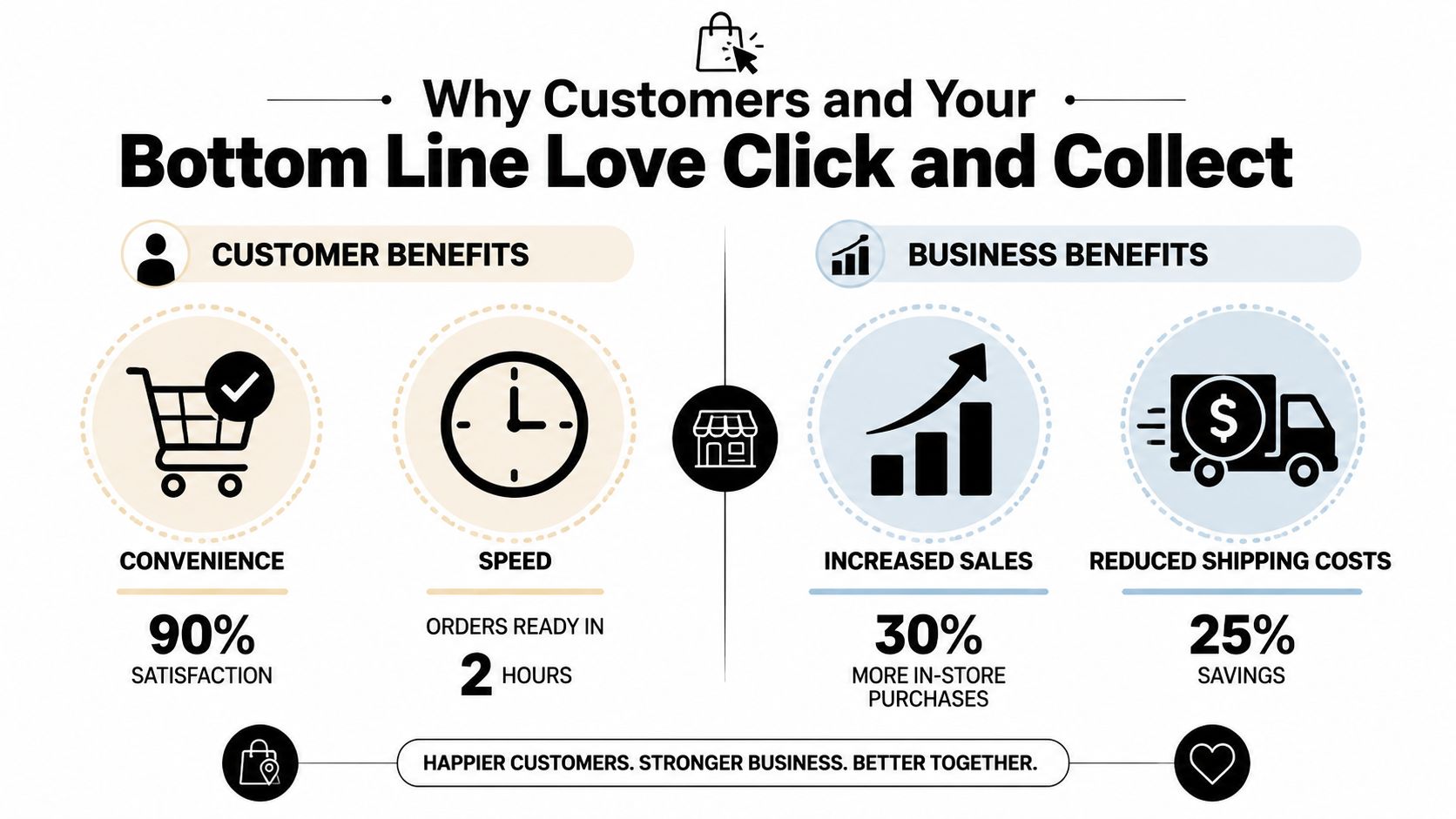
A customer buys on their lunch break, stops by after work, and walks out with the order the same day. No waiting for a delivery window. No porch theft risk. No surprise shipping fee at checkout. That convenience is why click and collect has become routine for many shoppers, not a niche preference, as noted earlier from ICSC's shopper research.
Why customers choose it
The appeal is simple. Customers get the speed of local retail with the control of online ordering.
Three benefits usually drive adoption:
- Faster access to the product: Shoppers can secure the item online and collect it the same day or on their own schedule.
- Lower checkout friction: Pickup removes shipping fees for customers who do not want to pay extra for delivery.
- More certainty: They know the item is set aside before they leave home.
That combination matters at checkout. Shipping cost and delivery timing still kill a lot of otherwise healthy orders. Offering pickup can remove that final objection, especially for nearby shoppers comparing convenience, not just price. If you are working on that part of the funnel, this guide on how to reduce cart abandonment is a useful companion.
Why merchants like it too
For merchants, the upside starts with fulfillment economics. Shipping less means fewer carrier charges, fewer package-loss complaints, and less margin pressure on low-ticket orders.
There is also a revenue benefit inside the store. ICSC found that many click-and-collect shoppers buy extra items when they arrive for pickup. That is one of the few cases where an ecommerce order can still produce an in-person add-on sale. Accessories, consumables, gifts, and high-margin impulse items all fit here.
I have seen this work best when the pickup path runs past products customers actually want, not a random clearance bin near the register.
The model can be especially attractive for operators who already depend on local traffic and repeat visits. For example, coffee and food-adjacent retailers thinking about pickup as part of their retail mix can learn from these essential steps for coffee shop success, especially around customer flow, staffing, and order readiness.
Margin upside is real, but it is not automatic
Click and collect can improve conversion and reduce fulfillment cost. It can also create a false sense of efficiency if merchants only look at the sale and ignore what happens after pickup.
The handoff is where profit protection starts. If customers wait too long, cannot find the pickup point, or leave with the wrong order, the short-term convenience turns into support cost, refund pressure, and disputed transactions later. Those problems do not show up in the sales pitch for click and collect, but they show up in margins.
A useful way to frame the channel is this:
| What customers expect | What protects your profit |
|---|---|
| Fast pickup | Orders are picked, labeled, and staged correctly |
| Confidence the item is there | Inventory is accurate before checkout |
| Clear instructions | Pickup communication is specific and timely |
| A smooth handoff | Staff verify the order and the person collecting it |
That is why strong click-and-collect programs outperform weak ones by more than convenience alone. The customer gets speed. The merchant gets the sale, the possible upsell, and a lower delivery burden. But those gains only hold if the pickup experience is controlled well enough to prevent the fraud, return, and chargeback issues that often show up after the customer walks out the door.
Getting Your Shopify Store Operationally Ready
The most common mistake is enabling local pickup in Shopify before the store is ready to support it. The checkout setting is easy. The operational work is not.
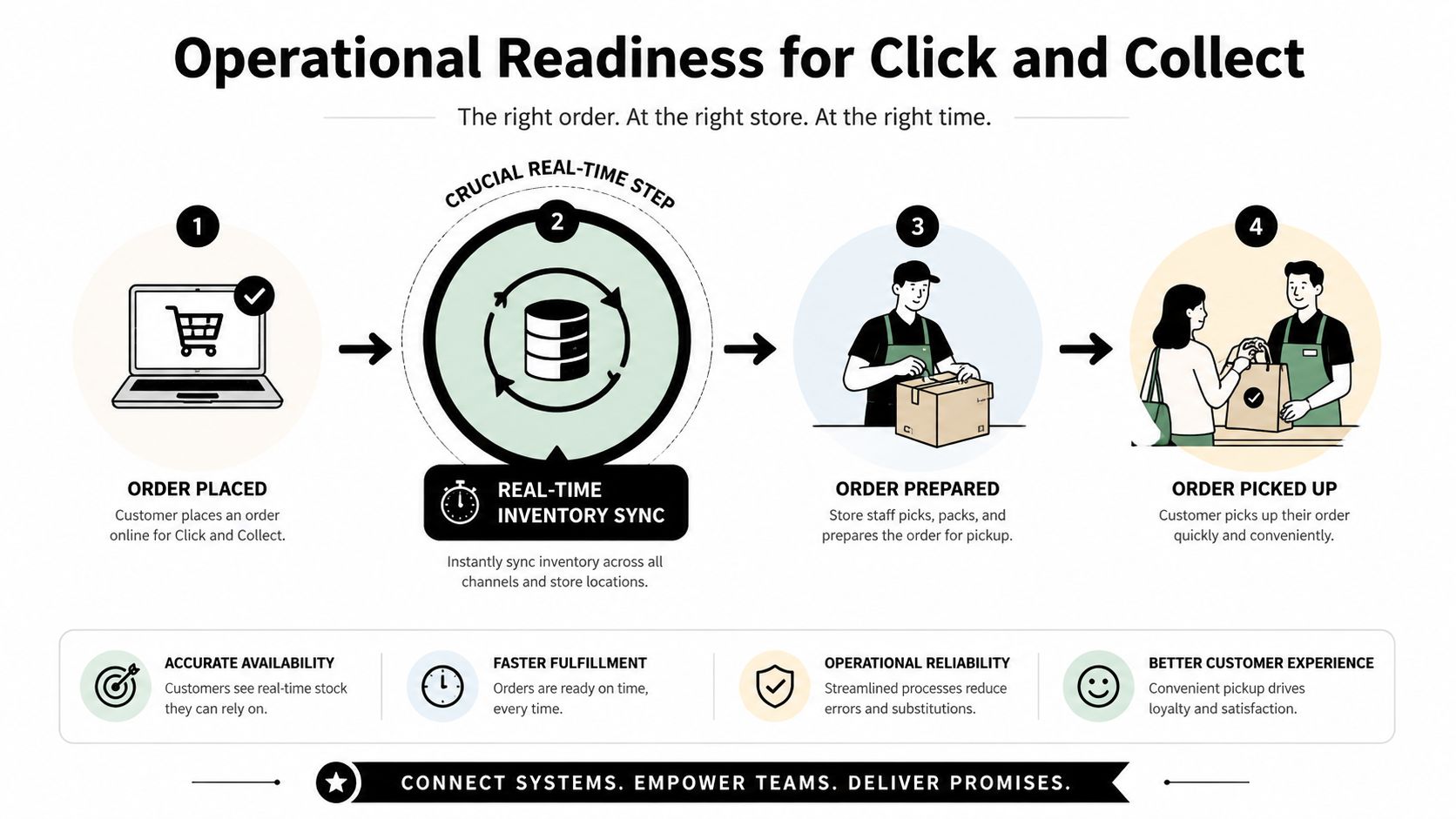
The foundation is inventory accuracy. A successful click-and-collect setup depends on real-time inventory synchronization between your online storefront and your in-store systems. Without that, you risk overselling and disappointing customers who arrive expecting an item that isn't available, as explained in Awayco's guidance on click-and-collect operations.
The four parts that have to work together
In Shopify terms, operational readiness usually comes down to four linked systems.
- Inventory sync
Your Shopify locations, POS, ERP, or inventory app need to agree on what's available. If stock moves in-store and your online count lags behind, pickup orders become a promise you can't keep.
Order routing
The order has to land in the right location. If your main store, warehouse, and showroom all appear as possible pickup points, staff need a clean rule for where orders are fulfilled and where they're staged.
Staff workflow
Someone needs to pick, verify, pack, label, and mark the order correctly. “We thought someone else handled it” is a common reason orders go missing internally.
Customer notification
The customer should know when the order is ready, where to go, what to bring, and how long the store will hold the item.
- Defined pickup locations: Don't let every address become a vague handoff point. Keep it specific.
- A staging area: Pickup orders need a controlled shelf, bin, cage, or back-counter zone.
- Mobile picking tools or barcode scanning: Staff should confirm the right item before it's marked ready.
- Role ownership: One team owns prep. One team owns handoff. Shared responsibility usually becomes no responsibility.
- A status change in Shopify
- A staff memory of the interaction
- A signature on paper
- Store camera footage that may not clearly show the handoff
- A note that says “picked up” without identity verification
- Order event logs: When the order was placed, approved, picked, packed, marked ready, and collected.
- Customer communication records: Email or SMS notifications that show the customer was told where and when pickup was available.
- Verification notes: Staff confirmation of what was checked at handoff.
- Return and exchange logs: A clear record of any post-pickup change to the transaction.
- Standardizing pickup verification
- Logging handoff events consistently
- Keeping notifications clear and time-stamped
- Making post-pickup returns traceable
- Using automation to assemble dispute evidence fast
- Make pickup visible: Use clear signage from the entrance to the handoff point.
- Keep the handoff fast: Staff should be able to retrieve staged orders quickly.
- Verify before release: Don't hand over goods first and sort out the details after.
- Handle returns at the same standard: If pickup returns are accepted, record them inside the same system of record.
- Order fulfillment time: From order placement to ready-for-pickup status.
- Customer wait time at pickup: Long waits create friction and lower repeat use.
- Additional in-store purchase behavior: This shows whether pickup is producing extra revenue during collection.
- Abandoned pickup orders: These usually point to weak communication, awkward hours, or a poor hold policy.
- Chargeback rate by fulfillment type: Compare click and collect against shipped orders. If pickup disputes are higher, your proof-of-handoff process likely needs work.
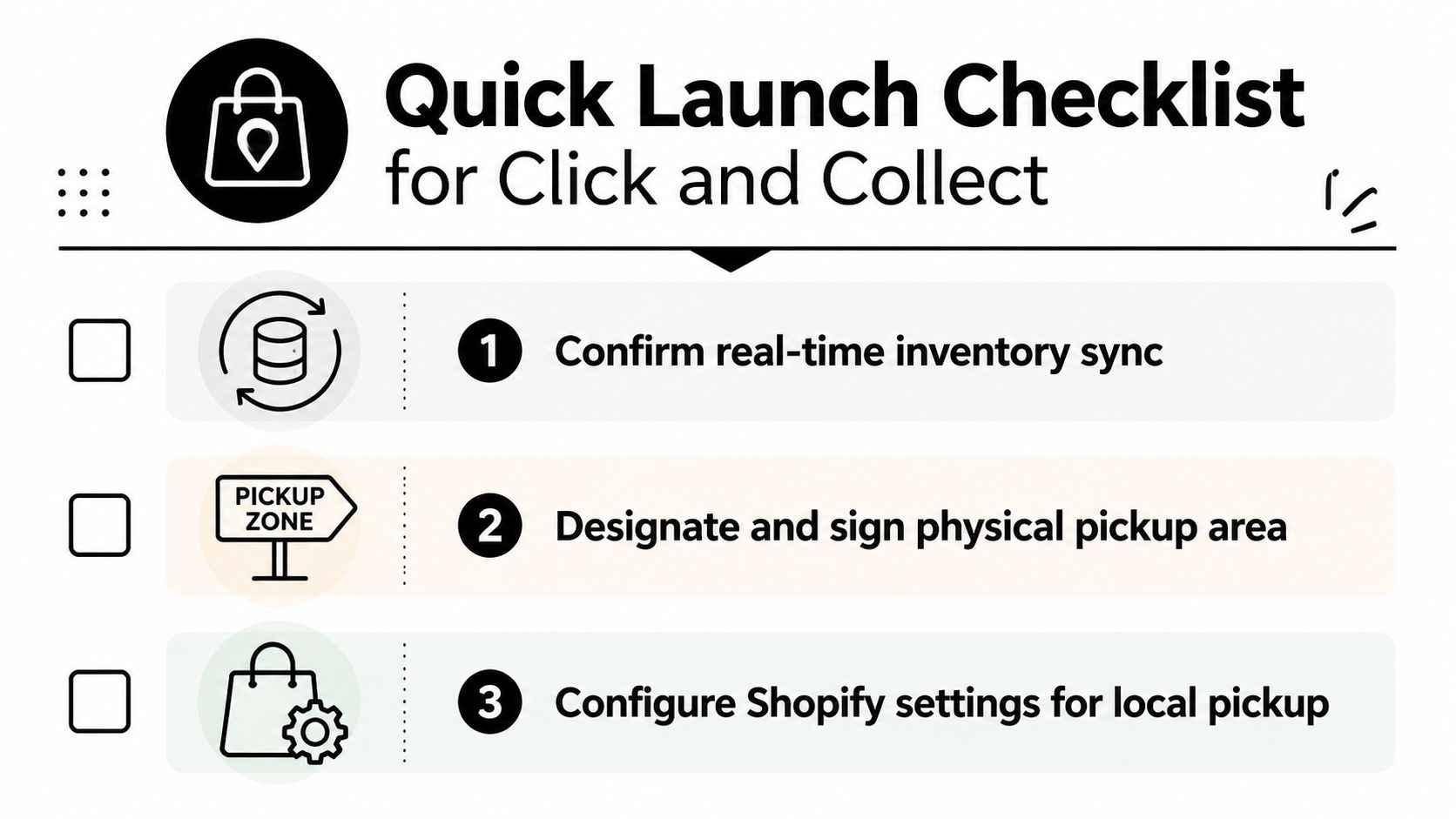
- Confirm real-time inventory sync across Shopify and your store systems.
- Choose one physical pickup area and sign it clearly.
- Configure local pickup properly in Shopify for the right location.
- Train staff on verification and handoff steps so every order follows the same process.
- Set up automated ready-for-pickup messages with simple instructions.
- Decide how returns and disputes will be documented before the first pickup goes live.
For merchants building tighter retail workflows, some of the same planning discipline shows up in other brick-and-mortar launches too. This guide on essential steps for coffee shop success is useful because it shows how physical operations, customer flow, and staff process all have to line up before growth tactics pay off.
What good setup looks like in practice
A workable setup inside Shopify usually includes:
This walkthrough is worth watching if you want to think through store-side execution before launch:
What usually breaks first
The first failure point is almost always stock visibility. The second is communication. Customers don't mind pickup. They mind uncertainty.
If your customer arrives before your staff can confidently say “yes, we have it and it's ready,” the problem started long before the handoff.
Fraud prevention also starts here. If you're already tightening your operational controls, it makes sense to review your payment-side defenses too. This overview of a Shopify fraud filter app can help you think about how pre-purchase screening and post-purchase pickup controls should support each other.
The Hidden Risk Chargebacks and Click and Collect Fraud
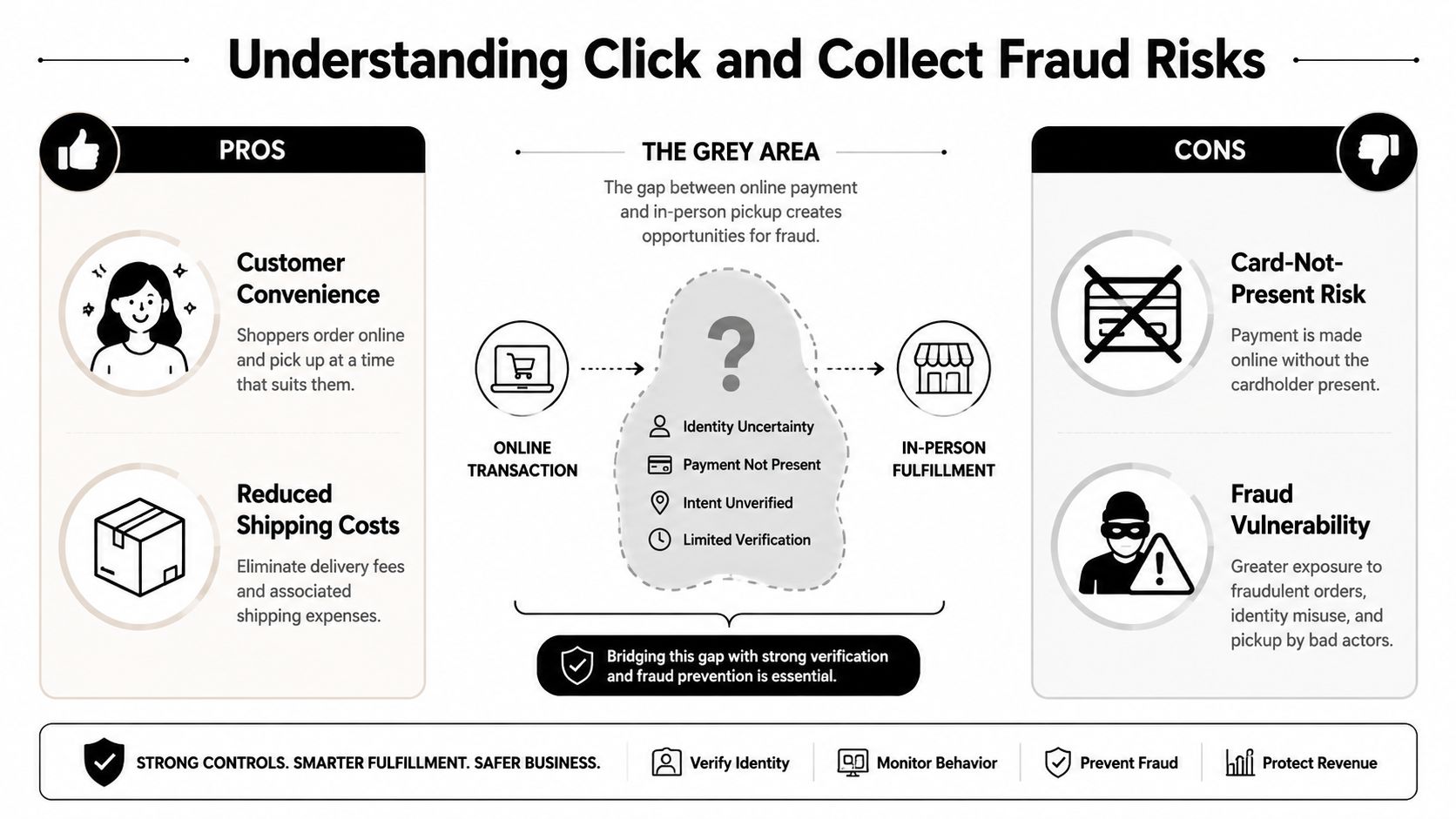
Click and collect gets tricky. The payment is usually made online, so the transaction behaves like a card-not-present order. But the fulfillment happens in person. That puts the merchant in an awkward middle ground.
Most public advice focuses on faster pickup, clearer signage, and smoother logistics. It rarely deals with what happens after the customer walks away with the order. That gap matters because proof of handoff is central to dispute prevention, as noted in Nelson Worldwide's discussion of successful click-and-collect solutions.
The dispute scenario merchants underestimate
A customer places the order using their card. Your team prepares it. The customer, or someone claiming to be authorized, picks it up. Later, a chargeback arrives for non-receipt.
With shipped orders, carriers usually provide a tracking trail. With click and collect, your evidence is often much weaker:
That's a hard package to defend if the issuer wants carrier-grade proof.
Where fraud and honest mistakes overlap
Not every dispute is organized fraud. Some are messy store mistakes.
| Scenario | What happened operationally | Why it becomes a dispute risk |
|---|---|---|
| Wrong person collected | Staff didn't verify identity | Cardholder claims they never received the item |
| Order marked picked up too early | Internal status was changed before handoff | Your records contradict the customer timeline |
| Split pickup and return conversation | Staff accepted an exchange or return informally | No clean record of what left and what came back |
| Long hold times and confusion | Customer didn't know where or when to collect | Frustration turns into a bank complaint |
That's why click and collect can produce “friendly fraud” conditions even when the original order looked clean. The customer may have collected the goods. The bank still sees a cardholder saying the order never arrived, and your proof may be patchy.
A useful comparison is the broader “undelivered order” problem in ecommerce. This article on addressing undelivered Amazon packages in UK shows how fast non-receipt claims become messy even when a marketplace has more shipping structure than a local pickup handoff.
A weak pickup trail turns a completed sale into a story the bank has to interpret. That's not where merchants want to be.
Returns make the problem worse
Returns are another blind spot. If a customer picks up in store, tries the item, then comes back with a complaint, the return process has to be tight. Informal refunds, partial exchanges, handwritten notes, and staff exceptions create gaps between what the customer says happened and what your records show happened.
Those gaps matter because disputes often get filed long after the store interaction, when no one remembers the details clearly.
If you're seeing more non-receipt or “merchandise not as described” claims around local handoff orders, your issue may be process design as much as fraud. This guide on chargeback prevention is a good next step because it helps frame pickup disputes as evidence problems, not just customer service problems.
Protecting Your Click and Collect Profits with AI
Manual controls help, but they don't scale well. Asking staff to remember every face, store every note, and build every dispute response by hand is expensive and unreliable.
That's why merchants need to connect store operations with dispute evidence. Click and collect is a last-mile optimization system, but poor process creates abandoned orders, customer friction, and more dispute risk. Clear notifications and dedicated pickup areas reduce wait times and handoff confusion, as explained in Pack & Send's click-and-collect overview.
What to automate before disputes start
The strongest defense starts before a chargeback is filed. For click and collect, that means building a record at each point of the order lifecycle.
A solid setup usually includes:
Why manual evidence falls apart
Manual evidence fails for simple reasons. Staff get busy. Notes are inconsistent. Attachments are stored in different places. By the time a dispute arrives, the merchant has fragments, not a case file.
That's exactly why AI-based dispute management matters for click and collect. The job isn't just to argue with the bank. The job is to turn scattered operational activity into a coherent evidence package.
Store rule: Every pickup interaction should leave behind data that another person can understand later without asking the original staff member.
When merchants automate this process, they remove a lot of the scramble. Instead of hunting through inboxes, Shopify timelines, and POS notes, the system can pull the relevant order history, customer records, and fulfillment activity together in one place.
If you want the larger picture of how that workflow works in practice, this guide to automated chargeback and dispute management using AI is worth reading. It's especially relevant for pickup orders because those disputes often hinge on whether the merchant can reconstruct the handoff clearly enough to be credible.
What actually improves outcomes
The goal isn't to create more friction for honest buyers. It's to tighten documentation without slowing the store down.
That usually means:
Merchants who do this well protect the convenience of click and collect without letting it become a loophole.
Best Practices and KPIs for a Successful Program
A profitable pickup program depends on discipline. If the process is sloppy, the sales lift gets eaten by labor waste, customer complaints, and avoidable disputes.
The good news is that the strongest controls are not complicated. They are repeatable.
Best practices that hold up under pressure
Start with the physical experience. Customers should never have to wander around the store asking three employees where pickup happens.
What works and what usually fails
Here's a simple comparison:
| Works | Fails |
|---|---|
| One defined pickup zone | Pickup from “whoever is free” at any counter |
| Orders staged by name or number | Bags scattered in back office shelves |
| Ready-for-pickup messaging with clear instructions | Vague notifications with no timing or location details |
| Staff verification at handoff | Informal recognition such as “I think I've seen them before” |
| Return logging in the same workflow | Side conversations and ad hoc refunds |
Fast handoff is good. Traceable handoff is better.
KPIs worth tracking in Shopify
Don't overcomplicate the scorecard. You need a handful of measures that tell you whether pickup is helping or hurting margin.
Track these consistently:
A practical review rhythm
Review these numbers weekly if pickup volume is meaningful. Review handoff mistakes individually. One failed pickup can reveal a broken process faster than a dashboard can.
If a pattern shows up, fix the workflow before you market pickup harder. More volume won't solve a weak system. It will only make the weak system more expensive.
Your Quick Launch Checklist and Next Step
If you want click and collect to help profit instead of leaking it, launch it with controls already in place.
Quick launch checklist
Click and collect can absolutely improve convenience, protect conversion, and create more in-store sales opportunities. But it only works as a profit channel when the handoff is controlled and the records are usable later.
The merchants who get the most from click and collect don't treat it like a checkbox. They treat it like a fulfillment lane with its own operational and payment risks.
ChargePay helps Shopify merchants protect that lane when disputes hit. It's an AI-powered chargeback management platform with a 92.4% win rate, 200K+ cases handled, and $10.8M+ recovered for merchants. It also holds a 4.9-star rating and the Built for Shopify badge. If you want click and collect revenue without manually fighting every post-pickup dispute, install ChargePay from the Shopify App Store.


.svg)


.svg)


.svg)
.svg)
.svg)