

Ever feel the pull to just dump more money into ads to boost your Shopify sales? It's a common impulse, but it's often like trying to fill a leaky bucket. Before you even think about driving new traffic, you need to plug the holes in your store that are quietly draining your profits.
The smartest move you can make is to turn more of your existing visitors into buyers. It's all about making every single click count by creating a shopping experience that’s smooth, trustworthy, and compelling.
Build a Foundation That Converts Visitors into Customers

If your store isn't set up to turn visitors into customers, you're just paying to send people to a dead end. Instead of burning cash on ads that won't perform, let’s start with a site audit. We're looking for the small tweaks that deliver surprisingly big results.
Think of it this way: every element on your product pages and in your checkout is either building momentum towards a sale or creating friction that stops it cold. Your mission is to hunt down and eliminate that friction.
Craft Product Pages That Tell a Story
So many Shopify stores make the same mistake: they list product features like a dry, technical manual. A feature is what something is ("100% organic cotton"), but a benefit is what it does for your customer ("ultra-soft fabric that won't irritate sensitive skin"). People buy benefits, not features.
Your product pages need to do more than list specs; they have to tell a story that solves a problem for your customer.
Write Compelling Descriptions: Don't just say "Durable backpack." Hook them by addressing a real pain point, like: "Tired of backpacks that fall apart mid-trip? Ours is built to withstand any adventure." See the difference?
Focus on Benefits Over Features: Translate every feature into a real-world benefit. Does your skincare product have Vitamin C? Great. The benefit is brighter, more even-toned skin. Always connect the dots for them.
Use High-Quality Visuals: Your images and videos are your digital storefront. Use high-resolution photos from multiple angles, show the product in use (lifestyle shots are huge!), and include a short video if you can. Visuals build desire and answer questions that words alone can't.
Establish Unshakable Trust Instantly
In an online world overflowing with options, trust is your most valuable currency. A visitor who doesn't trust you will never, ever buy from you. And you have mere seconds to earn it.
The moment a visitor lands on your site, they are looking for signals that you are a legitimate and reliable business. Social proof, clear policies, and a professional design aren't just nice-to-haves; they are essential conversion tools.
Authentic customer reviews are your secret weapon here. Integrate a reviews app and make it easy for customers to leave feedback, especially with photos. Displaying real opinions—even the occasional four-star review—makes your brand feel far more genuine and trustworthy than a page of flawless, generic praise.
Streamline Your Checkout to Prevent Abandonment
This is it—the final step. More sales are won and lost in the checkout process than anywhere else. A clunky, confusing, or slow checkout is an absolute conversion killer.
We see this all the time. According to Shopify data, a staggering 53% of users will ditch a site if it takes more than three seconds to load on mobile. Just by optimizing your store for mobile, you can slash cart abandonment by 15-25%. That's pure profit.
Here’s how to pave a smooth path to purchase:
- Offer Guest Checkout: Forcing someone to create an account is one of the biggest friction points. Always give them a guest checkout option.
- Simplify Your Forms: Only ask for what's absolutely necessary. Do you really need their phone number? Every extra field is another chance for them to give up and leave.
- Provide Multiple Payment Options: Offer trusted gateways like Shopify Payments, PayPal, and digital wallets like Apple Pay or Google Pay. A familiar payment logo builds instant confidence.
Before we move on, I've put together a quick table of some of the most effective changes you can make right now.
High-Impact Conversion Quick Wins
Making these smart, targeted improvements is the bedrock of learning how to increase Shopify sales. Nail this, and every dollar you spend on traffic will work harder for you. For a deeper dive, you can explore our full guide on how to improve ecommerce conversion rate.
Driving Targeted Traffic to Your Store
An amazing, high-converting store is a great start, but it doesn't mean much if no one ever sees it. Getting more of the right people to your digital doorstep is how you build a real, sustainable business. This isn’t about chasing every shiny new tactic; it’s about creating reliable streams of visitors who are genuinely interested in what you sell.
We'll kick things off with the most powerful long-term traffic source: search engines. After that, we’ll dip our toes into paid ads with a smart, budget-friendly approach that actually works.
Attract Free Traffic with Simple SEO
Search Engine Optimization (SEO) sounds way more complicated than it needs to be. For a Shopify store owner, it really boils down to one thing: making it dead simple for Google to find your products and show them to people who are already looking for them. This is the ultimate long game for free, high-intent traffic.
The entire foundation of good SEO is getting inside your customer's head. What are they actually typing into that search bar? Think beyond just your product name. If you sell hiking boots, they might be searching for "best waterproof boots for trail running" or "lightweight hiking boots for rocky terrain." Tools like Google Keyword Planner can be a goldmine for uncovering these phrases.
Once you have a few good keywords, it's time to put them to work:
- Product Pages: Your product titles and descriptions are prime real estate. Weave your keywords in naturally. Instead of a bland title like "Brown Boots," go for something descriptive like, "Men's Waterproof Leather Hiking Boots | The Ridgeline."
- Collection Pages: Don't just throw all your products onto one page. Grouping them into smart collections (like "Summer Dresses" or "Gifts Under $50") creates brand new pages that can rank for different search terms, casting a wider net.
- Start a Simple Blog: A blog is one of the most potent SEO tools you have. Writing helpful articles that solve a problem for your customer builds trust and attracts people who might not be ready to buy today, but will remember you when they are. A store selling coffee beans could write an article titled, "How to Grind Coffee Beans Without a Grinder." It’s pure value.
Use Paid Ads Without Wasting Your Budget
Paid ads, especially on a platform like Meta (Facebook and Instagram), can feel like a money pit if you don't have a plan. The secret is to start small and smart, not just throw cash at the wall and hope something sticks.
Your best first move is almost always retargeting. This just means showing ads specifically to people who have already visited your store but left without buying anything. They already know who you are, which makes them infinitely more likely to convert than a complete stranger.
A simple retargeting ad that shows a visitor the exact product they were looking at, maybe with a small "Come back and get 10% off" offer, is hands-down one of the highest-returning campaigns you can run. It’s a gentle, effective nudge to finish what they started.
When you're ready, set up your first Meta campaign with a tiny daily budget. I'm talking $10 to $20 a day. That's more than enough to start gathering data. Focus your ad creative on what makes your product special and make sure your call to action is crystal clear. The goal here isn't immediate profit; it's learning what messages and visuals actually resonate with your audience.
Expand Your Reach with Marketplaces
Don't feel like you have to generate all your traffic from scratch. Listing your products on established marketplaces like Google Shopping puts you directly in front of a massive, built-in audience of people who are actively shopping.
Think of it this way: you can either set up your shop on a quiet side street and hope people find you, or you can open a stall in a massive, bustling market. Marketplaces are the bustling market.
Integrating your Shopify store with Google Shopping is surprisingly straightforward. Once you do, your products can appear right in the search results when people are looking for things to buy, complete with pictures and prices. It’s an incredibly powerful way to capture buyers at the exact moment they’re ready to pull out their wallets.
Building multiple traffic sources is what separates the stores that thrive from the ones that struggle. This becomes undeniable during huge sales events like Black Friday. For instance, Shopify merchants generated a staggering $11.5 billion in sales during a recent BFCM weekend, a 24% increase from the previous year. That explosive growth is a direct result of effective traffic strategies capitalizing on peak shopping demand. Learn more about Shopify's massive sales growth. To get even more ideas, check out our other articles on e-commerce marketing strategies.
Turning One-Time Buyers into Lifelong Fans
Bringing in a new customer is a win, but the real secret to sustainable growth? Convincing that customer to come back. Again and again.
It costs far less to keep an existing customer than to acquire a new one, and that’s where the most profitable Shopify stores put their energy. This is all about shifting your mindset from chasing one-off transactions to building genuine, long-term relationships.
The most direct and powerful tool you have for this is email marketing. But let's be clear: this isn’t about blasting out generic newsletters. It’s about creating automated email flows that feel personal, deliver real value, and—best of all—drive sales on autopilot.
Build Automated Email Flows That Work for You
Imagine a system that automatically welcomes new subscribers, reminds shoppers about items they left behind, and follows up after a purchase to encourage another. That’s the power of automation. It’s like having a dedicated sales assistant working 24/7.
Here are the three essential flows every Shopify store needs to get started:
The Welcome Series: This is your first impression after someone subscribes. Don't just send a single "thanks for joining" email. Create a 3-4 email sequence that introduces your brand story, highlights your best-selling products, and offers a small, one-time discount to nudge them toward that crucial first purchase.
The Abandoned Cart Reminder: A shopper adds an item to their cart but gets distracted. This is a red-hot lead! An automated email sent just a few hours later can gently pull them back. Be sure to show them the exact item they left, use a compelling image, and maybe add a touch of urgency.
The Post-Purchase Follow-Up: After a customer buys, your job isn't over. A thank-you email is great, but a follow-up a week or two later is even better. Ask for a review, suggest related products they might love, or offer a special discount on their next order. This simple gesture makes customers feel valued, not forgotten.
Email marketing remains an absolute powerhouse for Shopify merchants. Those using automated flows see open rates averaging 20-30% and conversion boosts of 10-20%. Shopify’s own data shows that personalized emails recover an average of 15% of abandoned carts, and for top stores, repeat customers drive a massive 40% of total sales. You can find more Shopify revenue stats on ecommercetrix.com.
To help you visualize what these flows look like in practice, here’s a quick comparison of the big three.
Email Automation Flow Comparison
This table breaks down the purpose and key components of the essential email flows, giving you a clear picture of how they contribute to your bottom line.
As you can see, each flow plays a unique role in the customer journey. Implementing all three creates a powerful, automated system for nurturing leads and driving repeat business.
Use SMS and Loyalty Programs to Deepen Relationships
Beyond email, other channels can help you build a truly loyal following.
SMS marketing, for instance, is perfect for urgent, high-impact messages. Think flash sales, last-minute deals, or "back in stock" alerts for popular items. Because a text feels more immediate and personal, it cuts through the digital noise like nothing else.
Of course, all these retention strategies only work if you can get customers to your store in the first place. This is where a solid traffic acquisition plan comes in.
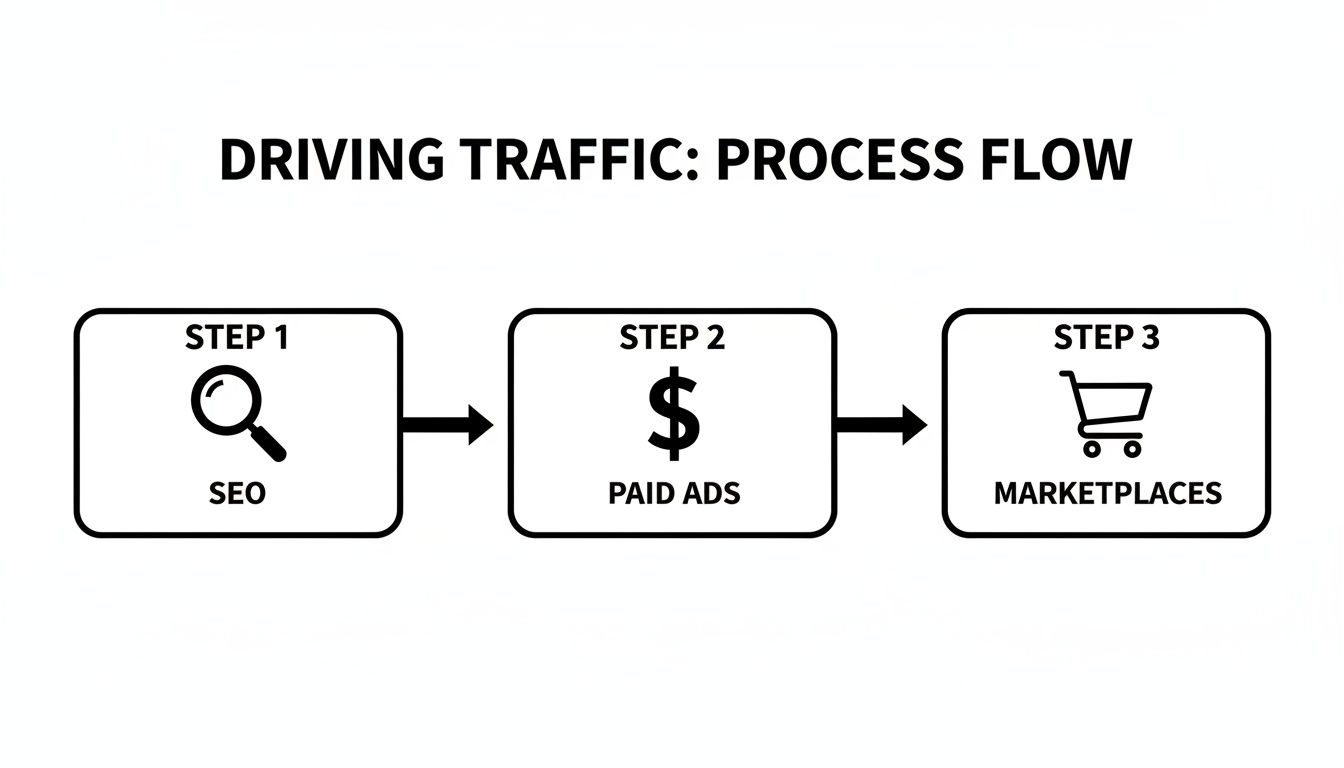
As the flow shows, a healthy traffic strategy combines long-term efforts like SEO with immediate boosts from paid ads and expanded reach through marketplaces.
Another powerful tactic is a simple loyalty program. You don’t need anything complex. A points-based system where customers earn points for every dollar spent is a fantastic starting point. These points can then be redeemed for discounts, free shipping, or exclusive products.
A great loyalty program does more than just offer discounts; it makes your best customers feel like insiders. It gives them a reason to choose you over a competitor, even if your prices are slightly higher.
Finally, consider subscriptions. If you sell consumable products—like coffee, skincare, or pet food—offering a subscription model creates predictable, recurring revenue. Customers get convenience and a slight discount, and you get a reliable income stream. This is one of the most effective ways how to increase Shopify sales consistently over the long term.
Ultimately, these communication and reward efforts are just extensions of great customer service. To learn more, check out our guide on the best practices in customer service that build lasting loyalty.
Smart Operations That Fuel Sustainable Growth
Everyone loves to talk about marketing and traffic, but the savviest Shopify merchants know that sustainable growth is really built behind the scenes. Your operational efficiency—the nitty-gritty of how you price, ship, and manage inventory—is the engine that actually drives your profitability.
Nail these things, and you'll create a seamless customer experience that protects your margins. Get them wrong, and you'll be drowning in angry customer emails and watching your profits disappear, no matter how many visitors you get to your site.
Rethink Your Pricing and Shipping Strategy
Your pricing isn't just about covering costs; it's a powerful lever for boosting your average order value (AOV), which is one of the quickest paths to growing revenue. So, let's move beyond a simple markup.
Try creating product bundles. If you sell shampoo, why not package it with the matching conditioner and a hair mask for a slight discount? The customer gets a fantastic deal on a full routine, and you just sold three items instead of one. It's a classic win-win.
Tiered pricing is another great play. Think "Buy 2, Get 10% Off; Buy 3, Get 15% Off." This simple nudge encourages shoppers to load up their carts, giving your AOV a direct lift.
Then there's shipping—the other half of the profitability puzzle. Surprise shipping costs are one of the biggest reasons people abandon their carts. Your job is to make it transparent and fair. A flat shipping rate works well, but offering free shipping on orders over a certain amount (like $75) is even better. It removes that last-minute sting and motivates customers to add just one more item to their cart to qualify.
Your pricing and shipping aren't just line items. They are a core part of the customer experience. A strategy that feels fair and delivers obvious value will always outperform one that feels confusing or punitive at checkout.
To make sure your Shopify store's growth is built to last, you'll need to go beyond marketing and implement proven actionable product growth strategies.
Master Your Fulfillment and Inventory
Okay, so you've made the sale. Now you have to get the product into your customer's hands, and you've got options.
For new stores, dropshipping is a popular low-risk entry point since you don't have to buy inventory upfront. The trade-off? You're usually looking at slimmer profit margins and have almost no control over the shipping times or unboxing experience.
Holding your own inventory gives you total command over branding, packaging, and speed, but it also ties up capital and requires space. As you start to scale, many merchants find a sweet spot by partnering with a third-party logistics (3PL) provider. A 3PL takes warehousing, picking, packing, and shipping off your plate, freeing you up to focus on what you do best—growing the business. For more on streamlining these backend tasks, check out the benefits of business process automation.
Finally, let's talk inventory management. Nothing stalls your momentum like a "sold out" notice on your hottest product. Dive into your Shopify Analytics to see what's flying off the shelves and make sure those items are always stocked. At the same time, you need to identify the slow-movers that are just sitting there tying up cash.
A simple ABC analysis is perfect for this:
- A-Items: These are your rockstars—the bestsellers bringing in the most revenue. Never let these go out of stock.
- B-Items: Your steady, mid-range sellers. Keep a close eye on their stock levels.
- C-Items: The slow-moving products taking up valuable space. It might be time to discount or bundle them to clear them out.
By fine-tuning these operational gears, you build a machine that can handle growth smoothly. As you figure out how to increase Shopify sales, your business will be ready to scale without descending into chaos, keeping both your customers and your bottom line happy.
Protecting Your Revenue from Chargebacks

As your Shopify sales climb, you'll inevitably run into an unwelcome side effect: chargebacks. A customer disputes a charge, and just like that, you're out the sale, the product, and you get hit with a hefty bank fee for your trouble. It’s one of the most frustrating parts of running an ecommerce store.
When you're just starting, a few of these a month might seem manageable. You can personally dig up the order details, find the tracking number, and submit your evidence. But as your order volume scales, this manual busywork quickly spirals into a time-sucking monster, pulling you away from the work that actually grows your brand.
The Losing Battle of Manual Disputes
Fighting chargebacks by hand often feels like you're set up to lose. Each bank and card network plays by its own set of confusing rules, and keeping up with their specific evidence requirements is a full-time job in itself. You can spend hours gathering screenshots and writing up responses, only to get a rejection because of a tiny formatting mistake.
This reactive approach always keeps you on the back foot. The pain isn't just the lost revenue from that one sale; it's the compounding bank fees and the hours of your life you'll never get back. Too many merchants just write off these losses as a "cost of doing business," but it absolutely doesn't have to be this way.
The true cost of a chargeback isn't just the transaction amount. It's the lost product, the non-refundable fees, and the countless hours your team spends on administrative tasks instead of growth and customer service.
As you grow, automating this entire process is the only way to effectively guard your bottom line.
How Automation Completely Turns the Tide
This is where automation becomes your secret weapon. Picture a system that plugs directly into your Shopify store and payment processors like Stripe or PayPal. The second a chargeback lands in your account, this intelligent system kicks into gear.
Instead of you scrambling for evidence, an AI-powered tool instantly gets to work analyzing the transaction. It automatically pulls together everything it needs to build a winning case:
- Customer details and their order history
- Shipping confirmations and delivery tracking data
- IP address logs and device information
- Any email or chat communications with the customer
With all the data compiled, it generates a compelling, evidence-packed dispute response formatted exactly how the specific bank wants to see it. This isn't some generic template; it’s a custom-built representment document designed to maximize your odds of winning.
Recovering Revenue and Getting Back to Growth
The point of automation isn't just to save you a headache—it’s to win back the money you rightfully earned. The best AI systems use machine learning to constantly update their strategies, drawing on insights from millions of past disputes to know what works for every bank and every reason code.
This sophisticated approach can massively increase your win rates, often recovering a huge percentage of your disputed revenue. For a growing store, that recovered cash can be the difference between hitting your profit goals and falling short. You can see more about how this works in our guide to Shopify chargeback protection.
Ultimately, protecting your revenue is a crucial, non-negotiable part of knowing how to increase Shopify sales for the long haul. By automating your chargeback management, you plug the financial leaks and free up your team to focus on what really matters: making customers happy and growing your business.
Common Questions About Growing Your Shopify Sales
As you start putting all these strategies into play to grow your Shopify store, you're going to have questions. Everyone does. To give you a head start, I’ve pulled together some of the most common questions I hear from store owners and laid out some straightforward, no-fluff answers.
What Is a Good Conversion Rate for a Shopify Store?
This is the million-dollar question, isn't it? The honest answer is: it depends. You’ll see a general benchmark of 1% to 3% thrown around, but that number can swing wildly depending on what you sell, your price point, and where your traffic is coming from.
Someone selling custom, high-end furniture might do a happy dance for a 0.5% conversion rate. On the other hand, a shop selling trendy, low-cost phone cases might be shooting for 4% or higher. Don't get fixated on a universal number.
The only metric that truly matters is how you stack up against yourself last month. Your real goal is continuous improvement. If you're at 1.5% today, the mission is to test and tweak your way to 1.7%, then 2.0%, and beyond.
This is where A/B testing becomes your best friend. Small, consistent changes—like changing the color of your "Add to Cart" button or rewriting a product headline—can create steady gains over time. Keep a close eye on your own progress in Shopify Analytics and Google Analytics to see what actually moves the needle for your audience.
How Much Should I Spend on Ads to See Results?
There's no magic number here. The smartest way to think about your initial ad budget isn't as a way to get sales, but as an investment in data. You're paying to learn what works.
A classic mistake is spending too little for too short a time, getting zero results, and then declaring, "ads don't work for me." To get any meaningful data from platforms like Meta or Google, your campaigns need enough runway to get out of their initial "learning phase."
A solid starting point for a new store is a daily budget you're comfortable losing for a week or two. For most people, this lands somewhere around $20-$50 per day.
- Be Focused: Start with just one or two ad sets and audiences. Spreading a small budget too thin is a recipe for failure.
- Prioritize Retargeting: Your warmest audience is people who’ve already visited your site. Make sure you’re showing them ads first.
- Analyze Everything: After a week, dig into the metrics. Look at your click-through rate (CTR) and cost per click (CPC). This data is gold—it tells you which ads and audiences are actually connecting.
Once you find a winning ad or a killer audience, then you can start scaling your budget with confidence. You'll know you're putting your money behind something that's already proven to work.
How Can I Compete with Big Retailers like Amazon?
Listen, trying to beat Amazon on price and speed is a losing battle. You can't. The good news? You don't have to. Your strength as a smaller Shopify store is your ability to do all the things a massive, faceless corporation can't.
You win by being more human. Here’s how:
- Have a Real Brand Story: People don’t form emotional connections with giant corporations; they connect with authentic stories and missions. Share what makes you different. Take people behind the scenes on social media. Let them see the real person behind the brand.
- Offer Expert Curation: Amazon is a bottomless, overwhelming pit of products. You can be the opposite: a trusted, expert source. By curating a fantastic, hand-picked selection in your niche, you become the go-to destination for people who care about quality and expertise, not just a low price.
- Provide Unforgettable Customer Service: This is your superpower. A handwritten thank-you note, a lightning-fast and personal reply to an Instagram DM, or a flexible solution to a customer's problem—these are things Amazon's army of bots simply can't replicate. That personal touch builds a fiercely loyal community that will choose you every single time.
Focus on your unique strengths—your brand, your curated products, and your service—to build a loyal customer base that isn't just chasing the cheapest deal. And if you're looking to keep learning and stay on top of new trends, checking out some of the top Shopify podcasts for e-commerce store owners is always a great idea.
By automating your chargeback management with ChargePay, you can protect your hard-earned revenue and focus on what truly matters—growing your store. Reclaim lost funds and eliminate manual busywork overnight. Discover how ChargePay can boost your win rates and protect your profits.


.svg)




.svg)


.svg)
.svg)
.svg)