


Losing money to chargebacks feels like a punch to the gut. It's not just a lost sale—it's your hard-earned revenue being ripped away, plus a penalty fee for your trouble.
Chargeback monitoring is the system that alerts you to these revenue fires before they burn down your profits. If you're a Shopify store owner, flying blind without a monitoring process means you're letting disputes silently drain your bank account.
At ChargePay, we've handled over 100,000+ disputes and recovered more than $2.8M for Shopify merchants. We know that reacting to chargebacks isn't enough. You need a plan.
Why You Can't Afford to Ignore Chargeback Monitoring
If you run a Shopify store, especially one using professional e-commerce web development for Shopify, you know managing risk is part of the job. Chargebacks are one of your biggest financial risks.
Each dispute is more than a simple refund. It’s a financial wound that gets deeper. You lose the sale amount, get hit with a non-refundable penalty fee from your processor, and then waste hours trying to fight it.

Think of it this way: a single chargeback is a small leak. But if you ignore it, those leaks multiply. Soon, your business is flooded, and your relationship with payment processors like Shopify Payments is in serious jeopardy.
The True Cost Is Much Higher Than You Think
The financial damage from one dispute is way bigger than the transaction value. The numbers don't lie. For every dollar of fraud, U.S. merchants are on track to lose a whopping $4.61 by 2026. That's a 37% jump in just a few years.
With global chargeback fraud losses expected to hit $28.1 billion in 2026, the quiet drain on your Shopify store can quickly become a full-blown crisis. You can see more chargeback statistics and findings if you're ready to face the numbers.
This is why waiting for disputes to happen is a losing strategy. Manually reacting to each one is a time-suck, it’s inefficient, and you have a business to run. The real goal isn't just fighting disputes—it's about building a fortress around your revenue.
At ChargePay, we've seen this story play out across more than 100,000+ disputes. The Shopify merchants who win are the ones who stop reacting and start preparing. They don't just survive; they protect their profits and keep their payment accounts healthy.
Automation Is Your Best Defense
Trying to keep up with chargebacks manually is impossible. An automated system for monitoring is the only way to stay ahead. Instead of spending hours digging through order details and writing dispute letters, an AI-powered system does the heavy lifting.
- Instantly spots new disputes the second they're filed.
- Automatically pulls all the evidence needed, like shipping confirmations and customer details.
- Submits a winning response for you, long before the deadline.
With a 92.4% win rate, ChargePay has already recovered over $2.8M for Shopify merchants by turning this frustrating chore into a solved problem. A strong monitoring system is the most important first step you can take. To learn more, check out our guide on effective chargeback prevention strategies.
Understanding Your Store's Chargeback Ratio
For your Shopify store, one number can keep you up at night: your chargeback ratio. Think of it as a report card on your business's financial health. Payment providers like Shopify Payments, Stripe, and PayPal watch this number very closely because it tells them how risky you are to work with.
The math is simple:
Chargeback Ratio = (Total Chargebacks in a Month / Total Transactions in a Month) x 100
So, if your store had 10 chargebacks out of 1,000 transactions last month, your ratio is 1.0%. That might not sound like a lot, but to a payment processor, it's a huge red flag.
Your Shopify Store's Chargeback Ratio Health Check
Here’s what those percentages actually mean for your store's health. The table below shows the different risk levels and what happens at each stage.
| Chargeback Ratio | Risk Level | Potential Consequences for Your Store |
|---|---|---|
| Below 0.5% | Good | You're in a safe zone. Processors see you as a low-risk merchant. |
| 0.5% - 0.89% | Warning | You're on their radar. You might get warnings or increased scrutiny. |
| 0.9% and above | High-Risk | Your account is in jeopardy. Expect monitoring programs, fines, and possible termination. |
Keeping your ratio well below the 0.9% threshold isn't just a good idea—it's essential for survival. Once you cross that line, getting back into good standing is a tough, uphill battle.
Why This Single Metric Can Make or Break Your Business
Imagine your Shopify store is growing. Business is booming, you’re processing hundreds of orders, and things look great. Then, a few chargebacks pop up.
You ignore them—just one or two, right? But the next month, five more land in your lap. If you had 500 sales, your ratio just hit 1.4%. Before you know it, an email lands in your inbox from your payment processor. Your account is in a "monitoring program."
This isn't just a warning. It comes with real, painful consequences:
- Higher Processing Fees: They'll start taking a bigger slice from every single sale.
- Mandatory Cash Reserves: They might hold a chunk of your money as a "rolling reserve" to cover future chargebacks, killing your cash flow.
- Account Termination: If that ratio doesn't drop, they could shut down your payment processing account for good. No account means no sales. Game over.
Your once-thriving business is now on life support, all because a handful of disputes weren't managed properly. This is why your chargeback ratio matters so much. To get a better handle on this, you can learn more about managing your e-commerce chargeback rate.
The Alarming Global Trend
This problem is only getting worse. Chargeback volumes are exploding. Predictions show a massive jump from 238 million in 2023 to an expected 337 million by 2026. That’s a 41% increase in just a few years.
For Shopify merchants, this means proactively monitoring chargebacks is no longer optional—it's a core business function. While the average U.S. chargeback rate is around 0.47%, even that small number drains millions from businesses. You can find more eye-opening chargeback statistics that show how urgent this is.
Staying below that critical 0.9% threshold is the name of the game. Winning a single dispute feels good, but the real goal of chargeback monitoring is to protect this fundamental metric. It’s all about protecting your ability to accept payments and stay in business.
At ChargePay, we've helped merchants recover over $2.8M by winning disputes and helping them maintain a healthy standing with their payment processors. Our 92.4% win rate across more than 100,000+ disputes is proof that fighting back works, and it directly helps keep those dangerous ratios down. Ready to protect your account? Install ChargePay from the Shopify App Store.
The Four Stages of the Chargeback Monitoring Workflow
Let's be real—managing chargebacks isn't about one magic fix. It’s a complete workflow, a four-part battle plan for protecting your revenue. Each stage has a specific job, guiding you from the initial shock of a dispute to a smarter strategy for preventing the next one.
Understanding this journey shows you why handling it all by hand is a losing game and how automation can completely change your odds. For any Shopify store owner, getting this workflow right means the difference between losing money and winning it back.
Stage 1: Detection and Alerting
This is the moment the alarm bells should ring. Detection is simply how you find out a customer has filed a chargeback. For most merchants, this starts with an email from Shopify.
- The Manual Grind: You're stuck checking your email constantly or logging into your Shopify admin every day. If you miss a notification over the weekend, you can lose precious days. With response deadlines as short as 7-10 days, missing that window means you automatically lose the dispute and the money.
- The Automated Edge: A tool like ChargePay spots the dispute the second it's filed. You get an instant alert, so no dispute ever slips through the cracks. The clock starts, but you're already sprinting.
Stage 2: Evidence Collection
Okay, you know about the dispute. Now you have to gather the proof to fight back. This is where the manual process becomes a real time-sink. You have to become a digital detective, digging through records to build your case.
You need to track down and organize every piece of evidence that proves the transaction was legitimate. This includes things like:
- Order Details: The customer’s name, email, and billing address.
- Proof of Delivery: Tracking numbers and carrier confirmations showing the package landed at the right address.
- Customer Communications: Any emails, chat logs, or support tickets connected to the order.
- Digital Footprints: The IP address used for the order and the AVS/CVV match results.
Pulling all this from Shopify, your shipping provider, and your helpdesk can take hours for just one dispute. With an automated solution, an AI does the heavy lifting, pulling all this data together in seconds.
Stage 3: Representment
Representment is the formal process of sending your evidence to the customer's bank to fight the chargeback. This is your one shot to make your case and get your money back.
A strong representment isn't just a folder of files; it's a persuasive argument. It needs to be clear, concise, and formatted exactly how the card networks demand. A poorly written or incomplete response is almost guaranteed to fail, no matter how solid your evidence is.
If you’re doing this manually, you’re writing a custom rebuttal letter for every single dispute. This is where our 92.4% win rate comes into play—ChargePay’s AI doesn't just gather data; it analyzes the dispute reason code and writes a tailored, compelling argument designed to win.
If you want to go deeper on this, check out our guide on chargeback dispute management.
Stage 4: Analysis and Prevention
Winning a dispute feels great, but preventing the next one is where you save the real money. The final stage of a solid monitoring workflow is analyzing data from past disputes to spot patterns and fix root causes.
The infographic below shows the critical thresholds for your chargeback ratio—the most important metric this entire workflow is designed to protect.
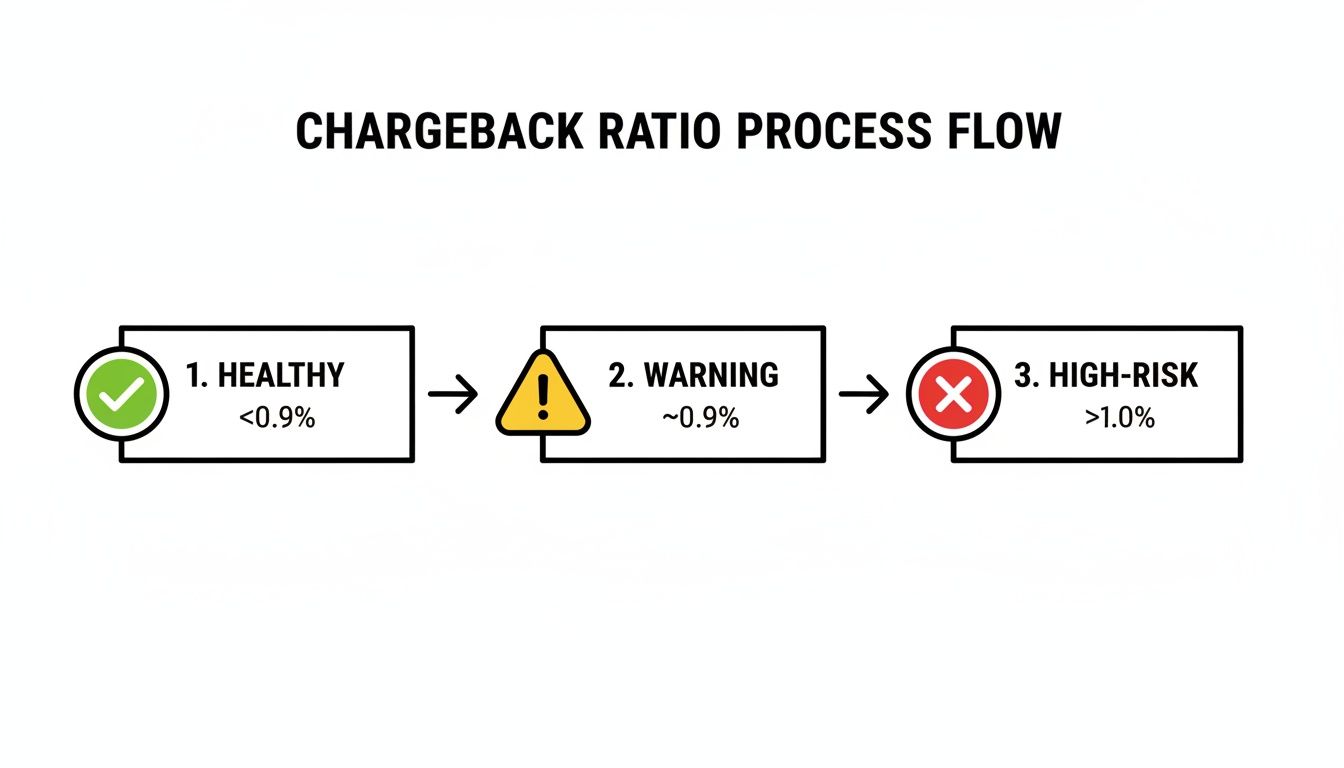
This flow shows just how quickly unmonitored disputes can push your store from a healthy status into a high-risk zone, putting your entire ability to process payments at risk.
By tracking why chargebacks are happening (like "Product Not as Described"), you can make smart changes, like rewriting product descriptions or improving shipping updates. An automated platform gives you dashboards that make these trends obvious, turning your dispute data from a headache into a powerful tool for growth.
Decoding Common Chargebacks and How to Fight Them
Not all chargebacks are created equal. Trying to fight them without knowing what you’re up against is like a doctor prescribing medicine without a diagnosis—it won't work. To build a solid chargeback monitoring plan, you first need to understand the different types of disputes that can hit your Shopify store. They fall into three main buckets.

While criminal fraud and your own mistakes are part of the picture, one category stands out as the single biggest threat to your bottom line.
The Rise of Friendly Fraud
The most common—and infuriating—dispute you'll face is friendly fraud. This is when a real customer buys from you, gets their product, and then files a chargeback anyway. They might claim the order never showed up or that they didn't authorize the purchase. The result? They keep your product and get a full refund, leaving you to foot the bill.
This isn't a minor annoyance; it's a massive problem for Shopify store owners. According to Mastercard, this type of first-party misuse is the main reason for disputes, making up a shocking 70% of all chargebacks. If that wasn't bad enough, a 2026 study revealed that 72% of merchants have seen a spike in these exact claims. It's the number one headache for e-commerce, and it's not going away. You can discover more insights about these friendly fraud findings to see the alarming trends for yourself.
What’s truly damaging about friendly fraud is that it often repeats. When you let an invalid chargeback slide, there’s a 50% chance the same customer will do it again within 90 days. It creates a cycle of lost revenue for your store.
How to Fight and Win Against Friendly Fraud
Let’s play out a classic scenario. A customer, Alex, orders sneakers from your store. You ship them, and tracking shows they were delivered and signed for. A week later, a chargeback alert hits your inbox: Alex claims he never got the package.
This is textbook friendly fraud. To win this fight, you have to prove the transaction was legitimate and the delivery was successful. Hunting down this proof manually takes ages, but it’s the only way to get your money back. Here’s what you need:
- Proof of Delivery: Your tracking number showing a "delivered" status to the correct address is your best evidence.
- IP Address Logs: Evidence that the order was placed from an IP address that matches the customer’s shipping location.
- AVS/CVV Match: Proof that the address verification and credit card security code were a perfect match at checkout.
- Customer Communications: Any emails or chat logs where the customer confirmed their address or talked about the order.
Pushing back isn't just about recovering one sale. It’s about sending a message that you won't be an easy target. This is where an automation tool like ChargePay becomes essential. Our AI instantly pulls together all this evidence, builds a professional case file, and submits a response designed to win. We’ve fought over 100,000+ disputes and our 92.4% win rate proves that with the right evidence, you can beat friendly fraud.
Other Chargeback Types to Know
While friendly fraud will be your main opponent, you should know the other two types:
- True Fraud: This is classic criminal fraud—a thief using a stolen credit card. Your fraud filters should catch most of these, but some might sneak through.
- Merchant Error: These are honest mistakes that happen on your end. Maybe you shipped the wrong size or had a confusing return policy. The best way to deal with these is to own the mistake, fix the root cause, and make sure it doesn’t happen again.
By understanding these categories, you can stop fighting blind. You can start tailoring your responses and build a chargeback monitoring strategy that turns a huge revenue leak into a manageable part of running your business.
Key Metrics to Track for Effective Chargeback Management
You can't fix what you don't measure. While your chargeback ratio is critical, a truly effective chargeback monitoring strategy goes deeper. Relying on that one number is like trying to fly a plane with only a fuel gauge—you're missing all the other instruments that tell you how you're flying.
To turn raw data into strategic insights that protect your revenue, you need to track a handful of key performance indicators (KPIs). Analyzing these metrics will show you exactly where your chargeback problems are coming from, giving you a clear path to fix the root cause.
Win Rate and Recovery Rate
These two metrics are the most direct measures of your success in fighting chargebacks. They sound similar, but they tell you slightly different things.
Win Rate: This is the percentage of disputes you fight and win. If you fought 10 chargebacks last month and won 8, your win rate is 80%. This tells you how effective your evidence is.
Recovery Rate: This one is all about the money. It measures the total dollar amount you've recovered from disputes compared to the total dollar amount you lost. It shows the real financial impact of your efforts.
At ChargePay, we focus obsessively on these numbers because they represent real money back in your pocket. Our 92.4% win rate across over 100K+ disputes has helped us recover more than $2.8M for Shopify merchants. That’s tangible proof that fighting back—and winning—is possible.
Chargebacks by Reason Code
This is where you stop reacting and start getting strategic. Every chargeback comes with a "reason code" from the cardholder's bank, like 'Product Not as Described' or 'Transaction Not Recognized'. Tracking these codes is like getting a detailed report card on your business.
A sudden spike in 'product not as described' chargebacks isn't just bad luck; it's a flashing red light telling you to check your product pages. Your photos might be misleading or your descriptions could be missing key details.
By digging into these reason codes, you can pinpoint specific problems:
- 'Fraudulent Transaction': Seeing a lot of these? It may be time for stronger fraud filters.
- 'Services Not Rendered': This could point to shipping delays or poor communication about delivery times.
- 'Credit Not Processed': This might mean your refund process is too slow or confusing for customers.
Fixing these root issues is the most powerful way to slash your chargebacks. For more ways to use data to your advantage, you can explore some of the top chargeback management tools available.
Dispute Aging
Dispute aging is how long it takes for a chargeback to go from initial alert to final resolution. The clock is always ticking. Banks give you a very tight window—sometimes just a few days—to submit your evidence.
If your dispute aging is high, you're taking too long to respond. This dramatically increases the risk of missing deadlines and automatically losing disputes you could have won. Slow responses are a huge liability.
An automated system eliminates this risk by responding instantly, ensuring you never lose a dispute because you were a day late. Tracking these KPIs is the only way to get a complete picture of your store's health and fight disputes effectively.
Automate Your Dispute Management with AI
Let's be honest. Managing chargebacks yourself is like trying to bail out a sinking boat with a teacup. It's an exhausting, never-ending cycle. The paperwork is a nightmare, the deadlines are tight, and you're often set up to lose from the start.
The alternative? Stop bailing and install a system that plugs the leak for you.
This is exactly why we built ChargePay. It’s an AI-powered chargeback app made specifically for Shopify merchants like you. We’ve earned our 4.9-star rating and the official 'Built for Shopify' badge by delivering real, measurable results.
From Manual Headaches to Automated Wins
Instead of spending your valuable time digging through old orders and piecing together evidence, you can have an app handle the entire fight. The second a new dispute hits your account, ChargePay’s AI is on the case.
It immediately identifies the chargeback, then gets to work gathering all the proof needed to build a winning case. We’re talking delivery confirmations, AVS/CVV match data, IP address logs—everything the banks want to see. From there, it crafts a custom, evidence-packed response and submits it for you, so you never miss a deadline.
We’ve successfully managed over 100,000 disputes for Shopify stores. Our track record? A 92.4% win rate, recovering more than $2.8 million in revenue that would have otherwise been lost. This isn't about winning a dispute here and there; it's about making chargebacks a solved problem for your business.
The whole idea is to take this stressful task completely off your plate. For busy Shopify store owners, that means no more forgotten deadlines, no more guessing what evidence to submit, and no more hours wasted on a fight you’ll probably lose on your own. If you want to dive deeper into automation, leveraging AI apps for Shopify stores is a great way to streamline these kinds of time-consuming processes.
A System That Knows How to Win
Our AI has been trained on hundreds of thousands of real disputes. It knows exactly what card issuers look for and how to frame the evidence to get your money back. This data-first approach lets you step away from the entire workflow and get back to what you do best: growing your business.
Here’s what that looks like in practice:
- Instant Detection: No dispute ever slips through the cracks.
- AI-Powered Evidence Gathering: Every piece of relevant proof is collected automatically.
- Expert Representment: A winning response is written and submitted on your behalf.
With ChargePay, you aren't just downloading a tool. You're getting a fully managed service that handles the A-to-Z of every dispute. Best of all, our pay-per-win model means we only make money when we get your money back.
Ready to see how it works? Read our complete guide to automated chargeback and dispute management using AI, or install ChargePay from the Shopify App Store and finally put your chargeback problems behind you.
Frequently Asked Questions About Chargeback Monitoring
As a Shopify store owner, you're bound to have questions when chargebacks pop up. It's a confusing part of e-commerce.
We hear the same questions all the time from merchants just like you. Here are some straightforward answers to help you get a handle on chargeback monitoring and deal with disputes a smarter way.
How Often Should I Monitor for Chargebacks?
You need to be checking for new disputes daily. No exceptions.
The deadlines set by banks are incredibly strict. Sometimes you only have a few days to get your evidence together and submit it. If you miss that window, you automatically lose the dispute and the revenue. No appeals, no second chances.
This is exactly why 24/7 automated monitoring is so valuable. A tool like ChargePay spots a dispute the second it’s filed and gets to work on your case immediately. You never have to lose money just because you were a day late.
Can I Handle Chargeback Monitoring Myself?
You can try, but it becomes almost impossible to do well once your store starts growing. You're looking at constant checking, digging up evidence for every order, and writing persuasive responses from scratch.
The tough reality is that the average win rate for merchants doing it all manually is often below 20%.
When you realize a single bogus chargeback can cost you more than four times the original sale in fees and lost product, a DIY approach quickly becomes more expensive than a dedicated tool that wins for you.
What Is the Difference Between a Chargeback and a Refund?
Think of a refund as a handshake. It's a cooperative process you manage directly with your customer to return their money, usually as part of good customer service. You’re in control, and there are no penalties.
A chargeback, on the other hand, is a forced reversal started by the customer's bank. It completely cuts you out of the process, slaps you with extra penalty fees, and damages your store's all-important chargeback ratio.
Refunds are a cost of doing business. Chargebacks are a direct threat to your business's health.
Ready to stop losing revenue to disputes? ChargePay has helped Shopify merchants like you recover over $2.8M with a 92.4% win rate. Let our AI handle the entire fight for you.
Install ChargePay from the Shopify App Store and turn chargebacks into a solved problem.


.svg)



.svg)


.svg)
.svg)
.svg)