

Your chargeback ratio is more than just a number—it’s the credit score for your Shopify store. It’s calculated by taking the number of chargebacks you get in a month and dividing it by your total transactions for that same month.
A low score tells payment networks you’re a safe bet. But a high one? That’s a major red flag, signaling that your business might be high-risk. This can trigger serious penalties, like higher fees or even getting your account shut down, which is why you absolutely have to get this number under control.
Why Your Chargeback Ratio Is a Critical Metric
For any Shopify store owner, the chargeback ratio isn't just another metric on your dashboard. It’s the single most important indicator of how trustworthy your business looks to payment processors like Visa and Mastercard.
A low ratio is a sign of a well-run store with happy customers and secure checkout. On the other hand, a high ratio immediately suggests problems—maybe with your products, your customer service, or your defenses against fraud.
This one number hits your bottom line in a few painful ways:
- Increased Fees: Processors often slap higher transaction fees on merchants they consider high-risk.
- Frozen Funds: Your processor might decide to hold a chunk of your money in a reserve account just in case they need to cover future chargebacks.
- Account Termination: This is the worst-case scenario. If your ratio stays too high for too long, your processor can close your merchant account, leaving you unable to accept credit card payments at all.
At ChargePay, we've helped over 100,000 Shopify merchants tackle this exact problem, recovering more than $2.8 million in revenue that would have otherwise been lost. We get that every single chargeback matters, not just for the lost sale, but for its impact on your store’s long-term health.
How Is the Chargeback Ratio Calculated?
Getting a handle on the math is the first step to taming your ratio. While different card networks might have tiny differences in their calculations, it almost always comes down to one of two methods.
Here's a quick look at the two primary ways payment networks calculate your chargeback ratio, so you know exactly what they're measuring.
| Chargeback Ratio Calculation Methods | ||
|---|---|---|
| Calculation Method | Formula | When It's Used |
| By Transaction Count | (Total Chargebacks in Month / Total Transactions in Month) x 100 | This is the most common method used by processors like Visa and Mastercard. |
| By Transaction Value | (Total Dollar Value of Chargebacks / Total Dollar Value of Sales) x 100 | This is less common but sometimes used to measure the financial impact of disputes. |
Most of the time, you'll be judged by the first method—transaction count. So, if your store had 100 chargebacks and 10,000 transactions in June, your ratio would be 1% (100 / 10,000). That’s the number payment processors are watching like a hawk.
To take back control, you need a solid process for both preventing and fighting these disputes. You can learn more about building that strong foundation in our guide to chargeback management. Properly handling disputes doesn’t just get your money back; it actively protects your store’s ability to keep operating.
What Is a Good Chargeback Ratio?
So, what’s a “good” chargeback ratio? It’s a question every merchant asks, but the answer isn't a single magic number. What's acceptable changes completely depending on your industry. For Shopify store owners, knowing your specific benchmark is the key to setting goals that actually make sense.
If there’s one number you need to burn into your memory, it’s 0.9%. This is the magic threshold where major card networks like Visa and Mastercard start seeing you as “high-risk.” Crossing that line is a big deal. It can trigger serious penalties, like higher processing fees and a whole lot of unwanted attention on your merchant account.
Card Network Thresholds
At the end of the day, the card networks are the referees. If they think your ratio is too high, you’re officially in the penalty box. Visa, for instance, has a monitoring program that keeps a close eye on merchants who consistently rack up too many disputes month after month.
You have one primary dispute ratio to track. This combines both fraud and non-fraud disputes, meaning every single chargeback—from criminal fraud to a simple customer complaint—counts against you.
This simple formula is all it takes: divide your total chargebacks by your total transactions for the month.
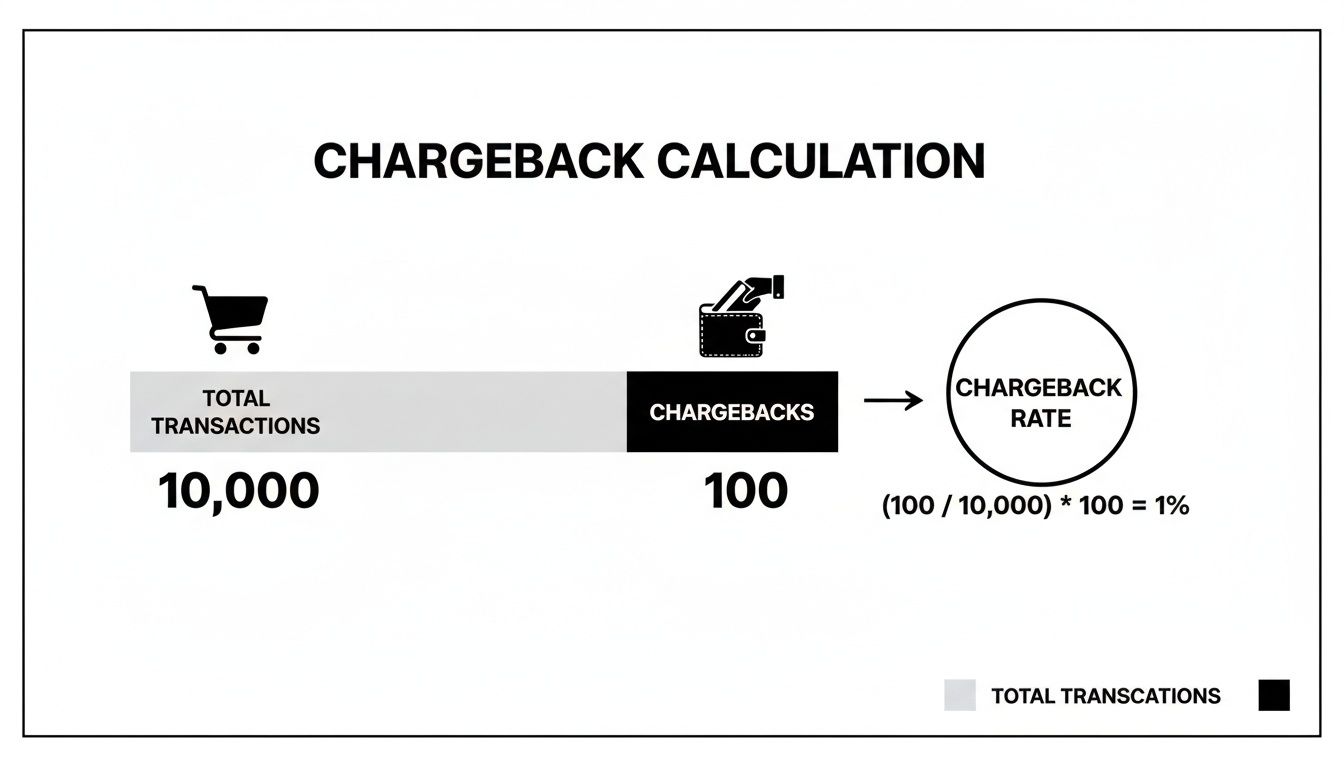
As you can see, it doesn’t take a massive number of disputes to tip you over the edge, especially if your transaction volume isn't huge. Every single chargeback matters.
Benchmarks Across Different Industries
Your chargeback risk is tied directly to what you sell and who you sell it to. A Shopify store selling digital downloads, for example, is going to have a much tougher time with disputes than a local shop selling handmade goods. Knowing these differences helps you see how your own store is really doing.
The average e-commerce retail ratio is about 0.95%, which puts a ton of stores right on that high-risk cliff edge. Some industries are way riskier. Digital goods can see ratios skyrocket to 3.62%, mostly from things like impulse buys and friendly fraud. On the flip side, countries like Japan and China have incredibly low ratios—around 0.18%—thanks to different payment cultures.
For a lot of Shopify merchants, especially in booming niches like supplements or DTC fashion, the biggest headache is "friendly fraud." This is when a legitimate customer files a chargeback just because it’s easier than asking for a refund. It’s a massive problem, with some data showing that 52% of these customers never even try to contact you first.
This is exactly the kind of bleeding revenue our AI platform is built to stop. We’ve fought over 100,000 disputes and maintained a 92.4% win rate. To see how your specific industry stacks up, check out our full guide on the average ecommerce chargeback rate.
The Top 3 Reasons Your Chargeback Ratio Is Too High
If you’re watching your chargeback ratio creep up, it’s usually not some big mystery. Most of the time, the problem can be traced back to one of three common culprits.
Figuring out which one is hitting your Shopify store is the first real step toward plugging the revenue leak and getting that ratio back where it belongs.
1. Friendly Fraud and Buyer’s Remorse
This is the number one headache for most Shopify merchants and, honestly, the sneakiest reason for a high chargeback ratio. Friendly fraud is what happens when a real customer buys something, receives it, and then goes straight to their bank to dispute the charge instead of coming to you for a refund.
They might not recognize the charge on their statement, completely forget they bought it, or just figure it’s easier to call their bank than to follow your return policy.
A huge chunk of these disputes—over 50%, according to some studies—happen without the customer ever reaching out to you. You end up losing the sale, the product, and get hit with a chargeback fee, all because of a communication gap that could have been bridged.
This category also includes what’s basically "cyber-shoplifting," where someone knows the charge is valid but disputes it anyway to get their item for free. This is a massive driver of high chargeback ratios in e-commerce today.
2. Merchant Errors and Poor Customer Experience
Sometimes, you have to look in the mirror. Simple mistakes or a clunky customer experience can send buyers running to their banks to file a dispute. If a customer hits a wall trying to solve an issue or can't get a response from you, a chargeback becomes their path of least resistance.
Here are some of the most common merchant slip-ups:
- Unclear Billing Descriptors: If your business shows up as something cryptic like "SP *WEBSERVICES" on a bank statement, customers will assume it’s fraud. Your descriptor needs to clearly state your store's name.
- Slow or Hidden Customer Service: When a customer can't find your contact info or has to wait days for a simple reply, their patience runs out. The next call they make is to their bank.
- Fulfillment and Shipping Delays: Long shipping times or products that show up way later than promised are a major trigger for "item not received" chargebacks.
- Confusing Return Policies: A difficult or overly strict return process will push customers toward the chargeback button. For them, it’s just an easier way out. Our guide on the top reasons for a chargeback breaks down more of these preventable issues.
3. Criminal Fraud
Finally, there’s good old-fashioned criminal fraud. This is what happens when a scammer uses stolen credit card details to buy something from your store. When the actual cardholder sees the unauthorized charge, they report it, and you get an immediate chargeback.
While this is often the first thing merchants think of, it’s frequently a smaller piece of the puzzle compared to friendly fraud and merchant error. That said, even a handful of fraudulent transactions can make your chargeback ratio spike if you don't have solid fraud filters in place.
How to Proactively Lower Your Chargeback Ratio
Waiting around for a chargeback alert to land in your inbox is like waiting for a hurricane warning before you board up the windows. A proactive game plan is the only way to actually protect your revenue and keep that chargeback ratio out of the red zone.
The real goal here is to get out in front of disputes before they even have a chance to start.
This requires a mental shift. You have to start treating every single order as a potential dispute just waiting for a reason to happen. When you adopt that mindset, you automatically begin building a defense system around each transaction. It’s not about being negative; it’s about being ready to defend the money you've worked hard to earn.
Set Up Your First Line of Defense
Simple, clear communication is your single most powerful weapon against friendly fraud and plain old customer confusion. Believe it or not, most disputes start as a small misunderstanding that just snowballs out of control.
You can stop these problems dead in their tracks with a few basic, but absolutely critical, adjustments:
- Clarify Your Billing Descriptor: That name showing up on your customer's credit card statement needs to be instantly recognizable as your store. Something like "SP*YOURSTORENAME" is miles better than a cryptic code that just screams "fraud."
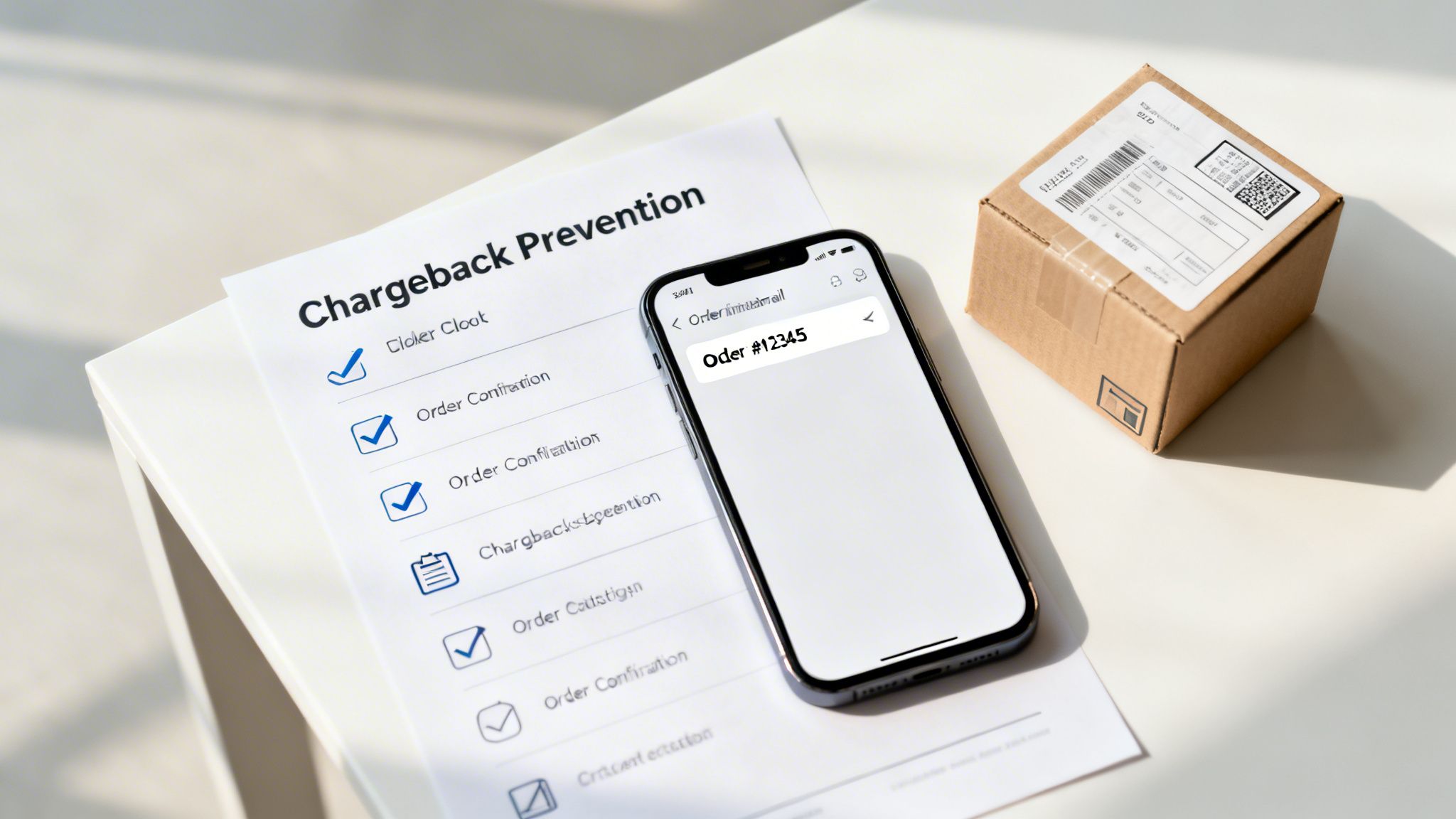
- Send Detailed Order Confirmations: Your confirmation email should be a complete digital receipt. It needs the item purchased, total cost, your store name, and an easy-to-find link to your customer service page.
- Make Your Policies Impossible to Miss: Your return, refund, and shipping policies should be crystal clear and practically jumping off the page. A customer who knows the right way to ask for a refund is far less likely to file a chargeback.
To cut down on the customer frustration that often leads to disputes, focusing on strong user experience design best practices can make a world of difference. A smooth, intuitive website builds trust and gets rid of a ton of friction.
Use Shopify’s Built-In Tools
Shopify actually gives you some powerful tools to stop sketchy orders before they turn into expensive chargebacks. Their built-in fraud analysis uses machine learning to flag orders with red flags, like an AVS mismatch or an IP address that’s thousands of miles from the billing address.
Don't just blow past these warnings. Take a moment to dig into any order that gets flagged as high-risk. A quick email or phone call to the customer can confirm if an order is legitimate or if you should just cancel and refund it right away. Taking that small step can save you from a guaranteed chargeback down the line.
Think of every order confirmation, shipping notification, and delivery confirmation as a piece of evidence. You’re not just serving a customer; you're building a case file to protect your revenue in case a dispute arises.
At ChargePay, we see this play out every single day. The merchants who consistently win disputes are the ones who have all their evidence locked and loaded from the very beginning. We've helped Shopify stores recover over $2.8M by turning this proactive mindset into an automated reality.
Our AI platform, which holds a 92.4% win rate across more than 100,000+ disputes, knows exactly what evidence you need to win. For more strategies, check out our complete guide on chargeback prevention.
How Winning More Disputes Protects Your Ratio
A lot of Shopify merchants have this idea that once a chargeback is filed, that money is just gone. Poof. But that’s a costly misconception. Every single dispute you win doesn't just put that sale's revenue back in your pocket—it actively helps lower your chargeback ratio.
Think of it this way: your ratio is a balancing act between the disputes coming in and all your successful transactions. Winning a dispute is like taking a weight off the chargeback side of the scale. It's a direct counter punch to new disputes and shows payment processors you’re on top of your game.
The Rising Tide of Disputes
For a busy store owner, trying to fight every dispute manually feels like an impossible task. The problem is only getting bigger, too. According to some projections, global chargeback volume is set to grow 24% between 2025 and 2028.
This isn't just a small leak; it's a flood that can sink your revenue. You can dive deeper into these latest chargeback statistics to see just how this trend impacts stores like yours.
A common mistake is to only focus on preventing future chargebacks. But what about the ones already filed? Ignoring them is like letting a small fire burn in your backyard—it will eventually spread and cause much bigger problems for your merchant account.
Winning disputes isn’t just about playing defense; it’s a proactive strategy. It sends a clear signal to the card networks that you’re a responsible merchant, which is key to keeping your payment processing account in good standing.
At ChargePay, our AI-powered platform makes this whole process feel less like a chore and more like a solved problem. We've handled over 100,000+ disputes for our Shopify merchants, rocking a 92.4% win rate and recovering over $2.8 million. Every one of those wins helped protect our clients' businesses.
Ready to stop leaving money on the table? Install ChargePay from the Shopify App Store and let our AI start winning back your revenue and protecting your ratio today.
Automate Your Chargeback Defense with ChargePay
If you're a busy Shopify owner, fighting chargebacks by hand feels like an impossible task. You’re forced to spend hours digging through order details, tracking numbers, and customer emails, all while you’re supposed to be running your actual business. It’s a slow, frustrating process—and every minute you spend on a dispute is a minute you’re not making sales.
This is where automation comes in and completely changes the equation. Instead of getting buried in paperwork, an AI-powered tool can take over the entire fight for you.
Let AI Fight for Your Revenue
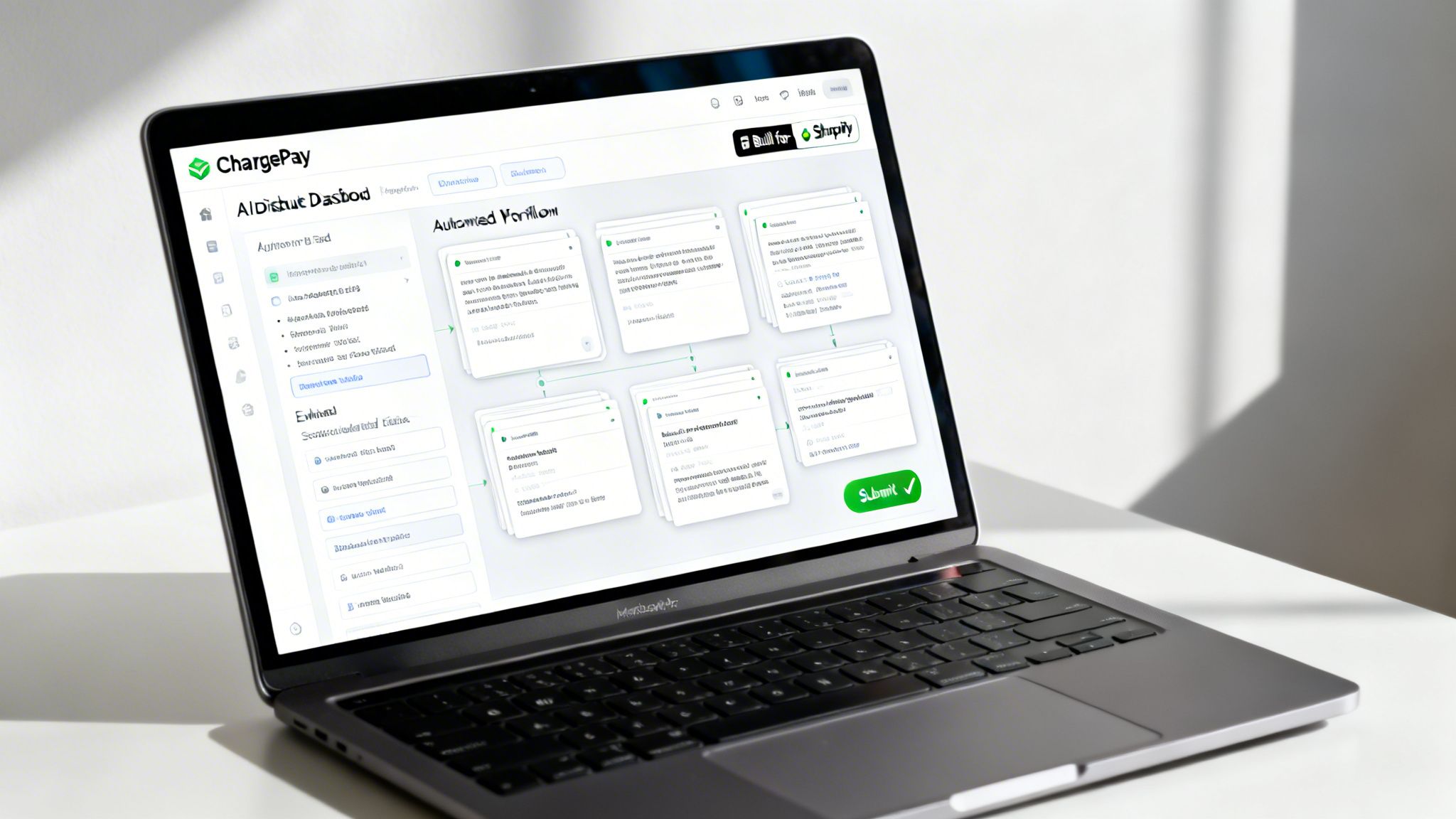
Imagine a chargeback alert hits your account. Instead of that familiar sinking feeling, our AI gets to work for you that very second. We designed ChargePay specifically for Shopify merchants, turning that manual headache into a solved problem.
Here’s how our AI flips the script on disputes:
- It instantly breaks down the dispute: The moment a chargeback is filed, our system analyzes the reason code and customer's claim to figure out exactly what evidence the bank needs to see.
- It gathers all the proof: The AI automatically pulls every relevant piece of data from your Shopify store—order history, shipping confirmations, customer messages, and more.
- It builds a winning case: It then assembles all this information into a professional, data-backed evidence package, formatted exactly how the card networks want it.
This whole process happens in real time, so you never risk missing a tight deadline. This is exactly how we’ve handled over 100,000+ disputes for Shopify merchants and maintain our 92.4% win rate.
A Proven Solution Built for Shopify
You don't have time to gamble on tools that might not work. That’s why we let our numbers do the talking. We've successfully recovered over $2.8 million for store owners just like you, turning what would have been lost revenue back into profit. This is the power you get when you have a specialized AI dedicated to one single job: winning your disputes.
For a Shopify owner, fighting chargebacks isn’t your primary job—but it’s ours. By automating your defense, you stop reacting to revenue loss and start proactively protecting every sale you make.
As a 'Built for Shopify' app with a 4.9-star rating, we're plugged directly into the platform you use every day. Our system gets the data and workflows that are unique to Shopify, giving you a huge advantage when it's time to defend your transactions.
Ready to see how automation can protect your chargeback ratio and put money back into your business? Explore the features of our automated product and see why thousands of merchants trust ChargePay to handle their disputes. You can install ChargePay directly from the Shopify App Store and let our AI win your next chargeback for you.
Your Top Questions About Chargeback Ratios, Answered
When you're trying to get a handle on your chargeback ratio, it's natural to have questions. We hear a lot of the same ones from Shopify merchants, so let's clear up some of the most common concerns.
How Quickly Can I Lower My Chargeback Ratio?
You can start to see the needle move in as little as 30-60 days. It all comes down to a two-part strategy. Your ratio is the number of disputes you get in a month divided by your sales in that same month.
First, you play defense. By putting strong prevention tactics in place right now—like making your billing descriptor crystal clear—you cut down on the number of new chargebacks coming your way. At the same time, you have to go on offense. Every dispute you win gets removed from that ratio calculation. Using an automated tool like ChargePay to fight every single dispute is the fastest way to get those wins, which helps pull your ratio down much quicker.
Will a High Chargeback Ratio Get My Shopify Account Shut Down?
This is a big one, and the answer is yes, but indirectly. Shopify itself probably won't close your store. The real danger is your payment processor, like Shopify Payments. They are the ones who will absolutely pull the plug on your merchant account if your chargeback ratio gets too high.
Why? Because to them, a high ratio screams financial risk.
If you lose your payment processor, you can't accept credit card payments. For pretty much any Shopify store, that’s game over. This is why keeping your chargeback ratio low isn’t just a good practice—it's absolutely critical for your business's survival.
Is It Realistic to Aim for a 0% Chargeback Ratio?
While a 0% chargeback ratio would be amazing, it's almost impossible for any e-commerce business to hit. You could have the most perfect products and the best customer service on the planet, and you'd still run into things you can't control.
You'll always have to deal with friendly fraud—where a customer disputes a perfectly valid charge because it's easier than asking for a refund—or just honest mistakes from buyers. A much healthier and more realistic goal is to keep your ratio safely under your industry's average, and most importantly, below the 0.9% high-risk line drawn by the card networks. Getting as close to zero as possible is where automation comes in, making sure you can effectively fight every dispute that comes your way.
Stop letting your chargeback ratio get the best of you. ChargePay has helped over 100,000 merchants recover more than $2.8 million with a 92.4% win rate. As a 'Built for Shopify' app with a 4.9-star rating, we turn chargebacks into a solved problem. Install ChargePay from the Shopify App Store and let our AI start protecting your revenue today.


.svg)



.svg)


.svg)
.svg)
.svg)