


Chargeback recovery is how you fight disputes to get your money back. It’s about collecting proof to show the bank that the original sale was legitimate. For any Shopify merchant, doing this right is essential to protect your hard-earned revenue.
The Hidden Costs of Chargeback Recovery
When you get that dreaded chargeback notification for a $100 order, it’s easy to think, “Okay, I’m out $100.” But that’s just the tip of the iceberg. The real financial hit is much, much worse.
Chargebacks have a nasty multiplier effect. They add operational costs, non-refundable bank fees, and all the money you spent on marketing to get that customer. That initial $100 loss can quickly balloon into something far more damaging.
This isn't just a small business headache; it’s a serious threat to your profitability. In fact, it's projected that by 2026, U.S. businesses will lose an average of $4.61 for every $1 disputed. That's a massive 37% jump in just five years, fueled by the sheer operational nightmare of managing these disputes.
The global picture is staggering, with $65.2 billion disputed in 2023 alone. This hits Shopify stores in high-risk niches like supplements, fashion, and electronics especially hard.
This flowchart shows just how quickly a simple order can spiral into a major financial loss.
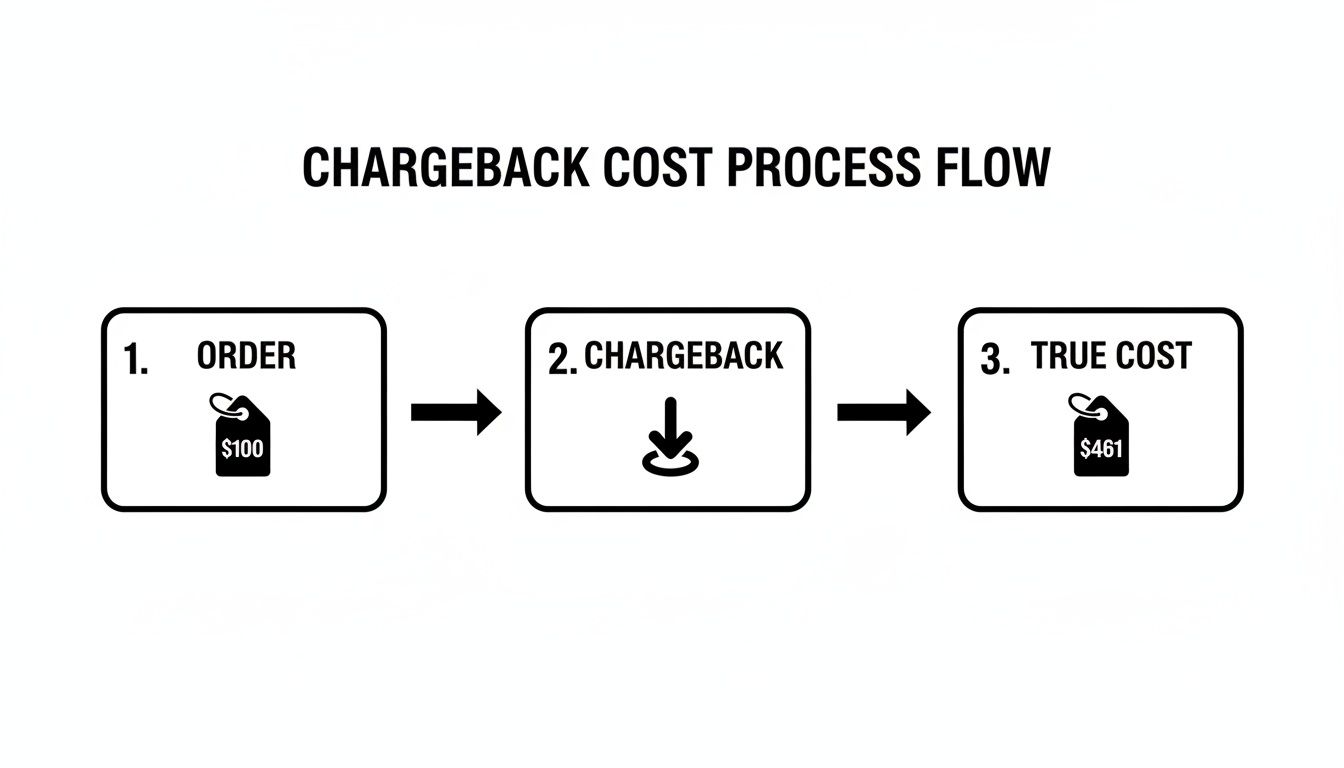
As you can see, the journey from a sale to a chargeback is an expensive one. It turns what should have been a profitable transaction into a significant liability, which is why having a solid chargeback recovery playbook isn't just a good idea—it's non-negotiable.
Understanding the True Financial Impact
To really grasp the damage, you have to look past the initial sale amount. Every single chargeback piles on multiple layers of costs that many Shopify store owners don't see at first. These hidden expenses are what make an effective recovery strategy so critical.
Here’s a breakdown of what each dispute is really costing you:
The True Cost of a Single Chargeback
This table breaks down the hidden costs beyond the initial transaction value, illustrating the multiplier effect on your business.
All told, that $100 chargeback actually costs your business $195 in this example—and that's before factoring in the long-term damage to your merchant accounts.
The reality for Shopify merchants is grim: manually fighting chargebacks is a slow, painful battle with a shockingly low success rate. Here at ChargePay, we've handled over 100,000 disputes, successfully recovering $2.8 million+ for our merchants by automating this entire headache.
Winning back your revenue is about more than just the money; it’s about reclaiming the time and energy you need to actually grow your business. To get a complete overview of the process, you can read our detailed guide on what is chargeback management.
This playbook will give you the actionable steps to build a winning strategy.
Building Your Evidence Package to Win Disputes
When it comes to winning a chargeback dispute, the evidence you submit is everything. A messy, incomplete, or weak package is a surefire way to lose—it gives the card issuer no reason to side with you. You have to think of your evidence as telling the complete story of the transaction. It needs to be clear, compelling, and leave no room for doubt.
This is where the battle is truly won or lost. At ChargePay, we’ve managed over 100,000 disputes for Shopify merchants and hold a 92.4% win rate, so we know firsthand that solid evidence is the backbone of every successful representment. Remember, a bank employee only spends a few minutes on your case, so your submission has to be easy to scan and understand instantly.
Essential Evidence to Gather
For any dispute that comes your way, there’s a core set of documents you’ll need to prove you held up your end of the deal. The moment you get that chargeback notification, start pulling these together.
- Order and Transaction Details: This is the basic who, what, and when. Include the order date, time, total amount, and exactly what was purchased, including SKUs. A quick screenshot from your Shopify dashboard works perfectly here.
- Customer Communications: Dig up any and all conversations you had with the customer. This means emails, live chat logs, or even DMs on social media. These can show they got support, acknowledged shipping, or were even happy with their purchase.
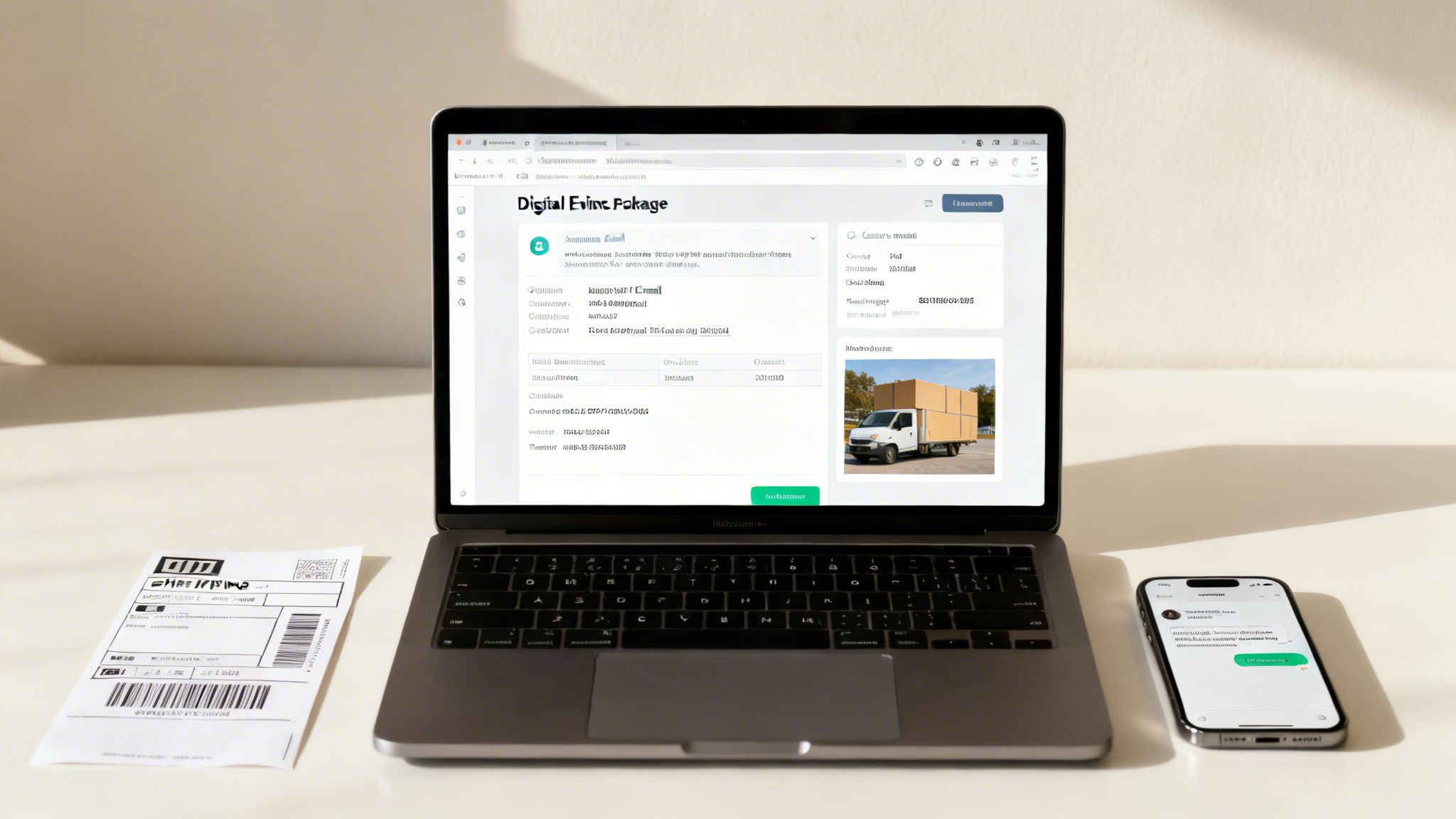
- Proof of Shipping and Delivery: This one is non-negotiable. You absolutely must include the tracking number and a direct link to the carrier’s page showing that "Delivered" status. If you have a delivery confirmation photo, that’s gold.
Every piece of evidence works together to build a strong case. For example, a customer claiming "Product Not Received" can be quickly refuted with a delivery confirmation photo showing the package at their front door, combined with AVS data confirming the shipping address matched the billing address.
Going Deeper with Your Evidence
Beyond the essentials, a few other data points can be the difference between winning and losing, especially when you’re up against friendly fraud. These details show you did your due diligence to verify the order and were totally transparent.
- Address Verification System (AVS) and CVV Matches: Show that the numbers in the billing address and the CVV code the customer typed in matched what the card issuer had on file. This is a massive indicator that the real cardholder placed the order.
- Customer’s IP Address and Geolocation: Documenting the IP address used for the purchase can help you connect the order to the same city or region as the shipping address. This makes claims of "unauthorized use" look a lot less credible.
- Screenshots of Your Policies: Don’t forget to include screenshots of your return, refund, and shipping policies. Make sure it's clear the customer had to agree to these terms at checkout, proving they knew your policies before buying.
Putting together a complete evidence package takes time, which is exactly why fighting chargebacks manually is such a drain for busy Shopify store owners. Every minute you spend hunting for screenshots is a minute you're not spending on growing your business.
If you get a retrieval request, which is often a heads-up before a formal chargeback, it's your best chance to get all this information ready early. You can check out our guide to understand the key differences between retrieval requests and chargebacks and get prepared.
Writing a Winning Chargeback Rebuttal Letter
If your evidence package is the what, your rebuttal letter is the why. This is your one shot to speak directly to the bank employee reviewing your case. It needs to be sharp, persuasive, and ridiculously easy to understand in just a few seconds.
Forget about writing dense paragraphs or using fancy legal terms. Your real goal is to connect the dots for the reviewer, linking the customer's claim directly to your evidence. After handling over 100,000 disputes and clawing back more than $2.8M+ for Shopify merchants, we’ve learned one thing: a direct, factual approach wins. A powerful rebuttal letter is the story that ties all your proof together.
Key Components of a Strong Rebuttal
Always, and I mean always, keep your letter to a single page. The person reading it is swamped, so you need to get straight to the point. Every winning rebuttal we build at ChargePay has three core pieces you should adopt immediately.
First, kick things off with a quick summary of the transaction. You'll want to include the order number, transaction date, amount, and the customer’s name. This gives the reviewer instant context so they know exactly what they're looking at.
Next, you'll dive into a point-by-point takedown of the cardholder's claim. Address their reason for the dispute head-on and explain precisely why it’s invalid. For example, if the claim is "Product Not Received," your rebuttal should state that the product was delivered and point them to the attached proof.
Finally, make it dead simple to find your evidence. Use bullet points to list the documents you’ve attached. Think "See Evidence A: Delivery Confirmation Photo" or "See Evidence B: AVS Match Confirmation." This creates a clear roadmap for the reviewer to follow.
Templates for Common Disputes
Let’s walk through how to structure your response for two of the most frequent chargeback reasons you'll see. Notice how the language is professional but direct—no emotion, just the cold, hard facts.
For a "Product Not Received" Dispute:
- Transaction Summary: Briefly state the key order details.
- Rebuttal: "The cardholder claims the product was not received. However, our records and the shipping carrier’s tracking confirm successful delivery to the address provided by the customer at checkout."
- Proof of Delivery with tracking number and delivery photo.
- Screenshot of the order page showing matching shipping and billing addresses.
- AVS/CVV match confirmation from the transaction.
For a "Friendly Fraud" (Product Not as Described) Dispute:
- Transaction Summary: State the order details.
- Rebuttal: "The cardholder claims the product was not as described. The product page, which the customer viewed before purchasing, provides an accurate description and images. We also did not receive any communication from the customer regarding dissatisfaction prior to this dispute."
- Screenshots of the product page from the time of purchase.
- Proof that the customer agreed to your store's return and refund policy at checkout.
- Any email or chat logs (or lack thereof) with the customer.
The secret to our 92.4% win rate isn’t magic; it’s all about data and clarity. We analyze what specific card issuers want to see and structure rebuttal letters that give it to them, every single time. A strong, data-backed statement will always win over a weak or emotional one.
Crafting the perfect response takes a bit of practice. To help you get started, you can explore a complete example of a rebuttal letter with detailed breakdowns. The better your letter, the better your chances of a successful chargeback recovery.
Automating Chargeback Recovery to Maximize Wins

Let's be honest, trying to fight chargebacks manually is a losing game for any growing Shopify store. It’s slow, prone to human error, and simply doesn't scale as your orders pile up.
With tight deadlines breathing down your neck for every dispute, each one you miss is a 100% loss of revenue. This is exactly where AI-powered automation stops being a "nice-to-have" and becomes absolutely essential for getting your money back.
The Problem with Manual Processes
Picture this: you get five chargebacks in a single day. That's five separate deep dives into Shopify, your shipping carrier's site, and your email history. You’re hunting for order details, tracking numbers, and customer conversations, then trying to piece it all together into five unique rebuttal letters. This can easily chew up hours you just don’t have.
This manual grind is exactly why so many merchants throw their hands up and accept the loss. To really maximize your wins, you need to implement effective business process improvement techniques, and automation is the single biggest leap forward you can make. It’s not just about saving time; it's about building a system that actually wins.
How AI Transforms Chargeback Recovery
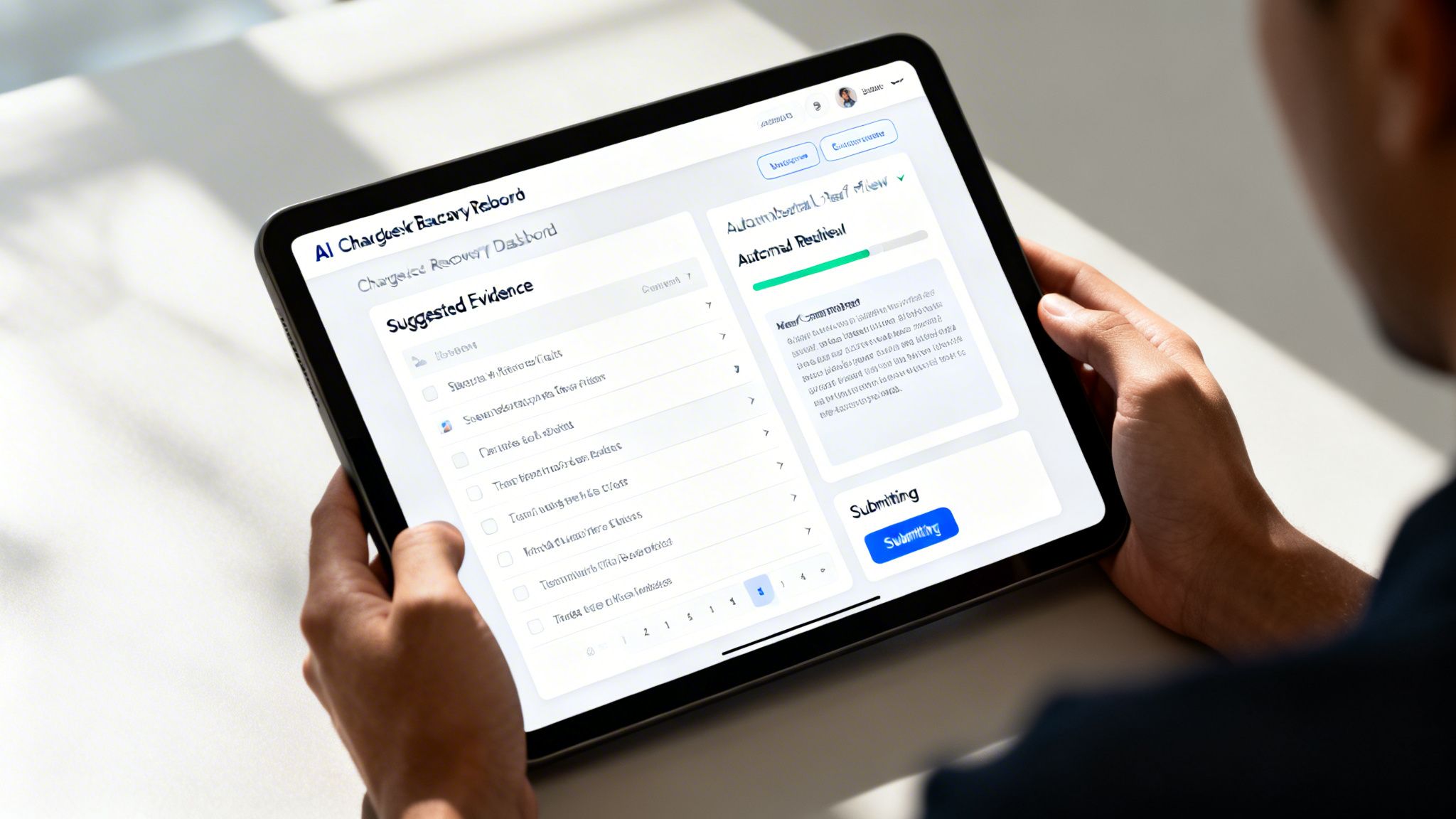
An AI-powered platform like ChargePay completely changes your recovery workflow. Instead of you spending hours on screenshots and writing letters, our AI does the heavy lifting for you, instantly. The moment a dispute hits your account, our system is already on the case.
Here’s what that looks like in action:
- Instant Analysis: The AI immediately analyzes the dispute reason code and the cardholder's claim to know exactly what evidence the bank needs to see.
- Automated Evidence Gathering: It automatically pulls all the necessary data right from your Shopify store—order details, tracking info, AVS/CVV results, and customer data.
- Tailored Rebuttal Generation: Drawing on insights from over 100,000+ handled disputes, our AI crafts a customized rebuttal letter proven to win. We’ve already recovered $2.8M+ for merchants this way.
This automated approach is critical, especially as global chargeback volume is set to explode. It's forecasted to jump from 261 million transactions in 2025 to a staggering 324 million by 2028, with the total value climbing to $41.69 billion. You can find out more about these chargeback trends and see why manual methods just can't keep up.
As a 'Built for Shopify' app with a 4.9-star rating, ChargePay offers a completely zero-risk solution. Our AI handles everything from the initial alert to the final submission, so you can get back to focusing on your business. You only pay a small fee when we successfully recover your money.
With a 92.4% win rate, automation isn't just about efficiency—it's about maximizing the revenue you get to keep. It turns a chaotic, time-sucking process into a solved problem.
If you're ready to stop losing money, install ChargePay from the Shopify App Store and let our AI start winning for you. Our guide on automated chargeback management gives you even more detail on how it all works.
From Recovery to Prevention: How to Stop Disputes Before They Start
Getting your money back from a chargeback feels great, doesn't it? But what if you never had to fight that battle in the first place? That’s the real endgame. The final, most crucial step in mastering chargebacks is moving from a reactive firefighting mode to a proactive, preventative one.
This means using all the data you gather from your wins—and your losses—to build a smarter, tougher defense against future disputes. Think of every chargeback as a breadcrumb trail leading back to a potential weak spot in your business. By following those trails, you can make targeted fixes that directly boost your bottom line.
Use Your Dispute Data to Find Weak Spots
Your chargeback dashboard is so much more than a win/loss record; it's a goldmine of business intelligence. You need to start digging in and looking for patterns.
Are most of your disputes coming from one particular product? Is a certain country flagging a lot of claims? Answering questions like these is how you pinpoint exactly where your defenses need shoring up. If one of your top-sellers is constantly getting hit with "not as described" disputes, that’s a massive red flag telling you its product page needs an overhaul.
Let's put this in perspective. Say you’re running a supplements brand and pouring cash into ads. Meanwhile, friendly fraud—that sneaky first-party misuse—is clawing back 55% of your disputed revenue on average, since merchants only win about 45% of cases manually. The problem is huge and it's not slowing down. There were 238 million chargebacks filed globally in 2023, and that number is projected to skyrocket to 337 million by 2026.
Put Practical Prevention Strategies in Place
Once you’ve spotted the trends, it’s time to roll out some practical fixes. These don’t need to be complex, over-the-top changes. Often, it's the small adjustments that make the biggest difference in stopping disputes cold.
Beef Up Your Product Pages: Add high-quality photos from every conceivable angle. Include videos showing the product in action. Write crystal-clear descriptions that leave no room for doubt. If you sell apparel, a detailed size chart is non-negotiable.
Make Your Policies Obvious: Your shipping and return policies should be impossible to miss. Plaster them on product pages, at checkout, and in your website footer. No one should ever be able to say, "I didn't know."
Level Up Your Customer Communication: The absolute best way to cut down on future disputes is to master customer service recovery. This is how you stop small issues from ever becoming chargebacks in the first place, turning frustrated shoppers into loyal fans.
Fix Your Billing Descriptors: Make sure your billing descriptor is instantly recognizable on a credit card statement. Instead of some generic processor name, use your store's name. This simple change prevents those "I don't recognize this charge" disputes.
This is where ChargePay really shines. Our AI doesn't just help you win disputes; it gives you the data you need to build this preventative shield around your business. After handling over 100,000+ disputes and recovering more than $2.8M+ for merchants, we know exactly what trends to look for.
By turning these insights into action, you create a powerful feedback loop. You can find even more great ideas in our complete guide to chargeback prevention strategies.
Ready to turn your data into your best defense? Install ChargePay from the Shopify App Store and let our AI get to work.
Frequently Asked Questions About Chargeback Recovery
Even with a solid playbook in hand, chargebacks can still feel like a confusing mess. That's completely normal. Let's clear up some of the most common questions we hear from Shopify store owners trying to get a handle on all this.
How Long Do I Have to Respond to a Chargeback?
This is where a lot of store owners slip up, so pay close attention. You have a very tight window, typically between 20-45 days, to respond. The exact timing depends on the card network, like Visa or Mastercard.
But here’s the most critical part: that clock starts ticking the moment the bank files the dispute, not when you first notice it in your Shopify admin.
Miss that deadline, and it's an automatic loss. No appeals, no second chances. This is precisely why trying to handle disputes manually is so risky. An AI system like ChargePay is built to make sure you never miss a submission window, automatically preparing and sending your response well before it’s due.
What Is a Good Chargeback Win Rate?
If you're fighting chargebacks all on your own, a win rate of around 45% is pretty standard. So, anything consistently above that mark is "good," but you should be aiming much higher to truly protect your revenue.
For comparison, ChargePay hits a 92.4% win rate for our merchants. We use data from over 100,000+ handled disputes to build and optimize every single response, giving you a much, much stronger chance of getting your money back.
That kind of success rate turns chargeback recovery from a frustrating coin toss into a predictable part of your revenue stream.
Can I Prevent Friendly Fraud Completely?
Honestly, stopping all friendly fraud is nearly impossible. But you can absolutely make your store a much harder target. Your best defenses are crystal-clear communication, top-notch customer service, and making sure your store policies are impossible to miss.
Here’s a simple but powerful tactic: check your billing descriptor. That's the name that shows up on a customer's credit card statement. Make sure it's instantly recognizable as your brand. A generic name like "SP*ONLINESTORE" just creates confusion and can lead to disputes from customers who simply don't recognize the charge.
Is It Worth Fighting a Small Chargeback?
Yes, absolutely. You should be fighting every single chargeback, no matter the dollar amount. It’s not just about that one sale.
When you fight back, you send a clear message that your store isn't an easy target for opportunistic fraud, which helps discourage repeat offenders.
Fighting every dispute also protects your merchant account. A high chargeback ratio is a major red flag for payment processors and can put your ability to accept payments at risk. With a pay-per-win service, it's always cost-effective to fight every single dispute and defend your business.
Stop letting chargebacks drain your revenue and waste your time. Let the AI-powered team at ChargePay handle the entire dispute process for you. As a 'Built for Shopify' app with a 4.9-star rating, we only get paid when we win. Install ChargePay from the Shopify App Store today and start recovering your money automatically.


.svg)



.svg)


.svg)
.svg)
.svg)