


So, you've been hit with a chargeback. The money’s been pulled from your account, and you're left wondering what to do. This is where chargeback representment comes in.
Simply put, representment is the formal process of fighting back. It’s your opportunity to re-present the original transaction to the customer's bank, armed with compelling evidence that proves the charge was legitimate. For any Shopify store owner, this is your chance to challenge the dispute and get back the revenue that was rightfully yours.
Think of it less like a chore and more like building a legal case. You're proving your side of the story after a customer—or their bank—has pointed the finger at you.
Why Winning Chargebacks Is a Skill You Must Master

Let's be blunt: chargebacks are a direct drain on your Shopify store's profits. Too many merchants just shrug and write them off as a cost of doing business, but that mindset leaves real money—sometimes thousands of dollars—on the table.
Every single lost dispute isn't just a refund. It's the lost revenue from the sale, plus a painful chargeback fee slapped on top. Ignoring the representment process is a luxury that serious e-commerce businesses just can't afford anymore.
The Sobering Reality of Chargeback Battles
If you’ve ever tried to fight a chargeback on your own, you know the process can feel rigged. The odds are often stacked against merchants, and without a solid strategy, it feels like the system is designed for you to lose.
The data paints a pretty clear picture of this uphill battle. Industry reports show that, on average, merchants only win about 45% of the disputes they actually fight. The financial stakes are massive, with chargebacks projected to cost merchants globally a staggering $41.7 billion by 2028.
For every ten disputes you contest, you’re likely losing more than half of them. That's a huge blow to your bottom line.
For Shopify merchants, this isn't just an abstract statistic. It's the difference between a profitable quarter and a loss. It's the gap between reinvesting in new inventory and scrambling to cover unexpected fees.
Turning the Tables with a Winning Strategy
So, if the deck is stacked against you, is it even worth fighting back? Absolutely. The secret is to stop treating representment as a defensive headache and start seeing it as a critical business skill—a way to actively recover revenue.
A well-executed strategy is what separates frustrating losses from recovered profits. This is what we live and breathe at ChargePay. We’ve seen firsthand what works by handling over 100,000 disputes for Shopify merchants, and we've refined an AI-powered approach that delivers results.
Our data proves what's possible when you have a focused, evidence-based strategy:
- A 92.4% Win Rate: We consistently win over 9 out of 10 disputes, showing that most chargebacks are winnable when you know how to present the right evidence.
- $2.8M+ Recovered: We’ve already recovered over $2.8 million for Shopify stores just like yours.
- Automated Expertise: Our AI builds the entire response for you, a process we've perfected to win even the toughest "friendly fraud" claims.
By mastering chargeback representment—or partnering with an automated tool that has—you stop the bleeding and start protecting your hard-earned revenue. If you're curious about the data behind these wins, you can read our detailed breakdown of how often merchants win chargeback disputes.
The 3-Step Playbook for Winning Chargeback Representment
When you get that chargeback notification, it’s easy to feel your stomach drop. But this isn't the time for frustration; it's the moment to switch from defense to offense. Building a winning chargeback representment case has nothing to do with luck. It’s all about following a clear, evidence-based playbook.
The entire process boils down to one thing: proving you held up your end of the deal. The bank reviewer on the other side doesn't know you, your store, or the customer. Your job is to hand them a clean, logical, and undeniable story backed by solid proof.
Step 1: Analyze the Reason Code
Every chargeback lands with a specific reason code. This is the customer's official claim, and it’s your starting point. Don't just glance at it; you need to dissect it. This little code tells you exactly what you need to disprove.
Is it a "Product Not Received" claim? Then your entire focus should be on proving delivery. Is it an "Unauthorized Transaction" dispute? You'll need to dig up evidence that connects the legitimate cardholder to the purchase. Each code demands a different set of evidence.
You'll run into a few common types of reason codes:
- Fraud Codes (e.g., Unauthorized Transaction): These are claims that the cardholder never approved the purchase. This is where "friendly fraud" loves to hide.
- Product/Service Codes (e.g., Product Not Received, Not as Described): These disputes point to a problem with either fulfillment or the item itself.
- Processing Error Codes (e.g., Duplicate Processing): These suggest a technical hiccup happened during the transaction.
Getting this first step right is everything. Trying to fight a "not as described" chargeback with only a delivery confirmation is a guaranteed loss. You have to directly counter the customer's specific argument.
Step 2: Gather Your Compelling Evidence
Once you know what you’re up against, it's time to gather your proof. Think of yourself as a detective building an open-and-shut case. For Shopify store owners, you have a goldmine of digital evidence right at your fingertips. Your mission is to collect everything that ties the legitimate cardholder to this specific order.
Here’s a checklist of compelling evidence we use at ChargePay to win disputes day in and day out:
- AVS and CVV Verification: Always, always include screenshots from your payment processor showing a successful Address Verification System (AVS) and Card Verification Value (CVV) match. An AVS match proves the billing address the customer typed in matches the one on file with their bank.
- IP Address Logs: This is incredibly powerful. Show that the IP address used to place the order matches the customer’s billing or shipping location. It's pretty tough for someone to claim fraud when the order was placed from their own home network.
- Delivery Confirmation with Tracking: For any "Product Not Received" claim, this is non-negotiable. Provide the tracking number and a screenshot from the carrier’s website clearly showing the item was delivered to the address the customer provided. If you have signature confirmation, that's even better—it’s a knockout punch.
- Customer Communications: Did the customer email you asking about their order? Did they post a picture on Instagram tagging your brand? Any communication where they acknowledge the order or its receipt is pure gold. Grab screenshots of those conversations.
- Order Details and Product Descriptions: For "Not as Described" claims, you must include a screenshot of the product page the customer ordered from. This proves the item was described accurately and they knew what they were buying.
Remember, the bank reviewer is looking for clarity and relevance. Don't just dump a folder of random files on them. Organize your evidence logically to tell a simple story: The real cardholder ordered this, you shipped it to their address, and they got it.
Step 3: Craft a Clear and Concise Rebuttal Letter
Your evidence is the foundation, but your rebuttal letter is the frame that holds it all together. This is no place for emotional pleas or angry rants about the customer. It needs to be professional, factual, and dead simple for a busy bank employee to scan and understand immediately.
A winning rebuttal letter follows a simple structure that makes your case undeniable. It should quickly summarize the transaction, state exactly why the chargeback is invalid, and point directly to the evidence you've attached. We've perfected this process over 100,000+ disputes, recovering over $2.8 million for merchants just by presenting the facts this way.
Your letter should methodically walk the reviewer through your proof. For instance, you could write, "As shown in Exhibit A, the transaction received a successful AVS and CVV match, confirming the cardholder's participation. Furthermore, Exhibit C provides proof of delivery from FedEx to the cardholder's verified address on May 15, 2024." This direct approach connects all the dots for them.
If you’re looking for a proven template to get you started, check out our guide with a real-world example of a rebuttal letter that you can adapt for your own use.
Following this structured process for every chargeback representment dramatically lifts your odds of winning. It turns a frustrating event into a methodical process of recovering your revenue. And for Shopify merchants looking to skip the manual work entirely, ChargePay automates this whole workflow. Our AI analyzes the reason code, gathers all the necessary evidence from your Shopify backend, and crafts the perfect rebuttal letter in an instant. You can install ChargePay from the Shopify App Store—it has a 4.9-star rating and is recognized with the Built for Shopify badge for its reliability.
Tailoring Evidence for Visa, Mastercard, and Amex
Ever felt like you submitted the perfect evidence for a chargeback, only to lose the dispute anyway? It’s a frustratingly common story. The reason is often simple: you treated all chargebacks the same.
Submitting a one-size-fits-all evidence packet is a recipe for failure. What works for a Visa dispute will likely fall flat with American Express. Each card network—Visa, Mastercard, and Amex—operates under its own unique set of rules.
Think of it like arguing a case in three different courts. You wouldn't use the exact same argument and evidence in each one, right? The same logic applies here. Learning the subtle but crucial differences in what each network considers “compelling evidence” is how you start turning those frustrating losses into wins.
This flowchart breaks down the fundamental process you should be following for every single case.
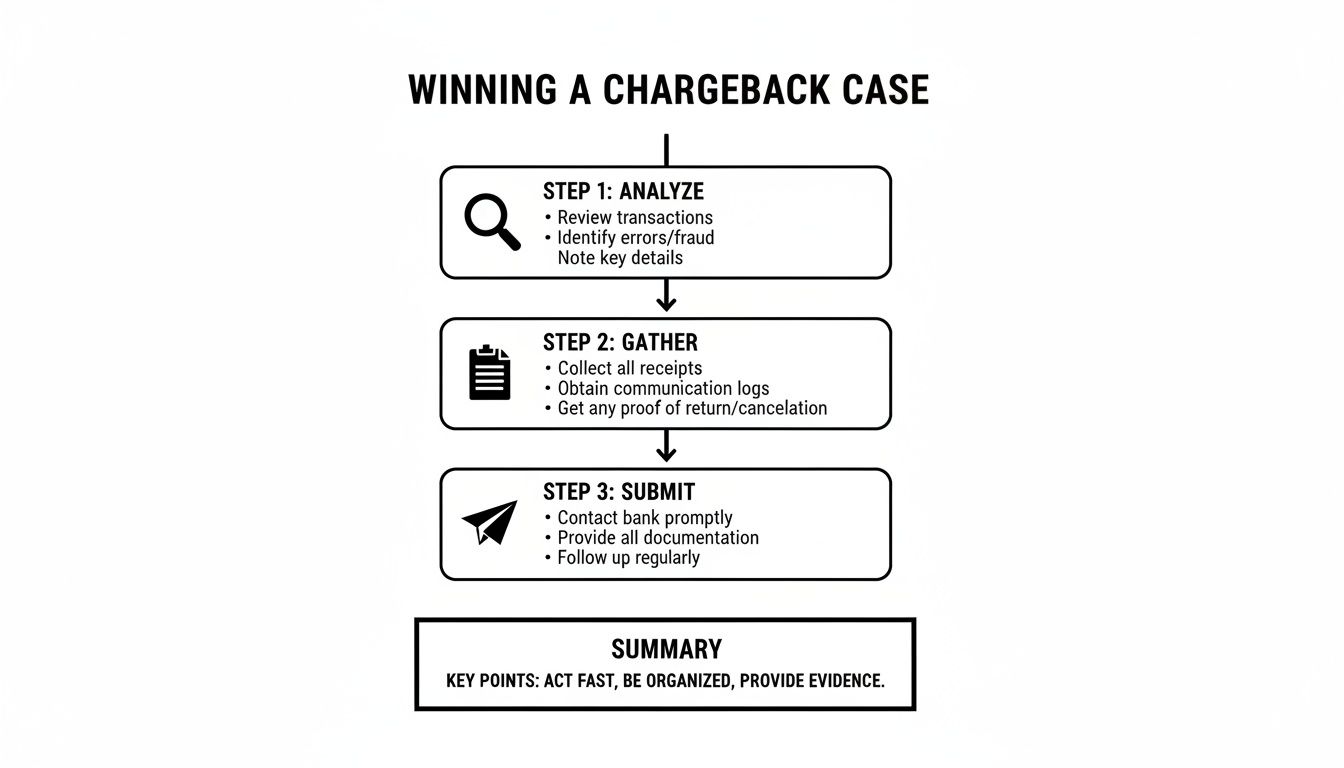
As you can see, a winning representment always starts with analyzing the claim, gathering the right evidence, and then submitting a clear, easy-to-understand case. This structured approach is what separates merchants who consistently win from those who keep losing revenue.
To help you get this right, here’s a quick-reference guide to what each major card network is looking for.
Card Network Representment Cheat Sheet
This table gives you a snapshot of the different priorities and requirements for Visa, Mastercard, and American Express. Use it as a quick guide before you build your next evidence packet.
| Requirement | Visa | Mastercard | American Express |
|---|---|---|---|
| Primary Focus | Data and Process Verification | Transaction Narrative | Overwhelming Proof |
| Key Evidence | AVS/CVV, IP Match, Delivery Proof | All standard proof + Customer Comms | All standard proof + Extensive Comms, Social Proof, Shipping Details (weight, etc.) |
| Tone | Factual and data-driven | Storytelling, connecting the dots | Comprehensive and undeniable |
| Subjectivity | Low | Moderate | High |
While this cheat sheet is a great starting point, let's break down exactly what this means in practice for your business.
How Visa Views Your Evidence
When you're dealing with a Visa dispute, think in terms of cold, hard data. They run a tight ship and want to see that you followed every procedure to the letter. Transaction and delivery verification are everything.
For fraud-related claims, your evidence packet absolutely must include:
- AVS and CVV Match Results: Show that the billing address and security code entered by the customer matched what the bank had on file.
- IP Address Confirmation: Prove the order was placed from an IP address that geographically corresponds to the cardholder's billing address.
- Prior Transaction History: If this isn't their first rodeo, show proof of previous, undisputed orders to establish a pattern of legitimate buying behavior.
For "product not received" disputes, delivery confirmation is your silver bullet. A tracking number showing the package was delivered to the verified address is non-negotiable. If you have signature confirmation, even better—that’s your knockout punch.
Visa’s system is incredibly structured. If you provide the exact pieces of evidence they require for a specific reason code, your odds of winning go way up. Miss just one key document, and your chances can plummet.
Cracking the Code for Mastercard Disputes
Mastercard’s process is quite similar to Visa’s, but they’re more interested in the full story. While they value the same core evidence—AVS/CVV matches, IP logs, and delivery confirmation—they are also much more receptive to supporting documents that build a complete narrative of the transaction.
This is where your customer communications become gold. If you have email chains with the customer discussing their order, screenshots of social media messages, or any record of them acknowledging the purchase, you need to include it.
With Mastercard, your job is to connect the dots for the reviewer. You’re building a logical case that shows a legitimate purchase was made by the cardholder and fulfilled exactly as promised. For a "not as described" claim, this means providing crystal-clear screenshots of your product page, including any sizing charts or specs the customer would have seen before checkout.
Winning Against American Express Claims
Let's be blunt: American Express is famous for siding with its cardholders, which can make winning disputes feel like an uphill battle. They often give their customers the benefit of the doubt, so your evidence has to be nothing short of overwhelming.
A simple delivery confirmation email often won't cut it.
When you're fighting an Amex chargeback, you have to bring your A-game. In addition to all the standard evidence, you should be ready to provide:
- Extensive Customer Communications: Every single email, chat log, or call record is critical.
- Detailed Shipping Documentation: Don’t just show it was delivered. Show the package weight and dimensions from the shipping manifest to prove the correct item was actually in the box.
- Social Proof: Did the customer post a picture of themselves with your product on Instagram? Find it and screenshot it. This kind of evidence can instantly invalidate a "not received" or "not as described" claim.
With Amex, your mission is to remove any and all shadow of a doubt. Because their process is more subjective, a detailed and persuasive rebuttal letter that walks the reviewer through your mountain of evidence is more important than ever.
And remember, every network has strict deadlines. It's crucial to act fast. You can learn more about the timelines for each network by reading up on the chargeback time limit. Knowing these deadlines is just as important as knowing what evidence to send.
Common Mistakes That Cause Merchants to Lose Disputes

Winning a chargeback representment isn't always about a brilliant, slam-dunk case. More often, it’s about not making simple, unforced errors. After looking at over 100,000 disputes, we've seen so many merchants lose perfectly winnable cases because of small, completely avoidable slip-ups.
These aren't complex legal blunders. They’re basic process breakdowns that can sink your case before a bank reviewer even gets to the juicy details. Let’s be honest: many merchants are their own worst enemy in the dispute process.
By getting familiar with these common traps, you can sidestep them and seriously boost your win rate, protecting your hard-earned revenue.
Missing the Response Deadline
This is, without a doubt, the most common—and most painful—way to lose a chargeback. Every single dispute comes with a strict deadline, usually somewhere between 20 and 45 days. If you miss that window by even an hour, it’s an automatic loss.
That’s it. No appeals, no do-overs. The money is gone, and you’re hit with the chargeback fee on top of it. For busy store owners already juggling a dozen other things, it’s scarily easy for a deadline to fall through the cracks.
This is where the big players have a huge leg up. The 2026 State of Chargebacks Report showed that large companies actively managing their disputes hit a 52% win rate, blowing past the 45% industry average. Why? They have teams and processes dedicated to making sure a deadline is never missed. You can learn more about these chargeback report takeaways to see how the pros get it done.
Submitting Disorganized or Irrelevant Evidence
Imagine you're a bank reviewer looking at hundreds of cases a day. When you open an evidence file, you want to understand the merchant's side of the story in less than a minute. Instead, what you often get is a chaotic mess of files with no labels and no context.
Merchants will just dump everything they have, hoping something sticks. But the reviewer doesn't have time to connect the dots between blurry screenshots, unlabeled PDFs, and a rambling rebuttal letter.
A winning submission is clean, organized, and speaks directly to the customer’s claim. A disorganized one is just a fast pass to a lost dispute.
We see these evidence mistakes all the time:
- Blurry or Unreadable Screenshots: If they can't read it, it doesn't count. Your evidence is worthless.
- Generic Order Confirmations: These are fine, but they don't prove the item was delivered or that the actual cardholder placed the order.
- Ignoring the Reason Code: You can't just send a delivery confirmation for a "product not as described" claim. It doesn't address the issue, and it's a guaranteed way to lose.
Writing an Emotional Rebuttal Letter
It’s completely normal to feel angry when you know a chargeback is fraudulent. You've been wronged. But letting that frustration bleed into your rebuttal letter is a critical mistake.
The person reviewing your case doesn't care about your feelings; they only care about facts and evidence. A letter filled with accusations or personal opinions about the customer instantly hurts your credibility. It makes you look unprofessional and distracts from the solid evidence you’ve gathered.
Keep it strictly business. Period.
- Stick to the facts of the transaction.
- Point directly to your proof with clear references like, "See Exhibit A: Delivery Confirmation."
- Never insult the customer or guess their motives.
A professional, fact-based rebuttal makes it easy for the reviewer to agree with you. An emotional rant just makes it easy for them to side with their customer.
Avoiding these simple mistakes is a huge first step. But having a proactive strategy to stop disputes before they even happen is even better. For a deeper look, check out our guide on effective chargeback prevention.
When to Automate Your Chargeback Representment Process
When you're first starting out, fighting every chargeback yourself feels doable. Annoying, but doable. But as your store scales, that trickle of dispute paperwork can quickly turn into a flood, drowning out the time you should be spending on what actually grows your business—marketing, sourcing new products, and talking to your customers.
So, where’s the breaking point? At what point does handling disputes manually stop making sense? If you get the feeling that your manual process is costing you more than it's saving, you're probably right. It’s time for a change.
The Tipping Point Is Closer Than You Think
For most Shopify merchants, the decision to automate chargeback representment isn't a single event. It's more of a slow burn, fueled by mounting frustration and disappearing profits. If any of these situations sound familiar, you're likely at that tipping point right now.
Maybe your win rate is in the gutter, or worse, you have no idea what it even is. If you're winning fewer than 50% of the disputes you take the time to fight, your current approach just isn't working. A low win rate means you're not just losing the original sale; you're also eating chargeback fees for absolutely nothing.
Or maybe you're constantly racing against the clock. The window to respond to a chargeback is incredibly tight, often just a few short weeks. Miss that deadline, and it's an automatic loss. As you get busier, it's way too easy for a dispute or two to slip through the cracks.
This isn't just about the money you're losing directly. Think about the opportunity cost. Every single hour you spend digging up evidence and writing rebuttal letters is an hour you can't get back—an hour you're not using to actually grow your business. When managing disputes starts feeling like a second job, you've hit a wall.
Calculating the Real Cost of Doing It Yourself
It’s easy to trick yourself into thinking that handling disputes in-house is "free," but that couldn't be further from the truth. Your time is your most valuable asset. Let's do some back-of-the-napkin math.
If you spend just five hours a week on chargebacks—and trust me, many merchants spend way more—that's 20 hours a month. What's an hour of your time worth? If you value it at $50, you're sinking $1,000 a month into the labor of fighting disputes alone. And that doesn't even count the revenue from the chargebacks you lose.
- Labor Cost: The hours you and your team pour into dispute paperwork.
- Lost Revenue: The full value of every chargeback you lose or simply don't have time to fight.
- Chargeback Fees: Those non-refundable penalties your payment processor hits you with for every single dispute, win or lose.
When you add it all up, that "free" manual process is one of the most expensive things in your business. For a deep dive into how automation can completely overhaul this, check out our complete guide to automated chargeback and dispute management using AI.
How Automation Flips the Script
This is exactly why we built ChargePay. We designed it for busy Shopify merchants who know they need to stop wasting time managing disputes and start winning them. Our AI-powered platform fully automates the entire chargeback representment process from start to finish.
The moment a chargeback hits your account, our system is on it. It instantly pulls all the compelling evidence from your Shopify store, analyzes the specific reason code, and constructs a powerful, evidence-backed rebuttal letter tailored to the card network's requirements. Then, it submits the entire package on your behalf, well before the deadline.
The difference is night and day. We've successfully handled over 100,000 disputes, recovering more than $2.8 million for merchants just like you. Our 92.4% win rate is proof that automation isn't just about getting your time back—it's about winning more of your money back.
Stop letting manual dispute management be a drain on your time, energy, and profits. Install ChargePay from the Shopify App Store—we’re Built for Shopify certified with a 4.9-star rating—and let our AI turn your chargeback problem into a problem solved.
Your Questions About Chargeback Representment Answered
Alright, we've gone through the A-to-Z of building a solid chargeback representment case. But I know you probably still have some nagging questions floating around.
Our team talks to Shopify merchants every single day who are fed up with losing revenue to disputes. Let's tackle the most common questions we hear, so you have clear, no-fluff answers when you need them most.
How Long Do I Have to Respond to a Chargeback?
This one is non-negotiable. The window to respond to a chargeback is incredibly tight, and there are no extensions. Depending on the card network, you’ll have somewhere between 20 and 45 days from the day you’re notified.
If you miss that deadline, even by an hour, it’s an automatic loss. You’re out the sale amount and you still get hit with the chargeback fee. Honestly, this strict timeline is one of the top reasons merchants lose cases they could have easily won—they just run out of time to pull everything together.
This is exactly where an automated tool becomes a lifesaver. Something like ChargePay gets to work the second a dispute is filed. It ensures a complete, evidence-packed response is sent way before the clock runs out. Think of it as your safety net against losing money to a simple calendar mistake.
What Is Compelling Evidence for a Shopify Store?
For a Shopify store owner, compelling evidence is anything that paints a clear picture for the bank, proving two things: you shipped what you promised, and the real cardholder bought it. You need to connect the dots for them.
Make sure your evidence file always includes these essentials:
- AVS and CVV Match Results: A simple screenshot showing the Address Verification System (AVS) and the card’s security code (CVV) checked out successfully is powerful.
- Customer IP Address: Show that the IP address used for the order matches the customer's billing or shipping city. This links the person to the place.
- Shipping Confirmation: Don't just send the tracking number. Include a screenshot from the carrier’s website showing the item was delivered to the customer's address.
The more data you have that ties the legitimate cardholder to the order they placed, the harder it is for the bank to side against you.
Can I Really Win Against Friendly Fraud?
Yes, absolutely. And you have to. Fighting friendly fraud—when a customer disputes a purchase they actually made—is a battle you can't afford to sit out. It's frustrating because it's fundamentally dishonest, but you can win with the right approach.
The secret is to present irrefutable proof that the cardholder got exactly what they ordered. When you provide delivery confirmation to their verified address, match their IP address, and include any emails where they discuss the order, you build a case that's hard to argue with.
This is an area where ChargePay's AI truly shines. After analyzing over 100,000 disputes, our system is dialed in on the specific patterns of friendly fraud. It's built to dismantle those claims and get your money back where it belongs.
Is It Worth My Time to Fight a Small Chargeback?
One hundred percent, yes. You need to fight every single chargeback, no matter how small the amount. For one, all those little disputes bleed you dry over time. They add up faster than you think.
But there's a bigger reason. When you don't fight back, you're essentially sending a signal to banks and fraudsters that your store is an easy mark. This can increase your overall dispute rate and even put your merchant account in jeopardy. Fighting back is about protecting your revenue and your reputation.
Let’s be real, manually fighting every dispute is a massive time-suck. ChargePay makes it simple and profitable to fight every single one. Our AI handles the entire representment process, achieving a 92.4% win rate and recovering millions for stores like yours. Stop leaving money on the table and install ChargePay from the Shopify App Store today.


.svg)



.svg)


.svg)
.svg)
.svg)