

Chargebacks rarely stop at the value of one lost order. For many Shopify merchants, each dispute can also add fees, consume support time, distort revenue reporting, and make it harder to trust the numbers you use to buy inventory or scale ads.
Dispute management works like an operating system for revenue recovery. It covers prevention, evidence collection, deadline handling, root-cause analysis, and process changes that reduce the next wave of disputes. That broader view matters because a chargeback is rarely an isolated event. It often points to a weak spot in your checkout, delivery experience, product messaging, or customer support flow.
I’ve seen this pattern across hundreds of stores. A dispute comes in, your team hunts for screenshots, pulls tracking details from three different tools, submits late or with thin evidence, loses the case, pays the fee, and gets back to work. Then the same issue shows up again next week because nothing in the system changed.
A stronger process changes the economics.
Instead of treating every dispute like a one-off fire, you build a repeatable system that helps you prevent avoidable chargebacks, recover more revenue from the ones that do happen, and learn from the pattern behind them. That is why smart merchants pair response workflows with chargeback prevention strategies for Shopify stores and, increasingly, AI tools that sort evidence, spot trends, and remove manual busywork.
ChargePay is part of that shift. Its reported results show what happens when representment and trend analysis are handled as one connected process, not two separate tasks. For you, the practical takeaway is simple: dispute management can move from a drain on margin to a measurable recovery system with clear ROI.
Why Your Store Is Losing Money to Chargebacks
Chargebacks do more than erase a sale. They can erase shipped revenue, add fees, consume staff hours, and distort the numbers you rely on to judge store performance.
That is why chargebacks should be treated as a revenue recovery system, not a back-office annoyance.
For many Shopify merchants, the main leak is not the dispute itself. It is the store process around it. We see the same pattern again and again. A customer disputes a charge, the team scrambles to pull order details, tracking, email history, and return terms from different tools, and the response goes out late or incomplete. Even when the order was legitimate, the revenue is hard to recover.
The expensive part is repetition. Chargebacks usually come from a small group of recurring issues tied to checkout clarity, shipping communication, product expectations, subscription terms, or support delays. If those causes stay in place, each new dispute is a rerun of the last one.
Reactive handling keeps the leak open
Case-by-case handling feels practical because it gives your team something immediate to do. It also traps you in manual work.
A store that only responds to individual disputes misses the larger pattern behind them. You are not only deciding whether to fight one case. You are also deciding whether the next ten cases will happen for the same reason.
That is where the money goes.
A single chargeback can point to several underlying problems:
- Policy confusion. Customers did not understand returns, billing terms, or renewal timing.
- Fulfillment gaps. Tracking is weak, delivery updates are unclear, or proof is missing.
- Expectation mismatch. Product pages, images, or sizing details created a different expectation than what arrived.
- Workflow breakdowns. Your team cannot gather the right evidence before the deadline.
ChargePay reports a high win rate and significant amounts recovered across numerous cases for merchants using AI-supported representment with trend analysis. The useful lesson is not the headline number. It is the model behind it. Stores recover more when evidence handling and root-cause analysis work as one system.
Dispute management works like inventory control
Inventory control is not a once-a-month count after products disappear. It is an operating system that tracks movement, flags issues early, and keeps small errors from becoming margin loss. Dispute management works the same way.
When you build it as a system, three jobs happen at the same time:
- Prevention through clearer policies, cleaner billing descriptors, stronger fraud checks, and better post-purchase communication
- Recovery through fast, organized representment with complete evidence
- Learning through trend tracking that shows which dispute reasons keep costing you money
This is the shift many merchants miss. A chargeback is not only a customer-bank event. It is feedback on how your store is performing under real-world pressure.
If prevention is where your process is weakest, start with these practical chargeback prevention strategies for Shopify stores.
A merchant who handles disputes one by one is doing casework. A merchant who fixes repeat triggers, standardizes evidence, and measures recovery is protecting revenue.
The Dispute Lifecycle from Start to Finish
Disputes feel chaotic when you only see the alert at the end.
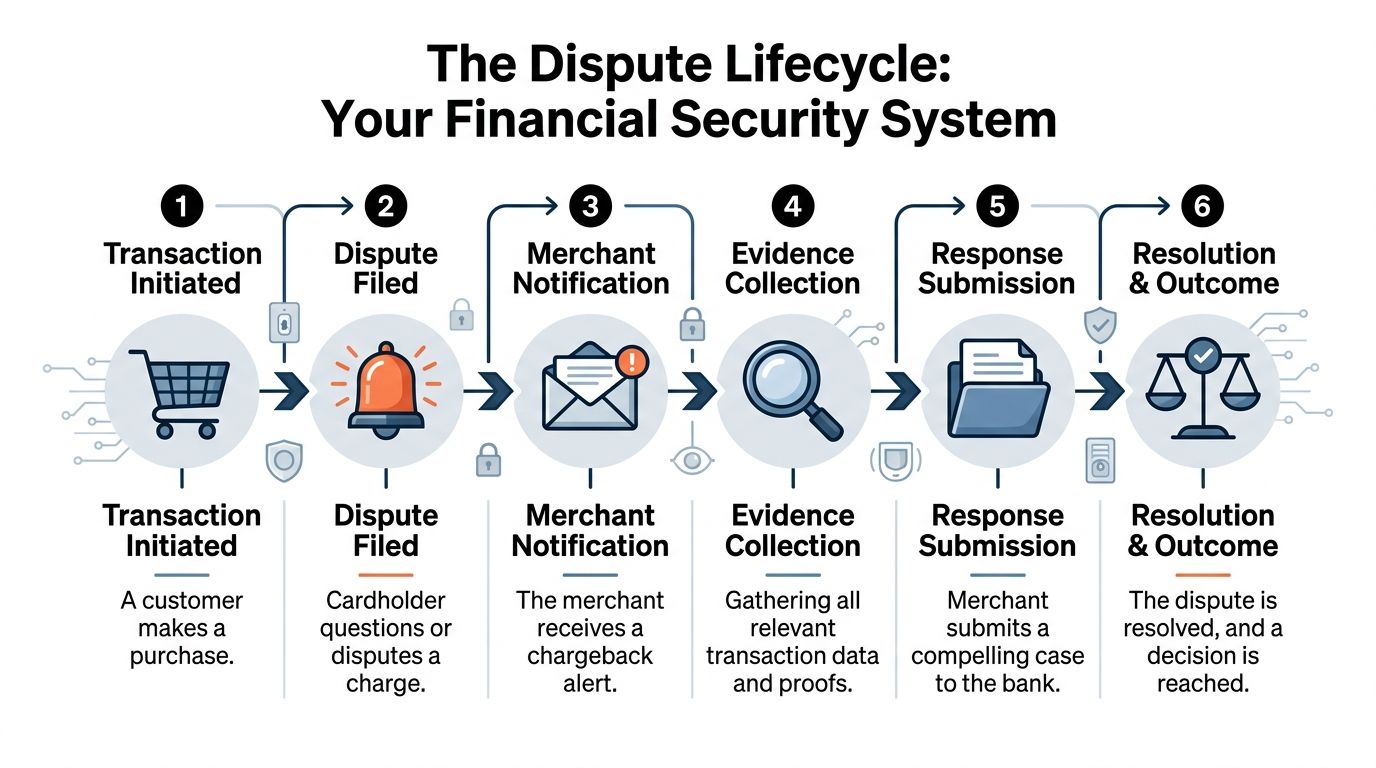
The process is much easier to handle when you know the sequence. I tell merchants to conceptualize it as a home security system. A sensor gets triggered, a signal goes out, the control panel logs the event, and a response kicks in.
It starts before you hear about it
A customer sees a charge on their statement and contacts the card issuer or payment provider.
Sometimes the customer is confused. Sometimes they are impatient. Sometimes they are committing friendly fraud. Either way, the bank opens a dispute path.
This kind of formal process is not unusual. Structured dispute systems are used at every level of commerce. In 2024, the ICC International Court of Arbitration managed a caseload worth US$354 billion, which shows how much global business depends on evidence-based dispute resolution rather than informal arguing or court delays, according to ICC dispute resolution statistics for 2024.
For a merchant, the lesson is simple. Documentation wins.
The six moments that matter
Here is the flow in plain language:
Transaction initiated
A customer places an order. At this point, your future defense is already being built through order data, billing details, shipping choices, and customer messages.Dispute filed
The cardholder questions the charge with their bank or provider.Merchant notification
You receive an alert through Shopify, your payment processor, or another payment tool.Evidence collection
You gather records. This usually includes order details, delivery proof, communication history, refund policy, and any signs of customer use or approval.Response submission
You send a representment package. This is your formal case for why the charge was valid.Resolution and outcome
The issuer reviews the file and makes a decision.
Where merchants get confused
The biggest confusion is vocabulary.
A chargeback is a disputed transaction that starts a formal reversal process. A retrieval request or inquiry is earlier and less final in some payment flows. A representment is your response package asking the bank to reverse the chargeback and return the funds.
Another common point of confusion is who does what.
- The cardholder starts the complaint
- The issuing bank reviews the customer’s side
- Your acquirer or processor passes information between systems
- The card network sets rules and reason code standards
- You provide evidence that the transaction was legitimate
Why speed and organization matter
Most merchants do not lose because they had no case.
They lose because the evidence was incomplete, late, or disconnected. The order was in Shopify. Tracking was in a shipping app. Customer emails were in Gmail. Refund policy screenshots were nowhere handy.
That is why having a standard process matters so much. If you want the merchant-side version of this map in more detail, this breakdown of the card dispute process for online stores is worth bookmarking.
The dispute lifecycle is not a mystery. It is a chain. If one link is weak, you lose money.
Common Dispute Causes and How to Spot Them
Not every chargeback means the same thing.
A useful way to read disputes is to split them into two buckets. Merchant error and friendly fraud. If you do not separate those two, you will keep fixing the wrong problem.

Merchant error
These are disputes you helped create, even if by accident.
That can be hard to hear, but it is good news because these are the easiest to reduce.
Common examples include:
Unclear billing descriptors
The customer does not recognize your charge and calls the bank instead of contacting you.Slow or poorly communicated shipping
The order is late, tracking is vague, and the customer files “item not received.”Product expectation gaps
Your product page says one thing, the item feels different in real life, and the customer chooses “not as described.”Refund process friction
The customer could have been refunded, but support was slow or policies felt hidden.
Many merchants do not realize that prevention often beats fighting. Mediation experts have long argued that strong communication and relationship-building can stop disputes before they escalate, a view discussed in this University of Florida legal scholarship piece on proactive dispute prevention.
Friendly fraud
This bucket looks different.
The order was real. The product was delivered. But the customer disputes it anyway. Sometimes they forgot the purchase. Sometimes a family member used the card. Sometimes they know exactly what they are doing.
Patterns to watch for:
Item received, then denied
Tracking confirms delivery, but the customer still claims non-receipt.Use then dispute
A customer uses the product and later says it was unauthorized or not as described.Subscription denial
The customer agreed to recurring billing, then disputes a renewal.Policy bypassing
Instead of requesting a return, the customer goes straight to the bank.
How to read the signal behind the reason code
Reason codes matter because they tell you what kind of evidence the issuer expects.
If you see an “item not received” style claim, you should immediately look for delivery scans, address match, and communication history. If it is a fraud-style claim, you look for billing match, order velocity, previous customer history, and proof of cardholder participation.
A reason code is not just a label. It is a clue about what story the bank is hearing.
Here is a practical perspective:
| Dispute pattern | Likely root issue | What to inspect first |
|---|---|---|
| Customer says package never arrived | Delivery or fraud | Tracking, delivery proof, shipping address |
| Customer says item not as described | Product expectation gap | Product page, photos, variant selection, support messages |
| Customer says transaction unauthorized | Fraud or friendly fraud | AVS/CVV result, device clues, prior orders, customer contact |
| Customer says credit not processed | Refund workflow issue | Refund timestamps, policy terms, support history |
A short explainer can also help if your team is new to chargeback categories:
Spot the repeat, not just the incident
One dispute is a case.
Five disputes with the same pattern are an operations problem.
Look for clusters around one SKU, one shipping lane, one ad promise, one subscription flow, or one seasonal campaign. That is where dispute management becomes more than defense. It becomes diagnosis.
If your dispute reasons repeat, stop arguing with the bank first. Start asking what in your store keeps creating the same argument.
Your Playbook for Winning Chargeback Disputes
Winning more disputes usually does not require a clever legal argument.
It requires discipline. The merchants who recover the most money do the boring things well. They make expectations clear, keep records tidy, and submit the right proof fast.
Prevent the dispute before it starts
A strong dispute management system begins before checkout.
Here are the store changes that prevent a lot of pain later:
Write product pages like a skeptical customer will read them
Show materials, sizing, delivery windows, refill terms, and limitations. If a buyer could misunderstand it, rewrite it.Make customer support easy to find
A visible contact path gives frustrated buyers somewhere to go besides their bank.Show shipping progress clearly
Silence creates disputes. Tracking updates and delay notices reduce panic.Use billing descriptors customers recognize
If your statement descriptor looks unfamiliar, valid charges can look fraudulent.Put refund and return terms where customers see them
Hidden policy language does not help when a bank reviews a claim.Save every customer touchpoint
Order confirmations, tracking notices, support chats, and refund messages all become evidence later.
What to do the minute a dispute arrives
When the alert comes in, do not start writing yet.
First, identify the claim type. Then build the evidence around that exact claim. Representment works best when the proof matches the reason code directly.
If you want a deeper tactical guide, this overview of chargeback representment for merchants lays out the process in more detail.
Build an evidence package that tells one clear story
Banks do not want a folder full of random screenshots.
They want a coherent explanation supported by documents. Your evidence package should answer three questions:
- Was the transaction legitimate
- Did the merchant fulfill the order as promised
- Does the documentation directly contradict the cardholder’s claim
The strongest packages usually include some mix of:
- Order confirmation
- Billing and shipping details
- Delivery confirmation
- Customer communication
- Product page copy or screenshots
- Return or cancellation policy
- Refund records when relevant
- Proof of prior customer use or account access
Use a rebuttal letter that stays factual
Your rebuttal letter should be plain, not emotional.
Good structure:
- State the dispute reason
- State your position clearly
- Summarize the supporting evidence
- Explain how the evidence contradicts the claim
- Reference attached documents by name
A simple example:
The disputed transaction was valid and fulfilled according to the terms presented at checkout. Attached records show order confirmation, shipment to the customer-provided address, delivery confirmation, and prior customer communication related to the order. These documents support that the cardholder authorized the transaction and received the merchandise.
Match the proof to the reason
Many merchants lose here. They send proof that the order existed, but not proof that answers the specific dispute.
Here is a practical checklist.
Evidence Checklist for Common Dispute Reasons
| Dispute Reason | Required Evidence | Pro Tip |
|---|---|---|
| Unauthorized transaction | Order details, billing match, device or account activity, customer communication, prior order history if available | Show signs the cardholder participated in the purchase, not just that a payment was captured |
| Item not received | Tracking number, delivery confirmation, shipping address, customer messages, carrier updates | If delivery reached the billing address, make that visible in the file |
| Not as described | Product page screenshots, variant selection, photos, customer communication, return policy | Freeze a copy of the exact product page the customer saw at purchase time |
| Credit not processed | Refund policy, return request history, refund timestamps, confirmation email, processor records | Put the refund date and amount near the top so the reviewer sees it immediately |
| Subscription or recurring billing dispute | Terms acceptance, renewal notice, cancellation path, usage history, order timeline | Include where and when the customer agreed to recurring billing |
Prioritize disputes strategically
Not every dispute deserves the same effort.
High-value orders, repeat-friendly-fraud patterns, and winnable claims should move to the front of the line. Low-value disputes with weak evidence may not justify the same manual time.
That is not “giving up.” It is managing cost against recovery.
Standardize the process inside your team
If one person handles disputes differently every time, your results will swing wildly.
Create one internal checklist. Decide where evidence lives. Name who owns deadlines. Save approved letter templates. Make sure your support team knows which customer conversations need to be preserved.
The best dispute management playbook is the one your team can repeat under pressure without guessing.
The Key Metrics Every Merchant Should Track
If you only look at whether a single case was won or lost, you miss the health of the system.
Good dispute management runs on a small dashboard of metrics. You need consistency.
Dispute rate
This is the percentage of your transactions that turn into disputes.
A rising dispute rate usually points to a business issue upstream. That could be fraud, shipping delays, poor product-market fit, confusing renewal terms, or support breakdowns. Track it by product line, campaign, payment method, and fulfillment partner if possible.
If your dispute rate jumps after one promotion, that promotion may be attracting low-intent buyers or setting the wrong expectation.
Win rate
This shows how often your representment efforts succeed.
Win rate tells you whether your evidence quality and process are improving. If it is low, ask:
- Are we matching evidence to the actual reason code?
- Are we missing deadlines?
- Are support, shipping, and order records stored in different places?
- Are we fighting disputes we cannot realistically win?
Automation can help here. According to Versapay’s discussion of dispute management KPIs, automated representment can reduce average dispute resolution time from over 21 days to just a few, while improving win/loss ratios by 25-35% by matching evidence to reason codes such as Visa 10.4 for fraud claims.
Net recovery rate
This is the metric many merchants forget.
Winning a case matters. But what matters more is how much money returns to your business after fees, labor, and operational cost. Net recovery rate keeps you honest. It tells you whether your dispute management process is producing real financial return.
Resolution time
Speed affects outcomes and workload.
When disputes sit too long, deadlines tighten, evidence gets harder to find, and your team works in panic mode. Faster resolution also means faster cash visibility. Even if the final decision takes time, your internal turnaround should be fast and predictable.
Root cause recurrence
This metric asks a simple question. Are the same disputes happening again?
If “item not received” keeps coming from one warehouse or one shipping route, that is not a representment problem. It is an operations problem. If “not as described” clusters around one SKU, look at photography, copy, sizing, or fulfillment accuracy.
A basic dashboard can track:
| KPI | What it tells you | What to do if it worsens |
|---|---|---|
| Dispute rate | How often transactions become disputes | Audit checkout, product pages, support, and fraud filters |
| Win rate | How effective your responses are | Improve evidence mapping and submission workflow |
| Net recovery rate | Actual money recovered after cost | Prioritize stronger cases and reduce manual waste |
| Resolution time | How quickly your team moves | Centralize records and use automation |
| Root cause recurrence | Whether the same issue repeats | Fix the store process creating the dispute |
How AI Automates Your Wins and Boosts ROI
Manual dispute handling breaks down fast.
The moment volume rises, your team starts chasing screenshots across apps, rewriting the same response letter, and racing deadlines. AI changes that by turning dispute management into a repeatable workflow instead of a scramble.

What AI does in a dispute workflow
Good AI is not magic. It is structured automation applied to the steps merchants already know they should be doing.
That includes:
- Classifying the dispute based on the reason code and case details
- Pulling evidence automatically from connected systems such as Shopify, shipping tools, and payment platforms
- Organizing the file into a reason-code-specific response package
- Creating an audit trail so every action is documented
- Submitting on time without relying on someone noticing an email alert
This changes the job from “hunt and assemble” to “review and improve.”
According to Ubiquity’s write-up on AI in the dispute process, AI-powered dispute management can reduce operational costs by 50%, cut resolution time from weeks to hours, and platforms using automated classification, API-based evidence retrieval, and audit trails have achieved win rates over 90%.
Why this creates real ROI
The value is not solely labor savings.
AI improves ROI because it helps merchants recover revenue that would otherwise be written off. It also reduces the hidden cost of inconsistency. One staff member may build strong evidence files. Another may forget a key attachment. AI removes a lot of that variation.
The biggest gains usually come from four places:
- More cases answered on time
- Better evidence-package quality
- Less staff time spent on repetitive admin
- Better trend data for prevention work
One practical example
A Shopify merchant handling disputes manually may have order data in Shopify, tracking in a delivery app, and customer messages spread across inboxes or helpdesk threads.
An AI system can connect those records, package the right proof for the exact claim, and preserve the submission history. That means the merchant spends less time collecting and more time fixing the root cause.
If you want to see how this approach works in more depth, this guide to automated chargeback and dispute management using AI covers the mechanics.
Where one merchant tool fits
One option built specifically for Shopify is ChargePay. It handles the dispute workflow from alert through submission, detects friendly fraud, generates representment responses in real time, and uses a pay-per-win model. According to the publisher brief provided for this article, it reports a strong win rate, has recovered significant amounts across numerous cases, and holds a high star rating with a Built for Shopify badge.
That kind of setup matters if your team is small or already overloaded. You are not adding another dashboard merely to look busy. You are reducing manual work and increasing the chance that valid cases get fought correctly.
AI does not replace dispute strategy. It enforces it consistently, at speed, and without forgetting attachments.
Stop Losing Money and Start Winning Today
Chargebacks do not have to stay in the “cost of doing business” bucket.
When you manage them one at a time, they feel random and exhausting. When you build a dispute management system, they become something you can measure, improve, and control.
You now have the important parts:
- You know why chargebacks keep draining stores
- You understand the lifecycle from dispute to decision
- You can separate merchant error from friendly fraud
- You have a practical playbook for prevention and representment
- You know which metrics tell you whether the system is working
- You have seen how AI can turn slow manual work into a faster recovery process
That last point is where many merchants finally get breathing room.
The goal is not to become an expert in bank procedures. The goal is to stop losing valid revenue because your team is too busy, your evidence is scattered, or your response process depends on memory.
If you want to see what that looks like in practice, book a ChargePay demo and compare your current workflow against an automated one.
The merchants who improve dispute outcomes usually do one thing first. They stop treating every chargeback as a surprise. They start treating dispute management as part of store operations, similar to fulfillment, returns, and customer support.
That shift protects cash. It also gives you back time and confidence.
If chargebacks are eating into your margin, install ChargePay from the Shopify App Store. It is built for Shopify merchants who want automated dispute handling, pay-per-win pricing, and a simpler way to recover revenue without doing the casework by hand.


.svg)



.svg)


.svg)
.svg)
.svg)