


Chargebacks don’t start in your payments dashboard. They usually start earlier, in a missed support reply, a vague delivery update, a refund conversation that dragged on, or a customer who felt ignored. That’s why kpis in customer service matter far more than most Shopify merchants think.
We’ve seen this firsthand. ChargePay has handled over 200,000 disputes, recovered more than $10.8 million in lost revenue, and documented a 92.4% win rate for Shopify merchants (ChargePay). The clear pattern is that stores with stronger support measurement usually give themselves a better shot at preventing disputes before they happen, and a better record to fight them when they do.
Most KPI guides stop at team efficiency. That’s not enough if you’re losing money to chargebacks. You need to know which service metrics protect revenue, which ones just make a dashboard look tidy, and where standard customer support reporting completely misses the core problem.
Your Customer Service Data Is a Goldmine for Fighting Chargebacks
If you treat support as overhead, you’ll miss what your own data is telling you.
Every customer message leaves a trail. Delivery complaints point to future “item not received” claims. Repeated refund questions point to policy confusion. Angry follow-ups point to weak first-touch handling. Those aren’t isolated service issues. They’re early chargeback signals.
The merchants who protect revenue well don’t separate support from payments operations. They connect them. They look at response speed, resolution quality, complaint categories, and repeat contacts, then ask one practical question. Which issues are likely to turn into disputes if we don’t fix them fast?
That shift matters. A support inbox isn’t just where you answer questions. It’s where you catch preventable losses before a bank gets involved.
Practical rule: If a customer had to contact you multiple times about the same order, that case deserves extra attention before it becomes a dispute.
We’ve seen that pattern over and over. Stores often obsess over ad spend, conversion rate, and average order value while ignoring the post-purchase moments that decide whether revenue sticks. Once a customer files a chargeback, you’re no longer just solving a service issue. You’re defending a transaction under a deadline.
That’s why your support metrics belong in the same conversation as fraud controls and dispute recovery. If you haven’t tied those together yet, start with a tighter chargeback prevention process for Shopify stores. The point isn’t to track more numbers for the sake of it. The point is to spot the numbers that tell you when money is about to walk out the door.
What strong teams do differently
Teams that use customer service data well usually do three things:
- They review complaints by reason instead of only by volume. “Where is my order?” and “I never approved this” are not the same risk.
- They look for escalation patterns across shipping, returns, subscription confusion, and product expectations.
- They use support history as dispute evidence when a customer later claims something different through their bank.
Generic KPI advice misses this. For Shopify merchants, support data is not just performance reporting. It’s part of your chargeback defense file.
What Are KPIs and Why They Matter for Your Shopify Store
A KPI, short for Key Performance Indicator, is a metric you track on purpose because it helps you catch a problem before it turns into lost revenue.
For a Shopify store, that matters after the sale. A support queue can look busy and still hide very different risks. One spike might come from shipping delays. Another might come from unclear subscription terms, duplicate billing, or customers who do not recognize the charge on their statement. Those issues do not carry the same chargeback risk, so they should not be managed the same way.

That is why KPI tracking matters. It gives you a way to separate noise from patterns that can turn into disputes.
The KPI groups that actually help you protect margin
For customer service, the useful KPI buckets are customer satisfaction, operational performance, and loyalty. Those labels are familiar, but for Shopify merchants, the practical question is simpler. Which metrics show whether support is reducing confusion fast enough to stop a customer from going to their bank?
Each group answers a different part of that question:
- Customer satisfaction KPIs show whether the interaction calmed the situation or made trust worse.
- Operational KPIs show whether your team resolved the issue quickly and clearly enough to prevent repeat contact.
- Loyalty KPIs show whether post-purchase confidence is holding after the problem is closed.
Used together, these metrics help you spot revenue risk earlier. We have seen this across more than 200,000 disputes at ChargePay. Stores rarely lose chargebacks because of one dramatic support failure. They lose them because small service breakdowns stack up. Slow first replies. Vague return instructions. Refund promises that never get confirmed. Customers fill in the gap by filing with their bank.
A simple example makes the point. If resolution time looks acceptable in aggregate, but repeat contacts are climbing for subscription orders, your team may be answering fast without fixing the actual billing confusion. That is a customer service problem on paper. In practice, it becomes a chargeback problem.
Why Shopify merchants need tighter KPI discipline
Shopify gives you strong order and storefront visibility. It does not tell you which support signals underlie disputes.
You need a short KPI list that your team can review every week and act on. If a metric does not help you reduce customer confusion, improve documentation, tighten response quality, or strengthen your dispute evidence, it should not be on the main dashboard.
A practical starting point looks like this:
- Track satisfaction after support interactions so you can isolate the conversations most likely to end in complaints or chargebacks.
- Track first response time and final resolution together so speed does not hide weak outcomes.
- Track repeat contacts by issue type so you can find unresolved problems before they become bank claims.
- Track support reasons against dispute reasons so operational issues and chargeback losses are reviewed in the same workflow.
Good KPI habits also matter as support channels change. If your store is adding automation, chat, or an AI shopping agent, the job stays the same. Measure whether the experience reduces confusion and protects revenue.
If you want a broader operating model for your team, this guide on best practices in customer service is a useful reference.
The best KPI setup is the one your team reviews consistently, ties to dispute outcomes, and uses to fix the causes of chargebacks before the bank gets involved.
The Most Important Customer Satisfaction KPIs
Support teams often treat satisfaction scores as soft metrics. In dispute work, they are early warning signals. At ChargePay, we’ve seen the same pattern across a large volume of post-purchase complaints. Customers who feel ignored, confused, or brushed off are far more likely to stop asking for help and file a chargeback instead.
For most Shopify stores, the two satisfaction KPIs worth tracking first are CSAT and NPS. They measure different parts of the customer relationship. Used together, they help you spot trust erosion before it shows up as lost revenue or a weaker dispute win rate.
CSAT tells you whether support reduced friction
Customer Satisfaction Score, or CSAT, measures how a customer felt about a specific support interaction. The format is simple. After the conversation, you ask a short question such as, “How satisfied were you with this support experience?” and collect a rating, usually on a 1 to 5 scale.
That simplicity is why CSAT is useful for chargeback prevention.
A poor CSAT score after a refund question, delivery complaint, or product issue tells you the conversation failed to lower risk. The customer may still contact you again, but they may also go straight to their bank. In many chargeback cases, the dispute itself was not the first problem. The final support interaction was.
Review CSAT by issue type, channel, and agent group. A blended average hides the problems that cost you money. If shipping complaints score poorly while sizing questions score well, the issue is probably not general service quality. It is your delivery communication, carrier visibility, or expectation setting after checkout. If refund-related CSAT is low, you may have a policy problem that support cannot fix on its own.
Three mistakes show up repeatedly:
- Collecting CSAT without reviewing comments. The score shows frustration. The written response usually shows the reason.
- Using one storewide average. That masks the issue categories most likely to turn into disputes.
- Treating CSAT as an agent-only metric. Low scores often come from broken workflows, delayed refunds, or unclear policies, not poor effort from the rep.
If you want fewer escalations, follow up with unhappy customers fast. A practical process for handling customer complaints before they escalate gives your team a better chance to recover the order and preserve evidence if a dispute still happens.
NPS tells you whether customers still trust your brand
Net Promoter Score, or NPS, measures something broader. It asks how likely a customer is to recommend your brand on a 0 to 10 scale.
That creates three groups:
- Promoters score 9 to 10
- Passives score 7 to 8
- Detractors score 0 to 6
NPS does not evaluate one ticket. It measures whether the customer still believes your store is worth buying from again. That matters because many chargebacks start with a trust problem, not a fraud problem. If a customer expects slow replies, rigid policies, or a fight over a refund, they are more likely to bypass support and call their issuer.
Low NPS also gives you context that CSAT cannot. A customer may rate one interaction as acceptable and still feel negative about the overall brand experience. That gap matters. Stores often miss it until disputes rise for reasons like “product not as described” or “credit not processed.”
Automation adds another trade-off. Used well, it speeds up answers and lowers support load. Used poorly, it makes customers feel trapped in loops and pushes more cases into escalation. If your team is reworking chat or conversational flows, Zinc’s guide to building an AI shopping agent is a useful reference for how buyer expectations are changing.
CSAT tells you how the last conversation went. NPS tells you whether the relationship is still intact. Track both, and tie both to refund requests, complaint rates, and dispute outcomes. That is how satisfaction metrics stop being vanity numbers and start helping you prevent chargebacks.
Operational KPIs That Directly Impact Your Bottom Line
Satisfaction metrics tell you how customers feel. Operational metrics tell you whether your team can keep problems from turning into losses.
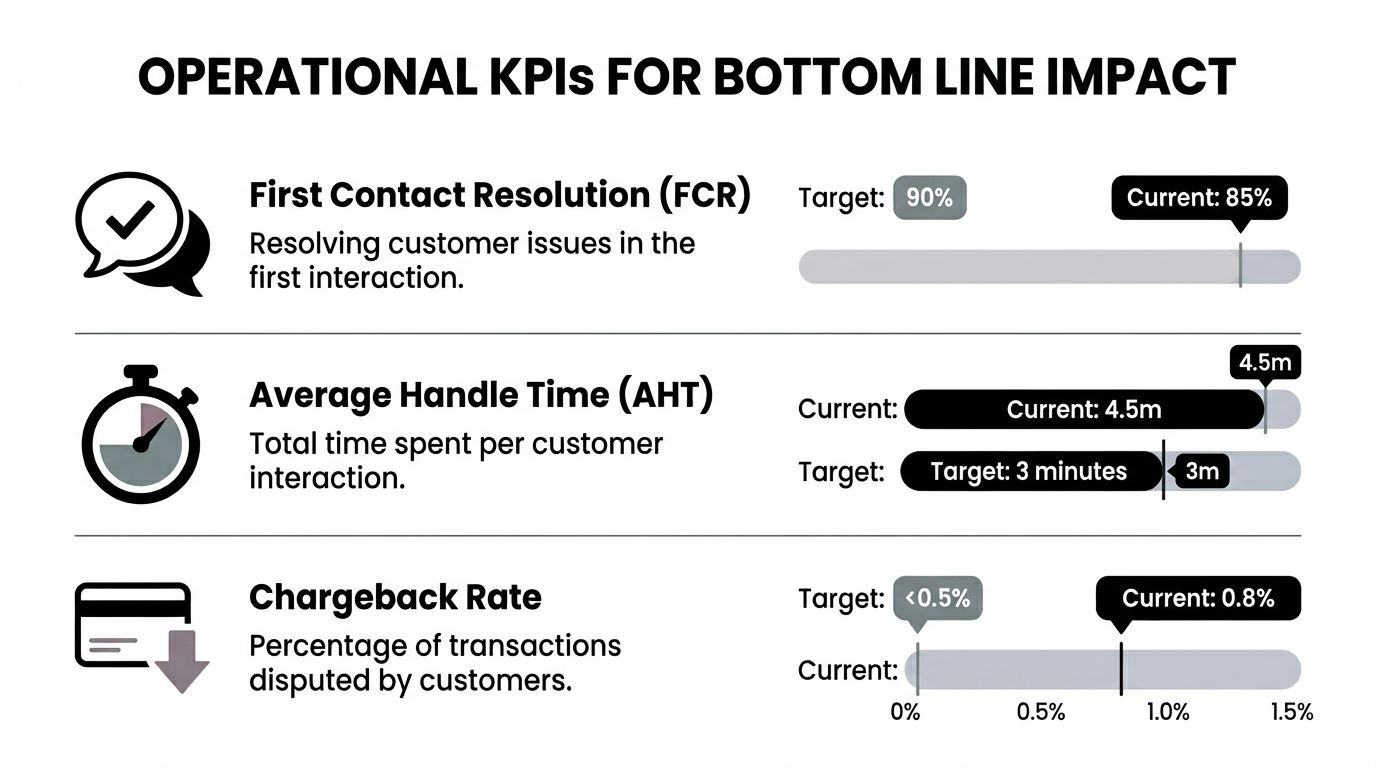
For chargebacks, three metrics matter most in day-to-day support operations: First Contact Resolution, First Response Time, and Average Handle Time. They don’t just describe support performance. They influence whether a frustrated customer calms down, asks for a refund, or disputes the charge.
First Contact Resolution reduces repeat friction
First Contact Resolution, or FCR, measures whether the issue was solved in the first interaction.
This metric matters because repeated contact creates effort for the customer and workload for your team. A buyer who has to explain the same shipping issue three times is far more likely to lose patience. In support environments broadly, high FCR is tied to reduced operational cost and better customer satisfaction, which is why it became a core efficiency metric in the first place.
For Shopify stores, low FCR usually points to one of these problems:
- Weak agent access to order details
- Unclear return or refund rules
- Too many handoffs between support, fulfillment, and finance
If your store sells across channels, operations outside support can also drag FCR down. For merchants reviewing upstream process issues, this resource on KPIs for supply chain and warehouse management is useful because shipping delays and inventory confusion often surface first as support failures.
First Response Time affects dispute viability
First Response Time, or FRT, measures how long it takes from the customer’s first message to your team’s first reply.
In general support, a fast first response improves customer perception because buyers read quick replies as a sign that your business is paying attention. In dispute-heavy environments, payment disputes operate under strict deadlines, making rapid initial responses essential, and for Shopify merchants optimizing FRT is directly correlated with higher dispute win rates and faster revenue recovery because it gives you more time to gather and submit evidence (Forethought on FRT and AHT).
That means FRT has two jobs. It reassures the customer quickly, and it gives your team a head start if the situation becomes a formal dispute.
Average Handle Time needs balance
Average Handle Time, or AHT, measures the total interaction time divided by the number of interactions. It captures the full support effort, including conversation time, research, and follow-up work.
AHT is useful, but merchants misuse it all the time. They try to push it down without checking whether issues were resolved. Shorter conversations are not automatically better. If the customer comes back angry, you didn’t save time. You delayed important work.
A better way to think about AHT is as a balance metric:
| Operational KPI | What it tells you | What goes wrong when you chase it blindly |
|---|---|---|
| FCR | Whether issues get solved on the first try | Teams close cases too early |
| FRT | How quickly customers hear back | Fast but vague replies create more follow-ups |
| AHT | How much effort each case takes | Agents rush and miss details that matter later |
Fast support helps. Fast and incomplete support creates repeat contacts, weak records, and more dispute risk.
The Missing KPIs for True Chargeback Management
Most customer service KPI frameworks stop too early.
They cover satisfaction, speed, and team efficiency well enough. They do not tell you whether your store is getting money back after a payment dispute. That’s the gap many Shopify merchants discover only after they’ve spent months improving support dashboards while chargeback losses keep piling up.
That blind spot is real. Existing customer service KPI frameworks rarely address metrics specific to payment dispute management. They focus on resolution time and satisfaction but miss chargeback-specific indicators like win rate percentage, evidence package quality, or time-to-recovery (Front on support KPI gaps).
Standard KPIs are necessary but incomplete
A healthy CSAT score is good. Fast first response is good. Better first-contact resolution is good.
None of those answer the most painful question for a merchant with recurring disputes: Are we recovering revenue when customers file chargebacks?
That’s why stores with meaningful chargeback exposure need a second KPI layer. Not a replacement for service metrics. An added layer that measures dispute performance directly.
The most useful chargeback-specific KPIs are simple enough to track, even if many teams never formalize them.
Essential Chargeback Management KPIs
| KPI | How to Calculate It | Why It Matters for Your Store |
|---|---|---|
| Chargeback Win Rate | Number of disputes won divided by total disputes responded to | Shows whether your evidence and representment process actually recovers revenue |
| Dispute Rate | Number of chargebacks compared with your transaction volume over the same period | Helps you see whether post-purchase issues are becoming a broader payment problem |
| Evidence Submission Time | Time between dispute notice and completed evidence submission | Measures how quickly your team moves before deadlines close |
| Evidence Quality Review | Internal review of whether each package includes the order record, delivery proof, policy acceptance, and customer communication history | Exposes weak submissions that lose even when the transaction was valid |
| Time to Recovery | Time from dispute opening to final outcome | Helps finance and operations understand how long disputed revenue stays at risk |
What these KPIs reveal that support dashboards miss
Take a common example. Your team answers customers fast and keeps handle time low. On paper, support looks efficient. But if your dispute responses are missing delivery records, policy screenshots, or prior customer communication, you can still lose valid cases.
That’s the difference between support efficiency and revenue recovery effectiveness.
A useful review habit is to compare two types of outcomes side by side:
- Did the support interaction close cleanly?
- If it became a dispute anyway, did your evidence hold up?
When those answers don’t match, you’ve found a process gap.
If your team can’t connect support history to dispute outcomes, you’re measuring activity, not protection.
For merchants building that process, a practical next step is looking at dedicated chargeback management tools for Shopify. Generic help desk reporting won’t give you this layer on its own.
How to Improve Your KPIs and Reduce Chargebacks
Improvement starts when you stop treating support, operations, and disputes as separate systems. The KPI gains that matter most usually come from fixing handoffs, reducing confusion, and tightening the evidence trail.

One warning before the tactics. Speed metrics can fool you. There’s often a disconnect between measuring agent performance and measuring customer outcomes. In chargeback work, an agent can reply quickly and still submit weak evidence, which hurts recovery. That’s why the useful improvements are the ones that raise both efficiency and dispute quality at the same time (Global Response on KPI disconnects).
Fix the causes, not just the dashboard
The fastest way to improve kpis in customer service is often outside the support tool itself.
- Tighten product descriptions: If the product page creates the wrong expectation, support inherits the complaint later. Clear sizing, materials, compatibility notes, and usage details reduce “not as described” frustration.
- Clean up shipping communication: Delivery anxiety drives a lot of avoidable tickets. Proactive tracking updates, delay notices, and clear fulfillment timing reduce inbound pressure and lower the chance that a customer assumes fraud.
- Make returns easy to understand: If your refund window, return conditions, or subscription terms are hard to find, customers don’t argue less. They escalate faster.
These changes help because they reduce preventable contacts before the ticket even exists.
Build support for first-touch resolution
Once the ticket arrives, your goal is simple. Solve the issue with enough clarity that the customer doesn’t need to come back.
That usually means giving agents better tools and tighter playbooks:
- Use saved replies for common cases: Templates for shipping delays, damaged goods, refunds, and subscription confusion shorten response time while keeping key details consistent.
- Give agents order context in one place: They shouldn’t have to jump through multiple systems just to verify shipment status, delivery confirmation, or prior messages.
- Create escalation rules for high-risk cases: Any order involving repeated contact, refund refusal, or delivery claim should follow a documented path.
Here’s a helpful walkthrough on how support teams can standardize that work without losing judgment:
Improve dispute KPIs with automation
Manual dispute handling usually breaks in the same places. Evidence is scattered. Deadlines sneak up. The submission goes out incomplete. Nobody ties the result back to the support history.
That’s where automation helps. Tools that pull order details, delivery data, customer communication, and policy acceptance into one evidence flow can improve consistency and reduce last-minute scrambling. For Shopify merchants, ChargePay is one option. It automatically fights disputes, builds evidence packages, detects friendly fraud signals, and submits responses before deadlines using data from the order and support trail.
The practical advantage isn’t just less manual work. It’s cleaner evidence, faster submission, and tighter alignment between your support record and your dispute response.
Real Scenarios Tracking KPIs for Post-Purchase Support
Theory is useful. Scenarios are where you see whether your KPI setup is helping or hiding problems.
Scenario one with an item not received complaint
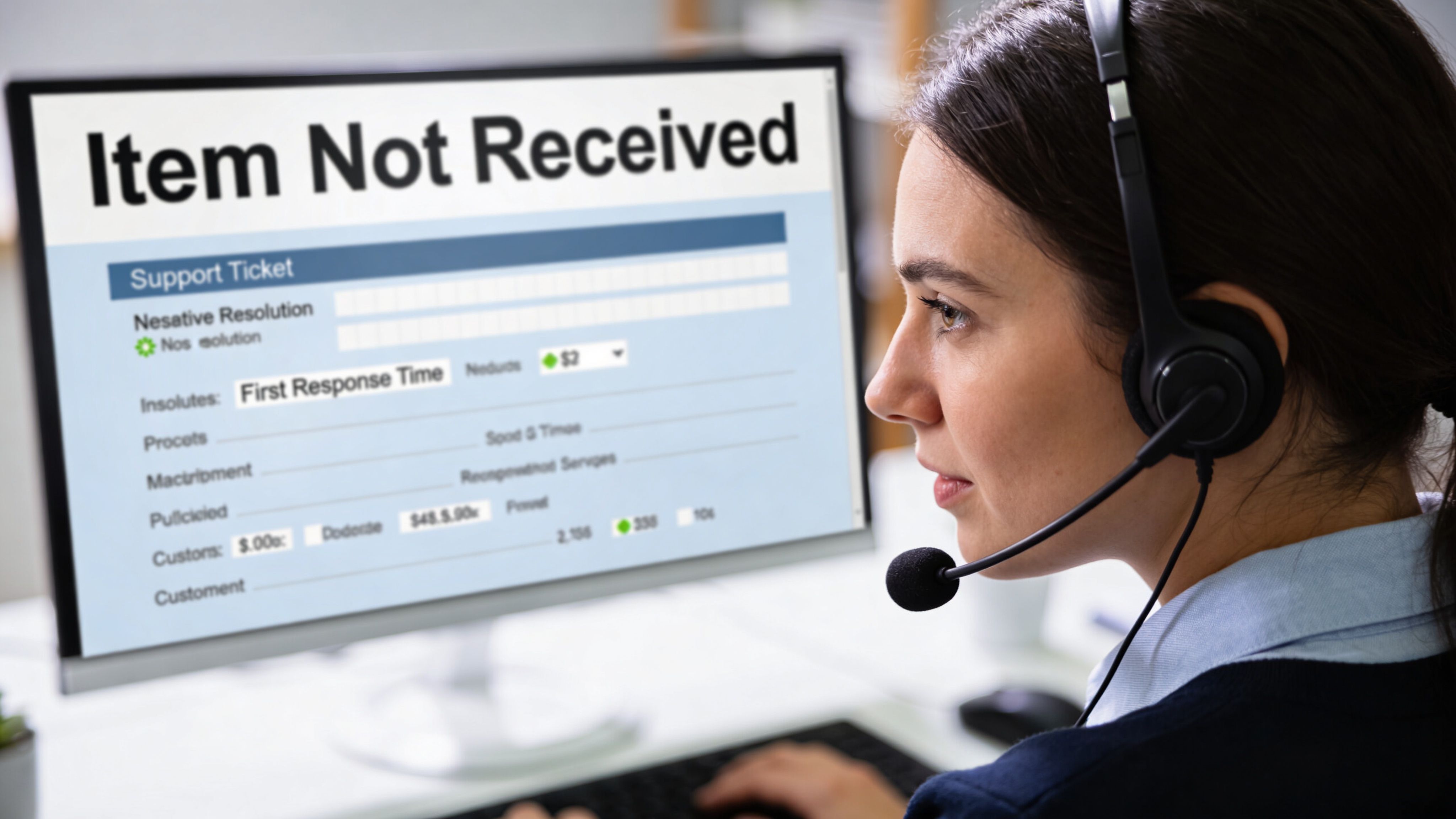
A customer places an order, then messages support asking where the package is. The tracking page hasn’t updated clearly. Support replies late, gives a generic answer, and doesn’t follow up when the customer responds again. A few days later, the customer files an “item not received” chargeback.
This case usually shows weak KPI management in three places:
| What happened | KPI signal | What it means |
|---|---|---|
| Customer waited too long for a reply | FRT is too slow | The customer felt ignored early |
| The issue took multiple back-and-forth messages | FCR is weak | Support didn’t resolve the concern on first touch |
| Notes and tracking proof are scattered | Evidence readiness is poor | The merchant struggles if a dispute is filed |
Now compare that with a store that tracks those signals tightly. The support team replies quickly, confirms shipment status, sends the tracking link again, explains the delay clearly, and flags the case if the package remains in transit too long. If needed, the team reships or refunds based on policy before frustration hardens into a bank complaint.
The same order problem can produce two very different outcomes. One becomes a chargeback. The other becomes a resolved support case.
Scenario two with friendly fraud
A customer receives the item, uses it, then disputes the charge with the bank. The merchant sees the dispute notice and realizes support had already handled a related message from the same customer. Maybe they asked about sizing, confirmed delivery, or requested help with use instructions.
A store that only tracks generic support KPIs often loses momentum here. The support conversation lives in one tool, order data lives somewhere else, and nobody has a chargeback-specific KPI framework to monitor evidence quality or submission timing. The dispute becomes a scramble.
A store that tracks chargeback-focused metrics works differently:
- Win rate is reviewed regularly, so the team knows whether representments are working.
- Evidence submission time is monitored, so cases don’t sit untouched.
- Customer communication history is preserved, so support records become part of the defense.
Good dispute management is rarely about one brilliant rebuttal. It’s about having the right records ready before the deadline.
These scenarios are common because post-purchase support and disputes are tightly connected. If your KPIs stop at service speed, you’ll miss the operational story that decides whether revenue is protected.
Stop Guessing and Start Measuring Your Way to Fewer Chargebacks
The primary value of kpis in customer service isn’t cleaner reporting. It’s better decisions while there’s still time to prevent a loss.
When you track the right metrics, support stops being a reactive inbox. It becomes an early warning system for delivery confusion, refund friction, policy misunderstandings, and the repeat contacts that often show up before a chargeback. Add dispute-specific KPIs on top, and you can finally connect service quality to revenue recovery.
That’s the shift many Shopify merchants need. Not more data. Better signal.
A useful setup is usually straightforward:
- Track customer sentiment so you know when trust is slipping.
- Track operational speed and resolution quality so problems don’t drag into escalation.
- Track dispute outcomes directly so you know whether your evidence process is protecting revenue.
If you want a deeper framework for automating that recovery layer, this guide to automated chargeback and dispute management using AI lays out what that process looks like in practice.
Stop measuring support like it exists in a vacuum. For a Shopify store, post-purchase service and chargeback performance belong in the same operating system.
If you're tired of losing valid revenue to chargebacks, install ChargePay. It’s built for Shopify, has a 4.9-star rating on the Shopify App Store, carries the Built for Shopify badge, and uses a pay-per-win model so you only pay when recovered funds come back to your store.


.svg)



.svg)


.svg)
.svg)
.svg)