

Friendly fraud is one of those terms that sounds almost harmless, but for an e-commerce merchant, it's anything but. At its core, friendly fraud happens when a customer buys something from your store, receives it, and then disputes the charge with their bank.
They might claim the charge was unauthorized or that the product never arrived, triggering a chargeback. The catch? They often keep the product. It’s a legitimate purchase that gets reported as a fraudulent one after the fact.
Understanding The Real Cost of Friendly Fraud
Think of it like this: a customer walks into a restaurant, orders a three-course meal, and eats every last bite. Then, they call their credit card company and say the charge was a mistake. Just like that, they get their money back, and the restaurant is left footing the bill for the ingredients, the labor, and an extra penalty fee from the bank.
That's exactly what friendly fraud feels like for your business.
It’s an incredibly frustrating and expensive problem because it isn't started by a criminal with a stolen credit card. The dispute comes directly from your actual customer. The reasons can be all over the map:
- Genuine Confusion: The customer simply doesn't recognize your business name on their bank statement.
- Family Purchase: A family member—often a child—made the purchase without their knowledge.
- Buyer's Remorse: They regret the purchase and see a chargeback as an easier, no-questions-asked way out of your return process.
- Intentional Misuse: Some customers know exactly what they're doing and abuse the system to get products for free. This is the most malicious form, and unfortunately, it's common.
Friendly Fraud vs Other Fraud Types
It's absolutely critical to understand that friendly fraud is not the same as the criminal fraud we usually hear about. To make it crystal clear, let's break down the key differences between friendly fraud, true criminal fraud, and simple merchant error.
This distinction is precisely why friendly fraud is so tricky for merchants on platforms like Shopify, Stripe, or PayPal to fight. You have proof the item was shipped and delivered to the cardholder’s confirmed address, yet you're still stuck defending the charge.
The simple (but costly) process is laid out below. It all starts with your customer.
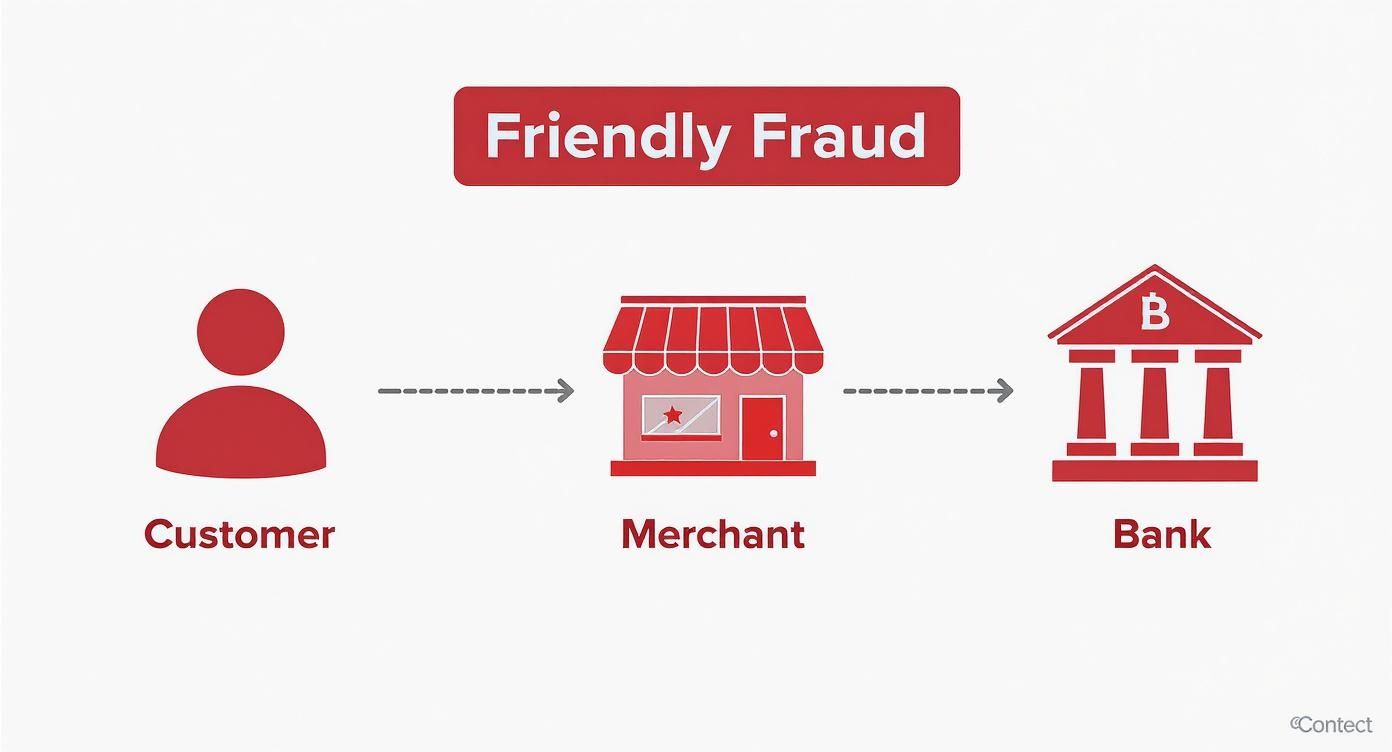
As the infographic shows, a simple dispute from a customer kicks off a chain reaction that directly hits your bottom line.
The financial fallout is staggering. Friendly fraud is a massive driver of credit card fraud globally, making up as much as 70% of all cases. The card payment industry bleeds over $132 billion every year from this problem alone—and that figure doesn't even count the value of the goods or services you, the merchant, lose in the process.
The entire chargeback system was built to protect consumers from theft. Because of that, it often puts the burden of proof squarely on the merchant's shoulders. You're forced to prove that a legitimate customer made a legitimate purchase, which can feel like an impossible, uphill battle.
This is far more than an occasional headache; it’s a major financial drain. The combination of lost revenue, lost products, and compounding penalty fees makes understanding why the chargeback issue a serious threat to your business. Next, we’ll dig into why this problem is only getting worse and what you can actually do to protect your store.
Why Is Friendly Fraud Suddenly Everywhere?

If it feels like you're dealing with more friendly fraud than ever before, you're not imagining things. This isn't just a random blip; it's a growing trend fueled by a perfect storm of modern tech, economic shifts, and some pretty big changes in how people shop and think. For any e-commerce merchant, getting a handle on why this is happening is the first step toward protecting your business.
A huge piece of the puzzle is simple economic pressure. When household budgets get tight and the cost of living goes up, some customers start looking at the chargeback process as a financial escape hatch. Instead of going through the hassle of a normal return for an item they regret buying, they misuse the dispute system to get a quick refund. It's almost like they're using it as a personal cash-flow tool.
This problem, which falls under the umbrella of first-party fraud, is blowing up. It now makes up a staggering 36% of all reported fraud cases worldwide—a massive leap from just 15% the year before. You can find more stats on the financial pressures driving this trend over at Fraud.net.
Social Media and Easy Checkouts Are Fanning the Flames
Another major reason? Social media. Hop on platforms like TikTok or X (what used to be Twitter), and you'll find a flood of posts and videos promoting so-called "chargeback hacks." They frame filing a dispute on a legitimate purchase as a clever, victimless trick to score free stuff, which essentially normalizes theft.
This behavior gets amplified by just how ridiculously easy it is to buy things online now. The very features designed to create a smooth, frictionless shopping experience have unintentionally made it just as easy to dispute a charge.
- One-Click Checkouts: When buying something is that seamless, customers can honestly forget they even made the purchase. Or, the cost doesn't fully register, leading to a nasty surprise when the credit card bill arrives.
- Confusing Billing Descriptions: A vague or weird-looking merchant name on a bank statement is a surefire way to trigger a chargeback. If a customer doesn't recognize "SP*COOLGADGETS" as the store they bought from, their first instinct is often to flag it as fraud.
- Subscription Services: Automatic renewals are a classic tripwire. A customer signs up for a free trial, forgets about it, and then disputes the first real charge instead of just contacting support to cancel.
All these factors have created the perfect environment for friendly fraud to thrive. The line between a genuine customer service issue and someone intentionally gaming the system has become incredibly blurry, making it easier than ever for customers to file a chargeback, whether they mean to or not.
At the end of the day, the simplicity of disputing a charge has completely outpaced customer education on when it's actually appropriate. You can learn more about how this behavior is categorized in our guide on what is first-party fraud.
What Friendly Fraud Looks Like in the Wild
It’s one thing to talk about friendly fraud in theory, but it’s another thing entirely to see it pop up in your own store. These aren’t masked criminals from a movie; they’re often customers you’ve dealt with before. And while the stories might look a little different on the surface, they always end the same way: you’re out the product, the money, and your valuable time.
To really drive this home, let's walk through a few scenarios that play out for merchants every single day. You’ll quickly see how a perfectly normal transaction can sour into a costly chargeback.
The Digital Downloader
Meet Sarah. She’s an entrepreneur who sells a fantastic online course on digital marketing. A customer comes along and buys her flagship course for $299. Within just a few hours, they download every single video module, workbook, and template. A week goes by, and then—bam—Sarah gets a chargeback notification.
The customer's reason? "Unauthorized charge." It’s a classic. Even though Sarah has the digital receipts, the IP address logs, and a name on the credit card that perfectly matches the customer's, the bank automatically sides with its cardholder.
The Damage to Sarah's Business:
- $299 in lost course revenue.
- A $15 non-refundable chargeback fee from her payment processor.
- Result: A total loss of $314, and her valuable course content is now in the hands of someone who essentially got it for free.
The Subscription Sampler
Next up is a subscription box company. They offer a free 30-day trial for their monthly service, which is a great way to attract new customers. Someone signs up, enjoys the free box, but then completely forgets to cancel before the trial ends. When the first $49 charge hits their statement, they don't call customer service or send an email. Instead, they go straight to their bank and file a chargeback.
They simply tell the bank they never authorized a subscription. The charge is reversed in an instant, and the merchant gets slapped with a fee. The customer took the path of least resistance, never even giving the business a chance to make it right.
The Family Fraudster
Finally, here's a situation that happens all the time on platforms like Shopify that sell digital goods or in-game items. A parent saves their credit card information on the family iPad. Their kid, eager to get some upgrades for their favorite game, makes $75 worth of in-app purchases without permission.
When the parent gets the credit card bill, they see a bunch of charges they don't recognize and immediately assume they've been hacked. So, they dispute the transactions as fraudulent. While this is a genuine mistake and there’s no malice involved, the financial hit to the merchant is exactly the same as if it were deliberate fraud.
Each of these stories paints a picture of the frustrating reality of friendly fraud. It doesn't matter if the customer’s motive was deliberate abuse, simple forgetfulness, or an honest-to-goodness mistake. At the end of the day, the merchant is the one left holding the bag—losing the sale, the product, and paying extra fees for the trouble.
How to Spot Potential Friendly Fraud Early

Preventing a friendly fraud dispute is always, always better than fighting one after the fact. While you can't read a customer's mind, you can learn to recognize transaction patterns that scream "high risk."
Think of it like being a detective at the scene of a crime. One single clue might not mean much, but when you start seeing a bunch of them together, they can paint a very telling picture.
Catching these signals early gives you a chance to hit pause, do a little more digging, and maybe stop a chargeback before it even gets filed. The goal isn't to shut down every sale that looks a bit weird. It's about being aware. A little extra scrutiny on the right orders can save you a mountain of cash and headaches down the road.
Common Red Flags to Watch For
Certain customer behaviors should definitely make your ears perk up. For instance, be extra cautious with a first-time customer who places an unusually large order and then pays a premium for expedited shipping. This combo is a classic move for someone trying to get their hands on high-value goods before the real cardholder—or you—catches on.
Another huge signal is when you see multiple orders coming through with different credit cards, but they're all being shipped to the same address. This could be someone testing out a list of stolen card numbers, or it could be the setup for a string of "unauthorized transaction" claims. Either way, it demands a closer look before you ship anything.
Keep in mind, none of these flags are a smoking gun on their own. But when you see several of them pop up in a single transaction? That's a strong sign that you need to do some extra verification before sending that order out the door.
Digital Downloads and Immediate Activity
If you're selling digital products—like e-books, software, or online courses—the warning signs look a little different.
A key red flag here is a customer who buys your product and then, almost instantly, downloads every single file available. This kind of rapid-fire consumption can be a dead giveaway for a planned chargeback, since the person has already squeezed all the value out of what you're selling.
By recognizing these patterns, you can start putting proactive measures in place to protect your revenue. Using effective transaction monitoring solutions can automate much of this detective work, flagging risky orders for a manual review. This simple layer of defense lets you confirm that a suspicious order is legit, slashing your exposure to friendly fraud.
A Merchant's Guide to Fighting Chargebacks
When a friendly fraud chargeback hits your account, it's easy to feel like the deck is stacked against you. The system can often feel like it automatically favors the customer, but just rolling over and accepting the loss isn't your only move. If you have a solid plan and the right proof, you can absolutely fight back and get back the revenue you earned fair and square.
Fighting a chargeback isn't about getting into an argument; it's about building a clear, logical case supported by cold, hard facts. The whole process can seem like a mountain to climb, but it really just breaks down into three simple stages. Get these steps down, and you’ll have a powerful playbook to defend your business.
Stage 1: Gather Your Compelling Evidence
First things first: you need to put on your detective hat. Your mission is to pull together every bit of information that proves the transaction was legitimate and you held up your end of the deal. The more detailed and specific you can be, the stronger your case will be when the issuing bank reviews it.
Start by grabbing the essentials for any dispute:
- Transaction Details: Get the AVS (Address Verification System) and CVV (Card Verification Value) match results. A successful match is a huge point in your favor, showing the real cardholder likely made the purchase.
- Delivery Confirmations: For physical products, this is a must-have. You need tracking information that shows the package was delivered to the customer's verified address—a signed confirmation is even better.
- Customer Communications: Dig up any emails, support tickets, or chat logs. If a customer reached out about their order before filing the dispute, it proves they knew about the transaction.
- Digital Footprints: Selling digital goods? IP logs are your best friend. Show when and where the customer accessed or downloaded their files to shut down any "unauthorized access" claims.
Stage 2: Craft a Professional Rebuttal
Once all your evidence is in one place, it’s time to package it into a professional rebuttal letter. This document is your single chance to tell your side of the story to the bank. Keep it short, factual, and incredibly easy to read.
Think of it like you're handing a case file to a judge. Start with a quick summary, then present each piece of evidence logically. Use bullet points and clear headings so the bank's review team can scan it in seconds. Whatever you do, keep emotion out of it and stick to the facts. A deep understanding of effective payment provider integration is a game-changer here, as it makes sure you can pull all this transaction data without a hitch.
Key Takeaway: Your rebuttal isn't the place for a long, winding story. It's a professional document where you methodically present proof that the charge was valid, the product was delivered, and the customer engaged with your business.
Stage 3: Respect the Deadlines
This last step is the simplest, but it’s also the one that trips up so many merchants: you have to submit your response on time. The chargeback process runs on a strict clock, and you usually only have a small window to get your evidence in. Miss that deadline by even a single day, and you automatically lose the dispute. It doesn't matter how perfect your evidence is.
The rise of friendly fraud is no joke. One study found that 79% of merchants now deal with it, a massive jump from 34% the year before. Consistently following these steps is your best defense. For a more detailed walkthrough, check out our guide on how to fight a chargeback and start protecting your revenue today.
Practical Ways to Prevent Friendly Fraud
While fighting chargebacks is a skill every merchant needs, the best defense is a good offense. Stopping disputes before they even start is the real win. Not only does it save you money, but it also avoids frustrating your customers and eating up your valuable time.
Many of the best tactics are actually simple tweaks to how you communicate and handle orders.
Your goal is to stamp out any potential confusion and make it a whole lot easier for customers to talk to you than to call their bank. Think of clear, simple communication as your number one weapon against those accidental disputes that spiral into costly friendly fraud cases.
Fortify Your Checkout and Communication
One of the most common reasons a customer files a chargeback is because they see a charge on their statement and have no idea what it is. Your billing descriptor—that little line of text that appears next to the transaction—has to be unmistakably clear. It needs to instantly connect the charge back to your store in the customer's mind.
To add another layer of security, you should always require the CVV (that three or four-digit code on the card) and use Address Verification System (AVS) checks. These simple tools are great for helping confirm that the person placing the order is the actual cardholder.
But it doesn't stop at the checkout. Keep the conversation going after the sale with detailed communication:
- Order Confirmations: Fire off an email immediately that spells out exactly what they bought, what they paid, and where it's headed.
- Shipping Updates: Don't leave them guessing. Proactively send tracking info and delivery alerts so they always know the status of their order.
- Easy-to-Find Support: Plaster your customer service email and phone number everywhere—on your website, in the footer, and in every single email you send.
The easier it is for a customer to reach you with a question, the less likely they'll be to just give up and file a chargeback. You'd be surprised how often top-notch service acts as a powerful fraud prevention tool.
Some apparel merchants are even getting ahead of "item not as described" disputes by using AI clothing try-on technology to help shoppers nail their size and style virtually.
By mixing crystal-clear communication with solid checkout security, you build a strong foundation. For a deeper dive into more advanced tactics, check out our complete guide on effective chargeback prevention.
Common Questions About Friendly Fraud
Even after breaking down the basics, you probably still have a few questions rolling around. Let's tackle some of the most common ones we hear from merchants just like you.
Is a Chargeback the Same as a Refund?
Not even close, and this is a big one. A refund is something you and your customer agree on directly. You control the process, return their money, and it’s basically a customer service interaction.
A chargeback, on the other hand, is a forced reversal that the customer’s bank initiates. It completely sidesteps you, slaps you with non-refundable penalty fees, and chips away at your reputation with payment processors.
Can I Completely Stop Friendly Fraud?
If only it were that simple! The honest answer is no, you can't eliminate it entirely. Some cases are genuine mistakes by a confused customer, while others are flat-out intentional.
But here’s the good news: you can absolutely reduce its impact. By using the strategies we’ve covered—like crystal-clear billing descriptors and proactive customer communication—you can dramatically cut down the number of friendly fraud incidents hitting your business.
Does Winning a Dispute Hurt My Business?
Quite the opposite. When you successfully fight and win an illegitimate chargeback, you're sending a clear signal to payment processors that you're a diligent, responsible merchant who tracks your orders properly.
The real damage comes from losing too many disputes. A high chargeback ratio can trigger higher processing fees or even get your account shut down. That’s exactly why fighting back is so critical.
Stop letting confusing chargeback claims eat into your revenue. ChargePay uses AI to handle the entire dispute process for you, creating winning responses to get your money back without the headache. Protect your business and boost your win rate today.


.svg)



.svg)


.svg)
.svg)
.svg)