

Payment reconciliation is the process of comparing your internal financial records against external statements—like those from your bank or payment gateways—to make sure everything lines up. It’s basically like balancing a checkbook for your e-commerce business, confirming that the money you think you made is what actually landed in your bank account.
What Is Payment Reconciliation and Why Does It Matter
If you’ve ever glanced at your Shopify sales report and then stared at your bank deposit, you've probably noticed the numbers don't perfectly match. That gap, whether it's a few cents or a few hundred dollars, is exactly what payment reconciliation is built to solve. It’s the essential accounting process of matching up every transaction to keep your financial records accurate, complete, and free of costly errors.
Think about it like this: your e-commerce store is the cash register, ringing up every sale. Your payment processor is the armored truck that moves the money, and your bank account is the vault where it all ends up. Payment reconciliation is the security audit that confirms every single dollar that left the register made it safely into the vault, minus any legitimate fees.
The Real Cost of Skipping Reconciliation
Ignoring this process is like trying to fly a plane with no instruments—you’re operating completely blind. You won't notice when a payment gateway overcharges you on fees, a customer's refund gets processed twice, or a chargeback slips through the cracks unchallenged. These little discrepancies add up fast, quietly siphoning money from your bottom line.
Historically, this has been a manual headache, and that's where the real trouble starts. In fact, error rates in manual reconciliation processes can range from 3% to a staggering 25%. Many businesses still pour hours into this mind-numbing task, which not only drives up operational costs but also leaves the door wide open for human error.
At its core, payment reconciliation is about financial truth. It answers a simple but vital question for any business owner: "Is the money I earned actually the money I have?"
To really get a handle on this, it helps to understand what each player in the transaction does, especially the system that actually moves the money. Take a look at our guide on what a payment processor is to see how they fit into the puzzle. Ultimately, solid reconciliation is a cornerstone of modern business, fitting into broader AI and e-commerce strategies that protect your revenue and fuel growth.
Following the Money: A Step-by-Step Reconciliation Journey
To really get what payment reconciliation is, let's just follow the money. Every single time a customer clicks that "buy" button, they're kicking off a financial journey with multiple legs. It's never a simple A-to-B transfer; it's more like a winding road with several checkpoints, and every one of them is a potential spot for things to go wrong.
Think of it like a relay race. Your e-commerce store starts things off, your payment gateway grabs the baton next, and your bank account is the finish line. Reconciliation is just the process of making sure the baton—your money—doesn't get dropped or mysteriously shrink along the way.
The visualization below shows this basic flow, from the moment of sale to the final payout that hits your bank.
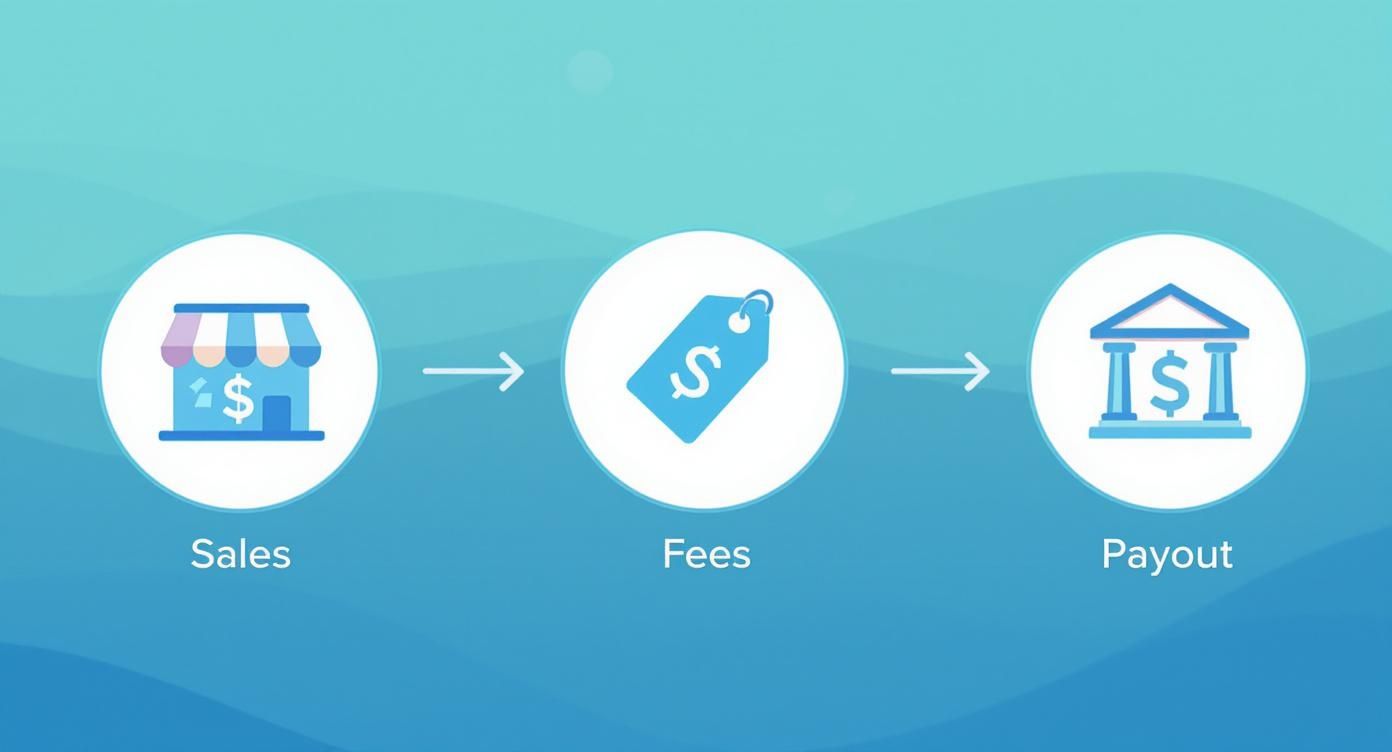
As you can see, a customer's payment gets nibbled away by different fees before the final, smaller amount actually lands in your account. Now, let’s break that journey down into its core pieces.
The Three Key Checkpoints
The entire reconciliation process really hinges on matching up three different sets of records. Each one tells a part of the story, and you can only be sure your finances are truly accurate when they all line up perfectly.
- Sales Data (Your Store): This is your internal source of truth. It’s the report from your platform, like Shopify or BigCommerce, that shows every single order placed, its total value, and any refunds you’ve pushed through.
- Gateway Reports (The Processor): This is the middleman's version of events. Reports from Stripe, PayPal, or your chosen processor show the transactions they handled, the fees they skimmed off the top, and any chargebacks filed against you.
- Bank Statements (The Final Deposit): This is the ultimate proof. Your bank statement shows the actual cash deposits—the final payout—that made it into your account after all the deductions.
The whole goal is to match the transaction in your sales data with its corresponding entries in the gateway report and, finally, the deposit on your bank statement. But here's the catch: it's almost never a clean one-to-one match.
Unpacking the Complexities
This is where the real work begins. Several things can complicate the journey from a $100 sale to what you actually see in your bank account, including:
- Processing Fees: Every gateway takes its cut. A typical fee might be 2.9% + $0.30, which immediately chips away at your sale amount.
- Refunds: If a customer returns an item, you process that refund through your store. This amount then gets deducted from a future payout batch, which can make it a real headache to trace back to the original order.
- Chargebacks: When a customer disputes a charge, the entire transaction amount plus a penalty fee (often $15-$25) is yanked from your account while the dispute is sorted out.
The sheer scale of these transactions is staggering. By 2025, the total value processed globally is expected to hit $3.1 trillion, with payment processors raking in around $64 billion in revenue. That incredible volume makes a rock-solid reconciliation process non-negotiable for any serious merchant.
Reconciliation isn't just about accounting; it's about visibility. It gives you a transparent map of every dollar, showing you precisely where your revenue is going—from fees to refunds to your final profit.
Trying to manage all these different data streams from multiple sources can quickly become a nightmare. That's where tools like a payment orchestration platform can come in handy, helping to centralize and simplify the data flow to make the whole reconciliation journey much smoother. At the end of the day, every step, from the initial sale to the final settlement, has to be carefully checked and verified.
Why Your Numbers Don't Match: Unpacking Common Discrepancies
So, you've traced the money from a customer's click to your bank deposit, but the final numbers just don't add up. It’s an incredibly common frustration for e-commerce merchants, and honestly, it’s where the real detective work of reconciliation begins.
These gaps between your sales data and bank statements are rarely one big, obvious mistake. Instead, think of them as a collection of small, sneaky discrepancies that quietly pile up over time. It's like a leaky bucket—one tiny hole won't empty it, but a dozen small drips will eventually drain your cash flow. Pinpointing these "leaks" is the key to protecting your revenue.
Let's dig into the usual suspects that throw your books out of whack.

Timing Is Everything
One of the most frequent culprits is simple timing. A customer buys something from your store on a Friday night, and Shopify instantly logs the sale. Great! But the payment gateway might not batch and process that transaction until Monday, and the money won't actually land in your bank account until Tuesday or even Wednesday.
This lag creates a temporary mismatch that can be a real headache. Your sales report for Friday shows revenue that your bank statement for that day doesn't. While it usually sorts itself out, this float can make month-end closing a nightmare if you aren't tracking it closely.
Hidden Fees and Surprise Deductions
Another classic reason for mismatched numbers is the swarm of fees that get skimmed off the top before a payout ever reaches you. You're probably well aware of the standard transaction fee, but all sorts of other costs can pop up and eat into your profits.
Keep an eye out for these:
- Cross-border fees for international orders.
- Currency conversion charges if you sell in multiple currencies.
- Monthly gateway subscription fees that are sometimes deducted directly from a payout.
- Chargeback and dispute fees, which are penalties tacked on top of the disputed amount.
These little deductions are easy to miss on their own, but they add up, causing a significant variance between your gross sales figures and your net bank deposits.
A chargeback, for instance, isn't just a simple refund. It's a forced reversal kicked off by the customer's bank, and it almost always comes with a non-refundable penalty fee of $15 to $25. You can learn more about the complexities of a payment reversal in our detailed guide.
Many of these issues can be traced back to messy or incomplete data from the get-go. To get ahead of them, it’s worth exploring some effective strategies to improve data quality across all your platforms. When you start with clean, accurate data, the entire reconciliation process becomes far less painful and much more reliable.
To help you quickly diagnose what might be going wrong, here’s a quick-reference table outlining the most common discrepancies we see.
Common Reconciliation Mismatches and Their Causes
This table isn't exhaustive, but it covers the vast majority of issues merchants face. By knowing where to look, you can spend less time hunting for errors and more time fixing the root cause.
Spreadsheets vs. Software: Choosing Your Reconciliation Method
Is your finance team drowning in a sea of CSV files and VLOOKUP formulas, trying to match thousands of transactions by hand? If that sounds familiar, you're not alone. This is a common scene in many growing e-commerce businesses.
When you're just starting, a simple spreadsheet seems like the most straightforward and affordable way to handle payment reconciliation. But as your order volume picks up, that manual approach quickly turns from a simple task into a major operational headache. What was once manageable becomes a time-consuming, error-prone chore that puts your revenue at risk. It might be time to consider an upgrade.

The Hidden Costs of Manual Reconciliation
At first glance, using spreadsheets seems free. But the hidden costs can be substantial, often lurking in places you don't immediately see. Manual reconciliation isn't just slow; it’s a breeding ground for human error.
A simple typo, a copy-paste mistake, or a missed line item can throw your entire month’s accounting off balance. These small errors can snowball into bigger problems, like failing to notice a payment gateway consistently overcharging you on fees or missing a batch of transactions that never got paid out.
The biggest costs of sticking with spreadsheets include:
- Wasted Hours: Your team spends countless hours exporting, formatting, and manually matching data instead of focusing on strategic financial analysis.
- Increased Risk of Errors: Every manual touchpoint is an opportunity for a mistake that could cost you real money.
- Delayed Financial Reporting: It can take days, or even weeks, to close the books each month, leaving you with an outdated picture of your financial health.
- Missed Revenue: Small discrepancies are often written off as a "cost of doing business" simply because finding them is too labor-intensive.
Manual reconciliation forces you to choose between speed and accuracy—and you rarely get either. The more you rush to finish, the more likely you are to make costly mistakes.
The Power of Automated Solutions
This is where automated payment reconciliation software completely changes the game. Instead of relying on manual effort, these tools plug directly into your e-commerce platform, payment gateways, and bank accounts. They pull all the necessary data automatically and match transactions in minutes, not days.
Think of automated software as a vigilant watchdog for your finances. It can instantly flag a mismatch between a Shopify sale and a Stripe payout, alert you to an unusual fee, or identify a refund that was processed incorrectly. This not only saves an incredible amount of time but also brings a level of accuracy that’s nearly impossible to achieve by hand.
The shift toward these tools is clear. The market for reconciliation software was valued at around USD 3.52 billion and is expected to hit USD 8.9 billion by 2033. This growth is all about the increasing need for financial accuracy and efficiency. To see more on this trend, read the full analysis of payment technology dominance.
By taking the tedious manual work off your team's plate, you free them up to focus on what truly matters—analyzing financial data, spotting growth opportunities, and improving your bottom line. To understand the wider impact, you can learn more about the numerous business process automation benefits in our article.
Building a Bulletproof Reconciliation Process
Having the right tools is a great start, but even the best software is only as good as the process you build around it. A solid, repeatable workflow is what turns payment reconciliation from a frustrating chore into a powerful tool that actually protects your bottom line. It’s all about creating a system that catches problems early and gives you a crystal-clear picture of your financial health.
First things first: you need a consistent schedule. Waiting until the end of the month to reconcile is like waiting for a small leak to become a flood. By then, the damage is done, and finding the source is a nightmare. For any serious e-commerce business, a daily or, at the very least, weekly reconciliation schedule is non-negotiable.
This frequency means you catch discrepancies almost as soon as they happen, which makes them far easier to dig into and fix.
Defining Roles and Responsibilities
A solid process needs clear ownership. If everyone is responsible, then no one is. You have to assign specific reconciliation duties to designated team members. This creates accountability and helps people become experts at their piece of the puzzle.
Think about structuring your team’s roles this way:
- Data Gatherer: This person’s job is to pull all the necessary reports from every source—your e-commerce platform, payment gateways, and bank accounts—right on schedule.
- Reconciliation Specialist: This is the person who does the actual matching. They compare the transactions, spot any discrepancies, and flag them for someone to look into.
- Investigator/Resolver: When a mismatch pops up, this person takes over. They dig into the root cause and see the issue through to the end, whether that means chasing down a payment processor or fixing an internal mistake.
This division of labor stops things from falling through the cracks and ensures every part of the process is handled by someone who knows exactly what they’re doing.
A bulletproof reconciliation process isn't about working harder; it's about working smarter. It creates a predictable system that turns complex financial data into actionable insights, giving you the confidence that every dollar is accounted for.
Finally, document everything. Meticulously. Every step, every discrepancy, and every resolution needs to be logged. This creates an audit trail that is invaluable for spotting recurring problems, training new people, and proving your financials are accurate. A well-documented process is the foundation of a truly reliable and scalable financial operation. When you combine a regular schedule with clear roles and detailed records, you build a workflow that actually safeguards your revenue.
How AI Is Changing the Reconciliation Game
While automated software was a huge leap forward from manual spreadsheets, Artificial Intelligence (AI) is playing in a completely different league. Instead of just following rules to match up transactions, AI-powered systems can actually learn, adapt, and even spot problems before they snowball.
Think of it like this: standard automation is a simple calculator, but AI is a full-fledged financial analyst working for you 24/7.
This new wave of tech goes way beyond basic one-to-one matching. AI algorithms can dig through massive, messy datasets in seconds, catching subtle patterns and outliers that a human—or even regular software—would easily miss.
For instance, an AI tool might notice a tiny, recurring overcharge on transaction fees from a specific payment gateway. It might only be pennies per transaction, but over months, that adds up to thousands in lost revenue. This is what modern reconciliation is all about.
From Matching to Intelligent Analysis
The real power of AI is its ability to understand context. It can accurately categorize transactions, detect potential fraud by flagging unusual activity, and even manage complex disputes with incredible precision. This is especially vital when dealing with chargebacks, where smart, quick analysis can be the difference between winning and losing.
An AI-driven system doesn't just check boxes; it connects the dots. It learns your business's unique financial patterns, getting smarter and more accurate with every transaction it processes.
This intelligence dramatically cuts down on the manual work needed to investigate discrepancies. The whole process of what is payment reconciliation shrinks from a multi-day headache into a task that can often be wrapped up in minutes.
AI tools are quickly becoming essential for any serious e-commerce business. They don't just save you time; they actively find and recover revenue that was once written off as an unavoidable cost of doing business.
As you look into automation, it's crucial to understand how AI can specifically tackle these costly issues. For a deeper look, check out our complete guide to automated chargeback and dispute management using AI to see exactly how this technology protects your bottom line.
Still Have Questions About Payment Reconciliation?
Even with the process laid out, a few questions about payment reconciliation tend to pop up again and again. Here are some straightforward answers to the most common ones we hear from e-commerce merchants.
How Often Should I Reconcile Payments?
For most e-commerce businesses, daily or weekly reconciliation is the way to go. If you wait until the end of the month, you’ll have a much harder time digging through weeks of data to find the root cause of any discrepancies.
Daily checks let you spot issues almost as they happen. This stops tiny errors from snowballing into big, expensive problems later on. Think of it as proactive financial hygiene—it keeps your data clean and reliable.
Can I Just Trust My Payment Gateway Reports?
While reports from gateways like Stripe or PayPal are a critical piece of the puzzle, they only show their side of the transaction. They don't know what your bank account actually received.
Reconciliation is all about confirming that three different records are in perfect sync: your store's sales data, your gateway's processing data, and your actual bank deposits. Trusting one without verifying the others is a recipe for missed errors, overcharged fees, and lost revenue.
What Is the Biggest Benefit of Automation?
The single biggest benefit is the powerful one-two punch of saved time and improved accuracy. Let's be honest, manual reconciliation is painfully slow and notoriously prone to human errors that can cost you real money.
Automation takes that tedious work off your plate, plugs the leaks that lead to lost revenue, and frees up your team to focus on financial strategy and growth instead of mind-numbing data entry. It turns a reactive chore into a proactive business advantage.
Stop letting chargebacks drain your revenue. ChargePay uses AI to automate the entire dispute process, recovering up to 80% of your lost funds without any manual work. Protect your profits and get back to growing your business by visiting https://www.chargepay.ai.


.svg)




.svg)


.svg)
.svg)
.svg)