

Ever wonder what that long string of letters and numbers on a receipt is for? That’s a transaction ID, and it’s basically a unique fingerprint for every single sale you make.
Think of it as the digital equivalent of a package tracking number. It gives you, your customer, and the payment processor a clear path to follow the money from start to finish.
The Digital Fingerprint of Your Sales

At its heart, a transaction ID (sometimes called a TXID) is just a special alphanumeric code that sets one purchase apart from millions of others. This little string of characters is crucial for keeping your financial records straight and secure. It’s the official record that proves a payment happened, answering key questions in an instant.
When a customer buys something, their payment travels through a pretty complex network. The transaction ID is the single source of truth that ties that whole journey together. If you're curious, you can get a full rundown of how credit card transactions actually work behind the scenes.
What Makes a Transaction ID So Important?
A transaction ID is automatically spit out by the payment system—whether it’s Stripe, PayPal, or a credit card network—the second a payment is processed. This unique string gets assigned to each financial transaction so everyone involved can track, manage, and verify the payment between a customer and a merchant.
This unique code handles a few vital jobs:
- Verification: It’s the proof that a specific payment actually went through.
- Tracking: It lets both you and the customer trace the payment's status.
- Record-Keeping: It serves as an official reference for accounting and reconciliation.
Think of the transaction ID as the definitive link between a customer’s order and their payment. Without it, trying to resolve disputes or even simple customer questions would be a total nightmare, turning your financial management into a guessing game.
In some systems, like those dealing with cryptocurrencies, transaction IDs are even more fundamental to how the whole thing works. To really get what a transaction ID is in that world, it helps to understand the basics of What is blockchain technology.
For any e-commerce business, getting a handle on this simple concept is the first step toward building a more organized and bulletproof operation.
How to Find a Transaction ID on Top Platforms
Knowing what a transaction ID is one thing, but knowing where to find it when a customer emails you or a dispute lands in your inbox is another. The good news is, most major platforms make this pretty straightforward once you know where to look.
Think of it like knowing exactly which drawer in a filing cabinet holds the specific document you need. Let's walk through how to locate this crucial piece of information on the platforms you likely use every day. Each one has its own dashboard, but the general idea is the same: find the specific order, then drill down into its payment details.
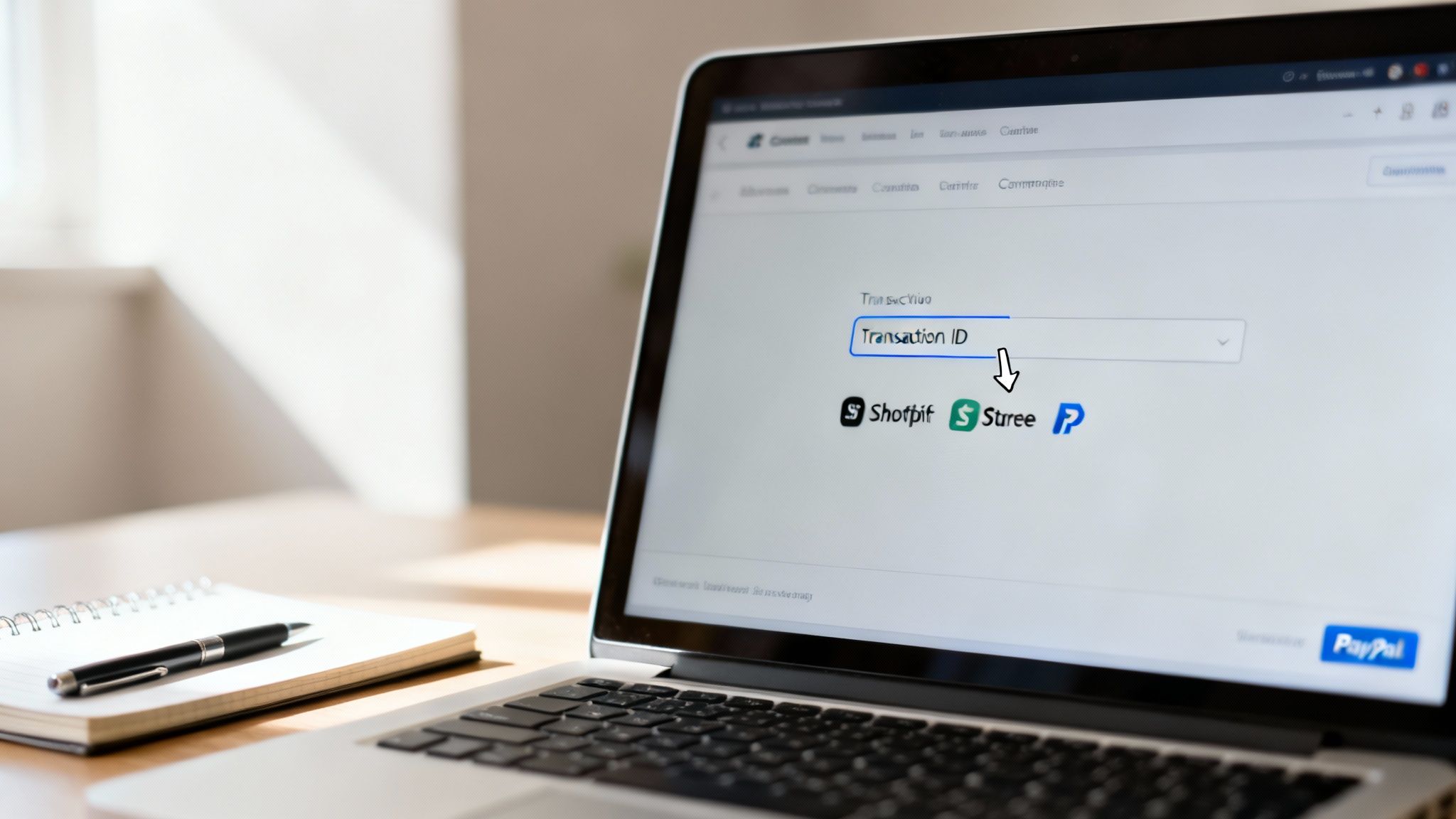
Finding Your Transaction ID: A Quick Reference
Navigating different dashboards can be a pain. To make it easier, here's a quick cheat sheet for finding the transaction ID on some of the most common platforms.
While this table is a great starting point, let's dig into the exact steps for the big three: Shopify, Stripe, and PayPal.
Finding the ID in Shopify
Shopify is fantastic at organizing order information, and the transaction ID is just a few clicks away. It's important to remember that Shopify often calls this the "Payment ID" or lists it under "Payment gateway transaction ID."
Here’s how you get to it:
- Log in to your Shopify admin dashboard.
- From the left-hand menu, click on Orders.
- Find and select the specific order you need to investigate. You can use the customer's name or order number to search.
- Once you're on the order details page, scroll down to the Timeline section at the bottom.
- Look for an entry that says something like "A $XX.XX payment was processed on [Payment Gateway]."
- Click on the "Information from the gateway" link. A pop-up will appear with all the raw payment data, including the transaction ID.
This unique identifier is your direct link to the payment record in your gateway, like Stripe or PayPal, making it incredibly easy to cross-reference information.
Locating Your Stripe Transaction ID
Stripe is a bit more direct. Their entire system is built around payments, so the transaction ID is front and center. In Stripe's world, this is usually called the Payment ID, and it always starts with py_.
Don't confuse the Payment ID (
py_) with a Charge ID (ch_) or a Balance Transaction ID (txn_). While they are all related, the Payment ID is typically what you'll need for customer inquiries and most chargeback defenses.
To find it, just follow these steps:
- Log in to your Stripe Dashboard.
- Navigate to the Payments tab from the main menu.
- Search for the specific transaction using the customer's email, name, or the last four digits of their card.
- Click on the payment to open its detailed view.
- You'll see the Payment ID listed clearly right at the top of the page. You can easily copy it with a single click.
How to Track Down a PayPal Transaction ID
PayPal is another beast entirely, and knowing where to find the transaction ID is essential, especially for handling disputes. For merchants, this is called the Transaction ID, and it's a 17-character alphanumeric string.
Here is the quickest way to find it:
- From Your Activity Feed: Log into your PayPal Business account and go to your Activity log. Each transaction listed there will have its corresponding Transaction ID displayed right next to the payment details.
- From Transaction Details: For a closer look, click on any transaction in your activity log to open the full "Transaction details" page. The Transaction ID will be prominently displayed near the top.
Knowing how to find this ID is the first step in managing any issues that come your way. If you ever face a disagreement, our guide on how to dispute a PayPal transaction can give you the next steps. Having that ID ready makes the entire process so much smoother.
When a chargeback notice lands in your inbox, it can feel like you’re immediately on the defensive. In this high-stakes moment, the transaction ID shifts from a simple record-keeping tool into your single most important piece of evidence. It becomes the official case file number that proves a specific sale actually happened.
Think of it this way: trying to tell a bank about a disputed charge without a transaction ID is like reporting a lost package without a tracking number. Sure, you can describe the box and what was inside, but they have no definitive way to find it in their massive system. Handing over the transaction ID right away establishes your credibility and helps everyone involved pinpoint the exact payment in question.
Connecting Your Evidence to the Sale
A chargeback defense is all about proof. You have to show the bank that the transaction was legitimate, the customer got what they ordered, and you held up your end of the deal. The transaction ID is the thread that ties all your evidence together, making it relevant to that specific dispute.
This simple string of characters is the direct link to:
- Order Details: It connects the payment to the exact products or services the customer purchased.
- Shipping Confirmations: It validates that the delivery tracking number you provide belongs to this specific order.
- Customer Communications: It ties any emails or support chats about the order directly to the payment.
Without this link, your evidence is just a jumble of unrelated documents. With the transaction ID, it all snaps into place to tell a clear, undeniable story of a valid purchase—a key part of navigating the card dispute process effectively.
A transaction ID acts as undeniable proof of purchase, serving as the universal reference point for the customer, the merchant, and the issuing bank. It removes all ambiguity, ensuring everyone is looking at the same transaction when reviewing evidence.
Turning a Potential Loss into a Winnable Case
This unique identifier isn’t just for your internal records; it’s a powerful tool for communicating with payment processors and banks. A recent survey of over 400 merchants highlighted just how vital transaction IDs are for tracing and resolving disputed payments efficiently. These IDs allow payment systems to follow a transaction's entire journey, which helps flag suspicious activity and cut down on incorrect rejections or duplicate charges. To dig deeper into these findings, you can learn more about their role in chargeback management.
When you present your case, leading with "The transaction ID is..." shows you are organized and have your records straight. It immediately moves the conversation from "Did a sale even happen?" to "Here is the proof for this specific sale." This simple step can dramatically improve your odds, turning a potential revenue loss into a successfully defended dispute.
Using Transaction IDs in Your Daily Operations
It's easy to think of a transaction ID as just a tool for emergencies, like when a chargeback hits. But only using it for damage control is like having a smartphone just for 911 calls. You'd be missing out on a ton of features that make everyday life easier.
These unique codes are workhorses for your daily operations, making everything from bookkeeping to customer support run a whole lot smoother. Think of the transaction ID as a universal key—a simple string of characters that can instantly unlock specific order details across all your systems.
When a chargeback does happen, the transaction ID becomes the central link connecting the initial alert directly to the evidence you need to fight it.
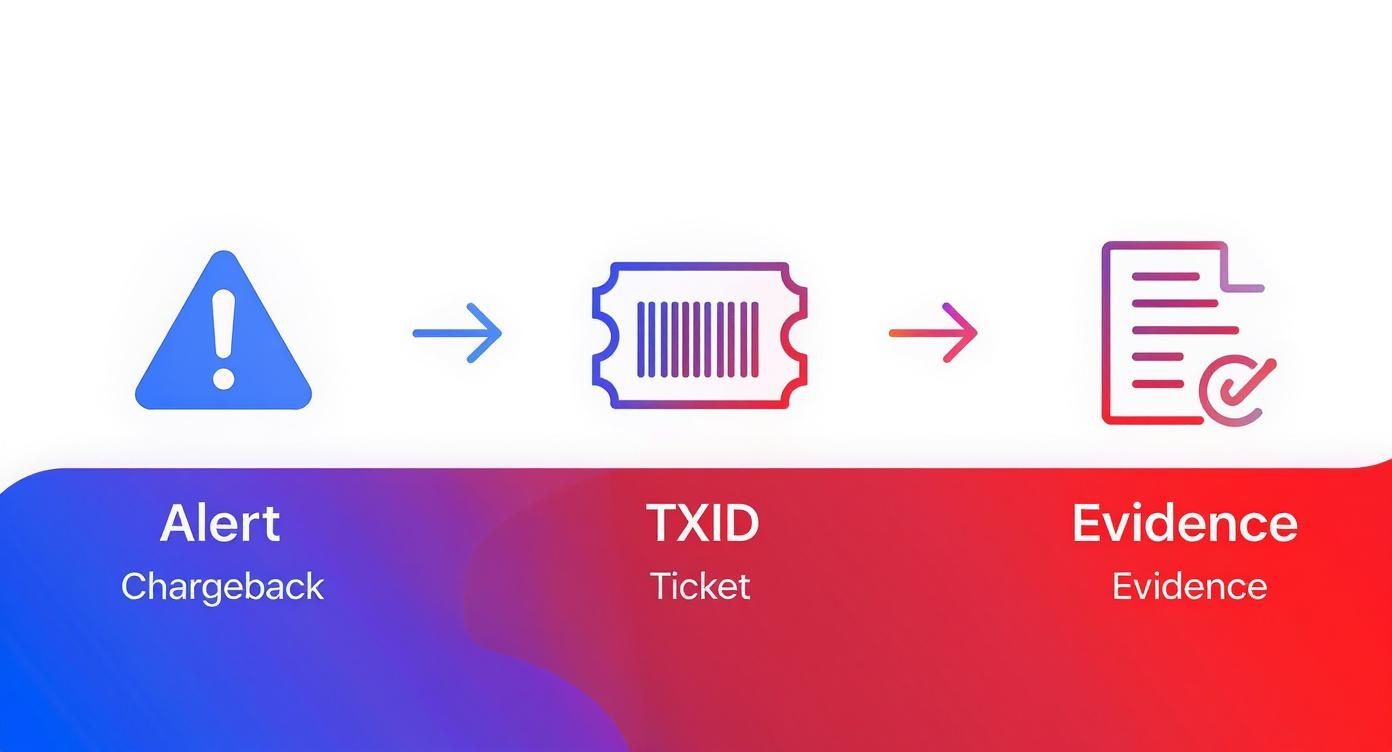
As you can see, that ID is the reference point that proves your evidence is tied to the exact payment in dispute.
Streamlining Your Accounting and Reconciliation
One of the most powerful everyday uses for a transaction ID is financial reconciliation. Come month-end, your accountant is faced with the tedious task of matching sales records from your store with the actual deposits landing in your bank account. It’s a process ripe for human error.
Transaction IDs make this a breeze. Each payout from your payment processor typically includes a report listing the IDs for every sale in that batch. You can quickly cross-reference that list against your own sales data, making sure every single dollar is accounted for.
With a transaction ID, there's no more guesswork. It confirms that the $50 sale from last Tuesday is the exact same $50 included in Friday's bank deposit. This simple check catches discrepancies early and prevents duplicate entries.
This process keeps your financial records clean and accurate, saving countless hours of manual work and creating a crystal-clear audit trail. This level of detail is also a cornerstone of effective transaction monitoring solutions that help safeguard your business from risk.
Enhancing Customer Service Interactions
When a customer gets in touch with your support team, speed and accuracy are everything. Whether they need a refund, are checking on an order, or have an issue with a product, asking them to describe what they bought and when is slow and frustrating for everyone.
Instead, your support reps can simply ask for the transaction ID. This one piece of information is all they need to pull up the exact order and its entire history in seconds.
Here’s how it transforms your support workflow:
- Faster Refunds: Instantly locate the payment to process a full or partial refund without any digging.
- Quick Order Lookups: Find a specific order immediately, even if the customer has a common name like "John Smith."
- Clear Communication: Both the agent and the customer are looking at the same purchase, which cuts down on confusion and mistakes.
By making the transaction ID a standard part of your customer service process, you empower your team to resolve issues much faster. The result? Happier, more loyal customers.
Solving Common Transaction ID Problems
Even with the best systems, things can sometimes go sideways. You might stare at your dashboard, unable to find a transaction ID, or a customer might send you a string of characters that looks nothing like the real thing. These little hiccups can be frustrating, but they’re almost always solvable with a bit of troubleshooting.
Think of this as your quick-start guide for the most common issues. We'll walk through what to do when things don't go as planned, so you can get the answers you need and get back to business. Most problems boil down to just a few common scenarios.
When the Transaction ID Is Missing
One of the most alarming issues is when a transaction ID seems to have vanished. You look up a sale in your system, and the field is just... empty. Don't panic; there's usually a logical explanation.
- Failed or Pending Payments: The most common culprit for a missing ID is a transaction that never actually went through. If a customer's card is declined or they abandon checkout midway, a payment is never officially processed, so an ID is never generated in the first place.
- System Lag: Sometimes, there’s a slight delay between your payment gateway processing the transaction and your e-commerce platform updating its records. Just waiting a few minutes and hitting refresh often solves the problem.
A transaction ID is the final stamp of a successful payment. If the payment fails for any reason, no ID will be created because, from the payment gateway's perspective, the transaction never officially existed.
Distinguishing Order IDs from Transaction IDs
A frequent point of confusion for both merchants and customers is mixing up the Order ID and the Transaction ID. While they're related, they serve very different purposes, and knowing the difference is key to solving problems quickly.
An Order ID is a reference number created by your e-commerce platform (like Shopify) to track the entire order—the products, customer details, and shipping info. The Transaction ID, on the other hand, is generated by your payment processor (like Stripe or PayPal) and relates only to the money changing hands.
Here’s a simple way to think about it:
- Order ID: Your internal filing number for the customer's purchase.
- Transaction ID: The bank's official receipt for the payment itself.
When a customer sends you an ID, double-check which one it is. If you're dealing with a payment-related issue like a refund or a dispute, you'll almost always need the Transaction ID. This is especially critical for financial inquiries like retrieval requests, and you can learn more about how retrieval requests vs. chargebacks are handled. Guiding customers to find the right ID in their email receipts can save everyone a ton of time.
Of course. Here is the rewritten section, crafted to sound like an experienced human expert, following all the provided guidelines and examples.
Where Do These IDs Fit into the Big Financial Picture?
You see transaction IDs every day, but it’s helpful to zoom out for a second. These aren't just random codes for your store; they're a core piece of a massive, global system built to keep payments moving safely and predictably across countless different networks.
Think of the digital economy as a giant, sprawling road network. A transaction ID is like a unique GPS coordinate on that map. It ensures a payment starting with a customer in one country can be perfectly pinpointed and handled by a bank on the other side of the world without getting lost. The whole system is built on this kind of trust and clarity.
A Global Standard Built on Trust
These identifiers are what keep everything in order. They act as a common language, allowing totally different players—from payment gateways like Stripe to the world’s biggest banks—to talk about the exact same payment without any mix-ups. This is the magic that makes global ecommerce actually work.
Every single time a transaction ID is created, it adds another layer of integrity to the financial system. It’s a small but powerful piece of the puzzle that ensures money moves reliably, building the trust your online business depends on to grow.
This need for a clear paper trail isn’t just a good idea; it's often required by law. For instance, in major financial markets, regulators brought in the Unique Transaction Identifier (UTI) to get a crystal-clear view of every trade and transaction. It was a huge step in making those markets safer for everyone. You can discover more insights about these global identifiers and see how they prevent chaos.
When it comes down to it, that simple string of characters you find on a receipt is your link to a secure and orderly worldwide financial network.
Got Questions? We've Got Answers
Even after walking through the whole process, a few specific questions always seem to pop up. We get it. Think of this section as your quick-reference guide for those moments when you need a straight answer, fast. Let’s clear up some of the most common points of confusion.
What's the Difference Between an Order ID and a Transaction ID?
This is easily the question we hear most often, and it's a great one because the distinction is crucial. Simply put, an Order ID is generated by your store (like Shopify) to keep track of what a customer bought. A Transaction ID, on the other hand, comes from your payment processor (like Stripe) to track the actual money.
- Order ID: It’s all about the products. Think of it as the receipt for the items in the cart and the shipping details.
- Transaction ID: This one is all about the cash. It's the unique fingerprint for that specific payment.
You'll lean on the Order ID for things like fulfillment and customer service questions about their purchase. But the moment money is involved—like with refunds or chargebacks—the Transaction ID is your go-to. Both are vital, but they play for different teams.
Are Transaction IDs Public or Sensitive Information?
Think of a Transaction ID as semi-private. It’s definitely not as sensitive as a full credit card number, but you wouldn’t want to post it on your company's social media page either. It’s a specific reference code meant for the eyes of you, your customer, and the payment systems involved in that sale.
It's perfectly safe—and often necessary—to share a transaction ID with your customer or your payment processor when you're sorting out a support issue. Just never post them publicly. At the end of the day, they confirm a financial event happened, and that’s not something you want out in the open.
What Should I Do if a Transaction ID Seems Invalid?
So, a customer gives you an ID, you plug it into your system, and… crickets. Nothing comes up. When this happens, a few things could be going on.
First, take a quick second to double-check that they sent you the transaction ID and not the order ID. It's an easy mix-up.
If you confirm it's the right type of ID and it’s still not working, the culprit is often a failed payment. If the payment didn’t go through, no official transaction was ever completed, which means a valid ID was never actually created. Your best bet is to kindly explain this to the customer and suggest they check their bank or credit card statement for a successful charge before you both spend more time digging.
Getting a handle on transaction IDs is a critical first step, but what about the chargebacks they’re tied to? That’s where the real fight for your revenue begins. ChargePay takes the entire dispute process off your plate, using AI to automatically build winning evidence so you can recover your money without lifting a finger. Stop losing profits to slow, manual processes and let us fight for you. Learn more about how ChargePay can help.


.svg)



.svg)


.svg)
.svg)
.svg)