


A WooCommerce chargeback is a whole different beast than a simple refund. Think of it less like a customer returning an item and more like their bank forcibly clawing money back from your store after the sale is done. It’s a penalty that hits you three times: you lose the product, the shipping costs, and get slapped with an extra fee.
It's a gut punch to your bottom line.
The Soaring Cost of WooCommerce Chargebacks

It’s tempting to write off chargebacks as another "cost of doing business." But that mindset is a quiet threat to your store's profitability. A handful of disputes can quickly snowball into a serious revenue drain, sour your relationship with payment processors, and even jeopardize your entire merchant account.
The financial hit is way worse than just losing the original sale amount. When a chargeback goes against you, the real cost starts to multiply.
Let's break down what a single lost chargeback actually costs you. It's not pretty.
The True Cost of a Single $100 Chargeback
| Cost Component | Example Amount | Impact on Your Business |
|---|---|---|
| Original Sale Amount | $100 | The revenue from the sale is reversed and sent back to the customer. |
| Cost of Goods Sold (COGS) | $40 | You lose the physical product you shipped, and you can't resell it. |
| Shipping & Handling | $15 | The money you spent to ship the item is gone for good. |
| Chargeback Fee | $20 - $100 | Banks and processors charge you this non-refundable penalty fee. |
| Total Loss | ~$175 - $255 | Your actual loss is nearly double or triple the original sale price. |
As you can see, for a single $100 sale, your store doesn't just lose $100. Once you add up the product cost, shipping, and non-refundable bank fees, the total damage can easily climb past $250.
This triple-loss—product, revenue, and fees—is exactly why having a solid chargeback plan isn't a "nice-to-have" anymore. It's essential for staying in business.
A Problem That's Getting Worse
Things have gotten a lot tougher for online merchants. The e-commerce world was hit with a staggering 233% surge in chargebacks between Q1 and Q3 of 2025 alone.
What does that mean for you? It means for every $1 lost to a chargeback, U.S. merchants now lose an estimated $4.61 in total costs. That's a 37% jump in just five years. If you want to dig into the numbers, you can explore the data behind this surge on payscout.com and see the full picture.
This explosion is being driven by everything from clever fraud schemes to the boom in "friendly fraud," where real customers dispute legitimate charges.
Why You Can't Afford to Ignore It
For Shopify store owners, this is a familiar and expensive fight. Here at ChargePay, we've seen firsthand how unchecked chargebacks can cripple a business. We've also proven that fighting back is the only way forward.
By automating the dispute process for over 100,000 disputes, we've recovered more than $2.8 million for merchants, holding a 92.4% win rate.
While this guide is focused on WooCommerce, the strategies for winning are universal. Understanding the threat is always the first step. If you're a Shopify merchant losing revenue to disputes right now, you can stop the bleeding today. Just install ChargePay from the Shopify App Store and let our AI get to work recovering your money.
Why WooCommerce Chargebacks Happen
If you want to get a handle on chargebacks in your WooCommerce store, you first have to understand where they're coming from. It’s not just one single issue, but a few different problems that all lead to the same result: lost revenue for you.
Think of it like trying to fix a leaky roof. You can't just slap a patch on one spot and call it a day. You have to find every single source of the leak to stop the water for good.
Chargebacks generally boil down to three main types. While some are completely out of your hands, you’d be surprised how many are preventable—and all of them are worth fighting.
The Three Faces of WooCommerce Chargebacks
Not every dispute is a clear-cut case of theft. Sometimes it’s a simple mistake, but other times, it's a calculated move to get something for free. Figuring out the "who" and "why" behind each dispute is the first step to building a solid response.
Here are the primary reasons chargebacks happen:
- Criminal Fraud: This is what most merchants immediately think of. A fraudster gets their hands on stolen credit card information and uses it to buy from your store. When the real cardholder sees the unfamiliar charge, they report it to their bank, and a chargeback is automatically initiated.
- Merchant Error: This one is on us, the merchants. It covers all the accidental slip-ups that can happen when running a business. Maybe a product description was a little off, the wrong item got shipped, or a recurring subscription was billed by mistake. These are honest errors, but they still result in legitimate customer disputes.
- Friendly Fraud: This is, without a doubt, the most common and frustrating type of chargeback you'll face. It’s when a real customer places an order, receives your product, and then disputes the charge with their bank anyway. They might not recognize the charge on their statement, get impatient with a shipping delay, or—worst of all—just want to get the item for free.
Friendly fraud is like a customer eating an entire meal at a restaurant, and then telling the manager the food was terrible just to get it for free. They got exactly what they paid for, but they're gaming the system to avoid paying.
The Growing Threat of Friendly Fraud and Refund Hacks
While criminal fraud gets a lot of attention, it’s a much smaller piece of the puzzle. The reality is that friendly fraud accounts for up to 80% of all chargebacks. It’s a massive drain on your bottom line because these disputes come from your actual customers, making them incredibly hard to predict.
This blurs the line between a genuine service issue and deliberate theft, which makes these cases tough to win without rock-solid evidence. Our own internal data at ChargePay, from handling over 100,000+ disputes, shows this is where merchants lose the most money.
What's making things even worse is a nasty trend spreading across social media: "refund hacks." These are viral videos and posts that teach people exactly how to exploit the chargeback process to get free stuff from online stores just like yours. This isn't just about a single customer with buyer's remorse anymore; it's becoming a popular, coordinated scam.
And this isn't just a hunch; the data backs it up. A recent industry report found that 22% of consumers had seen these refund hack tutorials online. Even more concerning, 10% admitted to trying these tactics themselves. This marks a clear shift from simple friendly fraud to organized, socially-driven theft. You can read more about the refund hack economy on Financial IT to see just how big this problem has become.
Because these disputes are started by the legitimate cardholder, your typical fraud filters are useless. The transaction sails through, looking perfectly normal, right up until the chargeback notice hits your inbox. That’s why you need a strategy that goes beyond just stopping fraud and focuses on managing every single dispute that comes your way.
What Really Happens During a WooCommerce Chargeback?
Getting that first chargeback notification can feel like a punch to the gut. Suddenly, you're tangled up in a confusing process filled with weird banking terms and deadlines that are set in stone. One wrong move or a missed deadline, and it's an automatic loss.
To keep your hard-earned money, you have to know the rules of the game. A WooCommerce chargeback isn't a simple disagreement between you and your customer. It’s a complicated, four-party affair involving banks and card networks, and the odds are stacked against you from the start.
The Four Parties in Every Dispute
Think of a chargeback like a formal debate where you get one shot to make your case. The customer lodges a complaint, and you have to prove them wrong. The catch? The judge is the customer's own bank, which has a built-in incentive to side with their client.
Here's who you're dealing with:
- The Cardholder: This is your customer, the one who kicks things off by calling their bank.
- The Issuing Bank: The customer’s bank (like Chase or Bank of America). They listen to the customer's story and file the official chargeback.
- The Acquiring Bank: This is your bank or payment processor, such as Stripe or PayPal. They're the ones who receive the chargeback and break the bad news to you.
- The Merchant: That’s you. You're now on the hook to defend the sale.
Overseeing this entire mess are the card networks like Visa and Mastercard. They're the ones who create the rulebook and set the tight deadlines everyone has to follow. To get a better sense of these specific rules, check out our guide on the Visa chargeback process.
This whole process gets triggered for a few key reasons, which can be grouped into three main buckets.
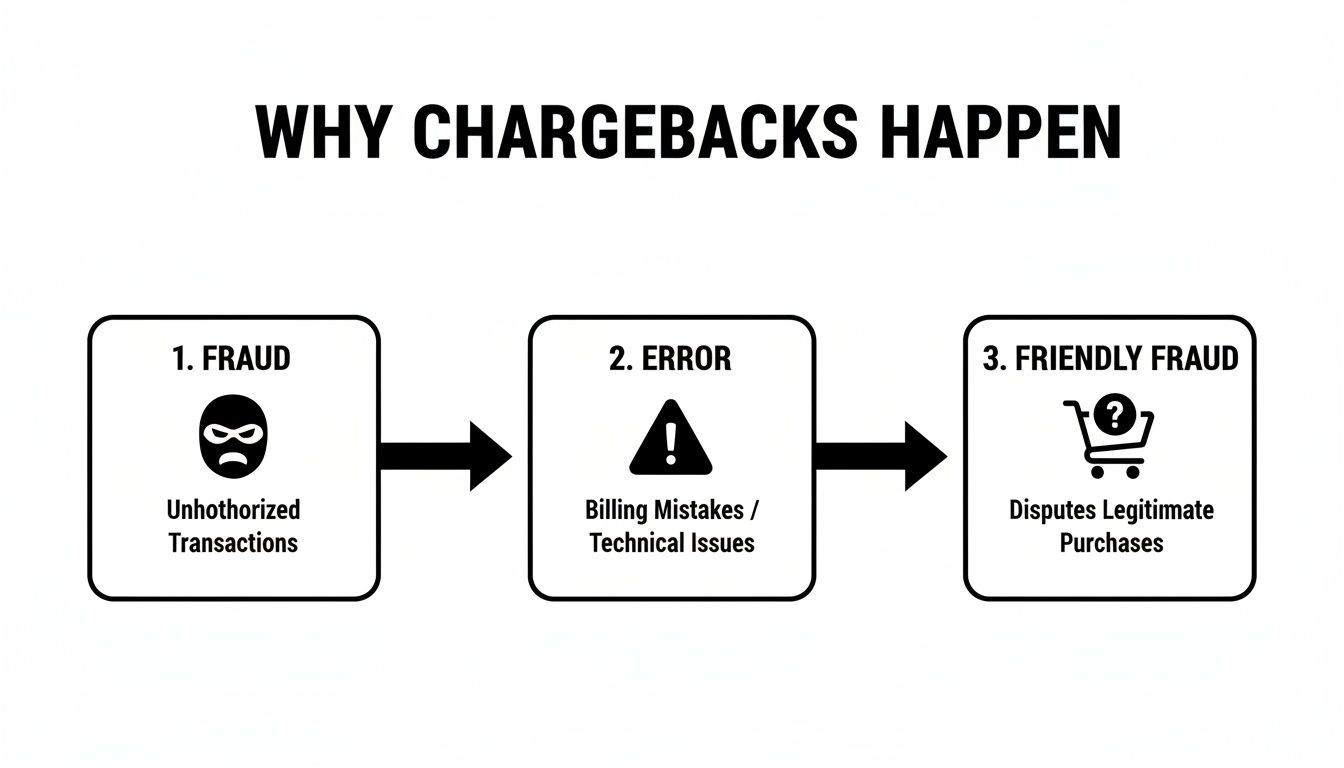
As you can see, it's not always about criminals or honest mistakes. Friendly fraud—when a real customer disputes a purchase they actually made—is one of the most common and frustrating reasons you'll see a WooCommerce chargeback.
The Dispute Lifecycle: A Step-by-Step Breakdown
The moment a customer files a dispute, a countdown clock starts ticking. You generally have somewhere between 20 and 45 days to fight back, depending on the card network. If you miss that window, you lose the money. Period.
Here’s exactly what happens and where you need to step in:
- Dispute Starts: The customer calls their bank to complain about a charge. If the bank thinks the claim has merit, they officially launch a chargeback.
- Funds Are Pulled: The bank immediately yanks the disputed amount from your account. They also tack on a chargeback fee (usually $15 to $100) that you'll never get back, even if you win.
- You Get Notified: Your payment processor sends you a notification about the dispute. It will include a reason code, like "Product Not Received," which is your cue to start building your case.
- Representment (Your Fight-Back): This is your one and only chance to respond. You need to pull together every piece of compelling evidence you have—shipping confirmations, delivery photos, customer emails—and submit it as a formal rebuttal. This package is called representment.
- Bank Reviews Your Case: The customer's bank sifts through your evidence. They're looking for undeniable proof that you held up your end of the deal and followed the terms your customer agreed to at checkout.
- The Final Verdict: The bank makes its decision. If you win, the money is returned to your account (but you still lose the chargeback fee). If you lose, the customer keeps the money, and you're out the product, the revenue, and the penalty fee.
Think of representment as your day in court. You are the defendant, and the evidence you submit is your only defense. A weak or poorly organized response will get thrown out immediately, costing you real money.
Fighting chargebacks is a high-stakes game where every single detail matters. For merchants on other platforms like Shopify, tools like ChargePay automate this entire headache. Our AI instantly analyzes the dispute, compiles all the necessary evidence, and submits a response designed to win. With a 92.4% success rate, we turn a painful, manual process into a problem you no longer have to think about.
How to Fight and Win WooCommerce Chargebacks
When that chargeback notice lands in your inbox, the first feeling is almost always frustration. It's a gut punch. But your very next move needs to be a call to action.
The dispute process is a race against the clock, and whether you win or lose boils down to one simple thing: compelling evidence.
Think of yourself as a detective. Your job is to build an airtight case that proves you held up your end of the deal. You need to tell a crystal-clear story to the bank reviewer, backing it up with undeniable proof. A messy, incomplete response is pretty much an automatic loss.
Structuring Your Rebuttal Letter
Once you have your evidence organized, it's time to present it in a rebuttal letter. Keep it professional, short, and to the point. Remember, the bank employee reviewing your case is probably scanning it in under 60 seconds. Forget long, emotional paragraphs; just stick to the facts.
Your letter should always have these three parts:
- A Clear Introduction: Right away, state the order number and why you're disputing the chargeback. For example: "This letter is in response to the chargeback for order #12345, filed for the reason 'Product Not Received'."
- A Summary of Events: Create a simple, easy-to-follow timeline of the transaction. Walk them through from the moment the order was placed to the moment it was delivered.
- An Evidence List: List every piece of proof you’ve attached and briefly explain what it shows. For example, "Attached as Exhibit A is the FedEx tracking confirmation showing delivery on May 25, 2026."
Think of your rebuttal as a cover letter for your evidence. It’s there to guide the reviewer through your proof, making it impossible for them to misinterpret the facts. Your only goal is to make it incredibly easy for them to rule in your favor.
Building a solid case for chargeback representment is a skill, and it's the only way you're going to get your money back.
Essential Evidence Checklist for Chargeback Rebuttals
Every WooCommerce chargeback is a fight for your revenue, and you need to show up ready. Before you even think about writing your response, it's time to gather your documents.
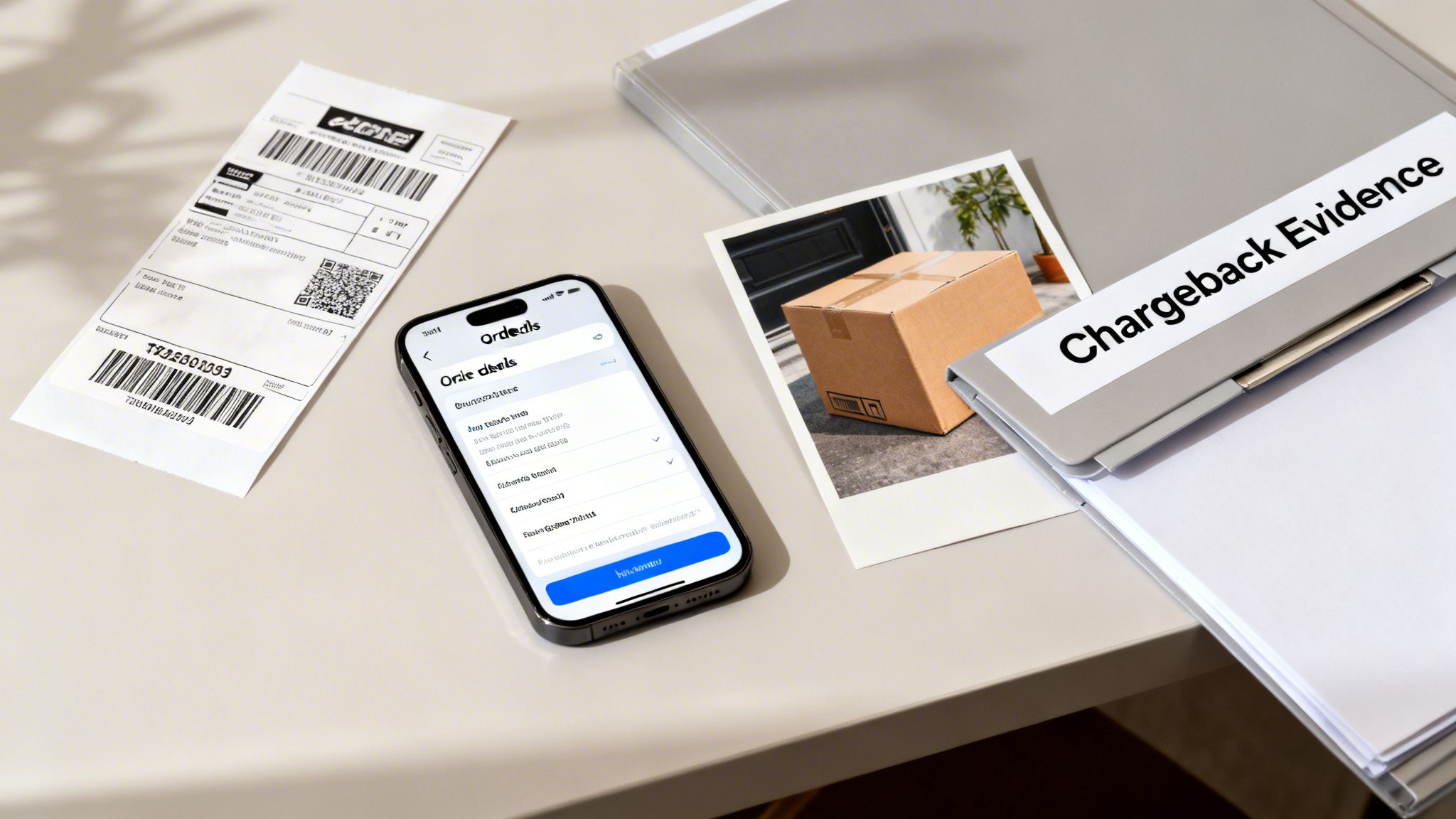
Here's a quick look at the non-negotiable pieces of evidence you'll need to pull together to build a winning case.
| Evidence Type | Why It's Important | Where to Find It in WooCommerce |
|---|---|---|
| Order Details | This is your starting point, showing exactly what was ordered, how much it cost, and where it was supposed to go. It proves the transaction was legitimate. | A screenshot of the order page in your WooCommerce dashboard. |
| Shipping & Delivery Proof | This is the knockout punch for "Product Not Received" claims. It shows you shipped the item and that the carrier confirms it arrived at the right address. | Your shipping provider’s website. Get a screenshot of the tracking page showing the "Delivered" status, date, and time. |
| Customer Communication | These records can show that the customer received order updates or that you tried to resolve their issue before they filed a dispute. | Your email provider, CRM, or help desk software (e.g., Zendesk, Gorgias). |
| Policy Screenshots | This proves your terms were clearly available at checkout. It's crucial for disputes over returns, refunds, or cancellations. | A screenshot of your checkout page showing that links to your policies are visible and accessible. |
Having this checklist handy for every dispute ensures you don't miss a critical piece of evidence that could mean the difference between winning and losing.
The Manual Way vs. The Automated Way
Let's be real—manually gathering all this evidence for a single WooCommerce chargeback can easily eat up 30-45 minutes. You're logging into WooCommerce, your email, and your shipping carrier's site, grabbing screenshots, and trying to organize it all into a coherent file.
For a busy store owner, that time adds up fast, especially if you're dealing with multiple chargebacks a month.
This is the exact problem we've been solving for Shopify merchants for years. At ChargePay, we’ve successfully handled over 100,000+ disputes, recovering more than $2.8 million for stores just like yours. Our AI completely automates this tedious process.
Instead of you spending half an hour digging for proof, our system does it in an instant. The moment a chargeback hits, our AI analyzes the reason code, pulls all the relevant evidence from your store's data, and drafts a powerful, evidence-backed rebuttal that’s built to win.
For Shopify users, it turns a time-draining revenue leak into a problem that gets solved automatically, with a 92.4% success rate. If you're a Shopify merchant tired of the manual fight, you can see how our AI works. It's become an essential tool for any serious e-commerce business looking to protect its bottom line.
Proactive Strategies to Prevent Chargebacks
It feels great to win a WooCommerce chargeback, but let's be honest—the real win is stopping them before they even start. Think of it this way: an ounce of prevention is worth a pound of cure, and in e-commerce, that ounce is worth thousands of dollars in revenue you don't have to fight for.
Building a solid defense isn’t about finding one silver bullet. It's about layering your protections so your store becomes a much harder target for fraudsters and a much easier place for legitimate customers to resolve their issues. Every layer you add makes your business stronger.
Optimize Your Storefront for Clarity
So many preventable chargebacks boil down to simple misunderstandings. When a customer feels like they didn't get what they paid for, their first call is often to their bank, not to you. Your first line of defense is being crystal-clear right on your product and policy pages.
- Detailed Product Descriptions: Don't just list the basics. Get into the nitty-gritty: dimensions, materials, how to care for the item, and exactly what comes in the box. The more accurate you are, the less room a customer has to claim the "product was not as described."
- High-Quality Images and Videos: Show your products from every possible angle. Use high-res images and think about adding a short video to show the product in action. This helps manage customer expectations and cuts down on buyer's remorse.
Make Your Policies Impossible to Miss
Hidden or confusing policies are practically an open invitation for chargebacks. If a customer can't find your return policy in a few seconds, they'll just assume the easiest path to a refund is a dispute.
Your shipping and return policies should be so clear and easy to find that a customer would have to actively try to avoid seeing them. A link in the footer isn't enough; display them prominently on product pages and during checkout.
Make sure your policies are fair and simple. A 30-day return window with clear instructions on how to start a return encourages customers to come to you first. This one step can turn a potential chargeback into a simple customer service chat.
Elevate Your Customer Service
Great customer service is one of your most powerful chargeback prevention tools. When customers know they can reach you easily and get a fast response, they're way more likely to work with you to solve a problem.
Plaster your contact information—email, phone number, a contact form—where anyone can find it. Make it a goal to answer every single inquiry within 24 hours. A quick, helpful reply can defuse a tense situation and stop a frustrated customer from going straight to their bank.
Harden Your Technical Defenses
While clear communication takes care of customer-related disputes, you also need the right tech to stop fraudsters in their tracks. Most payment gateways for WooCommerce have built-in security features you should have enabled, no exceptions.
- Address Verification System (AVS): This tool is essential. It checks if the billing address the customer enters matches what their credit card company has on file. A mismatch is a huge red flag for fraud.
- Card Verification Value (CVV): Always, always require the three- or four-digit code from the back of the card. This proves the customer physically has the card, making life much harder for criminals who only have stolen card numbers.
For more firepower, look into fraud detection apps or plugins. These tools analyze hundreds of data points on every order to flag high-risk transactions before you ship anything out. They can automatically block users from shady IP addresses or suspicious email domains, which is a fantastic way to stop repeat offenders. You can learn more about chargeback and fraud prevention strategies in our detailed guide.
A core part of stopping future disputes and protecting your store's financial health is implementing solid overall risk management strategies. When it comes down to it, every layer you add—from better product descriptions to turning on AVS—works together to protect your hard-earned revenue.
For our Shopify merchants, this proactive defense is automated. ChargePay has helped stores recover over $2.8 million by not just winning disputes but also providing insights to prevent them. With a 92.4% win rate across more than 100,000 disputes, we've proven that combining prevention with an aggressive fight-back strategy is the key to protecting your profits.
Why Manual Chargeback Management Fails

If you're running a growing WooCommerce store, trying to juggle chargebacks by hand is a battle you're destined to lose. It’s slow, frustrating, and incredibly prone to expensive mistakes.
Think about the time it takes. Every single dispute forces you to drop everything, hunt for records, and build a case against a tight deadline. Those are hours you should be pouring into marketing, new products, or anything else that actually moves your business forward.
It’s not just inefficient—it’s a one-way ticket to burnout and bleeding revenue.
The Problem with Doing It Yourself
As your store scales, manually fighting disputes just isn't sustainable. Here’s a closer look at why it’s a broken system:
- It’s Far Too Slow: Banks give you a very narrow window to respond. Trying to find shipping confirmations, order details, and customer emails takes precious time you simply don’t have. Missed deadlines mean automatic losses.
- It’s Full of Errors: It's so easy to miss one crucial piece of evidence that could have won you the case. A forgotten screenshot or a misinterpreted reason code can sink your entire response before the bank even gives it a serious look.
- It Doesn't Scale: One chargeback a month? Maybe you can handle it. But what happens when that turns into five? Or ten? The time you spend fighting disputes explodes, taking you away from the work that actually generates revenue.
Trying to manage chargebacks manually is like trying to bail out a sinking boat with a teaspoon. You might feel like you're making progress, but the sheer volume will eventually overwhelm you.
The Power of Automation
This is where AI-driven automation completely changes the game. While our own solution is focused on Shopify, the principle is the same for any platform: automation turns this manual nightmare into a solved problem.
For example, our AI at ChargePay automates the entire fight-back process, from analyzing the dispute to compiling and submitting a winning response. We’ve automatically handled over 100,000+ disputes and recovered more than $2.8 million for merchants by swapping tedious manual work for smart automation.
You can see exactly how this works in our complete guide to automated chargeback management.
The takeaway is clear: if you’re losing money to WooCommerce chargebacks or any other kind, it’s time to stop doing it all by hand. Our solution for Shopify has a 92.4% win rate and a 4.9-star rating on the Shopify App Store because automation is simply better. It’s a ‘Built for Shopify’ app that pays for itself—and it’s the kind of power every e-commerce merchant deserves.
Your Top Chargeback Questions, Answered
As a WooCommerce store owner, you've probably got a lot of questions about chargebacks. It's a tricky part of running an online business. Let's tackle some of the most common ones I hear from merchants just like you.
What Is a Safe Chargeback Rate?
Most payment processors, like Stripe and PayPal, will tell you that a chargeback rate below 1% is acceptable. But honestly, your real goal should be to keep that number as close to zero as humanly possible.
The moment you start consistently creeping over that 1% threshold, you risk getting your merchant account flagged as 'high-risk.' This isn't just a label; it comes with real consequences like higher processing fees, the processor holding larger cash reserves, or even outright account termination. That could completely shut down your ability to take payments.
Can I Block a Customer Who Files a Chargeback?
Yes, and you absolutely should. Inside WooCommerce, you have the power to block customers by their email address, IP address, or user account, preventing them from buying from you again.
This is a non-negotiable step for protecting your store from people who repeatedly commit friendly fraud. The data is pretty clear: somewhere between 40-50% of customers who successfully get away with friendly fraud will hit you again within 60 days if you don't stop them. Blocking them is your first line of defense.
Think of it this way: you wouldn't let a known shoplifter walk back into your physical store. The same exact logic applies online. Blocking a user after a fraudulent chargeback is just smart business security.
Is Fighting a Small Chargeback Worth It?
One hundred percent, yes. It’s so tempting to look at a $20 dispute and think it’s easier to just write it off and save the time. That's a huge mistake. Your chargeback rate isn't calculated on the dollar value of the disputes; it's based on the number of them.
Letting even the small ones slide sends a clear signal to banks—and to fraudsters—that you're an easy target. This can quickly snowball, inflating your dispute ratio and putting your entire payment processing account on the line. Fighting every single dispute is a necessary part of doing business and protecting your store's long-term health.
For Shopify merchants, managing the endless stress of chargebacks is a problem of the past. ChargePay uses AI to automate the entire dispute process, handling evidence gathering and submission instantly. With a 92.4% win rate and a 4.9-star rating on the Shopify App Store, our 'Built for Shopify' solution recovers your lost revenue for you. Stop losing money and install ChargePay today.


.svg)



.svg)


.svg)
.svg)
.svg)