


You wake up, open Shopify, and see another dispute notification waiting for you. The order looked normal when it came in. The package shipped. Tracking showed delivery. Then the customer called the charge “unauthorized” or said the item never arrived, and now the money is gone while you scramble for evidence.
That's the part most fraud articles skip. For a Shopify merchant, fraud isn't just about stopping a bad order at checkout. It's also about what happens days or weeks later, when a real sale turns into a chargeback and starts eating margin, staff time, and confidence in your own approval process.
That Sinking Feeling Another Chargeback Notice
A chargeback rarely arrives by itself. It shows up with extra work.
Someone on your team has to pull the order record, match the tracking, look for customer emails, check whether the billing and shipping details made sense, and then decide if the case is worth fighting. Meanwhile, inventory is already gone, payment fees may not come back, and your next batch of orders still needs review.
That's why this problem feels bigger than a single disputed sale. It creates drag across the whole store.
Why the pressure keeps rising
Payment fraud is getting more expensive. The European Banking Authority reported that payment fraud losses reached €4.2 billion in 2024, up from €3.5 billion in 2023, according to Feedzai's overview of AI fraud detection. When losses rise at that scale, merchants feel it through stricter issuer behavior, more scrutiny on transactions, and more post-purchase disputes.
A lot of founders respond the same way at first. They tighten manual review. They block more orders. They add simple filters. That helps for the obvious stuff, but it often creates a second problem: good customers get caught in the same net.
Practical rule: If your fraud process blocks revenue almost as often as it blocks fraud, the process needs work.
For merchants dealing with repeated disputes, chargeback prevention strategies for online stores usually start with checkout controls but have to extend into evidence, timelines, and representment. Otherwise, you're only solving half the problem.
Why AI entered the picture
Modern fraud systems don't work like a static blacklist sitting in the background. They score transactions in real time, using large amounts of payment, device, and behavioral data to decide whether an order looks normal or not. That matters because fraud moves faster than manual review ever will.
Consider this:
- A manual process catches suspicious orders after someone notices a pattern.
- A rule-based filter catches orders that break pre-set conditions.
- An AI system checks whether the order behaves like legitimate orders, even when the fraud pattern is new.
That last part is why AI powered fraud detection became a practical tool, not a buzzword. For a Shopify merchant, the goal isn't technical sophistication for its own sake. The goal is simple. Protect revenue before the order ships, and preserve evidence in case a dispute starts later.
What AI Fraud Detection Actually Is
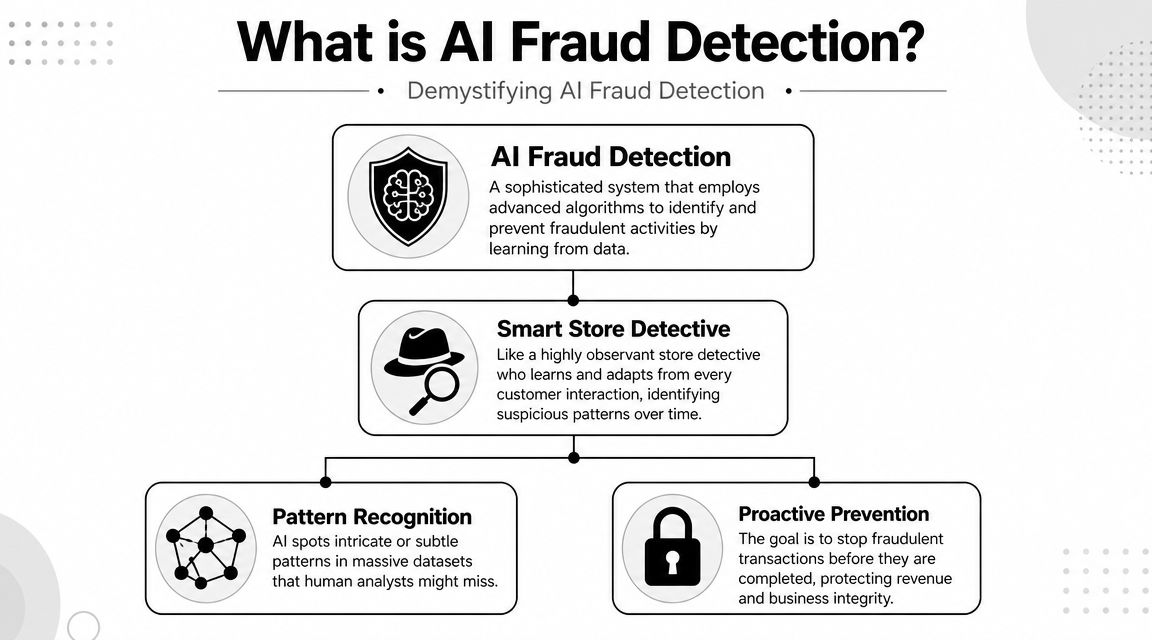
AI fraud detection is a smart risk filter. It watches what comes into your store, compares that behavior to what “normal” looks like, and flags orders that don't fit.
A simple rule says, “Block any order over a certain amount.” AI works more like a sharp store detective. It notices the amount, but it also notices whether the customer has ordered before, whether the device looks familiar, whether the behavior matches a real shopper, and whether the whole pattern feels off.
It's not experimental anymore
For serious fraud teams, AI is already standard. According to Visa's summary of current adoption, reported through Coursera, 99% of respondents in the 2025 Alloy State of Fraud report said they had implemented AI in fraud prevention systems, and AI-powered solutions can improve fraud detection accuracy by 40% compared with traditional methods, largely by reducing false positives, as noted in Visa's discussion of AI fraud detection.
That matters for merchants because false positives are expensive in a quieter way. A fraudulent order hurts once. A blocked legitimate customer can hurt current revenue and future repeat purchases.
What AI sees that basic filters miss
Traditional filters are rigid. They're useful, but they don't adapt well when fraudsters change tactics. AI looks for combinations of signals.
For example, a basic rule might flag:
- High order value
- Mismatch between billing and shipping
- Rush shipping
AI can look at those same signals and add context. Is the device known? Does the browsing behavior look human? Has this email interacted like a real customer? Does the network pattern resemble prior abuse?
If you want a useful outside primer on preventing online store fraud, Tagada's guide is worth reading because it frames fraud prevention as an operating habit, not just a plugin decision.
Good AI fraud detection doesn't replace judgment. It reduces the number of bad decisions you have to make under time pressure.
Merchants thinking beyond checkout should also look at how AI can catch chargeback fraud, because the same signals that help approve or reject an order can become valuable evidence later. That's where AI gets more useful than a yes-or-no gatekeeper. It starts contributing to revenue protection across the whole order lifecycle.
How AI Analyzes Your Shopify Orders in Real Time
When a new order hits your store, AI doesn't read it like a human looking at a dashboard. It breaks the order into signals, compares those signals against known patterns, and assigns a risk score fast enough to influence the checkout decision.
That speed matters because fraud review loses value once the package is already moving.

Two ways the model learns
The easiest way to understand it is to split AI fraud detection into two jobs.
Supervised learning learns from labeled history. It studies transactions already confirmed as legitimate or fraudulent and gets better at recognizing those patterns again.
Unsupervised learning looks for behavior that's unusual even if nobody has labeled it yet. That's important because fraudsters don't keep using the same playbook forever.
IBM describes modern systems as combining both approaches. They use supervised models for known attacks and unsupervised models for suspicious new behavior, while analyzing inputs like device fingerprints, behavioral biometrics, and network relationships to produce risk scores in milliseconds in IBM's overview of AI fraud detection in banking.
What the system actually checks
A strong system doesn't rely on one signal. It layers many.
Here's the kind of order context AI typically evaluates:
- Device signals like fingerprints that show whether the shopper is using a familiar or suspicious setup
- Behavioral signals such as how they move through checkout and interact with the session
- Relationship signals that connect the order to broader patterns, like linked identities or repeat abuse behaviors
- Transaction context including the purchase details themselves, viewed together instead of in isolation
That's why a suspicious order can look “fine” to a person but still get flagged by a model. Fraud often hides in the combination, not the headline detail.
For merchants trying to understand the broader stack around this, transaction monitoring solutions for e-commerce risk control help show where order scoring fits into daily operations.
A quick visual makes this easier to follow:
What happens after the score
Once the model finishes, your system usually takes one of three actions.
| Outcome | What it means for the order | Typical merchant response |
|---|---|---|
| Approve | The order looks normal enough to pass | Fulfill without delay |
| Review | The order has mixed signals | Check details manually |
| Decline or challenge | The risk is too high | Stop fulfillment or require more verification |
The practical trade-off is simple. If your rules are too loose, fraud gets through. If they're too harsh, good customers get blocked. AI powered fraud detection works best when it narrows that middle ground and leaves fewer gray-area orders on your team's desk.
The Real Benefits and Limitations for Your Store
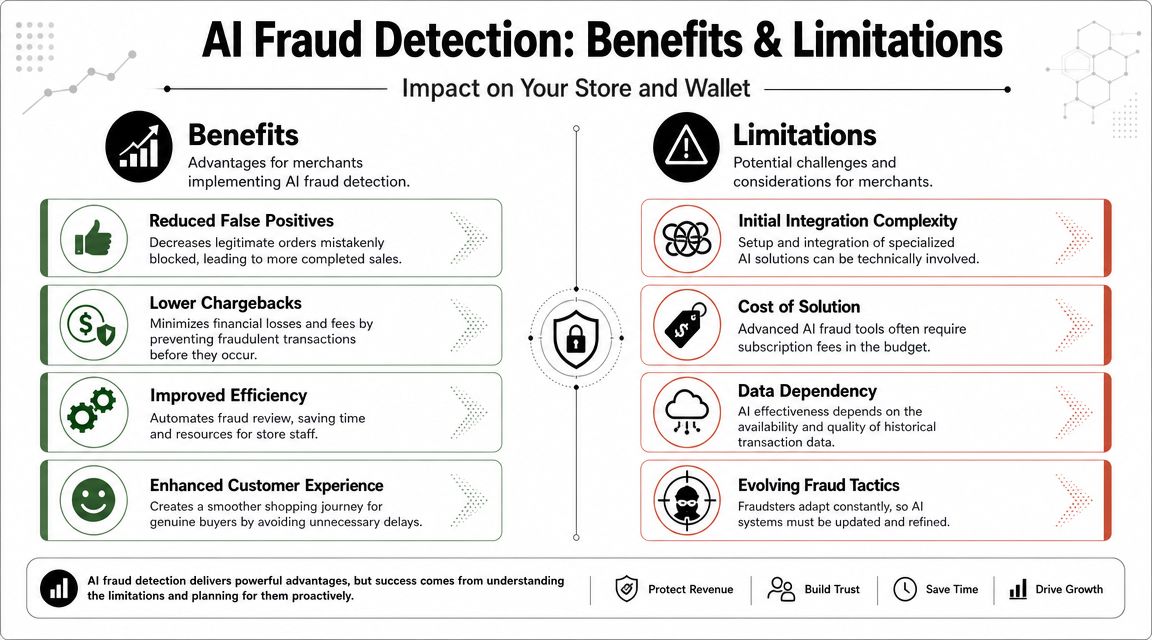
The biggest benefit of AI isn't that it catches cartoonishly obvious fraud. Most merchants can already catch some of that with manual checks and simple rules. The bigger win is precision. AI helps you stop more suspicious orders without turning your checkout into a wall for legitimate buyers.
That can protect revenue in two directions at once. You avoid some bad orders, and you keep more good orders from being rejected by blunt filters.
Where merchants usually see the value
In practice, the benefits show up in everyday decisions.
- Fewer false alarms means staff spends less time manually checking orders that were never risky in the first place.
- Cleaner approvals mean real customers get their orders faster and with less friction.
- Better evidence capture gives you a stronger record of what happened during the transaction.
That last point matters more than many merchants expect.
The part most fraud tools leave unfinished
A lot of fraud content ends at the checkout button. But for Shopify brands, a painful share of loss happens after the order is approved, when the dispute arrives and the bank asks for proof.
Datawalk points out that most articles on AI fraud detection ignore the post-purchase phase where merchants fight chargebacks, especially friendly fraud, and argues that AI should be judged not only on fraud blocking but also on its ability to provide evidence for representment and revenue recovery in Datawalk's analysis of AI-powered fraud detection.
A fraud tool that only helps you decline orders is useful. A fraud system that also helps you recover disputed revenue is far more useful.
Friendly fraud is where this becomes real. The cardholder may be genuine. The order may have been delivered. The problem is the dispute reason doesn't match what transpired. In those cases, prevention alone isn't enough. You need records, context, and deadlines handled correctly.
What AI does not solve by itself
AI isn't magic, and merchants get into trouble when they treat it that way.
A few limits are worth being honest about:
- It depends on good data. If your records are messy or disconnected, model quality suffers.
- It needs tuning. Approval thresholds that work for a supplement brand may be wrong for electronics or fashion.
- It won't eliminate disputes. Some chargebacks come from customer confusion, buyer's remorse, or abuse after fulfillment.
- It still needs a dispute workflow. If evidence isn't organized and submitted on time, even a well-flagged order can become a loss.
That's the operational reality. AI powered fraud detection is a front-line defense. It's not the whole defense.
Choosing and Integrating an AI Solution
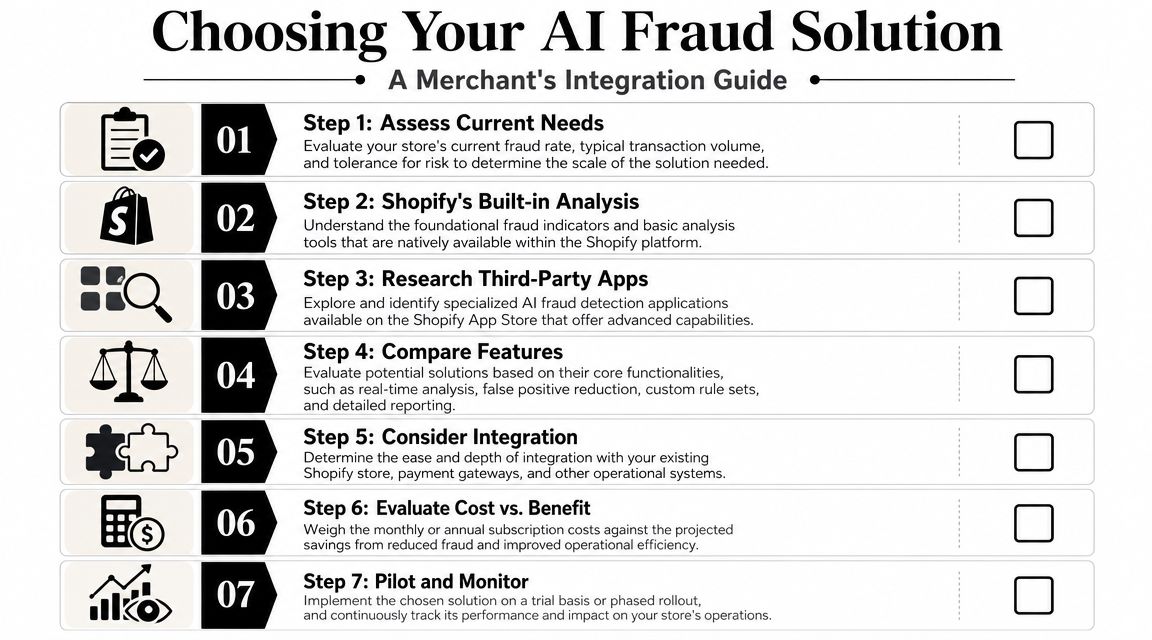
Most Shopify merchants start with Shopify's native fraud indicators because they're already there. That's a reasonable starting point. The question is whether those signals are enough for your order profile, your team size, and your chargeback pain.
If your staff still spends too much time reviewing orders or responding to disputes, you probably need more than a dashboard warning.
What to compare before you install anything
Use this checklist when you evaluate tools.
- Start with your actual pain point. Are you losing money at checkout, after fulfillment, or both? Some apps focus on order screening. Others focus on disputes.
- Check how deep the Shopify integration goes. A tool that reads orders is one thing. A tool that can use order, fulfillment, and customer data properly is more useful.
- Look at pricing incentives. Subscription models can work. So can outcome-based pricing. What matters is whether the vendor gets paid for activity or for recovered revenue.
- Review merchant feedback. App Store reviews won't tell you everything, but they can reveal setup friction, support issues, and workflow gaps.
- Ask what happens after approval. If the answer stops at “we block fraud,” keep looking.
Here's a simple way to frame the choice:
| Option | Good for | Watch out for |
|---|---|---|
| Shopify built-in analysis | Basic screening and quick visibility | Limited depth for dispute recovery |
| Third-party fraud tools | More detailed risk scoring and controls | Can stop at prevention only |
| Dispute-focused AI tools | Post-purchase recovery and evidence automation | May need to work alongside existing fraud checks |
Fit matters more than feature count
A long feature list can distract from what your store needs. Some merchants need better pre-transaction screening. Others need help with friendly fraud and representment. If you sell in higher-risk categories or deal with frequent disputes, make sure the app helps with evidence, deadlines, and processor submission, not just risk flags.
For founders comparing technical vendors more broadly, this round-up of outsourcing companies for Web3 and AI is useful because it shows how varied AI implementation partners can be across different use cases.
If your stack already includes multiple payment and risk tools, it also helps to understand where payments orchestration platforms fit. Orchestration, fraud review, and dispute management often touch the same transaction from different angles, so bad handoffs between tools can create blind spots.
One factual example in this category is ChargePay, which is a Shopify app focused on automating chargeback dispute management. It has a 4.9-star rating, a Built for Shopify badge, and uses a pay-per-win model where merchants pay when money is recovered, according to the publisher information provided.
Stop Losing Revenue to Chargebacks Today
The practical lesson is straightforward. Fraud prevention matters, but it's only one checkpoint in the revenue journey. A store can approve legitimate orders, ship on time, and still lose money later if it can't answer disputes with strong evidence and fast submissions.
That's why the best AI strategy for a Shopify merchant isn't just “block more fraud.” It's “protect the order before purchase, then defend the revenue after purchase.”
The standard you should use
When you evaluate tools, ask two questions.
- Does this help me make better order decisions in real time?
- Does this improve what happens when a customer disputes a charge anyway?
If the answer to the second question is weak, you're still exposed. Friendly fraud doesn't care how smart your checkout filter looked on the day of purchase.
Recovering disputed revenue is part of fraud defense, not a separate admin task.
If you're exploring your stack more broadly, this guide to AI apps for Shopify merchants is a useful starting point because it shows where fraud tools sit alongside support, marketing, and operations apps.
Merchants that want a tighter response to disputes should also look at Shopify chargeback protection options. The key is speed and consistency. Evidence has to be assembled correctly, matched to the dispute reason, and submitted before the deadline. That work is repetitive, but the financial impact is not.
The stores that handle this well usually stop treating chargebacks as random interruptions. They build a system for them. That system can include better screening, cleaner fulfillment records, clearer customer communication, and AI that helps preserve and present evidence when the dispute hits.
If you're still fighting chargebacks by hand, the cost isn't just the orders you lose. It's the time your team burns on work that should already be automated.
Chargebacks don't have to stay a weekly fire drill. ChargePay helps Shopify merchants automate dispute responses, recover revenue, and handle friendly fraud without manual back-and-forth. It has a 92.4% win rate, has handled 200K+ cases, recovered $10.8M+ for merchants, carries a 4.9-star Shopify App Store rating, and holds the Built for Shopify badge. If chargebacks are draining margin from your store, install ChargePay from the Shopify App Store.


.svg)



.svg)


.svg)
.svg)
.svg)