


At ChargePay, we've helped Shopify merchants handle over 100,000 disputes, recovering more than $2.8 million in lost revenue. How? By mastering chargeback evidence. With a 92.4% win rate, we know what it takes to win.
Chargeback evidence is the proof you pull together to show the bank that a disputed sale was legitimate. Think of it as building a case file. This collection of documents and data, often called compelling evidence, is your one shot at defending a sale and preventing a direct hit to your revenue.
Why Weak Evidence Is a Silent Profit Killer
Losing a chargeback feels like a gut punch—you’re out the product, and the money you thought you made is clawed back. But what if the real enemy isn't just a dishonest customer, but the flimsy evidence you're sending in to fight back?
It's a tough pill to swallow for many Shopify store owners: a huge number of lost disputes come down to disorganized, incomplete, or unconvincing proof. You were in the right, but you couldn't prove it.
The banks reviewing your case are buried in disputes and operate on strict, black-and-white rules. A single tracking number or a forwarded order confirmation just doesn't cut it anymore. They need a complete story that paints a clear picture, leaving no room for doubt that the transaction was valid and you held up your end of the bargain. Sending anything less is a gamble, and the house almost always wins.
The True Cost of a Single Lost Chargeback
The financial sting of a lost chargeback is way more than just the original sale amount. When you dig into the numbers, you'll see a domino effect of losses that add up fast. You’re not just losing the revenue; you’re also losing the product itself, the money you spent on shipping, and then you get slapped with a non-refundable chargeback fee from your payment processor. These penalties alone can be anywhere from $15 to $100 per dispute.
We built this table to show you just how quickly those hidden costs stack up on a typical $100 order.
| Cost Component | Average Amount | Description |
|---|---|---|
| Original Transaction | $100.00 | The full amount of the sale that gets refunded to the customer. |
| Cost of Goods Sold | $40.00 | Your wholesale cost for the product you've now lost. |
| Shipping & Handling | $12.00 | The non-refundable cost you paid to ship the item. |
| Processor Chargeback Fee | $25.00 | The penalty fee charged by your payment processor (e.g., Shopify Payments, Stripe). |
| Operational Costs | $18.00 | The time your team spends gathering evidence and managing the dispute. |
| Total Loss | $195.00 | The true financial impact from a single $100 lost chargeback. |
As you can see, a single lost dispute on a $100 order can easily end up costing your business nearly double that amount.
And this problem is only getting worse. Global chargeback volumes are on track to hit a staggering 337 million cases by 2026, which is a 27% spike from just a few years ago. This surge is fueled by the boom in e-commerce and a rise in "friendly fraud," where legitimate customers dispute valid charges. In fact, for every dollar lost to this type of fraud, U.S. merchants could end up losing an estimated $4.61 by 2026 in associated costs.
At ChargePay, our AI has automatically handled over 100,000 disputes, recovering more than $2.8 million for Shopify merchants just like you.
How? By automatically building and submitting evidence packages that leave no stone unturned. This approach gives our merchants a 92.4% win rate, proving that fighting back with the right evidence isn't just a defensive move—it's a profitable one.
Every dispute you lose because of weak evidence is revenue you're just handing over. It's time to stop absorbing these hits and start building a chargeback strategy that actually protects your bottom line. Ready to see how our AI can do all the heavy lifting for you? You can Install ChargePay from the Shopify App Store.
Building Your Evidence Library Before a Dispute Ever Happens
The worst time to start hunting for chargeback evidence is after a dispute notice lands in your inbox. Suddenly, the clock is ticking, the pressure's on, and every minute you waste digging through old emails is a minute you aren't running your business.
The only way to win this game is to be proactive, not reactive. Winning disputes starts long before the fight even begins.
You have to start treating every single transaction as a potential future dispute. This means building a digital evidence locker for each order, methodically collecting the data points that banks and card networks actually find compelling. This isn't just about good record-keeping; it's about building an airtight case from the moment a customer clicks "Buy." When a dispute does hit, you won't be scrambling. You'll be ready.
Configure Your Store to Capture Key Data
Your Shopify store is already a goldmine of data. The trick is making sure you’re capturing and storing the most critical pieces of information for every single transaction. Many of these can be configured right inside Shopify and your payment processor. Think of it as setting up your surveillance system before a crime happens.
These data points are absolutely essential for proving a transaction was legitimate, especially when you're fighting those frustrating "Fraudulent Transaction" or "Unrecognized Transaction" claims.
- AVS (Address Verification System) Results: This checks if the numbers in the billing address match what the card-issuing bank has on file. A "match" is incredibly strong evidence.
- CVV (Card Verification Value) Results: This proves the person making the purchase likely had the physical card in their hands. A "pass" or "match" is a crucial piece of your defense.
- Customer IP Address: Capturing the IP address helps geolocate the buyer. If the IP location matches the billing or shipping address, your case gets a whole lot stronger.
- Device Information: Knowing the device (like an iPhone 15 or Windows PC) and browser can help establish a pattern of legitimate buying behavior, especially for repeat customers.
By systematically logging this information for every order, you create a foundational layer of proof. When a customer claims a transaction was unauthorized, you can immediately show data proving their card details were verified and the order came from a location consistent with their address.
The Essential Chargeback Evidence Checklist
Once your store is set up to capture the right data, you need to get organized. For every order, you should have a standard file or folder containing a complete record of the transaction's lifecycle. Making this a habit will completely change how you handle disputes. Instead of a frantic search, your response becomes a simple matter of retrieve and submit.
Here's a checklist of the evidence you should be gathering for every single sale:
- Transaction Details: The basics—order date, time, amount, and what was purchased.
- AVS/CVV & IP Data: The core verification data we just covered.
- Customer Communications: Save every email, chat log, or social media message. This is gold for refuting claims like "Product Not as Described" or "Cancellation Request Ignored."
- Shipping Confirmation & Tracking: A tracking number isn't enough. You need a direct link or a screenshot from the carrier's website showing the full delivery address and a clear "Delivered" status.
- Proof of Delivery: This is your knockout punch for "Product Not Received" claims. If your carrier provides delivery photos showing the package at the customer's doorstep, save them. GPS delivery maps are also powerful.
- Your Store Policies: Have copies of your refund, shipping, and terms of service policies that were active at the time of purchase. Proving the customer agreed to these terms is a key part of your rebuttal.
Building this library might sound like a ton of work, and doing it manually for every order can definitely drain your resources. This is where exploring different chargeback management tools becomes a smart move for any scaling business.
The goal here is simple: create an undeniable trail of proof that tells a clear story. The customer placed the order, you fulfilled it correctly, and the product was delivered to their address. Having this evidence organized and ready to go is the single most effective way to turn the tables on friendly fraud and protect your revenue. With a 92.4% win rate across over 100,000 disputes, we at ChargePay know that a prepared merchant is a winning merchant.
Matching Your Evidence to the Reason Code
Throwing the same generic documents at every chargeback is a surefire way to lose. You wouldn't use the same defense for every legal case, right? The same logic applies here. Banks and card networks use specific reason codes to categorize chargebacks, and each one demands a unique, tailored response.
When you send a one-size-fits-all evidence packet, you're telling the bank reviewer you haven't bothered to look at the details. To win, you have to counter the customer's exact claim with precise, relevant proof. A "Product Not Received" dispute needs delivery evidence, while a "Fraudulent Transaction" claim requires proof of authorization.
This is exactly how ChargePay helps Shopify merchants hit a 92.4% win rate. Our system doesn't just dump a folder of data. It pinpoints the reason code and pulls the exact evidence needed to dismantle that specific claim. It’s all about strategy, not just a mountain of paperwork.
Evidence Checklist by Chargeback Reason Code
To make this easier, think of it like a quick-reference checklist. Here’s a breakdown of the most common chargeback reasons and the essential evidence you’ll need to fight back effectively.
| Chargeback Reason Code | Primary Evidence Required | Secondary Evidence to Include |
|---|---|---|
| Fraudulent Transaction | AVS & CVV match results; IP address matching billing/shipping location. | Customer's order history; communication logs prior to the sale. |
| Product Not Received | Proof of delivery screenshot/link showing full address and "Delivered" status. | Photo proof of delivery (if available); signature confirmation; GPS delivery map. |
| Product Not as Described | Screenshots of the product page from the time of purchase. | All customer communication (emails, chats); clear links to your return/refund policies. |
| Subscription Canceled | Proof of cancellation confirmation sent to the customer (with timestamp). | Screenshots of your cancellation policy; customer's usage history after alleged cancellation. |
Having the right documents on hand for each specific code is half the battle won. Now, let's dig into the details for the most common ones you'll face.
Responding to "Fraudulent Transaction" Claims
This is one of the most frustrating disputes. The customer is claiming they never made the purchase, implying their card was stolen. Your job is to prove the real cardholder knew about and authorized the transaction.
Your evidence needs to build a clear connection between the cardholder and the order. Here's what you absolutely need to include:
- AVS and CVV Results: This is your best friend in a fraud dispute. A match on the Address Verification System (AVS) and Card Verification Value (CVV) is powerful proof that the person placing the order had the physical card and knew the associated billing address.
- IP Address Geolocation: Show that the IP address used for the purchase is in the same city or region as the card's billing address. A quick screenshot from a tool like IP-tracker.org can make this crystal clear for the bank.
- Previous Order History: If they've bought from you before, show it! This establishes an existing relationship and makes a "friendly fraud" claim of "I don't recognize this store" look pretty weak.
Fighting "Product Not Received" Disputes
With this claim, the customer isn't saying they didn't order—they're saying you never delivered. Your only goal here is to provide undeniable proof that the package made it to the address they gave you.
A simple tracking number just doesn't cut it anymore. You have to paint the full delivery picture.
Don't just paste a tracking number and hope for the best. You need to provide a direct link or a full-page screenshot of the carrier’s tracking page. Make sure it clearly shows the "Delivered" status, the complete shipping address, and the delivery date. Leave no room for doubt.
Beyond the basic tracking status, this is the kind of evidence that wins disputes:
- Photo Proof of Delivery: This is a game-changer. Many carriers now snap a photo of the package right on the customer's doorstep. It's tough to argue with a picture of the box sitting by your front door.
- GPS Delivery Map: Some carriers even provide a map showing the exact GPS coordinates where the package was scanned as delivered.
- Signed Delivery Confirmation: If you sell high-value items, always require a signature. A signature is almost irrefutable proof of receipt.
This whole process—from order to evidence file—is a logical flow. This flowchart helps visualize how you should approach every dispute.
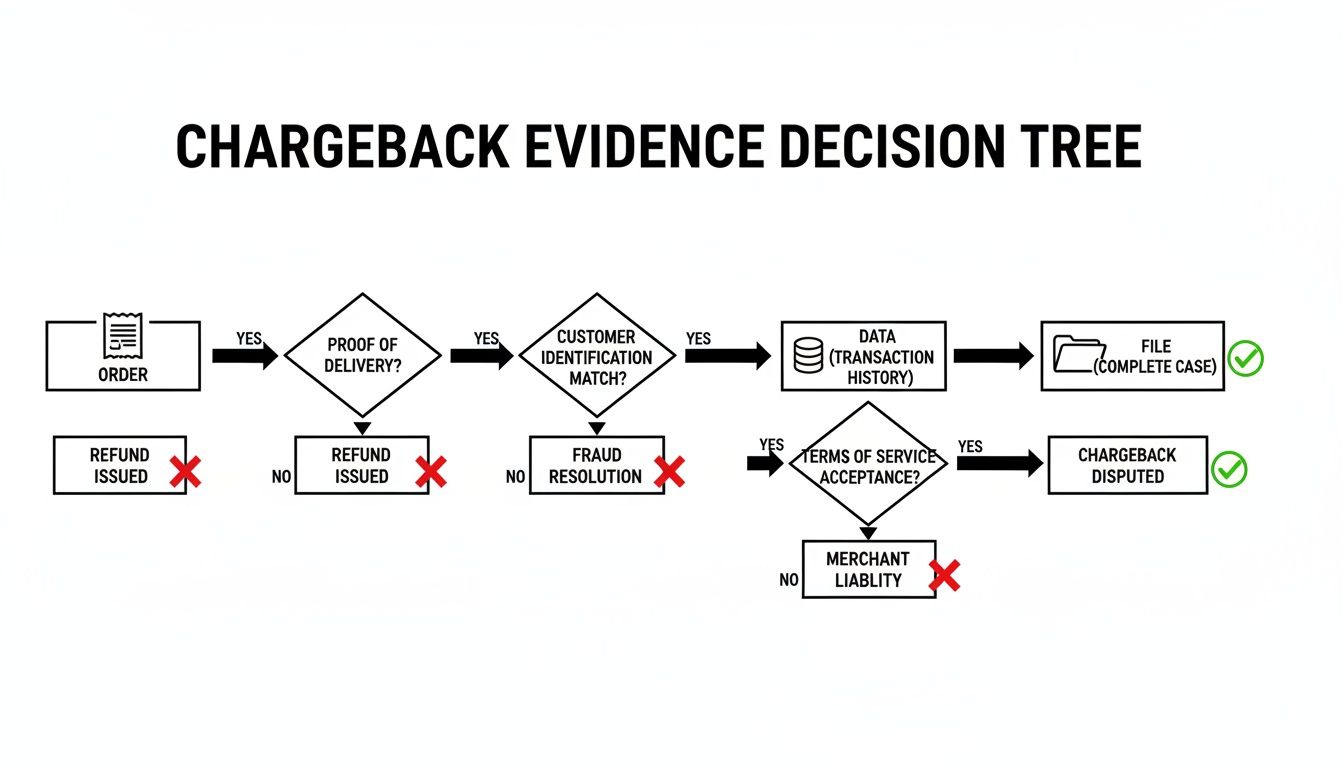
As you can see, a strong case is built piece by piece. The initial order details tell you what kind of evidence to look for, which you then package into a compelling file for the bank.
Tackling "Product Not as Described" or "Defective"
Here, the customer has the item but claims it's not what they were promised—it’s the wrong color, poor quality, or broken. To win this, you need to prove two things: the product you sent matched your online description, and you gave the customer a fair chance to resolve the issue directly with you.
Your evidence should focus on showing you managed expectations and acted in good faith:
- Product Page Screenshots: Pull up a screenshot of the product page as it looked when the customer placed their order. Be sure to highlight the product photos, description, materials, and dimensions.
- Customer Communications: This is absolutely critical. Include every email, chat log, or social media DM where you offered a solution in line with your policies, like a return for a refund, a replacement, or store credit. This shows the bank you tried to do the right thing.
- Your Store Policies: Provide proof that your refund and return policies were easy to find before the customer checked out.
Friendly fraud is on the rise, with social media trends teaching people how to game the system. By 2026, we're expecting a surge in e-commerce chargebacks, especially in industries like apparel and cosmetics, where disputes could make up 20% of all chargebacks. Knowing how to fight back with the right evidence is no longer optional.
Getting a handle on each reason code is the secret to mastering your chargeback representment strategy. When you match your evidence perfectly to the claim, you stop playing defense and start taking control, which dramatically increases your chances of getting your money back.
How to Write a Clear and Compelling Rebuttal
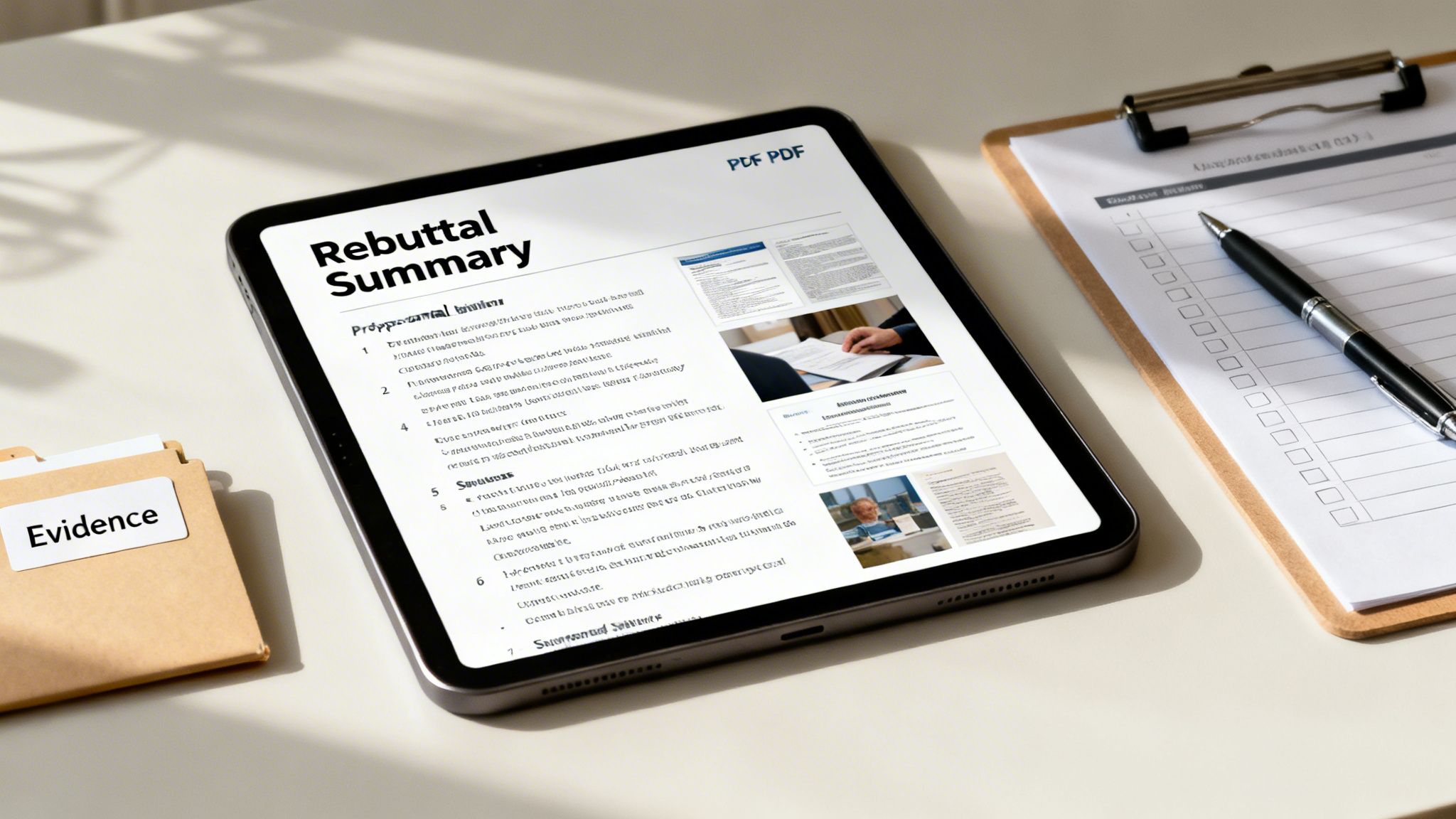
Having all the right evidence is a great start, but it's only half the battle. Now, you need to tell the story. Your rebuttal letter is the cover letter for your evidence package—it connects all the dots for the bank reviewer and makes your case impossible to ignore. A messy pile of documents without a clear narrative is just static to a busy analyst.
Think of the reviewer as a judge with about 60 seconds to hear your case. Your rebuttal needs to be so clear, concise, and persuasive that they get your side of the story instantly. This letter is your one shot to guide them through your proof and show them exactly why the customer's claim doesn't hold up.
This isn't the time for a long, angry letter. It's about a professional, fact-based presentation that dismantles the dispute, point by point. We’ve seen this exact approach work time and time again across the 100,000+ disputes we've handled, helping Shopify merchants claw back over $2.8 million in lost revenue.
Start with a Professional Summary
Before you get into the nitty-gritty, kick things off with a brief, professional summary. This sets the stage and gives the reviewer immediate context. Keep it short and to the point.
Your summary should always include these three key things:
- A clear statement of your goal: "We are disputing this chargeback."
- The core transaction details: Slap the order number, transaction date, amount, and customer name right at the top.
- A one-sentence conclusion: Something like, "The evidence provided confirms the customer authorized this purchase and received the merchandise at their verified address."
This quick intro shows you’re organized and helps the reviewer immediately grasp the basics before they even glance at your files.
Respond Directly to the Customer's Claim
After your summary, your next move is to tackle the chargeback reason code head-on. Don't just list your evidence; explain how each piece of proof directly refutes the customer’s specific claim.
For example, if the reason is "Product Not Received," your rebuttal should say something like: "The customer claims the product was not delivered. However, the attached shipping confirmation from UPS (Evidence A) shows the package was successfully delivered to the verified shipping address on March 15, 2026. Furthermore, the delivery photo (Evidence B) clearly shows the package at the customer's front door."
A strong rebuttal connects every single piece of evidence to a specific point in your argument. It’s a narrative that walks the reviewer from the customer's claim to the only logical conclusion: the claim is invalid. This methodical approach is a huge part of how ChargePay achieves its 92.4% win rate.
For more detailed guidance and to see how our AI often structures these letters, check out our guide with a complete example of a rebuttal letter.
Crucial Formatting Tips for Submission
How you package your evidence is just as important as the evidence itself. Banks have strict rules for file submissions, and if you don't follow them, your dispute can get tossed out before a human even lays eyes on it.
Here are the non-negotiable formatting rules you need to follow:
Label Your Files Clearly: Forget about uploading files named
IMG_5043.jpgorscreenshot-2.png. Name each file so the reviewer knows exactly what they’re looking at. Use a simple convention likeEvidence_A_Order_Confirmation.pdfandEvidence_B_Delivery_Proof.pdf.Consolidate into a Single PDF: Bank submission portals can be incredibly clunky. Instead of making them download a dozen separate files, combine your rebuttal letter and all your evidence into a single, organized PDF. This ensures the reviewer sees everything in the correct order you intended.
Watch Your File Size: Most banks have tiny file size limits, often around 1-5MB. A single high-resolution image can easily blow past that. Before you hit submit, compress your PDF to make sure it's under the limit. If it’s too large, it might get rejected automatically.
Presenting your case in a professional, easy-to-digest format signals to the bank that you're a credible merchant. It makes the reviewer's job easier, which makes them far more likely to rule in your favor. With ChargePay, you don't have to worry about any of this—our AI formats and submits everything for you, a feature that helped us earn our 4.9-star rating on the Shopify App Store.
Let AI Automate Your Chargeback Evidence
Let's be honest: fighting chargebacks by hand is a losing game. As your Shopify store grows, it becomes a time-sucking, frustrating process that just doesn't scale. Every time a dispute notice lands, you're forced to drop everything, play detective, and scramble to beat the clock.
You're essentially trying to solve a modern e-commerce problem with outdated, manual tactics. This means you're losing precious hours—time better spent on marketing or product development—to a repetitive admin task. Even worse, one tiny mistake, a missed deadline, or an incomplete evidence file results in an automatic loss. That’s real money walking out the door.
It's time to stop the grind. Automation isn't just a time-saver; it’s a smarter, faster, and more effective way to fight disputes and protect your bottom line.
The Headache of Manual Evidence Collection
Think about the manual process for a second. A dispute hits. First, you have to track down the order in Shopify. Then, the real digging begins. You’re pulling up transaction details, sifting through emails for customer communication, and logging into your shipping carrier's portal to screenshot a delivery confirmation.
After you've gathered everything, you have to piece it all together into a story, write a rebuttal letter, and then wrestle with formatting it all into a single, tiny PDF that a bank's ancient portal might actually accept. This whole song and dance can take anywhere from 30 minutes to over an hour for just one dispute. Now multiply that by five, ten, or twenty disputes a month.
The reality is, fighting chargebacks by hand is not a valuable use of your time. It’s a low-value activity that drains your focus while delivering inconsistent results.
This whole process isn't just inefficient; it's incredibly stressful. You're constantly on edge, worried about forgetting a key piece of chargeback evidence or submitting everything before the deadline. It’s a recipe for burnout and lost revenue.
How ChargePay's AI Solves This Problem
This is exactly where ChargePay comes in. The second a dispute is filed against your Shopify store, our AI gets to work. No more manual labor, no frantic searching for files, and zero stress about deadlines.
Here’s a quick look at how our AI handles the entire process for you:
- Instant Data Gathering: Our system is deeply connected with Shopify. It automatically pulls every relevant piece of evidence tied to the order—transaction details, AVS/CVV results, IP address, customer history, and all shipping information.
- Smart Reason Code Analysis: The AI immediately identifies the chargeback reason code and knows exactly what kind of proof is needed to win that specific type of dispute. It doesn't just collect data; it collects the right data.
- Automated Rebuttal Writing: Drawing on insights from over 100,000 successfully handled disputes, our AI crafts a clear, professional, and convincing rebuttal letter. It builds a logical case that connects each piece of evidence directly to the customer's claim, making it easy for the bank reviewer to understand.
- Perfect Submission, Every Time: Finally, the AI compiles the rebuttal and all supporting evidence into a perfectly formatted package that meets all bank requirements. It then submits it on your behalf, well before the deadline.
For many merchants, fighting fraud feels like a guessing game. A recent Mastercard report backs this up, noting that while merchants globally believe 45% of their chargebacks are fraudulent, proving it is a whole other challenge. With global dispute volumes projected to hit 261 million in 2025, solid proof is the only way to protect your revenue. You can dig into the full report for more on the true cost of chargebacks on mastercard.com.
This is why automation is so powerful. Our AI isn't just filling out a template; it's running a proven, data-driven strategy that has delivered a 92.4% win rate and recovered over $2.8 million for Shopify merchants. You can learn more about how it all works in our complete guide to automated chargeback management.
Stop trying to solve a 21st-century problem with 20th-century methods. Let our AI handle the entire fight, so you can get back to what you do best: growing your business.
Ready to put your chargebacks on autopilot? Install ChargePay from the Shopify App Store and let our AI start winning back your revenue today. As a Built for Shopify app with a 4.9-star rating, we’re trusted by thousands of merchants to turn their biggest headache into a solved problem.
Common Questions About Chargeback Evidence
When you're staring down a chargeback, knowing what evidence to submit can feel like a guessing game. Get it right, and you get your money back. Get it wrong, and it's an automatic loss.
Let's clear up the confusion. We've pulled together some of the most common questions we hear from Shopify store owners just like you, with straight-to-the-point answers.
How Long Do I Have to Submit My Chargeback Evidence?
The clock starts ticking the second a dispute is filed, not when you first get the notification. This window, often called the "representment" period, is set by the card network (like Visa or Mastercard) and usually gives you between 20 to 45 days.
Miss that deadline? It's an automatic loss. No exceptions, no second chances. That tight timeframe is exactly why trying to handle this manually is so risky. You just can't afford to let a dispute fall through the cracks because you got busy.
What Is the Single Most Important Piece of Evidence?
It really depends on the reason for the dispute, but for "Product Not Received" claims, solid proof of delivery is everything. And I don't just mean a tracking number. A simple number on its own won't be enough to sway a bank reviewer.
To build a case that's hard to argue with, you need to paint a clear picture. Think compelling proof like:
- A screenshot from the carrier’s website clearly showing the "Delivered" status.
- The full shipping address on the tracking page, which has to match the customer's order.
- A photo of the package on the customer's doorstep, if your carrier offers that service.
- GPS map data pinpointing the final delivery scan location.
The goal is to make it impossible for the bank to doubt that you held up your end of the bargain. The more visual and data-rich your evidence is, the better your odds of winning.
Can I Really Use Social Media Posts as Evidence?
Absolutely. And in "friendly fraud" cases, it can be a total game-changer. Let's say a customer files a chargeback claiming they never received their order, but then you see them post a selfie on Instagram wearing the product.
A screenshot of that post is gold. When you submit it, make sure you capture their profile name, the date of the post, and a clear image of them with your product. This directly torpedoes their claim and exposes the dispute for what it is.
How Do I Prove a Transaction Was Actually Authorized?
For those frustrating "unauthorized transaction" disputes, your mission is to prove the real cardholder was involved. You do this by connecting the dots with the data you have. The strongest evidence includes AVS and CVV match results, which confirm the card details were entered correctly at checkout.
On top of that, providing the customer’s IP address and showing that it matches their billing or shipping city adds another powerful layer of proof. If they're a repeat customer, you should absolutely include their past order history. It demonstrates an established relationship with your store and makes an "unauthorized" claim look pretty unbelievable.
Manually digging up and piecing together these details for every single dispute is a massive drain on your time and energy. That’s where ChargePay comes in.
Our AI automates the entire headache. It gathers the right evidence for the specific dispute reason, writes a compelling rebuttal based on what we’ve learned from over 100,000 disputes, and submits it on your behalf—all with a 92.4% success rate. As a Built for Shopify app with a 4.9-star rating, we're here to win your money back.
Install ChargePay from the Shopify App Store and let our AI turn your chargebacks into a solved problem.


.svg)



.svg)


.svg)
.svg)
.svg)