

That chargeback notification isn’t just an alert; it's a gut punch to your bottom line. At ChargePay, we see this every day. For Shopify store owners, chargeback management—the process of preventing and fighting these revenue-draining disputes—often feels like an uphill battle you're destined to lose. But it doesn’t have to be.
We’ve helped over 100,000 Shopify merchants fight back, recovering over $2.8 million with a 92.4% win rate. Let's talk about how to stop losing money.
The Real Cost of Shopify Chargebacks
A chargeback is so much more than just a reversed transaction. It’s a triple-threat to your finances: you lose the original sale revenue, you lose the product you shipped, and you get slapped with hefty, non-refundable fees that add insult to injury.
Every single time a customer disputes a charge, you're not just handing back the money from the sale. You're also paying a penalty for the "privilege" of the dispute itself. You can learn more about how these penalties stack up by exploring the true cost of a chargeback fee.
This constant drain can quickly eat away at your profit margins. For a growing Shopify store, trying to absorb these hits just isn't sustainable. It’s a silent killer of profitability, quietly working against your business in the background.
Why Manual Management Just Doesn't Work
Many store owners try to take on these disputes themselves. You know the drill—spending hours digging through orders, gathering evidence, and writing responses, only to lose the fight anyway. It’s not just time-consuming; it's incredibly inefficient. The odds are stacked against you from the start.
In fact, the numbers are pretty grim. Merchants battling chargebacks on their own face a win rate of only about 45% of disputes on average. That means a staggering 55% loss rate that drains ecommerce profitability. This isn't a small sample size, either—that statistic is drawn from 238 million chargebacks in 2023 alone.
This is exactly where automation stops being a "nice-to-have" and becomes a necessity. At ChargePay, we built our AI platform to solve this exact problem for Shopify merchants. By automating the entire process, we flip the odds dramatically.
We’ve handled over 100,000 disputes for our merchants, recovering more than $2.8 million in revenue that would have been lost forever. We do this with a 92.4% win rate—a number that proves what’s possible when you stop fighting manually and start fighting intelligently.
See the dramatic difference in outcomes when you switch from handling chargebacks manually to using an AI-powered solution built for Shopify.
Manual vs. AI-Powered Chargeback Management
This isn’t about just winning a few disputes here and there. It’s about implementing a systematic approach that protects every dollar, turning a major financial leak into a solved problem. That way, you can get back to focusing on what you do best: growing your business.
Why Chargebacks Happen to Shopify Stores
To stop chargebacks, you have to know why they start in the first place. It’s easy to assume every single dispute is a malicious attack on your store, but the reality is a bit more complicated. Most chargebacks you’ll see fall into three main buckets, and each one needs a totally different game plan for effective chargeback management.
When a customer disputes a charge, it’s not always with bad intent. Sometimes, it’s a simple misunderstanding or a mistake that happened on your end. Figuring out the root cause is your first step toward preventing future disputes and getting your revenue back.
Merchant Error The Accidental Chargeback
These are the chargebacks that are often the most frustrating because, in hindsight, they were usually preventable. Merchant errors are problems that come directly from your store’s operations that push a customer to file a dispute. They're honest mistakes, but they cost you real money.
Here are a few common scenarios:
- Slow Shipping Times: You promised 3-day shipping, but the package shows up two weeks later. The customer gets tired of waiting and files a "product not received" dispute.
- Poor Product Descriptions: A customer orders a t-shirt they believed was 100% cotton, but a polyester blend arrives instead. They file a "not as described" chargeback because what they got didn't match the expectation you set.
- Unclear Return Policy: Your return process is buried on your site or is a huge headache to navigate. The customer decides it’s just easier to call their bank than to deal with your customer service team.
These chargebacks are a signal that something in your fulfillment or customer communication needs a tune-up. While they sting, the good news is you have the power to fix the underlying issues and stop them from happening again.
Criminal Fraud The Obvious Attack
This is what most people picture when they hear the word "fraud." It’s straight-up theft, where a criminal uses a stolen credit card to buy something from your store. Eventually, the real cardholder spots the unauthorized transaction, reports it to their bank, and a chargeback is triggered.
You are almost certain to lose these disputes because the transaction was genuinely unauthorized. The focus here isn’t on winning the chargeback—it’s on preventing the fraudulent transaction from ever happening.
For these situations, your best defense is a powerful fraud detection system that can flag and block suspicious orders before you ship them. Trying to fight the chargeback itself is a losing battle.
Friendly Fraud The Silent Profit Killer
This is, by far, the most common and damaging type of chargeback for Shopify merchants, making up as much as 80% of all disputes. "Friendly fraud" is when a legitimate customer buys something, receives it, and then disputes the charge with their bank anyway.
It gets the name "friendly" because there's no stolen card involved, but the damage to your bottom line is just as bad. The customer’s motivations can vary widely:
- Buyer's Remorse: The customer simply regrets their purchase and sees a chargeback as a quick and easy way to get a refund without going through a return.
- Unrecognized Billing Descriptor: They look at their credit card statement, see "SP*MERCHANTNAME," and don't recognize it as your store, so they assume it’s a fraudulent charge.
- Family Member Purchase: A teenager uses their parent’s credit card without permission, and the parent disputes the charge they don’t recognize.
This is where having an expert chargeback management strategy is absolutely critical. Unlike criminal fraud, you can and should fight these disputes. With the right evidence—like proof of delivery, IP address logs, and AVS/CVV match data—you can prove the purchase was legitimate. This is exactly what ChargePay was built for. Our AI automatically pulls together all this evidence to fight for your revenue, which is how we’ve recovered over $2.8 million for our merchants with a 92.4% win rate.
Your Step-By-Step Guide to the Dispute Process
The moment a chargeback notification pops up on your Shopify dashboard, a clock starts ticking. You’ve just been pulled into the dispute process, a formal series of events with strict rules and tight deadlines. It can feel like a punch to the gut, but knowing the playbook is half the battle.
Think of it as a mini-court case for your transaction. There are a few key players you need to know:
- The Issuing Bank: This is your customer’s bank (like Chase or Bank of America). They’re the ones who kick off the chargeback on behalf of their cardholder.
- The Acquiring Bank: This is your bank or payment processor, such as Shopify Payments. They get the dispute notice from the issuing bank and pass the bad news on to you.
- The Card Network: These are the rule-makers like Visa and Mastercard. They set the guidelines for how the entire dispute process unfolds.
Here’s what happens: when a customer disputes a charge, their bank gives them a provisional credit right away. To do that, they pull those funds directly from your account. Your acquirer then alerts you, and that ticking clock gets louder.
Mapping the Dispute Timeline
Every card network has its own set of deadlines, but you can generally expect to have between 20 and 45 days to submit your side of the story. This isn't a friendly suggestion; it's a hard cutoff. If you miss that window, you automatically lose the dispute. That means you lose the sale, the product, and the money—no second chances.
This is where so many Shopify merchants trip up and lose revenue. You get busy running your business, a notification gets buried in your inbox, and by the time you see it, the deadline has passed. It's a simple mistake, but a costly one.
The whole thing can feel confusing, but getting a handle on the basic steps is the best way to prepare. For a deeper look at all the roles and rules, check out our guide on the complete card dispute process.
The single biggest mistake a merchant can make is sending a weak or incomplete response. You only get one shot to present your case, and a flimsy argument is as bad as no argument at all.
This flow chart breaks down where disputes come from before they even hit your dashboard.
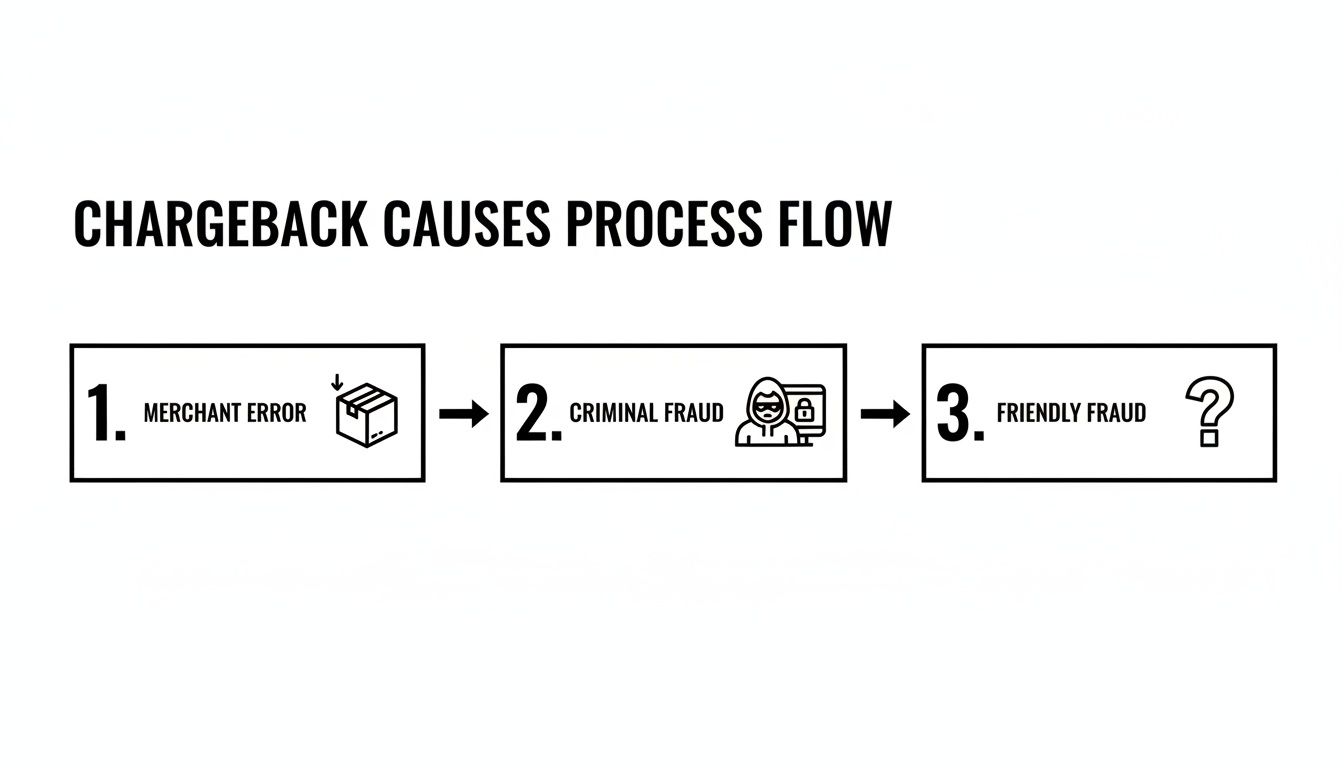
Figuring out if a dispute is from a simple merchant error, straight-up criminal fraud, or the all-too-common friendly fraud is your first step to building a winning response.
What Is Compelling Evidence?
"Compelling evidence" is the heart and soul of your chargeback response. It’s all the proof you can gather to show the customer’s bank that the original transaction was totally legitimate. What you need will depend on the chargeback reason, but for a Shopify store, it almost always comes down to these key pieces:
- Order & Transaction Details: The basics, like the date, amount, and exactly what was purchased.
- Shipping & Delivery Confirmation: This is your knockout punch. You need proof the product was delivered to the right address. A photo of the delivery and a live tracking number are gold.
- AVS and CVV Match Results: Show that the Address Verification System (AVS) and Card Verification Value (CVV) checks passed at checkout.
- Customer Communications: Any emails, support tickets, or chat logs that show your interactions with the customer are incredibly helpful.
- IP Address & Geolocation Data: This proves the order was placed from an IP address that lines up with the customer’s location.
Hunting down all this info for every single dispute is exactly why fighting chargebacks manually feels so exhausting. You're bouncing between Shopify, your shipping carrier, and your email, trying to piece everything together before the deadline. This is where AI completely changes the game. ChargePay automatically pulls all of this compelling evidence together in seconds, then packages it into a professional, win-ready response without you having to lift a finger.
How to Build a Winning Chargeback Response
When a chargeback hits, the response you send back—what the industry calls representment—is your one and only shot at getting your money back. Firing off a weak, disorganized response is a surefire way to lose. You have to think of it like presenting your case to a judge: you need clear, undeniable proof.
Building a powerful case isn't just about dumping a folder of data on the bank. You need to tell a simple story that a reviewer, who probably spends just a few minutes on your case, can understand immediately. Your goal is to make it impossible for them to deny the transaction was legitimate.

Getting this right is more critical than ever. Chargebacks are exploding globally, with volumes projected to hit 261 million this year and soar to 324 million by 2028. For merchants in the U.S., it's a brutal reality: for every $1 charged back, they lose an average of $4.61. Even more shocking, a whopping 45% of these are flagged as fraudulent.
Your Essential Evidence Checklist
Every winning chargeback response is built on a foundation of compelling evidence. Before you can even think about writing your argument, you need to gather the right documents. To put together a response that actually wins, having a solid grasp of what is a proof of purchase is the first step in collecting your evidence.
Start with this checklist of must-have items:
- Proof of Delivery: This is your knockout punch, especially for "product not received" claims. You need a tracking number showing delivery to the customer's address. A delivery photo of the package on their doorstep is even better.
- AVS and CVV Match Results: Show the bank that the address verification (AVS) and card security code (CVV) checks passed at checkout. This is strong proof that the actual cardholder authorized the payment.
- Customer Communications: Pull up any emails, live chat logs, or support tickets. If a customer was raving about your service one day and filed a chargeback the next, that contradiction is gold.
- IP Logs and Geolocation Data: Match the IP address from the time of purchase to the customer’s shipping or billing address. This directly links the order to their physical location.
Presenting Your Case: The Rebuttal Letter
Once you have your evidence, you need to package it all with a clear, professional rebuttal letter. This letter is your narrative—it connects the dots for the bank reviewer and walks them through why each piece of evidence proves the charge is valid. For a complete walkthrough and a template, check out our guide on writing an effective example of a rebuttal letter.
Your rebuttal letter must be tailored specifically to the dispute’s reason code. A response for "product not as described" requires totally different evidence and a different story than one for "transaction not recognized."
A great rebuttal letter is easy to scan, directly argues against the customer’s claim, and presents your proof step-by-step. Never assume the reviewer will piece it all together for you; you have to lead them to the only logical conclusion: the charge was legit.
Turning Hours of Work into an Automated Win
As you can see, gathering and presenting all this evidence for every single dispute is a massive time-drain. It's frustrating, tedious work that pulls you away from what you should be doing—growing your business. This is exactly where ChargePay's AI completely changes the game for your chargeback management.
Our system plugs directly into your Shopify store and automatically pulls all this critical data the moment a dispute is filed. It instantly analyzes the reason code, gathers the right evidence like IP logs and delivery confirmations, and generates a professional rebuttal letter designed to win.
We’ve successfully fought over 100,000 disputes and recovered more than $2.8 million for Shopify merchants, backed by our 92.4% win rate. Instead of spending hours building a case, you can let our AI do it for you—perfectly, every single time. Ready to stop losing revenue? Install ChargePay from the Shopify App Store and let us turn your disputes into money back in your bank.
How to Prevent Chargebacks Before They Happen
An ounce of prevention is worth a pound of cure, right? That old saying couldn't be more true for chargebacks. The cheapest dispute to win is the one that never happens in the first place.
While fighting chargebacks with solid evidence is a must for recovering revenue, the real secret is stopping problems before they even start. A few simple, proactive tweaks can save you thousands in lost sales, painful fees, and operational headaches. This lets you get back to focusing on what you do best: growing your business.
These aren't complicated, high-tech fixes. They're straightforward tactics you can put into action on your Shopify store right now. The goal is to build trust and smooth out the little bumps in the road that can lead a customer to file a dispute.
Communication That Leaves No Room for Doubt
A lot of chargebacks, especially the ones coded as "product not as described," boil down to one thing: a gap between what a customer expected and what they actually got. Your best defense is to close that gap completely.
- Write Product Descriptions That Sell and Inform: Don't just say "blue t-shirt." Think more like, "100% heavyweight cotton, classic fit blue t-shirt with a pre-shrunk, true-to-size cut." Get specific. Include materials, dimensions, and how to care for the product.
- Show, Don't Just Tell, with Images and Video: Let your customers see your products from every possible angle. Use high-quality photos with zoom functions and, if you can, short videos showing the product in action. Give them the full picture so there are no surprises.
- Be Honest About Shipping Times: This one is huge. Always be upfront about your shipping and handling windows. If you know it takes 3 days to process an order before it even leaves your warehouse, say so—clearly, on your product pages and at checkout.
Make Your Policies Easy to Find and Fair
When a customer isn't happy, you want their first move to be contacting you, not their bank. If your return policy is buried or confusing, they'll go straight for a chargeback because it just seems easier.
Your return and refund policy should be impossible to miss. Put it in your store's footer, link to it from product pages, and even mention it in your order confirmation emails. Don't hide it. Make it simple to find, easy to read, and fair for everyone.
Think of your customer service and return policy as your first line of defense. Every customer you successfully help is one less chargeback you have to fight. Prompt, helpful support can de-escalate a potential dispute and turn a frustrated customer into a loyal one.
Fix Your Billing Descriptor
One of the most common, and most frustrating, reasons for friendly fraud is when a customer scans their bank statement and has no clue who a charge is from. A cryptic billing descriptor like SP*WEBSTORE123 is just asking for a "transaction not recognized" dispute.
The good news is you can customize this in Shopify Payments to make it instantly recognizable. Use your store's name or website URL. For example, SP*BRANDNAME is crystal clear and will stop countless disputes before they even start. For more tips like this, you can find our full guide on achieving better Shopify chargeback protection.
By putting these simple strategies into play, you create a shopping experience that feels transparent and trustworthy. This doesn't just cut down on disputes; it builds stronger relationships with your customers. But since prevention isn't foolproof and some chargebacks will always slip through, having an automated system like ChargePay in your corner is essential to protect your revenue 24/7.
Why AI Automation Is Your Unfair Advantage
Let’s be honest: fighting chargebacks by hand is a losing game. It’s slow, full of potential mistakes, and just doesn’t work once your business starts to grow. Every single dispute yanks you away from what you should be doing—building your brand—and throws you into a frustrating loop of digging for evidence and stressing about deadlines. This is exactly why we built ChargePay for Shopify merchants like you.
Our AI works tirelessly in the background, giving you a serious upper hand in chargeback management. It looks at every dispute, automatically digs up the right evidence from your Shopify data, and immediately puts together a custom response designed to win. This is how you stop just reacting to chargebacks and finally get ahead of them.
How AI Changes the Game
Think of our AI as your personal chargeback specialist, one that never takes a break. The second a dispute hits your store, the AI is on it. It gathers all the compelling evidence you need—from delivery confirmations and IP logs to AVS/CVV match results. Then, it packs all that data into a professional, win-ready response that’s tailored to the specific reason code.
This completely gets rid of the hours you’d normally waste on mind-numbing manual work. But more importantly, it takes human error out of the equation. Our AI makes sure every response is perfect, complete, and sent in well before the deadline, every single time.
Proven Success By the Numbers
This isn't just a theory; we have the data to back it up from thousands of real Shopify merchants. It’s why we’ve earned the official ‘Built for Shopify’ badge and hold a 4.9-star rating on the Shopify App Store.
We’ve put together some real-world numbers that show exactly what ChargePay delivers for merchants every day.
These numbers aren't just statistics; they represent real money back in the pockets of businesses just like yours and countless hours saved.
And great automation doesn't just stop at fighting chargebacks—it improves your whole customer experience. When you handle disputes this efficiently, you also uncover insights to make your service better. For example, you can learn how to automate customer support with AI to slash response times, cut down on operational costs, and build a stronger defense against future problems.
A Risk-Free Partnership for Shopify Merchants
We firmly believe you should only ever pay for results. That’s why ChargePay is built on a simple, no-risk model: you only pay a small fee when we win your money back. If we don’t win the dispute for you, you don’t pay a single cent. It’s a true partnership where our success is directly linked to yours.
This is how you turn a complicated, costly problem into a solved one. You get your time back, your revenue is protected, and you can get back to focusing on growth.
Ready to stop losing money to chargebacks? Install ChargePay from the Shopify App Store and let our AI start winning for you today. You can also get a deeper look at our approach by reading our complete guide to automated chargeback and dispute management using AI.
Frequently Asked Questions
Diving into the world of chargebacks can feel like you're learning a new language. A lot of questions pop up. We get it. Here are some of the most common questions we hear from Shopify merchants, with straight-to-the-point answers.
How Long Do I Have to Respond to a Chargeback?
You’ve got a window, but it’s not a big one. Typically, you have between 20 and 45 days to fight a chargeback. This timeline isn't set in stone; it changes depending on the card network, like Visa or Mastercard.
But make no mistake, this is a hard deadline. Miss it, and you automatically lose the dispute. That money is gone for good. Acting fast is non-negotiable, which is why having an automated system like ChargePay is a game-changer. It makes sure your responses get in well before the clock runs out, preventing those simple, avoidable losses.
What Is a Good Chargeback Rate for a Shopify Store?
Most payment processors, including Shopify Payments, want to see your chargeback rate stay below 1% of your total transactions. If you start creeping above that number, you're entering the danger zone. You could be hit with penalties, higher fees, or even have your merchant account shut down.
But here’s the thing: even a "good" rate can mask a serious leak in your revenue. Your goal shouldn't just be to stay under the 1% threshold. It should be to prevent disputes wherever possible and have a rock-solid system to win back every single dollar you can from the ones that inevitably happen.
Can I Prevent Friendly Fraud?
You can’t stop friendly fraud completely, but you can absolutely make it harder for it to happen. Simple moves can make a world of difference.
- Use a clear billing descriptor so customers recognize the charge on their bank statement.
- Make your customer service easy to find and quick to respond.
- Always, always use delivery confirmation with tracking information.
For the disputes that still get through, your only real defense is a powerful, evidence-backed response.
Friendly fraud is the black hole where most Shopify stores leak revenue. The key is proving the transaction was legitimate, but digging up all that evidence manually is a massive time-drain. We built ChargePay specifically for this problem, using your own store's data to automatically build and submit winning cases for you.
Does ChargePay Work with PayPal or Other Gateways?
ChargePay is built from the ground up to integrate deeply and exclusively with Shopify Payments. We handle every chargeback that comes through that gateway, whether the customer paid with Visa, Mastercard, AMEX, or any other major card network Shopify processes.
If you get a dispute directly through a separate gateway like PayPal, you’ll need to handle that inside PayPal's own system. Our focus is laser-sharp: provide the absolute best chargeback automation for Shopify Payments. That’s how we've recovered over $2.8 million for merchants, driven by our 92.4% win rate.
Tired of losing money and wasting time on chargebacks? Let ChargePay turn your disputes into recovered revenue. With our ‘Built for Shopify’ badge and a 4.9-star rating, we're the trusted partner for thousands of merchants. You only pay when we win.
Install ChargePay from the Shopify App Store and start protecting your profits today.


.svg)



.svg)


.svg)
.svg)
.svg)