


For a Shopify merchant, the chargeback time limit isn’t just a deadline. It's a ticking clock that feels intentionally designed to make you lose. Cardholders often have months to dispute a transaction, while you might get just a handful of days to pull together evidence and fight back. From the very beginning, it’s an unfair race.
Why Chargeback Time Limits Are a Merchant's Biggest Threat
Think of a chargeback like a tennis match where the rules are stacked against you. Your customer gets to plan their shot for up to four months, taking their time to decide when and how to serve. When the ball finally flies over the net, you're given just seconds to react and hit a perfect return. This isn’t just a minor procedural detail; it's a direct threat to your revenue and a huge part of effective chargeback risk management.
This imbalance is a real problem for Shopify store owners. While you're busy with the day-to-day of running your business, a dispute notification can pop up for an order you shipped months ago. Suddenly, you have to drop everything and scramble to meet a ridiculously tight deadline.
The Unfair Advantage Customers Have
The system gives the cardholder a massive advantage. For instance, a customer often has a generous window of up to 120 days from the transaction date to file a dispute. In some situations, like claims for undelivered goods, this can stretch to an incredible 540 days.
Meanwhile, you’re squeezed into a tiny response window, sometimes as short as 7-10 days, especially when a case goes into pre-arbitration. You can read more about these chargeback trends and see for yourself just how lopsided these timelines really are.
This huge window for customers creates an environment where friendly fraud can easily take root. A buyer might use a product for several months and then file a chargeback, knowing the odds are stacked in their favor. For you, this means losing the revenue, the product, and getting stuck with a non-refundable chargeback fee.
Turning the Tables on Unfair Deadlines
Losing money to a missed deadline is one of the most frustrating parts of running an e-commerce store. It’s a loss that feels completely avoidable, yet it happens every single day to merchants trying to manage disputes on their own. At ChargePay, we've seen it all, and we built our platform to fix this exact problem.
We’ve successfully handled over 100,000 disputes for Shopify merchants, recovering more than $2.8M in lost revenue. Our 92.4% win rate proves that you don't have to lose revenue to unfair timelines.
Our AI-powered platform automates your entire dispute response, submitting compelling evidence long before the deadline even gets close. You never have to worry about missing a response window again.
If you're tired of losing the race against the clock, Install ChargePay from the Shopify App Store. As a Built for Shopify app with a 4.9-star rating, we're the trusted partner for merchants who want to stop losing money and start winning disputes.
Breaking Down The Chargeback Time Limits For Visa, Mastercard, and Amex
Not all chargeback time limits are the same. In fact, the rules set by Visa are different from Mastercard, and American Express plays by its own book entirely. For a Shopify merchant, this creates a confusing web of deadlines that can change based on the card your customer used. Getting a handle on these differences is your first line of defense.
Here’s the most important thing to understand: there's a huge difference between the cardholder's filing window and your merchant response window. A customer can get up to 120 days (or even more!) to file a dispute. But once they do and you get that dreaded notification, your window to respond—known as representment—shrinks dramatically, often to just 7 to 30 days.
This is probably the most unfair part of the whole chargeback process. The timeline is completely stacked in the customer's favor.
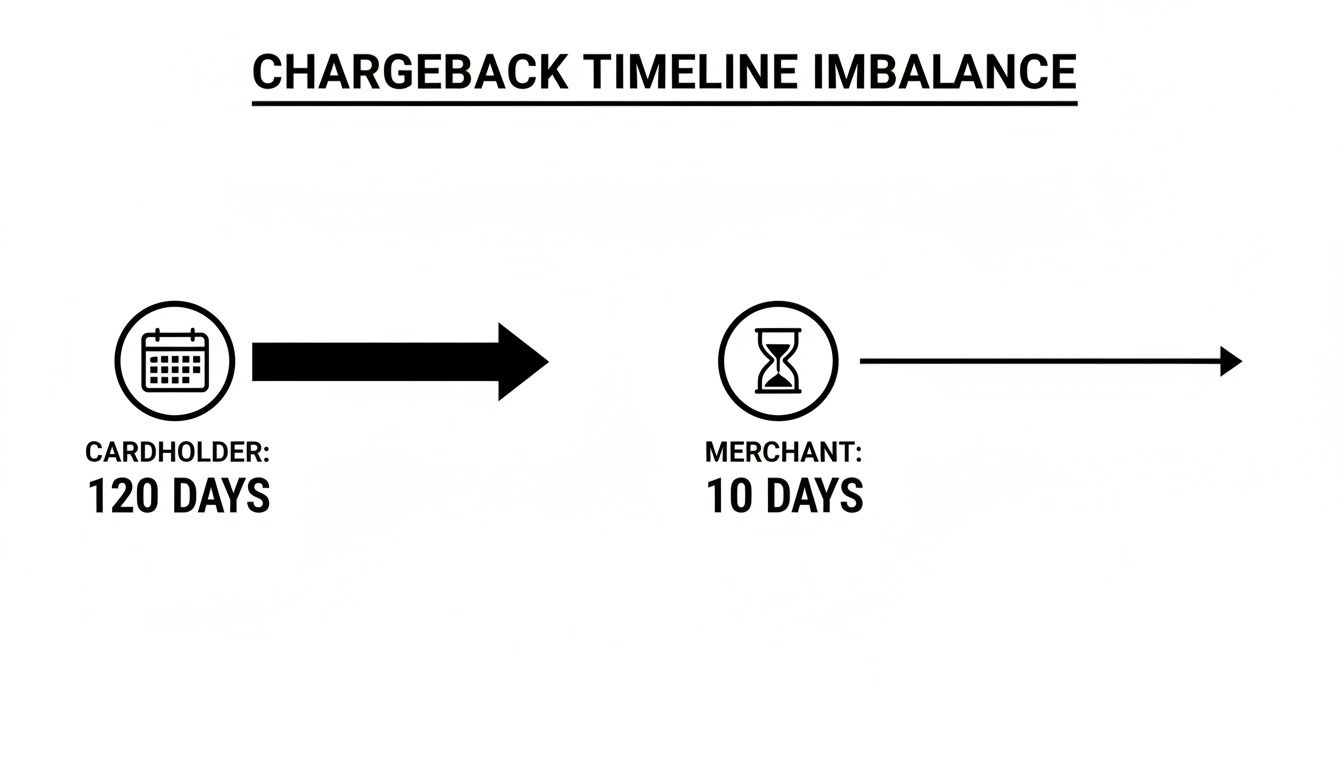
As you can see, they get months to think about it, while you’re left scrambling to build a winning case in just a handful of days.
A Closer Look at Card Network Rules
While the big card networks all mention a general 120-day rule for cardholders, the way they start the clock can vary. This tiny detail can have a massive impact on your business.
Visa: For Visa, the 120-day clock usually starts from the transaction processing date or the expected delivery date, whichever is later. This is designed to protect customers who pre-order items or run into shipping delays. You can learn more in our detailed guide on the Visa chargeback time limit.
Mastercard: Mastercard's 120-day window often depends on the specific reason code. For something like a recurring billing error, the clock might start from the statement date of the very first incorrect charge.
American Express: Amex is famous for being flexible with its cardholders and doesn't publish a single, rigid time limit. It's not uncommon to see disputes pop up many months after a transaction, as Amex tends to review them on a case-by-case basis.
Discover: Discover mostly sticks to a 120-day rule that starts from the transaction date or the expected service date.
The bottom line is you can't use a one-size-fits-all strategy. You have to treat each dispute as unique and understand the specific network's rules to know what you're up against.
How Reason Codes Change The Clock
The chargeback reason code doesn’t just tell you why a customer is unhappy; it also changes the chargeback time limit. The starting point for that countdown shifts based on what the complaint is about.
For instance, a "Transaction Not Recognized" dispute—a common fraud code—usually starts its 120-day countdown from the transaction date. But a "Product Not Received" dispute starts its clock from the expected delivery date, which could be weeks or months after the customer first paid.
This means a chargeback can legally land on your desk long after you thought a sale was final. A customer who ordered a product with a 60-day delivery window could file a valid chargeback almost half a year after they clicked "buy."
The table below breaks down the typical time limits a Shopify merchant will face. Just remember, these are general guidelines. Your payment processor might give you an even shorter window to get your evidence submitted.
Chargeback Time Limits by Card Network
| Card Network | Cardholder Filing Window | Merchant Response Window (Representment) | Common Notes for Shopify Merchants |
|---|---|---|---|
| Visa | 120 calendar days | 20-30 days | The clock starts on the transaction or delivery date. If it goes to pre-arbitration, your response window shrinks to just 10 days. |
| Mastercard | 120 calendar days | 45 days | Timelines vary a lot by reason code. Some service-related disputes can be filed up to 540 days later. |
| American Express | No fixed rule; often 120+ days | 20 days | Amex is known for siding with the cardholder and gives merchants a very short, strict window to respond. |
| Discover | 120 calendar days | 20 days | Similar to Visa, the clock can start from the expected service date, which extends the overall dispute period. |
Trying to keep track of all these different rules, reason codes, and deadlines by hand is next to impossible, especially as your store grows. This complexity is exactly why so many merchants lose disputes—not because they have a weak case, but simply because they miss a deadline. This is where automation with ChargePay becomes a necessity, not a luxury.
How to Calculate Your Actual Response Deadline
The official chargeback time limit you see from card networks is only half the story. If you're a Shopify merchant, you can't just glance at Visa's 20-day rule and think you have three weeks to get your evidence together. The real deadline you’re up against is almost always much, much shorter.
Getting this calculation wrong is one of the most common and costly mistakes a merchant can make. It’s an instant loss.
The countdown doesn’t start when you get that notification email from Shopify. Not even close. The clock actually starts ticking the second the customer’s bank files the dispute. This is probably the single most misunderstood part of the whole process, and it costs merchants millions.
The Hidden Delays That Steal Your Time
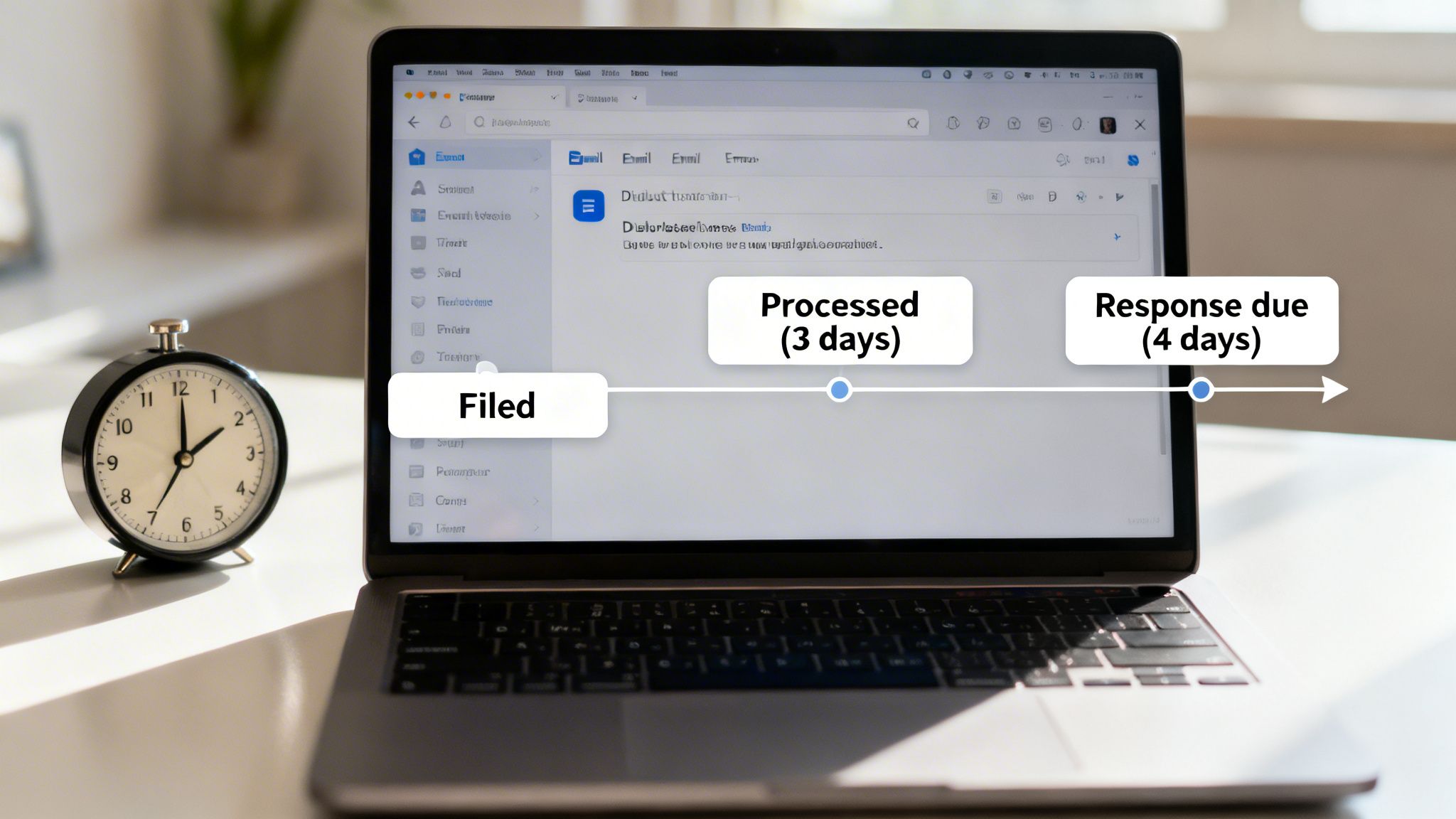
Let’s walk through a real-world scenario. A customer's bank files a chargeback against your store on a Monday. Your payment processor, like most, has its own internal process. It might take them three full days just to receive the dispute, process it, and finally push the notification to your Shopify account.
By the time you see that alert on Thursday morning, you've already lost three precious days. If the card network gave you a 7-day response window to begin with, you now have only four days left to find everything you need and submit a winning response.
This isn't some rare exception; it’s just how the system works. Payment processors and acquiring banks build in these buffers for their own reviews, which quietly eats away at your response time without any warning.
A Step-by-Step Calculation Example
To keep from getting blindsided, you need to work backward from the deadline your processor gives you.
- Find the Official Deadline: In your dispute dashboard, your processor will list a "respond by" date. Let's say it's Friday, October 18th.
- Identify the Notification Date: Now, look at the date you actually got the notification. Let’s say that was Tuesday, October 15th.
- Calculate Your Real Window: You have just three days to act. Not the 7, 10, or 20 days the card network might officially allow.
This simple math shows you the intense pressure you're really under. A couple of days of processing delay can slice your available time in half, making a manual response almost impossible for a busy store owner. You can dig deeper into how these timelines vary in our guide on the general time limit for a chargeback on a credit card.
The Problem with Pre-Dispute Alerts
Adding another layer of urgency are pre-dispute alerts from services like Ethoca and Verifi. These alerts are a bit of a double-edged sword. On one hand, they give you a heads-up that a chargeback is coming, giving you a quick chance to issue a refund and avoid the dispute entirely.
The catch? The window is incredibly short—often just 24 to 72 hours. If you don't see the alert and act immediately, it escalates into a full-blown chargeback, and you’re right back to facing a tight representment deadline.
This imbalance is baked right into the system. Visa may give a cardholder 120 days to file a dispute—which can even be extended to 540 days for items not received—but merchants often get squeezed into a tiny 10-day window during pre-arbitration. As you can learn more about these lopsided rules, it becomes clear the playing field is anything but level.
Ultimately, trying to manually track processor delays, pre-dispute alerts, and constantly shifting deadlines is a losing game. It’s exactly why we built ChargePay—to bypass these delays. Our AI platform plugs directly into the system, catching alerts the moment they happen and automatically preparing and submitting your response. We’ve helped over 100,000 Shopify merchants win back over $2.8M because we operate on the real timeline, not the one that shows up in your inbox days too late.
A Missed Deadline Means an Automatic Loss of Revenue
So, what happens if you miss that chargeback time limit? The answer is simple, harsh, and final: you automatically lose the dispute. And the money. There are no second chances, no appeals, and no room for excuses.
The second that response deadline flies by, the funds are gone for good—permanently transferred back to the cardholder. You've already lost the product you shipped, and to add insult to injury, you're still on the hook for the non-refundable chargeback fee from your payment processor. It’s the worst possible outcome for any Shopify merchant.
The True Cost of a Missed Deadline
Losing the revenue from a single sale is painful enough, but the real damage of a missed deadline sends ripples far beyond that one transaction. Each time you lose automatically, it hurts your business in a few critical ways:
- Guaranteed Financial Loss: You don't just lose the sale amount. You also lose the cost of your goods and the shipping expenses. On top of all that, you get slapped with a chargeback fee, which can be anywhere from $15 to $100.
- Wasted Inventory: The product is gone. Once you've lost the dispute, there’s no getting it back.
- Damaged Chargeback Ratio: Every single loss, especially an automatic one, pushes your chargeback ratio higher. Banks and processors watch this metric like a hawk.
A high chargeback ratio can have some seriously scary consequences, making it more expensive or even impossible for you to process payments. To get the full picture, you can learn more about how chargebacks hurt your business in the long run.
How Automatic Losses Jeopardize Your Store
Picture this: you get a few dispute notifications over a busy weekend. You're swamped with a new product launch and don't even see them until Tuesday. By then, the short response window has snapped shut. Just like that, you've automatically lost $1,500 in sales without ever getting a chance to defend yourself.
This isn't just a hypothetical story; it happens to Shopify merchants every single day. Each of those automatic losses drives up your chargeback-to-transaction ratio. Card networks like Visa and Mastercard monitor this ratio very, very closely. If it creeps over a certain threshold (usually around 1%), they can stick your business in a high-risk monitoring program.
Once you're labeled "high-risk," you're looking at higher processing fees, a rolling reserve where the processor holds back a percentage of your sales, and the very real threat of having your merchant account shut down completely. Suddenly, you can't accept credit card payments at all.
This is the ultimate danger of missed deadlines. A handful of "unseen" disputes can set off a chain reaction that threatens your store's ability to even operate. Trying to juggle disputes manually, with their confusing and ridiculously tight timelines, is a gamble you just can't afford to take. Every missed deadline is another step toward losing your payment processor, proving that a reliable, automated system isn't a luxury—it's essential for survival.
Automate Your Defense and Never Lose to a Deadline Again
If you're a busy Shopify store owner, you know the drill. You're juggling marketing, managing inventory, and keeping customers happy. The last thing you have time for is becoming a part-time chargeback expert, trying to track dozens of disputes—each with its own reason code, card network rule, and a ticking clock.
It’s a recipe for disaster.
We’ve already covered how the whole chargeback system is a maze of tight deadlines and hidden delays that seem designed to trip you up. A missed deadline is an automatic loss. This is where automation stops being a "nice-to-have" and becomes your most powerful weapon against lost revenue.

The Definitive Solution to Tight Timelines
Imagine this: instead of frantically racing against a clock that’s already been running for days, a system springs into action the instant a dispute is filed. That’s exactly what ChargePay does. We solve the problem of the chargeback time limit by taking human delay right out of the equation.
Our AI platform hooks directly into your Shopify store, completely bypassing the processor delays that chew away at your response window. When a dispute alert comes in, we see it in real-time. You don't have to wait three days for an email to finally land in your inbox.
This instant connection is the secret sauce. It immediately claws back the precious days that processor lag would have stolen, giving you the maximum possible time to build a winning case.
How AI Builds a Winning Response in Real Time
As soon as ChargePay gets a dispute notification, our AI gets to work. There’s no manual sorting or review queue. The system is built for one purpose: to fight and win for you before the deadline even becomes a concern.
Here’s a quick look at how it all unfolds:
- Instant Analysis: The AI immediately reads the dispute and its reason code. It knows instantly if it's a fraud claim, a "product not received" issue, or something else.
- Evidence Gathering: The platform automatically pulls all the compelling evidence needed straight from your Shopify data. Think customer info, order details, shipping confirmations, tracking numbers, and delivery proof.
- Custom Rebuttal Generation: Using the reason code and the card network's specific rules, our AI constructs a professional, evidence-packed rebuttal letter. This isn't some generic template; it’s a tailored response designed to beat that exact dispute type.
- Automatic Submission: The entire evidence package is compiled and submitted automatically, well before the deadline. You don’t have to lift a finger, log into a clunky portal, or upload a single document.
The results really do speak for themselves. ChargePay has handled over 100,000 disputes for Shopify merchants, hitting a 92.4% win rate and recovering more than $2.8 million in revenue. This isn't just about fighting chargebacks; it's about winning them over and over again.
From Manual Chaos to Automated Success
Think about what this actually means for your day-to-day. No more panic when a dispute notice shows up. No more late nights spent digging through old orders trying to find a tracking number. And most importantly, no more automatic losses because you missed a deadline by a few hours.
Automation turns a chaotic, reactive fire-drill into a managed, proactive defense. Just like you'd explore marketing automation strategies to grow your top line, you need smart automation to protect your bottom line.
If you want to get into the nitty-gritty, our complete guide to automated chargeback management breaks down exactly how AI is changing the game for merchants.
As a 'Built for Shopify' app with a 4.9-star rating, ChargePay is the partner that merchants trust when they’re tired of losing money to a system that feels stacked against them. The entire process is handled for you, so you can get back to focusing on what you do best: growing your business.
It really is that simple. Stop gambling with deadlines and start winning back your money. Install ChargePay from the Shopify App Store and make chargeback time limits a problem of the past.
Answering Your Questions About Chargeback Timelines
Even when you think you have the rules down, the details of a chargeback time limit can still feel like a maze. As a Shopify merchant, you're not just dealing with theory; you've got real, practical questions about what these deadlines mean for your store.
We get it. We've handled over 100,000 disputes and recovered more than $2.8M for merchants just like you, so we know exactly what's on your mind. Let's cut through the noise and get you some straight answers.
Can a Chargeback Time Limit Be Extended?
Here's the frustrating truth: yes for your customers, but almost never for you. It's another way the system is built to protect the cardholder first.
Card networks like Visa have rules that allow them to extend a customer's filing window. This might happen if a product was pre-ordered for a future delivery date, or if a merchant suddenly goes out of business. In some cases, like non-delivery claims, Visa’s rules can stretch a dispute window out to 540 days after the transaction.
Your deadline, however, is set in stone. When your payment processor gives you a deadline—whether it's 7, 10, or 20 days—it is final. There are no do-overs and no extensions. If you miss it by a single minute, you automatically lose the dispute and the revenue. This is why you can't ever count on getting extra time; you need a system that responds instantly, making extensions totally irrelevant.
Does the Timeline Start From the Order Date or Delivery Date?
This is a critical question, and the answer can make or break your case. It all comes down to the chargeback reason code—the starting point for the countdown clock isn't one-size-fits-all.
For Fraud or Authorization Issues: When a customer disputes a charge for "fraud" or "transaction not recognized," their 120-day window almost always starts from the transaction processing date.
For Merchandise or Service Issues: For claims like "product not as described" or "product not received," the clock often starts from the expected or actual delivery date.
That small difference has huge implications. It can leave your store exposed to chargebacks for weeks or even months longer than you'd expect. A customer could get a product, wait 60 days, and then file a completely valid chargeback because the delivery was a bit late, catching you totally off guard. This is why collecting all your evidence right away is so important.
How Can I Prove I Responded Within the Time Limit?
Proving you met the deadline is thankfully handled digitally. When you submit your evidence through your payment processor’s portal or a platform like ChargePay, the system creates a timestamped record. That's your proof.
The real challenge isn't just submitting something on time; it's putting together a strong, evidence-backed case within that tight window. Manually digging for order details, tracking numbers, customer emails, and then writing a convincing rebuttal letter can burn hours you simply don't have.
This is exactly where ChargePay lifts the entire burden. Our platform doesn't just submit the evidence for you via API; it keeps a full audit trail of the whole process. You get a clear, indisputable record that every single dispute was fought on time and backed by compelling evidence our AI found for you.
We've recovered millions for merchants by automating this exact process. With a 92.4% win rate, our system ensures you not only meet the deadline but also submit a response built to win.
What Is the Difference Between Pre-Arbitration and a Chargeback Response Time?
Think of the chargeback process as a game with multiple rounds, each with its own non-negotiable clock.
A standard chargeback response is your first shot at fighting back. This is called representment, and your deadline is usually somewhere between 7 and 30 days, depending on your processor and the card network.
If the issuing bank isn't convinced by your first response, the dispute can escalate to the next stage: pre-arbitration (for Visa) or a "second chargeback" (for Mastercard). This gives you a second, much shorter window—often just 7-10 days—to either provide more evidence or accept the loss. Lose this round or miss the deadline, and the case can move to binding arbitration, which gets very expensive, very fast.
The deadlines in the pre-arbitration stage are incredibly strict. Missing one is a guaranteed loss. It's this multi-stage complexity that makes trying to manage chargebacks by hand so risky. ChargePay is built to handle the entire dispute lifecycle, including these urgent pre-arbitration responses, to protect your revenue at every single stage.
Stop letting unfair deadlines and complex rules drain your revenue. ChargePay was built by Shopify experts to give you the automated defense you need to fight back and win. With a 4.9-star rating and a 'Built for Shopify' badge, we're the trusted solution for merchants who are serious about protecting their bottom line.
Install ChargePay from the Shopify App Store and let our AI turn your chargeback problem into a solved one.


.svg)



.svg)


.svg)
.svg)
.svg)