


Your chargeback win rate is simple: it’s the percentage of payment disputes you win after deciding to fight them. For a Shopify store owner, it’s a critical report card on how well you're managing chargebacks. It's a number that speaks volumes about your financial health and whether your process for fighting disputes is actually working.
At ChargePay, we've recovered over $2.8 million for Shopify merchants by achieving a 92.4% win rate across more than 100,000 disputes. We know that a low win rate isn't just a number; it's real money walking right out your door.
Why Your Chargeback Win Rate Matters More Than You Think
A low chargeback win rate is a direct hit to your bottom line. Too many store owners shrug and accept chargebacks as a "cost of doing business." That's a losing strategy, especially if you're in a competitive market like fashion, electronics, or supplements where every dollar counts. Each dispute you lose is lost revenue, plain and simple.
On the flip side, a high win rate tells you that your dispute management process is solid. It means you’re doing a great job proving your transactions are legitimate and getting back the money that is rightfully yours. Tracking and boosting this metric is one of the smartest things a Shopify store owner can do for their business.

A Low Rate Is a Sign of Bigger Problems
Ignoring a poor win rate can cause serious headaches beyond just the lost cash. It’s often a big red flag pointing to deeper issues that you need to fix, fast.
- Weak Evidence Collection: You might be gathering the wrong proof—or not enough of it—to convince the banks.
- Slow Response Times: The deadlines for fighting disputes are tight. Miss one, and you automatically lose.
- Manual Processes: Trying to handle chargebacks by hand is slow, full of mistakes, and just won't scale as your store grows.
At ChargePay, we’ve seen it all after handling over 100,000 disputes for Shopify merchants. The data doesn't lie: stores that actively fight their disputes recover a lot of revenue. We've recovered over $2.8 million for our clients by hitting a 92.4% win rate—a huge jump from the typical 30-40% that most merchants are stuck with.
Turning a Metric Into a Strategy
Your win rate is more than just a number; it’s a game plan. A rising win rate is proof that your efforts to fight fraud and improve how you handle disputes are working. It shows you’re getting a real return on your investment in any tools or services you're using.
For a deeper look at the basics, check out our guide on what is chargeback management.
If you’re a Shopify store owner who’s tired of losing money, focusing on this one metric is the first step to taking back control. With an AI-powered solution like ChargePay—which has a 4.9-star rating and is Built for Shopify—you can finally stop leaving money on the table. You can install ChargePay right from the Shopify App Store and turn your biggest revenue leak into a solved problem.
How to Calculate Your Chargeback Win Rate
You can't fix what you can't measure. Calculating your chargeback win rate is the first real step to see how much money you’re leaving on the table and whether your current process is working. For any Shopify store owner, this number is a direct snapshot of your dispute management health.
The formula itself is simple. At its core, you're just measuring how many of the disputes you fought were actually won.
Chargeback Win Rate Formula:
(Total Disputes You Won / Total Disputes You Fought) x 100 = Your Win Rate %
This simple math gives you a clear percentage that shows how successful you are at getting your revenue back. It’s a vital number for any e-commerce business, especially if you're in a competitive space like supplements, fashion, or electronics.
The Right Way to Calculate Your Win Rate
To get a number you can trust, you have to be careful about what you include. The single biggest mistake merchants make is counting chargebacks they never tried to fight. If you looked at a dispute and decided to accept it without sending in any evidence, it shouldn’t count against your win rate.
Why does this matter? Your win rate is supposed to measure how effective your dispute responses are, not how many chargebacks you get. Including uncontested disputes will tank your win rate and give you a skewed picture of how well you’re doing. You're trying to see how strong your evidence is, not just track your total losses.
Let's walk through a quick example.
Chargeback Win Rate Calculation Example
Imagine you run a Shopify store called "Peak Performance Powders." We'll look at your numbers for May to see how you'd calculate your true win rate.
| Metric | Example Data (Fictional Supplement Store - May 2026) | Calculation |
|---|---|---|
| Total Chargebacks Received | 15 | This is your starting point. |
| Chargebacks You Accepted (Did Not Fight) | 5 | You decided not to fight these, so they are excluded. |
| Total Chargebacks You Fought | 10 | This is your denominator (15 received - 5 accepted). |
| Chargebacks You Won | 6 | This is your numerator. |
| Chargebacks You Lost | 4 | (10 fought - 6 won) |
| Chargeback Win Rate | 60% | (6 Won / 10 Fought) x 100 |
Plugging those numbers into the formula—6 won disputes divided by 10 fought disputes—gives you a 60% win rate.
This 60% figure tells a powerful story: when you actually take the time to fight, you win more often than you lose. It’s a solid starting point and gives you a clear benchmark to improve on. This kind of accurate tracking is the cornerstone of effective chargeback dispute management.
At ChargePay, we live by this calculation because it represents real money for our clients. By focusing only on the disputes we can win and building airtight cases for every single one, our AI-driven approach delivers a 92.4% win rate.
Benchmarking Your Win Rate Across Different Industries
Your chargeback win rate doesn't exist in a vacuum. A 40% win rate might feel discouraging on its own, but if you’re selling consumer electronics, you’re actually doing better than many of your competitors. Context is everything.
Knowing where your industry stands helps you set realistic goals and get a handle on the unique challenges you’re up against. Are you lagging behind, keeping pace, or leading the pack? The answer tells you just how much revenue you're leaving on the table compared to everyone else.
Why Product Type Drastically Affects Win Rates
What you sell is one of the biggest factors in how hard it is to win a chargeback. The kind of evidence you need to prove a transaction was legitimate changes completely between a digital download and a physical product, and the data shows it.
When you look at the numbers, the contrast is stark: businesses selling digital goods have an average win rate of around 73%. Meanwhile, those selling physical goods see a much lower 53% success rate.
This gap exists because digital items—like software or e-books—often come with clearer proof of delivery, like IP logs and account login timestamps. This makes it much tougher for a customer to falsely claim they never received their purchase.
For Shopify merchants shipping physical items, the battle is usually fought over delivery. A customer can claim an item never arrived even with a valid tracking number, making these disputes incredibly difficult to win without ironclad proof.
For Shopify store owners, this data is a wake-up call. If the average win rate for physical goods is just over 50%, it means without an optimized process, you are essentially flipping a coin on every dispute. That’s a risky way to manage your revenue.
A Look at Specific Industry Benchmarks
When we zoom in on specific categories, the picture becomes even clearer. Some industries are just higher-risk than others, dealing with more friendly fraud and tougher standards from the banks.
Here's how some common e-commerce sectors stack up:
- Supplements & Skin Care: 52.9% win rate
- Apparel: 35.81% win rate
- Travel & Hospitality: 30.47% win rate
- Health Products: 29.17% win rate
- Consumer Electronics: 16.59% win rate
If you sell electronics, that average win rate is a painful 16.59%. This is because high-ticket items face more scrutiny, and the disputes themselves can be incredibly complex.
In contrast, the supplements and skin care category—a favorite for many Shopify brands—fares better at 52.9%. This is partly because these disputes often relate to types of fraud that can be effectively fought with the right evidence. You can learn more about how often merchants typically win these disputes in our detailed guide.
The Gap Between Average and Excellent
These industry benchmarks highlight a crucial point: "average" is not good enough. While a 35% win rate might be typical for an apparel store, it still represents a massive amount of lost revenue every month. The real opportunity is in smashing these averages.
This is where a dedicated, automated solution makes all the difference. While the industry struggles with win rates between 16% and 53%, ChargePay consistently delivers a 92.4% win rate for our Shopify clients across all categories. We've handled over 100,000 disputes and recovered more than $2.8 million by turning industry benchmarks into a starting line, not a finish line.
Our AI-powered system doesn't care if you sell electronics or apparel. It gathers the precise evidence needed for each specific case and submits a perfectly formatted response, every single time. If you’re tired of being average, you can install ChargePay from the Shopify App Store and see what a 92.4% win rate does for your bottom line.
It’s one of those things in ecommerce that feels completely backward. You’d think a huge $500 sale would be something to celebrate, but when it comes to chargebacks, that big order can be way tougher to defend than a simple $25 one.
There's a strange, inverse relationship between how much an order is worth and your chances of winning a dispute. The more an item costs, the closer the customer's bank looks at the transaction, and the more likely they are to take their cardholder's side.
This is a tough reality for anyone selling high-ticket items like electronics, furniture, or designer goods. While those big sales look great on paper, they carry a much heavier risk if a chargeback pops up. The bank’s thinking is straightforward: a $500 loss hits a consumer harder than a $20 loss, so they’re going to put the merchant’s evidence under a bigger microscope.
Why Are High-Value Disputes So Hard to Win?
When a customer disputes a big purchase, the stakes are suddenly higher for everyone. The issuing bank isn't just an impartial referee; they have an interest in keeping their customer happy. It's often easier for them to absorb a small loss than to risk ticking off a valuable client over a large, messy dispute.
This means your evidence has to be absolutely airtight. A simple tracking number showing "delivered" might be enough to win a $30 dispute. But for a $1,000 order? The bank will want more. They’ll ask questions—was it delivered to the right person? Could it have been stolen off the porch? These are doubts that rarely come up for low-value items.
The chart below shows how win rates can differ across industries, which often lines up with the average price of products in those sectors.
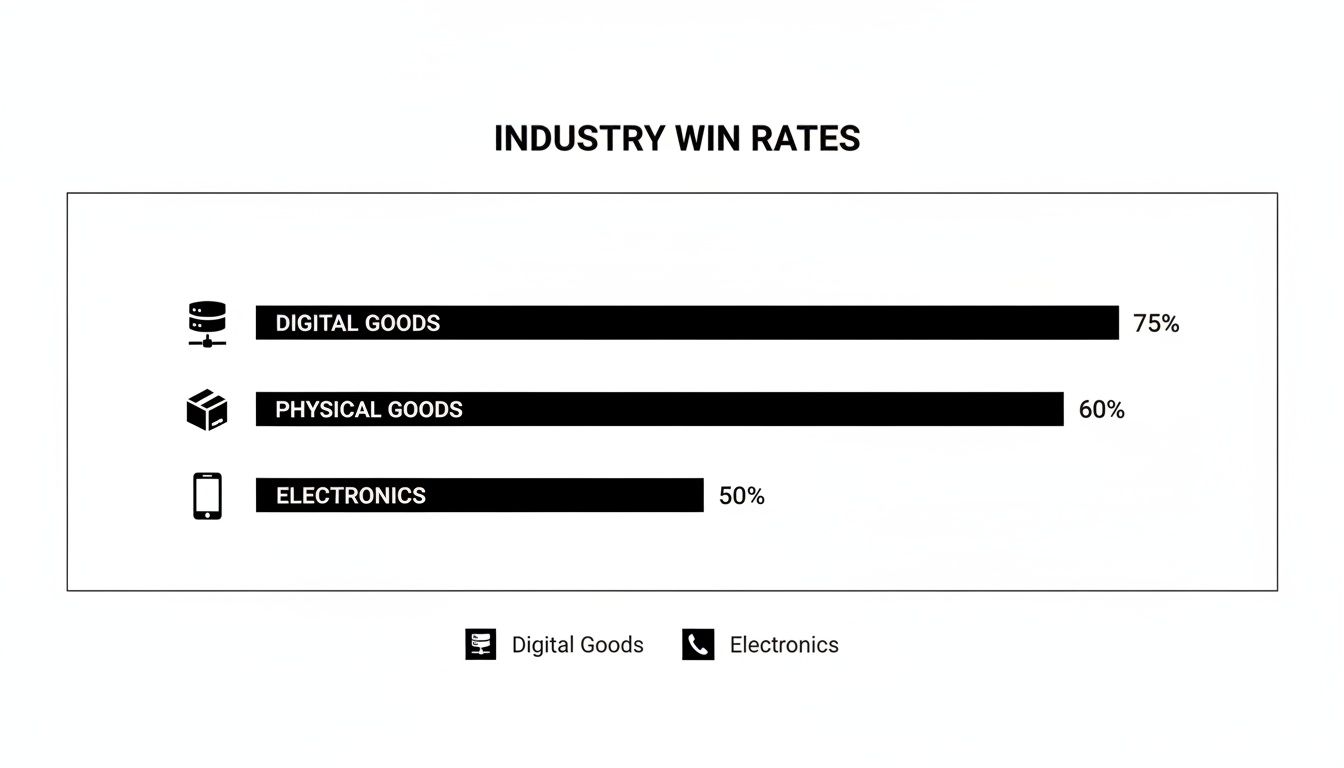
As you can see, digital goods tend to have higher win rates, partly because of lower transaction values and clear delivery evidence. On the other hand, physical goods, and especially pricey electronics, have a much tougher time.
The Data Doesn't Lie
The numbers back this up, showing a clear nosedive in win rates as order values climb.
Here’s a quick look at how transaction value impacts your odds of winning a chargeback dispute.
Chargeback Win Rate by Transaction Value
| Transaction Value | Average Merchant Win Rate |
|---|---|
| <$29.99 | 46.85% |
| $30-$99.99 | 40.12% |
| $100-$299.99 | 33.78% |
| >$300 | 27.64% |
This data paints a stark picture. While you have a nearly 50/50 shot at winning a dispute for an item under $30, your chances plummet to just 27.64% for orders over $300. These sales quickly become a huge liability.
This is exactly why a merchant selling high-end electronics might see their win rate crater, even if they have what feels like solid evidence. A low win rate on your most expensive products can turn a profitable business into a financial headache, fast.
How to Build a Stronger Case for Big-Ticket Sales
If you sell high-value products, you can’t treat every dispute the same. You need to build a rock-solid, undeniable case from the moment the customer clicks "buy." This means going way beyond standard proof of delivery.
Here are a few tactics to start protecting your high-value orders:
- Require a Signature on Delivery: This is an absolute must for expensive items. Signature confirmation is some of the strongest evidence you can have against "item not received" claims.
- Get Tougher with Fraud Filters: Use your platform’s fraud analysis tools to their full potential. Flag orders with mismatched addresses, suspicious IP locations, or unusual buying patterns. It’s far better to cancel and refund a sketchy order than to risk a chargeback you’re statistically likely to lose.
- Document Everything: Seriously, everything. Take photos of the item as it’s being packaged. Keep detailed records of every email, chat, and phone call with the customer.
For merchants who regularly deal with these kinds of sales, it’s often a sign that you’re operating as a high-risk merchant account without even realizing it. That means you need a much more aggressive and detailed defense strategy to protect your revenue.
If you feel like your chargeback win rate is stuck in first gear, you're not alone. When we see Shopify merchants with low win rates, it almost always boils down to a handful of common—and totally fixable—mistakes.
Figuring out where your process is failing is the first step to clawing back that lost revenue. Let’s walk through the top three reasons you might be losing disputes that you absolutely should be winning.
1. You're Submitting Weak or Irrelevant Evidence
This is the big one. The single biggest mistake a merchant can make is sending the wrong evidence for a specific reason code. The bank gives you a very specific reason for the chargeback, and your evidence has to directly shut down that exact claim.
Here’s a classic example: a customer files a chargeback claiming "Product Not as Described." You know you shipped it, so you send the tracking number showing a successful delivery. You will lose this dispute 100% of the time.
Why? The customer isn't saying they didn't get it; they're saying it wasn't what they were promised. What the bank actually needed to see was compelling proof like:
- Product page descriptions that perfectly match the item.
- High-quality product photos from your Shopify store that leave no room for doubt.
- Customer service chats or emails where the customer never mentioned a problem with the item.
That tracking number is completely irrelevant. This is a costly mistake that happens all the time when you're in a rush, manually handling disputes without focusing on the details.
2. You're Missing Tight Response Deadlines
The chargeback clock is unforgiving. Issuing banks give you a short window—sometimes just 20-30 days—to pull together all your evidence and submit a full response. Miss that deadline by one second, and you automatically lose. The money is gone for good.
For a busy store owner, this is a massive headache. You’re already juggling marketing, managing inventory, and handling customer support. The idea of stopping everything to dig up order details, find shipping confirmations, and write a convincing response is almost impossible.
Imagine getting five chargeback alerts on a Monday morning while you’re prepping a new product launch. Just handling one could take an hour you don't have. It's easy to see how a couple could slip through the cracks, leading to automatic, preventable losses.
This isn't a battle you can win by just working harder. As your store grows and dispute volumes rise, it becomes a systemic problem that will bleed you dry.
3. You're Not Equipped to Fight Friendly Fraud
Friendly fraud is when a legitimate customer buys something, receives it, and then files a chargeback claiming they never authorized the purchase or never got the package. They're trying to get a free product, and it's a huge drain on revenue for Shopify merchants.
Winning against friendly fraud is tough because the burden of proof is on you. You have to prove the actual cardholder made the purchase and that they (or someone at their address) received the goods. This requires a deeper level of evidence:
- IP address that matches the cardholder’s billing city and state.
- AVS and CVV match confirmations from the payment gateway.
- The customer's order history, showing they’ve successfully purchased from you before.
- Delivery confirmation with a signature or photographic proof of delivery.
Trying to gather all this data for every single dispute is incredibly time-consuming. Most merchants simply don't have easy access to this information or the time to piece it all together for a winning case. So what happens? They give up and let the fraudster win, which only encourages them to do it again.
How to Automate Your Way to a Higher Win Rate
If you’ve ever felt like you're fighting an uphill battle against chargebacks, you're not alone. The manual process of gathering evidence and responding to disputes is draining, and it often feels like you're set up to lose. But what if you could change the rules?
Instead of accepting a low win rate, you can use automation to turn that losing fight into a consistent win. It isn’t about working harder; it’s about giving your Shopify store the right tool for the job.
This is exactly how ChargePay achieves a 92.4% chargeback win rate for merchants. Our AI-powered system completely takes the manual work, stress, and guesswork out of the dispute process. It was built from the ground up to solve the very problems—like weak evidence, missed deadlines, and friendly fraud—that sink most merchants' chances.
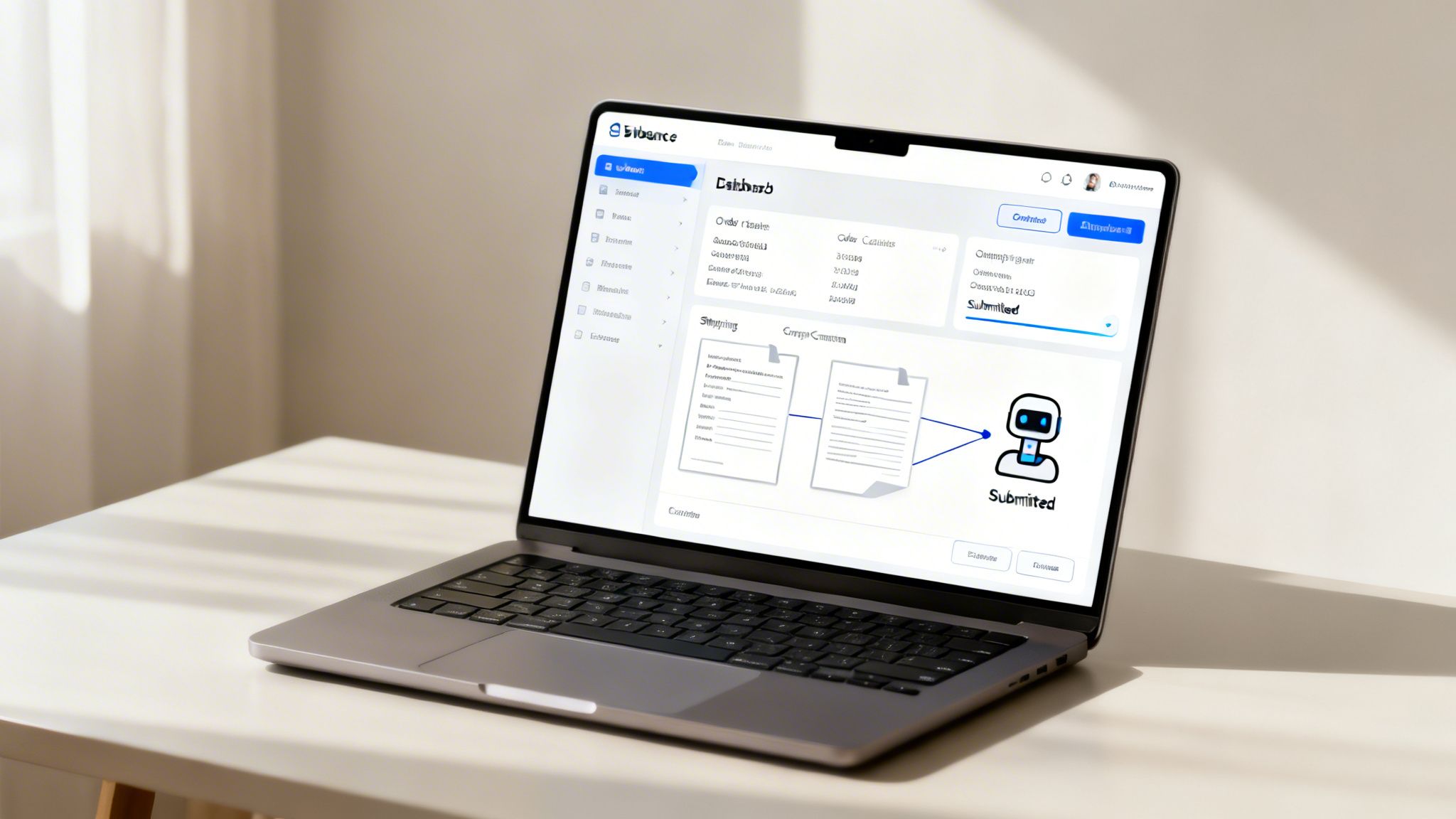
The image above shows a workflow automation interface, which is the secret behind smart chargeback management. This approach replaces tedious, error-prone manual tasks with a system that works perfectly every time—a critical shift if you want to improve your chargeback win rate.
Building an Unbeatable Case, Every Time
ChargePay's AI doesn't just plug details into a generic template. It builds a custom-tailored response for every single dispute. The moment a chargeback hits your store, our system is on the case.
It automatically pulls together all the evidence needed to dismantle that specific claim, including:
- Order details and customer information directly from Shopify.
- IP data and geolocation to prove the buyer's location.
- AVS and CVV match results from your payment gateway.
- Shipping confirmations and delivery proof from your carriers.
And by automating evidence collection, perhaps by using a good receipt maker, you can be sure you always have the documentation you need. The AI then organizes all this proof into a professional representment document designed to win and submits it for you, guaranteeing you never miss a deadline. This is how we've successfully managed over 100,000 disputes and recovered more than $2.8 million for Shopify stores just like yours.
Smashing Industry Averages with AI
The difference between fighting chargebacks manually and using AI automation is night and day. Consider the average win rates for different e-commerce niches: consumer electronics merchants win a dismal 16.59% of disputes, while apparel stores only average 35.81%. Even a high-performing category like supplements only hits 52.9%.
These numbers show just how tough the odds are for Shopify merchants, especially with friendly fraud expected to surge by 40% by 2026.
A 92.4% win rate isn't magic; it's the result of a system built to beat the odds. While the average merchant wins back just a fraction of their disputes, ChargePay turns chargebacks into a reliable source of recovered revenue.
This level of automation completely changes how you handle disputes. You can learn more about how it all works in our complete guide to automated chargeback management using AI.
A No-Risk Decision to Recover Your Revenue
We get it. Trying a new tool can feel like a gamble when you're already losing money to chargebacks. That's why we made ChargePay a completely no-risk solution for Shopify merchants.
Our pay-per-win model is straightforward: you only pay a small fee on the revenue we successfully recover for you. If we don't win the dispute, you don't pay a single cent. It’s a guaranteed positive return on your investment from day one.
As a Built for Shopify app with a 4.9-star rating, ChargePay is trusted by thousands of store owners to handle their disputes securely and effectively. You can finally stop accepting losses and start winning back your money. Install ChargePay directly from the Shopify App Store and let our AI turn your chargeback problem into a solved one.
Got Questions? We’ve Got Answers
We get it—chargebacks can be a minefield. Let's tackle some of the most common questions Shopify merchants ask about their win rate. We're here to give you straightforward answers so you can feel confident taking the next step.
What’s Considered a Bad Chargeback Win Rate?
Any win rate that’s dipping below the average for your industry is a red flag. If you’re selling physical goods and your win rate is under 30%, that’s a clear sign you’re leaving recoverable money on the table.
But the absolute worst win rate? The one you aren't trying to fix. Simply accepting those losses as a cost of doing business is a recipe for disaster for any growing Shopify store.
How Much Time Does It Take to Fight Chargebacks Manually?
This is where it gets painful. We hear from Shopify merchants who spend anywhere from 15 minutes to over an hour on a single dispute. That might not seem like a big deal at first, but it piles up fast.
If your Shopify store gets just 10 chargebacks a month, you could easily burn an entire workday just digging for evidence and writing responses. That’s time you should be using to grow your business, not chasing down lost revenue. This is exactly why automation is a game-changer.
Can I Really Win Against Friendly Fraud?
Yes, you absolutely can. Winning friendly fraud cases is completely doable, but it all comes down to the quality of your proof. You need to show compelling evidence that the real cardholder bought the item and that you delivered it successfully.
This is where a system like ChargePay really shines. Our AI is built to find this exact kind of evidence—like IP address matches and delivery confirmations—to construct a solid case against these claims and get your money back.
Is Using an Automated Tool Like ChargePay Worth It?
With ChargePay, the answer is yes. Our entire model is built around a simple idea: we only get paid when you do. It's a pay-per-win system, meaning you only pay a small fee on the revenue we successfully recover for you.
If we don’t win the dispute, you don’t pay. Simple as that. This guarantees a positive return on your investment because there are no upfront costs or financial risks. It’s a completely safe way to stop revenue loss.
Ready to stop guessing and start winning? ChargePay has helped Shopify merchants recover over $2.8 million with a 92.4% win rate. Install ChargePay from the Shopify App Store and turn your chargeback problem into a solved one.


.svg)



.svg)


.svg)
.svg)
.svg)