

If you've ever applied for a standard merchant account and been turned down, it’s easy to feel like you did something wrong. But getting labeled “high-risk” isn't a knock on your business's legitimacy—it’s simply a financial classification based on industry patterns and potential risk.
A high-risk merchant account is just a specialized payment processing account for businesses that banks see as carrying a higher chance of chargebacks or fraud. Think of it like specialized insurance; it lets you accept credit and debit cards, but the "premiums" (your fees) and the terms are a bit stricter to cover the bank's added risk.
What Is a High-Risk Merchant Account, Really?

Here's the deal: whenever a customer pays with a credit card, the payment processor and its partner bank are essentially fronting you the money while the transaction officially clears. They're taking on a tiny bit of risk with every single sale.
For certain industries or business models, that risk is statistically much higher, mostly because of the increased odds of chargebacks—those frustrating instances where a customer disputes a charge and forces a refund.
An Analogy That Makes It Clear
Imagine two people applying for car insurance.
The first is a 40-year-old with a flawless driving record who drives a minivan to and from the office. The second is a 19-year-old with a brand-new sports car and a couple of speeding tickets already under their belt.
The insurance company will cover both of them, no problem. But you can bet the teenager is going to pay a much higher premium.
Why? It’s not because the insurance company thinks they're a "bad" driver, but because statistics show they're a riskier one. A high-risk merchant account works exactly the same way. Your payment processor is the "insurer," and if your business looks more like the sports car driver, they'll require a "higher premium" through fees and stricter terms to protect themselves from potential losses.
This classification is just a normal part of doing business for thousands of successful, legitimate companies.
The Core Reasons for a High-Risk Label
So, what actually makes a payment processor flag your business as a bigger risk? It almost always boils down to a few key areas that signal a higher chance of customer disputes or financial bumps in the road.
- High Chargeback Ratios: If your industry is notorious for customer disputes (think subscription services with tricky billing cycles), you’re pretty much automatically in the high-risk category. A chargeback ratio that creeps above 1% is a massive red flag for processors.
- Industry Type: Some fields are just high-risk by nature. This includes regulated industries like firearms or CBD, but also businesses like travel agencies where there’s a long delay between when a customer pays and when they actually get the service.
- Your Business Model: Things like selling digital products, running a subscription box, or using a dropshipping model often get this label because of a higher rate of "friendly fraud" or customer buyer's remorse.
- Average Transaction Size: This one is tricky because both very high and very low average sales can be a problem. A single $5,000 transaction is a huge loss if it gets disputed, while tons of tiny transactions can be a classic sign of criminals testing stolen credit cards.
The key takeaway here is that being "high-risk" is an operational reality, not a business failure. It just means you need a payment partner who understands your industry's specific challenges and has the tools to manage them.
Industries That Usually Need High Risk Processing
Hearing your business called “high risk” can feel like a slap in the face, but trust me, it’s almost never personal. Payment processors are simply playing a numbers game. They look at industry-wide statistics, and some business models just have a greater chance of running into chargebacks and fraud.
Figuring out if your business falls into one of these categories is the first real step toward finding a payment partner who actually gets what you do. This isn't about being in a "bad" industry; it's about acknowledging the unique hurdles your business model faces, whether that’s from recurring billing or the very nature of what you sell.
Why Certain Industries Are Considered High Risk
Let's break down some of the most common industries that get flagged as high-risk. It’s not about judging the quality of your business, but about recognizing the specific challenges and patterns that make traditional processors a bit jumpy.
The bottom line is that these industries simply have a higher built-in potential for financial turbulence. That’s where a specialized high-risk merchant account comes in—it’s built specifically for businesses that navigate these kinds of waters.
The Usual Suspects and Why They Fit the Profile
Let's dig a little deeper into a few of these.
Some business models just come with risk factors baked right in. A standard processor sees these patterns and immediately gets nervous. It’s not an attack on your company, just a reaction to industry data.
Here are some of the most common high-risk groups and the logic behind the label:
- Subscription and Recurring Billing: This model is a total chargeback magnet. Customers forget they signed up, see a charge they don’t recognize, or get frustrated trying to cancel. Every time someone says, "I didn't authorize this," it can blossom into a costly dispute.
- Travel and Hospitality: Think about it: you might book a family vacation six months in advance. That massive time gap between when you pay and when you actually go creates a huge window for things to go sideways. Canceled trips, changed plans, or even the travel company going under can all trigger a wave of chargebacks.
- Digital Goods and SaaS: When you're selling software, e-books, or an online course, there’s no physical item being shipped. This makes the industry a prime target for “friendly fraud,” where a customer uses your product and then claims they never got it just to get their money back.
- Nutraceuticals and Supplements: This space is often under a microscope for its marketing claims and can see a lot of returns. If a customer doesn't feel the "miracle" results they expected, they’re far more likely to just file a chargeback than to bother with your official return process.
- Dropshipping and E-commerce: While it’s a massively popular way to do business, dropshipping means you're at the mercy of third-party suppliers. Any shipping delays or problems with product quality are completely out of your control, but you’re the one who has to deal with the angry customer and the resulting dispute. If your store is seeing a lot of flagged transactions, our guide on handling Shopify high-risk orders can offer some valuable insights.
The common thread is a higher potential for customer disputes. A high risk merchant account is designed specifically for businesses that operate with this built-in potential for financial turbulence.
Regulated and High-Ticket Industries
Beyond the business model, some industries get the high-risk label because of heavy government oversight or the simple fact that they sell very expensive things. A single chargeback on a $5,000 watch is a much bigger financial hit for a processor than one on a $50 t-shirt.
This group includes businesses like:
- Jewelry and Luxury Goods: The sky-high price tags mean that a single fraudulent sale or disputed charge can create a significant financial hole. This inherent risk makes processors extra cautious.
- Firearms and Ammunition: With heavy federal and state regulations, selling firearms online is a complex game. The legal and reputational risks are so high that these merchants are automatically placed in the high-risk bucket.
- CBD and Cannabis-Related Products: This is one of the textbook high-risk industries. Because these products live in a legal gray zone—legal in some states, but not federally—most traditional banks and processors want nothing to do with them. This forces these businesses to find processors who specialize in their niche.
Ultimately, being in one of these industries just means you need a payment partner who knows the ropes. A high risk merchant account isn't a penalty; it's a specialized tool built for your exact needs, letting you take payments securely while navigating the unique challenges of your field.
How Underwriters Really Evaluate Your Business
Applying for a high-risk merchant account can feel like you’re being put under a microscope. And honestly? You are. Underwriters at the acquiring bank are the financial detectives tasked with one core mission: to figure out just how much risk your business represents. They aren't trying to catch you in a lie; they're trying to build a complete picture of your operations to see if a partnership makes sense for the long haul.
Think of it like applying for a major business loan. The lender wants to see your business plan, your financials, and your professional background. An underwriter does the same, digging into your company's health, history, and operational model to make an informed decision. Their job is to protect the bank from the financial sting of excessive chargebacks, fraud, and any potential damage to their reputation.
This flow chart shows a simplified view of the process for a few common high-risk industries that underwriters see every single day.
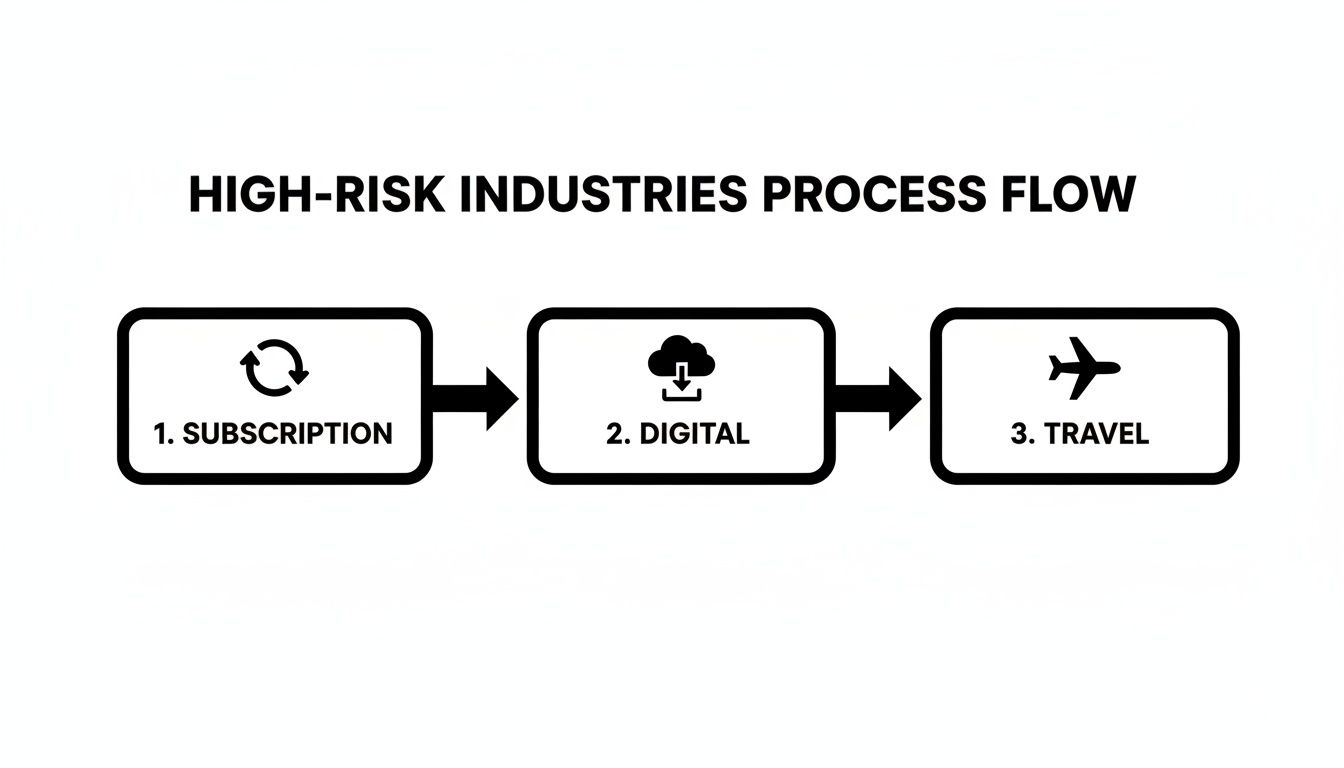
Each of these industries, from recurring subscriptions to travel bookings, has its own unique risk profile that underwriters are trained to spot and assess.
The Paper Trail They Follow
When you submit your application, underwriters don't just give it a quick glance. They dive deep into a specific set of documents to verify who you are, what you're selling, and how your business actually works. Being prepared with this information is the single best thing you can do to speed up your approval.
Here’s what they’re looking for:
- Business Bank Statements: You’ll typically need to provide three to six months of statements. This gives them a clear snapshot of your financial stability by showing your cash flow, average daily balance, and any negative balance days.
- Processing History: If you've accepted cards before, this is non-negotiable. They'll want to see your monthly processing volume, average ticket size, and most importantly, your chargeback ratio. If it’s consistently over 1%, that’s a major concern.
- Business Model and Website: Your website is your digital storefront. Underwriters will scrutinize it to make sure your products or services are clearly described, your pricing is transparent, and your terms of service and refund policies are easy for customers to find.
An underwriter's primary goal is predictability. The more organized, transparent, and consistent your documentation is, the more confident they will be in approving your high risk merchant account.
Red Flags That Can Sink Your Application
Just as a clean paper trail builds confidence, certain red flags can bring the whole process to a screeching halt. Underwriters are trained to spot inconsistencies and potential problems from a mile away. Knowing what these are ahead of time can help you address them before you even apply.
One of the biggest red flags is a history of terminated merchant accounts. If you’ve been placed on the MATCH List (also known as the Terminated Merchant File), it's a serious problem. Being on this list signals to other banks that a previous processor shut you down for issues like excessive chargebacks or fraud, making any new approval much, much harder to get.
Other common red flags include:
- Inconsistent Information: Your business name, address, and ownership details have to be identical across every single document—from your bank statements to your website's contact page. No exceptions.
- Poor Personal Credit: For many small businesses, the owner's personal credit score is a huge factor. A low score can suggest financial instability, which makes underwriters nervous.
- Unclear Business Practices: If your website is vague about what you sell, how you ship, or what your return policy is, it’s a problem. Transparency is everything.
Effectively managing disputes is a critical part of maintaining a healthy processing history. For more strategies on this, check out our comprehensive guide on chargeback risk management to learn how to keep your ratios low. By presenting a clean, professional, and well-documented application, you're not just asking for an account—you're proving you're a reliable business partner.
Understanding High Risk Fees and Contract Terms
Stepping into the world of a high risk merchant account means you’ll be looking at a different kind of price tag. It's not like the pricing for standard accounts, but it's not arbitrary, either. Think of it less as a penalty and more like a higher insurance premium for a specialized plan. Each fee is there to help the payment processor balance out the extra risk they're taking on by working with you.
Getting a handle on these costs from day one is absolutely critical for managing your cash flow and avoiding any nasty surprises down the line. The numbers might look steep at first, but they’re a reflection of the reality in industries that see a lot of chargebacks and fraud. Let's pull back the curtain on what you can expect to find in your contract.
Why Are the Processing Rates Higher?
The first thing you'll probably notice is the per-transaction processing rate. While a typical low-risk business might pay somewhere around 2-3%, high-risk merchants are often looking at rates that are quite a bit higher. This isn't just a random markup; it's a calculated cushion against potential losses.
For high-risk e-commerce, it’s common to see processing fees in the 4-8% range. This premium directly answers the higher chance of chargebacks in sectors like CBD, online gaming, or subscription box services. With card-not-present fraud on the rise—projected to hit $28.1 billion by 2026—processors need that extra margin to protect themselves. You can dig deeper into how these costs affect online businesses in this report on e-commerce statistics. Ultimately, that higher rate is the processor's main tool for navigating the financial bumps common in these industries.
Decoding the Common Fees You Will See
On top of the transaction rate, your contract will likely list a few other standard fees. These aren’t hidden charges; they're just part of the package for a high risk merchant account.
- Setup Fees: This is a one-time charge to cover the detailed underwriting process and all the technical legwork to get your account live.
- Monthly Fees: Think of this as a subscription for account maintenance, having access to customer support, and using the payment gateway.
- Monthly Minimums: Processors might require you to hit a certain sales volume each month. If you fall short, you'll be charged the difference. This ensures the account stays worthwhile for them to maintain.
- Chargeback Fees: This one stings. It’s a penalty, usually $25 to $100 per dispute, that you get charged every single time a customer files a chargeback. You pay this whether you win or lose the fight. These can stack up fast, which is why having a solid dispute management strategy is a must. To get a better grip on this specific cost, check out our guide on what a chargeback fee entails.
Remember, these fees aren't there to punish you. They are the transparent costs of managing risk, and they’re what allows processors to support the very businesses that traditional banks often refuse.
The Rolling Reserve Explained
One of the most important—and easily misunderstood—terms you'll encounter is the rolling reserve. This is basically a security deposit that the processor holds to cover potential future losses from chargebacks. It's not a fee they keep; it's a slice of your own revenue that they hold onto temporarily.
It works a lot like a landlord's security deposit. They don't pocket the money, but they hold it just in case there's damage to the apartment. In the same way, a processor holds a rolling reserve to make sure there are funds available to cover a sudden wave of customer disputes, even if you were to shut down your business.
Here's the typical breakdown:
- Percentage Held: The processor will hold back a set percentage from each transaction you process. This is usually between 5% and 10%.
- Holding Period: These funds are held for a specific amount of time, most often for 180 days (or six months). This isn't a random number; it lines up with the window customers generally have to file a chargeback.
- Release of Funds: Once a transaction's holding period is over, that money is released back into your account. This creates a "rolling" cycle where funds are constantly being held and then returned to you.
A rolling reserve can definitely put a squeeze on your cash flow in the short term, but it’s a standard and necessary part of the deal. It creates the financial safety net that gives processors the confidence to work with industries that come with a bit more uncertainty.
Practical Ways to Lower Your Risk and Reduce Chargebacks
Landing a high-risk merchant account doesn't mean you're locked into paying sky-high fees forever. By being proactive and shoring up your business operations, you can start chipping away at that "high-risk" label in the eyes of your processor. The one metric they care about above all else is your chargeback ratio. That’s where you need to put your focus.
Think of your chargeback ratio as your business's credit score with payment processors. The lower you can get that number, the healthier your account appears. Driving it down proves you're a responsible merchant, which is your best leverage for negotiating better rates and terms down the road.

This isn't just about dodging penalties; it's about taking the reins of your financial health. With a few smart, practical strategies, you can begin to shed that high-risk classification and build a more stable, predictable processing relationship.
Start with Crystal-Clear Communication
You'd be surprised how many chargebacks have nothing to do with malicious fraud. The real culprit is often simple confusion. When a customer sees a charge they don't recognize or can't figure out a policy, their first move is usually to call their bank, not you. Fixing this starts with being radically transparent.
Here are a few simple tweaks that can make a massive difference:
- Set a Clear Billing Descriptor: Make sure the name that pops up on a customer's credit card statement is instantly recognizable. Ditch the generic legal name like "XYZ Holdings LLC" and use your brand name instead, like "BRANDNAME*MEMBERSHIP."
- Write Easy-to-Find Policies: Your return, refund, and cancellation policies shouldn't be buried in the fine print. Make them impossible to miss on your homepage and checkout page so customers know exactly what they're agreeing to before they click "buy."
- Provide Proactive Customer Service: Send order confirmations, shipping notifications with tracking numbers, and follow-up emails. Keeping customers in the loop every step of the way builds trust and heads off anxiety-driven disputes.
Use Modern Tools to Fight Fraud
While friendly fraud from confused customers is a big piece of the puzzle, deliberate fraud is a constant threat for any high-risk merchant. Using modern security tools isn't just a good idea; it's an absolute must for protecting your revenue.
The most effective way to stop fraudsters before they can do any damage is with a multi-layered security approach.
A great fraud prevention setup is like a bouncer at a club. It quickly checks IDs (AVS and CVV), spots suspicious behavior (like unusual order patterns), and stops trouble before it gets inside—all without bothering your legitimate customers.
Key tools you should have in your arsenal include:
- Address Verification Service (AVS): This tool checks if the billing address the customer entered matches what their credit card company has on file. A mismatch is a classic red flag for a stolen card.
- Card Verification Value (CVV): Requiring that three or four-digit code on the back of the card proves the customer has the physical card in their hands. This makes it much harder for fraudsters to use stolen card numbers they bought online.
- IP Geolocation: This tech helps you see where an order is being placed from. If a customer's IP address is in one country but their billing address is in another, that’s a strong signal of potential fraud.
Turn Chargeback Management into a Strength
Even with the best prevention strategies in place, some chargebacks are simply going to happen. The real test is how you handle them. Fighting disputes manually is a time-consuming, soul-crushing nightmare that most businesses can't keep up with. This is where automation becomes your secret weapon.
The scale of the problem is just massive. In 2024, businesses around the world lost a staggering $8.9 billion to chargebacks, and that number is only climbing as fraudsters get craftier. For high-risk merchants, especially those on platforms like Shopify or PayPal, this hits particularly hard. Globally, a whopping 238 million chargebacks were filed in 2023 alone, leading to billions in losses. You can read more about these troubling fraud trends on The Payments Association website.
This is precisely where a solution like ChargePay completely changes the game. Instead of you or your team burning hours digging for evidence and writing responses, ChargePay uses AI to automate the entire fightback process.
It analyzes the dispute, pulls together all the necessary evidence, and submits a professional representment on your behalf. This doesn't just recover revenue you would have otherwise written off; it also proves to your processor that you are actively and effectively managing your account. Over time, a strong win rate and a falling chargeback ratio are the most powerful arguments you can make for getting better terms and lower fees.
Protecting Your Revenue as a High Risk Merchant
Getting slapped with a "high-risk" label can feel like a major setback, but it's not a dead end. Think of it more as a business challenge that simply requires a smarter approach. It just means you operate in an industry where disputes are statistically more common. If you understand your risk profile, put together a rock-solid application, and manage your account with intention, you can build a stable, long-term relationship with your processor.
The real secret is switching your mindset from reactive to proactive. In the past, this was a manual grind, but today's tools have completely changed the game for high-risk businesses, making it easier than ever to protect your bottom line.
Turning Chargeback Management into an Advantage
Instead of just accepting chargebacks as a cost of doing business, the sharpest merchants are treating them as an area ripe for improvement. Let's be honest, manually fighting disputes is a soul-crushing, slow, and often losing battle. This is precisely where AI-powered automation becomes a game-changer.
The numbers don't lie. Fraud losses from online payments are projected to explode to $40 billion by 2025, a huge leap from $20 billion in 2020. With a staggering 98% of high-risk sellers experiencing fraud attacks and global card-not-present fraud set to hit $28.1 billion by 2026, processors are understandably on edge.
A high-risk label doesn't define your business's potential. With the right tools and strategies, you can not only survive but thrive by turning your biggest operational headache into a source of recovered revenue.
A solution like ChargePay is built to tackle this problem head-on, transforming the entire dispute process into a hands-off, revenue-recovering machine.
- Automated Representment: ChargePay’s AI gets to work the moment a dispute comes in. It analyzes the claim, pulls together the necessary evidence, and submits a compelling, well-documented response on your behalf, giving your win rates a serious boost.
- Seamless Integration: It connects directly with the platforms you already rely on, like Shopify, Stripe, and PayPal. Getting started is incredibly simple.
- Proven Results: By taking over the fight, ChargePay helps merchants recover up to 80% of funds that would otherwise be gone for good.
When you adopt an automated approach to merchant chargeback protection, you’re sending a clear signal to processors that you are serious about managing your risk. This proactive stance is your best ticket to long-term stability and growth. It's also worth noting that beyond traditional loans, high-risk businesses can explore other funding avenues like finding out What Is Revenue Based Financing to keep cash flow healthy.
Got Questions? We’ve Got Answers.
Jumping into the world of high-risk merchant accounts can feel like learning a new language. It’s totally normal to have questions. We’ve put together some straightforward answers to the things merchants ask us most often, so you can get the clarity you need to move forward.
How Much Does a High-Risk Merchant Account Actually Cost?
There's no single price tag, but you should definitely expect to pay more than you would for a standard account. Monthly fees often fall somewhere between $10 to over $75, and your per-transaction rates will likely land in the 2.7% to 4.5% range.
Be on the lookout for other costs, too. Things like setup fees, penalties for chargebacks, and a rolling reserve—where the processor holds back 5-10% of your sales for a short period—are all part of the territory.
Can I Still Get an Account if I Have Bad Credit?
Yes, it’s absolutely possible. While a rough personal credit score might raise a few eyebrows, many high-risk providers are used to working with business owners who have less-than-perfect credit.
They’ll just put more emphasis on other things, like your business's processing history, bank statements, and overall financial health to make their call.
A low credit score makes the application a bit tougher, but it's not a deal-breaker. The trick is to come prepared with strong documentation that proves your business is on solid ground and you’re actively managing your risk.
What Exactly Is the MATCH List?
Think of the MATCH List as a blacklist for merchants. Its official name is the Member Alert to Control High-Risk Merchants, and it’s basically a database of businesses whose previous merchant accounts were shut down by a processor.
Getting on this list is a big deal, usually because of out-of-control chargebacks or fraud. Most standard processors won’t even look at an application from a MATCH-listed business, but some specialized high-risk providers are willing to hear you out.
How Long Does Approval Usually Take?
The timeline can really vary. If you’ve got all your ducks in a row with a well-prepared application, you could see an approval in as little as 24-48 hours.
However, if your business is in a particularly complex industry or the underwriters need more info, the process could stretch to a week or more. The cleaner your application is from the start, the faster you’ll get an answer.
Stop letting confusing chargebacks eat into your revenue. ChargePay puts the entire dispute process on autopilot, using AI to recover up to 80% of your lost funds without you lifting a finger. Get your demo today and see just how easy it is to protect your bottom line.


.svg)



.svg)


.svg)
.svg)
.svg)