


When a customer disputes a debit card transaction, they're asking their bank to forcibly take the money back out of your business account. For anyone selling online, this isn't just a refund. It's a sudden reversal that costs you the sale, piles on extra fees, and creates a massive operational headache.
What a Debit Card Dispute Means for Your Business

Think of a debit card dispute like a customer calling in a referee—their bank. Instead of reaching out to you for a simple return, they go straight to their financial institution to report a problem with the purchase. This one move kicks off a process that can feel completely stacked against you from the start.
The bank almost always sides with its customer, at least temporarily. They immediately pull the disputed amount from your merchant account while they "investigate." That means the money is gone before you even get a chance to tell your side of the story.
Why Disputes Are More Than Just Lost Sales
The true cost of a dispute goes way beyond the original transaction amount. Every single dispute comes with a separate, non-refundable fee from your payment processor. You have to pay this fee even if you win the case.
Those fees can stack up fast, turning what was once a profitable sale into a painful loss. It's not uncommon for a single dispute to cost a merchant much more than the price of the item sold.
On top of that, a high number of disputes can seriously damage your relationship with payment processors, leading to higher processing rates or, in the worst-case scenario, account termination. The ripple effects are real, making it critical to understand what you're up against. You can dive deeper into how chargebacks hurt your business in our detailed guide.
A debit card dispute isn't just a customer service issue; it's a financial and operational threat. It forces you to prove a transaction was legitimate, costing you time, money, and resources that could be spent growing your business.
The Growing Challenge of Disputes
Disputes are becoming more and more common, creating a massive challenge for online sellers. In 2023, the global chargeback volume exploded to over 238 million disputes. It's projected to hit a staggering 337 million by 2026.
A huge driver of this trend is "friendly fraud," where a customer disputes a completely legitimate charge. This isn't a small problem—it accounts for up to 75% of all chargebacks, turning your valid sales into frustrating write-offs.
This trend makes one thing clear: disputes are an unavoidable part of doing business online. But they are a solvable problem. By understanding why they happen and building a solid response strategy, you can protect your revenue and fight back effectively.
The Real Reasons Customers File Debit Card Disputes
To really get a handle on debit card disputes, you first need to understand what’s driving them. It helps to think like a detective. Was it a simple mistake, a clear-cut crime, or something a bit more complicated? Every dispute falls into one of three main buckets, and knowing which one you're dealing with is the key to building a winning case.
These categories aren't just labels; they completely shape your response strategy. Let’s break them down so you can quickly figure out the root cause of any dispute that lands on your desk.
Category 1: Merchant Error
This is the most straightforward kind of dispute. It happens when you, the merchant, make an honest mistake. Maybe you accidentally shipped the wrong size t-shirt, billed a customer twice for the same order, or a product showed up damaged.
The good news? These disputes are almost always preventable. While frustrating, they’re a golden opportunity to take a hard look at your internal processes. Tightening up your quality control, order fulfillment, and customer service can dramatically cut down on these claims.
Category 2: Criminal Fraud
This is what most people picture when they hear the word "fraud." It’s a classic case of a criminal using a stolen debit card or lifted account information to make an unauthorized purchase from your store.
You are the victim here, just as much as the actual cardholder. The purchase wasn't made by the legitimate account owner, and there's no way you could have known at the time. In these situations, the dispute is almost always lost because the transaction was genuinely unauthorized. Your best defense is prevention, plain and simple—investing in solid fraud detection tools is a must.
Category 3: Friendly Fraud
Now, this is where things get messy. Friendly fraud is the single biggest reason merchants face disputes, and it's often the toughest to fight. It happens when a legitimate customer makes a purchase but disputes the charge with their bank anyway.
This isn't some stranger with a stolen card; it's your actual customer. Their reasons can run the gamut from genuine confusion to outright deception.
There are two main shades of friendly fraud:
- Accidental Friendly Fraud: This is completely unintentional. A customer might not recognize your business name on their bank statement (a classic "billing descriptor" issue), forget about a recurring subscription payment, or maybe a family member used their card without them knowing. They honestly believe the charge is fraudulent.
- Intentional Friendly Fraud: This is also known as "chargeback abuse." Here, the customer knows the charge is valid, but they dispute it to get something for free. They might claim the package never arrived when it did, or say an item was defective to get around your return policy. It’s basically digital shoplifting.
Friendly fraud is a massive headache for merchants because it blurs the line between customer service and actual fraud. You're forced to prove that a legitimate customer, who has your product in their hands, is wrong.
This isn't some minor issue; it's the dominant challenge in the world of disputes. In fact, friendly fraud accounts for up to 70% of all chargebacks, and merchants only win about 45% of the cases they fight back against. A staggering 40% of customers file disputes just because they don't recognize the business name on their statement, leading to billions in lost revenue for businesses on platforms like Shopify and Stripe. For a deeper look into these numbers, you can explore detailed chargeback statistics and trends.
Winning these cases comes down to one thing: having compelling evidence that proves the customer authorized the purchase and received exactly what they paid for.
Your Step-By-Step Plan for Responding to a Dispute
Getting a debit card dispute notification can make your stomach drop. It feels like an accusation, and seeing the funds instantly pulled from your account only makes it worse. But panicking won't help. The best way forward is a calm, methodical approach—think of it less as a fight and more as a process you need to navigate correctly.
A clear plan of action is your best friend here. It transforms a stressful, chaotic event into a series of manageable tasks, making sure you don’t miss a critical deadline or forget a key piece of evidence. This guide is your playbook for responding like a pro.
Step 1: Review the Dispute Notification Immediately
The second that notification hits your inbox, the clock starts ticking. Don't put it off. Open it immediately and figure out exactly what you're dealing with. Zero in on two critical pieces of information: the dispute reason code and the response deadline.
The reason code is just a number, but it tells you the entire story from the customer's perspective. It could be anything from "product not received" to "unrecognized transaction." This code is the cornerstone of your entire response because it tells you exactly what kind of proof you need to find.
That response deadline? It's non-negotiable. If you miss it, you automatically lose, no matter how solid your evidence is. Circle that date on your calendar, then work backward to give yourself plenty of time to build a strong case.
Step 2: Gather Your Compelling Evidence
Okay, you have the reason code. Now it's time to play detective and gather all the evidence that proves the transaction was legitimate. This isn't about throwing everything at the wall to see what sticks; you need specific, compelling proof that directly shuts down the customer's claim.
Your evidence checklist will change depending on the reason code, but you'll almost always need some of these:
- Order and Transaction Details: The basics—order date, time, amount, and exactly what was purchased.
- Customer Communications: Pull up any emails, chat logs, or support tickets you have with the customer. These can be gold.
- Proof of Delivery: For physical goods, this is your knockout punch. A tracking number with a confirmed delivery status to the customer’s address is incredibly powerful.
- Digital Footprints: Selling digital products or services? IP address logs, server records, and usage data can prove the customer accessed and used what they paid for.
- AVS and CVV Results: Showing that the Address Verification System (AVS) and Card Verification Value (CVV) matched at checkout helps prove the real cardholder made the purchase.
This flowchart breaks down the three main reasons a dispute will land on your desk.
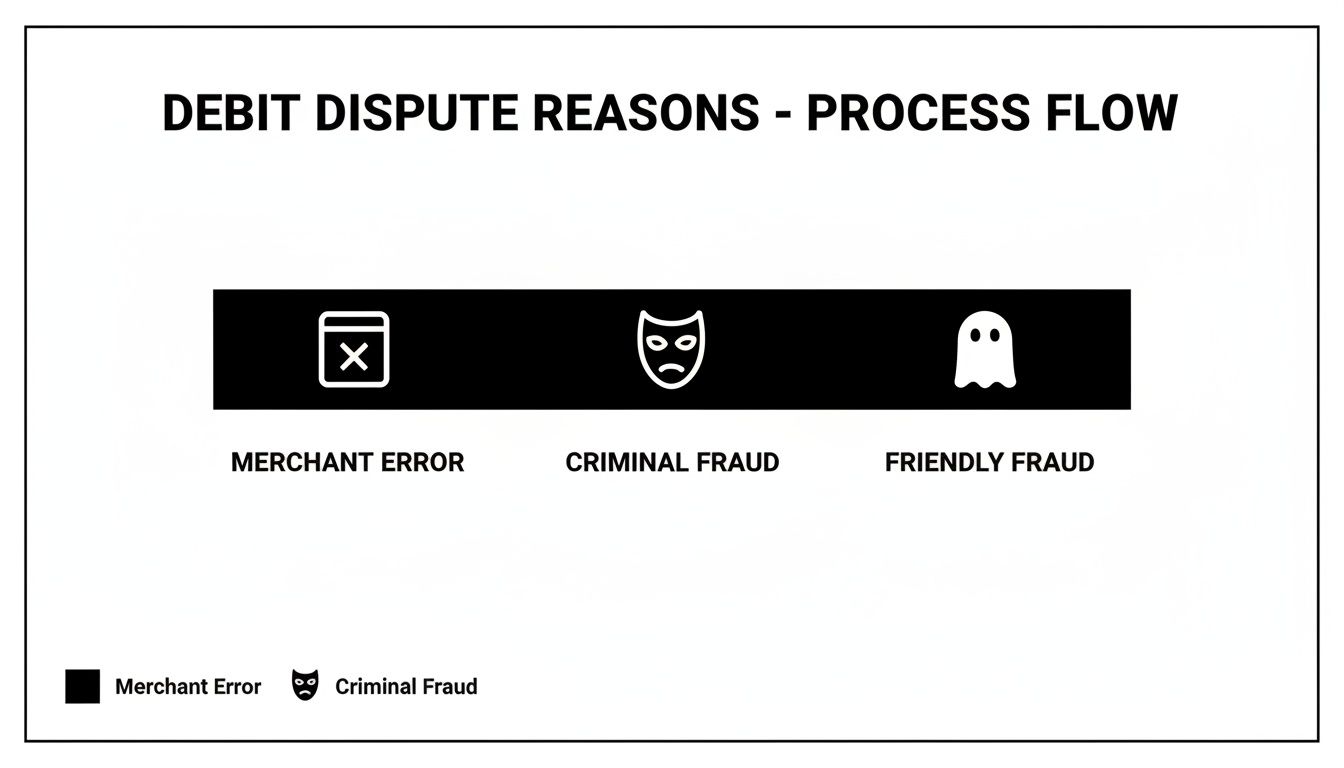
As you can see, while merchant errors and outright criminal fraud happen, that big, murky category of "friendly fraud" is often where you'll spend most of your time gathering evidence.
Step 3: Write a Clear Rebuttal Letter
Your pile of evidence needs a cover story. That’s what a rebuttal letter is: a short, professional summary of your case that guides the bank's investigator through your proof and explains exactly why the dispute should be overturned.
Keep your letter factual, to the point, and easy to skim. This is not the place for emotional pleas or accusations. Just state the facts and clearly reference the evidence you’ve attached to back them up.
Think of your rebuttal letter as the cover sheet for your evidence package. Its only job is to connect the dots for the investigator, linking each document to your core argument: this transaction was valid.
Start by clearly identifying the transaction. Then, tackle the dispute reason code head-on and explain how each piece of your evidence proves the customer's claim is invalid. For a masterclass on this, you can learn more about how to structure a winning chargeback representment letter in our guide.
Step 4: Submit Your Complete Response Package
Once your evidence is organized and your rebuttal letter is polished, it’s go-time. Before you hit send, do one final check to make sure every single required document is there. One missing screenshot could be the difference between winning and losing.
Follow the submission instructions from your payment processor to the letter. Whether you’re uploading documents to a portal or attaching them to an email, make sure everything is formatted correctly and submitted well before the deadline. Once it’s sent, save a copy of the entire submission for your records.
Step 5: Await the Decision
You’ve done your part. Now, the case is in the hands of the customer's bank. An investigator will review the evidence from both sides to make a final call. This part requires patience, as the review can take several weeks, sometimes even a couple of months.
During this waiting period, the disputed funds will stay with the cardholder. If the bank sides with you, the money will be returned to your account. If you lose, the funds stay with the customer, and the case is closed. Knowing how this final stage works helps set realistic expectations from the start.
How to Build a Winning Case with the Right Evidence

When you're fighting a debit card dispute, your evidence isn't just important—it's everything. Think of yourself as a detective building an airtight case. The bank investigator looking at your claim needs clear, undeniable proof that you held up your end of the deal. Your job is to make it impossible for them to say no.
The kind of proof you need changes completely based on why the customer filed the dispute. A claim that a product never arrived requires a totally different set of documents than one for an "unauthorized" transaction. Tailoring your evidence is the secret to a successful representment.
Let’s break down exactly what you need for the most common disputes, turning a stressful scramble for proof into a simple, repeatable process.
For 'Product Not Received' Claims
This one is an e-commerce classic. The customer says they paid, but the package never showed up. The good news? It's often the easiest type of claim to shut down with the right paperwork.
Your knockout punch here is proof of delivery. I don't just mean a tracking number; I mean a tracking number that shows a clear "delivered" status from the carrier, complete with the date, time, and the exact address where it was left.
Here's what your evidence package should include:
- Shipping Confirmation: A screenshot of the delivery confirmation right from the carrier's website (like USPS, FedEx, or UPS).
- Address Match: Proof that the shipping address on the label is the same one the customer entered at checkout.
- Customer Communication: Any emails or messages you sent to the customer with their tracking info.
This trifecta of evidence directly torpedoes the customer's claim. It shows that according to the official shipping carrier, the package made it to its destination.
For 'Not as Described' Claims
These disputes can be a real headache. The customer got the package, but they're claiming what was inside wasn't what they ordered. Maybe it was damaged, the wrong color, or just not what they pictured in their head.
To fight this, you need to prove the product you shipped was a perfect match for the description on your website when they bought it. Your site is the source of truth.
Your goal is to show the bank investigator that you delivered exactly what you promised. Use screenshots of your product page as it appeared when the customer bought the item. This creates a clear picture of what the customer agreed to purchase.
Your evidence checklist should look like this:
- Product Page Screenshots: Grab high-quality images of the product page, showing all the photos, the full description, and any specs.
- Order Details: Include a copy of the customer's invoice or order confirmation, showing they picked that specific item.
- Your Return Policy: Add a screenshot of your return or exchange policy. This proves the customer had a way to solve the problem with you directly before running to their bank.
When you show the product was accurately represented, you build a powerful case that this is just a case of "buyer's remorse," not a legitimate issue with the product.
For 'Friendly Fraud' and 'Unrecognized Transaction' Claims
Welcome to the toughest battleground. In this scenario, a real customer is claiming they never authorized the purchase at all. It's up to you to prove that the actual cardholder made the purchase and knew all about it. This means you have to become a digital detective.
Your best evidence will come from your payment processor and e-commerce platform. You're looking for data that connects the dots between the transaction and the legitimate cardholder.
- AVS and CVV Results: Show that the Address Verification System (AVS) and Card Verification Value (CVV) checks were successful. A match is strong proof the person making the purchase had the physical card in hand.
- IP Address Match: Provide the IP address used for the purchase and show that its location matches the customer's billing address.
- Customer History: Do they have past orders with you? Include proof of previous purchases from the same customer, using the same card, or shipping to the same address.
- Digital Goods Proof: If it was a digital product, provide logs showing the item was downloaded or accessed from the customer's IP address.
Pulling all this digital evidence together can feel complicated, which is why a clear and compelling rebuttal letter is so critical. If you need a hand structuring your argument, check out this helpful example of a rebuttal letter to get you started.
Smart Strategies to Prevent Disputes from Happening
You know the old saying: an ounce of prevention is worth a pound of cure. When it comes to debit card disputes, that couldn’t be more on the money. While knowing how to fight a dispute is critical, the real win is stopping them from happening in the first place. It's about shifting from reactive damage control to proactive prevention—a move that saves you time, protects your revenue, and frankly, builds better relationships with your customers.
A surprising number of disputes start from simple misunderstandings. A customer glances at their bank statement, sees a charge they don't recognize, and their first move is to call the bank. The good news? You have the power to head off a massive chunk of these issues with a few smart, straightforward strategies.
These aren't expensive, complicated fixes. They’re foundational practices that create a clearer, more trustworthy experience for everyone who clicks "buy" on your site.
Make Your Billing Descriptor Unmistakable
One of the fastest ways to trigger a "friendly fraud" dispute is with a vague or confusing billing descriptor. This is the little line of text that shows up next to a transaction on a customer's bank statement. If it says something generic like "WEB PAYMENT SERVICES" instead of your actual brand name, you're practically asking for a dispute.
Your descriptor needs to be instantly recognizable. Use your store's name or whatever name your customers know you by. A clear descriptor like "SNEAKERWORLD" is infinitely better than a generic one from your payment processor. This one simple change can wipe out a huge number of "unrecognized transaction" claims.
Prioritize Top-Notch Customer Service
Think of your customer service team as your first line of defense. When a customer has a problem—a missing package, a damaged item—their first instinct should be to contact you, not their bank. Your job is to make that incredibly easy for them.
- Be Accessible: Plaster your contact info everywhere on your site. A phone number, email address, and maybe even a live chat option should be easy to find.
- Respond Quickly: Acknowledge customer emails and calls as fast as you can. A quick, empathetic response can completely de-escalate a frustrating situation and show the customer you're on their side.
- Offer Clear Solutions: Make sure your return and refund policy is straightforward and fair. When customers know they can get a resolution directly from you, they have zero reason to file a debit card dispute.
Write Crystal-Clear Product Descriptions
"Not as described" disputes are almost always a case of expectations not matching reality. Your product pages are your chance to set those expectations perfectly. Be honest, be thorough.
Use high-quality photos from every possible angle, list all the important dimensions and materials, and write descriptions that are detailed and painfully accurate. The more information you provide upfront, the less room there is for a customer to claim they were misled. If you're looking for more ways to protect your store, you can explore other ecommerce fraud prevention best practices.
The best way to manage a debit card dispute is to create an environment where they rarely occur. Clear communication, transparent policies, and excellent service are your most powerful preventative tools.
And this isn't something you can ignore. The volume of disputes is rising at an alarming rate. Mastercard projects that chargebacks will jump from 238 million in 2023 to 324 million by 2028. That's a 24% surge, fueled by the explosion of digital payments. For e-commerce merchants, this is a serious threat, especially when you consider that up to 40% of cardholders file a dispute just because they don't recognize the billing descriptor.
By putting these strategies into practice, you can tackle the root causes of many disputes head-on. For more in-depth tips, check out our guide on how to prevent chargebacks before they happen.
Automate Your Dispute Management with ChargePay
After walking through the manual process of fighting a debit card dispute, you might be thinking there has to be a better way. And you're right. Manually tracking deadlines, digging for evidence, and writing custom rebuttal letters for every single claim is a massive drain on your time and resources.
This is exactly where automation steps in, transforming a complex, painstaking process into something simple and efficient. Instead of forcing you to become a part-time detective, an automated system can do all the heavy lifting.
How Automation Simplifies Everything
Imagine a system that instantly gets to work the moment a dispute lands. It knows the reason code, figures out precisely what kind of evidence is needed, and starts building your case file for you. That’s what ChargePay does.
Instead of you having to manually pull up screenshots, order details, and tracking numbers, ChargePay automatically gathers the right proof to dismantle the customer's claim. It then uses that evidence to build a professional, compelling representment package designed to win that specific type of dispute.
The big idea is simple: let technology handle the repetitive, detail-obsessed work so you can get back to growing your business. Automation takes the guesswork and human error out of the equation, leading to consistently stronger cases.
A Set-It-and-Forget-It Solution
For merchants on major e-commerce platforms like Shopify, Stripe, and PayPal, the whole process is even smoother. ChargePay integrates seamlessly, making it a true set-it-and-forget-it solution. Once you connect it, the system works quietly in the background, managing your disputes without needing your constant input.
You can find out more about how ChargePay’s product features work and see how it connects directly with your store.
This hands-off approach doesn't just save you a few minutes here and there—it frees up countless hours every single month. More importantly, it delivers results that are incredibly difficult to achieve by hand. By using AI to build the strongest possible case every time, merchants using ChargePay can boost their win rate by up to 3.5x and recover as much as 80% of lost revenue.
It’s all about working smarter, not harder, to protect your bottom line.
Common Questions About Debit Card Disputes
Even once you get the basics down, a few nagging questions always seem to pop up about the debit card dispute process. Let's tackle some of the most common ones we hear from merchants.
Think of this as your quick-reference guide for those "what if" moments. Getting these details straight helps you set realistic expectations and make smarter decisions the next time a dispute notification lands in your inbox.
How Long Does the Dispute Process Usually Take?
You'll need to be patient here. The debit card dispute process is definitely not an overnight thing, and the timeline can vary quite a bit. After you've submitted your side of the story, the customer’s bank generally has between 30 to 90 days to investigate and make a final call.
This window gives the bank enough time to review all the evidence from both sides—yours and the cardholder's. While some cases get wrapped up faster, it’s smart to prepare for the whole ordeal to take a couple of months from start to finish.
Can I Be Penalized Even If I Win a Dispute?
Unfortunately, the answer is yes. Every single dispute filed against you—win or lose—counts toward your chargeback ratio. This is a critical metric payment processors watch like a hawk to gauge how risky your business is. It’s calculated by dividing your monthly disputes by your total transactions.
If that ratio creeps up too high, processors might slap you with higher fees or, in worst-case scenarios, even threaten to shut down your merchant account. It’s a stark reminder that preventing disputes in the first place is always the best strategy. Winning them is just the second-best outcome.
What Is the Difference Between a Dispute and a Refund?
This is a really important distinction for every merchant to understand. A refund is a friendly, direct resolution between you and your customer. They contact you, you agree to return their money, and you process it through your system. It's a normal part of doing business and can even be a sign of great customer service.
A debit card dispute, on the other hand, is a forced, aggressive reversal kicked off through the bank. It completely bypasses you, yanks money directly out of your account, and saddles you with extra fees and a black mark on your record. Always, always encourage customers to contact you first for a refund—it’s a much healthier and cheaper solution for everyone involved.
Tired of manually fighting every debit card dispute? ChargePay uses AI to automate the entire process, from gathering evidence to submitting a winning response. Recover up to 80% of lost revenue and boost your win rate without lifting a finger. Learn more at ChargePay.ai.


.svg)



.svg)


.svg)
.svg)
.svg)