


When a customer files a dispute, they’ve officially gone to their bank to challenge a transaction. That kicks off the chargeback process, which immediately pulls the funds from your account. For Shopify merchants losing money to chargebacks, how you respond determines whether you lose that money for good.
The key is to treat every single dispute not as a lost sale, but as a winnable case. With ChargePay's 92.4% win rate, we know it's possible.
Why Winning Disputes Is Crucial for Your Bottom Line
Another lost chargeback notification hits your inbox. It’s tempting to shrug it off as just another cost of doing business online, but that mindset is a fast track to bleeding profits. Mishandling the dispute process isn't just about one lost sale—it’s a direct and painful hit to your cash flow, your inventory, and your operational sanity.
Each dispute you lose costs far more than the original price tag. You're out the revenue from the sale, the cost of the goods you shipped, and the non-refundable shipping fees. To add insult to injury, your payment processor slaps you with a separate chargeback fee, which can be anywhere from $15 to $100 per incident.
A single $50 chargeback can easily end up costing your business over $100 when you factor in all the associated expenses. And that’s before you even consider the time and effort your team spends trying to manage it.
The Real Financial Damage of a Single Dispute
Let’s break it down with a real example. Imagine you sell a high-end electronic gadget for $400. A customer files a dispute claiming they never received it, even though your tracking information clearly shows it was delivered.
If you fail to fight it or you lose the case, the damage looks like this:
- Lost Revenue: You're out the full $400.
- Lost Product: The gadget is gone, so you lose its wholesale cost (let's say $220).
- Shipping Costs: You can't get back the $20 you spent on shipping.
- Bank Fees: Your payment processor adds a $25 chargeback fee.
In this all-too-common scenario, that one $400 sale has now cost your business $665. Now, multiply that by five or ten disputes a month, and you can see just how quickly it cripples your profit margins.
The Growing Threat of Friendly Fraud
This isn't a problem that's going away; in fact, it's getting worse. A huge chunk of disputes now come from 'friendly fraud,' where a legitimate customer disputes a charge, either out of confusion or, unfortunately, on purpose.
The numbers are staggering. Global chargeback volumes are projected to surge from around 261 million in 2025 to a whopping 324 million by 2028—that's a 24% increase. For U.S. merchants, it's particularly brutal—they lose an estimated $4.61 for every $1 in chargebacks. You can find more insights on this trend in the Sift Q4 2025 disputes report.
At ChargePay, we've handled over 100,000 disputes and recovered more than $2.8 million for Shopify merchants. We know from experience that a reactive, disorganized approach to fighting chargebacks is a failing strategy. You need a methodical, evidence-based system to protect your hard-earned revenue.
The True Cost of a Single Chargeback
Here's a breakdown of the hidden costs you face for every dispute, showing why the total loss is much bigger than the original sale.
As you can see, the financial fallout goes far beyond the initial transaction. Every lost dispute chips away at your profitability and operational efficiency.
Your Playbook for Responding to a Dispute
When that dispute notification lands in your inbox, it feels like an alarm bell. The clock starts ticking immediately, and how you respond in the next few days determines whether you keep your money or take a loss. Responding to a dispute isn't about firing off a quick email; it's about building a methodical, evidence-backed case to get your money back.
Your first move should always be to analyze the dispute reason code. This code, provided by the customer's bank, tells you exactly why the charge is being challenged. It could be anything from "Merchandise Not Received" to "Fraudulent Transaction." Understanding this code is non-negotiable—it dictates the specific evidence you need to gather.
A single lost dispute hurts more than just the initial sale. The costs cascade quickly.
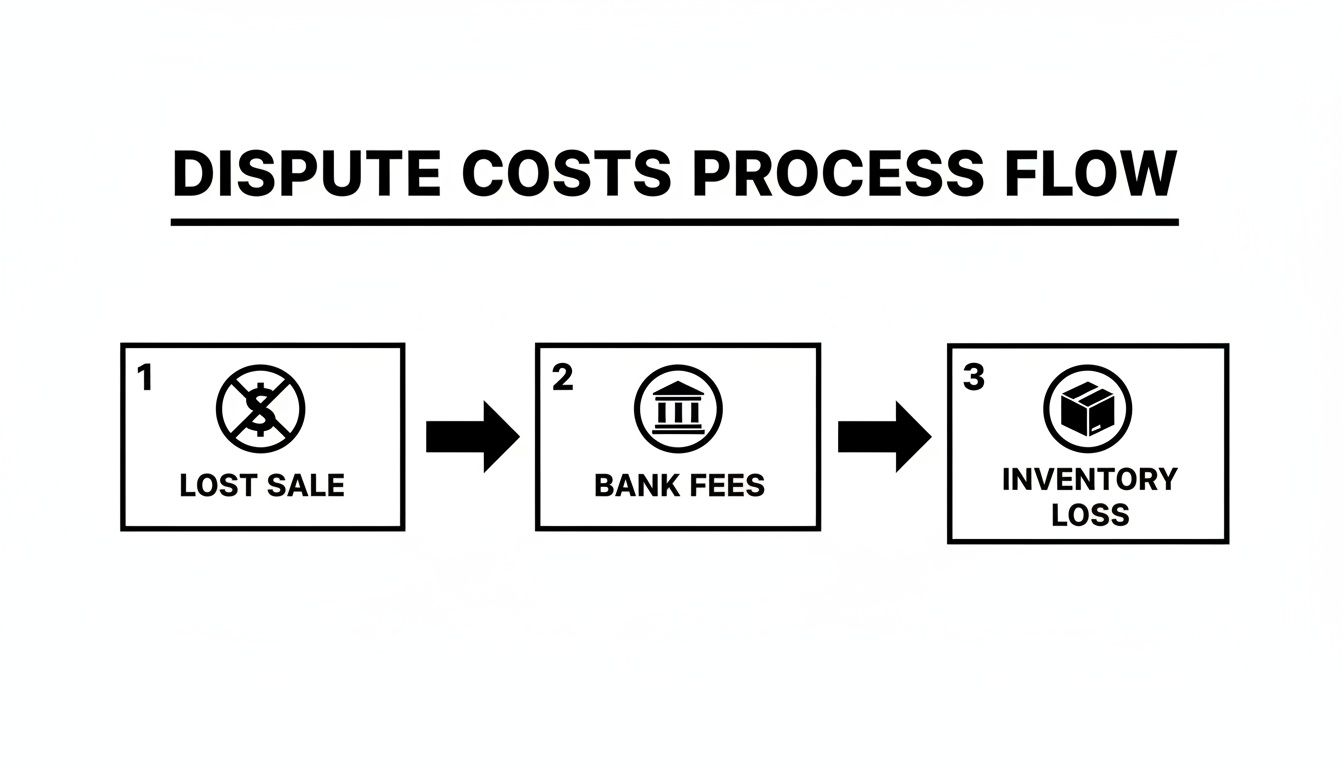
As you can see, a lost dispute triggers a chain reaction of financial losses, from the sale itself to bank fees and the cost of your inventory. It adds up fast.
Matching Evidence to the Dispute Reason
Once you know the why, you can focus on the what. Each reason code requires a different set of compelling evidence. Generic responses get ignored; specific, targeted proof is what wins cases.
For example, let's say a customer files a dispute with the reason code for "Item Not Received." Your evidence package must prove two things: that you shipped the item and that it was delivered to the correct address.
Your response needs to include things like:
- A clear copy of the shipping confirmation email you sent the customer.
- The tracking number from a reputable carrier (like UPS or FedEx) showing the full delivery address and a "Delivered" status.
- A delivery confirmation photo, if available, which is now a standard for many carriers.
On the other hand, for a "Not as Described" claim, your evidence has to prove the customer knew exactly what they were buying. This means providing a screenshot of the product page as it appeared when they purchased, highlighting the product photos, description, and specifications.
At ChargePay, we've handled over 100,000 disputes for Shopify merchants. We see firsthand that a response with detailed, relevant evidence has a 92.4% chance of winning, while a generic one almost always fails.
Crafting a Professional Response Letter
Your evidence needs a cover letter—a professional, concise summary of your case. This isn't the place for emotion or frustration. Just stick to the facts and guide the bank reviewer through your evidence.
Start with a clear introduction that includes the order number, transaction date, and amount. Then, state the dispute reason and directly counter it. For instance, "The customer filed a dispute for 'Item Not Received.' However, as the attached evidence shows, the order was successfully delivered to the customer's verified address on [Date]."
Use a bulleted list to itemize the evidence you've included. This makes it super easy for the reviewer to follow along.
- Exhibit A: Order confirmation email with customer details.
- Exhibit B: Screenshot of the tracking information showing "Delivered" status.
- Exhibit C: Photo of the package at the customer's doorstep.
Conclude with a firm but polite closing statement, like, "Based on the compelling evidence provided, we request that this dispute be closed in our favor and the funds returned to our account." This direct, organized approach leaves no room for doubt and significantly improves your odds.
For more specific examples, you can learn how to win a credit card dispute in our detailed guide. Following this methodical process can turn a stressful situation into a manageable task you can master.
How to Build an Airtight Evidence Package
Winning a dispute isn't about luck. It's about burying the cardholder's bank in so much irrefutable proof that they have no other choice but to side with you. A weak or incomplete evidence package is basically an invitation for an automatic loss.
We're moving beyond just a tracking number. It's time to build a strategic defense using the data you already have sitting in your Shopify store.
When you're pulling together your dispute response, you need to think like an investigator. Your job is to paint a complete picture of the transaction that leaves zero room for doubt. This means connecting all the dots between the person who placed the order and the person who received it.

Go Beyond Basic Proof of Delivery
A simple "delivered" status from the shipping carrier just doesn't cut it anymore, especially with friendly fraud skyrocketing. You have to dig deeper into the transactional data that platforms like Shopify provide to prove the order was legit.
Your evidence package needs to tell a story, and every piece of data is a character in it. For instance, let's say a customer claims a $500 order was fraudulent. A powerful response would include pieces like:
- AVS and CVV Match Results: Show that the billing address and the three-digit security code entered actually match the cardholder's records.
- IP Geolocation Data: Drop in a screenshot showing the customer's IP address at the time of purchase matches their shipping city. It's a small detail that packs a big punch.
- Customer Communication: Provide transcripts of any emails, live chats, or social media DMs you've had with the customer.
This extra layer of data makes it so much harder for a bank to side with a cardholder who's just trying to get something for free. And to make sure your proof holds up, it's critical to ensure data integrity across all your records.
The Essential Evidence Checklist
Never submit a response without running a final check. Forgetting one piece of evidence can be the difference between winning back your money and losing it for good.
The average chargeback costs merchants a staggering $190 per incident when you factor in lost revenue, fees, and operational costs. With some reports showing that 45% of all chargebacks are fraudulent, meticulous evidence gathering is the best investment you can make.
A winning response does more than just state your case—it proves it. At ChargePay, we've helped Shopify merchants recover over $2.8 million by automatically assembling evidence packages that banks find compelling. Our AI pulls all the relevant data points instantly, so nothing gets missed.
Before you hit "submit" on your next dispute response, make sure you have these things locked and loaded:
- Order and Transaction Details: A clean record of the purchase date, amount, and items.
- Customer Information: The name, email, and shipping address they gave you at checkout.
- Proof of Delivery: Tracking number with confirmed delivery status and a clear address match.
- Digital Footprints: The IP address, AVS/CVV match status, and browser/device info.
- Product Validation: Screenshots of the product page to fight back against those "Not as Described" claims.
- Your Rebuttal Letter: A concise letter that quickly summarizes your evidence and tells the bank exactly why you should win.
Building a strong evidence package is a critical skill, but let's be real—it's also incredibly time-consuming. This is where AI-driven dispute management becomes a game-changer for busy Shopify store owners.
Navigating the Dispute Submission Process
Once you have all your evidence pulled together, the next big hurdle is figuring out exactly where and how to submit it. This is where a lot of merchants trip up. Every platform has its own workflow, and fumbling the submission is a surefire way to blow a deadline and kiss your revenue goodbye.
Let’s cut through the confusion and walk through the process for the platforms you use every day.
Submitting Your Evidence on Different Platforms
If you're a Shopify merchant, the process is streamlined. Shopify keeps everything centralized right inside your admin dashboard. The moment a chargeback hits, you'll see a notification on your home screen and in your "Orders" section.
When you click on the disputed order, Shopify takes you to a dedicated page just for that chargeback response. This is your command center for uploading all the evidence you’ve collected, from tracking numbers to screenshots of customer emails.
The interface is simple enough, with clear fields for your rebuttal letter and any supporting documents. But don't let the simplicity fool you; the clock is ticking. Card networks like Visa and Mastercard usually give you a 30 to 45-day window to respond, but Shopify's internal deadline is often much shorter to ensure everything gets processed on time.
While Shopify keeps things neatly in one place, other platforms like PayPal take a different approach. PayPal has its own "Resolution Center," a completely separate portal for all dispute-related matters.
Here are the main differences you’ll need to watch out for:
- PayPal’s Resolution Center: Unlike Shopify’s integrated system, you have to log into your PayPal account and navigate to the Resolution Center to manage anything. All your documents and your response get submitted there, not through your e-commerce store.
- Card Network Deadlines: No matter where the dispute comes from—Shopify Payments, PayPal, or another gateway—the final deadlines are always set by the card networks (Visa, Mastercard, Amex, etc.). These are hard stops. Miss one, and you automatically lose the dispute.
Juggling these different submission portals and tight deadlines is exactly where most merchants lose money. At ChargePay, we’ve fought over 100,000 disputes for Shopify stores, recovering more than $2.8 million. Our AI plugs directly into Shopify to manage the entire submission for you, guaranteeing the right evidence gets to the right place on time, every single time.
Why Timing Is Everything
You absolutely have to respect the deadlines set by the card networks. For example, once you submit your evidence, the customer's bank (the issuing bank) has up to 60 days to review it. If they still side with the customer, you might get a chance to fight again in a stage called pre-arbitration, but that comes with its own set of even tighter timelines.
The entire card dispute process is built around these strict schedules. Your first and most important job is to file your response correctly and well before the deadline. If you mess this up, you've lost before you even get a chance to state your case. For busy store owners, this is where automation becomes a lifesaver, ensuring no deadline ever slips through the cracks.
Stop Losing Revenue and Let Automation Fight Your Disputes
What if you could win over 92.4% of your disputes without lifting a finger? That’s not a hypothetical; it’s what ChargePay is already doing for Shopify merchants every single day.
When you fight a dispute manually, the odds are stacked against you. Merchants, on average, only win about 20% of their dispute cases. Meanwhile, the issuing banks are winning 75% of the time. That massive gap helps explain a painful statistic from a recent Mastercard report: a staggering 46% of chargebacks are just accepted as a loss by merchants, usually because they don't have the time or the right evidence to fight back.
It's time to stop being part of that losing statistic and flip the script with smart AI automation.

How Our AI Instantly Builds a Winning Case for You
The second a dispute hits your Shopify store, our AI gets to work. It’s not just about filling out a form—it’s about building an airtight case. Our system immediately analyzes the dispute reason code, then dives deep into your store’s data to pull every critical piece of evidence.
We’ve seen it all, having handled over 100,000 disputes and recovered more than $2.8 million for Shopify merchants just like you. We know exactly what evidence makes a bank take notice, and our AI assembles it automatically. This isn't just basic order info; we're talking about the data that wins cases:
- Crucial Transactional Data: We pull the AVS/CVV match results and IP address geolocation to prove the cardholder was present.
- Solid Shipping Evidence: We grab tracking numbers and delivery confirmation details to show the product arrived safely.
- Customer Order History: We look for past orders from the same customer to spot patterns and challenge friendly fraud.
This entire evidence package gets compiled and submitted on your behalf, well before any deadlines loom. If you want to see how this kind of efficiency can transform a business, check out these powerful workflow automation examples.
A Zero-Risk Way to Protect Your Bottom Line
We had a Shopify store selling high-end electronics that was getting hammered by friendly fraud, losing thousands every month. After installing ChargePay, they slashed their chargeback losses by 85% in just three months.
The best part? You only pay when we win. It’s a completely risk-free way to shield your revenue from bogus claims.
With a 4.9-star rating on the Shopify App Store and a prestigious ‘Built for Shopify’ badge, you can trust our tech to take up the fight for you. It's time to stop manually filing disputes you're likely to lose and start automatically winning them back.
Common Questions About Filing a Dispute
Let's be honest, navigating chargebacks can feel like a maze. But getting clear answers to the most common questions is the first step toward responding with confidence. Here are the straightforward answers to the questions we hear most often from merchants who are tired of losing money to disputes.
How Long Do I Have to Respond to a Shopify Chargeback?
You have a very short window, and it's not forgiving. Typically, you're looking at between 7 and 21 days, depending on the card network (like Visa or Mastercard). The exact deadline is always listed right in your Shopify admin under the chargeback details.
Miss this deadline, and it's an automatic loss. No appeals, no second chances. This is exactly why automated systems are a game-changer—they ensure you never miss a critical deadline and hand over your revenue without a fight.
What Is the Most Important Piece of Evidence to Include?
There’s no single "magic bullet" piece of evidence. It's all about matching your proof to the specific claim being made. Think of it like a legal case—you need the right evidence for the right argument.
- For 'Product Not Received' Claims: Your absolute must-have is solid proof of delivery to the correct address. This means a tracking number clearly showing a 'Delivered' status and a screenshot of the shipping confirmation that matches the customer's order address perfectly.
- For 'Product Not as Described' Claims: Clear screenshots of your product page are your strongest defense. I'm talking about the page as it looked when the customer made the purchase. Include high-quality images and detailed descriptions that prove the customer knew exactly what they were buying.
Can I Do Anything to Prevent Disputes?
Yes, and this is where you can save yourself a ton of headaches. Proactive prevention is always your best strategy. You can cut down your dispute rate significantly by focusing on a few key areas.
Start with crystal-clear product descriptions and photos to manage customer expectations from the get-go. Offer excellent, easy-to-find customer service so shoppers come to you with problems, not their bank. On top of that, use Shopify’s built-in fraud prevention tools to check for AVS and CVV mismatches. This can help you flag sketchy orders before they even get processed.
For a deeper dive into common concerns, you can explore more answers in our comprehensive FAQs for merchants.
What Happens If I Lose a Dispute?
When you lose, it's a double whammy. The disputed funds are returned to the cardholder, and you also get hit with a non-refundable chargeback fee from the bank. That decision is final.
But the pain doesn't stop there. Consistently losing disputes damages your merchant account health. This can lead to higher processing fees down the road or, in worst-case scenarios, even account termination. It’s why working with a service that has a proven track record is so critical. Our 92.4% win rate at ChargePay dramatically shifts these odds back in your favor, protecting both your revenue and your business reputation.
Stop letting manual errors and missed deadlines drain your profits. ChargePay uses AI to automatically fight and win your disputes, recovering revenue you thought was lost for good. With a 4.9-star rating and a "Built for Shopify" badge, we're the trusted solution for thousands of merchants. You only pay when we win.
Install ChargePay from the Shopify App Store and turn your chargeback problem into a solved one.


.svg)



.svg)


.svg)
.svg)
.svg)