


You’re checking your Shopify dashboard, feeling good about recent sales, and then you see it: a stack of chargebacks piling up. This is the new reality for countless e-commerce merchants. Financial transaction card fraud is a real threat, and it’s quietly eating away at your hard-earned revenue.
The True Cost of Card Fraud to Your Shopify Store

For Shopify store owners, card fraud isn't just an abstract concept; it’s a direct hit to your bottom line. It's that sinking feeling when a sale you thought was legitimate gets reversed, leaving you without your product and without the payment. This isn’t a small cost of doing business—it's a massive and growing drain on your resources.
The scale of this problem is staggering. Global online payment fraud losses shot up to $41 billion in 2022, more than double what it was just two years earlier. If we zero in on just card fraud—that's both credit and debit card scams—the number hit $33.83 billion worldwide in 2023. That's a 19% jump since 2020, and it shows no signs of slowing down.
From Global Problem to Your Store's Bottom Line
What do these huge numbers actually mean for your Shopify store? The Merchant Risk Council figures that e-commerce businesses lose an average of 3.2% of their annual revenue to fraud.
Think about it this way: for every $100 in sales, you could be kissing $3.20 goodbye, right into the hands of a fraudster. For a store pulling in $500,000 in annual sales, that's a $16,000 loss straight from your profit margin.
And that calculation doesn't even touch on the hidden costs. Beyond losing the money from the sale itself, you're also stuck with non-refundable transaction fees and, worst of all, chargeback fees. These penalties stack up fast, turning a single fraudulent order into a financial headache with multiple layers. If you want to get a better handle on these costs, check out our deep dive on chargeback fees and what they mean for merchants.
Why This Is More Than Just a Numbers Game
Losing money to card fraud is one thing. But the manual work it takes to fight it? That’s even more draining. You're forced to spend hours digging through order details, tracking down shipping confirmations, and writing rebuttal letters—all while you're trying to actually run and grow your business. It's a time-sucking battle that most merchants feel like they're set up to lose.
But what if you could flip the script?
At ChargePay, we've helped over 100,000 merchants fight back, recovering more than $2.8 million that would have otherwise vanished. We do this by automating the entire dispute process with AI, hitting a 92.4% win rate without you having to lift a finger.
This guide will break down how financial transaction card fraud works and, more importantly, how you can stop it from draining your profits.
Decoding the Common Fraud Schemes Targeting Your Store
To protect your store from financial transaction card fraud, you first have to understand the enemy. Fraudsters are constantly cooking up new tactics, from simple scams to complex schemes, each designed to poke holes in your e-commerce process. Once you can recognize their patterns, you can start building a much smarter defense.
It's a battle that gets more intense every day. The latest data shows a scary trend: consumer fraud losses skyrocketed 25% year-over-year to a staggering $12.5 billion in 2024, with a huge chunk of that hitting card transactions. As a Shopify store owner watching sales roll in, this fraud tsunami is a silent killer for your bottom line. To get ahead of it, you need to know what you’re really up against. You can dive deeper into this trend in Alloy's 2026 State of Fraud Report.
Let's break down the main types of fraud you’ll run into as a merchant.
Common Types of Card Fraud Explained
Here’s a quick overview of the top fraud schemes, what they actually look like, and how they can hurt your Shopify store.
Now that you have the big picture, let's explore what makes each of these fraud types so uniquely damaging for your business.
Classic Criminal Fraud
This is the most straightforward type of financial transaction card fraud. It’s what happens when a criminal gets their hands on stolen credit card details and uses them to make unauthorized purchases from your store.
These stolen details usually come from a few places:
- Data Breaches: Hackers steal massive lists of card numbers from other companies.
- Phishing: Fraudsters trick people into giving up their card information through fake emails or websites.
- Skimming: Physical devices are used to copy card data from ATMs or gas pumps.
For you, the merchant, this means you ship out a product that was paid for with a stolen card. Once the legitimate cardholder reports the fraud, you're hit with a chargeback. You lose the product, the revenue, and get a fee for your troubles.
Account Takeover Fraud (ATO)
Account takeover is a much more sophisticated attack. Instead of just stealing a credit card number, a fraudster gains full control over a legitimate customer's account on your Shopify store.
From there, they might change the shipping address, use the saved payment information, and place orders that look completely normal at first glance.
ATO is especially dangerous because it damages the trust you've built with your most loyal customers.
An order from a long-time customer with a sudden, unexplained change in shipping address—especially to a different state or country—is a major red flag for account takeover.
Friendly Fraud
This is maybe the most frustrating type of fraud for merchants. Friendly fraud happens when a legitimate customer makes a purchase but then disputes the charge with their bank, claiming it was fraudulent or that the product never arrived.
They essentially get to keep your product for free.
The transaction was real, the delivery was successful, but the customer is abusing the chargeback system to get a refund. This is a huge problem in the Card-Not-Present (CNP) world of online shopping. You can learn more about the unique challenges of CNP transactions in our guide to Card-Not-Present fraud.
Understanding these three fraud types is the first step toward protecting your business. Whether it's a clear-cut criminal attack or a tricky case of friendly fraud, recognizing the signs early is your best defense. This is precisely where ChargePay’s AI excels, helping you identify and fight all types of fraud-related chargebacks automatically.
The Modern Fraudster’s AI-Powered Playbook

The days of a fraudster simply swiping a credit card number and calling it a day are long gone. Today’s fraudsters are tech-savvy operators, running complex schemes designed to sidestep the basic security you have in place. They’ve got a modern playbook, and they use it to bleed your revenue.
This new breed of financial transaction card fraud is more organized, more automated, and a whole lot harder to spot. Scammers aren't just lone wolves anymore. They're often part of sophisticated groups, sharing tactics and using automation to launch attacks at a massive scale. For your Shopify store, this means the threat isn't just a single stolen card; it's a coordinated campaign that can hit you from all sides at once.
Synthetic Identity Fraud: The Ghost in the Machine
One of the most unnerving tactics in the modern fraud arsenal is synthetic identity fraud. This isn't just about stealing someone's identity. It's about building a brand new, completely fake person from scratch. Fraudsters will take a piece of real, stolen information (like a valid Social Security number) and combine it with a mountain of fabricated details—a fake name, a made-up address, you name it.
This new "synthetic" person looks just legitimate enough to slip through initial credit checks and open new accounts. For a Shopify merchant, this is a nightmare scenario. A fraudster can place an order that looks like it's coming from a real person with a decent credit history. It's almost impossible to flag as fraudulent until it's far too late, and the inevitable chargeback lands in your lap.
A synthetic identity is like a ghost customer. It has just enough real data to appear solid but is designed to vanish without a trace after the fraud is committed, leaving you to deal with the loss.
This method has become a cornerstone of the modern fraud playbook because it turns the very systems meant to verify identities into a weapon against your business.
The Rise of AI-Powered Attacks
It gets worse. Fraudsters are now using AI to make their schemes even more powerful and scalable. They can automate the creation of thousands of synthetic identities, launch massive bot attacks, and even whip up convincing fake storefronts in minutes. Understanding how they use these automated tools is key to grasping the real depth of the threat.
Here are just a few ways AI is being weaponized against merchants:
- Fake Storefronts: Scammers use AI to quickly spin up professional-looking e-commerce sites that are perfect clones of legitimate Shopify stores. They then run slick social media ads to draw in real customers, snatch their payment information, and vanish, damaging your brand’s reputation in the process.
- Deepfake Verification: An emerging threat is the use of deepfake technology. This can be used to fool even advanced security systems by creating fake videos or photos to bypass identity verification checks.
- Advanced Courier Scams: These scams are a scary blend of the digital and physical worlds. A fraudster might physically steal a card and PIN, then use deepfake voice calls to convince a victim—or even a bank representative—that everything is on the up-and-up.
The data paints an alarming picture. Projections show that by 2026, fake online stores will explode, using AI-generated designs and social media ads to trick customers before disappearing. And this is happening while global fraud at the point of interaction is already surging. Research from Visa drives this home, revealing that 80% of merchants struggle to improve their AI and machine learning fraud tools. You can dig into this growing problem and learn about the latest fraud report findings from Visa.
This is exactly why having a powerful AI on your side is no longer a luxury; it’s a necessity. ChargePay was built to fight these exact threats. Our AI digs through thousands of data points to spot and fight the kind of sophisticated fraud that basic filters miss. We’ve successfully handled over 100,000 disputes and recovered more than $2.8 million for merchants like you by fighting fire with fire. To see how it works, check out our post on how AI technology helps catch chargeback fraud.
Proactive Prevention Strategies You Can Implement Today
Knowing the threats is one thing; actively stopping them is another. To shield your Shopify store from financial transaction card fraud, you need a defense that’s more than just skin deep. It’s time to move beyond the basic Address Verification System (AVS) and CVV checks and put some powerful, practical tactics to work—stopping fraudsters before they can ever cause a chargeback.
These strategies are your first line of defense. They empower you to secure your store and protect your hard-earned revenue. By building a smarter security perimeter, you can dramatically cut down on the number of fraudulent orders that slip through the cracks.
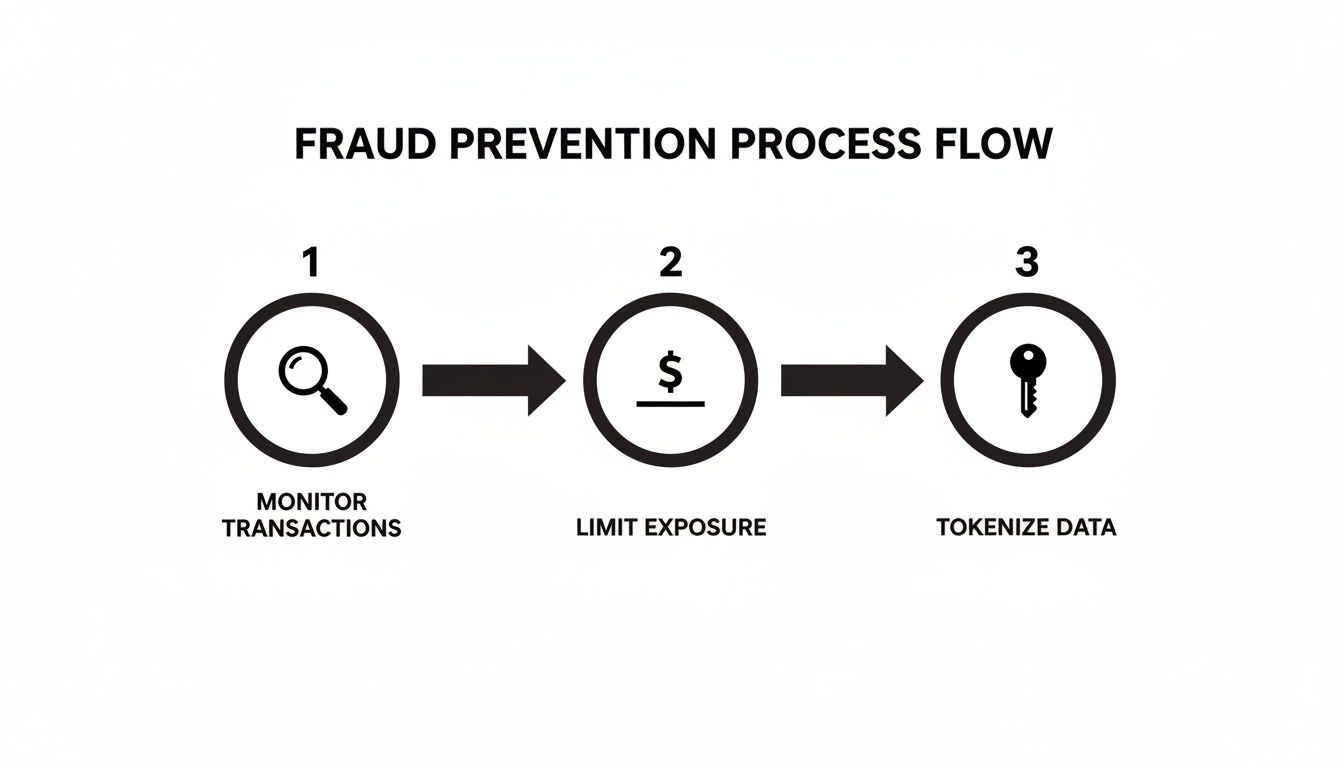
Fortify Your Transaction Monitoring
Effective fraud prevention really starts with paying close attention to transaction patterns. If you know what to look for, you’ll see that fraudsters often have predictable behaviors you can spot. Instead of just reacting to fraud alerts, you can get ahead of the game by proactively monitoring for suspicious activity.
Here are a few key signals to keep an eye on:
- Transaction Velocity: A single customer or IP address suddenly placing a huge number of orders in a short time is a massive red flag. Real customers just don't buy like that. You can set limits on how many transactions can be attempted from one source within a specific timeframe.
- Order Value Limits: Fraudsters often test stolen cards with small purchases to see if they work before going for the big-ticket items. Figure out your store's average order value and set a sensible maximum. Any order that blows past this limit should get a manual review.
- Geolocation Data: This one is huge. Compare the customer's IP address location to their billing and shipping addresses. A customer in Germany using a card with a U.S. billing address to ship to a third country? That’s highly suspicious and definitely warrants a closer look.
By keeping a close watch on these variables, you can catch a significant amount of fraud before the transaction is even finalized.
Implement Stronger Authentication and Data Security
While monitoring helps you spot fraud in action, stronger underlying security can stop it from happening in the first place. Two of the most powerful tools you have for this are advanced authentication methods and payment tokenization.
Payment tokenization swaps your customer’s sensitive card data for a unique, non-sensitive "token." This token can only be used for that specific transaction, making the original card details completely useless to thieves if they’re ever stolen.
Implementing robust measures like following the standards laid out in PCI Compliance in Australia is a fundamental step in securing your customers' card data and cutting down on fraud risks. These standards give you a clear framework for handling payment information safely.
Another powerful tool is 3-D Secure. It adds an extra layer of verification at checkout, asking customers to enter a password or a one-time code sent to their phone to approve the purchase. This makes it much, much harder for criminals to use stolen card details. To get a better sense of how it all works, check out our guide on 3-D Secure authentication. Sure, it can add a little bit of friction to the checkout process, but the reduction in fraudulent chargebacks often makes it more than worth it.
But let's be realistic—even with the best defenses, a few fraudulent orders will inevitably get through. That’s where an automated chargeback management system becomes your safety net, making sure that when fraud does happen, you can recover your money without lifting a finger.
How to Fight Chargebacks and Actually Win
If you’re a Shopify merchant, you’ve probably felt that sinking feeling when a chargeback notification pops up. It’s easy to feel like the whole process is stacked against you, and fighting back feels like a waste of time. Many store owners just write them off as a cost of doing business.
But that’s a myth—and a very expensive one. You can and absolutely should fight to get your revenue back.
The formal process for challenging a chargeback is called representment. This is your one shot to prove to the customer’s bank that the transaction was legitimate and the charge should stand. Winning takes more than just saying, "the customer is wrong." You need to build a rock-solid case with compelling evidence that leaves no room for doubt.
When a sneaky fraudulent order slips through your prevention efforts, a strong representment strategy is the crucial safety net that catches your lost revenue.
The Old Game Plan: The Manual Way
Decided to handle representment yourself? Get ready, because the burden of proof is all on you. It means digging through records, hunting down every scrap of relevant data, and piecing it all together into a rebuttal letter.
Here’s a quick look at the evidence you’ll need to track down:
- Proof of Delivery: This is non-negotiable. You need a shipping confirmation with a tracking number that clearly shows the package was delivered to the customer’s address.
- Customer Communications: Pull up any emails, live chat logs, or support tickets where the customer talks about their order or product.
- Order Details: Grab screenshots from your Shopify dashboard showing the customer’s info, including the billing and shipping addresses.
- AVS and CVV Match: You'll need proof that the Address Verification System (AVS) and card security code (CVV) checks came back as a match.
After you’ve gathered everything, you have to write a clear rebuttal letter that walks the bank through all your evidence. This whole process can easily eat up hours for just one dispute, with no guarantee you’ll even win.
The Smarter Game Plan: The Automated AI Approach
Now, imagine doing all of that—the digging, the compiling, the writing—in just a few seconds, without you lifting a finger. That’s the power of an AI-powered solution. Instead of you hunting for screenshots and stressing over rebuttal letters, the AI does all the heavy lifting for you.
This is exactly why we built ChargePay. We created it for busy Shopify merchants who don't have time to become part-time chargeback experts. The moment a dispute hits your store, our AI gets to work.
Our AI instantly analyzes the transaction, gathers all the evidence from your Shopify store and shipping carriers, and crafts a powerful, customized rebuttal letter. The complete evidence package is then submitted for you, well before any deadlines.
This automated approach is how ChargePay hits a 92.4% win rate for our merchants. We’ve successfully managed over 100,000 disputes, recovering more than $2.8 million in revenue that would have otherwise been lost forever.
Take a look at how the two approaches stack up.
Manual vs. AI-Powered Chargeback Representment
The difference is pretty stark. One path involves a lot of manual labor with a low chance of success, while the other offers a hands-off, highly effective solution.
Fighting chargebacks isn't just about winning a single dispute here and there. It’s about having a reliable system that protects your revenue consistently. While you focus on what you do best—making sales and growing your brand—our AI works 24/7 in the background to make sure you keep the money you earn.
Ready to stop leaving money on the table? Install ChargePay from the Shopify App Store. Our "Built for Shopify" badge and 4.9-star rating show you're in good hands.
Put Your Chargeback Defense on Autopilot with ChargePay
You’ve learned the tactics fraudsters use and the proactive steps to guard your store. But what about when a sneaky transaction slips past your defenses and turns into a costly chargeback?
This is where you stop playing defense and start taking back control. Instead of losing hours fighting an uphill battle, you can automate your disputes and get your money back.
We built ChargePay specifically for Shopify merchants like you. Our AI platform takes the entire dispute process off your plate, turning a manual, time-consuming headache into a solved problem. We’ve already handled over 100,000 disputes and recovered more than $2.8 million for our merchants.
How ChargePay Fights for Your Revenue
When a chargeback hits, you don’t have to lift a finger. Our AI gets to work instantly.
- Instant Analysis: The AI looks at the disputed transaction and cross-references thousands of data points to get the full story.
- Automated Evidence Gathering: It pulls all the necessary proof—shipping confirmations, delivery details, customer data, and AVS/CVV results—directly from your Shopify store and shipping carriers.
- Winning Responses: Our system then crafts a custom, compelling rebuttal letter designed for the specific chargeback reason code and submits the complete evidence package for you.
This isn't some generic template. It’s a precise, evidence-backed response built to win. It's how we've achieved our 92.4% win rate.
The best part? ChargePay is entirely risk-free. We operate on a 'pay-per-win' model, so you only pay a small percentage of the money we recover for you. If we don’t win the dispute, you don’t pay a dime.
Built for Shopify and Trusted by Merchants
We get the unique challenges of running a Shopify store, which is why we’ve earned the official ‘Built for Shopify’ badge. This seal means our app meets Shopify's highest standards for performance, security, and user experience.
With a 4.9-star rating from thousands of merchants in fashion, electronics, supplements, and more, we're a partner you can count on. You can learn more about our product features to see exactly how ChargePay integrates with your store.
It’s time to stop writing off financial transaction card fraud as a cost of doing business. Let our AI fight your chargebacks and recover the revenue you rightfully earned.
Install ChargePay from the Shopify App Store today and start protecting your profits.
Your Financial Transaction Card Fraud Questions Answered
We’ve covered a lot of ground on the threats and strategies around financial transaction card fraud. But you probably still have some questions. Let's tackle some of the most common concerns we hear from Shopify merchants head-on. Our goal is to give you practical, direct answers so you can feel confident protecting your business.
Will Fighting Chargebacks Hurt My Relationship with Customers?
This is a big one, and it's a valid concern. The short answer is no—not when you handle it the right way.
Fighting a clearly fraudulent chargeback is just good business sense. It has zero impact on your legitimate, happy customers. For those tricky "friendly fraud" cases where a customer might be confused or forgetful, a professional, evidence-based dispute can actually clear things up.
This is where ChargePay shines. We present a clear, non-aggressive case directly to the bank. We stick to the facts, not blame, which protects your brand’s reputation while getting your money back. It simply shows you run a serious, buttoned-up operation.
Can I Really Afford to Fight Every Chargeback?
If you were doing it all by hand, fighting every single chargeback would be a massive time sink. But with ChargePay, the economics completely flip.
We built our service on a strict 'pay-per-win' model. That means you only pay us a percentage of the money we successfully recover for you.
If we don't win the dispute, you don’t pay us a single cent. This makes it not just affordable but highly profitable to fight every fraudulent chargeback. You're recovering revenue that you would have otherwise written off as a complete loss.
My Store Uses Shopify Payments. Do I Still Need a Separate Fraud Tool?
Yes, absolutely. Think of it this way: while Shopify Payments provides a solid first line of defense with its built-in fraud analysis, it’s a general-purpose tool. Plenty of fraudulent transactions still slip through the cracks.
More importantly, Shopify’s native tools do not automatically fight and win chargebacks for you. That's a whole separate battle.
ChargePay is a specialist, a chargeback recovery system that slots in perfectly alongside Shopify’s features. We’ve recovered over $2.8 million for merchants just like you, proving our value goes way beyond standard platform tools by automating the entire recovery process from start to finish.
How Long Does It Take to Get Started with ChargePay?
You can be up and running in minutes. We designed the setup to be incredibly fast and simple because we know you’re busy running a business.
Just install the ChargePay app from the Shopify App Store, connect your account with a few quick clicks, and our AI gets to work immediately. There's no complicated configuration or manual setup needed. You can get right back to growing your business while we start protecting your revenue in the background.
Stop letting financial transaction card fraud and chargebacks bleed your profits dry. ChargePay has helped over 100,000 Shopify merchants recover their money with a 92.4% win rate. It's time to put your revenue defense on autopilot.


.svg)



.svg)


.svg)
.svg)
.svg)