

Every online sale feels like a victory, but lurking behind each one is a risk that can silently chip away at your profits. At its core, a fraud prevention solution is like a high-tech security guard for your e-commerce store, analyzing every transaction in real-time to spot and stop bad orders before they do any damage.
Why Fraud Prevention Is a Must-Have for Online Stores

Think about a brick-and-mortar shop for a second. You’d never dream of leaving the front door unlocked overnight. Yet, so many online merchants operate without a digital security system, leaving them wide open to threats far more complex than a simple shoplifter.
For an online store, these threats can be anything from straightforward scams using stolen credit card numbers to more sneaky schemes like "friendly fraud"—where a real customer buys something, then falsely claims they never got it. It's a massive problem; a recent survey revealed that 65% of organizations have been hit by payment fraud.
The True Cost of Ignoring Fraud
When a fraudulent transaction slips through, you lose a lot more than just the product. You're also out the shipping fees, slapped with painful chargeback penalties from your payment processor, and you risk serious damage to your store's reputation. Those costs pile up fast, turning what should have been a profitable month into a loss.
Effective fraud prevention isn't a luxury just for the big-box retailers anymore. It’s an essential tool for any merchant, especially if you're running on platforms like Shopify, PayPal, or Stripe. Putting the right solution in place pays off in a few key ways:
- Protect Your Revenue: It’s a direct defense, stopping sales that would have resulted in lost money and goods.
- Reduce Chargebacks: Fewer fraudulent orders automatically mean fewer chargebacks, which keeps your payment processing accounts in good standing.
- Build Customer Trust: When legitimate buyers see you have a secure checkout, it gives them the confidence they need to hit that "buy" button.
The goal isn’t just about blocking bad actors. It's about creating a secure environment where your business has the space to grow, letting you focus on what you do best instead of constantly plugging financial leaks.
To get a deeper understanding, explore our complete guide on e-commerce fraud prevention for more strategies.
How Different Types of Fraud Prevention Tools Work
Just like home security systems can range from a simple door alarm to a full surveillance network, fraud prevention solutions come in several different flavors. Figuring out how they operate is the first step in picking the right one for your store.
Each type has its own way of spotting trouble, from straightforward checklists to intelligent systems that learn on the fly. Let's break down the most common approaches. We’ll get into what makes each one tick, what it’s good at, and where it might fall short.
Rule-Based Systems: The Digital Bouncer
The most traditional form of fraud prevention is a rule-based system. Think of it as a bouncer at a club with a very specific checklist. If a customer tries to get in wearing sneakers and the rule is "no sneakers," they're turned away. It’s that simple.
In e-commerce, these rules look at the details of a transaction. For example, you might set rules like:
- Flag any order over $500. This helps you manually review unusually large purchases.
- Block transactions where the shipping address is in a different country than the billing address. This is a classic red flag for stolen credit cards.
- Reject orders if a customer tries more than three different credit cards in five minutes. This often signals a fraudster frantically cycling through stolen card numbers.
These systems are great for catching obvious, clear-cut fraud and give merchants a ton of direct control. The downside? They can be rigid. A legitimate customer traveling abroad might get blocked by an address mismatch rule, creating a frustrating experience and costing you a sale.
Machine Learning and AI: The Experienced Detective
This is where things get a lot smarter. Machine learning (ML) and Artificial Intelligence (AI) tools act less like a bouncer with a checklist and more like a seasoned detective. Instead of just following fixed rules, they analyze thousands of data points to spot subtle patterns that a human—or a simple rule—would miss entirely.
These solutions learn from your store's historical data, constantly getting better at telling the difference between a real customer and a scammer. They might notice that a weird combination of a brand-new email address, an expedited shipping request, and a specific high-value product is highly likely to be fraudulent, even if none of those things alone would trigger a rule.
The real power of AI is its ability to adapt. As fraudsters change their tactics, the system learns and adjusts its defenses automatically, helping you stay one step ahead.
Device Fingerprinting and Behavioral Analytics
Beyond the transaction itself, other methods dig even deeper. Device fingerprinting creates a unique ID for a customer’s computer or phone by looking at details like the browser type, operating system, time zone, and plugins. If a device previously linked to fraud tries to make a new purchase, the system flags it instantly.
Behavioral analytics takes it a step further by watching how a user interacts with your site. A real customer might browse a few pages, read reviews, and then head to checkout. A fraudster, on the other hand, might paste stolen card info into the payment fields unnaturally fast. These tiny behavioral clues can be powerful indicators of risk.
Effective transaction monitoring solutions often combine all of these techniques to get a much more complete and accurate picture of every single order.
The financial stakes of getting this wrong are climbing. Chargeback values are projected to soar from $33.8 billion in 2025 to $41.7 billion by 2028, with fraudsters becoming more sophisticated every day. You can learn more about these chargeback trends and their impact on merchants in this detailed report.
Comparing Fraud Prevention Techniques
To make sense of it all, it helps to see these methods side-by-side. Each one has its place, and the best strategy often involves a mix of different approaches. This table breaks down the key differences to help you see which one might be the best fit for your business.
Ultimately, there's no single "best" tool—it's about building a layered defense that protects your business without turning away good customers. Understanding these core methods is the first step toward creating a strategy that works for you.
Key Features to Look for in a Fraud Solution
Knowing the different types of fraud solutions is one thing, but actually choosing the right one means you have to look under the hood. It’s a lot like buying a car—you wouldn’t just pick one based on its color, right? You’d want to know about its engine performance, safety features, and reliability. The same logic applies here.
Not all fraud tools are built the same. The best ones share a few core features that are non-negotiable for protecting your revenue without accidentally blocking legitimate customers. Let's walk through the checklist of what you should be looking for.
This diagram gives you a quick visual of how modern tools layer different methods for a much stronger defense.
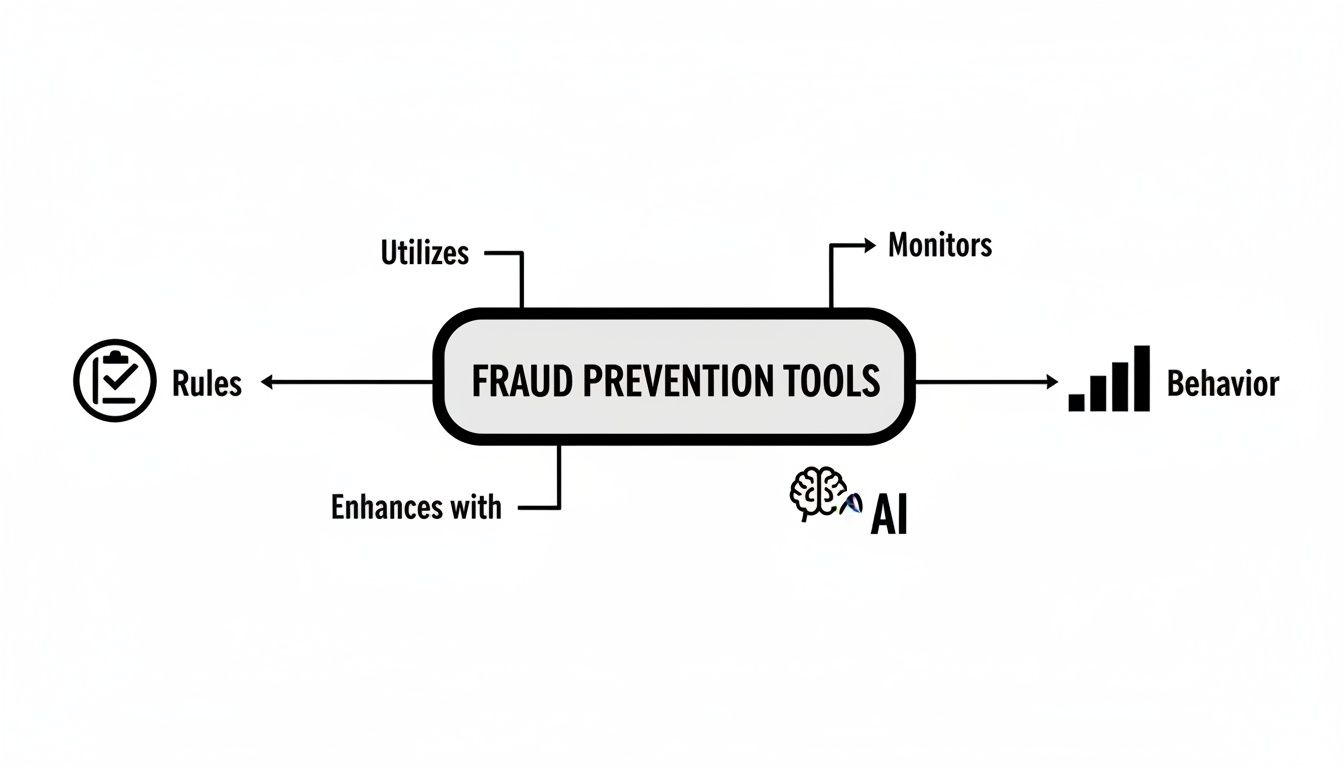
The big takeaway here is that the most effective systems don't rely on just one trick. They blend rules, behavioral analysis, and AI to create a security net with multiple layers.
Real-Time Analysis and Speed
In e-commerce, speed is the name of the game. A fraud check that drags on for more than a few seconds is a recipe for abandoned carts and lost sales. That’s why real-time analysis isn’t just a nice-to-have; it’s critical.
The best solutions work in milliseconds, crunching hundreds of data points behind the scenes before your customer even blinks. This instant decision-making keeps the checkout experience smooth for good buyers while slamming the door on fraudsters. It’s the difference between a seamless tap-to-pay and an infuriatingly long wait for approval.
Customization and Flexibility
Your business is unique, and so are your fraud risks. A one-size-fits-all approach simply won’t cut it. You need a solution that offers deep customization, letting you fine-tune the rules and risk thresholds to fit your specific industry, products, and customer base.
Think about it: a shop selling high-end electronics has a completely different risk profile than one selling handmade crafts. The ability to adjust your settings means you can build a defense that’s tough on criminals but gentle on your actual customers—striking that perfect balance is key.
A great fraud solution should feel like it was built just for you. It needs to adapt to your business reality, not force you into a generic, rigid box.
Clear Reporting and Analytics
How can you be sure your fraud solution is actually working? If you can't see the data, you're flying blind. A quality tool absolutely must provide detailed reporting and analytics that give you a transparent look at its performance.
You should be able to easily track the metrics that matter, such as:
- Approval Rate: What percentage of transactions are getting the green light?
- Block Rate: How many transactions are being stopped as potentially fraudulent?
- Chargeback Rate: What percentage of your sales are ending up as chargebacks?
This data helps you spot fraud trends, measure the ROI of your tool, and make smart adjustments to your rules. It turns fraud prevention from a mysterious black box into a clear, measurable part of your business strategy. For a closer look at the tools that help with this, you can learn more about the different chargeback management tools available.
Integrating Fraud Prevention with Shopify and Stripe

The idea of bolting a new piece of technology onto your store might sound like a headache, but getting a fraud prevention solution up and running is much simpler than you’d think. Modern tools are built for busy merchants, not developers, and they connect smoothly with major platforms like Shopify and Stripe.
Forget about wrestling with complex code or messing with server settings. Most of these solutions are designed to be "plug-and-play." You can usually find them right in your platform's app store, where installation is as easy as adding any other tool—just a few clicks and you're good to go.
Connecting to Your Shopify Store
For anyone running on Shopify, the process is incredibly straightforward. The Shopify App Store is your first stop, where a quick search will pull up a ton of different fraud prevention options.
Here’s what that integration usually looks like:
- Find the App: Just search for a fraud prevention tool in the Shopify App Store.
- Install with One Click: Add the app to your store. This simple action automatically gives the tool the permissions it needs to see your transaction data.
- Basic Configuration: After installing, you'll land on a setup wizard. You’ll connect your account and can often start with pre-set configurations that give you solid protection right out of the box.
This whole process is designed to get you protected in minutes, not days. The tool starts analyzing orders immediately, giving you instant peace of mind without a massive learning curve.
Setting Up Protection with Stripe
Stripe also makes it incredibly easy to add extra layers of security. While Stripe has its own built-in tool called Radar, many third-party solutions offer more specialized features that plug directly into your Stripe account. If you want to go deeper on this, our guide on Stripe chargeback protection lays out more specific strategies.
Connecting an outside tool typically just involves an API key.
Think of an API key as a secure password that lets two different applications talk to each other. Your fraud solution uses it to safely pull your Stripe transaction data and look for red flags.
You’ll generate this key in your Stripe dashboard and paste it into your new fraud tool's settings. The connection is instant, and the system starts monitoring payments without getting in the way of your customer's checkout experience. The same logic applies to other payment processors, like PayPal, making sure you can lock down all your sales channels.
Beyond the big names like Shopify and Stripe, exploring platforms like WooCommerce and their payment gateway plugins can give you even more insight. Researching popular WooCommerce payment gateway plugins shows that the need for simple, powerful integration is a universal theme in e-commerce. No matter what platform you're on, the goal is always the same: to give you powerful protection without the technical headaches.
How to Know If Your Fraud Prevention Is Working
So you've invested in a fraud prevention solution—that's a fantastic first step. But how do you actually know if it's paying off? Without looking at the right numbers, you're flying blind. It's like installing a top-of-the-line security system but never checking the cameras. You have no idea if it’s stopping bad guys or just annoying your friends.
Measuring success is all about turning fraud prevention from a mysterious line item on your budget into a powerful, revenue-protecting asset. By tracking a few key metrics, you can get a crystal-clear picture of what's working, what's not, and make smart tweaks to dial things in perfectly.
Tracking Your Chargeback Rate
The most direct way to check the pulse of your fraud prevention is your chargeback rate. It’s a simple but powerful number: the percentage of your total transactions that customers dispute. Your goal is to get this as close to zero as possible, and you should definitely aim to keep it well under 1%.
If you see your chargeback rate consistently dropping after putting a new tool in place, that's your proof. It's a clear signal that you’re successfully weeding out fraudulent orders before they can hit your bank account. Think of this number as your north star; it directly reflects how well you’re protecting your bottom line.
Finding the Balance with False Positives
While stopping fraud is the main event, you can’t afford to be a bulldog about it. This brings us to the false positive rate—the percentage of perfectly good orders that your system mistakenly flags as fraud.
Think of a high false positive rate like an overzealous bouncer at a club who starts turning away your best customers. Sure, the place is safe, but you're also killing your business and leaving a lot of good people with a bad taste in their mouth.
Finding that sweet spot is the real art. You need a system sharp enough to catch criminals without alienating the genuine buyers who keep your lights on. If your chargebacks are down but your sales are taking a hit from declined orders, it’s time to recalibrate your rules.
And this challenge is only getting bigger. Global chargeback volumes are projected to hit 337 million cases by 2025, a massive 27% jump in just three years. This surge costs merchants billions, and it highlights just how critical it is to have smart fraud prevention that can tell the difference between a friend and a foe with near-perfect accuracy. You can dig into more of these eye-opening chargeback statistics and what they mean for merchants.
Key Metrics for a Complete Picture
Beyond those two heavy hitters, a few other numbers can help you build a complete dashboard to gauge your fraud prevention performance.
- Approval Rate: This one’s simple—it’s the percentage of transactions your system approves. A healthy approval rate means you're not sacrificing sales at the altar of security.
- Manual Review Rate: This is the percentage of orders your system isn't sure about and flags for a human to check. A lower number here means your automated tool is doing its job well, saving you precious time and money.
By keeping a regular eye on these metrics, you can see exactly how your fraud prevention is performing and fine-tune your approach. The ultimate goal is to create a secure, smooth checkout experience that protects your revenue while keeping your customers happy and coming back for more.
Automating Chargeback Recovery with ChargePay

Most fraud prevention solutions are like a security guard posted at your front door. Their entire job is to spot trouble and block suspicious transactions before they can get inside. But what happens when someone inevitably slips past the guard? A huge chunk of lost revenue comes from fighting chargebacks long after a sale is complete.
This is where a specialized tool like ChargePay comes into the picture. It's not another front-door guard. Think of it more like an automated legal expert working around the clock to recover money that has already walked out the door.
A Different Layer of Defense
While preventative tools are absolutely essential, they don’t cover the entire battlefield. Chargebacks are going to happen, whether it's from a sophisticated scammer or from "friendly fraud," where a legitimate customer disputes a charge they actually made.
Fighting these disputes manually is a nightmare. It's a soul-crushing cycle of digging up evidence, filling out paperwork, and hoping for the best.
ChargePay flips this entire process on its head by using AI to fully automate the chargeback dispute process from start to finish.
The system hunts down all the necessary evidence, builds a compelling dispute response tailored to card network rules, and submits everything on your behalf. It turns a frustrating, manual chore into a hands-off revenue recovery machine.
This approach gives you a critical final layer of defense. It’s laser-focused on clawing back revenue you've already lost, making sure you’re protected both before and after every single transaction. It’s a key piece of any complete fraud strategy, securing your business from every possible angle.
If you’re tired of losing money to chargebacks and want to see how this kind of automation can get it back, you can schedule a demo of ChargePay to see it in action. You can finally turn the costly problem of chargebacks into a resolved issue and get back to focusing on growing your business.
Frequently Asked Questions
Jumping into the world of fraud prevention can bring up a lot of questions. We get it. Here are some straightforward answers to the common concerns we hear from merchants just like you.
Will a Fraud Prevention Solution Slow Down My Checkout Process?
Nope. Modern fraud prevention tools are built for speed. They analyze hundreds of data points in the blink of an eye—literally milliseconds—so your legitimate customers will never even know it's happening.
The entire security check happens instantly behind the scenes. This means you get a smooth and secure checkout experience that protects your business without hurting your conversion rates.
Do I Need to Be Technical to Use These Tools?
Not at all. Most fraud prevention solutions, especially those designed for platforms like Shopify, are incredibly user-friendly. They usually install just like any other app with a few clicks.
Plus, they come with simple dashboards and automated settings, so you don't need to be a developer to get top-notch protection for your store.
What Is the Difference Between Fraud Prevention and Chargeback Management?
While they sound similar, they tackle the problem from two completely different angles.
Think of it this way: fraud prevention is the security guard at your front door, trying to stop troublemakers before they get inside. Chargeback management is the team you call after a problem has already happened to recover your stolen goods.
It really breaks down like this:
- Fraud Prevention is all about being proactive. Its main job is to spot and block bad transactions before they ever get processed. This saves you from the initial loss.
- Chargeback Management is reactive. It kicks in after a chargeback has been filed, focusing on disputing the claim to get your lost revenue back.
A truly solid strategy needs both. A tool like ChargePay is a specialist in that second part, automating the entire recovery process to reclaim money that has already left your account. It’s the final piece of your financial defense.
Stop losing money to confusing chargeback disputes. ChargePay uses AI to automate the whole process, recovering your revenue without you lifting a finger. Learn how it works and get started today.


.svg)



.svg)


.svg)
.svg)
.svg)