


A PayPal order hits your Shopify admin. The address looks normal. The customer email looks ordinary. Then you dig into the payment details and realize the money may have come from a gift card paypal balance.
That’s where a lot of merchants get sloppy.
They treat it like any other PayPal payment, ship fast, and deal with the mess later. That’s a mistake. Gift card funded PayPal payments can bring real demand, but they also create a visibility problem. You often see the end of the payment chain, not the beginning. If the underlying funds came from a compromised or resold gift card, you may not spot the risk until the dispute lands.
Why PayPal Gift Card Sales Are a Double-Edged Sword
The upside is obvious. The gift card market is big, growing, and tied to how people already shop online. The global gift card market is projected to reach $584 billion by 2026, digital gift cards are growing at 26%+ annually, and 73% of consumers plan to buy gift cards. If you run Shopify, that’s too much buyer behavior to ignore.
The downside is less obvious until it costs you money.
A customer paying through gift card paypal often looks cleaner than a stolen card checkout. PayPal sits in the middle. The order may pass basic checks. Your team sees an approved payment and moves on. But approval is not the same as low risk, especially when prepaid funds and account balance payments are involved.

Why merchants misread the risk
Most merchant guidance focuses on the customer side. How to redeem the card. How to check balance. How to pay with PayPal. That’s not your problem.
Your problem is whether the payment can survive a dispute.
Gift cards and prepaid funding methods reduce transparency. They also attract the exact kind of buyer behavior that causes losses later: account takeovers, reseller abuse, and first-party fraud. If you already deal with prepaid card fraud patterns in e-commerce, gift card paypal payments belong in the same risk bucket.
Practical rule: Don’t treat a PayPal payment as safe just because PayPal approved it. Treat it as a transaction that still needs fraud review and dispute-ready records.
The revenue tradeoff is real
You shouldn’t block every PayPal gift card funded order. That would be lazy and expensive. Plenty of legitimate customers use stored balances because it’s convenient.
But you also shouldn’t process those orders with the same fulfillment rules you use for a repeat customer on a clean card. A gift card funded payment deserves tighter review on product type, delivery speed, account history, and evidence retention. The smart move isn’t rejection. It’s controlled acceptance.
That’s the difference between protecting revenue and just hoping PayPal sorts it out for you.
How PayPal Gift Cards Fund Transactions
A PayPal gift card isn’t a card your customer swipes at checkout on your store. That’s the first thing to get straight.
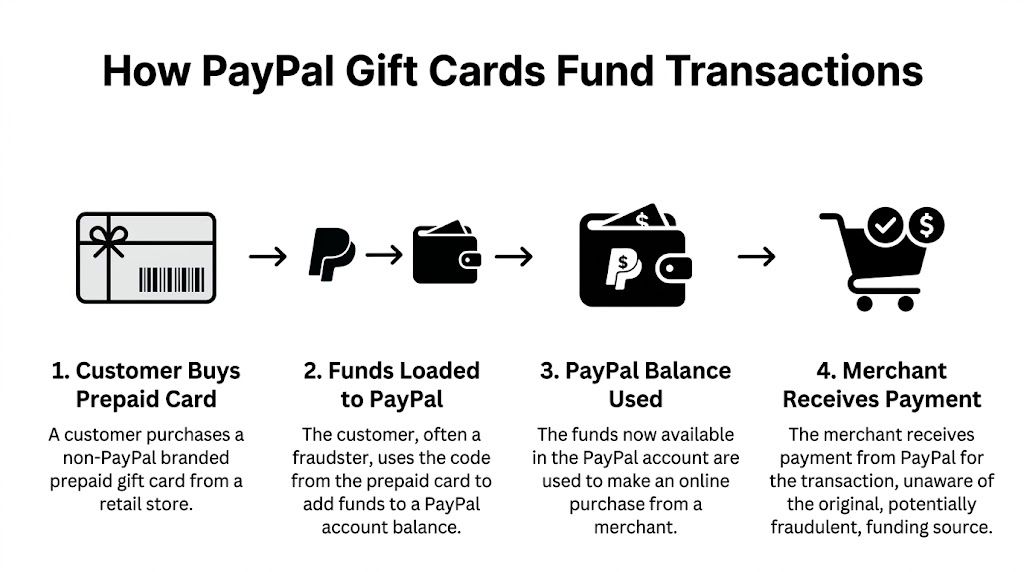
It works more like a wallet top-up. The customer redeems a code, the funds move into their PayPal balance, and then PayPal uses that balance when they buy from you. It's similar to adding money to a stored-value app before placing an order.
What happens behind the checkout button
The technical part matters because it affects your dispute evidence later. When a PayPal gift card is redeemed, the funds are loaded into the user’s PayPal balance, and PayPal uses balance-first deduction at checkout before falling back to a linked bank account or card, as explained in this breakdown of how PayPal gift cards work.
That means the payment path usually looks like this:
The buyer gets a prepaid code
They may buy it directly, receive it digitally, or obtain it through a resale marketplace.The buyer redeems the code into PayPal
The funds become part of the PayPal wallet balance, not a visible standalone card payment on your end.The buyer checks out on your store with PayPal
PayPal draws from the balance first.You receive a PayPal payment
You see the transaction inside PayPal’s system, but you usually don’t see the original source of the gift card funds.
Why this matters in disputes
This structure cuts both ways. The hidden funding source creates blind spots, but the balance-first system also creates a transaction trail inside PayPal. That trail can help if you need to prove the payment was completed, tied to a PayPal account, and used in a specific order.
The merchant mistake is simple. Teams save the Shopify order record but fail to preserve the PayPal transaction details that explain how the payment moved.
For physical goods, that missing record can weaken your response to an “unauthorized transaction” or “item not received” claim. For digital goods, it’s even worse because your evidence window is narrower in practice. If you don’t grab the PayPal-side details while the order is fresh, your support team ends up reconstructing the payment after the buyer has already framed the dispute.
What your ops team should do immediately
If your store accepts PayPal, build an internal rule for every suspicious balance-funded order:
- Save the PayPal transaction screen with timestamp, payer details, and transaction ID.
- Match it to the Shopify order before fulfillment, not after.
- Log customer communication from confirmation through delivery.
- Tag unusual orders for delayed shipment or manual review.
That’s boring operational work. It’s also what separates recoverable disputes from write-offs.
The Merchant's Blind Spot Gift Card Fraud
Gift card paypal fraud hurts merchants because it often starts outside your store.
You don’t see the stolen card used to buy the gift card. You don’t see the resale listing. You don’t see the account compromise that loaded the funds into PayPal. You see an approved order and a buyer who wants fast fulfillment.

The clean-looking dirty payment
One common pattern is triangulation-style fraud.
A fraudster gets gift card value using compromised funds or through a shady secondary channel. They redeem that value into PayPal. Then they place an order on your site using that PayPal balance. The checkout may look normal because the payment reaches you through PayPal, not through the original compromised card.
You ship the order. Later, the fraud unravels somewhere upstream, or the buyer files a dispute that throws the transaction back onto your desk.
Your loss isn’t abstract. It’s inventory, shipping cost, labor, and the revenue reversal.
Secondary marketplaces make this worse
Third-party marketplaces are a major weak point because they create distance between the fraud and your store. According to this review of PayPal gift card marketplace risk, digital gift card fraud rose 25% in 2025, PayPal-related cases rose 18%, and the average loss is $150 per dispute.
That’s exactly why resold gift card value is dangerous. The buyer can use apparently valid PayPal funds and still become a dispute problem later.
If you want the short version, it’s this:
- The funding looks legitimate at checkout
- The order gets fulfilled quickly
- The dispute shows up after the value is gone
- You carry the loss unless your records are strong
Fraud moves to the place with the weakest visibility. With gift card paypal payments, that weak spot is often the merchant.
A lot of this also overlaps with first-party fraud behavior that merchants misclassify. The buyer may have received the goods, used the goods, and still claim the transaction wasn’t authorized.
Two patterns that cost merchants most
Resold value fraud
A buyer acquires discounted or stolen gift card value through a marketplace, funds PayPal, buys from your store, then disputes the purchase. The order may have no obvious card mismatch because the transaction happened inside PayPal.
This is especially painful for digital products, fast-ship electronics, and limited inventory drops.
Friendly fraud using PayPal balance
The customer tops up their own PayPal account, buys from you, receives the product, and later claims non-receipt or unauthorized use. Because support teams often assume a PayPal balance payment is cleaner than a direct card payment, they fail to collect the right evidence early.
This explainer helps show how layered fraud works in practice:
Orders you should review before shipping
You don’t need to panic over every PayPal order. You do need rules.
Review manually when you see:
- High-risk product mix such as resale-friendly goods, digital delivery, or rush shipping
- New customer behavior with no prior order history and immediate high intent
- Mismatch signals between account details, shipping patterns, and support behavior
- Pressure tactics like repeated delivery change requests or urgency messages after payment
Most losses happen because merchants fulfill too quickly and document too slowly.
How Chargebacks Work With PayPal Gift Card Payments
A PayPal dispute is not the same thing as a card network chargeback. That distinction matters.
When the payment came through a PayPal balance funded by a gift card, the first fight usually happens inside PayPal’s dispute process. The customer can claim the transaction was unauthorized or say the item never arrived. If you lose there, the money can be pulled back fast.
PayPal is already signaling what it considers risky
PayPal’s own controls tell you how it thinks about concentrated gift card activity. It enforces a $5,000 usage limit per rolling 180 days per account for certain gift card activity tied to PayPal, particularly eBay gift cards, as described in this guide to PayPal gift card usage tracking.
That policy matters for merchants because it shows something important. PayPal itself treats heavy gift card use as a risk signal worth limiting.
You should do the same on your side.
What the dispute process usually looks like
When a claim hits, your team needs to separate the issue into one of three buckets:
Unauthorized transaction
The buyer says they didn’t approve the purchase. Your evidence needs to tie the PayPal account activity to the order, fulfillment, and customer behavior.Item not received
The buyer says the package never arrived. Standard shipping evidence matters, but PayPal-side payment details still help anchor the case.Other service or fulfillment complaints
These can turn messy if support records are weak or if your delivery proof is incomplete.
If you haven’t already reviewed how PayPal chargeback policy differs from standard card dispute flow, fix that. A lot of merchants lose because they send generic card-dispute evidence into a PayPal-centered case.
Operational advice: Build a PayPal-specific response template. Don’t recycle the same packet you use for Visa or Mastercard disputes.
What merchants should change right now
Use PayPal’s own limit policy as a lesson, not trivia.
Flag orders for extra review when you see concentrated prepaid behavior, unusual repeat purchases, or transaction patterns that don’t fit the customer profile. You won’t always know a gift card funded the order at the start, but when the signs are there, slow down fulfillment long enough to collect records that can defend the payment later.
The biggest procedural mistake is waiting for the dispute notice before gathering evidence. By then, key details are already scattered across Shopify, PayPal, your shipping system, and support inboxes.
How to Build a Winning Dispute Case
A weak dispute response usually fails for one reason. The merchant submits proof of order creation, not proof of legitimate payment and fulfillment.
With gift card paypal transactions, you need both. PayPal transaction details matter because they anchor the payment inside PayPal’s system. Fulfillment evidence matters because it proves the buyer received what they paid for. Customer behavior evidence matters because it fills the gaps fraudsters exploit.
The evidence that actually matters
Start with the records closest to the transaction itself:
- PayPal transaction details showing transaction ID, payer information, timestamp, and order amount
- Shopify order record matched to the same customer and product details
- Shipping proof with tracking, carrier scans, and delivery confirmation
- Customer communication including email replies, support tickets, delivery questions, and address confirmation
- Account activity records that show normal buyer behavior before and after the sale
Then add context. If the customer downloaded a digital product, changed shipping details after ordering, or contacted support using the same email tied to the order, keep that. Small details often decide close cases.
PayPal gift card fraud red flags and evidence checklist
| Red Flag | Required Evidence to Collect |
|---|---|
| New buyer places a high-risk order through PayPal | Save PayPal transaction details, Shopify order data, and any customer account creation history |
| Customer asks for rush shipping or address changes | Keep support messages, address edit logs, and fulfillment timestamps |
| Buyer later claims unauthorized use | Preserve PayPal payment record, order confirmation, device or session logs if available, and all customer communication |
| Buyer claims item not received | Submit tracking, carrier delivery scans, proof of delivery, and any post-delivery support interaction |
| Order involves digital goods or instant fulfillment | Keep access logs, download records, license delivery records, and the payment timestamp |
| Customer behavior looks inconsistent across systems | Match PayPal payer info, Shopify customer info, shipping details, and internal fraud-review notes |
Save the evidence when the order is paid, not when the dispute arrives. Retrieval gets harder, and your team gets sloppier, once the case is already live.
Why merchants lose even when they were right
Most merchants don’t lose because the buyer had a stronger story. They lose because the merchant’s data lives in five different places and nobody assembles it properly before the deadline.
That’s especially true in PayPal cases. Your support team has one piece. Ops has another. Shipping has another. The actual payment proof sits in PayPal. If nobody combines those records into one clear argument, the case feels incomplete even when the transaction was legitimate.
If you want to understand how merchants structure stronger responses, this guide to chargeback representment is worth reviewing. The key lesson is simple: evidence has to tell one consistent story.
Keep your case tight
Don’t flood the response with irrelevant screenshots.
Use a clear sequence:
- Show payment completion
- Show order confirmation
- Show fulfillment or access delivery
- Show buyer engagement after the sale
- Show why the claim conflicts with the record
That’s the structure reviewers can follow quickly. Confused evidence loses. Organized evidence wins.
The Automated Solution to PayPal Chargebacks
Gift card paypal payments create a messy combination of demand, opacity, and post-sale risk. The order can look legitimate. The funding trail can be harder to see. The dispute process can require a different evidence set than a normal card claim. That’s too much manual work for most Shopify teams to handle consistently.
It also gets worse once regional rules enter the picture. According to this summary of PayPal gift card regional issues, some PayPal gift cards in the US may expire after 12 months, while new EU rules effective January 2026 mandate indefinite validity, and expired balances are tied to a 15-20% higher dispute rate. Manual reviews miss details like that all the time.
Manual handling is a bad use of your team
Your ops team should be focused on fulfillment, retention, and margin. Instead, they end up chasing screenshots across PayPal, Shopify, shipping tools, and support threads.
That’s not a serious system. It’s a patch job.
If your store gets enough PayPal volume for gift card funded payments to matter, then you need automated dispute handling. You need the case assembled fast, in the right format, with the right payment records, before the deadline closes.
Good fraud ops isn't about reviewing more orders by hand. It's about building a process that catches risk early and answers disputes without chaos.
What a better setup looks like
The right workflow does three things well:
- Flags risky transactions early so fulfillment teams can slow down when needed
- Collects evidence automatically across payment, order, support, and shipping systems
- Submits dispute responses on time without relying on a support rep to manually build every case
That’s why more Shopify merchants are moving toward automated chargeback and dispute management with AI instead of handling PayPal claims ad hoc.
For stores dealing with repeat friendly fraud, gift card-funded disputes, or a growing PayPal mix, manual representment is too slow and too inconsistent. Automation isn’t a nice add-on anymore. It’s basic revenue protection.
Chargebacks from gift card paypal payments don’t go away on their own. If you want them handled without pulling your team into manual evidence gathering, install ChargePay from the Shopify App Store. ChargePay has a 92.4% win rate, has handled 200K+ disputes, and recovered $10.8M+ for merchants. It carries a 4.9-star rating, has the Built for Shopify badge, and runs on a pay-per-win model, so you only pay when money is recovered. Stop writing off PayPal disputes as a cost of doing business. Put them on a system that fights back.


.svg)



.svg)


.svg)
.svg)
.svg)