

When it comes to chargebacks, a simple truth holds: clarity beats confusion, and proactivity beats reactivity. The best way to win a chargeback is to prevent it from ever happening. For Shopify store owners, this starts with building a proactive plan that sets crystal-clear expectations for your customers long before they even think about clicking "buy."
Your Proactive Plan to Stop Chargebacks Before They Start
For Shopify store owners, chargebacks are a silent profit killer. They're not just a lost sale; they directly attack your revenue, your time, and your merchant standing. For every dispute, you lose the product, the shipping costs, and get slapped with a penalty fee. A single chargeback can easily cost you 2-3 times the original order value.
Trying to fight them one by one is a tough, uphill battle, especially when you have a business to run.
The good news? You can build a powerful defense system. Here at ChargePay, we've helped merchants handle over 100,000 disputes, recovering more than $2.8 million in lost revenue with a 92.4% win rate. We know what works. It all begins with making your store a difficult target for fraudsters and a clear, simple experience for honest customers.
Create Ironclad Store Policies
Think of your store policies as the foundation of your chargeback defense. If they're vague, hidden, or confusing, you're practically inviting disputes. A customer who can't find your return policy will often go straight to their bank instead.
Your policies must be:
- Easy to Find: Don't hide them in the footer and hope for the best. Link to your policies on product pages, in the cart, during checkout, and within your order confirmation emails. Make them impossible to miss.
- Easy to Understand: Use simple, direct language. A customer should be able to grasp your shipping times, return process, and refund conditions in under 30 seconds.
- Comprehensive: Cover all your bases. Clearly state your shipping timeframes, return eligibility (especially for "final sale" items), refund methods (like store credit versus the original payment method), and who is responsible for return shipping costs.
Key Takeaway: A clear, accessible return policy acts as a pressure-release valve. It gives a frustrated customer an easy option besides initiating a chargeback. Making returns straightforward is one of the most effective strategies you can implement. Our comprehensive guide on chargeback prevention dives deeper into this topic.
For a quick overview, here are the most critical pre-transaction tactics you can implement right away.
Key Prevention Tactics at a Glance
| Prevention Area | Actionable Tactic | Why It Works |
|---|---|---|
| Store Policies | Prominently display clear, simple-to-understand return and shipping policies on multiple pages. | Gives customers a clear path to resolution, preventing them from going directly to their bank. |
| Product Pages | Use highly detailed descriptions, multiple high-res photos/videos, and accurate size charts. | Eliminates ambiguity and sets precise expectations, defending against "Product Not as Described" claims. |
| Customer Service | Provide an easy-to-find contact email or phone number for support. | Makes customers feel heard and offers them a direct channel to resolve issues without a dispute. |
| Checkout Process | Use a clear and recognizable billing descriptor for your store name. | Prevents "friendly fraud" where a customer doesn't recognize the charge on their bank statement. |
By implementing these tactics, you're not just reducing risk; you're building a more trustworthy and transparent brand that customers feel confident buying from.
Write Product Descriptions That Eliminate Doubt
A huge chunk of chargebacks come from the "Product Not as Described" reason code. This is rarely intentional fraud; it's a communication breakdown. Your product pages need to paint a complete picture and leave nothing to the imagination.
For instance, if you sell apparel, don't just write "blue shirt." Go into detail: "a slim-fit, 100% cotton crewneck t-shirt in navy blue." Then, back it up with high-resolution photos from every angle, a video of the product in use, and a detailed size chart with measurements in both inches and centimeters.
The goal is to stop a customer's imagination from filling in the gaps, which often leads to disappointment and, eventually, a dispute. This kind of precision is your best weapon against claims of misrepresentation.
And this problem is only getting bigger. In 2023, the e-commerce world was hit with over 238 million chargebacks. That number is projected to surge by 41% to 337 million by 2026. This is fueled by rising fraud losses that are expected to hit $28.1 billion globally. Taking these proactive steps is no longer a "nice-to-have"—it's essential for survival. By fortifying your store policies and product descriptions, you're building the first and most important line of defense to protect your hard-earned revenue.
Mastering Fraud Detection During Checkout
That moment a big order comes in is a rush. But let's be honest, it can also be a huge source of anxiety. Is this a real customer or a fraudster about to hit you with a chargeback? Simply trusting your built-in Shopify fraud analysis isn't going to cut it long-term. To really protect your profits, you need to get a bit smarter and more hands-on, stopping the bad guys without scaring off your best customers.
Here at ChargePay, we've seen it all. After handling over 100,000 disputes and recovering more than $2.8 million for merchants, we can tell you a solid fraud detection system is an absolute must. It’s about looking past the surface-level green flags and learning to spot the subtle warning signs that fraudsters almost always leave behind.
Reading the Red Flags in Real Time
Think of the Address Verification System (AVS) and Card Verification Value (CVV) as your first line of defense. Almost every payment processor gives you this data, but the real trick is knowing what to do with it, especially when things don't line up perfectly.
AVS Mismatches: This check compares the billing address the customer typed in with the one their bank has on file. A partial match, like a correct ZIP code but a misspelled street, is probably just a typo. But a total mismatch? That’s a big red flag. It’s time to pause that order and take a closer look.
CVV Failures: The CVV is the little three or four-digit code on the card. If the check fails, it's a strong sign the person doesn't have the physical card. You should set up your payment gateway to automatically reject any transaction with a failed CVV check. No exceptions.
Getting these two basics right lets you automate away the most obvious fraud, freeing you up to investigate the trickier orders.
Spotting Suspicious Order Patterns
Experienced fraudsters know how to look like legitimate customers, but they often give themselves away with patterns that just feel... off. Manually reviewing orders that fit these profiles is one of the most effective things you can do to prevent fraud.
Keep an eye out for these kinds of orders:
- Multiple Orders, One Address, Different Cards: This is a classic. A fraudster gets their hands on a list of stolen cards and starts testing them by shipping small orders to a single drop-off point or freight forwarder.
- Unusually Large First-Time Orders: A huge order from a new customer is exciting, but it should also make you cautious. If they're also demanding expedited shipping, be extra suspicious. They're often trying to get the goods before the real cardholder even knows their card is stolen.
- Shipping and Billing Address Mismatches: A customer shipping a gift is one thing. But when the shipping address is in another country or a known high-risk area, and the AVS is also showing a mismatch, you need to investigate.
- Rapid-Fire Order Attempts: Ever see a string of failed payments followed by a successful one? That could be a fraudster burning through stolen card numbers until one finally works.
This decision tree gives you a good visual for how to think about these risks. It's all about being proactive.
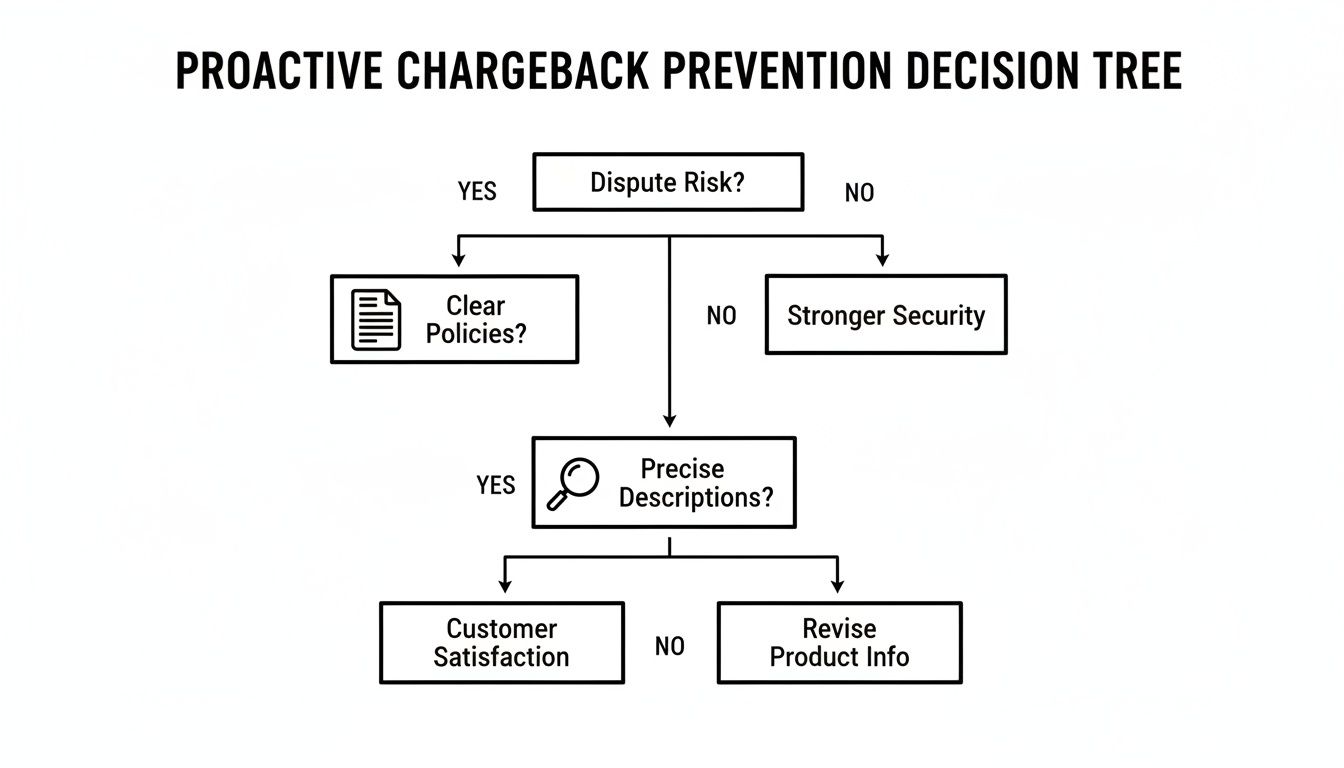
The real takeaway here is that you need a two-part strategy: tackle customer confusion with clarity and fight criminal fraud with smart verification.
A layered security approach doesn't mean rejecting every suspicious order. It means flagging them for a quick, human review. A simple email to the customer asking to verify their order details can often confirm a legitimate purchase or scare off a fraudster.
Add Another Layer of Security
For an even stronger defense, think about using 3-D Secure authentication. It adds an extra step at checkout where the customer has to approve the purchase with a password or a one-time code sent to their phone. If you want to get into the nitty-gritty, check out our guide on 3-D Secure authentication and how it can help.
The best part? It shifts the liability for fraudulent chargebacks from you to the card-issuing bank, stopping "Card Not Present" fraud dead in its tracks. You might not want to turn it on for everyone, but it’s a powerful tool for those high-risk or high-value orders that make you nervous.
Ultimately, mastering fraud detection is about building a smart, responsive system that protects your business. And when a dispute does get through, having a tool that automates the fightback process is crucial. That’s why thousands of merchants trust ChargePay, a Built for Shopify app with a 4.9-star rating, to handle their disputes. Ready to automate your defense? Install ChargePay from the Shopify App Store and let our AI start protecting your revenue today.
The Hidden Threat of Friendly Fraud and How to Fight It
Let's talk about one of the most frustrating—and costly—problems for any Shopify store owner: friendly fraud. This isn't your typical fraudster with a stolen credit card. This happens when a real customer buys something from your store, receives their order, and then disputes the charge with their bank anyway. It’s maddening, and it’s a silent killer for your profit margins.
Make no mistake, this isn't a minor issue. Friendly fraud is the main driver of chargebacks, making up over 70% of all disputes. Customers file these claims for all sorts of reasons—sometimes it's buyer's remorse, but often it’s just because they think it's easier than contacting you for a return. In fact, a staggering 52% of customers admit they've gone straight to their bank to dispute a charge without ever reaching out to the merchant first.
Last year alone, this behavior led to Americans disputing an unbelievable $83 billion in credit card charges. To make matters worse, the average cost to fight each dispute has jumped by 16%. Trying to win these feels like an uphill battle, but you have more control than you think. Since friendly fraud starts with your own customers, your best defense is always clear communication.
Make Your Billing Descriptor Unmistakable
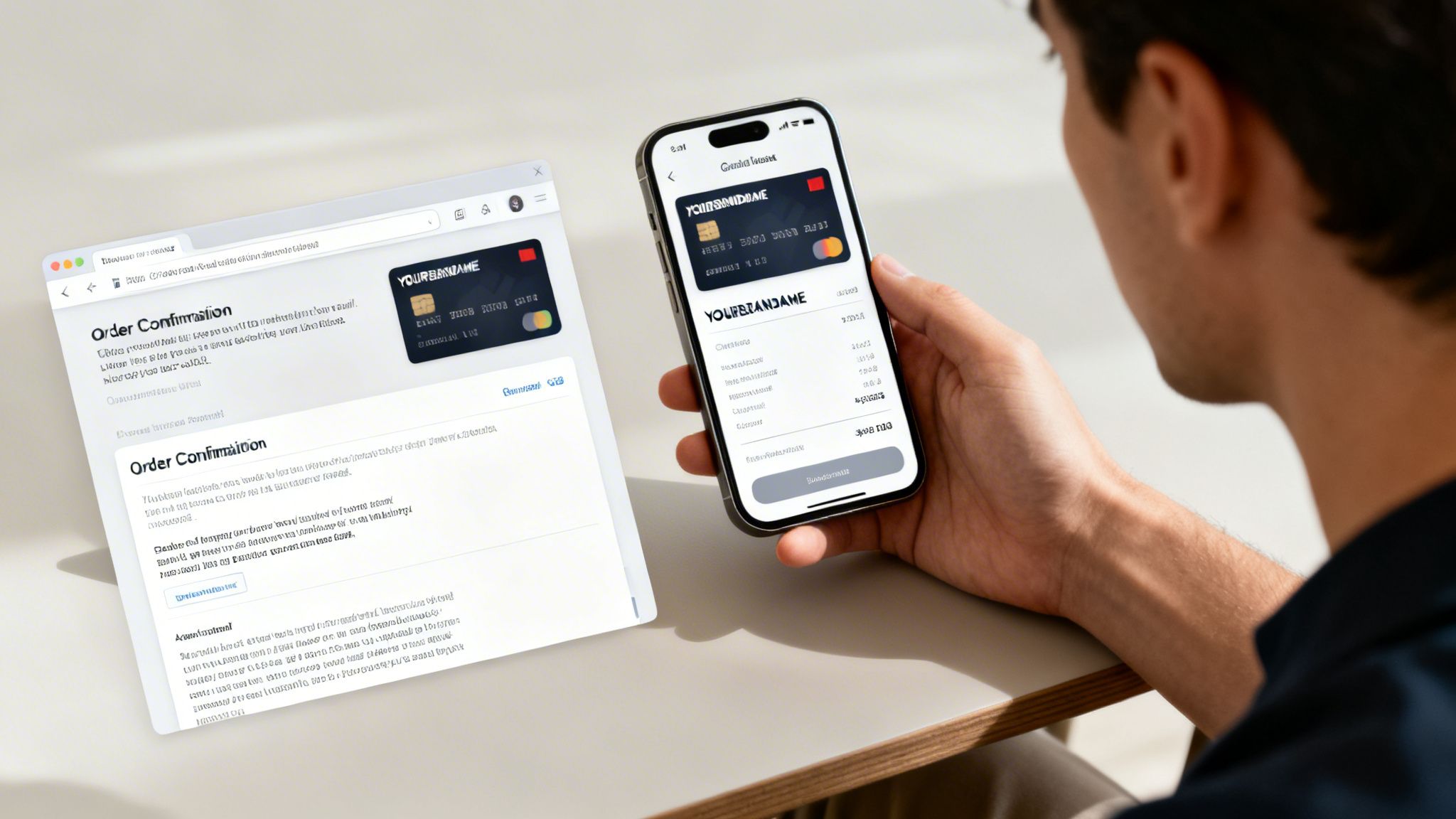
One of the easiest ways to trigger a friendly fraud chargeback is with a confusing billing descriptor. Imagine a customer scrolling through their credit card statement and seeing a charge from "SP*MERCHANT123." They have no idea what it is. Their first instinct? "I don't recognize this. I'll dispute it."
You can stop this dead in its tracks by setting a clear, recognizable billing descriptor in Shopify.
- Bad Descriptor:
PAYMENTCO*SHOPor a generic legal company name. - Good Descriptor:
YOURBRANDNAMEorYOURBRAND.COM
This tiny change makes it instantly obvious who charged them, short-circuiting that "what is this?" moment of confusion that leads to so many unnecessary disputes. It’s one of the simplest and most effective moves you can make.
Use Communication as Your Strongest Evidence
When a friendly fraud chargeback does land in your lap, the evidence you've already collected is what will win the fight. Clear, consistent communication creates a paper trail that proves you held up your end of the deal.
At ChargePay, we've handled over 100,000 disputes. We can tell you that a clear record of communication is one of the most powerful pieces of evidence you can have. It shows the bank that you were transparent and proactive at every step.
Here’s what your communication trail should look like for every single order:
- Detailed Order Confirmation: The moment an order is placed, a detailed email should go out. It must include the exact products ordered, the total cost, the customer’s name, and the shipping address they provided.
- Shipping Notification with Tracking: As soon as the item ships, send another email. This one must include the tracking number and a direct link to the carrier’s tracking page. This proves you sent the item to the address on file.
- Delivery Confirmation: Many carriers offer delivery confirmation notifications. If you can, trigger a final email that says, "Your order has been delivered!" This closes the loop and adds another layer of proof.
This sequence builds an airtight case. If a customer claims they never received their order, your tracking number proves it was delivered. If they claim they ordered something different, your initial confirmation email proves them wrong. If you want to learn more about the specifics, you can dive deeper into friendly fraud in our article.
Build Loyalty to Reduce Disputes
Here’s an often-overlooked strategy for fighting friendly fraud: build real relationships with your customers. When people feel connected to your brand, they’re far more likely to reach out with a problem than to just file a chargeback. Implementing effective loyalty strategies can turn one-time buyers into loyal fans who genuinely want to see your business succeed.
A customer who feels valued is a customer who will give you the benefit of the doubt. That small shift in mindset can have a huge impact on your chargeback rate. Ultimately, preventing chargebacks is all about building trust through every single interaction—from your billing descriptor to your post-purchase emails.
How to Build a Dispute-Winning Evidence Package

Let’s be real—even if you do everything by the book, some chargebacks are going to slip past your defenses. It’s just part of being a Shopify merchant. When that dispute notification hits your dashboard, your chance of getting your money back hinges on one single thing: how good your evidence is.
If you’re scrambling to dig up old emails and tracking numbers after a dispute is filed, you’re already on the back foot. The secret is having a rock-solid system for collecting and organizing this stuff from day one. At ChargePay, we’ve seen it all, helping Shopify store owners fight over 100,000 disputes and hitting a 92.4% win rate. Trust us, it all starts with an airtight evidence package.
Your Go-To Evidence Checklist
Think of this as your chargeback battle station. When a dispute lands, you need to pull these documents together in minutes, not hours. The goal is to paint a crystal-clear picture for the bank, leaving zero room for doubt.
Here’s exactly what you should be gathering for every single order you ship:
- All Customer Communications: This means every email, from pre-sale questions to your automated order and shipping confirmations. If you chatted on social media or a helpdesk, save that too.
- Solid Proof of Delivery: This is the big one. You absolutely need a valid tracking number showing the package was delivered to the address the customer provided. For your more expensive items, getting a signature confirmation is a smart move.
- Order and Transaction Details: Grab screenshots from your Shopify dashboard. You'll want to show the order details, the total amount paid, and the date the transaction went through.
- Fraud Scan Results: Don't forget the AVS (address) and CVV (security code) check results from your payment processor. A "match" is powerful proof that the person who placed the order likely had the physical card in their hand.
- IP Address & Geolocation Data: Make a note of the IP address and device used to place the order. If the IP address location matches the billing and shipping address, it makes a fraud claim look a lot less credible.
A well-organized evidence file does more than just help you win. It makes the entire chargeback representment process faster and less stressful, allowing you to focus on growing your business instead of fighting disputes.
Getting this system in place moves you from being a reactive victim to a prepared defender. For a deeper dive into structuring your arguments, you can read our guide on the chargeback representment process.
Putting Your Rebuttal Letter Together
Okay, you’ve got all your evidence. Now you need to package it into a compelling rebuttal letter. This is not the time to get emotional or vent your frustrations. You need a professional, purely fact-based summary that makes it ridiculously easy for a busy bank employee to side with you.
Think of your rebuttal as the cover letter for your evidence, guiding the bank reviewer straight to the point.
A Rebuttal Structure That Wins
A strong rebuttal letter is simple and direct. Don’t overthink it.
- Quick Intro: Start with the basics—order number, transaction date, and the amount in dispute.
- Tackle the Claim Head-On: State the chargeback reason (e.g., "Product Not Received"). Then, immediately counter it with your strongest piece of evidence (e.g., "As you'll see in the attached proof of delivery, the package was delivered to the cardholder's address on [Date] via tracking number XYZ.").
- Connect the Dots: Briefly walk them through your other evidence. Something like, "Exhibit A shows the customer received an order confirmation email, and Exhibit B confirms that the AVS and CVV checks were successful, indicating a legitimate purchase."
- Polite Conclusion: Wrap it up by politely asking for the dispute to be reversed in your favor based on the clear evidence provided.
You're not writing a novel; you're building an undeniable case. By making the facts impossible to ignore, you give yourself the best possible shot at winning.
Of course, this can feel like a full-time job. With ChargePay, our AI does this heavy lifting for you. It analyzes the dispute, gathers the right data, and crafts a rebuttal letter designed to win. If you’re tired of the manual fight, install ChargePay from the Shopify App Store and let us take it from here.
Automating Your Defense with AI
For any growing Shopify store, trying to fight chargebacks by hand is a losing game. It’s not just the hours you pour into digging up evidence and writing rebuttals; it's the terrible return you get for all that effort.
On average, merchants who go it alone see win rates dip below 45%. When you factor in all the hidden costs, your net recovery can be as low as 18% of the money you were trying to get back. That’s a lot of work for a very small reward.
You’ve got a business to run. Products need to be shipped and customers need your attention. Wasting your week wrestling with bank portals and confusing reason codes isn't just frustrating—it’s actively holding your business back. That's why automation has stopped being a "nice-to-have" and become the only realistic way to protect your revenue as you scale.
This is exactly why we built ChargePay. Our AI platform was designed from the ground up to take this entire burden off your plate. When a dispute hits your account, our system doesn't just sit there waiting for you. It gets to work instantly.
How AI Flips the Script on Your Dispute Process
Think about the manual grind you go through now. You get an alert, log into Shopify, hunt down the order, pull up the tracking info, search for customer emails, and then try to stitch together a response you hope will satisfy the bank. It's slow, easy to mess up, and a massive time sink.
Our AI turns that entire process on its head.
The moment a new dispute is filed, ChargePay is on it. The AI instantly analyzes the reason code, the issuing bank, and the card network involved. It then automatically connects to your Shopify store to pull all the critical evidence—order details, AVS/CVV results, tracking numbers, and delivery confirmations.
Using what it’s learned from handling over 100,000 disputes, the AI then generates a custom, data-backed rebuttal letter. This isn't a generic template; it's a response crafted specifically to counter the exact reason for that chargeback, presented in the way banks expect to see it. All of this happens in real-time, 24/7. While you're sleeping or shipping new orders, ChargePay is already fighting for your money.
This isn't just about moving faster; it's about winning more. We’ve managed over 100,000 disputes, hitting a 92.4% win rate and recovering over $2.8 million for merchants just like you. Our AI knows what evidence makes a difference and how to present it for maximum impact.
This shift to automation is happening everywhere. Manual order reviews and outdated fraud tools are being left behind. In fact, over 60% of merchants are planning to dramatically cut back on manual processes as AI becomes more accessible. Small businesses that adopt modern fraud filters are already seeing a 10-15% drop in chargebacks, and those who automate their dispute responses can slash their chargeback volume by up to 33%. All told, AI has been shown to cut chargeback-related losses by a staggering 80%. You can discover more insights about AI's impact on chargeback trends.
From Manual Grind to Automated Success
Let's imagine a real-world scenario. A customer files a "Product Not Received" chargeback. Doing it manually means you have to find the order, copy the tracking number, head over to the carrier's site, screenshot the delivery confirmation, and attach it all to your rebuttal. That's easily 15-20 minutes down the drain for just one dispute.
With ChargePay, our AI does all of that for you in seconds. It fetches the tracking and delivery proof, packages it perfectly into the evidence, and submits the response on your behalf. You just get a notification that it's been handled. For a more detailed look at the process, read our guide on automated chargeback management using AI.
This automated approach doesn't just give you your time back; it completely rewrites the economics of fighting chargebacks.
A Zero-Risk Way to Get Your Revenue Back
We firmly believe you should only pay for results. That’s the entire idea behind ChargePay’s pay-per-win model.
There are no monthly fees, no setup costs, and no hidden charges. We only get paid when we successfully recover your money. It’s a completely risk-free way to put our chargeback AI in your corner.
You have nothing to lose except the revenue you're currently giving away.
ChargePay is a Built for Shopify app, a distinction given for its quality, performance, and seamless integration with the platform. We’re trusted by thousands of merchants who have given us a 4.9-star rating in the Shopify App Store.
Stop letting chargebacks be a constant drain on your time and profits. Install ChargePay from the Shopify App Store today, and let our AI turn your biggest headache into a solved problem.
Got Questions About Preventing Chargebacks? We’ve Got Answers.
Even with the best plan in place, you’re bound to have questions. As a Shopify merchant, getting the details right on chargeback prevention is a huge part of protecting your profits. Let's tackle some of the most common ones we hear from fellow store owners.
How Much Does a Single Chargeback Really Cost Me?
It’s so much more than just the sale price. When a chargeback hits, you lose the revenue from the sale, the product you shipped, and the money you spent on shipping. Ouch.
On top of that, your payment processor will slap you with a non-refundable chargeback fee, which typically runs between $15 to $25.
Then you have the hidden costs—the hours you or your team will waste fighting it, plus the damage it does to your merchant account's health. When you add it all up, the true cost of a single chargeback is often 2-3 times the original order value.
The real danger isn't one dispute; it's the snowball effect. Let too many of them pile up, and you could be looking at higher processing fees or, even worse, getting your merchant account shut down. That puts your whole online business at risk.
Can I Just Block Customers Who File Chargebacks?
You technically can, but it’s like putting a band-aid on a broken leg. It's a shortsighted fix for a much bigger problem.
Blocking a customer who filed a "friendly fraud" dispute might stop them from buying again, but it does absolutely nothing to fix why they did it. Was your return policy a maze? Did they just not recognize the charge on their statement? You’re left guessing.
Even worse, this tactic is completely useless against actual fraudsters using stolen cards. They’ll just pop back up with a different name and card number.
A much smarter move is to focus on preventing disputes before they happen and using a dedicated tool to handle the ones you can't. That’s why thousands of Shopify merchants use ChargePay. Our AI has handled over 100,000 disputes, automating the entire fight so you can focus on running your business.
My Chargeback Rate Is Low. Should I Still Worry?
Absolutely. A low chargeback rate can feel safe, but it can also hide underlying issues like a confusing return process or vague product descriptions. Ignoring it is like ignoring a tiny leak in your roof—sooner or later, it’s going to cause some serious damage.
Card networks like Visa and Mastercard are very strict. They consider a chargeback rate of around 0.9% of your total transactions to be the "acceptable" limit. Get too close to that line, and you risk getting put in a high-risk monitoring program, which comes with some pretty hefty penalties.
Think of chargeback prevention as basic business maintenance, not just an emergency procedure.
- It’s a sign of a healthy business: A low dispute rate usually means you have happy customers and a smooth operation.
- It gives you a buffer: Keeping your rate super low provides a safety cushion for those unexpected times when disputes might spike.
- It’s easy to automate: With a tool like ChargePay, managing and preventing disputes becomes a "set it and forget it" safety net for your store.
What’s the Difference Between a Refund and a Chargeback?
This is a huge one, and every merchant needs to know the difference.
A refund is a conversation between you and your customer. You are in control. It’s a chance to provide good customer service and make things right. You issue the refund, and the interaction ends on a positive (or at least neutral) note.
A chargeback, on the other hand, is a forced payment reversal started by the customer's bank. You're completely cut out of the loop. It comes with penalty fees, hurts your standing with payment processors, and you lose both the money and the product.
Making your refund process incredibly easy to find and use is one of the single best ways to stop chargebacks. A lot of customers only file a dispute because they think it's faster or easier than figuring out how to ask you for a return. Don't let that be the reason you lose money.
Let's be real: fighting chargebacks by hand is a battle most merchants can't afford to fight. The time, the money, the stress—it's a massive drain. ChargePay was built from the ground up to take this entire problem off your plate. Our AI handles everything automatically, boasting a 92.4% win rate.
Stop losing your hard-earned revenue to preventable disputes. Install ChargePay from the Shopify App Store and let our Built for Shopify app—with its 4.9-star rating—start protecting your business today.


.svg)



.svg)


.svg)
.svg)
.svg)