

A Shopify order comes in. AVS passes. The customer name looks normal. The basket size is a little high, but not crazy. Then you check the order details and see the IP country doesn't line up with the shipping address.
That single mismatch creates a familiar problem. If you cancel a good order, you lose revenue and possibly a repeat customer. If you ship a bad one, you may lose the product, the payment, and the dispute that follows. For merchants dealing with Shopify Payments or PayPal, that decision happens fast and usually with incomplete information.
Chargeback teams see this pattern constantly. ChargePay reports a 92.4% win rate across 200K+ cases and $10.8M+ recovered for merchants. Those results come from building evidence around signals like order metadata, customer behavior, delivery proof, and yes, IP data. But the key lesson is simple: IP address verification helps when you know how much weight to give it, and it hurts when you treat it like final proof.
Why IP Verification Matters for Your Bottom Line
A mismatched IP isn't just a technical detail. It can become part of the story you tell when a transaction turns into a chargeback.
Say you run a Shopify store selling supplements. An order ships to New York, the billing address is in California, and the order IP shows activity from another region entirely. That doesn't prove fraud. People travel, use work networks, browse on mobile data, or shop through privacy tools. But it does tell you the transaction deserves a closer look before you fulfill it.
The revenue problem behind the IP field
Most merchants don't lose money because they missed one dramatic red flag. They lose money because they made the wrong call on borderline orders over and over.
A weak review process creates two expensive outcomes:
- You approve bad orders: the order ships, the cardholder disputes it later, and you scramble to defend a transaction you never properly reviewed.
- You reject good customers: legitimate buyers get canceled for normal behavior, then buy elsewhere.
- You waste staff time: someone manually checks orders, but without a clear rule for what an IP mismatch means.
That's why IP address verification matters. Not because it gives certainty. Because it helps narrow uncertainty.
Practical rule: Treat IP data like a security camera angle. Useful, sometimes decisive when paired with other evidence, but rarely enough on its own.
For Shopify merchants, the ultimate goal isn't to find a magic fraud signal. It's to build a better decision trail. If your current workflow relies on gut feeling, start with a documented review process and pair IP checks with stronger controls like AVS, CVV, delivery confirmation, and order history. Chargeback prevention works better when these checks happen before fulfillment, not after the dispute arrives. A solid primer on that process is this guide to chargeback prevention for merchants.
What Is an IP Address and How Does Verification Work
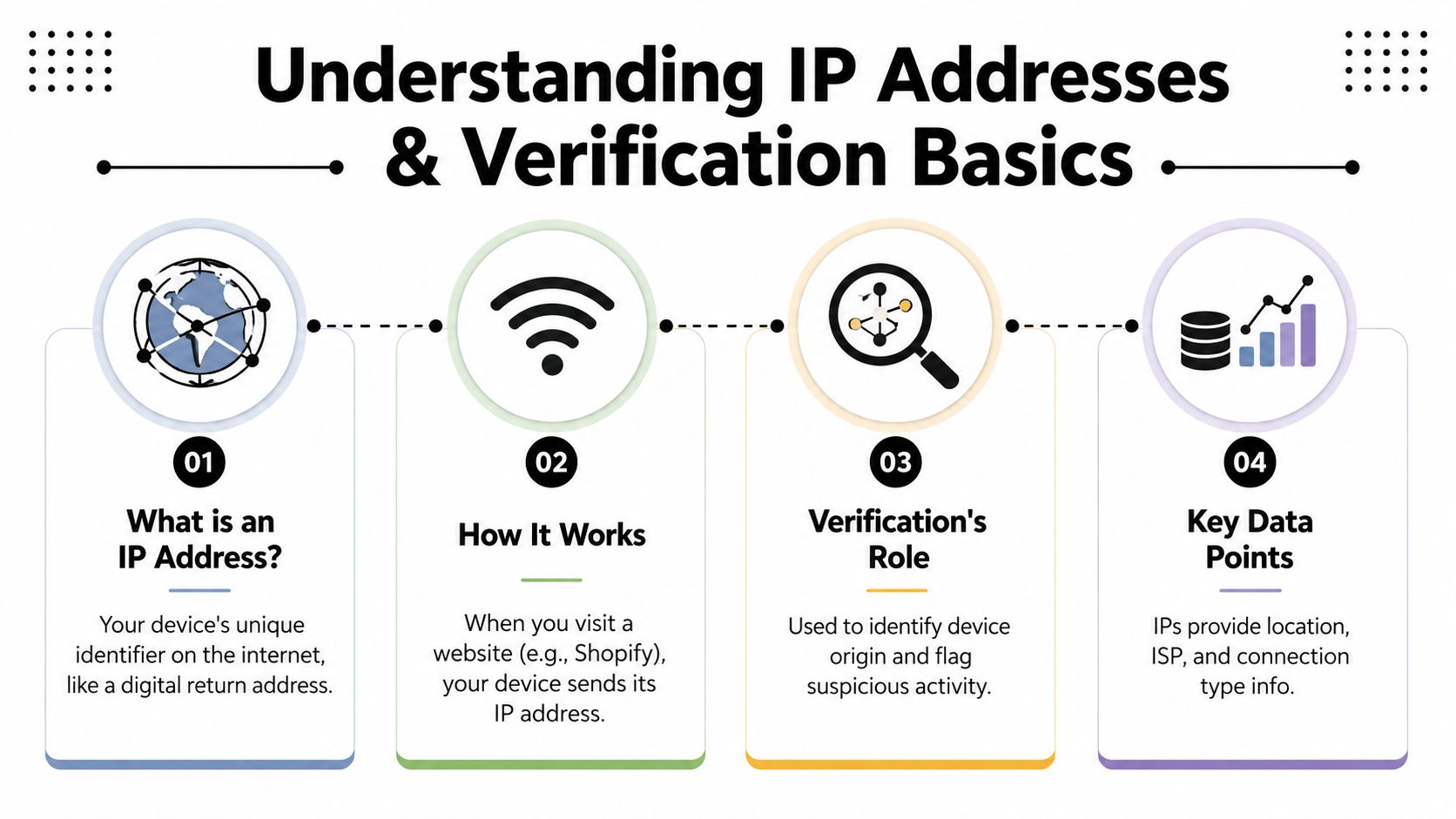
An IP address is the internet version of a return address. When a shopper visits your store, their phone or laptop sends that address along with the request so the site knows where to send data back.
That doesn't mean the IP tells you exactly who the person is. It tells you about the connection being used at that moment. That's an important difference.
What an IP check can tell you
A basic IP lookup usually gives you a few practical clues:
- Approximate location: country and sometimes city or region.
- Network provider: the ISP or network owner associated with the connection.
- Connection context: whether the traffic appears to come from a mobile network, home connection, corporate network, hosting provider, or another environment.
For fraud review, that helps you ask better questions. Does the network location broadly fit the billing or shipping story? Does the order come from a normal consumer connection, or from infrastructure that looks less typical for a retail purchase?
What a stronger verification process looks like
A better IP verification workflow doesn't stop at geolocation. For higher-confidence checks, the IP should be paired with WHOIS or RDAP ownership data, because those records show the registered holder, allocation details, and administrative information for the address block. That helps you spot cases where a customer's claimed identity doesn't fit the network that's sending the traffic, as described in this explanation of IP WHOIS lookup and RDAP-based ownership checks.
In practice, that means you're verifying two different things:
| Check | What it answers | Why it matters |
|---|---|---|
| Basic IP lookup | Where does this connection appear to come from? | Useful for spotting obvious location conflicts |
| WHOIS or RDAP review | Who controls this address block? | Useful for understanding whether the network context makes sense |
Merchants often mix up AVS and IP verification. AVS compares billing address details with card issuer records. IP verification looks at the network origin of the order. Both help, but they solve different problems. If you want a cleaner breakdown of the billing side, see this guide on AVS address verification.
An IP address tells you about the road the order traveled on. It doesn't tell you, by itself, who was driving.
Key Verification Methods Unpacked
If you only look at the country tied to an IP, you're using one small piece of a bigger toolset. Useful review comes from combining several methods and asking whether they agree.
Geo-IP lookup
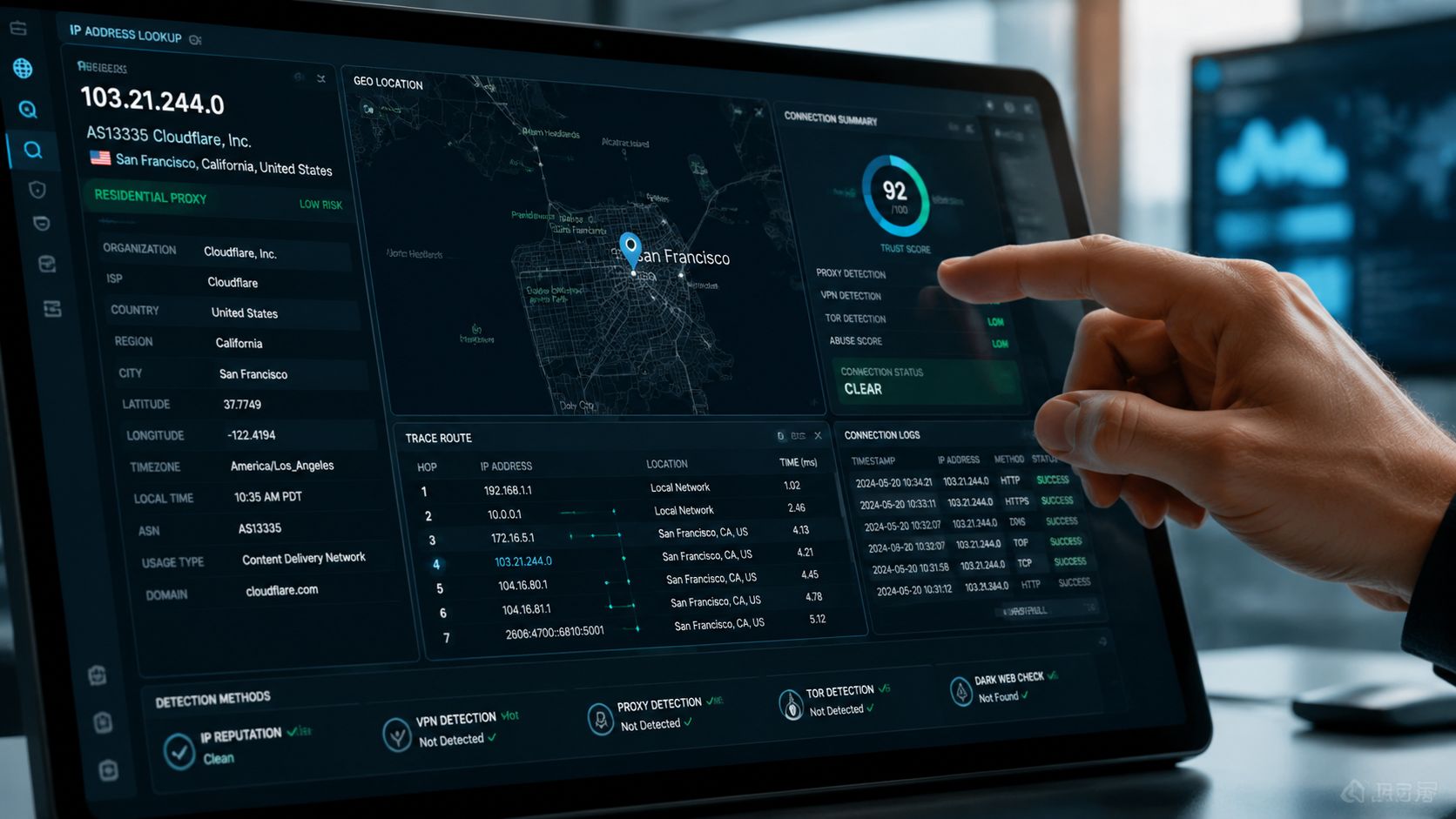
This is the first pass. You check where the IP appears to be located and compare it with the billing and shipping information.
A broad mismatch can matter. If the order says the customer is local but the connection originates far away, that deserves attention. A close mismatch may mean much less. Mobile users, business travelers, and customers using carrier routing often look strange without doing anything wrong.
Use geo-IP to triage, not to convict.
Reverse DNS and network naming
Reverse DNS can sometimes show the hostname associated with the IP. That may reveal whether the traffic comes from a residential provider, corporate network, cloud host, or other setup.
This isn't always available or cleanly labeled, but when it is, it gives context. An expensive consumer order coming from a network that looks more like infrastructure than a person browsing from home may need extra review.
HTTP header analysis
Order traffic carries more than the IP itself. HTTP headers can provide hints about browser type, device behavior, language settings, and whether the connection profile feels normal.
Headers aren't identity proof either. They can be manipulated. But they can help answer an operational question: does the order look like it came from a regular shopper using a normal browser session, or from automation, relayed infrastructure, or something stitched together?
A useful comparison looks like this:
- Normal shopper profile: consumer browser, plausible language settings, ordinary device behavior, residential or mobile network context
- Higher-risk profile: unusual browser signatures, inconsistent connection clues, hosting-related infrastructure, or signs the customer is hiding origin
Proxy and VPN detection
This is the method merchants usually care about most, and for good reason. Fraudsters often try to hide where they really are.
Public explanations of IP checks often reduce this to a yes or no question, but the underlying issue is risk scoring. Shared networks, NAT, proxies, and similar conditions can weaken IP-based client identification, and stronger authentication is sometimes the better answer, as discussed in Stanford's work on detecting NAT and proxy usage in client identification.
That matters for Shopify stores because a proxy result doesn't always mean fraud, but it does change how much trust you should place in the location signal.
Before you make a fulfillment call, it helps to pair network signals with payment-side friction tools. One example is 3D Secure authentication, which can add issuer-backed proof that matters far more than an IP check when a dispute lands.
A quick walkthrough helps make these layers clearer:
The Hard Truth About IP Address Accuracy and Limits
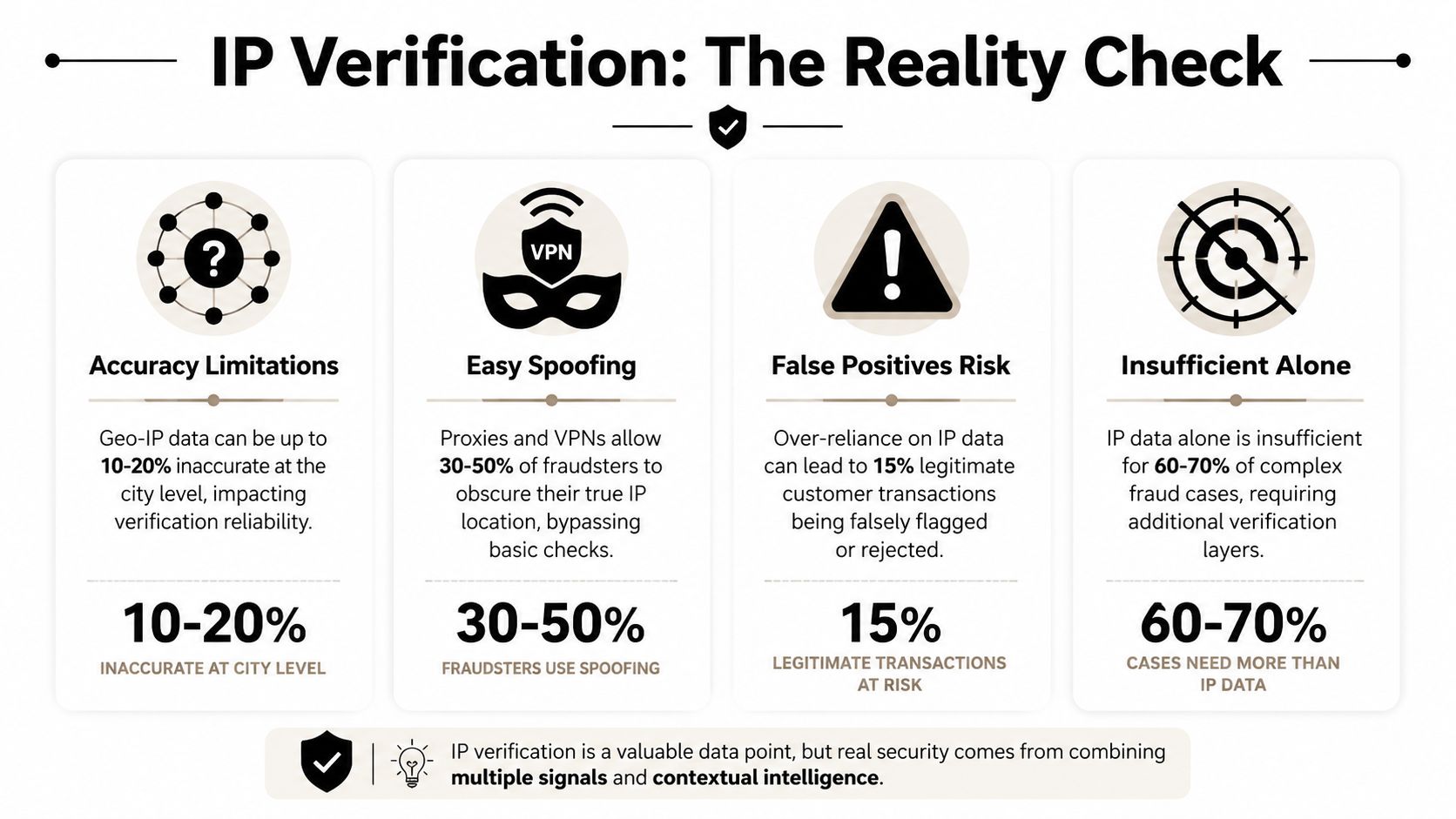
Many merchants assume IP address verification is more precise than it really is. It isn't.
A 2025 Truthset analysis found that IP-to-postal matches were accurate only 13% of the time and IP-to-email matches were accurate only 16% of the time. It also found that different providers agreed on only 6.4% of IP-to-postal linkages and 2.8% of IP-to-email linkages, which is a strong warning that IP-based identity matching varies materially by provider and method. The same analysis found 3× more IPs per postal code than ISP reports would suggest, reinforcing that IPs are not stable one-to-one household identifiers, according to Truthset's analysis of IP address accuracy.
Why good customers look suspicious
These weak match rates make more sense when you look at how internet connections work.
- Mobile connections shift often: a customer can place an order from a phone and appear to come from a network region that doesn't neatly match their home address.
- Households share one connection: several people can sit behind the same public IP.
- Corporate and campus networks blur location: the visible network exit point may not be where the customer physically sits.
- VPN use is normal: some shoppers use privacy tools for routine browsing, not fraud.
That means a mismatch often signals ambiguity, not guilt.
If you auto-cancel every order with an IP mismatch, you'll block real customers for behavior that is completely ordinary online.
What merchants should trust instead
The most useful question isn't "Does the IP match?" It's "How much weight should this mismatch carry relative to everything else?"
Use this decision frame:
| Situation | How to read it |
|---|---|
| IP mismatch only | Low-confidence risk clue |
| IP mismatch plus delivery red flags | Stronger concern |
| IP mismatch plus account behavior issues | Escalate review |
| IP aligns, but everything else looks wrong | Don't let the IP create false comfort |
False confidence hurts merchants. A nearby IP doesn't prove a transaction is good. A faraway IP doesn't prove it's bad. IP data is one input. The value comes from how well you combine it with the rest of the order record.
Using IP Data to Win Shopify and PayPal Chargebacks
The most profitable use of IP data isn't at checkout. It's in the dispute file after a customer claims the purchase wasn't valid.
Take a common PayPal situation. The customer says the item wasn't received, or says they didn't authorize the transaction. You have delivery confirmation, order timestamps, and Shopify order details. Buried in that record is the IP address used when the order was placed. On its own, that field won't win the case. Combined with the rest, it can help you build a much stronger story.
Build a consistency argument, not an IP argument
IP address verification is strongest when it's part of a real-time location consistency check that compares the device's observed network location with the user's declared address and flags divergence as a risk indicator, as explained in this overview of real-time address verification and location consistency checks.
For a dispute response, that means your job is to show inconsistency across the transaction profile.
A practical file might include:
- The Shopify order page screenshot showing billing address, shipping address, order timestamp, and order IP.
- Carrier proof of delivery showing the package reached the address the customer provided.
- Customer communication such as order confirmation, shipping updates, or support replies.
- Order timeline evidence showing the purchase, fulfillment, and any account activity in sequence.
A merchant-friendly example
Suppose the billing address is in California. The package ships to New York. The order IP points to activity from outside that expected customer pattern. Then the customer later disputes the transaction through PayPal.
You don't want to write, "The IP was different, therefore fraud."
You want to write something closer to this:
The transaction details show multiple location indicators that do not align in a normal way. The customer submitted a billing address in one state, requested shipment to another, and placed the order from a network location inconsistent with the declared customer profile. This mismatch should be reviewed together with the confirmed delivery record and the successful order activity tied to the purchase.
That wording matters because it doesn't overclaim. It presents the IP as one part of a broader inconsistency pattern.
What evidence actually helps
Merchants usually get better results when they package IP data with concrete operational proof.
- Show the full order context: include the Shopify admin view, not just an isolated IP lookup screenshot.
- Tie the IP to the order event: make clear that the IP was captured during checkout or account activity connected to the purchase.
- Pair it with fulfillment proof: delivery scans, signature records if available, and shipping address confirmation carry weight.
- Include customer actions: account login, email confirmation, or support messages after purchase can help undermine a friendly fraud claim.
A concise dispute package often works better than a huge one. Reviewers need a clean narrative.
For Shopify merchants using Shopify Payments, these cases often overlap with broader payment dispute workflows. This guide on Shopify Payments chargebacks is worth reading if you want to tighten the process around evidence collection and submission timing.
The goal isn't to prove the IP equals the customer. The goal is to show the transaction behavior was consistent with a real purchase or inconsistent with the customer's later claim.
Automating Your Defense Beyond IP Checks
Manual IP review breaks down fast. It takes time, and modern attackers know how to route around simple rules.
Recent fraud infrastructure, including the 911 S5 botnet, shows how organized attackers can mask origin effectively. The practical takeaway is that IP verification now works better as a detection enrichment layer than as a standalone trust decision, as discussed in this merchant-focused piece on recent changes in IP address verification and fraud infrastructure.
Why single-signal review fails
A fraudster can hide an origin IP. What they struggle to fake consistently is the full transaction pattern.
That's why stronger review systems correlate signals such as:
- Order behavior: unusual checkout speed, repeat attempts, or strange item combinations
- Customer profile: whether the email, shipping pattern, and account history fit normal buying behavior
- Device and session clues: whether the device context stays consistent through the journey
- Post-purchase evidence: delivery events, customer messages, and dispute timing
One signal can be noisy. A pattern is harder to argue with.
What automation changes
The primary value of automation isn't that it checks more boxes. It's that it builds a defensible evidence trail at the speed chargeback operations require.
Instead of asking a staff member to inspect every risky order manually, automated systems can:
| Manual process | Automated process |
|---|---|
| Review one order at a time | Evaluate many signals together |
| Depend on subjective judgment | Apply consistent evidence logic |
| Miss deadlines during busy periods | Keep dispute workflows moving on time |
That matters because chargebacks are operational work as much as fraud work. Evidence has to be gathered, organized, and submitted before deadlines. If that process is scattered, even a valid defense can lose.
If you're looking at the bigger picture, this guide to automated chargeback and dispute management using AI lays out what merchants should expect from a system that handles prevention, evidence building, and representment together.
A modern chargeback defense doesn't ask whether the IP matched. It asks whether the full record supports the merchant's side of the dispute.
Chargebacks don't wait for your team to become fraud analysts. If you're running a Shopify store and losing time or revenue to disputes, ChargePay is built to handle the work automatically. It has a 92.4% win rate across 200K+ cases, has recovered $10.8M+ for merchants, carries a 4.9-star Shopify App Store rating, and holds the Built for Shopify badge. Install it from the Shopify App Store if you want AI-generated evidence packages, faster responses, and a pay-per-win model that only charges when money is recovered.


.svg)



.svg)


.svg)
.svg)
.svg)