

When you lose a payment dispute, you're not just losing the sale. For every $100 you lose to a chargeback, our data shows you lose another $35 in fees and operational costs. We’ve handled over 100,000 disputes for Shopify merchants, recovering $2.8 million with a 92.4% win rate, and we’re here to show you how to fight back. This guide pulls back the curtain on the real damage payment disputes cause and how you can stop the bleeding.
The True Cost of Payment Disputes for Shopify Stores
That first payment dispute notification feels like a punch to the gut. Your immediate thought is probably about the $100 you just lost from that sale. The reality, though, is much worse. A dispute isn't a simple refund; it's a chain reaction of fees, wasted time, and potential penalties that quietly bleed your profits dry.
After helping Shopify merchants navigate over 100,000 disputes, we’ve seen one thing surprise store owners the most: the hidden costs they never accounted for.
Beyond the Lost Sale
Let's walk through how a single $100 chargeback quickly spirals into a much larger loss. You're not just losing the revenue from the sale; you’re also on the hook for a whole lot more.
- Transaction Reversal: First, the $100 sale amount is immediately pulled from your account.
- Chargeback Fee: Your payment processor then tacks on a non-refundable fee, usually between $15 and $25, just for handling the dispute.
- Operational Costs: Think about the hours you or your team spend digging for evidence, writing responses, and making sure you don't miss a deadline. That’s valuable time you could have spent on marketing or talking to customers.
- Lost Product: And, of course, you've likely already shipped the item. So, you're out the product itself and the money you spent to acquire it.
This isn't a small problem. It's exploding, largely thanks to "friendly fraud"—when a customer disputes a completely legitimate charge. Global payment fraud losses shot up to $41 billion in 2022, a massive jump from $17.5 billion just two years earlier. This type of friendly fraud now makes up a staggering 45% of all chargebacks merchants face.
The bottom line for Shopify merchants is painful. For every $100 lost to a chargeback, businesses are absorbing total costs of around $35. It’s a huge revenue leak that too many Shopify store owners just accept as part of doing business.
How a Single $100 Chargeback Impacts Your Bottom Line
To really see how the costs multiply, let's lay it all out. What starts as a $100 problem quickly becomes a much bigger hole in your budget.
As you can see, a single dispute over a $100 product can easily end up costing you nearly double that amount. This is money straight out of your pocket.
The Financial Snowball Effect
A couple of disputes here and there might seem like no big deal, but they add up fast. Once your dispute-to-transaction ratio starts to climb, payment processors will flag your store as "high-risk." This can trigger even higher processing fees, force you into expensive monthly monitoring programs, or worse, lead to them shutting down your merchant account entirely.
Simply ignoring disputes isn't an option. It's a direct path to burning cash and putting your entire store at risk. At ChargePay, we've recovered over $2.8 million for merchants by fighting these disputes head-on, proving you don’t have to take these losses lying down. Our 92.4% win rate demonstrates that with a solid strategy, you can win.
If you want to get into the nitty-gritty of the fees themselves, check out our guide on what a chargeback fee really entails.
Ultimately, every dispute you lose is more than a one-time transaction—it’s a financial wound that slowly eats away at your business. Understanding the true cost is the first step. The next is building a defense. With ChargePay, an app recognized with a Built for Shopify badge and a 4.9-star rating, you can automate your entire dispute process. Install ChargePay from the Shopify App Store and stop the bleeding for good.
Your First 24 Hours When a Dispute Notification Arrives
That "Payment Dispute" email just landed in your inbox. Your stomach drops. Before you let the panic take over, just know this: the clock is officially ticking. A fast, organized response is your single biggest advantage. Banks and card networks see a slow reaction as a sign you're disorganized, which puts you on the defensive right from the start.
What you do in these first 24 hours sets the stage for your entire case. This isn't about writing the perfect rebuttal just yet. It's about quickly figuring out what's going on and pulling together the exact evidence you need to prove you did everything right.
Triage and Categorize the Dispute
First things first, you need to understand what kind of dispute you're dealing with. They aren't all the same, and your initial read on the situation will tell you exactly what evidence to hunt for. Most disputes fit into one of three buckets:
- Potential Criminal Fraud: This is the classic stolen card scenario. Keep an eye out for red flags like a mismatch between the billing and shipping addresses, failed AVS or CVV checks, or a sudden burst of orders from a brand-new customer.
- Customer Service Issue: Maybe the customer is genuinely unhappy. Perhaps the product showed up damaged, or it was the wrong size. These are often legitimate problems that could have been sorted out with a simple email or a refund before it ever became a dispute.
- Likely "Friendly Fraud": This is, by far, the most frustrating one. Here, a real customer buys something, gets their item, and then disputes the charge. They'll often claim they "don't recognize" the transaction or that the "product was not received." It’s basically buyer's remorse dressed up as fraud.
Sorting the dispute into one of these categories helps you focus. If the claim is "Product Not Received," your proof of delivery is your golden ticket. For a "Transaction Not Recognized" claim, you'll need to connect the customer to the order using things like IP data, their order history, and any emails you've exchanged.
The moment a payment dispute is filed, the cost of that transaction starts to climb. What began as a simple sale now includes the reversed funds, a non-refundable dispute fee, and the potential permanent loss of your product and shipping costs.
This visual shows just how quickly the cost of a dispute can spiral far beyond the original sale price.
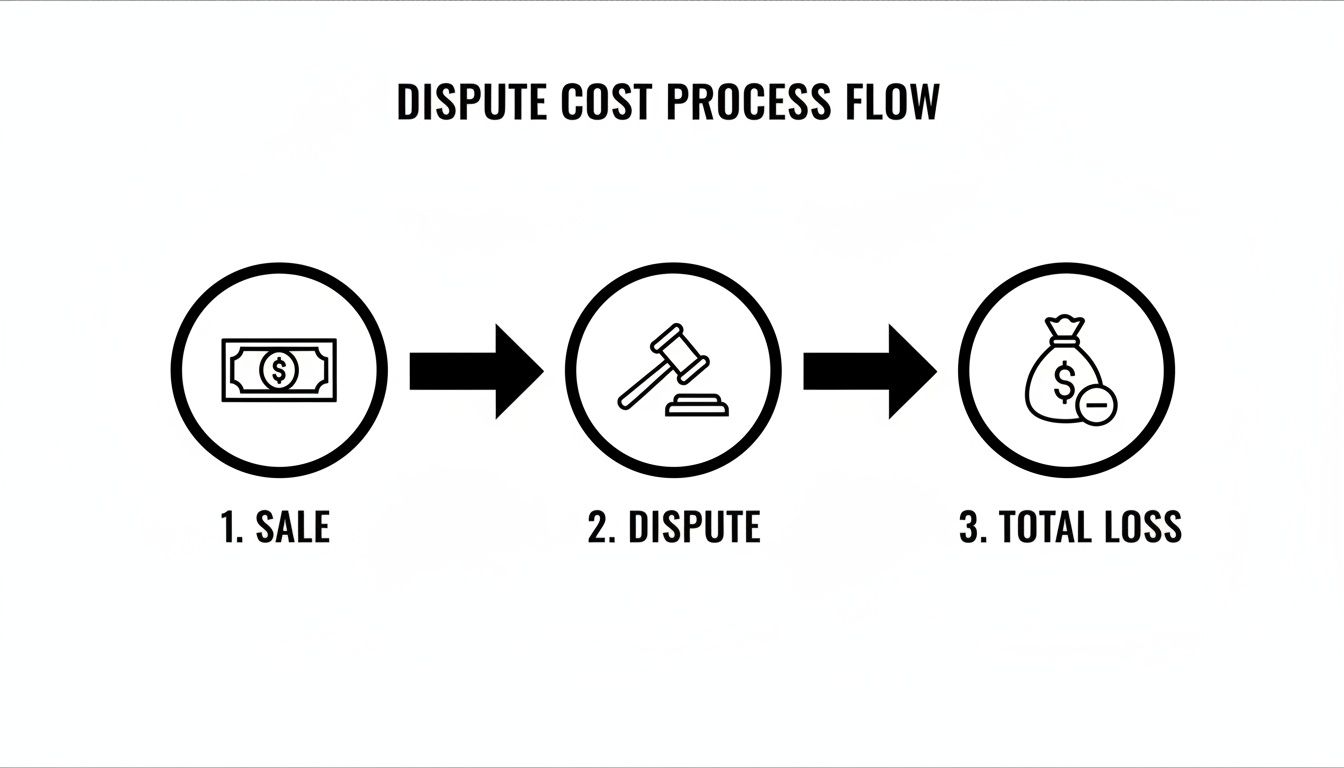
It’s a stark reminder of why a quick, evidence-backed response is so important—every lost dispute costs you way more than just the initial order value.
Immediately Gather Your Core Evidence
Okay, you've categorized the dispute. Now it's time to build your evidence file. Don't put this off. Log into your Shopify dashboard and any other systems you use and start pulling everything related to that order. Your mission is to paint a complete picture of a valid, fulfilled transaction.
Here’s your evidence checklist:
- Order and Customer Details: Screenshot the order page in Shopify. Make sure it clearly shows the customer's name, email, billing/shipping addresses, and the products they bought.
- Proof of Delivery: This is an absolute must-have. Grab the tracking number and get the official proof of delivery from the carrier's website. If you have a photo of the delivery or a signature confirmation, that’s even better.
- Customer Communications: Dig up every email, live chat log, or social media DM you've had with the customer. Showing that they contacted you—or more importantly, didn't contact you—about a problem provides powerful context.
- Transaction Data: Get the AVS and CVV response codes and the IP address that was used to place the order. Showing that the IP address matches the customer's billing city is a strong piece of evidence against friendly fraud.
By grabbing all this data right away, you arm yourself with the facts to shut down the specific claim being made. If you want to see how this all fits into the bigger picture, you can learn more about the complete card dispute process in our detailed guide.
This proactive sprint stops you from scrambling for documents days later and makes sure you're ready to fight back effectively. It's the same systematic approach our AI at ChargePay follows to hit a 92.4% win rate for Shopify merchants. We’ve successfully handled over 100,000 disputes and recovered $2.8 million by turning this 24-hour dash into an instant, automated action.
Building an Evidence File That Wins
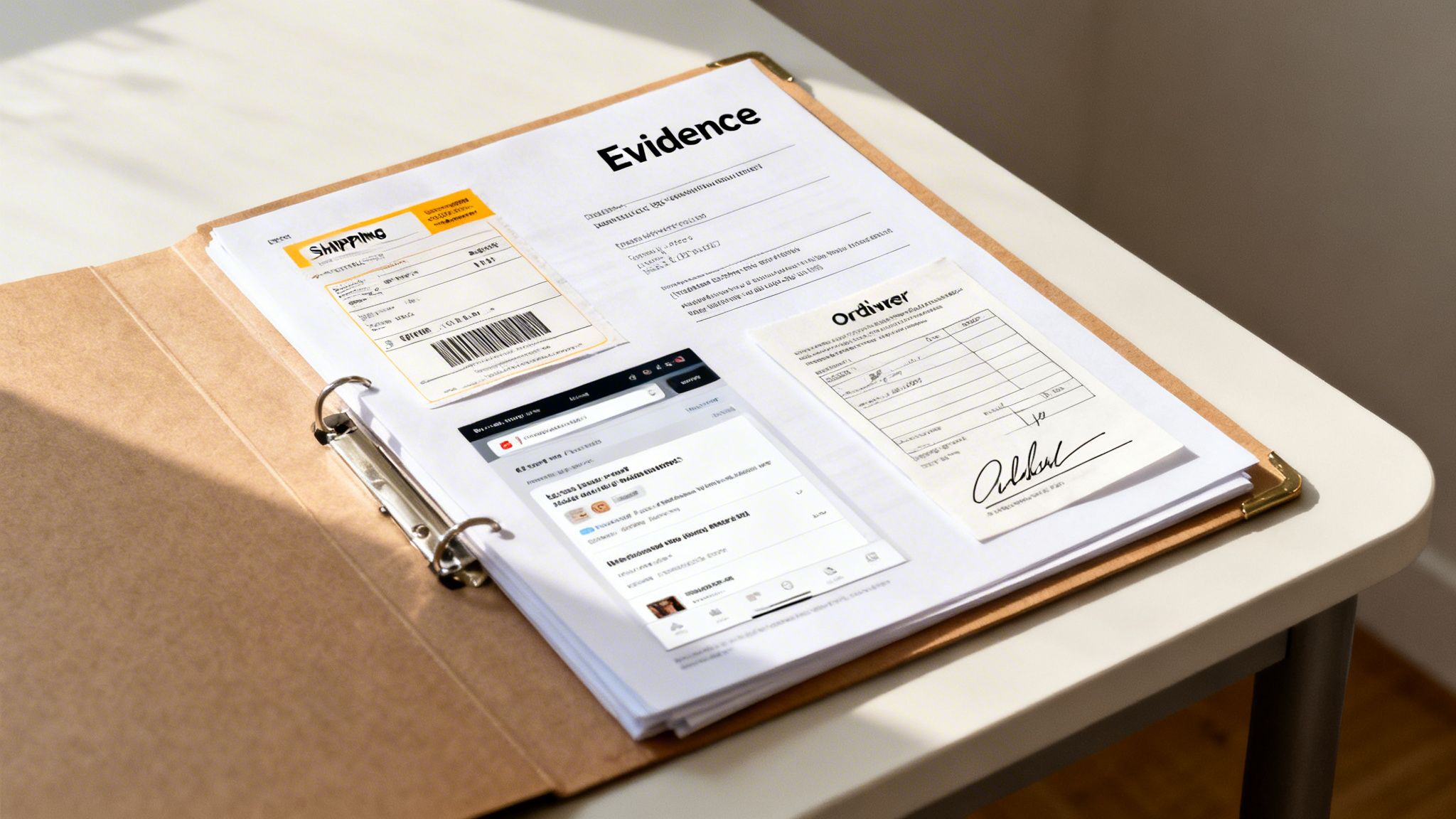
Throwing weak, incomplete evidence at a payment dispute is the fastest way to lose your money. When a dispute lands on a bank reviewer's desk, they have one job: decide if the transaction was legit based on the proof you provide. A simple tracking number just doesn't cut it anymore. You have to build an airtight case that tells a complete story and leaves zero room for doubt.
Think of it like this: the bank reviewer is a juror who knows nothing about your business or this specific order. Your evidence file is your only shot to convince them. A thin, confusing file gets tossed aside, and you lose by default. It’s exactly why a systematic approach is so critical. It’s how we at ChargePay have hit a 92.4% win rate across more than 100,000 disputes, getting over $2.8 million back for merchants like you.
The stakes are higher than you might think. In 2023, global chargeback volume exploded past 238 million disputes. Merchants only won about 45% of these fights, and the losses go way beyond the sale price. For every $100 lost to friendly fraud, merchants get hit with an average of $35 in extra costs from fees and operational headaches.
Go Beyond the Tracking Number
The single biggest mistake we see merchants make is just submitting a tracking number and calling it a day. It’s not enough. A tracking number that says "Delivered" proves something was dropped off in a zip code, but it doesn't prove what was delivered or that it went to the right person.
Your goal is to build a wall of compelling evidence that makes it impossible for a reviewer to side with the cardholder. You need to connect the person who placed the order to the person who received the goods.
This means pulling together different types of proof:
- Transaction and Order Details: Screenshots of the Shopify order page, AVS and CVV match confirmations, and the IP address used for the purchase.
- Proof of Service/Delivery: Go beyond the tracking number. Get delivery confirmation that shows the full address. A photo of the package at the door or a signature is even better.
- Customer Communications: Include every email, chat log, or social media message with the customer. This can prove they never tried to solve the issue with you first, which torpedoes their claim.
- Product and Policy Pages: Screenshots of the product page the customer ordered from, plus your shipping and refund policies. This proves you were transparent about what you were selling and the terms of the sale.
Structuring Your Evidence for Clarity
Once you have your evidence, how you present it is just as important as what you include. Don't just dump a folder of random files on the bank. You have to organize it logically so a busy reviewer can understand your case in seconds.
A strong evidence package should be built to directly counter the specific reason for the dispute.
Example Scenario: Dispute for "Product Not Received"
A customer files a dispute claiming they never got their item. A weak response is just the tracking number. A winning response, on the other hand, would include:
- Shopify Order Details: Clearly showing the customer's name and the exact shipping address they provided.
- IP Address Match: Proof that the IP address from the order's geolocation matches the cardholder's billing city.
- Shipment Confirmation Email: A copy of the email you sent the customer with their tracking information.
- Carrier Proof of Delivery: The official delivery confirmation from the carrier’s website showing the full address and a "Delivered" status. A photo is gold here.
By layering these pieces of evidence, you're no longer just saying, "We sent it." You're proving, "The person who owns this card ordered from this location, we sent the package to the address they gave us, and the carrier confirms it was delivered there."
This methodical approach completely shuts down the "I never got it" argument. It’s the kind of comprehensive response our AI builds automatically for every single dispute, making sure no detail is ever missed. You can check out our complete guide to chargeback dispute management for more strategies.
Fighting payment disputes shouldn't be a guessing game. By building a strong, story-driven evidence file, you dramatically improve your odds of winning. If collecting all this sounds like a ton of manual work, that's because it is. That's why we built ChargePay—our AI does all of this for you in an instant. Install ChargePay from the Shopify App Store and let our 4.9-star rated, Built for Shopify platform turn your evidence into recovered revenue.
Writing a Rebuttal Letter That Gets You Paid

You've gathered all your evidence, and your case feels solid. But all that proof is just a pile of documents without a clear, persuasive rebuttal letter to tie it all together. This short letter is your chance to tell your side of the story and guide the bank reviewer to a decision in your favor.
Think of the person on the other end. They're sifting through dozens, maybe hundreds, of cases every single day. They don’t have time to connect the dots on a confusing claim. A poorly written, emotional, or jumbled letter can sink your case, even if you have rock-solid evidence. Your letter needs to be the roadmap that makes their job easy.
After personally managing over 100,000 disputes for Shopify merchants, we’ve learned exactly what it takes to win. It isn't about crafting a lengthy legal brief. It's about being direct, staying professional, and laying out the facts so clearly that the only logical outcome is you getting paid.
Start with a Clear Transaction Summary
Before you dive into your argument, set the stage. The very first thing your letter should do is give the reviewer a quick, factual snapshot of the transaction. No opinions, no arguments—just the simple who, what, when, and where.
Make sure you include these details right at the top:
- Customer Name: The name on the order.
- Order Date: The day the purchase was made.
- Order Amount: The total value of the transaction.
- Brief Product Description: Something simple like "one blue T-shirt, size large."
- Delivery Date: The date the carrier confirmed the delivery.
This simple introduction immediately gives the reviewer the context they need to understand the case. It shows you’re organized and sets a professional tone from the get-go.
Directly Counter the Customer's Claim
Now it's time to get to the heart of the matter. Clearly state the reason for the dispute (e.g., "The customer has filed a dispute under the reason code 'Product Not Received.'") and then immediately push back with your most powerful evidence.
This is where you connect your letter directly to the proof you’ve gathered. Guide the reviewer by referencing each piece of evidence you've attached.
For a "Product Not Received" claim, your response could look something like this:
"We are contesting this claim. As documented in Exhibit A (Shopify Order Details), the customer provided a shipping address of 123 Main Street. Our records in Exhibit B (Shipment Confirmation Email) show the item was shipped to this exact address on [Date]. Critically, Exhibit C (Carrier Proof of Delivery) includes photographic confirmation that the package was successfully delivered to the customer’s address on [Date]."
See how that works? You’re not just saying it happened; you’re showing them the proof, step-by-step. This clear, evidence-based approach is a core reason ChargePay achieves a 92.4% win rate. We’ve seen time and again that clarity is what wins disputes.
Maintain a Professional and Factual Tone
It’s completely understandable to feel frustrated, especially when you’re dealing with what looks like obvious friendly fraud. But letting that emotion seep into your rebuttal letter is a massive mistake. You must avoid angry, sarcastic, or accusatory language at all costs. Just stick to the facts.
Ditch phrases like:
- "The customer is clearly lying."
- "This is a ridiculous and false claim."
- "We demand you reverse this fraudulent chargeback immediately."
Instead, keep it calm, objective, and professional:
- "The documentation provided does not support the customer's claim."
- "The transaction was valid, and the product was delivered as described."
- "Based on the attached evidence, we request that the dispute be closed in our favor."
A level-headed, factual tone signals to the bank that you're a serious business professional, not just an angry merchant. This builds the credibility you need to win. Our AI at ChargePay is trained to do exactly this—generate perfectly toned, data-driven rebuttals for every dispute, taking the emotion out of the equation and recovering over $2.8 million for our clients. Stop letting poorly written responses cost you money. Install ChargePay from the Shopify App Store and let our 4.9-star rated, Built for Shopify app write the letters that get you paid.
Putting Your Dispute Management on Autopilot with AI
Let's be honest: fighting every payment dispute yourself is a slow, frustrating grind. It yanks you away from the important work of actually running your business and throws you into a high-stakes admin role you never wanted.
This is where automation comes in. For Shopify merchants, it doesn't just help—it completely changes how you handle disputes. Instead of spending hours digging for evidence and worrying about deadlines, an AI-powered system can manage the whole process for you. At ChargePay, we built our platform to do just that, and we've seen firsthand how automation can plug a serious revenue leak.
How AI Changes the Dispute Workflow
Picture this: a new dispute notification lands. Instead of that sinking feeling in your stomach, an automated process kicks into gear instantly. Our AI gets to work, analyzing the dispute to pinpoint the reason code and figure out exactly what evidence you need to win.
Then, the system connects to your Shopify store and automatically pulls all the crucial data:
- Order Details: The customer's information, what they bought, and the transaction amount.
- Shipping Confirmations: Tracking numbers and official delivery confirmations from carriers.
- Customer History: Any past orders or communication you've had with them.
- Fraud Signals: Details like AVS/CVV checks and IP address data.
This entire process, which would take a person a significant amount of time, happens in seconds. No more sifting through old emails or downloading files. The AI gathers everything, gets it organized, and starts building your winning case.
Crafting the Perfect Response, Every Time
Once all the evidence is collected, the AI generates the rebuttal letter. This isn't just filling out a bland template. Our system uses insights from successfully handling over 100,000 cases to create a perfectly structured response tailored to the specific dispute.
This is the very system that has recovered over $2.8 million for merchants like you. It knows what bank reviewers are looking for and how to present your evidence in the most compelling way possible. The AI then submits the complete package on your behalf, ensuring you never miss a deadline with an optimized response.
This approach is so important because the system is often stacked against you. Research shows that 76% of cardholders find it easier to dispute a charge with their bank than to contact the merchant. And since 89% of them trust their bank to handle it fairly, you're starting on the back foot. You can read more about these trends in this report on cardholder dispute behavior. AI automation is how you level the playing field.
The ChargePay Advantage: Proven Results
We built ChargePay from the ground up for Shopify merchants because we know the unique challenges you face. Our platform isn't just about sending automated replies; it’s about winning disputes. That’s why we maintain a 92.4% win rate and have earned a 4.9-star rating along with the prestigious 'Built for Shopify' badge.
With ChargePay, payment disputes stop being a daily headache. They become a background task that’s handled for you, freeing you up to focus on growing your brand with the confidence that your revenue is protected.
This isn't some theoretical improvement—it’s a practical solution that puts money back into your business. The technology powering this is advancing at an incredible pace. If you're curious about how AI is simplifying complex tasks in other fields, checking out the best legal AI tools for lawyers offers a fascinating look into its broader applications.
For a deeper dive into how it all works, take a look at our complete guide to automated chargeback management using AI.
Ready to put your dispute management on autopilot? Install ChargePay from the Shopify App Store and let our AI start turning your chargebacks into recovered revenue.
Frequently Asked Questions About Payment Disputes
Running a Shopify store is tough enough without payment disputes throwing a wrench in the works. They can be confusing, frustrating, and feel like an uphill battle. We get it.
After handling over 100,000 disputes for merchants just like you, we’ve heard pretty much every question imaginable. Here are the answers to the ones that pop up most often.
What Is Friendly Fraud and How Do I Prove It?
Friendly fraud is a particularly nasty headache for store owners. It’s when a customer makes a legitimate purchase with their own card, receives their item, and then contacts their bank to claim the charge was unauthorized or that the product never showed up. It's basically buyer's remorse disguised as a real problem.
To fight back, you have to prove the person who owns the card is the same person who placed the order and received the goods. You need to build a solid case by connecting the dots.
Your evidence should include:
- AVS and CVV matches: This is your first line of defense, showing that the person placing the order had the physical card and knew the associated billing address.
- IP address logs: Proving the order was placed from an IP address that matches the cardholder’s location is a huge blow to any "unauthorized purchase" claim.
- Delivery confirmation: This is non-negotiable. A photo or signature confirming delivery to the right address is your best weapon against "product not received" claims.
- Customer communications: Did the customer email you before filing the dispute? If not, pointing out their lack of contact is powerful. It shows they didn’t even try to resolve the issue with you first.
The key is to paint a complete picture for the bank reviewer. You're not just saying, "This was a valid charge." You're proving, with evidence, that the real cardholder ordered the item, gave you the shipping address, and got exactly what they paid for.
This evidence gathering is precisely what our AI at ChargePay does in seconds. It pulls together all the critical data to build a winning response against friendly fraud, which is a big reason we’ve recovered over $2.8 million for our clients.
How Long Do I Have to Respond to a Dispute?
This is a big one. The official deadline to respond to a dispute usually falls somewhere between 20 and 45 days, depending on the card network (like Visa or Mastercard). But you should never, ever treat that as a casual timeline. The quicker you get a detailed response submitted, the better your chances.
Waiting until the last day is a surefire way to lose money. If you miss that deadline by even a minute, you automatically lose the dispute. The money is gone, and there are no do-overs. Banks are incredibly strict about this. Honestly, this is one of the biggest dangers of managing disputes by hand—it's just too easy to miss an email or lose track of a date.
An automated system makes this a non-issue. ChargePay submits every response well before the deadline, preventing these automatic losses and helping us maintain our 92.4% win rate.
Does Winning a Dispute Stop the Customer from Doing It Again?
Unfortunately, no. Winning one dispute doesn't prevent that same customer from trying their luck again on a future order. In fact, some people who get away with friendly fraud once will do it over and over, turning it into a habit.
While you can't block them from their bank, you can make your store a bad target. When you have a strong, automated dispute process in place, you're always ready to fight and win. Serial fraudsters learn quickly. When they realize they can't get free products from you, they’ll move on to a store that’s an easier target. It's all about having a defense that's stronger than their offense.
Can I Just Refund the Customer to Avoid a Chargeback?
Refunding a customer before a dispute is filed is just good business. It’s the best way to solve a problem and keep a customer happy. But once a formal payment dispute is initiated with the bank, issuing a refund is the worst thing you can do.
This is a critical point that trips up so many merchants. If you refund a customer after they've filed a chargeback, you will lose the money twice. The bank will still pull the disputed amount from your account, and you’ll also be out the money from the refund you just sent. On top of that, you still have to pay the non-refundable dispute fee.
Once a dispute is officially in the system, your only way to get your money back is to fight the dispute and win it. This is why having amazing, easy-to-reach customer service is so important for prevention—it encourages customers to talk to you first, so you can solve the problem before it ever gets to the bank.
Stop letting payment disputes drain your profits and your time. ChargePay turns this frustrating process into a solved problem. As a Built for Shopify app with a 4.9-star rating, our AI handles everything automatically, from finding the right evidence to submitting a winning response.
Install ChargePay from the Shopify App Store and let our AI start recovering your money today.


.svg)



.svg)


.svg)
.svg)
.svg)