

That feeling when another chargeback notification hits your inbox? It’s a gut punch. You’re not alone. The hard truth is, even with what seems like solid payment gateway fraud detection, these expensive disputes find a way to slip through. It happens because e-commerce fraud today is a lot more complicated than just stolen credit cards—it's a real threat that eats directly into your Shopify store's profits.
At ChargePay, we've recovered over $2.8 million for Shopify merchants by winning chargeback disputes they thought were lost causes. With a 92.4% win rate across more than 100,000 disputes, we see firsthand how the right defense can turn a loss back into revenue.
The Hidden Costs of Fraud on Your Shopify Store

For Shopify store owners, every single sale feels like a win. But what happens when that win turns into a loss a few weeks down the road? That's the painful reality of e-commerce fraud, and the damage goes way beyond just the initial transaction. You lose the product, the revenue, and get hit with a chargeback fee.
The numbers are pretty shocking. Global losses from online payment fraud shot up to an incredible $41 billion in 2022, and by 2023, just card fraud losses by themselves hit $33.83 billion across the globe. This isn't just some problem for giant corporations; it's a direct blow to your bottom line. If you want to dig into the data, TransUnion’s latest Global Fraud Report breaks it all down.
Beyond Stolen Cards to Friendly Fraud
The classic picture of fraud—some scammer with a long list of stolen credit card numbers—is totally outdated. These days, one of the biggest threats you'll face is something much sneakier: friendly fraud. This is when a real customer buys something, gets their product, and then calls their bank to dispute the charge, claiming they never authorized it.
From your payment gateway's point of view, the order looked completely legitimate.
- The address verification (AVS) was a match.
- The CVV code checked out.
- The transaction sailed right through approval.
But weeks later, a chargeback notice lands in your lap. Now you’re out the product you shipped, you've lost the money from the sale, and you’re stuck paying a non-refundable chargeback fee. It's a triple-loss situation that your standard fraud filters were never really designed to stop.
This is what we call the "chargeback gap"—that gray area where a transaction passes all the initial fraud checks but still ends up as a dispute. It's where Shopify merchants lose the most money, because their gateway’s job is over, but their financial risk is just getting started.
Why Your Gateway's Defenses Aren't Enough
Your payment gateway, whether you use Shopify Payments, Stripe, or someone else, is your first line of defense. It’s great at screening Card-Not-Present (CNP) transactions in real-time, which is obviously a must-have for any online store. Its main job, though, is to make a split-second decision: approve or decline the sale.
It's not built to handle the complicated, evidence-heavy battle that comes after a chargeback is filed. That’s a completely different game, and it requires a different playbook. Trying to fight these disputes on your own is a time-sucking nightmare of digging up screenshots, order details, and shipping confirmations, with zero guarantee you'll even win. For a deeper dive into proactive strategies, take a look at our complete guide on chargeback prevention.
This is exactly why we built ChargePay. We saw Shopify merchants bleeding money in this exact gap. While your gateway is busy focusing on pre-transaction fraud, ChargePay acts as your post-transaction safety net. Our AI is built for one thing and one thing only: winning chargeback disputes. Stop letting friendly fraud drain your profits. Install ChargePay from the Shopify App Store and let our AI start turning your chargeback losses back into revenue.
How Your Payment Gateway Screens for Fraud

Think of your payment gateway as the bouncer at the front door of your e-commerce store. When a customer hits that "Buy Now" button, your gateway has just milliseconds to decide if this person is friend or foe. It runs a series of lightning-fast checks to spot any obvious signs of trouble before the transaction even gets a chance to be authorized.
This frontline defense is what we call payment gateway fraud detection, and it all happens behind the scenes. These initial tests are designed to answer one simple, crucial question: does the person making this purchase actually have the right to use this card?
The First Line of Defense: AVS and CVV
The two most fundamental tools in your gateway's arsenal are the Address Verification System (AVS) and the Card Verification Value (CVV). You've seen them a million times at checkout.
- AVS Check: This system quickly compares the billing address the customer typed in with the address the card-issuing bank has on file. It's looking for a match on the street number and ZIP code. A mismatch is an immediate red flag, suggesting the buyer might not be the real card owner.
- CVV Check: That little 3- or 4-digit code on the back (or front) of a credit card is the CVV. Since this number isn't supposed to be stored in merchant databases and isn't part of the card's magnetic stripe, getting it right helps prove the buyer physically has the card.
These checks are your first filter. They do a decent job of catching low-effort fraud where a scammer might only have a stolen card number but nothing else. But let's be honest—they're far from foolproof against a determined fraudster. A great extra layer of security that works alongside these checks is 3-D Secure, and you can learn more about how 3-D Secure authentication adds protection in our detailed guide.
Calculating a Fraud Score
Beyond these basic checks, modern payment gateways like Shopify Payments use a much smarter method: fraud scoring. Instead of a simple pass-or-fail grade, the system analyzes hundreds of data points in real time to assign a risk level to every single transaction.
It’s a bit like a credit score, but for catching fraud. Each piece of information adds or subtracts from the score, and the final number determines if the order is approved, declined, or flagged for you to look at manually.
A fraud score isn't just one thing; it's a combined analysis of dozens of signals. The gateway is looking for patterns that don't add up, trying to spot behavior that deviates from a legitimate customer's actions.
So, what kinds of signals influence this score? Here are a few key ones:
- IP Address Geolocation: Does the customer's IP address match their billing or shipping address? An order coming from a high-risk country but shipping to a U.S. address is a massive warning sign.
- Order Value: Is this order unusually large compared to your store’s average? Fraudsters often try to max out their payday with big-ticket items.
- Device Fingerprinting: The gateway analyzes the device used for the purchase. A fraudster using proxies or virtual machines leaves a very different digital footprint than a regular shopper on their personal phone.
- Email Address Age: An email address created just hours before a large purchase is highly suspicious and a classic fraudster move.
- Shipping vs. Billing Address: A mismatch here isn't always fraud—it could be a gift. But it definitely raises the risk level, especially when combined with other red flags.
The Limits of Gateway Detection
These tools are powerful, no doubt. But they have one critical limitation: they are built to stop fraud before the sale goes through. They can’t do a thing about a dispute that pops up weeks later, especially in "friendly fraud" cases where the original transaction looked perfectly fine.
This is exactly where merchants get hit the hardest. A transaction can pass every AVS, CVV, and fraud score check with flying colors, only to become a chargeback a month down the road. At that point, your gateway’s job is done, but your revenue is suddenly on the line.
This is the gap where ChargePay steps in. While your gateway guards the front door, we provide the expert security you need to handle disputes that slip through and come back later. We recover your money, with a 92.4% win rate on over 100,000 disputes and counting. For more comprehensive guidance on payment security standards, a detailed PCI DSS compliance checklist is an indispensable resource.
Why AI Is a Game-Changer for Fraud Detection
If your payment gateway’s fraud rules are like a bouncer with a strict checklist, then AI is like a seasoned detective who can spot suspicious behavior a mile away—things no list could ever cover. Standard gateway checks are great for catching the obvious fakes, but they often fall short when dealing with today's sophisticated scams. This is where Artificial Intelligence and Machine Learning completely change the game for payment gateway fraud detection.
Instead of just ticking boxes—like an AVS or CVV match—AI systems work by analyzing massive amounts of data over time. They learn what normal customer behavior looks like specifically for your store, building a complex and constantly evolving picture of your legitimate shoppers.
This allows AI to pick up on subtle things that just don't feel right. For instance, a simple rule might block a sale just because the shipping and billing addresses don't match. An AI, however, can see that this customer has bought from you before, their device is recognized, and their behavior on your site fits a trusted pattern. It correctly flags this as a legitimate gift purchase, saving you from a frustrating false decline.
Rules-Based Systems Versus AI-Powered Detection
It's one thing to talk about the differences, but seeing them side-by-side makes it clear why so many merchants are making the switch. Old-school rules just can't keep up with modern fraud, which is getting smarter by the day.
Here's a direct comparison that shows you why AI-powered systems are so much better at tackling the complex fraud you're up against.
At the end of the day, rules-based systems are reactive. You're always one step behind the fraudsters. AI, on the other hand, puts you on the offensive, actively hunting for threats before they can cause damage.
Adapting to Fraudsters in Real Time
Here's the biggest problem with a rules-based system: it's static. You set the rules, and they stay that way until you go in and manually change them. Fraudsters are clever; they quickly figure out your rules and find ways to sneak past them.
AI, on the other hand, is completely dynamic. It learns and adapts on the fly.
- Pattern Recognition: AI can connect the dots between seemingly unrelated transactions to spot a coordinated fraud attack, even when each individual order looks fine on its own.
- Behavioral Analysis: It watches how a user moves around your site—things like mouse movements, typing speed, and how long they spend on a page—to tell a real shopper from a bot.
- Instant Adaptation: When a new fraud tactic pops up, the AI model updates itself almost instantly to recognize and block it. This is something that would take a human team days or even weeks to catch.
This ability to constantly learn is what makes it so powerful. As your store grows, you process more transactions, which feeds the AI more data. This makes it even smarter and more accurate at protecting your business—a level of defense that static rules just can't offer.
The hard truth is that fraudsters are using AI, so you need AI to fight back. A system that can’t adapt in real time is a system that’s already been beaten. Smarter detection also means fewer false declines, so you keep your good customers happy and bring in more revenue.
How AI Directly Reduces Chargebacks
Ultimately, better fraud detection is all about protecting your bottom line. Every fraudulent order that slips through is a potential chargeback, and that costs you the product, the revenue, and a penalty fee. AI attacks this problem head-on.
But AI's real power isn't just in stopping fraud; it's also about proving it. For the sneakiest types of fraud, like "friendly fraud" where the original order looked perfectly legitimate, AI is your best weapon. ChargePay's AI, for example, has been specifically trained on over 100,000 chargeback disputes.
When a customer files a dispute, our system analyzes their claim against all the original order data and the customer's history. It then automatically builds and submits a powerful evidence package designed to win that specific dispute. This is how we maintain a 92.4% win rate and have recovered over $2.8 million for Shopify merchants. You can learn more about how our AI technology catches chargeback fraud and turns those losses back into revenue.
Stop trying to outsmart fraudsters with outdated rules. Install ChargePay from the Shopify App Store—with its "Built for Shopify" badge and 4.9-star rating—and let our AI give you a real advantage in the fight against chargebacks.
Closing the Gap Where Chargebacks Happen
Here’s a frustrating scenario every Shopify merchant knows all too well: you do everything right. You use a great payment gateway with solid payment gateway fraud detection, the transaction gets a green light, and you ship the product. Weeks later, a dispute notification lands in your inbox, and just like that, your profit is gone.
This painful disconnect is what we call the "chargeback gap."
It's that treacherous space between what looks like a successful sale and the surprise chargeback that comes later. This happens because your gateway’s job is to make a split-second judgment before the sale. It’s fantastic at catching obvious, real-time fraud, like a stolen card number being used from a suspicious IP address. But it simply wasn't built to handle disputes that pop up long after the fact—especially the sneakiest kind of all: friendly fraud.
When Approved Transactions Go Wrong
Friendly fraud is when a real customer makes a purchase but later files a chargeback, often claiming the charge was unauthorized or that the product never arrived. From your gateway's point of view, the transaction looked perfect.
- The AVS and CVV checks passed with flying colors.
- The fraud score was low.
- The transaction was approved without any red flags.
The problem is, the "fraud" doesn't happen at the point of sale. It happens weeks, or even months, later when the customer decides to dispute the charge. At that point, your gateway has moved on. Its job was to approve the transaction, which it did. Now you’re left holding the bag—out the product, the revenue, and stuck with a non-refundable chargeback fee.
This flow chart shows how a transaction moves from initial checks to, hopefully, winning back revenue after a dispute is filed.
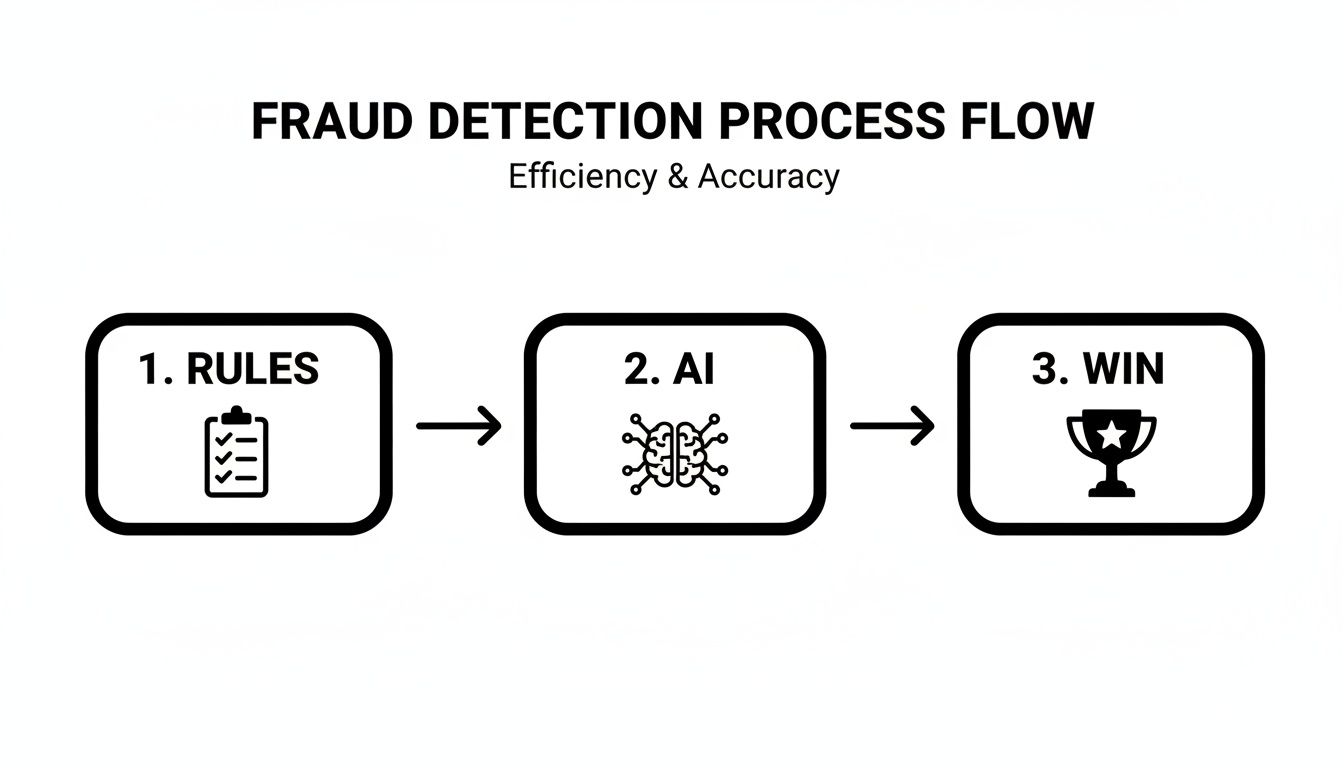
While basic rules and AI are great for the initial screening, the real "win" comes from having a specialized process ready to handle the disputes that inevitably slip through.
ChargePay: Your Post-Sale Defense System
This is exactly the gap ChargePay was built to fill. We saw that Shopify merchants were bleeding money in this post-transaction blind spot. Think of your payment gateway as the bouncer at the front door, checking IDs. We’re the expert security team inside, ready to handle any problems that arise after the guests are already in.
Our job isn’t to approve or decline sales. We have one single focus: winning chargeback disputes after they happen, turning those revenue losses back into profit.
ChargePay doesn't replace your payment gateway's fraud detection; it completes it. We provide the crucial final step in protecting your revenue by managing and winning the disputes that your gateway was never built to fight.
Understanding how to navigate these issues is vital no matter where you sell. The challenges in resolving Amazon chargeback disputes, for example, are rooted in the same principles of compelling evidence and timely responses.
How We Turn Losses into Wins with AI
When a chargeback hits, winning the fight comes down to one thing: evidence. But gathering it all manually is a nightmare. You have to dig up order details, shipping confirmations, and customer communications, then package it all perfectly to meet the bank’s strict rules and deadlines.
ChargePay automates this entire headache with AI. Our system is built for one purpose: chargeback representment. For a deeper dive into this process, you can check out our guide on what chargeback representment involves.
Here’s how it works for you:
- Instant Alerts: The moment a chargeback is filed, our system gets notified through its direct Shopify integration.
- AI-Powered Evidence Gathering: Our AI instantly reads the chargeback reason code and scours your Shopify data for all the compelling evidence needed—order history, shipping details, delivery confirmations, and more.
- Automated Response Generation: It then constructs a professional, evidence-backed dispute response specifically tailored to beat that type of chargeback.
- Submission Before the Deadline: The complete response is submitted on your behalf, so you never have to worry about missing a critical deadline again.
This isn’t some generic template. Our AI has been trained on over 100,000 disputes, learning exactly what evidence wins and what gets ignored by the banks. This specialized intelligence is how we achieve our 92.4% win rate and have recovered over $2.8 million for merchants just like you.
Stop accepting chargebacks as an unavoidable cost of doing business. Let your gateway handle the front door, and let ChargePay protect your profits on the inside. Install ChargePay from the Shopify App Store today—our 4.9-star rating and "Built for Shopify" badge show you're in good hands.
Your Action Plan to Fight Fraud and Win Chargebacks
Knowing how payment gateway fraud detection works is one thing, but putting that knowledge into practice is what actually saves you money. It's time to move from theory to action. This is your practical checklist for turning your Shopify store into a fortress against fraud and a machine for winning back chargeback revenue.
This isn’t about making complicated technical changes. It's about using the tools you already have more effectively and adding the one critical piece that most merchants are missing. Let's build your defense, layer by layer.
Step 1: Configure Your Shopify Fraud Analysis
First things first: Shopify comes with a powerful, built-in fraud analysis system as part of Shopify Payments. Your first job is to make sure it’s working for you, not against you. This system automatically flags orders it considers low, medium, or high risk.
Check your settings and make sure fraud analysis is active. For most stores, the default settings are a great starting point. The system uses machine learning that gets smarter over time by analyzing transactions across all of Shopify, so it's already quite powerful out of the box. Don't be tempted to create overly strict rules right away—you might end up with too many false declines and lose good customers and their sales.
Step 2: Understand and Act on Risk Levels
When an order comes in, Shopify gives you a clear signal. Knowing what to do with these signals is crucial for balancing fraud prevention with a smooth customer experience.
- Low Risk: Green light. These orders are generally safe to fulfill immediately without a second thought.
- Medium Risk: Yellow light. These orders have some flags that are a bit unusual but aren't necessarily fraudulent. This is where a quick manual review is worth your time.
- High Risk: Red light. These orders have multiple strong indicators of fraud, like a shipping address thousands of miles from the card's registered location. The default recommendation is to cancel and refund these orders to avoid an almost certain chargeback.
The key is to develop a quick, efficient process for that "medium risk" category. Don't spend more than a minute or two on each. If you can't quickly verify an order's legitimacy, it's often safer to cancel it than to risk a chargeback.
Step 3: Know When a Manual Review Is Worth It
Manually reviewing every single order is a waste of your valuable time. Instead, focus your energy only on the medium-risk orders and look for quick-to-check signals.
Ask yourself these questions during a one-minute review:
- Does the billing address AVS match? A full match is great; a partial match (like ZIP code only) is a yellow flag.
- Does the IP address location make sense? An order from a customer in Ohio with an IP address from Vietnam is a major red flag.
- Is this a first-time customer placing an unusually large order? This is a classic fraudster pattern. It might be worth reaching out via email to confirm the purchase before you ship.
If an order still feels off after this quick check, trust your gut. A single chargeback can easily wipe out the profit from dozens of successful sales.
Step 4: Install Your Automated Safety Net
Alright, this is the most important step. Even with perfect settings and diligent manual reviews, some disputes will inevitably slip through—especially friendly fraud. Your gateway’s fraud detection tools are your first line of defense, but they are not your last.
This is where you install an automated chargeback management solution to serve as your essential safety net.
ChargePay is designed specifically for this exact moment. While your gateway focuses on stopping fraud before the sale, we focus on recovering your money from the disputes that happen after the sale. Our AI completely eliminates the painful, time-consuming process of manually fighting chargebacks.
After handling over 100,000 disputes and recovering $2.8M+ for Shopify merchants, we’ve learned exactly what it takes to win. Winning disputes on your own is a tough, time-consuming job; you can learn more about how to win a credit card dispute in our dedicated guide.
With a proven 92.4% win rate, our AI handles everything automatically. There's no evidence to gather and no deadlines to remember. You just get your money back. Stop letting chargebacks drain your profits. Install ChargePay from the Shopify App Store—look for the "Built for Shopify" badge and our 4.9-star rating—and let our AI turn your chargeback problem into a solved problem.
Answering Your Top Questions About Fraud and Chargebacks
You've got questions, and when it comes to fraud and chargebacks, you deserve straight, no-fluff answers. After helping thousands of Shopify merchants navigate the confusing world of payment disputes, we've pretty much heard it all. This section tackles the most common questions we get, giving you the clarity you need to protect your revenue.
My Gateway Has Fraud Detection. Why Do I Need ChargePay?
That’s a great question, and it gets right to the heart of a common misunderstanding. Think of your payment gateway's fraud detection as a bouncer at a club—its main job is to stop obvious troublemakers at the door (pre-transaction). It checks IDs (like AVS and CVV) and looks for immediate red flags to decline a sale before it even happens.
But it can't do anything about someone who looks legitimate, gets inside, and then causes trouble an hour later. That’s exactly what friendly fraud is. The customer makes a real purchase that passes all the initial checks, only to dispute the valid charge weeks later.
This is where ChargePay comes in. We’re your expert security team inside the club. We specialize in resolving these disputes after they happen. Our AI is trained to prove the original purchase was legitimate, winning back your money. Your gateway prevents some fraud; we recover the revenue from the disputes that still get through.
What Exactly Is Friendly Fraud and Why Is It So Hard to Stop?
Friendly fraud happens when a real customer makes a legitimate purchase with their own card but later files a chargeback, claiming the transaction was unauthorized, they never got the item, or it wasn't as described. It’s incredibly difficult to stop with traditional payment gateway fraud detection because, at the moment of purchase, the order looks completely normal.
All the standard fraud checks—AVS, CVV, even IP location—often come back clean. The "fraud" only happens weeks or even months later when the customer goes to their bank. It’s a post-sale problem, which is why pre-sale tools can't stop it.
Friendly fraud isn't "friendly" at all. It's a massive drain on revenue for Shopify merchants because it bypasses standard security, forcing you into a lengthy, evidence-based fight you're not equipped to win on your own.
This is where ChargePay shines. Our AI analyzes the order data against the specific chargeback claim. It automatically builds and submits a professional evidence package that proves the purchase was valid, dismantling the friendly fraud claim. This specialized approach is how we achieve our 92.4% win rate.
How Much Work Is Involved for Me After I Install ChargePay?
Zero. That's the honest answer and the core of our service. Once you install ChargePay from the Shopify App Store, our AI handles the entire dispute process from start to finish. You don't have to lift a finger.
Here's what happens automatically:
- A customer files a chargeback against your store.
- Our system is instantly alerted through its deep Shopify integration.
- The AI gathers all relevant evidence: order details, shipping confirmations, customer history, and more.
- It generates a professional, evidence-backed response tailored to the bank's specific reason code.
- The response is submitted on your behalf, well before the deadline.
We've handled over 100,000 disputes this way, recovering $2.8M+ for merchants. And with our pay-per-win model, you only pay when we successfully get your money back.
Can I Really Trust an AI to Handle My Customer Disputes?
Absolutely, and here's why: our AI has a better track record than a human team. This isn't some generic chatbot; it's a highly specialized system trained on a massive dataset of real chargeback cases. With a 92.4% win rate across over 100,000 disputes, the results speak for themselves.
Our AI is far more effective and consistent than manual responses because it knows exactly what evidence banks need to see for every specific reason code. It never forgets a detail, never misses a deadline, and never gets tired. It works 24/7 to protect your bottom line.
Our official "Built for Shopify" badge and a 4.9-star rating on the Shopify App Store are testaments from thousands of merchants who trust our technology to turn their chargeback losses into recovered revenue.
Ready to stop losing money to chargebacks? Let ChargePay automate the fight and win back your revenue. Install the app in minutes from the Shopify App Store and let our AI get to work.


.svg)



.svg)


.svg)
.svg)
.svg)