

A PayPal refund scam is a particularly nasty trick where a dishonest buyer manipulates PayPal’s dispute system to get an item for free. You’re left without your product and the money you thought you earned.
These scams usually lean on bogus claims like "Item Not Received" or "Significantly Not as Described," even when you’ve ticked every box and shipped the product perfectly. The end result is a forced refund that goes straight into the scammer’s pocket, all at your expense.
How the PayPal Refund Scam Actually Works
It’s a scenario that plays out far too often for online merchants. A sale that seems perfectly normal goes through, you ship the product, and then—bam—a dispute notification lands in your inbox. Suddenly, you're scrambling to prove you held up your end of the bargain.
Scammers have gotten incredibly good at gaming the system. They know the ins and outs of buyer and seller protection policies and are masters at finding loopholes to exploit. Let's pull back the curtain on the most common tactics they use.
To give you a quick overview, here are some of the most frequent schemes merchants run into.
Common PayPal Refund Scams at a Glance
Each of these tactics is designed to catch you off guard, but knowing what to look for is the first step in protecting your business.
Common Scam Tactics Unpacked
One of the most popular plays is the 'Item Not as Described' (SNAD) claim. Here’s how it works: a buyer receives your product, which is in perfect condition, but files a dispute saying it was damaged, counterfeit, or completely different from what you listed.
To "prove" their case, they might even mail back a box of rocks or a broken, unrelated item. Now you’re stuck trying to convince PayPal that you’ve been duped.
Another go-to is the 'Unauthorized Transaction' report. The fraudster buys from you and then immediately contacts PayPal or their bank, claiming their account was compromised and they never approved the payment. If you can’t provide rock-solid proof of delivery to a verified address, the funds are often clawed back automatically.
The core of the PayPal refund scam is pure deception. Fraudsters engineer a situation where your evidence looks weaker than their claim, betting on the system to side with the "unhappy customer."
This has become a massive headache for e-commerce merchants, especially those on platforms like Shopify. Imagine this: a buyer purchases a high-ticket item, pays with PayPal, and then contacts you with a sob story. You, trying to provide good service, offer a partial refund of maybe 20-30%. The gut punch comes next: they accept your refund, keep the perfectly fine item, and then file a full chargeback anyway.
The Tricky Overpayment Scheme
A less common but equally devastating tactic is the overpayment scam. A "buyer" intentionally sends you more money than the item costs. They’ll ask you to refund the difference via a separate wire transfer or another unsecured payment method.
Once you’ve sent the extra cash back, they file a dispute on the original, full payment, claiming it was unauthorized. You’re left having lost the product and the "overage" you kindly refunded.
Understanding the fine print of these disputes is your first line of defense. You can learn more about how to handle the different types of PayPal disputes in our in-depth guide.
Spotting the Warning Signs Before a Scam Happens
The best defense against a PayPal refund scam is a good offense. This means learning to trust your gut and spot suspicious orders before they turn into frustrating disputes. Scammers often leave a trail of digital breadcrumbs, and knowing what to look for can save you a ton of time and money down the road.
Think of it as a quick pre-flight check for every order. Does the customer's behavior seem a bit off? Are they overly pushy about shipping times or making strange requests? These are often the first hints that something isn't right.
Mismatched Details and Odd Requests
One of the most classic red flags is a mismatch between the billing and shipping addresses. Sure, there can be legit reasons for this—like sending a gift—but it’s a detail worth a second look, especially on a large or high-value order.
Another one to watch for is an unusually large first-time purchase. A brand-new customer suddenly dropping thousands of dollars should immediately set off alarm bells. Fraudsters love to max out a stolen card before it gets shut down.
Pay close attention to the buyer's communication, too.
- Urgent Shipping Demands: Scammers often pressure you to ship an item immediately. They’re hoping you’ll overlook other red flags in the rush to get the order out the door.
- Vague or Broken Language: While not always a dead giveaway, emails riddled with grammatical errors and odd phrasing can be a sign of a fraudster working from a script.
- Requests to Communicate Off-Platform: If a buyer insists on moving the conversation to a personal email or another messaging app, it's a huge red flag. They're trying to get the conversation out of PayPal's view, where it can't be used as evidence.
The goal isn't to be paranoid about every single sale, but to be mindful. A few moments of extra scrutiny on a questionable order is far less painful than dealing with a chargeback for weeks.
Beware the Overpayment Scheme
The overpayment scheme is a particularly nasty type of PayPal refund scam. Here’s how it works: a fraudster might "accidentally" send you $1,000 for an $800 item. Then, they'll urgently ask you to refund the $200 overage directly to their bank account, often with a convincing sob story.
Once you send the money, they file a claim for the original $1,000, leaving you out the product and the cash you "refunded."
A key part of dodging these scams is implementing robust phishing protection strategies, since many of these cons start with a deceptive email. For a deeper dive into proactive security, check out our guide on eCommerce fraud prevention best practices.
How to Build a Winning Case Against a Fraudulent Dispute
Getting hit with a fraudulent dispute notification from PayPal is one of the most frustrating things for any online seller. But don't panic. This isn't the end of the road; it's your chance to fight back with cold, hard evidence.
Think of yourself as a detective building a case. Your goal is to lay out a clear, factual story that leaves zero room for doubt. PayPal gives you about 10 days to respond, so you need to act fast. Let's get your evidence in order.
Start with the Evidence You Already Have
Your own records are always the best place to start. Every piece of data you have on the transaction is another tool you can use to shut down a PayPal refund scam.
First, pull together the basics:
- Order and payment confirmations: Grab the original order details from your e-commerce platform (like Shopify) and the payment confirmation from your PayPal account.
- Customer communications: Screenshot everything. Every email, live chat log, or DM you had with the customer can paint a picture of their intent.
- Product details: Have the link to the original product listing handy. Clear photos and an accurate description prove the item was sold "as described."
To really nail down claims of non-delivery, you need a solid grasp on how couriers track packages. It's worth understanding delivery confirmation because this is often the linchpin of your entire case.
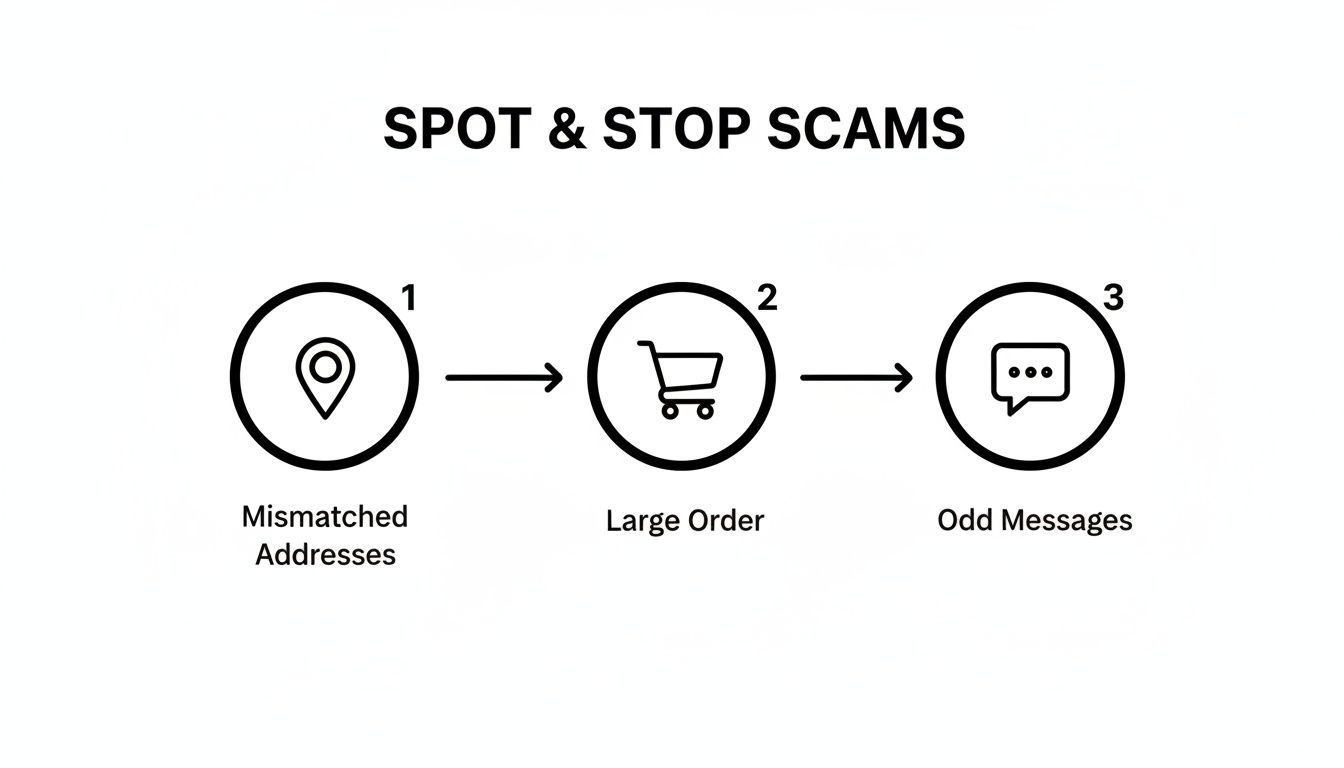
Spotting red flags like these before a dispute is filed helps build a stronger context for why the claim might be fraudulent from the get-go.
Your Evidence Checklist for Winning Disputes
Putting together a solid case means knowing exactly what to look for and why it matters. Think of this checklist as your game plan for gathering everything you need to win.
Having these documents organized and ready to go will make your response process smoother and far more effective.
Proof of Delivery Is Your Best Friend
When a scammer files an "Item Not Received" claim, nothing shuts them down faster than irrefutable proof of delivery. This isn't optional; it's essential. You have to prove the package made it to the exact address listed on the PayPal transaction page.
Here’s what you absolutely need:
- A valid tracking number from a recognized carrier like UPS, FedEx, or USPS.
- Delivery confirmation showing the date, time, and city where the package was dropped off.
- Signature confirmation for any high-value orders. This is the gold standard and can single-handedly win you the case.
Pro Tip: Never, ever ship to an address that isn't the one on the PayPal transaction details. If a buyer pays and then messages you asking to ship it somewhere else, it’s a huge red flag. Your only move is to politely cancel and refund the order, then ask them to repurchase with the correct address.
Crafting a Professional Response Letter
Once you have all your evidence, you need to present it in a clear and compelling way. A well-structured response, often called a rebuttal letter, can make or break your case. Keep it professional, factual, and straight to the point.
This is not the time to get emotional. Stick to the facts, present your evidence in a logical order, and clearly state why the dispute is invalid. For a solid template on how to structure your argument, check out this helpful example of a rebuttal letter.
Following these steps gives you the best possible shot at winning the dispute and getting your money back where it belongs.
Proactively Protecting Your Store from Future Scams
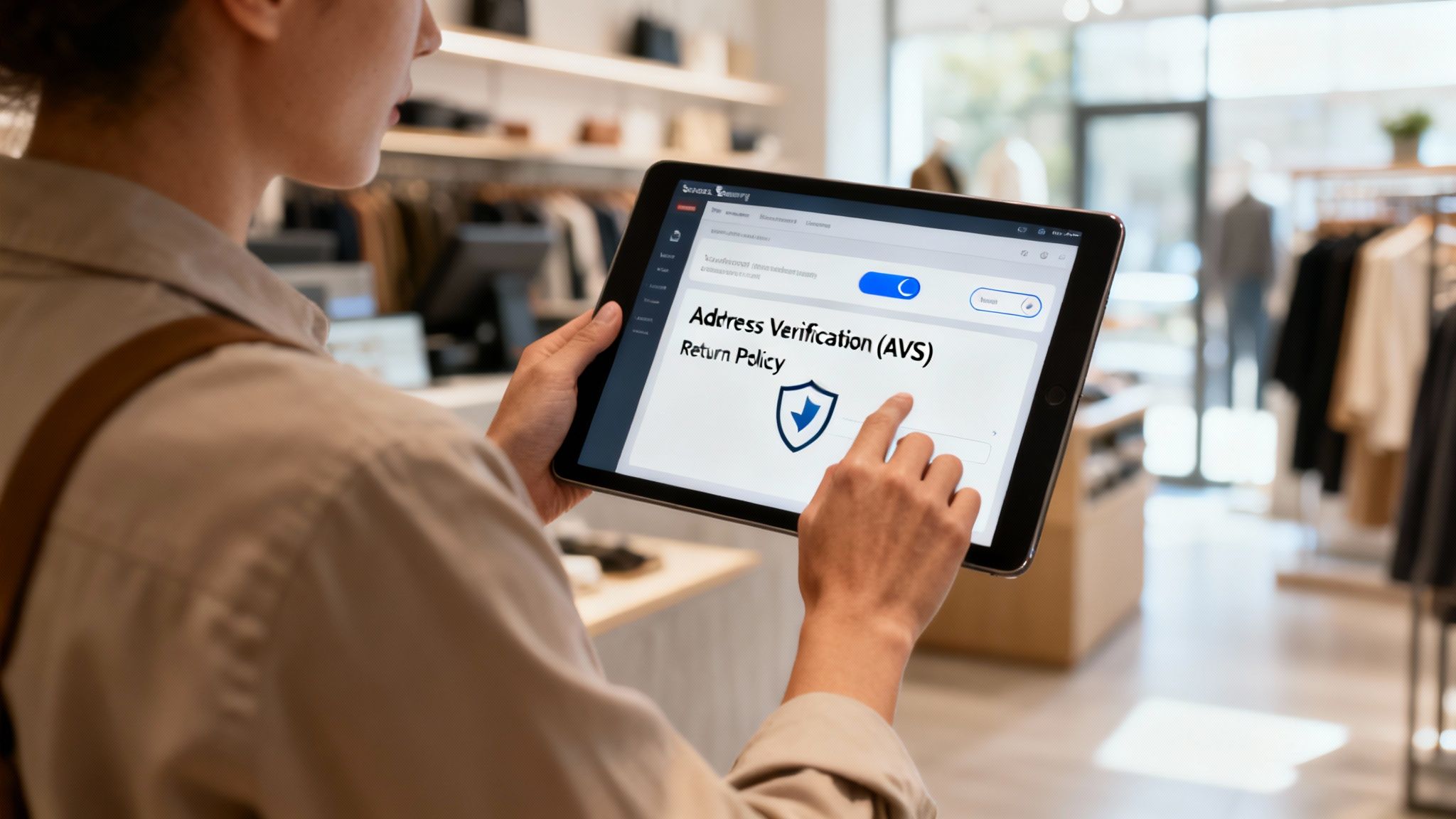
Winning a dispute feels great, but let's be honest—it’s a reactive fix. You’ve already lost time and energy dealing with the headache. The real win is making your store a much harder target for anyone trying to pull a PayPal refund scam in the first place.
This is about building a digital fortress around your business, one simple setting at a time. And no, you don't need a bunch of expensive, complex software to do it. The best place to start is with the tools you already have in your PayPal and Shopify dashboards. A few strategic tweaks can create powerful barriers against common fraud tactics.
Fine-Tune Your Payment Settings
One of the quickest and most effective moves you can make is to enable Address Verification Service (AVS) and Card Verification Value (CVV) checks in your payment gateway settings. These are your first line of defense.
AVS is simple: it confirms that the billing address the customer enters matches the one their credit card company has on file. A mismatch is a classic red flag for a stolen card. Likewise, requiring the CVV (that three or four-digit code on the back) helps prove the person making the purchase actually has the physical card. While not foolproof, these two checks alone will stop a surprising amount of low-effort fraud dead in its tracks.
You can take it a step further by setting up rules to automatically flag or even block transactions that fail these checks. Consider setting up filters to manually review orders that show other suspicious signs, such as:
- Unusually large orders from a first-time customer.
- Several orders placed in a very short amount of time.
- Orders where the billing and shipping countries don't match.
Your Return Policy Is a Legal Shield
A lot of merchants treat their return policy as just another customer service page. But when a dispute hits, that page becomes a critical piece of your evidence. A vague or hard-to-find policy gives scammers all the room they need to argue their case.
Your policy needs to be crystal clear, easy to find, and written in plain English. Spell out the exact conditions for returns, who is responsible for return shipping costs, and the timeframe for making a return. Get specific about what "significantly not as described" actually means for your products.
For example, you could state that minor color variations due to monitor settings do not qualify for a full refund under the "not as described" clause. This kind of detail removes ambiguity and gives PayPal's resolution team a clear framework to work with if a bogus claim comes through.
Most importantly, make sure customers have to check a box agreeing to your terms before completing their purchase. This simple step turns your policy into a binding agreement and dramatically strengthens your position against fraudulent "not as described" claims.
Use Fraud Detection Apps as Your Watchdog
As your store grows, it becomes impossible to manually review every single order. This is where fraud detection apps from the Shopify App Store can be a total game-changer. These tools automatically analyze hundreds of data points for each order in real-time.
They'll assign a risk score based on everything from the customer's IP address location and proxy usage to the history of their email address. High-risk orders get flagged for your review, letting you focus your attention where it's truly needed. Think of it as having an automated security guard who never sleeps, constantly watching for the tell-tale signs of a PayPal refund scam before it can ever hurt your business.
Using Automation to Fight Chargebacks for You
Trying to fight every single fraudulent dispute by hand is a noble goal, but let's be real—it's a massive time sink, especially as your store grows. Before you know it, you're spending your days digging through order histories and piecing together evidence instead of focusing on what matters: running your business.
This is the point where automation shifts from a "nice-to-have" to a "can't-live-without."
Modern AI tools are built to take this entire process off your plate. They plug directly into your payment platforms like PayPal and Shopify, instantly analyze new disputes, pull all the required evidence, and build a solid case for you. This isn't just about saving time; it's about using technology specifically designed to beat the PayPal refund scam.
How AI Gives You an Unfair Advantage
Think about it this way: a scammer files a flimsy dispute with a generic claim. To fight it manually, you have to become a detective, hunting down every shred of proof to poke holes in their story. An automated system does all of that in seconds.
It connects the dots between different data points that are easy to miss on your own:
- Matching AVS and CVV codes to prove the card was present.
- Cross-referencing the order's IP address with the shipping location.
- Analyzing the customer's purchase history for any red flags or suspicious patterns.
This screenshot from ChargePay gives you a glimpse of how a clean, centralized dashboard can cut through the chaos. No more guesswork—just a clear overview of every dispute.
The platform organizes everything you need in one spot, turning a mess of data into actionable insights that get your money back.
Automation isn't here to replace your judgment. It’s about giving you a powerful assistant that works 24/7, handling the tedious, repetitive work so you can focus on bigger things.
The manual grind is especially brutal for Shopify merchants who rely on PayPal. Without some help, win rates for these kinds of disputes can be as low as 10-20%. It’s incredibly frustrating. But solutions like ChargePay use AI to auto-generate the representment documents, which can boost win rates by 3.5x and help you recover up to 80% of your funds.
Recovering Revenue on Autopilot
The real magic of automation is its ability to claw back revenue you might have otherwise written off as a loss. It flips the script entirely. Suddenly, it's not profitable for scammers to target your store anymore.
When every bogus claim is met with a swift, evidence-packed response, your business stops looking like an easy target.
You stop just accepting losses and start actively reclaiming your money. This shift from defense to offense doesn't just protect your bottom line; it also improves your standing with payment processors over time. To see how this works from start to finish, check out our complete guide to automated chargeback and dispute management using AI. It’s all about making your revenue protection as smooth as your sales process.
Frequently Asked Questions About PayPal Scams
When you’re staring down a PayPal refund scam, it’s easy to feel frustrated and confused. You did everything by the book, but now your revenue and products are on the line. Let's clear the air and tackle some of the most common questions merchants have about these stressful situations.
Does PayPal Seller Protection Actually Stop Scammers?
In theory, yes. In the real world, it's more of a safety net than an impenetrable shield. While PayPal's Seller Protection is definitely helpful, savvy scammers have gotten very good at finding and exploiting the gaps.
For instance, the protection might not cover you if a buyer claims an item is "significantly not as described" and you can't prove them wrong with concrete evidence. Another classic loophole involves shipping addresses—you absolutely have to ship to the exact address listed on the transaction details page. Relying solely on Seller Protection is a gamble; a layered defense is always the smarter play.
How Long Does the PayPal Dispute Process Take?
Get ready to be patient, because this isn't a quick fix. A typical PayPal dispute can drag on for anywhere from 30 to 75 days from start to finish. For that entire time, the funds from the sale are completely frozen, which can throw a real wrench in your cash flow.
While you can't speed up PayPal's internal review, the best thing you can do is submit a rock-solid, evidence-packed response as fast as possible. This long wait time is precisely why scammers love this tactic—it's designed to be disruptive and wear you down. For a deeper dive into this, our article on whether PayPal protects against scams has more details.
What Is the Most Important Evidence for Fighting a Dispute?
If you have to pick just one thing, it's undeniable proof of delivery to the buyer's verified address. This means a tracking number from a major carrier showing the package was successfully delivered to the specific address tied to the PayPal transaction. No exceptions.
For any order with a significant price tag, always spring for signature confirmation. It's the gold standard of proof and can shut down a bogus "Item Not Received" claim in its tracks. A lot of scammers win simply because a merchant's shipping records were too vague.
The bottom line is this: if you can't prove it arrived at the right place, it's your word against theirs. And unfortunately, in those scenarios, the system often sides with the buyer.
Is It Worth Fighting Chargebacks on Small Orders?
Absolutely, and here’s why: fighting every single fraudulent claim, no matter the dollar amount, sends a powerful message. When you ignore the small ones, you're basically putting up a sign that says, "Easy target here!" Fraudsters often run small test scams before they hit you with much larger, more painful ones.
On top of that, your chargeback rate is a key metric payment processors like PayPal monitor very closely. Letting too many disputes go unchallenged can tarnish your reputation, which could lead to higher processing fees or even account limitations. Protecting your business means defending it against threats of all sizes.
Tired of losing revenue to frustrating PayPal disputes? ChargePay uses AI to automatically fight and win chargebacks for you, recovering up to 80% of your lost funds without you lifting a finger. See how it works at https://www.chargepay.ai.


.svg)



.svg)


.svg)
.svg)
.svg)