


If you run subscriptions on Shopify, recurring billing disputes aren't a side issue. They're a revenue leak that keeps charging your business long after the original order.
Chargeback losses are projected to rise from $33.79 billion in 2025 to $41.69 billion by 2028, and U.S. merchants lose an estimated $4.61 for every $1 in actual chargebacks once fees and operational damage are included, according to Sift’s disputes report. That should change how you think about every disputed rebill. You’re not dealing with one upset customer. You’re dealing with a payment system that punishes slow, messy, manual work.
That’s why AI automation is no longer optional for subscription merchants. Recurring billing disputes move fast, pile up across billing cycles, and require evidence that is often not organized well enough to be submitted on time. If you’re still handling them one by one in spreadsheets, inbox threads, and processor dashboards, you’re already behind.
Recurring Disputes Are Costing You More Than You Think
Recurring disputes drain profit in ways Shopify merchants often miss until margins start slipping.

If you sell subscriptions, memberships, refill programs, or any recurring offer, one dispute rarely stays contained. A customer can question a renewal, claim they canceled, say the billing descriptor looked unfamiliar, or dispute a charge months after signup. Suddenly your team is not defending one payment. You are defending the full customer history.
That changes the math fast.
Why recurring disputes hurt more
Recurring billing disputes create a wider loss window than standard ecommerce chargebacks. You can lose the current payment, lose future rebills from that customer, and spend staff time rebuilding a timeline from signup to cancellation request. If your dispute count climbs, your processor can add pressure with reviews, reserves, or tougher account terms.
The chargeback amount is only the surface cost. Processor penalties matter too, and this breakdown of a chargeback fee and how it affects merchant margins shows why small disputes still damage profitability.
Here’s the practical rule we use with subscription merchants. If you only track the disputed order value, you are underreporting the problem and underfunding the fix.
Manual handling is where profit disappears
Manual dispute work fails at subscription scale. Evidence lives in too many places. Billing logs sit in one system, cancellation requests in another, support replies in Gmail, and terms acceptance somewhere else entirely. By the time someone stitches it together, the deadline is close and the response is weak.
That is why recurring billing disputes hit harder than many merchants expect. The payment networks reward organized records, fast turnaround, and consistent evidence. Manual workflows produce the opposite. They create slow submissions, missing documents, and avoidable losses.
We see this constantly at ChargePay. Merchants assume the dispute itself is the problem. The bigger problem is the response process. If your team is still chasing screenshots, copying order notes into templates, and building cases one by one, you are losing revenue to operational drag before the issuer even reviews your evidence.
AI automation fixes the part that manual teams cannot keep up with. It pulls billing history together, matches evidence to the claim, and helps you respond at the speed recurring disputes demand. For subscription merchants, that is no longer a nice upgrade. It is how you stop preventable losses from piling up every billing cycle.
The True Cost of a Subscription Chargeback
A single chargeback can wipe out far more than the subscription payment itself. If you only count the order amount, you are understating the loss and making bad decisions about how to stop it.
The direct hit is obvious. Revenue is pulled back. A dispute fee is added. Your team loses time investigating what happened and preparing a response.
The expensive part is what comes next.
Recurring billing disputes often force you to rebuild a timeline across Shopify, your subscription platform, email, support tickets, cancellation records, and billing logs. That work is slow, and slow work loses cases. Meanwhile, the customer relationship is usually gone, so you also lose the future value of that subscriber.
The cost is operational, not just transactional
A subscription chargeback creates six separate costs at once:
- Lost revenue from the disputed charge.
- Processor dispute fees added on top of the reversal.
- Staff time spent gathering records and writing the response.
- Tool and coordination costs across support, billing, and ops.
- Lost lifetime value if the subscriber churns for good.
- Higher payment risk if disputes keep stacking up.
That last one matters more than many Shopify merchants realize. A rising dispute rate puts your payments account under pressure. More monitoring, more friction, and less room for error all cut into margin.
Subscription disputes punish weak records
Recurring disputes are rarely isolated mistakes. They usually expose a documentation problem.
If a customer disputes a renewal, the bank is not interested in your intent. It wants proof. You need to show when the customer signed up, what terms they accepted, when rebill notices were sent, whether they used the product, and what happened when they tried to cancel. If that evidence is scattered, your team burns hours chasing it down under deadline.
That is where profit disappears.
Manual work makes this worse. One person checks Shopify. Another searches Gmail. Someone else pulls screenshots from your subscription app. By the time the file is complete, it is often incomplete. For subscription merchants handling disputes at scale, manual response work is not just inefficient. It is expensive enough to erase recoverable revenue.
If you sell subscriptions in software or other recurring-billing models, this guide to SaaS chargebacks and billing disputes shows how these costs show up across the full customer lifecycle.
The fix is better systems, not more scrambling
Do not wait for the dispute alert to start getting organized. Store signup consent, billing history, cancellation activity, usage data, and customer communications in a way your team can retrieve immediately.
That is how you recover more money. The key is not “fighting harder.” It is documenting earlier, faster, and with less manual work.
This is also why AI is now required for serious subscription merchants. The volume and complexity of recurring billing disputes outgrew spreadsheet workflows a long time ago. If your team still builds cases by hand, you are paying for that inefficiency on every dispute you lose and every hour you waste trying to defend a valid charge.
Why Subscription Chargebacks Happen
Most recurring billing disputes come from a short list of causes. If you can't identify which one is hitting your store, you won't fix it.
Industry analysis says fraud, including friendly fraud, drives nearly 80% of all chargebacks, and in subscription-heavy sectors like software, Canceled Services reason codes often outpace fraud claims, according to Chargeback Gurus’ analysis of subscription chargeback causes.

Friendly fraud is the first thing to investigate
Friendly fraud is the most common pattern I see in Shopify subscription businesses. The customer did authorize the original purchase. Then time passes. They forget the trial converted, don’t recognize your legal entity on the card statement, or decide they no longer want the subscription and dispute it through the bank instead of contacting you.
A simple example: a customer signs up for a quarterly beauty subscription, gets the first box, then forgets about the next billing date. The rebill hits months later under a statement descriptor they don’t connect to your storefront name. They call the bank and say the charge looks fraudulent.
That doesn’t feel like “fraud” from their side. From your side, it’s still revenue loss.
If this pattern sounds familiar, review how friendly fraud works in card disputes and compare it against your own support and billing logs.
Customers often file these disputes because the bank is faster than support, not because the charge was invalid.
Cancellation friction creates avoidable disputes
The second cause is legitimate frustration. The customer tries to cancel but can’t find the option, doesn’t trust that the cancellation worked, or gets billed again after they thought they were done. At that point, many people skip support and go straight to the issuer.
This shows up constantly in recurring commerce:
- Buried cancellation links: The option exists, but it’s hidden in account settings or a support form.
- Slow support handling: The customer emails before renewal and gets a response after the charge posts.
- No cancellation confirmation: They click cancel, but you never send a clear confirmation email.
- Rigid plan structure: They wanted to pause or downgrade, but your only options were keep paying or leave.
That last one matters more than most merchants think.
Before the next part, watch this quick explainer on how these disputes play out in practice:
Merchant errors still cause real damage
Not every recurring billing dispute is customer behavior. Sometimes the problem starts on your side.
I’m talking about duplicate charges, billing on the wrong date, charging after a cancellation should have processed, or issuing a promised refund too late. These aren’t gray-area disputes. They’re operational failures, and they train customers to stop trusting your billing.
Here’s a useful diagnostic checklist:
- Check your descriptors: If the statement name doesn't match your storefront, confusion is predictable.
- Audit your cancellation flow: Run it yourself on desktop and mobile.
- Review rebill timing: Make sure charges happen when your terms say they will.
- Match support promises to billing action: If an agent says “we’ve taken care of it,” your system has to reflect that.
Three root causes, three different fixes
You don’t solve all recurring billing disputes with one tactic.
| Root cause | What it looks like | What fixes it |
|---|---|---|
| Friendly fraud | “I don’t recognize this charge” | Better descriptors, renewal reminders, stronger evidence |
| Cancellation friction | “I canceled and still got charged” | Easier cancellation, immediate confirmations, pause options |
| Merchant error | “I was billed incorrectly” | Billing QA, refund discipline, support and subscription sync |
The wrong response is to treat every dispute like an isolated complaint. The right response is to spot the pattern and remove the reason it keeps happening.
Card Network Rules and Evidence You Must Know
Banks do not decide recurring billing disputes based on who sounds more reasonable. They decide based on rules, timestamps, and proof. If your records are messy or your response is late, you hand the win to the issuer.
Recurring disputes are especially dangerous because the claim often reaches back across the full subscription relationship, not just the latest charge. A customer can challenge a rebill long after it happened. By the time the notice hits your inbox, you need to prove what the customer agreed to, what you charged, what you communicated, and what they received. Manual teams break down here. The volume is too high, the timelines are too tight, and every missing record turns into lost profit.
The rule that matters most
Start with the reason code and the deadline.
Those two details control everything. They tell you what the issuer says went wrong and how much time you have to answer. If you build a response before checking them, you risk sending the wrong evidence or missing the submission window entirely. For a clear breakdown of filing windows and issuer deadlines, keep this guide to chargeback time limits close.
You also need records for the full subscription lifecycle. The original checkout is only the beginning. Issuers want to see that the customer accepted recurring terms, understood the billing schedule, had a real way to cancel, and kept using the service or received the product tied to the disputed charge.
Miss the deadline and the rest stops mattering.
The evidence banks actually care about
For recurring billing disputes, your evidence has to prove a timeline. Not a theory. Not a summary from support. A timeline.
Use evidence that answers these five questions:
- Did the customer authorize the subscription? Show the signup record, accepted terms, and the plan selected.
- Were the billing terms clear? Show the amount, interval, renewal terms, and cancellation policy presented at signup.
- Did you communicate after signup? Include receipts, rebill notices, renewal reminders, cancellation confirmations, and relevant support messages.
- Did the customer receive value? Provide delivery proof for physical goods or login, session, feature use, and account activity for digital services.
- Does the account history support the charge? Prior successful billings, continued access, and unchanged account details help connect the cardholder to the subscription.
Many Shopify merchants often lose cases they should win. They have the facts, but not in a form the bank can review quickly. AI now matters because it can assemble the right records, in order, before your team burns hours digging through billing tools, inboxes, and support threads.
Evidence checklist for recurring billing disputes
| Evidence Type | Visa (CE 3.0) Requirement | Mastercard Requirement |
|---|---|---|
| Initial signup record | Show the customer authorized the original transaction and accepted recurring terms | Show the cardholder agreed to the transaction and billing arrangement |
| Terms acceptance | Include the recurring billing terms accepted at checkout or signup | Include proof that recurring terms and cancellation conditions were disclosed |
| Billing history | Show prior successful charges tied to the same account or subscription | Show transaction history that supports an established billing relationship |
| Customer identity match | Include account identifiers, login data, device or transaction consistency where available | Include account and transaction records connecting the customer to the subscription |
| Renewal communication | Include receipts, rebill notices, or reminders if available | Include customer communication showing notice of billing or renewal |
| Cancellation records | Show whether cancellation was requested, when it was processed, and what happened after | Show timestamps, support interactions, and confirmation records tied to cancellation |
| Fulfillment or usage proof | For physical goods, include delivery proof. For digital services, include access logs or usage history | Include service access, delivery confirmation, or account activity supporting fulfillment |
What weak evidence looks like
Weak evidence is common, and banks reject it fast.
A screenshot of your pricing page is not proof the customer accepted the terms. A help center article is not proof the customer saw the cancellation policy. An internal note that says “resolved” is not proof of a refund, a cancellation, or a billing correction. If there is no timestamp, no account identifier, and no clear link to the disputed transaction, it will not carry the case.
Your submission should be chronological, specific, and easy to verify. Put the signup first. Then the billing events. Then the communications. Then the usage or fulfillment record. If a reviewer has to piece the story together on their own, your response is too weak.
That is why manual dispute handling becomes a margin problem. Every extra minute spent hunting for screenshots, exports, and support logs raises your labor cost and lowers your odds of recovery. Subscription merchants need a system that captures evidence automatically as the customer relationship unfolds. Anything less leaves revenue exposed.
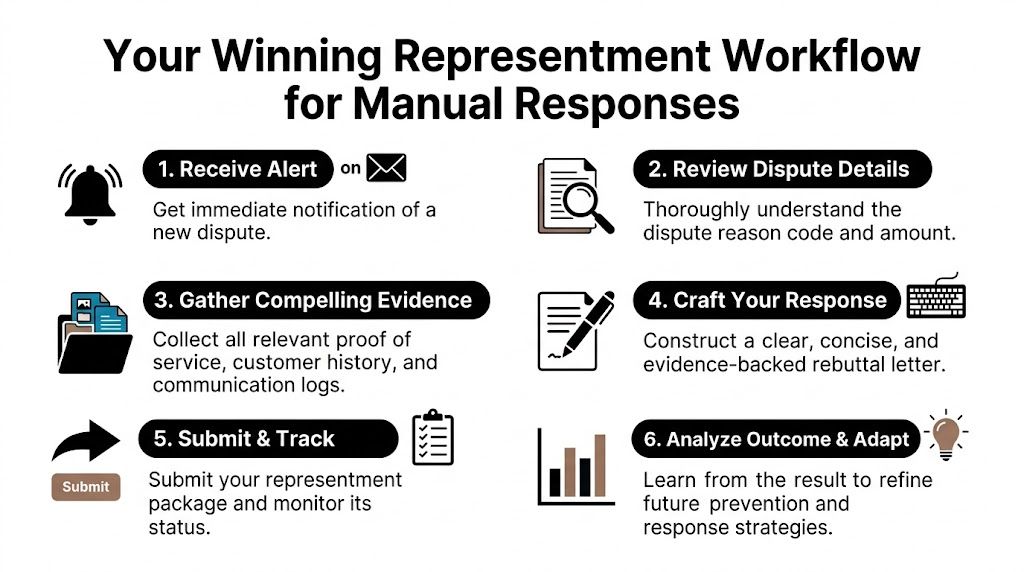
Your Winning Representment Workflow for Manual Responses
Manual representment still works when the case is strong and your records are clean. But it takes discipline. A sloppy response loses even when the charge was valid.
Start with the reason code, not your opinion
Your first move is to read the reason code and claim details carefully. Don’t write a generic defense letter before you know what the bank is alleging.
A recurring billing dispute for canceled services needs a different response than one for fraud or unrecognized charges. If you answer the wrong claim, you waste your best evidence.
Build the case in this order
Use this workflow every time:
Read the dispute notice fully
Confirm the reason code, disputed transaction, filing date, and deadline.Pull the account timeline
Collect signup date, rebill dates, cancellation attempts, support contacts, refund actions, and fulfillment or usage records.Match evidence to the claim
If the customer says they canceled, lead with cancellation records and post-cancellation activity. If they say fraud, lead with authorization and account history.Write a short rebuttal letter
Stick to facts. State why the charge was valid and point to the attached evidence in order.Package documents cleanly
Use clear file names, date order, and consistent labels so the reviewer can follow the story fast.Submit early and track the outcome
Don’t wait until the final day. Late surprises kill recoverable cases.
Field note: The strongest rebuttal letters are usually the shortest ones. They don't argue. They prove.
What to include in your rebuttal
A strong manual response usually contains:
- Transaction summary: Order details, rebill amount, and billing date.
- Authorization proof: Signup record and accepted recurring terms.
- Customer history: Prior payments, account logins, order fulfillment, or subscription usage.
- Communication record: Receipts, rebill notices, cancellation emails, and support interactions.
- Clear narrative: A brief explanation tied directly to the claim.
Common manual mistakes
Merchants often lose for boring reasons, not dramatic ones.
| Mistake | Why it hurts |
|---|---|
| Sending too much irrelevant material | Reviewers miss the key evidence |
| Ignoring the reason code | The response doesn't answer the actual claim |
| Submitting screenshots without context | The bank can't tell what they prove |
| Leaving out timestamps | The sequence becomes unclear |
| Writing an emotional letter | Opinions don't outweigh records |
When manual stops making sense
If you only see the occasional dispute, manual handling can be manageable. Once recurring billing disputes become a regular weekly task, the cost of doing it by hand climbs fast. Your team spends time gathering documents instead of fixing the root causes in billing, support, and retention.
That’s the inherent limit of manual work. It isn't just slow. It pulls smart people into repetitive evidence assembly that software can handle better.
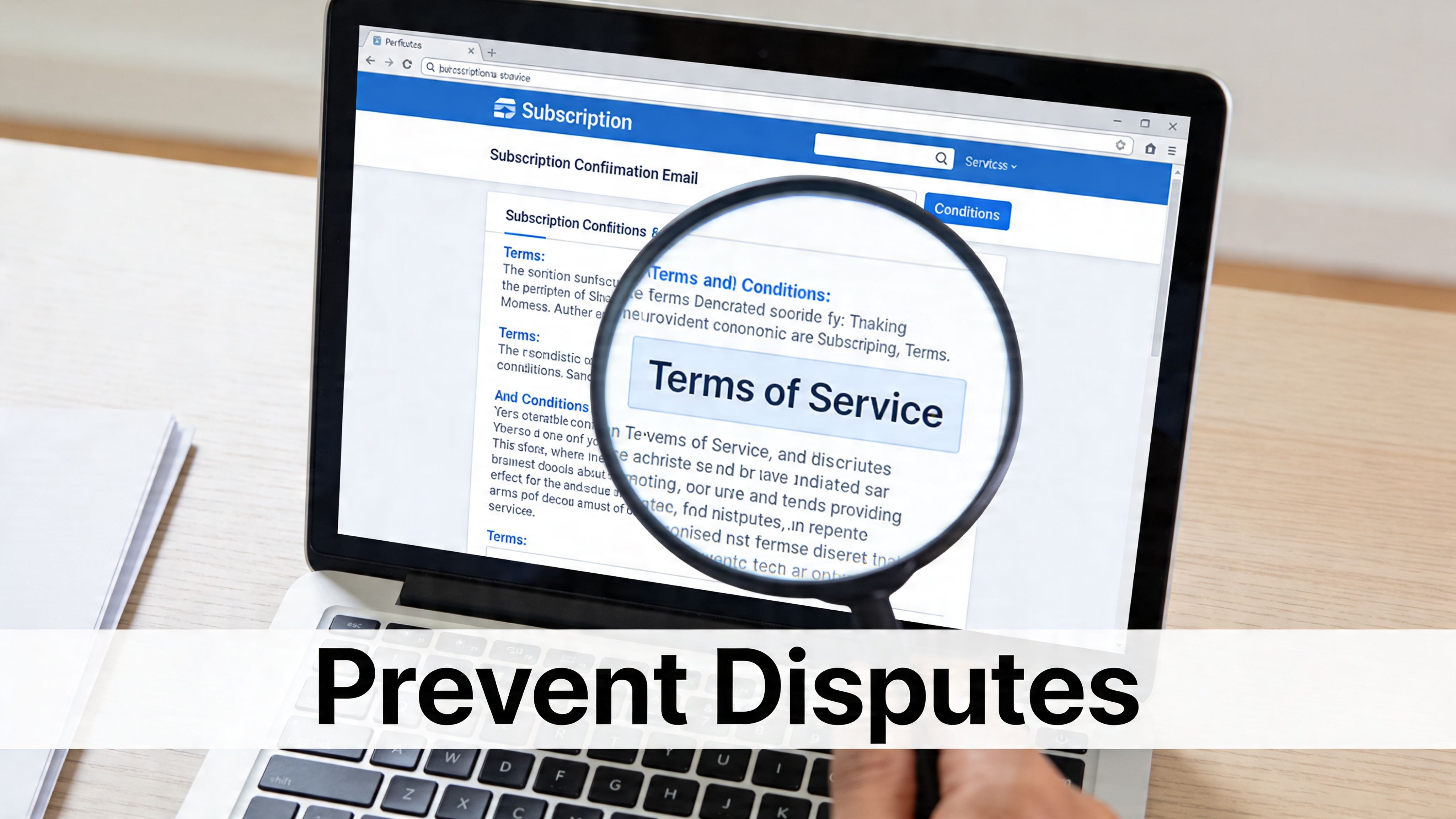
How to Prevent Disputes Before They Start
Every preventable recurring billing dispute costs you twice. You lose the sale, then you lose time and margin cleaning up a problem your subscription flow should have stopped earlier.
Prevention starts before the rebill hits the card. If your billing experience creates confusion, surprise, or friction, banks get pulled into customer service issues that never should have become disputes.
Fix the obvious friction first
Start with the basics. Every Shopify subscription merchant should tighten these points now:
- Use a recognizable billing descriptor: The name on the statement should clearly match your store.
- Send rebill reminders: Do this for annual plans, trial conversions, and any renewal likely to catch the customer off guard.
- Make cancellation easy: Put it inside the customer account. Do not force people into a support queue.
- Confirm every cancellation immediately: Send the effective date and the next billing status in writing.
- Train support to resolve billing issues fast: Delays before renewal often become disputes after renewal.
These fixes reduce avoidable confusion. They also cut off the most common excuse customers use when they call the bank.
Change the subscription design, not just the cancellation flow
Making cancellation easier is a good first step, but it doesn't fix the deeper problem.
A rigid subscription creates disputes. If the customer can only keep paying full price or leave entirely, some of them will choose a third option and dispute the charge. Give them practical alternatives before frustration turns into a chargeback.
That means offering plan controls that match real customer behavior:
- Pause instead of cancel: Useful for seasonal demand, membership fatigue, or temporary budget pressure.
- Skip a shipment: Ideal for replenishment brands when customers have too much product on hand.
- Downgrade the plan: Keep price-sensitive subscribers instead of forcing an all-or-nothing decision.
- Shift the billing date: Solve timing problems without losing the account.
- Use pre-renewal education: Remind customers what renews, when it renews, and how to manage it.
Manual prevention breaks at scale
Here’s the part many merchants miss. Prevention is no longer a checklist your team can handle with reminders, templates, and good intentions. Subscription disputes move too fast, across too many customer touchpoints, for manual work to keep up.
You need systems that detect risk before it becomes lost revenue. That includes automated renewal messaging, cancellation confirmation, account change tracking, and dispute pattern monitoring. If you are still patching this together by hand, you are paying for that inefficiency in churn, chargebacks, and support load. Our guide to automated chargeback and dispute management using AI explains what that operational shift looks like.
The same pattern is showing up in adjacent compliance-heavy workflows. AI legal assistants are gaining traction because repetitive document work is expensive and slow when humans do all of it. Subscription dispute prevention has the same problem. Too many signals, too many deadlines, too much revenue at risk.
Prevention is retention and margin protection
Recurring billing disputes are rarely just a fraud problem. They usually point to a subscription setup that forces unnecessary conflict.
If a customer wants less, later, or different, your subscription should support that decision without pushing them toward their bank. That protects retention. It protects revenue. It also gives your team room to fix the accounts worth saving instead of wasting hours on preventable disputes.
If dispute volume is rising, inspect the offer first. A better subscription experience prevents the next dispute faster than any manual process ever will.
Recover Revenue Automatically with ChargePay AI
Manual dispute handling drains subscription merchants because the work never shows up in one place. Your signup proof is in one tool, rebill notices are in another, cancellation logs live somewhere else, and support history is buried in inboxes or help desk threads. A team member then has to pull that record together case by case, under a fixed card network deadline, while new disputes keep coming in.
That is a profit problem, not an admin problem.
AI automation fixes the part of recurring billing disputes that breaks manual teams at scale. In other compliance-heavy workflows, tools like AI legal assistants are getting used for the same reason. They handle repetitive, evidence-driven document work faster and with fewer gaps. Subscription dispute management follows the same pattern. The volume is high, the evidence has to be precise, and delays cost money.
For Shopify merchants, ChargePay automates chargeback and dispute handling, including recurring billing cases. It pulls the evidence, drafts the response, and submits the case before the deadline. That matters because manual teams lose recoverable revenue every time a response goes in late, leaves out a key rebill notice, or misses the account activity that proves the cardholder used the service.
Why automation beats manual representment
Manual teams can improve process. They cannot create more hours in the day.
Automation gives you four clear advantages:
- Faster case assembly: Evidence starts pulling as soon as the dispute hits, instead of waiting for someone to find records across platforms.
- Stronger consistency: Every case follows the same evidence standard, so you are not relying on whoever happened to pick up the ticket.
- Better data coverage: Billing history, customer communication, usage signals, and cancellation records get connected in one response file.
- Lower operating drag: More disputes stop turning into more headcount, more backlog, and more missed deadlines.
If you want to see what that system looks like in practice, read this guide to automated chargeback and dispute management using AI.
What to do next
Keep the basics tight. Clean up your descriptor, make cancellation easy, send rebill reminders, and store evidence in a way your team can retrieve fast.
Then remove the manual bottleneck. If recurring disputes are now part of running your Shopify subscription business, AI is no longer optional. It is how you protect margin, recover funds, and stop losing profitable cases because your team is buried in document work.
If recurring billing disputes are draining your store, ChargePay is worth a close look. It has a 4.9-star rating, a Built for Shopify badge, and a pay-per-win model, so you only pay when funds are recovered. Install it from the Shopify App Store if you want AI to handle the dispute workflow and help you stop losing revenue to chargebacks.


.svg)



.svg)


.svg)
.svg)
.svg)