

When a customer disputes a charge on their credit card, it triggers something far more damaging than a simple refund. It’s called a Shopify chargeback, and it’s a forced reversal of funds initiated directly by the customer’s bank.
Unlike a refund request that you control, a chargeback bypasses you completely. The money is instantly yanked from your account, and to make it worse, Shopify hits you with a non-refundable $15 dispute fee. This isn't just a lost sale; it's a direct attack on your cash flow and your ability to even process payments.
At ChargePay, we see this story play out every day. We’ve automated the fight for over 100,000 disputes, recovering more than $2.8 million for Shopify merchants just like you. We know firsthand that chargebacks are a silent profit killer.
The Real Cost of Shopify Chargebacks on Your Business

That $15 Shopify fee? It's just the start. The true cost of a single chargeback is a painful multiplier effect that bleeds your business dry. Right away, you lose the full transaction amount. Then you lose the non-refundable shipping fees, the cost of the product itself, and any ad spend you used to get that customer.
But the financial pain doesn't stop there. Now you have to sink your own time—or pay an employee—to dig through records, piece together evidence, and actually fight the dispute. Every hour spent on a chargeback is an hour you’re not spending on growing your business.
To see what this really looks like, let's break down the math.
The Hidden Costs of a Single $100 Chargeback
As you can see, that one dispute for a $100 product can easily end up costing you more than $200. It's a silent profit killer that gets more destructive as your order volume grows.
Why Your Chargeback Rate Is a Ticking Time Bomb
Beyond the cost of each individual dispute, the real danger is your chargeback rate. This is the number that payment processors like Shopify Payments, Stripe, and PayPal watch to judge how "risky" your store is. It's a simple calculation: the number of chargebacks you get in a month divided by your total transactions for that month.
The number you must stay under is 1%. If your rate goes over this line, you’re flagged as "high-risk," and a lot of bad things can happen:
- Higher processing fees on every single one of your future sales.
- Forced account reserves, where the processor holds back a portion of your own money.
- Account termination—the worst-case scenario. You lose the ability to accept credit cards entirely.
This isn't a far-off threat. While the average merchant's chargeback rate is around 0.56%, a shocking 25% of merchants operate above the critical 1% threshold. That means one in four stores is in constant danger of penalties or getting shut down by their payment processor.
The Hidden Impact on Your Business Operations
Dealing with Shopify chargebacks puts your business in a constant state of reactive firefighting. Instead of focusing on marketing and growth, your team is stuck digging through old orders to defend past sales. This administrative nightmare drains morale and pulls your focus away from what really matters: serving your great customers. You can learn more in our deep dive into the Shopify chargeback rate and associated fees.
At ChargePay, we built our AI-powered platform to handle this for you, delivering a 92.4% win rate. Our tool earned the official 'Built for Shopify' badge and a 4.9-star rating because it works. You can install ChargePay from the Shopify App Store and let us turn your chargeback problem into a solved one.
Cracking the Code on Chargeback Reasons and Response Times
When a chargeback hits your Shopify dashboard, it always comes with a reason code—a short message from the customer's bank that explains why the dispute was filed. Think of it as the bank's one-line summary of the issue, with common ones being "Fraudulent" or "Product Not Received."
Understanding these codes is the absolute first step to winning any dispute. Each code points to a specific type of claim and requires a specific kind of evidence. If you try to fight a "Product Not Received" chargeback by showing how great your product quality is, you're guaranteed to lose. It's totally irrelevant to the bank.
The Most Common Shopify Chargeback Reason Codes
While card networks like Visa and Mastercard have dozens of reason codes, you'll likely see the same handful pop up over and over again on Shopify. Let's translate the bank-speak into plain English.
- Fraud or Unauthorized Transaction: This is the big one. The cardholder is claiming they didn’t approve the purchase at all. This suggests their card details might have been stolen. Your job here is to prove that the legitimate cardholder was, in fact, the one who made the purchase.
- Product Not Received: It's simple—the customer says they paid for an item but it never arrived. This is a direct challenge to your fulfillment and shipping process. You need to prove successful delivery.
- Product Unacceptable or Not as Described: The customer got the item, but they're claiming it was damaged, faulty, or just not what your product page promised. To win this, you need to prove the product was exactly as advertised and delivered in good condition.
- Credit Not Processed: This happens when a customer says they returned an item but are still waiting on their refund. It usually points to a communication breakdown or a snag in your returns workflow.
Every reason code is a road map. It tells you exactly what kind of argument you need to build and what evidence the bank is looking for to side with you.
Key Takeaway: Stop treating all Shopify chargebacks the same. The only way to build a winning case is to tailor your response to the specific reason code. A one-size-fits-all approach is a surefire way to lose revenue.
The Clock Is Always Ticking
Just as critical as knowing the why is respecting the when. Every single chargeback comes with a strict, non-negotiable deadline for you to submit your response. This timeline is set by the card network (Visa, Mastercard, etc.) and can be shockingly short—sometimes as little as 7-21 days from the day the dispute is initiated.
If you miss the deadline, you automatically lose the dispute.
It doesn't matter if you have bulletproof evidence. It doesn't matter if you know for a fact the customer is committing friendly fraud. A missed deadline means you automatically forfeit the sale amount and have to eat the non-refundable chargeback fee. Banks are ruthless about these timelines, and there are no second chances or extensions. You can learn more about how these timelines impact your response strategy in our guide on the chargeback time limit.
This is where so many Shopify merchants get tripped up. They see a new dispute, plan to handle it "later," and before they know it, the response window has slammed shut. This is precisely why we built ChargePay’s AI to submit responses automatically. We’ve fought over 100,000 disputes for merchants and recovered over $2.8 million—and a huge piece of our 92.4% win rate is making sure no deadline is ever missed.
To effectively manage various time-sensitive legal matters, such as calculating response windows for disputes, consider using a legal deadline calculator to stay on top of these critical dates. As your store grows, keeping track of all this manually becomes next to impossible. Automation isn’t a luxury anymore; it's a necessity for protecting your bottom line.
Building a Winning Evidence Package for Your Dispute
Winning a Shopify chargeback has nothing to do with luck. It all comes down to the quality of the evidence you submit. When a bank reviews a case, they are looking for a clear, documented story that proves you held up your end of the bargain.
Think of it like this: the bank is a judge who has never heard of your store, and you have exactly one chance to present your case. A messy, incomplete, or disorganized submission is the fastest way to lose. You need to build a compelling package that tells a complete story and leaves no room for doubt.
Your Essential Evidence Checklist
The moment you get a chargeback notification in your Shopify admin, the clock starts ticking. Don't panic; get organized. While the exact evidence you need depends on the reason code, some items are critical for every single dispute.
Your core evidence should always start with these basics:
- Customer Communications: Pull together every email, live chat transcript, or social media message you have with the customer. This can prove they received order updates or that you offered to help resolve their issue.
- Order and Shipping Details: This includes screenshots of the order from your Shopify admin, packing slips, and, most importantly, delivery confirmation with tracking. A tracking number showing "Delivered" is your strongest weapon against "Product Not Received" claims.
- Proof of Service/Usage: For digital goods or services, this is your version of a delivery confirmation. Provide software download logs, IP addresses that accessed the content, or account login history.
Remember that even text messages can be powerful. It's worth learning how to prepare legally admissible text messages for court if that's where your key conversations happened.
Before we move on, let's organize this. You need a go-to checklist for the most common chargeback reasons.
Essential Evidence Checklist by Chargeback Reason
Here's a quick-reference table I put together based on years of fighting these disputes. It breaks down exactly what you need to pull together based on the claim type.
This isn't exhaustive, but it covers the vast majority of disputes you'll face. Having this ready makes the whole process much less stressful.
Digging Deeper with Technical Data
Beyond the basics, Shopify gives you powerful technical data that can completely dismantle a fraud claim. These details are what help prove the legitimate cardholder was the one who actually made the purchase.
At ChargePay, we've recovered over $2.8 million for merchants by automatically pulling this data for every single dispute. Our AI knows exactly what to look for, which is how we’ve hit a 92.4% win rate across more than 100,000+ disputes.
You can find these data points right in your Shopify order details:
- AVS (Address Verification System) Match: This shows if the billing address entered at checkout matches the one on file with the bank. A "match" is incredibly strong evidence.
- CVV Match: This confirms the 3- or 4-digit security code from the back of the card was entered correctly.
- IP Address Geolocation: This shows the geographic location of the computer or phone used to place the order. If the IP address location matches the shipping address, it makes a fraud claim look very weak.
This flowchart gives you a simple visual path for thinking through the evidence you'll need for the most common chargeback types.
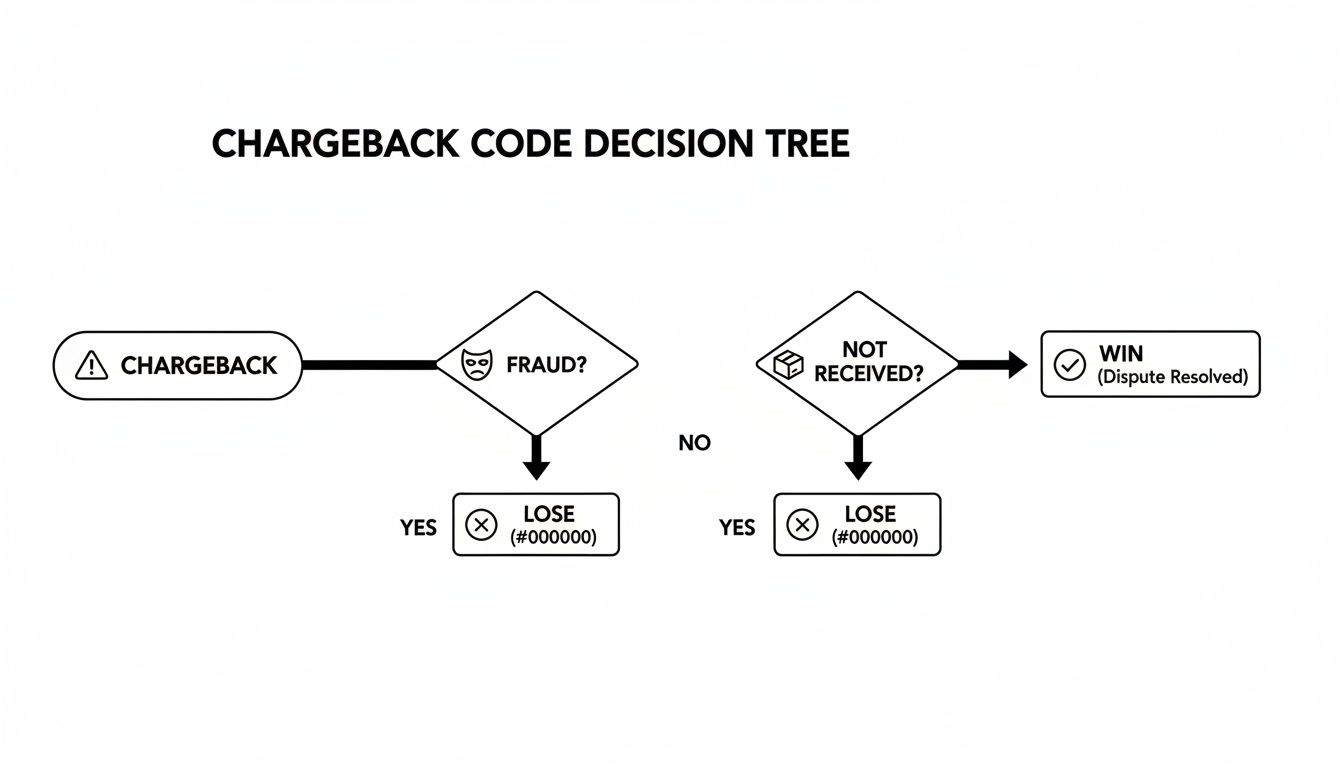
As you can see, claims of fraud or non-receipt require very specific proof. Without it, you’re almost guaranteed to lose.
By the way, it’s also important to know how your metrics are tracked. Shopify made an important update to its chargeback rate calculation on January 28, 2026. Your rate now includes all disputes, even those resolved automatically through programs like Visa's Rapid Dispute Resolution (RDR). This gives you a more complete view of your risk, although the backend evaluation process hasn't changed. You can get more details on Shopify's chargeback rate updates on their changelog.
Structuring Your Rebuttal Letter
Your evidence is only as strong as the letter that presents it. This rebuttal letter is your cover sheet for the bank investigator, and it has to be professional, concise, and incredibly easy to follow. A well-written letter walks the agent through your evidence and makes a clear, simple argument for why the chargeback should be overturned.
For a great template and structure, check out our guide on how to write an example of a rebuttal letter.
Manually digging up all this evidence and writing custom rebuttal letters for every dispute is a massive time-suck. It’s the main reason so many merchants just give up and eat the cost. That's exactly why we built ChargePay. Our AI automatically builds the complete evidence package, writes the perfect data-filled rebuttal, and submits it for you.
If you're tired of losing revenue to Shopify chargebacks, it's time to automate. Install ChargePay from the Shopify App Store—it’s 'Built for Shopify' with a 4.9-star rating for a reason.
Practical Ways to Prevent Friendly Fraud on Shopify
Fighting Shopify chargebacks often feels like you're constantly on defense. But the best way to protect your revenue is to get ahead of disputes before they happen, especially when it comes to friendly fraud. This is when a real customer disputes a charge they actually made, usually out of confusion, impatience, or simply trying to get something for free.
And it's not a small problem—it's a massive one. Friendly fraud has become the number one cause of chargebacks for Shopify merchants, making up around 75% of all disputes. It's a silent revenue killer, and it's only getting worse.
The good news? You can fight back with a few simple but powerful adjustments right inside your Shopify store.
Clarify Your Billing Descriptor
One of the most common reasons for a friendly fraud chargeback is simple confusion. A customer scans their credit card statement, sees a charge they don’t recognize, and immediately calls their bank to report fraud. This happens all the time when your billing descriptor—the little line of text next to the charge—is unclear.
A generic name like "SP*MERCHANT123" is just asking for trouble. You need to customize this in your payment settings so your brand is instantly recognizable.
- Good: YOURBRANDNAME
- Better: YOURBRAND - Sneaker Shop
- Best: YOURBRAND.COM 800-555-1234
Adding your store name and a customer service number gives the customer an easy way to contact you directly instead of going straight to their bank. I've seen this one change stop dozens of disputes in their tracks.
Master Your Communication and Policies
Another huge trigger for friendly fraud? Impatience. A customer can’t easily find your return policy, they don’t get a shipping update quickly enough, or they can't reach your support team. Instead of waiting, they take the path of least resistance and file a chargeback.
You can get ahead of this by making your policies and communications impossible to miss.
We see this all the time at ChargePay. A merchant loses a dispute because their return policy was buried on a forgotten page. Making your key policies prominent isn't just good customer service; it’s a core part of your chargeback defense strategy.
Make sure your shipping, return, and refund policies are linked in your site's header, footer, and on your product pages. Even more important, put them in your post-purchase emails. An order confirmation should include not just the order details, but a direct link to your return policy and a clear estimated delivery window.
Use Data to Spot Red Flags
While many friendly fraud cases are honest mistakes, some are more deliberate. You can use the order data right inside Shopify to spot potentially risky transactions before you ever ship the product.
Keep a close eye on these warning signs:
- Mismatched Addresses: The billing and shipping addresses are in completely different states or countries.
- Sudden High-Value Orders: A brand-new customer places an unusually large order, especially for your priciest products.
- Rushed Shipping Requests: The customer demands overnight shipping on a high-ticket item. This is often a sign they want the goods before a fraud alert can be triggered.
- Signature Confirmation: For any order over a certain amount (say, $200), requiring a signature on delivery gives you undeniable proof against those "Product Not Received" claims.
These strategies are your first line of defense. By making your business operations more transparent, you can dramatically cut down on the number of disputes that hit your account. Our guide on what is friendly fraud has even more tactics you can use.
While these steps will definitely help, they can't stop every single dispute. That's where automation becomes a lifesaver. Here at ChargePay, our AI manages over 100,000 disputes for Shopify merchants, recovering more than $2.8 million with a 92.4% win rate. When prevention isn’t enough, we win the fight for you. Install ChargePay from the Shopify App Store and see why we're 'Built for Shopify' with a 4.9-star rating.
When to Automate Chargeback Management with AI
Manually fighting every single Shopify chargeback is a time-consuming battle. When you're first starting out, handling one or two a month might seem manageable. But as your Shopify store scales, you’ll quickly reach a tipping point where the manual effort just isn’t worth it anymore.
That stolen time adds up fast. Are you finding yourself spending more than a few hours a week digging through old orders, gathering tracking numbers, and trying to write the perfect rebuttal letter? This is a clear sign that chargebacks are no longer just an occasional nuisance; they’re an operational drag that’s pulling you away from actually growing your business.
Identifying the Tipping Point
Another major red flag is a creeping chargeback rate. Even if you're winning some disputes, a rising number of incoming claims puts your merchant account at risk. If your rate starts getting anywhere close to the 1% threshold that payment processors watch, it’s a serious signal that your manual process isn't cutting it. You might be missing tight deadlines or submitting evidence that just isn't strong enough.
Think about the real cost here. It’s not just the lost revenue and that painful $15 Shopify fee for every single dispute. It’s the hours you or your team sink into a low-value, reactive task. That’s time that could be spent on marketing, product development, or talking to your best customers. When the operational cost of fighting these disputes starts to rival the amount you’re actually recovering, you’ve hit the wall. It’s time to automate.
At ChargePay, we see merchants hit this point every single day. They come to us because they're tired of fighting alone and seeing their money walk out the door. Our AI platform was built specifically to take over this entire process, which is how we’ve recovered over $2.8 million for Shopify stores just like yours.
Automating with AI isn't just about saving time; it's about winning more often. Our system has successfully handled over 100,000+ disputes, achieving a 92.4% win rate. It gets these results by taking human error and inefficiency completely out of the equation.
How AI Transforms Your Chargeback Process
An AI-powered platform like ChargePay doesn't just speed things up; it completely changes how you handle Shopify chargebacks. Instead of you reacting to a dispute notification, our AI takes over the second it appears.
Here’s what that looks like in practice:
- Instant Evidence Gathering: The AI automatically dives into Shopify and other integrated sources to pull all the critical data—AVS/CVV matches, IP logs, customer history, and delivery confirmations. No more manual digging.
- Tailored Response Generation: It analyzes the specific chargeback reason code and writes a compelling, data-rich rebuttal letter designed to win that exact type of dispute.
- Automated Submission: The entire evidence package is submitted on your behalf, well before the bank's deadline. You'll never lose a dispute due to a missed timeline again.
Here is a look at the ChargePay app in the Shopify App Store, where you can see our 'Built for Shopify' badge and stellar rating.
That 4.9-star rating comes from thousands of merchants who have stopped the manual grind and started winning back their revenue on autopilot. This isn't just another tool; it's like having a dedicated chargeback expert working for your store 24/7. To learn more about this approach, you can read our complete guide to automated chargeback and dispute management using AI.
The best part? You only pay when we win a dispute for you. There are no monthly fees or hidden costs. It’s a completely risk-free way to turn a major revenue drain into a solved problem. Stop letting chargebacks steal your time and money. Install ChargePay from the Shopify App Store and let our AI start recovering your revenue today.
Frequently Asked Questions About Shopify Chargebacks
If you're running a Shopify store, chargebacks are one of those headaches you just can't ignore. They're frustrating, they're costly, and the rules can feel confusing.
Let's clear up some of the most common questions we get from merchants just like you. We'll give you straight answers so you can stop guessing and start protecting your bottom line.
Can I Win a Chargeback for a Digital Product?
Yes, you absolutely can, but it’s a different ballgame than shipping a physical product. You can't just show a tracking number and call it a day. The whole game shifts to proving the customer accessed and used what they bought.
To build a winning case for a digital item, you need to dig up proof of access. This could be:
- Server or download logs: Show that the file was actually downloaded from your end.
- User account history: If they had to log in, show their login activity.
- IP address matching: This is a powerful one. Show that the IP address used to access the product is the same one used to buy it.
- Customer emails or messages: Any communication where they admit to receiving or using the product is pure gold.
Having rock-solid terms of service that spell out your digital delivery and refund policies is also a must. You just need to show the bank that the customer got what they paid for.
What Happens if I Get Too Many Shopify Chargebacks?
Getting too many chargebacks is a fast track to big problems. The magic number everyone watches is the 1% chargeback rate—that’s one dispute for every 100 orders. Go over that, and payment processors like Shopify Payments will start seeing your store as "high-risk."
This isn't just a label; it comes with real, painful consequences.
Once you’re flagged, you could be hit with:
- Higher processing fees on every single sale you make.
- A rolling reserve, which means the processor holds a chunk of your money to cover any future disputes.
- Account termination. This is the worst-case scenario. You could lose the ability to accept credit card payments entirely.
This is exactly why you have to fight back. It’s not just about getting the money back from one sale—it’s about keeping your entire business healthy and in good standing.
At ChargePay, we know that keeping your chargeback rate low is a top priority. Our AI has handled over 100,000+ disputes and recovered more than $2.8 million for merchants, helping them maintain good standing with payment processors.
Should I Contact the Customer Who Filed the Chargeback?
Sometimes, yes. It can be a smart move, especially if you think it's a simple mistake or a case of "friendly fraud" where the customer just didn't recognize the charge on their statement.
A quick, polite email can often clear things up. You could ask if they recognized the purchase or if something was wrong with their order that you could fix. A lot of times, a customer who acted in haste will be happy to call their bank and cancel the dispute.
But here’s the critical part: you still have to submit your evidence to the bank no matter what. You can't just take the customer's word for it. There's no guarantee they'll actually follow through, and you can't afford to miss that submission deadline.
Is the Shopify Chargeback Fee Refundable?
Yes, and this is a big one that many merchants overlook. When you fight a Shopify chargeback and win, Shopify refunds the $15 dispute fee. They don't just give you back the original sale amount; they refund the penalty fee, too.
This makes it a no-brainer to fight every single illegitimate chargeback, even the small ones. Losing the sale is bad enough. Letting the processor keep a penalty fee on top of it is just adding insult to injury.
Navigating the world of Shopify chargebacks shouldn't feel like a full-time job. ChargePay's AI-powered platform automates the entire fight for you, from gathering the right evidence to submitting it on time, all backed by our 92.4% win rate. As a 'Built for Shopify' app with a 4.9-star rating, we only get paid when we win back your money. Stop losing revenue and install ChargePay from the Shopify App Store today.


.svg)



.svg)


.svg)
.svg)
.svg)