

Let's be direct: a Shopify Payments chargeback is much more than just a reversed transaction. It’s a forced refund that a customer initiates through their bank, and it hits your business from multiple angles. You don't just lose the sale—you also lose the product you shipped and get slapped with an automatic, non-refundable $15 dispute fee from Shopify.
It's a direct punch to your revenue. And it's a problem we've solved for Shopify merchants. Here at ChargePay, our AI has handled over 100,000 disputes, recovered $2.8 million+ in lost revenue, and maintains a 92.4% win rate.
What Are Shopify Payments Chargebacks

Think of a chargeback as a sudden, unavoidable tax on your sales. It's not a simple refund request you can manage. When a customer disputes a charge, their bank immediately claws the money back from your Shopify Payments account. No questions asked, at first.
You are then left scrambling to prove the transaction was legitimate. The whole system puts you on the defensive, forcing you to prove your innocence in a process that's stacked against you from the start.
The True Cost Goes Beyond Just One Sale
You might think losing one sale isn't a big deal, but the real costs are often hidden. They stack up quickly, turning a single dispute into a significant financial drain.
The True Cost of a Single Chargeback
| Cost Component | What It Means for Your Business |
|---|---|
| Transaction Amount | The full sale amount is immediately returned to the customer. |
| Dispute Fee | Shopify charges a $15 fee for every dispute, win or lose. |
| Lost Product | You're out the cost of the goods you shipped. |
| Shipping & Handling | The money spent to pack and ship the order is gone. |
| Customer Acquisition Cost | The marketing and ad spend used to get that customer is wasted. |
| Operational Time | The hours your team spends fighting the dispute is time not spent growing the business. |
When you add it all up, the financial hit is far greater than just the price tag on the item. This is why a small number of chargebacks can have a surprisingly large impact on your profit margin.
A Problem That’s Only Getting Bigger
This isn’t a small-scale issue, and it's getting worse. The explosion in online shopping—where card-not-present (CNP) sales now make up 63% of all merchant volume—has created a perfect storm for disputes. High-growth Shopify stores, especially in sectors like fashion and electronics, are feeling this pain the most.
Industry forecasts are alarming. Experts predict a 24% jump in chargebacks, from an estimated 261 million in 2025 to a staggering 324 million by 2028. For Shopify merchants, this means the threat to your revenue is growing every single day.
Your Most Valuable Resource: Time
Beyond the money, fighting chargebacks is a frustrating, time-sucking ordeal. You have to dig up evidence, write a convincing rebuttal, and submit everything before a strict deadline—usually just 7 to 21 days. Miss that window, and you lose automatically.
Every minute you spend manually fighting a dispute is a minute you're not spending on marketing, product development, or customer service—the activities that actually grow your business.
This is the exact problem we built ChargePay to solve. Our AI was designed for Shopify merchants who are tired of losing time and money to a broken system. We take this manual, frustrating battle and turn it into an automated process that wins.
To date, our AI has successfully managed over 100,000 disputes, recovering more than $2.8 million for stores just like yours. If you want to get back to basics, take a look at our complete guide on what every Shopify merchant should know about chargebacks.
The Real Reasons You Get Chargebacks
When a chargeback notice lands in your Shopify account, it’s natural to think the worst. Your first instinct is probably to assume a fraudster with a stolen credit card targeted your store. And while that definitely happens, it’s a surprisingly small piece of the chargeback puzzle.
The frustrating truth is that most disputes aren't the work of professional criminals. To protect your revenue, you have to look past the obvious and understand the three main buckets every Shopify Payments chargeback falls into. It’s less about outsmarting crooks and more about understanding your customers—and sometimes, fixing your own mistakes.
Criminal Fraud The Obvious Threat
This is the one everyone pictures first. A thief gets their hands on stolen credit card details, heads over to your store, and makes a purchase. The real cardholder eventually spots the charge, reports it to their bank, and boom—a chargeback is filed.
While this is a serious problem, it’s often not the most common type of dispute you'll face. Shopify’s own fraud analysis tools are pretty sharp at flagging major red flags, like when a shipping address and IP address are on opposite sides of the world. This kind of fraud is cut and dried. It’s illegal, and it's certainly not your customer's fault.
Merchant Error The Ones You Can Control
This one can be a tough pill to swallow because it means the chargeback was probably preventable. These disputes pop up when a simple mistake or a breakdown in communication on your end pushes a legitimate customer to file a dispute with their bank.
Think about these common slip-ups:
- Shipping Delays: The package takes forever to arrive, and your customer’s patience runs out.
- Unclear Policies: Your return policy is buried on your site or is so confusing that the customer gives up and calls their bank instead.
- Poor Product Descriptions: The item that shows up looks nothing like the pictures or description online, leading to a “product not as described” claim.
- Confusing Billing Descriptor: Your company name shows up on their statement as something weird like "SP*MERCH-CO LLC," which they don't recognize and assume is fraud.
The good news? You have direct control over every single one of these. By tightening up your operations and being crystal clear in your communication, you can stop these chargebacks before they ever start.
Friendly Fraud The Biggest Problem
This is the silent profit killer for so many Shopify merchants and, by a huge margin, the biggest reason you get chargebacks. Friendly fraud is what happens when a real customer makes a real purchase, receives their item, and then disputes the charge anyway. It’s the online equivalent of a dine-and-dash.
It plays out in a few classic ways:
- Buyer's Remorse: The customer regrets their purchase and decides it’s easier to call their bank for a quick refund than to go through your return process.
- Forgotten Subscription: They signed up for a monthly subscription, forgot about it, and dispute the charge when it hits their statement.
- Family Purchase: Someone else in their household, like a teenager, used their card without asking, and the cardholder disputes the charge.
This isn't just a small annoyance; it's the main driver behind most disputes today. In fact, friendly fraud is now responsible for an estimated 61% of all chargebacks. The problem is even more pronounced for Shopify merchants, where 72% have seen a spike in this exact type of dispute. For a more detailed breakdown of these scenarios, check out our guide on the top reasons for a chargeback.
This behavior has become so common because customers have learned it’s a fast, easy way to get a refund, no questions asked. They often don't realize it costs you the product, the sale, and a $15 dispute fee.
Many of these situations stem from simple misunderstandings or a customer feeling frustrated. Because of this, learning how to handle customer issues is one of your most powerful preventative tools. Honing your skills in dealing with difficult customers can help you defuse a tense situation long before it turns into a costly chargeback. While you can't stop every single case, understanding the game is the first step toward fighting back effectively.
Navigating the Shopify Dispute Process
When a Shopify Payments chargeback hits your account, it kicks off a confusing and high-stakes process that immediately puts you on the defensive. It’s not just an argument between you and your customer; it involves banks, card networks, and a series of rigid steps where one mistake can cost you the sale for good.
Think of it like being summoned to court without any warning. The customer is the one pointing the finger, their bank is the judge, and you're the one on trial. The biggest problem? This court runs on a brutally tight schedule, and the burden of proof is entirely on you.
The Chargeback Workflow Step by Step
The moment a customer disputes a charge with their bank, the funds are yanked directly from your Shopify Payments account. You’ll get an alert in your Shopify admin, and a digital countdown clock immediately starts ticking.
This response window is incredibly short, often just 7 to 21 days. If you can't put together a compelling case with solid evidence before that deadline, you automatically lose the dispute. There are no extensions and no do-overs.
During this time, you have to scramble to collect all the evidence needed to prove the transaction was legitimate. This usually includes:
- Order confirmations and any emails with the customer.
- Shipping details, especially proof of delivery.
- Address Verification System (AVS) and CVV match results.
- The customer's IP address from when they placed the order.
Shopify acts as the go-between here, giving you the platform to submit your evidence. But it's absolutely critical to understand that Shopify does not decide who wins. The final judgment comes down to the customer's bank, and their bank alone.
The tight deadlines and the headache of gathering all the right evidence make fighting Shopify Payments chargebacks manually a painful and often losing battle. Miss a single deadline, and you automatically lose the sale, the product, and the $15 dispute fee.
Who Are the Key Players?
Understanding who's involved helps explain why the whole process feels so stacked against you. There are four main parties in this game, and you’re just one piece of the puzzle.
- The Customer (Cardholder): The person who started the dispute with their bank.
- The Issuing Bank: The customer’s bank. They act as the judge and make the final call.
- The Acquiring Bank: Your bank or payment processor (in this case, Shopify Payments).
- The Card Network: The company that sets the rules for the whole process, like Visa, Mastercard, or American Express.
This infographic breaks down the main reasons that kick off this entire complex process.
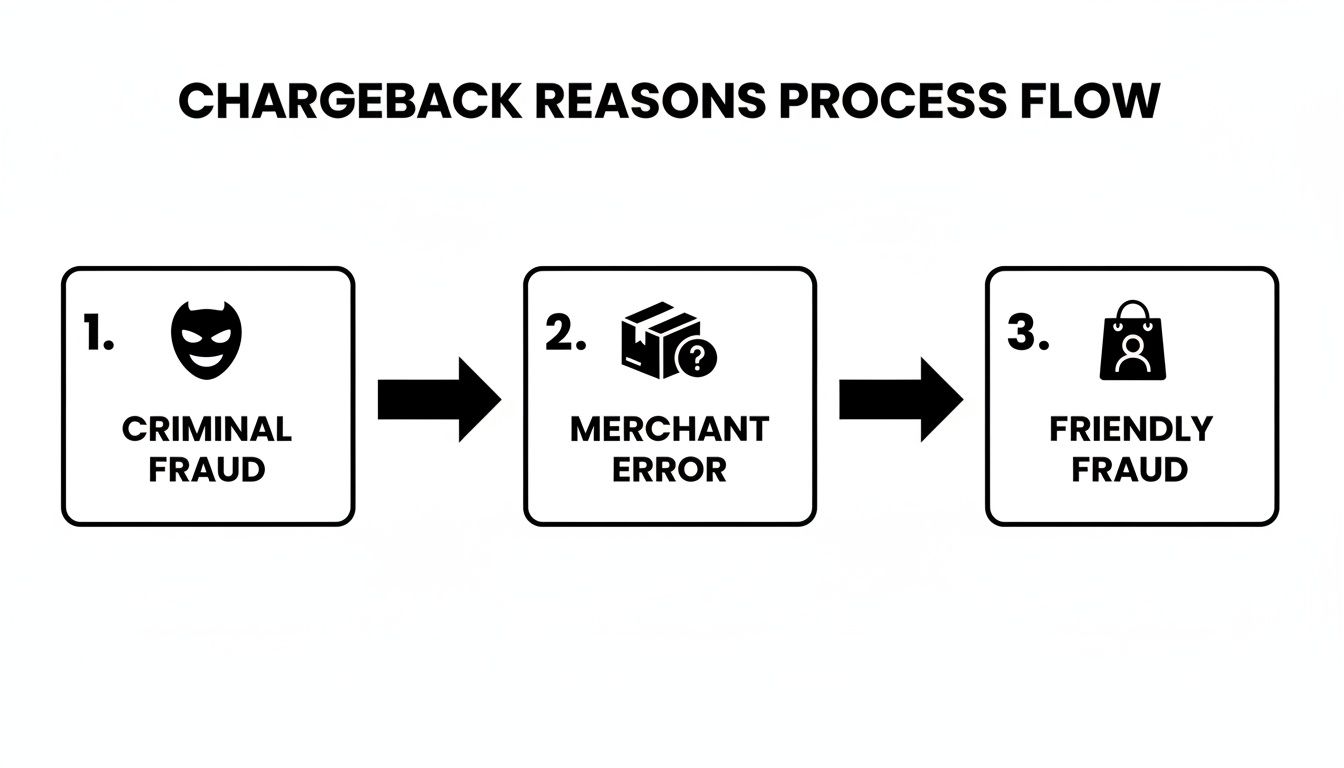
As you can see, the reasons range from outright criminal fraud to simple merchant errors and, most frustratingly, friendly fraud. The intricate card dispute process in our detailed article is the battleground where all of these claims are fought.
The hard truth is that this entire system was designed to protect consumers, not merchants. That’s why you need a powerful defense. ChargePay’s AI automates this whole workflow for you. We’ve handled over 100,000 disputes, recovering more than $2.8 million for Shopify stores by navigating this exact process with a 92.4% win rate.
Avoiding the Shopify 1% Chargeback Threshold

For most Shopify store owners, there's one number that causes more stress than shipping costs or ad spend: 1%. This isn't just a guideline; it's the hard-and-fast chargeback threshold for Shopify Payments.
Going over this limit isn’t a small slap on the wrist. It’s a serious threat that can get your account frozen or even shut down for good.
The math is simple, and it doesn't leave any room for error. For every 100 orders you process, you're allowed just one single chargeback before you step into the danger zone. One bad week, a sudden spike in friendly fraud, or a carrier delay you can't control could be all it takes to push your store over the edge.
This is about more than just lost sales. It's about protecting the very foundation of your ability to do business on Shopify.
The Math Behind the Risk
Let's look at how quickly a few disputes can spin into a full-blown crisis. If your store handles 500 orders in a month, you can only have five chargebacks before Shopify's alarms start going off.
Get just six disputes in that same 30-day period, and you're at a 1.2% chargeback rate. That instantly lands you in Shopify’s high-risk category.
What feels like a handful of annoying customer issues can escalate into a business-ending problem, fast. The pressure is immense, especially for merchants who are already close to that line.
On top of the lost revenue, every chargeback filed against your store comes with a $15 fee from Shopify Payments. You only get that fee back if you fight the dispute and win.
To make matters worse, chargebacks chip away an average of 0.47% from a retailer's total annual revenue. You aren't just losing the sale; you're paying extra penalties for being the target of a dispute. You can find more data on Shopify's policies and what leads to account issues at Swell.is.
More Than a Fee, It's an Existential Threat
Losing your Shopify Payments account is a nightmare scenario for any merchant. It means you can no longer take credit card payments through Shopify’s built-in system.
You’re forced to scramble for a third-party processor, which almost always means higher fees, a clunky setup, and a checkout experience that feels disjointed for your customers.
The fallout is immediate and severe:
- Immediate Revenue Loss: Your main channel for processing sales is gone.
- Operational Chaos: You have to stop everything to find and integrate a new payment gateway.
- Damaged Reputation: An account suspension is a red flag to other processors, marking you as a high-risk business.
This is exactly why managing chargebacks isn't just a "good practice"—it's a critical survival skill. You simply can't afford to ignore disputes or give them a half-hearted effort.
This is where automation becomes your best defense. At ChargePay, we built our AI specifically to shield Shopify merchants from this exact threat. Our system takes over every dispute automatically, from pulling the right evidence to submitting a response that’s built to win.
With a 92.4% success rate, we turn this constant threat into a solved problem.
Stop losing sleep over the 1% threshold. Install ChargePay from the Shopify App Store and let our Built for Shopify app, rated 4.9-stars by merchants, defend your revenue and protect your business.
How to Build a Winning Chargeback Response

When a Shopify Payments chargeback lands in your lap, your one and only job is to make it impossible for the bank to side with the customer. Just sending over a tracking number and hoping for the best won't cut it. To win, you have to build a rock-solid case with undeniable proof that shuts down the customer's claim.
Think of yourself as a lawyer preparing for court. Every piece of evidence you submit is another brick in a wall of proof showing you did everything right. This is your shot to prove the chargeback is invalid, especially when you’re dealing with friendly fraud.
The Essential Evidence Checklist
Building a powerful response means going way beyond the basics. You have to remember, the people reviewing these cases at the bank see hundreds a day. Your submission has to be organized, crystal clear, and absolutely packed with proof. The moment a dispute hits, start pulling these items together.
- Order and Customer Details: Grab screenshots from your Shopify admin showing the order confirmation. Make sure it includes the customer's name, email, and exactly what they bought.
- Payment Verification Data: This is huge. Include the results for the Address Verification System (AVS) and Card Verification Value (CVV). A "match" is powerful proof that the real cardholder placed the order.
- IP Address Geolocation: Find the IP address used for the purchase and show how it matches the billing or shipping city. This connects the person who clicked "buy" to the location where the package was sent.
- Shipping and Delivery Confirmation: This one’s non-negotiable. You need proof of delivery straight from the carrier, showing the date, time, and full address. If you have a signature, that's even better—it's almost a slam dunk.
- All Customer Communications: Pull every single email, chat log, or DM you exchanged with the customer. These can prove they received order updates or, more importantly, that they never once complained about an issue before filing the dispute.
Missing even one of these details can be the difference between getting your money back and losing the sale, the product, and getting stuck with that $15 dispute fee.
Crafting a Compelling Rebuttal Letter
Your rebuttal letter is your opening statement. It’s where you take all that evidence and weave it into a story that’s easy to follow. Don't just dump a pile of files and expect the bank to connect the dots. You need to walk them through it, explaining exactly why the claim is wrong.
Keep it professional and stick to the facts. Start with the order number and the reason for the dispute. Then, point to each piece of evidence and explain what it proves. For example: "As you can see in Exhibit A, the IP address from the order matches the shipping city, which confirms the cardholder was in that location when they made the purchase."
A strong rebuttal letter doesn't just list facts—it tells a story that proves the transaction was legitimate. It directly refutes the specific reason code for the chargeback, leaving no room for interpretation.
Figuring out how to structure this letter is a make-or-break skill for any store owner. To get a head start, you can check out our rebuttal letter template and guide to see exactly what a winning submission looks like.
Manual Response vs. Automated AI Response
Let's be honest, the work involved in building a winning response for every single dispute is a huge time suck. Every hour you spend digging through records is an hour you're not spending on marketing, product development, or actually growing your business. This is where automation completely changes the game.
To see what I mean, let's compare the reality of putting a response together yourself versus letting an AI-powered tool like ChargePay handle it.
Manual vs Automated Chargeback Response
| Feature | Manual Process (You) | Automated with ChargePay |
|---|---|---|
| Speed | Hours of digging for files and writing for each dispute. | Seconds. The AI generates and submits the full response instantly. |
| Evidence | It's easy to miss key data points like IP logs or past order history. | Gathers every relevant piece of data from Shopify and other sources automatically. |
| Quality | Inconsistent. The quality depends entirely on how much time you have. | Consistently high-quality. Uses optimized templates for every reason code. |
| Win Rate | Merchants fighting alone average around a 12% win rate. | 92.4% across over 100,000 disputes handled. |
A manual response might have a tracking number and an order confirmation if you're lucky. An AI-powered response from ChargePay includes that, plus IP data, AVS/CVV results, detailed shipping history, a customer's past order history, and a professionally written rebuttal letter customized for the specific reason code.
The difference in how complete the evidence is speaks for itself, and frankly, so do the results.
Automate Your Defense and Win More Disputes
After digging into the headaches of Shopify Payments chargebacks, it's clear that manually fighting every dispute is a tough battle. It’s a race against the clock, a scramble for evidence, and honestly, a major source of frustration. But there's a much better way to protect your revenue and get your time back.
This isn't just theory; we're talking about real results. Here at ChargePay, our AI platform has taken on over 100,000 disputes for Shopify merchants just like you, clawing back more than $2.8 million in revenue. We do it with a 92.4% win rate, turning what feels like a guaranteed loss into a recovered sale.
How AI Transforms Chargeback Management
Imagine a world where you never have to personally respond to another chargeback. That’s exactly what our AI is built to do. The second a dispute hits your store, our system is on the case. No more frantic digging through old orders or staring at a blank page, wondering what to write.
Our process handles everything from start to finish, completely on autopilot:
- Instant Detection: The AI spots any new chargeback in your Shopify account the moment it appears.
- Automatic Evidence Gathering: It immediately pulls all the crucial data—order details, AVS/CVV results, IP logs, and shipping confirmation—right from Shopify.
- Custom Rebuttal Generation: Our system analyzes the chargeback reason code and writes a professional, persuasive rebuttal letter designed to beat that specific claim.
- Automated Submission: The complete evidence package is submitted for you, well before the deadline even gets close.
This all happens quietly in the background without you lifting a finger. You can rest easy knowing every single dispute is being fought with the best possible evidence, so you never lose a sale just because of a missed deadline or a weak response.
You don't have to become a chargeback expert to fight like one. ChargePay's AI handles the entire process, allowing you to focus on what you do best: growing your business.
Built for Shopify, Trusted by Merchants
We designed ChargePay from the ground up specifically for the Shopify ecosystem. As a Built for Shopify app, we meet the platform's highest standards for performance, quality, and security. It's a badge we're proud of, earned by delivering real, consistent wins for store owners, which is why we have a 4.9-star rating on the Shopify App Store.
We also believe you should only pay when you win. Our platform runs on a simple pay-per-win model. No monthly fees, no hidden costs—if we don't win the dispute and recover your money, you don't pay a cent. It's a completely risk-free way to defend your revenue. If you're looking for more details, check out our complete guide to automated chargeback management.
It’s time to stop letting friendly fraud and frustrating disputes chip away at your profits. Stop losing your time to a system that feels stacked against you.
Your best defense against Shopify Payments chargebacks is here. Install ChargePay from the Shopify App Store and let our AI start winning back your hard-earned revenue today.
Your Top Shopify Chargeback Questions, Answered
Even with a solid game plan, you're bound to have some questions about Shopify Payments chargebacks. It’s just part of running an online store. Let’s tackle some of the most common ones we hear from merchants just like you.
Can I Prevent Shopify Chargebacks Completely?
The honest answer? No, not entirely. It’s pretty much impossible to get your chargeback count to zero, mainly because of tricky situations like friendly fraud. But you can absolutely slash the number you have to deal with.
Think of it like this: the best defense is a great offense. Focus on crystal-clear return and shipping policies, offer great customer service, and use smart fraud detection tools. For the disputes that still manage to sneak past your defenses, having an automated system in place is your best bet for getting that money back.
How Long Do I Have to Respond to a Shopify Chargeback?
You have to act fast. Once a chargeback is filed, the clock starts ticking, and you typically only have between 7 to 21 days to respond. This isn't a suggestion—it's a hard deadline.
If you miss that window, you automatically lose the dispute. That means the product, the sales revenue, and your time are all gone. This tight turnaround is exactly why automation has become a lifesaver for so many store owners. A tool like ChargePay can submit every response for you, making sure you never lose a dispute just because you ran out of time.
Missing the response deadline is one of the easiest ways to lose money to a Shopify Payments chargeback. It’s a completely avoidable loss that automation solves instantly.
Is the $15 Shopify Dispute Fee Refundable?
Yes, but there’s a catch. You only get the $15 fee back if you win the dispute. Shopify pulls that $15 fee from your account the second a chargeback is initiated. If you fight it and win, they'll refund it. But if you lose or just don't respond, that fee is gone for good, right along with the original sale amount.
This makes winning even more critical. With ChargePay's 92.4% win rate, our merchants don't just recover their lost sales—they also get that frustrating fee returned to them in the vast majority of cases.
Does Responding to Chargebacks Hurt My Store?
Not at all—in fact, it's the complete opposite. Ignoring illegitimate disputes sends a signal to banks that you might be an easy target, which can unfortunately invite more chargebacks down the road.
Fighting back professionally, especially against friendly fraud, is one of the most important things you can do. It shows you run a serious business, helps you keep your chargeback ratio below the dangerous 1% threshold, and protects your relationship with your payment processor. It’s a vital part of keeping your store healthy and profitable.
It's time to stop letting chargebacks drain your revenue and waste your time. ChargePay's AI-powered platform automates your entire defense, handling over 100,000 disputes and recovering more than $2.8 million for merchants like you. As a trusted Built for Shopify app with a 4.9-star rating, we turn this problem into a solved one.
Install ChargePay from the Shopify App Store and let our AI start winning back your money today.


.svg)



.svg)


.svg)
.svg)
.svg)