


If you’re running a Shopify store with Stripe, you know that painful feeling of getting a Stripe chargeback. It's not just a simple refund. It's a forced reversal from a customer's bank that yanks money right out of your account, and then kicks you while you're down with a penalty fee.
For so many Shopify store owners, it feels like a never-ending battle that slowly chips away at your profits. You're losing money, and you're not sure how to stop it.
What a Stripe Chargeback Means for Your Store
Chargebacks are designed to protect shoppers, but for merchants, they’re a serious problem. The moment a customer files a dispute with their bank, Stripe pulls the full amount of the sale from your account and puts it on hold.
But it doesn’t stop there. Stripe also tacks on a $15 dispute fee just for handling the claim. You lose the revenue from the sale, the product you already sent out, and what you paid for shipping. Even if you fight the dispute and win, that $15 fee is gone for good.
The True Cost of a Single Chargeback
That multi-layered loss is exactly how one chargeback can quickly spiral into a much bigger financial hit. Let’s break down how a single dispute on a modest sale can cost you far more than the original transaction amount.
| Cost Component | Average Financial Impact |
|---|---|
| Original Transaction Amount | $50.00 |
| Stripe Dispute Fee | $15.00 |
| Cost of Goods Sold | $25.00 |
| Shipping & Handling Costs | $10.00 |
| Customer Acquisition Cost | $15.00 |
| Total Loss to Your Business | $115.00 |
As you can see, a simple $50 chargeback can easily end up costing your business over $115. You’re not just losing the sale; you’re losing money on top of it.
The Problem Is Getting Worse
This isn't just a minor annoyance; it's a growing threat to your bottom line. And unfortunately, the problem is escalating fast.
Global chargeback volumes are projected to hit a staggering 337 million by the end of 2026, up from 265 million in 2023—a 27% surge in just three years. This tidal wave of disputes means every Shopify merchant needs a serious defense strategy.
The financial damage is massive. Global chargeback values are expected to climb from $33.79 billion in 2026 to $41.69 billion by 2029. You can dig into the full scope of these chargeback statistics to see just how quickly this issue is spiraling for online sellers.
Losses add up fast, especially with the rise of "friendly fraud"—when a customer disputes a completely valid purchase. This one issue is responsible for a huge chunk of all chargebacks. You have to fight back, but trying to do it all yourself is a massive time sink with a low chance of success.
That's where ChargePay comes in. We’ve turned this constant threat into a solved problem for Shopify merchants on Stripe. Our AI-powered app automates the entire dispute process for you.
With a 92.4% win rate across over 100,000 disputes, we've recovered more than $2.8 million for stores just like yours. Instead of just accepting losses, you can fight back effectively and win. You can install ChargePay directly from the Shopify App Store, where we've earned our "Built for Shopify" badge and a 4.9-star rating from merchants who were tired of losing money.
The Stripe Chargeback Process Step by Step
Dealing with a Stripe chargeback can feel like you've been pulled into a high-stakes legal drama you never asked to star in. The second a customer disputes a charge, a complicated process begins, and the clock immediately starts ticking—against you. Knowing each step is your best shot at building a winning defense.
It all starts when your customer calls their bank to question a charge. Maybe they don't recognize your store name on their statement, claim they never got their order, or argue the product wasn't what they expected. Whatever their reason, their bank files a formal dispute, which kicks off the whole Stripe chargeback process.
Before you even get a chance to tell your side of the story, the financial hit is immediate. This is what it looks like.
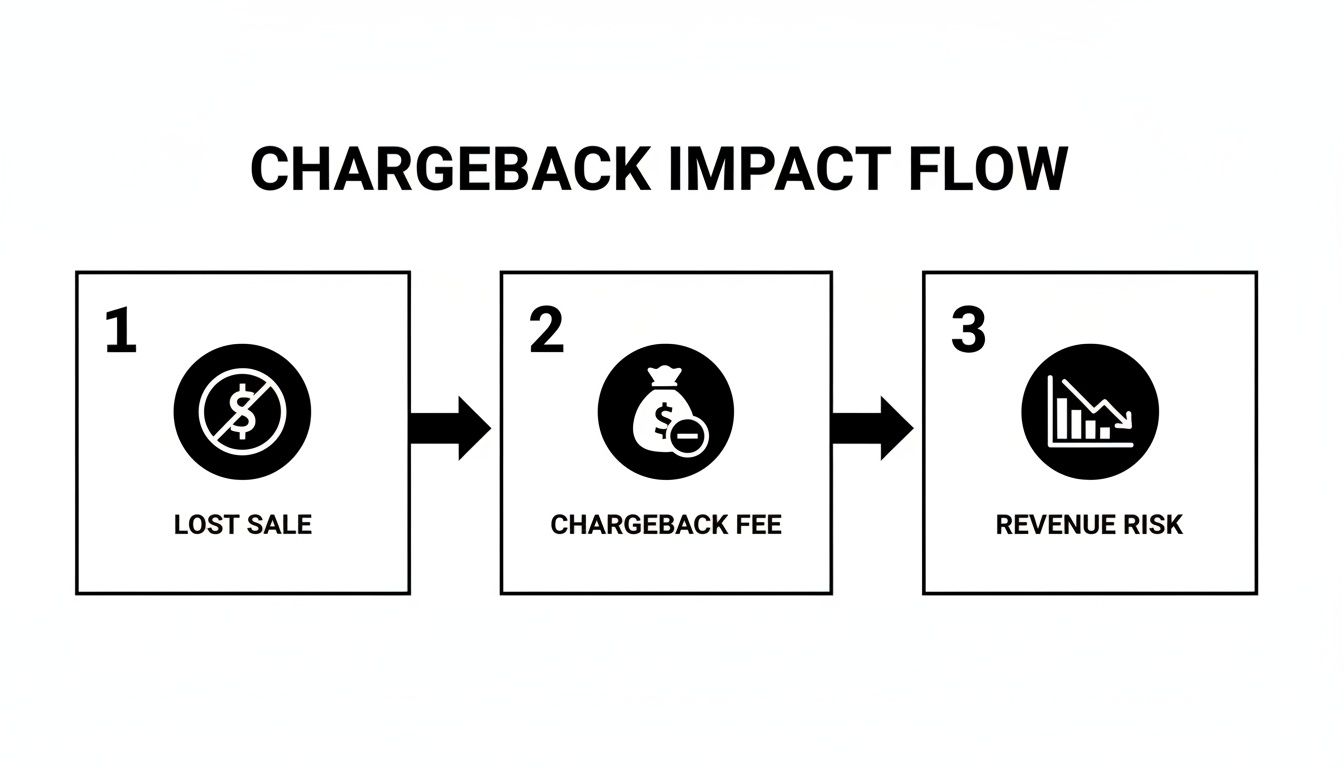
As you can see, it's not just about the lost sale. You're also hit with a fee, and it puts your future revenue at risk.
Phase 1 The Initial Dispute And Evidence Window
The first you'll hear of it is a dispute notification from Stripe. In the same breath, Stripe will pull the full disputed amount right out of your account, plus a non-refundable $15 dispute fee. That money is then held by the card network (think Visa or Mastercard) until the whole thing is settled.
From that moment, you’re on a tight deadline—usually between 7 and 21 days. This timeline isn't set by Stripe; it’s dictated by the customer's bank. If you miss that deadline, it's an automatic loss. You're out the disputed cash and the fee, no second chances.
Phase 2 Compiling And Submitting Your Evidence
This is your one and only shot to make your case. It’s on you to gather every piece of relevant evidence that proves the charge was legitimate and submit it through the Stripe Dashboard. The quality of what you submit is everything.
A weak or incomplete response is almost a guaranteed loss. You have to build a compelling story that directly shuts down the customer's claim. For a deep dive into what documents you need for different claims, check out our full guide on the card dispute process.
Your evidence package should absolutely include:
- Proof of Customer Authorization: This means records of AVS (Address Verification System) and CVV checks.
- Proof of Service/Delivery: Shipping confirmation with a tracking number is a must, plus a screenshot showing it was delivered to the customer’s address.
- Customer Communications: Any emails, support tickets, or chat logs you have with the customer about their order.
- Order and Product Details: Clear descriptions of what they bought, along with screenshots of the product page and your store policies (like refund and shipping).
Think of it like this: The person at the bank reviewing your case knows nothing about you, your customer, or this order. Your job is to hand them a file so packed with clear, undeniable proof that they have no other option but to rule in your favor.
Phase 3 Review And Final Decision
After you submit your evidence, Stripe forwards it to the customer's bank. This isn't a conversation; it's a one-way submission. The bank then looks at the evidence from both sides—yours and their cardholder's. This review period can drag on, sometimes taking over 60 days.
All this time, the disputed money is still on hold. If the bank sides with you, the funds are returned to your Stripe account. But if they rule in the customer's favor, that money is gone for good.
This whole manual process—gathering evidence, writing a persuasive response, and submitting it all on time—is exactly what eats up countless hours for merchants. It's a low-win-rate game that most store owners just aren't set up to win consistently.
This is the very problem ChargePay was built to solve. We automate the entire workflow, using AI to build and submit winning responses for you in real-time. For Shopify merchants using ChargePay, this has resulted in a 92.4% win rate.
Common Reasons for Chargebacks and How to Spot Them
If you want to fight Stripe chargebacks effectively, you first have to understand the dispute. Think of a chargeback reason code as a clue. It’s the bank’s way of telling you why the customer disputed the transaction, but that clue is often wrapped in confusing industry jargon.
Decoding these reasons is your first step. It’s how you figure out what happened and how to build a winning response. Most disputes you’ll see in your Stripe dashboard boil down to just a handful of common problems. Let’s translate them into plain English so you know exactly what you’re up against.
Decoding Stripe Chargeback Reason Codes
When that dispute notification lands in your inbox, it comes with a specific reason. While the official codes from card networks like Visa or Mastercard can feel a bit technical, they almost always point to one of a few core issues. Knowing the real-world story behind the code is everything.
Here’s a simplified breakdown that translates those technical codes into scenarios you’ve likely seen before.
Stripe Chargeback Reason Codes Explained
| Common Scenario | Stripe Reason Code Category | What It Means |
|---|---|---|
| "I never bought this!" | Fraudulent | The customer claims they didn't authorize the purchase. This could be a stolen card, but it’s often a cover for friendly fraud. |
| "My order never showed up." | Product Not Received | The customer says the package never arrived. This could be a real shipping snag or someone trying to get a freebie. |
| "This isn't what I wanted." | Product Unacceptable | The item was damaged, the wrong size/color, or simply didn’t match your Shopify store’s description. |
| "I forgot I subscribed to this." | Credit Not Processed | The customer expected a refund they didn't get, or they canceled a subscription but were still charged. |
Each of these scenarios requires a completely different kind of evidence to fight back successfully. For a deeper dive into these categories and what they mean for your store, you can explore the most common reasons for a chargeback in our dedicated guide.
The Big Problem: Friendly Fraud
Here’s the frustrating part: while some chargebacks are legitimate, a huge percentage are not. This is where friendly fraud enters the picture. It’s when a customer disputes a completely valid charge, either because they’re confused, impatient, or deliberately trying to get something for free.
Friendly fraud is the silent profit-killer for so many Shopify stores, accounting for up to 45% of all chargebacks. It's a frustrating and costly problem because the customer received exactly what they ordered, yet you're the one left holding the bag.
Common friendly fraud scenarios include:
- Buyer’s Remorse: The customer regrets their purchase but would rather file a dispute than follow your official return policy. It’s just easier for them.
- Family Fraud: A family member, often a child, uses the card without asking. Instead of handling it at home, the cardholder disputes the charge.
- Forgotten Purchases: The customer simply doesn’t recognize your store’s name on their billing statement and assumes it must be fraud. This happens a lot with subscription renewals.
The costs are staggering. While the global average chargeback rate is around 0.65%, it jumps to 0.95% for eCommerce retailers. Worse, for every dollar of fraud, merchants will lose an average of $4.61 by 2026—a figure that has already shot up 37% since 2021. You can learn more about these costly chargeback statistics and trends to see the full financial impact.
Spotting the Difference: Criminal vs. Friendly Fraud
Telling the difference between a true fraudster and an opportunistic customer is key to building a strong defense. There's no single foolproof method, but you start to see patterns that raise red flags.
| Clue | Likely Criminal Fraud | Likely Friendly Fraud |
|---|---|---|
| Order History | A brand-new customer placing a large, rushed order for high-ticket items. | An existing customer with a history of previous, undisputed purchases. |
| Shipping Address | Mismatched billing and shipping addresses, especially if the shipping destination is a freight forwarder. | The shipping and billing addresses match, and tracking confirms a successful delivery. |
| Customer Contact | Absolute silence. The chargeback notification is the first you hear of any problem. | The customer may have contacted you but was unhappy with the resolution or too impatient to wait. |
| Product Type | High-value, easily resold items like electronics or designer goods. | Any type of product, often including digital goods or subscription services. |
Recognizing these patterns helps you diagnose each Stripe chargeback more accurately. For a criminal fraud case, your evidence will focus on proving you took every fraud prevention step. For friendly fraud, your evidence needs to prove you delivered the right product to the right person at the right address.
Trying to manually analyze every dispute for these nuances is exhausting and eats up valuable time. This is exactly the kind of detailed work ChargePay’s AI was built for. Our system automatically analyzes hundreds of data points for each dispute to identify the true reason and build the strongest possible evidence package—it's how we’ve recovered over $2.8 million for merchants with a 92.4% win rate.
How to Build a Winning Chargeback Case
When that Stripe chargeback notification lands in your inbox, it’s time to act. This is your one and only shot to prove to the customer’s bank that the sale was legitimate. Just uploading an invoice and crossing your fingers isn’t going to work. You need to build a rock-solid case with undeniable proof.
Winning a dispute isn't about writing long, emotional paragraphs explaining your side. It’s all about giving the bank clean, organized, and relevant evidence that directly shuts down the customer’s claim. The person reviewing your case knows nothing about your store or this order, so your job is to make their decision an easy one.

Match Your Evidence to the Claim
The first rule of fighting back is to address the specific reason for the chargeback. Sending proof of delivery for a “Product Unacceptable” claim is just a waste of everyone's time. You have to tailor your evidence to directly counter what the customer is arguing.
Here’s a quick rundown of what evidence is crucial for different dispute types:
- For "Fraudulent" Claims: You need to prove the real cardholder was involved. Focus on AVS (Address Verification System) and CVV match results, IP address logs that match the customer's location, and any past order history you have for that customer.
- For "Product Not Received" Claims: This is all about proving delivery. Your best evidence will be the shipping confirmation email, the tracking number, and a screenshot from the carrier's website showing a "delivered" status to the correct address.
- For "Product Unacceptable" Claims: Your goal is to show the customer got exactly what they ordered. Include screenshots of the product page from your Shopify store, your clear return and refund policies, and any emails or messages where the customer talks about receiving the item.
Think of it as a checklist you need to complete for every single dispute. If you want a more detailed look at building your defense, check out our guide on how to win a credit card dispute.
The Anatomy of a Perfect Submission
Once you've got your evidence, how you present it matters just as much as what's in it. A messy, confusing submission is a fast track to getting rejected. You want to make it as simple as possible for the bank to see things your way and rule in your favor.
A winning submission is always structured logically:
- A Clear Summary: Start with a short, one-paragraph summary. State the order number, what was bought, and a simple reason why the chargeback is wrong.
- Organized Evidence: Attach your documents as separate, clearly named files. Think "Proof_of_Delivery.pdf" or "Customer_Email_Comms.png."
- Relevant Details Only: Don't tell your life story. Stick to the facts and evidence that directly relate to the reason for the dispute.
Manually fighting chargebacks this way has a notoriously low success rate, with merchants typically winning only 20-30% of cases they contest. It's a system that favors the cardholder, and merchants often lack the time and expertise to build a winning case every single time.
This low win rate is a painful truth for Shopify merchants. For every dollar of fraud, U.S. merchants will lose an estimated $4.61 by 2026. This number includes the lost revenue, bank penalties, unrecovered products, and all the time you waste fighting a battle you're likely to lose.
The ChargePay Advantage: From Defense to Offense
Let’s be honest, trying to build a winning case for every Stripe chargeback is a full-time job. It’s draining, it's complicated, and the odds are stacked against you from the start. This is the exact problem we built ChargePay to solve for Shopify merchants.
Instead of you spending hours digging through records, our AI-powered platform does it all for you in seconds. When a dispute hits your Stripe account, ChargePay automatically:
- Analyzes the reason code to instantly understand the claim.
- Gathers all the right evidence from your Shopify store and other connected sources.
- Builds a customized, compelling evidence package formatted exactly how the card networks want to see it.
- Submits the winning response on your behalf, long before the deadline ever arrives.
This automated workflow is how we’ve hit a 92.4% win rate across more than 100,000 disputes, recovering over $2.8 million for merchants like you. We turn the manual, frustrating process of fighting Stripe chargebacks into a solved problem.
Proactive Strategies to Prevent Chargebacks
Fighting and winning a Stripe chargeback feels good, but you know what’s even better? Stopping it from ever happening. The best defense is a good offense, and being proactive is your strongest move against lost sales and painful disputes. It’s all about getting out in front of problems before they even start.
A lot of chargebacks don't come from professional fraudsters. They come from simple mix-ups, a customer's impatience, or just plain unclear communication. Someone who doesn't recognize your store's name on their bank statement is just as likely to file a dispute as a bad actor. By tightening up a few key spots in your Shopify store, you can head off these issues and watch your dispute rate drop.

Optimize Your Store for Clarity and Trust
Think of your Shopify store as your first line of defense. Every single page, from your product descriptions all the way to checkout, is a chance to build trust and set the right expectations.
Start with your billing descriptor. That’s the little bit of text that appears on a customer's credit card statement. You have to make sure it’s instantly recognizable as your store. A generic name like "SP *ONLINE STORE" is a direct path to "Fraudulent" chargebacks from people who just forgot what they bought.
Next, take a hard look at your product pages. Vague descriptions and blurry photos are a leading cause of "Product Unacceptable" disputes.
Your descriptions need to be rock-solid and include:
- Detailed specifications: Give them the exact dimensions, materials, colors, and features. Don’t leave anything up to their imagination.
- High-resolution images and videos: Show your product from every angle. Let customers see exactly what they're paying for.
- Honest representation: Don't oversell it. If a product has a known quirk or limitation, just be honest about it.
Getting this level of detail right ensures that what shows up in the box is exactly what the customer thought they were buying. This simple step cuts off a huge source of disputes right from the start.
Make Policies and Shipping Crystal Clear
Hidden or confusing policies are a chargeback magnet. Your customers should never have to go on a scavenger hunt to find your shipping, return, or refund rules. Make them so obvious they can't be missed.
Create dedicated, easy-to-read pages for your policies. Then, link to them everywhere—in your site’s header, footer, and even on your product pages. Use simple, everyday language, not legal-speak. Clearly state your return window, what qualifies for a refund, and who's responsible for return shipping costs.
Transparency is your best friend. A customer who can easily find and understand your 30-day return policy is far more likely to contact you for a return than to file a chargeback because they felt stuck.
Shipping is another make-or-break area. Always provide realistic delivery estimates and do your best to meet them. Most importantly, give every single customer a tracking number the second their order is on its way. This one step is your number one piece of evidence against "Product Not Received" claims.
Add Layers of Fraud Prevention
While many disputes are born from confusion, real fraud is definitely still out there. Beefing up your security can stop fraudulent orders before they ever get processed. Basic tools like the Address Verification System (AVS) and Card Verification Value (CVV) checks are non-negotiable.
For an even stronger shield, think about using 3D Secure authentication. This tech adds one more step at checkout where the customer has to confirm their purchase directly with their bank. In many fraud cases, this shifts the liability for the chargeback from you back to the card-issuing bank. If you're curious how it all works, you can learn more about 3D Secure authentication in our guide.
Even with all these proactive steps, a few disputes are bound to slip through. That's when a powerful automated solution becomes your backup plan. ChargePay jumps in the moment a dispute happens, using AI to build and submit a winning evidence package on your behalf. It protects your revenue so you can stay focused on prevention.
Automate Your Defense with ChargePay
Let's be honest: fighting a Stripe chargeback by hand is a game you're set up to lose. It's slow, it's frustrating, and every minute you spend digging up evidence is a minute you're not spending on what really matters—growing your business. For Shopify merchants, it's an exhausting cycle that eats up your time for a pretty low chance of getting your money back. This is exactly the problem ChargePay was built to solve.
Instead of you having to scramble every time a dispute notification pops up, our platform handles the entire defense process for you. The second a new chargeback hits your Stripe account, ChargePay is on the case. No frantic evidence gathering, no late-night responses—just results.
Let Our AI Win for You
ChargePay was designed from the ground up specifically for Shopify merchants dealing with this headache. We don't just fire off a generic template. Our AI digs into hundreds of data points from your store to build a rock-solid, custom evidence package that’s designed to win.
Here’s a quick look at how it works the moment you install ChargePay:
- Instant Detection: Our system plugs right into your store and flags a new dispute the second it lands.
- AI-Powered Evidence Gathering: The AI instantly gets to work, pulling together all the proof you need—customer details, order info, shipping confirmations, AVS/CVV match data, and a whole lot more.
- Automated Submission: We package everything into a professional, compelling response, formatted exactly the way banks and card networks expect to see it, and submit it for you.
This isn't just theory; it’s a proven system that flips the odds back in your favor. This automated workflow is how we've hit a 92.4% win rate for our merchants.
We’ve successfully fought over 100,000 disputes for Shopify stores just like yours, recovering more than $2.8 million in revenue that would have otherwise vanished. That's real money put right back where it belongs—in your pocket.
The reality is that the old manual approach is broken. Stop wasting hours fighting a battle you're not equipped to win. With ChargePay, you get an expert system that fights for you 24/7. Our technology is so trusted that we've earned the official "Built for Shopify" badge and a 4.9-star rating from merchants who were tired of losing their hard-earned money to unfair chargebacks. You can see more about how our AI-driven product features turn losing disputes into recovered revenue.
Instead of just writing off chargebacks as a cost of doing business, you can make them a problem of the past. Go ahead and install ChargePay from the Shopify App Store and let our AI start winning back your money today.
Frequently Asked Questions About Stripe Chargebacks
If you're dealing with a Stripe chargeback, you've probably got some questions. Let's get right into the answers we give Shopify merchants every single day.
Can I Get the $15 Stripe Dispute Fee Back?
Let’s get this one out of the way first. Unfortunately, no. That $15 dispute fee Stripe charges is non-refundable, no matter what happens.
Even if you put together the perfect response and win the dispute, Stripe holds onto that fee to cover their administrative time. It’s a tough pill to swallow, and it's exactly why preventing disputes before they even happen is so important. Every single one has a cost.
How Long Do I Have to Respond to a Dispute?
You don't get much time, usually somewhere between 7 and 21 days, to get your evidence submitted. It's a tight window.
And here's the kicker: Stripe doesn't even set this deadline. It comes directly from the card networks like Visa and Mastercard. If you miss that window, you automatically lose the dispute and the sale. No second chances.
What Happens If I Get Too Many Chargebacks?
This is where things can get serious. Getting hit with too many chargebacks puts your entire Stripe account on the line. Card networks keep a close eye on your dispute rate—the number of chargebacks you get compared to your total sales.
If that rate creeps up too high, typically over 0.75%, you could land in a monitoring program, get slapped with higher fees, or even have your account shut down completely. This is why you can't just write off disputes as a cost of doing business. You need a solid game plan to fight and win them to keep your account healthy.
Tired of navigating the complex and frustrating world of Stripe chargebacks on your own? ChargePay automates the entire process, using AI to build and submit winning evidence packages for you. With a 92.4% win rate across over 100,000 disputes, we've recovered more than $2.8 million for Shopify merchants. Install ChargePay from the Shopify App Store and let our AI win back your revenue.


.svg)



.svg)


.svg)
.svg)
.svg)