

Chargebacks are not a customer service annoyance. They are a margin problem, an operations problem, and if you ignore them long enough, a merchant account problem.
Most Shopify merchants get trapped in the wrong debate. They ask, “How do I stop every chargeback?” Wrong question. The right question is, “What is the cheapest, smartest mix of prevention and defense for your store?”
That shift matters. Some disputes should be prevented upstream with cleaner policies, better communication, and risk screening. Others should be fought hard with the right evidence and a sharp rebuttal. If you treat every dispute the same, you waste money in both directions.
The True Cost of Chargebacks for Your Store
Chargebacks are growing fast. Global chargeback volume is projected to rise from 261 million transactions in 2025 to 324 million by 2028, a 24% increase, while the total cost is projected to climb from $33.79 billion to $41.69 billion. U.S. merchants are projected to lose $4.61 for every dollar of fraud in 2025 according to Mastercard’s 2025 analysis of the true cost of a chargeback.
That number should reset how you think about chargeback defense. The transaction amount is only the visible loss. The full impact includes fees, staff time, missed deadlines, and the pressure that repeated disputes put on your processor relationship.

The hidden losses stack up fast
A single chargeback can trigger several costs at once:
- Lost revenue: You lose the sale if the issuer sides with the cardholder.
- Operational drag: Your team has to pull order data, shipping records, and support logs.
- Ratio pressure: Too many disputes can damage your standing with processors and acquirers.
- Policy distortion: Merchants often react by making returns too generous or fraud rules too strict, which creates new costs elsewhere.
If you want a better breakdown of the fee side of this problem, this guide on what is a chargeback fee is worth reading.
Why this hurts Shopify merchants more than they expect
Shopify brands move fast. You launch products, test offers, push bundles, run paid traffic, and optimize checkout. Then a wave of disputes lands and eats the profit you thought you made.
The worst part is timing. Chargebacks usually show up after fulfillment, after ad spend, after pick-and-pack, after support handled the first complaint. By the time the dispute appears, you have already paid most of the costs.
Bottom line: If you only track refunded orders and obvious fraud, you are undercounting your losses. Chargeback defense belongs in your profit model, not your admin backlog.
Your First Line of Defense Smart Prevention Tactics
Good chargeback defense starts before the dispute exists.
Most “prevention advice” is too vague to help. “Improve customer communication” is not a plan. You need specific fixes inside your Shopify store, your order flow, and your fraud workflow.
Fix the disputes you are causing yourself
A surprising number of disputes start with preventable confusion.
Use this checklist:
- Tighten product pages: Show exactly what the buyer gets. Include dimensions, materials, compatibility details, and what is not included.
- Match images to reality: If the color, size, or bundle contents can be misunderstood, your product page is creating future evidence problems.
- Make shipping windows obvious: Put processing times and delivery expectations in plain language before checkout.
- Write return rules like a human: Customers should know when they can return, what condition items must be in, and how refunds are handled.
- Use a clean billing descriptor: If the cardholder does not recognize the charge, they often go to the bank first.
A lot of store owners hurt themselves by making the buying experience look polished while leaving the policy pages muddy. That is backwards. Clear policy language reduces confusion and gives you stronger records later.
If you are also working on the front-end buying experience, this guide on how to improve ecommerce conversion rates is useful because better conversion does not have to mean looser controls.
Communicate after the sale
Silence after checkout creates disputes.
Send messages that answer buyers' key questions:
- Order confirmation: Confirm product names, quantities, and billing details.
- Shipping update: Send tracking as soon as it exists.
- Delivery notice: Tell the customer when the package is marked delivered.
- Support path: Make refund or replacement help easy to find.
This is not just good service. It creates a paper trail. When a customer later says the item never arrived or that the transaction looks unfamiliar, you have a record of what they saw and when they saw it.
Tip: Save customer communications in a system you can search fast. Evidence that lives across five inboxes is barely evidence.
Add behavioral prediction before orders turn into disputes
Prevention gets much stronger when you stop treating every order the same.
Machine learning-driven behavioral prediction can boost overall recovery by 15% to 30% via prevention, and these tools analyze purchase history, IP data, and device fingerprints in real time to trigger interventions that can reduce chargeback rates by 20% to 40% according to PayCompass on the chargeback process.
That matters because not every risky order should be auto-canceled. Smarter stores use risk signals to decide what action fits the order:
- Low-risk but odd behavior: Send extra confirmation or a support follow-up.
- Medium-risk signals: Hold the order briefly for verification.
- High-risk pattern: Require stronger validation before fulfillment.
The goal is not maximum friction. The goal is selective friction.
For Shopify merchants, automation earns its keep. The right setup screens for risk in the background, flags unusual behavior early, and reduces the number of cases that ever need formal chargeback defense. For a deeper look, read this guide on chargeback prevention.
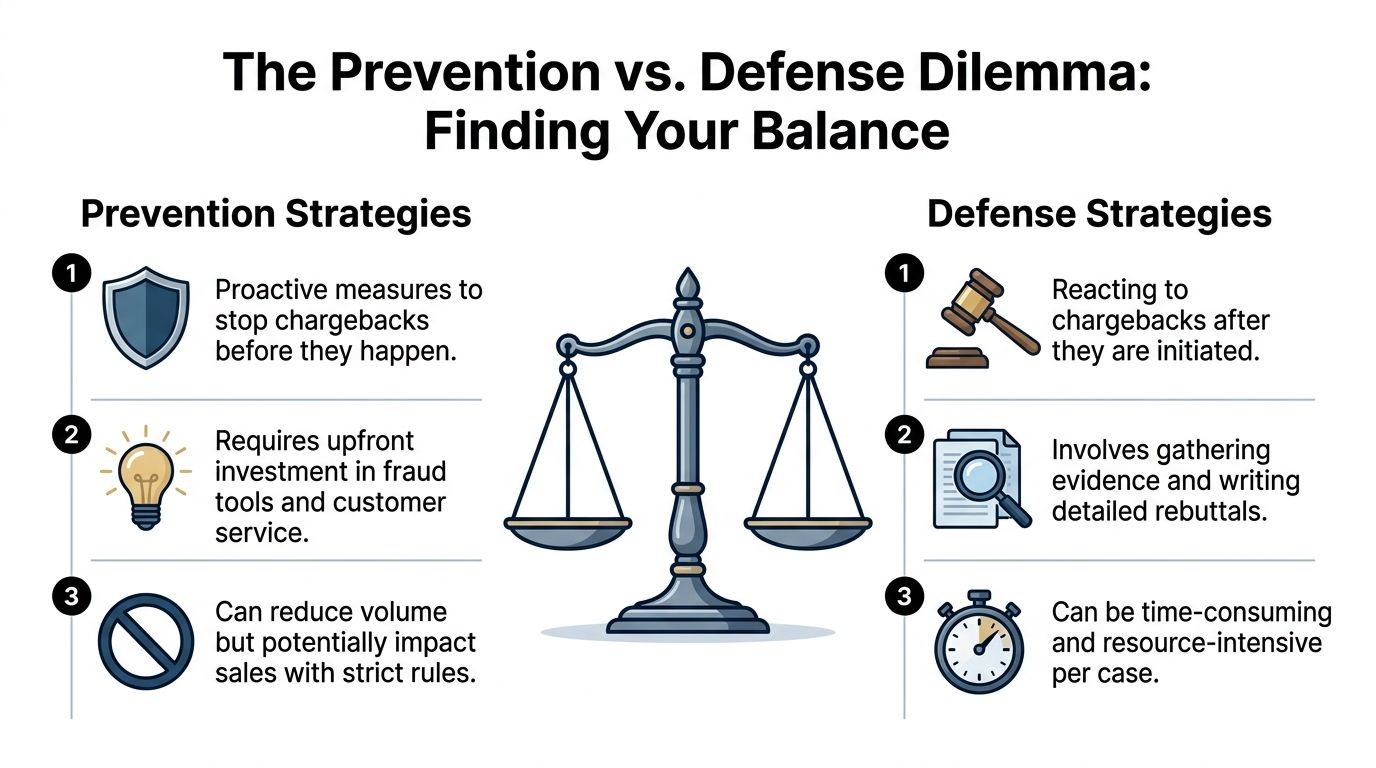
The Prevention vs Defense Dilemma Finding Your Balance
A lot of merchants hear one piece of advice on repeat: prevent every chargeback at all costs.
That is bad advice.
Prevention costs money. Defense costs money. Easy returns cost money. Strict fraud checks can cost sales. The essential job is balancing those costs instead of pretending one side solves everything.
Prevention can get expensive fast
Store owners often overcorrect after a run of disputes. They loosen returns, refund too quickly, or approve customer-friendly exceptions just to avoid a chargeback.
Sometimes that is the right move. Sometimes it is a false economy.
If you refund too broadly, you train customers to push for concessions. If you make return handling too generous, you may lower some disputes while increasing refund losses and operational overhead. You protected your chargeback metric but damaged your margin.
Defense has a hard limit too
The opposite mistake is just as common. Merchants fight everything without considering the impact on their dispute ratio or internal workload.
Merchants must balance winning individual disputes with protecting their overall compliance standing, because even a won chargeback still counts against the chargeback ratio. The safe threshold is widely considered to be 0.56% of transactions according to ChargebackHelp’s guide to lowering chargebacks under 0.56%.
That single fact changes strategy.
Winning a case gets your money back. It does not erase the dispute from your ratio. So if your store is drifting toward that threshold, pure defense is not enough. You need fewer disputes entering the system in the first place.
Use a cost-optimization model, not a moral model
Do not ask whether prevention is “better” than defense. Ask these questions instead:
| Decision area | Better prevention bet | Better defense bet |
|---|---|---|
| Customer confusion issues | Fix descriptors, shipping language, and return policies | Fight only if records clearly support your case |
| High-risk customer patterns | Add screening and verification before fulfillment | Use defense if the order was fulfilled with strong evidence |
| Low-margin products | Avoid expensive exceptions that erase profit | Be selective about what you contest |
| High-value legitimate orders | Use extra verification and delivery controls | Fight hard with full documentation |
The smartest stores do both, but not evenly.
They prevent disputes that are cheap to prevent and likely to repeat. They defend disputes where the order was valid, the evidence is strong, and the recovery is worth it. They stop treating every chargeback as a customer service failure.
If you want to evaluate tool options for that balance, this overview of chargeback management solutions can help.
Key takeaway: Prevention protects your ratio. Defense protects your cash. You need both, but you should not overpay for either one.
Building an Unbeatable Evidence Package
Most merchants do not lose chargebacks because they were wrong. They lose because their evidence is weak, incomplete, late, or mismatched to the reason code.
That is why manual chargeback defense performs so poorly. Merchants won only 45% of chargebacks on average in 2023, and first-party fraud accounted for 21% of all chargebacks according to PayCompass chargeback statistics. Friendly fraud is especially ugly because the transaction often looks legitimate on the surface.
What good evidence looks like
Your evidence package should answer one question clearly: why should the issuer believe you over the cardholder?
That means submitting records that fit the actual claim, not dumping every document you can find.
For most Shopify stores, the core evidence set includes:
- Order record: Product, amount, timestamp, and checkout details.
- Payment checks: AVS and CVV results when available.
- Customer identity signals: Device data, purchase history, and account activity.
- Fulfillment proof: Tracking, delivery confirmation, and shipping address match.
- Customer communication: Emails, support chats, consent logs, and complaint history.
- Policy acceptance: Proof the buyer had access to shipping, return, or subscription terms.
Evidence checklist by chargeback reason code
| Reason Code Type | Required Evidence | Pro Tip |
|---|---|---|
| Fraud or unauthorized use | Order details, AVS/CVV results, device and account data, prior purchase history, customer communication | Show that the order fits the customer’s normal behavior if you have that history |
| Item not received | Tracking, proof of delivery, delivery timestamps, shipping address match, any delivery photo or carrier confirmation | Do not just submit tracking. Explain how the package reached the address used at checkout |
| Not as described | Product page copy, item images, variant details, support exchanges, return policy, proof of what was shipped | Match the exact product listing to the exact SKU ordered |
| Subscription or recurring billing issue | Consent record, checkout acceptance, billing terms, cancellation policy, usage or access logs | Issuers want to see that the customer agreed before billing continued |
| Refund not processed or duplicate remedy | Refund logs, timestamps, support thread, payment confirmation | Show sequence clearly if the customer asked for a refund and then filed a dispute |
Match the reason code before you build the case
Merchants waste a lot of wins at this point.
If the chargeback says “item not received,” your best evidence is not a long story about fraud screening. It is proof of fulfillment. If the dispute is unauthorized use, generic delivery proof may not be enough on its own. You need to show authorization signals and cardholder connection.
Build your file in this order:
- Read the reason code carefully.
- Pull only the evidence that directly addresses that claim first.
- Add supporting context second.
- Remove anything confusing or irrelevant.
Tip: A smaller evidence package that clearly answers the issuer’s question is stronger than a bloated file full of unrelated screenshots.
Shopify merchants should systemize this, not improvise it
Evidence collection should not start when the dispute arrives. It should start when the order is placed.
You want your store, support inbox, and shipping records organized so you can pull a case file quickly. That includes keeping product pages archived, preserving customer messages, and storing fulfillment events in a consistent format.
If you need examples of how winning cases are structured, this guide on how to win a credit card dispute is a practical reference.
Writing Rebuttals That Win
Evidence wins cases only when the issuer can follow your argument.
A messy rebuttal wastes good proof. A sharp rebuttal turns scattered documents into a clear case. That is why strong chargeback defense is not just about collecting records. It is about presenting them in the right sequence.

The structure issuers respond to
A solid rebuttal does three things fast:
- States the claim you are answering
- Presents the transaction story in chronological order
- Links each piece of evidence to that story
That sounds simple, but most merchants miss it. They write emotional responses, complain about fraud, or paste support notes with no narrative.
A disciplined, reason-code-specific representment process works better. That process includes instant reason code analysis, automated evidence collection, and a professionally crafted rebuttal narrative submitted before the deadline. Proof of delivery can boost wins by 25% to 35% in the right cases according to Curbstone’s chargeback dispute methodology.
Weak rebuttal versus strong rebuttal
Here is the difference.
Weak version
- Customer is lying.
- We shipped the item.
- This chargeback is unfair.
- Please reverse it.
That language does nothing. It gives the issuer no structure and no confidence.
Strong version
- The cardholder placed the order through the store checkout.
- The order was approved and fulfilled to the address entered at purchase.
- The package was delivered according to carrier confirmation.
- Attached records show the timeline from checkout through delivery and post-purchase communication.
That works because it is factual, calm, and tied to evidence.
Use a repeatable rebuttal framework
Build every rebuttal around this simple flow:
- Opening summary
State why the transaction was valid and which claim you are rebutting. - Transaction timeline
Show the order date, payment approval, fulfillment event, delivery event, and customer communication in order. - Evidence mapping
Name each attached record and explain what it proves. - Closing request
Ask for reversal based on the documented validity of the transaction.
Tip: Never make the issuer hunt for your point. If a screenshot matters, explain exactly why it matters.
If you want a template to model, this example of a rebuttal letter gives you a useful baseline.
The AI Advantage How ChargePay Automates Your Defense
Chargebacks get expensive fast when your team is spending payroll hours on cases that may never pay back. The true problem is not just losing disputes. It is paying too much to fight them.
Automation is designed to solve this problem.

For a Shopify store owner, that means the case file gets built without the usual scramble across apps, inboxes, and carrier portals. AI can pull order details, customer messages, tracking records, and policy screenshots into one organized submission, then draft a rebuttal that matches the actual reason code. Your team stops starting from zero every time a dispute hits.
ChargePay handles that workflow for Shopify merchants. It automates evidence collection, rebuttal generation, and submission, and it uses a pay-per-win pricing model. That pricing structure matters because it turns chargeback defense into a cost-control decision. You stop burning fixed internal labor on every case and start fighting the disputes that are worth recovering.
That is the strategic advantage most stores miss.
If you try to prevent everything, costs rise fast. More manual review, tighter rules, more declined orders, more customer friction. If you defend everything by hand, your ops team gets buried and small-dollar disputes stop making financial sense. Pay-per-win AI changes the balance. You can keep prevention focused on clear risk signals, then let automation handle valid disputes at a cost tied to actual recovered revenue.
If you want to see how an automated flow looks in practice, watch this short walkthrough.
What this changes in real life
Your team gets out of repetitive dispute work like:
- digging through order notes
- copying screenshots into PDFs
- rewriting the same rebuttal language
- missing response windows because a case sat in the wrong inbox
Keep your prevention controls. Keep your policies tight. But stop treating chargeback defense like a manual admin task. For a growing Shopify store, the smarter move is to use automation where defense work is repetitive and time-sensitive, and keep your people focused on the decisions that improve margin.
Frequently Asked Questions on Chargeback Defense
What is the difference between a dispute and a chargeback
A dispute is the broader problem. A chargeback is the formal pullback of funds through the bank.
In practice, that distinction matters because earlier intervention can sometimes stop the issue before it becomes a full chargeback. Once it becomes formal, the process gets stricter and the evidence burden gets heavier.
If I win a chargeback, does it disappear from my ratio
No.
A won chargeback may recover the money, but it still counts against your chargeback ratio. That is why stores need both prevention and defense. One protects your record. The other helps recover revenue when prevention fails.
How fast do I need to respond
Fast.
Deadlines are tight, and slow responses lose cases. The safest operating rule is to treat every new dispute like it needs action immediately, not at the end of the week.
Should I fight small-dollar chargebacks
Sometimes yes, sometimes no.
If your team handles disputes manually, small-dollar cases may not be worth the labor. If you use a pay-per-win system, the math changes because you are not burning internal time on every file. The decision should come down to evidence strength, reason code, and whether fighting the case supports your broader strategy.
What is the hardest type of chargeback to defend
Friendly fraud is usually the most frustrating.
The customer often made the purchase, received the product, and then disputed it anyway. These cases are hard because the transaction can look legitimate at every stage. You win them by showing a full story, not by sending one isolated record.
What should I do first when a chargeback lands
Do three things immediately:
- Identify the reason code.
- Lock down the order record, support history, and shipping data.
- Decide whether the case should be prevented next time, defended now, or both.
Most merchants wait too long because they treat chargebacks like random noise. They are not random. They are operational signals.
If chargebacks are eating your margins, stop handling them like one-off admin tasks. Install ChargePay from the Shopify App Store and turn chargeback defense into an automated, pay-per-win workflow instead of a recurring drain on your team and cash flow.


.svg)



.svg)


.svg)
.svg)
.svg)