

TL;DR: Yes. PayPal charges a fee to receive money for goods and services, and Shopify merchants should treat that fee as a direct hit to margin. Personal payments can be free in limited cases, but sales revenue is different. If you sell through PayPal, assume a percentage of every order is gone before payout. Then account for the bigger threat. Disputes and chargebacks can claw back the sale, add penalties, and turn a paid order into a net loss.
A customer buys through PayPal, Shopify records the order, and your available cash is already lower than the number you saw at checkout.
That shortfall is not just a processing cost. It affects inventory planning, ad spend, payroll, and how aggressively you can scale. The merchants who protect margin do more than ask, “does PayPal charge a fee to receive money.” They calculate the full cost of getting paid, including standard processing fees, cross-border charges, and the revenue lost when a chargeback wipes out both the sale and additional fees. If you want the broader context for how this fits into your store economics, review this breakdown of Shopify payment processing fees alongside your own payout data.
Your Guide to PayPal Receiving Fees for Shopify Merchants
If you're asking does paypal charge a fee to receive money, the short business answer is simple. If you're selling products, you're paying to receive those funds.
For Shopify merchants, this isn't a technicality. It's margin. A payment processor takes its cut before you can use that money for inventory, ads, payroll, or cash flow. When you stack that fee across every order, it becomes a real operating cost, not background noise.

What Shopify merchants usually get wrong
A lot of merchants think the main question is whether PayPal charges a fee at all. That's too small a question.
The better question is this: how much revenue disappears between checkout and final payout, and which part of that loss can you control?
You can control more than you think. You can price with fees in mind, monitor your payment mix, and tighten the places where revenue leaks after the payment is approved. If you want a broader view of how these costs fit into your store economics, this guide to Shopify payment processing fees is worth reviewing alongside your own numbers.
Practical rule: Treat payment fees as a margin input, not as an annoying surprise on your payout report.
What actually matters
Three things matter to your store:
- What type of payment it is. Personal transfers and commercial transactions are treated differently.
- Where the buyer is located. International sales add more cost.
- What happens after the order. A clean sale is one thing. A disputed sale is another.
Most merchants focus only on the first deduction and ignore the later ones. That's a mistake. The first fee hurts. The forced reversals hurt more.
Personal vs Commercial The Two Worlds of PayPal Fees
A customer checks out through your Shopify store, pays with PayPal, and the money lands in your account looking like a normal sale. It is not a normal transfer. It is a commercial payment, and PayPal prices it that way.
That distinction matters because many merchants still lump all PayPal payments together. Doing that leads to bad margin math. Worse, it makes chargeback losses feel random when they are actually built into the risk profile of commercial transactions.
The line PayPal draws
Personal transfers and business payments sit in separate categories.
If someone sends money to a friend from their PayPal balance or bank account, receiving that payment can be free. If a customer pays for a product, an invoice, or any Shopify order, you should treat that payment as commercial from the first click. A fee applies.
For a merchant, that means the question is not whether PayPal charges to receive money on store sales. It does. The main task is identifying which payments trigger standard commercial fees, which ones carry extra cross-border or conversion costs, and which ones can still come back later as disputes.
Why Shopify merchants belong in the commercial bucket
Your store is selling goods. PayPal is processing a business transaction with fraud checks, buyer protection exposure, and dispute risk attached to it.
That last part is where many stores lose the plot.
The receiving fee is the first deduction. A chargeback is the bigger threat because it can reverse the sale and add a separate penalty on top. So the personal versus commercial split is not just about fee labels. It tells you which payments carry post-sale risk and which ones do not.
If you want a clear example of how payment type affects dispute rights, read this explanation of whether PayPal Friends and Family payments can be charged back.
Treat every customer payment through PayPal as a commercial transaction with two possible costs. The processing fee you see now, and the dispute loss you may see later.
The practical takeaway for store owners
Build your margin model around the commercial reality of PayPal, not the personal-transfer exception.
Use this simple framework:
| Payment scenario | How to classify it |
|---|---|
| Paying back a friend | Personal transfer |
| Receiving money from a customer order | Commercial transaction |
| Personal receipt funded by balance or bank | Often free to receive |
| Product sale through Shopify | Fee applies and dispute risk exists |
That classification clears up the confusion fast. For a Shopify merchant, PayPal is a paid sales channel, not a free way to collect money.
Breaking Down PayPal's Commercial Fee Structure
The fee structure got more expensive for many merchants in August 2024, when some PayPal Checkout rates increased to 3.49% + $0.49. On a typical $100 domestic payment, that equals $3.98 in fees (PayPal fee calculator breakdown).
That number is small enough to ignore on one order and large enough to subtly damage your margin across a month of sales.
Common PayPal commercial transaction fees
Here’s the version that matters most for a Shopify merchant selling online in the US.
| Transaction Type | Fee Rate |
|---|---|
| Standard commercial receiving fee in the US | 2.99% + $0.49 |
| Some PayPal Checkout and Venmo payments | 3.49% + $0.49 |
| Cross-border surcharge for international sales | Add 1.50% |
| Currency conversion on international sales | Add 3% to 4% above mid-market |
If you want to estimate your own orders quickly, this PayPal transaction fee calculator can help you map fees against your average order value.
A domestic example
Say you sell a $100 item to a US customer through a flow charged at 3.49% + $0.49.
Your fee is $3.98. You keep $96.02 before any cost of goods, shipping, returns, or ad spend.
That's the clean version. No refund. No issue. No dispute.
An international example
Now take that same $100 sale from a buyer in another market. The source above notes that international sales can add a 1.50% cross-border fee and 3% to 4% in currency conversion, bringing the total effective cost to 6% to 8% of the transaction.
That changes the economics fast. On international orders, your “great top line” can turn into average net revenue if you haven't priced with those costs in mind.
Pricing tip: If PayPal is a meaningful share of your checkout mix, build the fee into your retail price instead of pretending it's a rare exception.
What to do with this information
Use fees in three places:
- Product pricing so your margin survives the transaction.
- Channel analysis so you know which payment paths cost more.
- International planning so cross-border orders don't look better than they really are.
A lot of brands look at gross sales and feel healthy. Then they inspect payment costs by order type and find out some transactions were far less profitable than they assumed.
The Hidden Costs Beyond Standard PayPal Fees
Most merchants stop at the transaction fee. That's where they lose the plot.
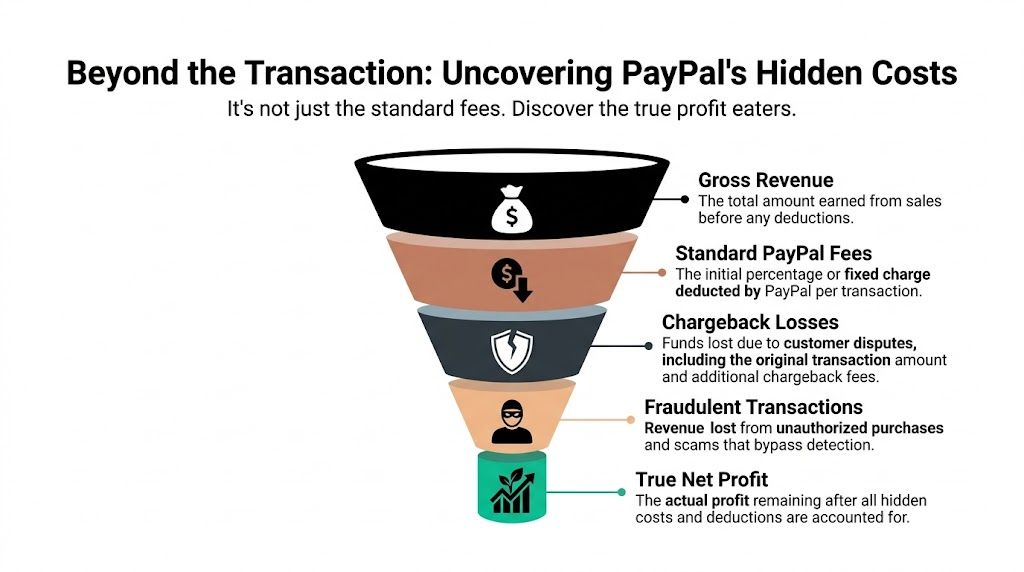
The standard fee is only the first deduction. The nastier losses show up after the order, especially when a buyer disputes the charge through their bank.
Refunds are annoying. Chargebacks are expensive.
A refund is painful because the sale disappears. But a chargeback is worse because it doesn't just reverse the revenue. It adds another direct cost.
PayPal deducts a $20 fee per chargeback in the US, on top of the original transaction fee you've already paid. The same source also notes that win rates without automated tools are often below 30%, and that friendly fraud has become a serious profitability threat, especially in DTC fashion and electronics (chargeback cost breakdown for PayPal merchants).
What a disputed sale really looks like
Take a $100 order. You already lost the receiving fee when the payment came in. If that order turns into a chargeback, PayPal can add the $20 chargeback fee on top.
The point isn't to obsess over one order. It's to see how quickly “payment processing” turns into revenue erosion when disputes start hitting your store.
Here are the business consequences:
- You lose the original sale amount if you don't win the dispute.
- You absorb the chargeback fee on top of the earlier processing cost.
- You spend staff time gathering evidence, chasing order records, and replying before deadlines.
- You get pressured twice on the same order, once at checkout and again after fulfillment.
A disputed order doesn't behave like a normal cost. It acts like a second attack on the same revenue.
Why cross-border orders need extra scrutiny
If you're selling internationally, this gets even riskier. Cross-border orders already carry extra payment costs. If one of those transactions becomes a dispute, you don't just lose margin. You lose margin on top of already inflated payment expense.
That's one reason merchants doing international volume should study their cross-border e-commerce risk separately from domestic orders. The payment fee isn't the whole story. Delivery timing, customer expectations, and post-purchase support all affect dispute exposure.
Strategies to Minimize and Recover PayPal Fees
You can't eliminate PayPal fees from commercial transactions. You can reduce how much they hurt.
The smartest merchants split this into two jobs. First, reduce fee impact before the sale. Second, recover revenue aggressively after a dispute.
Reduce the damage before checkout
Start with pricing. If a payment method regularly takes a chunk out of each order, your pricing should account for that instead of hoping volume will save you.
A few practical moves:
- Adjust pricing intentionally. If PayPal is common in your store, build expected payment cost into your product margin.
- Push larger carts. A fixed fee hurts less when customers buy more in one order.
- Watch international orders carefully. Cross-border and conversion costs can make a “good” sale far less attractive than it looks.
- Review your books monthly. Clean bookkeeping helps you see which fees are controllable and which are just the price of doing business. If you need a simple refresher on expense handling, these tax deductions for small business owners are a useful starting point.
Recover what actually matters
You usually won't recover the original processing fee just because an order went sideways. That’s frustrating, but it’s not the biggest lever.
The biggest lever is recovering the sale itself when a customer files a chargeback.
That means your dispute workflow has to be tight:
- Pull the order record fast.
- Match it with fulfillment proof and customer communication.
- Respond before the deadline.
- Use evidence that addresses the issuer's claim, not generic screenshots.
Bottom line: Saving a sale through representment is worth more than obsessing over a single transaction fee.
Stop treating disputes like admin work
A lot of Shopify stores still treat chargebacks as back-office cleanup. That's the wrong mindset.
Disputes are a margin defense function. If your team handles them inconsistently, too slowly, or only when someone has spare time, you're choosing revenue loss by default.
Why Winning Chargebacks Is Your Best Defense
You can trim pricing, watch international costs, and clean up your payment mix. All good moves. But none of them protects revenue like winning chargebacks.
That's the part many merchants avoid because manual dispute work is miserable. It takes time, the evidence requirements vary, and the result often feels random.
Manual fighting is a bad use of merchant time
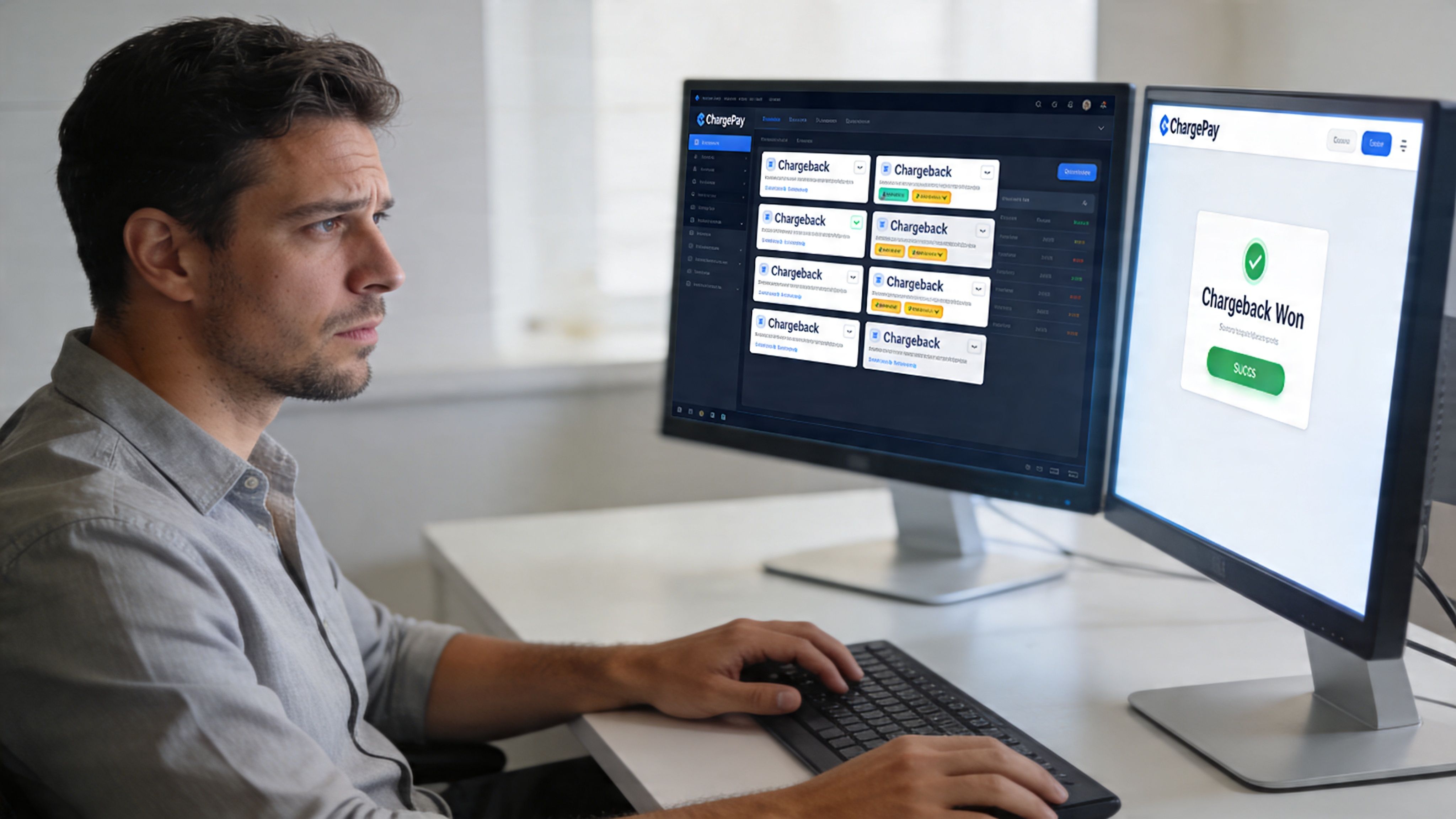
Your team shouldn't have to build every dispute response from scratch. Order timelines, tracking records, delivery confirmation, and customer communication need to be assembled correctly and submitted on time. That work is repetitive, deadline-driven, and expensive when it's done poorly.
Automation starts to make sense. Not because it's trendy, but because merchants lose real money when representment is inconsistent.
If you want a deeper look at the mechanics, this guide to chargeback representment is a solid place to start.
The case for automated recovery
ChargePay reports a 92.4% win rate across 200K+ cases and says it has recovered $10.8M+ for merchants, according to the company information provided in this brief.
Those numbers matter because they point to the opportunity. You're not trying to shave a few cents off checkout. You're trying to get paid for fulfilled orders that would otherwise stay lost.
The model is straightforward:
- The system detects dispute patterns, including signs of friendly fraud.
- It builds evidence packages automatically using your store and order data.
- It submits on time so you don't miss recovery windows.
- It removes manual busywork from your ops team.
For merchants who care about trust signals, ChargePay also carries a 4.9-star rating on the Shopify App Store and a Built for Shopify badge, based on the publisher information provided for this article.
This walkthrough shows how dispute automation works in practice:
Why this beats fee obsession
You should still understand PayPal fees. You should still price correctly. But if you're losing completed sales to disputes, that's the bigger fire.
A merchant who manages fees but loses chargebacks is still leaking revenue. A merchant who wins more disputes protects the money that matters most.
Your Next Steps to Protect Your Revenue
At this point, the answer to does paypal charge a fee to receive money should be clear. Yes, for Shopify sales it does. The more important lesson is that processing fees are only the first layer of cost.
The stores that stay healthy don't just monitor payout deductions. They protect net revenue after the transaction, especially when disputes hit.
What to do this week
Keep this practical.
- Audit your last payout batch. Check how much PayPal took from commercial orders.
- Separate domestic and international orders. They don't carry the same economics.
- Review disputed transactions. Look for the orders that turned from sales into losses.
- Tighten your finance visibility. If your reporting is messy, use a better online accounting platform so payment costs and dispute losses are easier to track.
The decision that matters
You don't need to panic over every fee. You do need to stop accepting preventable losses as normal.
Payment fees are part of selling online. Chargeback losses don't have to be.
If your store is doing enough volume for PayPal fees to sting, it's already doing enough volume for disputes to deserve a real system. That's where profitable operators separate themselves from merchants who spend every month wondering why strong sales still produce weak cash flow.
If you're tired of losing revenue to PayPal disputes, install ChargePay from the Shopify App Store. It’s built for Shopify, carries a 4.9-star rating, and runs on a pay-per-win model, so you only pay when money is recovered.


.svg)



.svg)


.svg)
.svg)
.svg)