

Fraud is no longer a background problem for Shopify stores. It’s a revenue problem with a very real ceiling on growth. The projected value of eCommerce fraud is $131 billion by 2030, up 133% from 2025, and US merchants lose an average of $4.61 for every $1 of fraud when chargebacks and operating costs are included, according to Juniper Research.
If you run a store, you already know how this shows up in real life. A high-ticket order lands. Shipping and billing don’t quite line up. The email looks odd. The customer wants rush fulfillment. You stare at the order, wonder if Shopify’s indicators are enough, and know that whatever you choose could hurt you. Approve it and you might eat a chargeback. Cancel it and you might reject a real buyer.
That tension is what e commerce fraud detection is really about. It’s not a technical side quest. It’s part of protecting margin, keeping your team sane, and stopping fraud from dictating how you run your business. And the hard truth is this. Even strong prevention stacks miss things. Some fraud slips through. Some “fraud” turns out to be friendly fraud. Some valid orders get blocked when they shouldn’t.
That’s why smart merchants think about both sides of the problem. They need better detection up front, and they need a recovery plan when prevention fails. If you’re losing revenue to disputes, ecommerce chargeback protection isn’t optional anymore.
Why E-Commerce Fraud Detection Matters Now More Than Ever

Merchants used to treat fraud review like a back-office task. That approach doesn’t hold up anymore. Fraud is bigger, faster, and more expensive than most operators realize until they see margin disappear through chargebacks, reships, support time, and lost inventory.
A lot of founders focus on the fraudulent order itself. That’s too narrow. Significant damage often comes after the sale. You lose the product, the payment, the dispute fee, and the time your team spends digging through order history and customer emails.
Fraud is a growth tax
When fraud pressure rises, stores react in predictable ways. They tighten rules. They slow fulfillment. They review more orders manually. They become suspicious of international orders, mobile checkouts, and first-time customers. Some of that is reasonable. Too much of it hurts conversion and customer experience.
Practical rule: If fraud forces you to second-guess too many legitimate orders, it’s no longer just a risk issue. It’s a growth issue.
That’s why e commerce fraud detection matters now more than ever. Good detection protects revenue before the order is fulfilled. Good dispute management protects revenue after a chargeback hits. You need both.
The cost isn’t limited to stolen cards
Most merchants think “fraud” means stolen payment details. That still matters, but the broader problem includes chargeback abuse, account misuse, card testing, and edge cases that don’t fit neatly into one label. In practice, your store pays for all of it.
Here’s the mistake I see often. Merchants spend all their time trying to build a perfect filter. There is no perfect filter. There’s only a better decision system, backed by a process for when a bad transaction or bad dispute gets through.
Know Your Enemy The Common Types of E-commerce Fraud
The first step is simple. Stop treating all fraud like the same thing. Different fraud types leave different clues, create different losses, and require different responses.

According to Radial’s eCommerce fraud statistics, credit card fraud remains the most common type, mobile transactions drive 33% of eCommerce fraud costs in the US, and Latin America has a domestic fraud rate of 3.7% of all orders. That mix matters because fraud risk changes by channel, payment behavior, and region.
True fraud
This is the version most merchants recognize right away. A fraudster uses stolen card details to place an order, usually for products that are easy to resell. You ship the order. The cardholder disputes the transaction. You lose.
Typical warning signs include:
- Mismatched details: Billing and shipping don’t make sense together.
- Urgent fulfillment requests: The buyer pushes for overnight shipping or unusual delivery instructions.
- Odd order patterns: Multiple attempts, repeated declines, or several cards tied to one customer identity.
Friendly fraud
This one is more frustrating because the order may look normal. The customer places the purchase, receives the product, then disputes the charge anyway. Sometimes it’s confusion. Sometimes it’s deliberate abuse.
If this is a problem in your store, read ChargePay’s breakdown of what friendly fraud is. It’s one of the most common reasons merchants feel blindsided by chargebacks, especially when the order looked legitimate at checkout.
The dangerous part of friendly fraud is that prevention tools don’t always flag it clearly at the time of purchase.
That’s why stores that only focus on pre-checkout screening still get hammered by disputes later.
Account takeover and card testing
Account takeover happens when someone gets access to a real customer account and uses saved payment methods or stored details to buy. These orders can look trustworthy because they come from a real account with history.
Card testing is different. Fraudsters run small purchases or repeated attempts to see which stolen cards still work. If you miss it, your store becomes a testing ground.
A quick primer helps here:
Policy abuse and gray-area fraud
Not every loss comes from an obvious criminal pattern. Some buyers exploit return policies, claim non-delivery without basis, or dispute subscriptions they forgot about. These cases don’t always start as “fraud” in the usual sense, but they still turn into lost revenue.
That’s why merchants need to classify disputes better. If you lump every bad outcome into one bucket, you won’t know whether to improve checkout screening, tighten account security, or improve your evidence for disputes.
Your Digital Toolkit Core Fraud Detection Methods Explained
Fraud tools usually sound more complicated than they are. Under the hood, most systems rely on a few core methods. If you understand those, you’ll make better decisions about what to trust and what to ignore.

FICO’s analysis of machine learning in e-commerce fraud shows that machine learning models can improve real-time value detection rates by at least 30% without increasing genuine transaction declines, and top-tier systems can score a transaction in under 10 milliseconds. That speed matters because checkout decisions can’t lag.
Rule-based systems
Rules are the oldest tool in the stack. They work like simple gates.
If shipping country doesn’t match billing country, flag it.
If order value is unusually high for a first-time customer, hold it.
If too many attempts come from one source, block it.
Rules are useful because they’re easy to understand and fast to deploy. They’re also blunt. A rigid rule can stop obvious fraud, but it can also block legitimate orders that happen to look unusual.
Machine learning
Machine learning is what you use when fixed rules stop being enough. Instead of checking one condition at a time, the model looks at patterns across many signals and estimates risk based on what it has learned from prior behavior.
That’s why ML tends to outperform pure rules in messy real-world environments. Fraud doesn’t stay still, and static logic gets stale fast.
Operator takeaway: Use rules for hard stops and obvious red flags. Use machine learning for pattern recognition where human-written logic breaks down.
Device fingerprinting
Think of device fingerprinting as a digital fingerprint for the device making the purchase. It helps identify recurring devices, suspicious reuse patterns, and relationships between orders that don’t look connected at first glance.
This matters when fraudsters try to hide behind different names, cards, or delivery addresses while coming from the same technical setup. Device intelligence won’t solve everything, but it helps expose repeat abuse.
Behavioral analytics
Behavioral analytics watches how a user acts, not just what data they submit. It looks for unusual navigation, checkout behavior, or deviations from normal customer patterns.
This is especially helpful when an order looks fine on paper. A customer profile may be real. The card may pass basic checks. But the behavior around the session can still look wrong.
If you’re comparing fraud stacks with payment setups, this broader guide for SaaS payment software is useful because it helps frame how payment tooling and risk tooling fit together instead of evaluating them in isolation.
Authentication still matters
Fraud detection is not the same as authentication. Detection estimates risk. Authentication confirms identity more directly.
That’s where tools like 3D Secure fit in. If you want a practical merchant-level breakdown, read what 3D Secure authentication is. It can reduce certain types of payment risk, but it also adds friction, so you need to apply it carefully.
Putting Your Fraud Detection Strategy into Action
Most stores don’t need a giant fraud operation. They need a layered system that matches the size of the business and the way fraud manifests in orders.
The key principle is simple. Don’t rely on one signal, one app, or one person’s gut. Research on Information Fusion Technology in fraud detection shows that systems combining multiple sources such as user behavior, device fingerprints, and geolocation outperform models that rely on a single algorithm. That lines up with what merchants see in practice. Fraud is easier to catch when signals are combined.
Start with what Shopify already gives you
Shopify’s built-in fraud indicators are a decent starting point. Use them. Don’t worship them.
If an order is flagged, review the order details, customer history, shipping choices, and any mismatch between account behavior and purchase behavior. If an order is marked low risk, that doesn’t guarantee safety. It just means Shopify didn’t see enough to raise concern.
Add layers based on your real failure points
A practical setup usually looks like this:
- Basic screening at checkout: Use Shopify’s native analysis and payment verification features.
- Identity and behavior checks for edge cases: Add a fraud app when your order mix gets more complex or your manual queue grows.
- Authentication where needed: Apply stronger verification to suspicious flows, not every customer.
- Chargeback readiness after the sale: Keep order records, delivery proof, customer communication, and policy visibility organized from day one.
If you’re also reviewing your broader security posture, this resource on managed IT services for PCI can help you think through compliance and payment security responsibilities around card data handling.
Know when manual review is costing you too much
Manual review feels safe because it gives your team control. But too much manual review usually means your system is underpowered or your rules are too broad.
You should invest in stronger tooling when:
| Situation | What it usually means |
|---|---|
| Your team spends too much time reviewing routine orders | Basic filters aren’t separating obvious good orders from risky ones |
| You see chargebacks from orders that looked normal | Your stack isn’t catching friendly fraud or account-level risk |
| You’re declining too many “weird but good” orders | Your rules are too rigid |
| Fraud patterns keep changing faster than your rules | You need adaptive models, not just static blocks |
A useful reference point for merchants tightening operations is ChargePay’s article on chargeback prevention. Prevention should reduce exposure without turning your checkout into a minefield for good customers.
Measuring Success KPIs and the Hidden Cost of False Positives
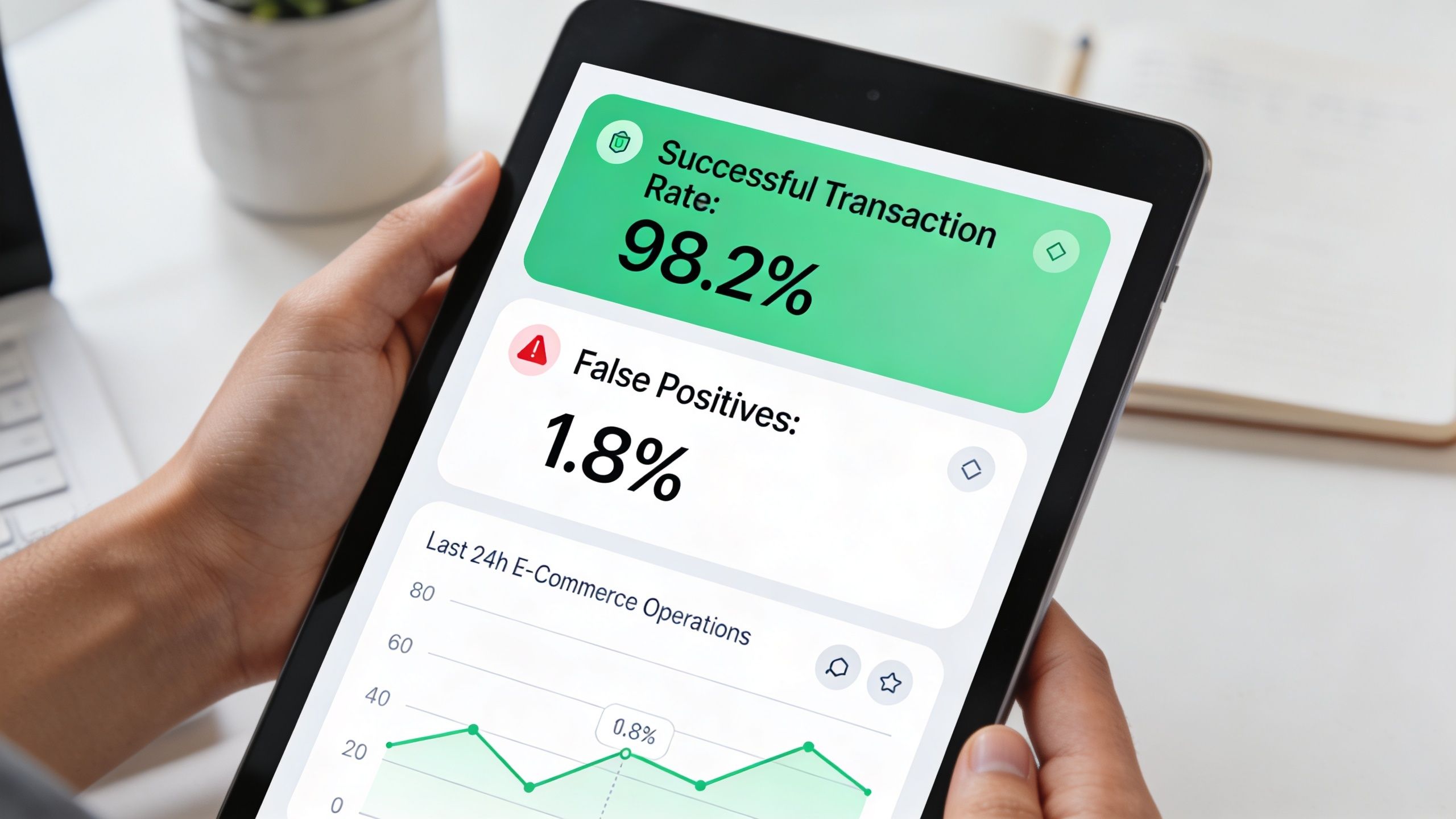
A lot of merchants measure fraud prevention the wrong way. They ask one question: “Did we stop bad orders?” That’s incomplete. You also need to ask, “How many good orders did we kill along the way?”
That second question matters because the hidden cost of false positives is often bigger than people expect. Stripe’s ecommerce fraud prevention and detection guidance notes that traditional rule-based systems often generate a high number of false positives, which leads to lost sales, and also points out that there’s little data quantifying the direct customer lifetime value impact for Shopify merchants. In plain English, stores know they’re losing good orders, but many don’t measure the damage well.
The three KPIs that actually matter
Don’t build your scorecard around one metric. Track a small set that reflects both risk and revenue.
- Chargeback rate: This tells you whether fraud and dispute abuse are still getting through.
- Manual review rate: This shows how much human effort your current system demands.
- False positive rate: This tells you how often you reject or delay legitimate buyers.
A fraud setup that lowers chargebacks while crushing conversion isn’t a win. It’s a different kind of loss.
False positives are not harmless
When a real customer gets blocked, the damage doesn’t stop at one order. You may lose the sale, waste the ad spend that brought them in, trigger support tickets, and push that customer to a competitor.
If your fraud rules are too aggressive, your store starts treating good customers like bad ones. Buyers notice.
Fraud and conversion efforts overlap at this junction. If you’re trying to improve approval quality without hurting checkout performance, these ecommerce CRO strategies are worth reviewing alongside your fraud setup. Conversion optimization and fraud screening shouldn’t be run as separate worlds.
What good measurement looks like
You don’t need a complicated dashboard to start. You need a habit of checking outcomes.
Review orders that were blocked, not just orders that charged back. Look for patterns in approved disputes and declined good orders. Ask whether specific rules are helping or just making the team feel safer.
Hard truth: A merchant can “improve” fraud prevention on paper while quietly losing more profit through false declines.
That’s why e commerce fraud detection should be judged by business results, not just by how many suspicious orders got flagged.
When Detection Fails Turn Losses into Wins with AI
Even the best fraud stack fails sometimes. That isn’t pessimism. It’s just how commerce works. Customers dispute valid orders. Fraudsters adapt. Some transactions look fine until the chargeback lands weeks later.
The bigger gap in the market isn’t detection. It’s what happens next. Research discussed in IntechOpen’s fraud chapter points out that most fraud literature focuses on real-time transaction detection and largely ignores post-detection dispute recovery, including evidence packaging and chargeback defense optimization. That gap is exactly where merchants keep losing money.
Prevention and recovery are different jobs
Fraud prevention asks, “Should I approve this order?”
Chargeback recovery asks, “Now that this dispute exists, can I prove the transaction was valid and recover the revenue?”
Those are different workflows. Different evidence. Different deadlines. Different operational pain.
A lot of stores treat disputes like admin work. They scramble for screenshots, order confirmations, tracking data, and customer communication after the fact. That’s why responses are inconsistent and deadlines get missed. If you want the bigger picture, this complete guide to automated chargeback and dispute management using AI lays out what an automated workflow should cover.
Where ChargePay fits
ChargePay is one option merchants use for the recovery side. It’s an AI-powered chargeback management app for Shopify that automates dispute handling, builds representment responses, and submits evidence before deadlines. According to the publisher brief provided for this article, ChargePay reports a 92.4% win rate, has handled 100K+ disputes, and recovered $2.8M+.
That matters because most merchants don’t need more dashboards. They need fewer lost disputes and less manual work.
My recommendation
Run fraud like a two-part system.
First, tighten approval quality with layered detection. Second, assume some percentage of bad outcomes will still happen and build an automated recovery process before they do. Merchants who only focus on blocking orders leave money on the table when valid disputes could have been won.
If you’re on Shopify, this is the practical move. Keep your checkout protected, keep your false positives under control, and stop treating chargebacks like unavoidable write-offs.
Install ChargePay if you want your fraud strategy to cover the part most tools ignore: recovering revenue after disputes hit. ChargePay is built for Shopify, has a 4.9-star rating and a Built for Shopify badge, and uses a pay-per-win model so you only pay when money is recovered.


.svg)



.svg)


.svg)
.svg)
.svg)