

Organizations lose up to 5% of annual revenue to fraud each year, according to ACFE-derived industry reporting summarized by Linkurious. If you run a Shopify store, that number stops being abstract the moment a chargeback hits, PayPal freezes funds, or a suspicious order slips through and turns into lost inventory.
Most advice on the fraud investigation process is too broad to help you. It talks like a bank, not like a merchant staring at a Shopify order timeline and trying to decide whether to ship, refund, fight, or document everything before a deadline closes.
This guide is the practical version. It's built for Shopify and PayPal merchants who need fast decisions, clean evidence, and a repeatable process that protects margin. If you also want to tighten prevention before the next bad order lands, review these e-commerce fraud prevention tactics for Shopify stores.
Why Your Store Needs a Fraud Investigation Process
Every fraud case creates the same pressure fast. Ship now or hold. Refund or fight. Trust the customer or trust the warning signs in Shopify and PayPal.
A fraud investigation process gives you a way to decide under pressure without making expensive guesses. For a Shopify merchant, that means knowing what to save, where to look, who reviews the order, and how quickly your team has to act before evidence gets messy or deadlines close.
The cost of having no process shows up in familiar places. A support rep promises a refund before anyone checks tracking. A warehouse ships a high-risk order because nobody flagged it in time. A PayPal dispute lands, and your team submits a few screenshots instead of a clean timeline with delivery proof, customer messages, device details, and order metadata.
That is how winnable cases get lost.
What breaks when you don't have a process
You lose more than the product.
- You lose response time: Staff stop doing revenue work and start digging through inboxes, Shopify notes, PayPal case logs, and tracking portals.
- You lose evidence: Carrier scans update, fraud app signals disappear from view, and internal context gets buried in email or Slack.
- You lose consistency: One employee cancels risky orders. Another approves the same pattern an hour later.
- You lose case quality: The facts may support you, but the file you send to PayPal or a card issuer is incomplete and easy to reject.
Practical rule: If your store has seen chargebacks, INR claims, unauthorized transaction disputes, or suspicious high-risk orders, you need a fraud investigation process now.
For Shopify and PayPal merchants, the process should be simple and repeatable. First, freeze the facts. Then verify what happened in the order timeline, payment record, shipping history, and customer communication. Next, separate likely friendly fraud from outright criminal fraud, because the evidence and response are not the same. If you also need to reduce how often these cases show up, tighten your filters with these e-commerce fraud prevention tactics for Shopify stores.
What this looks like in a Shopify store
This is not a corporate policy binder nobody reads. It is a working playbook your team can use during a bad order or live dispute.
| Situation | Wrong move | Better move |
|---|---|---|
| Large first-time order with overnight shipping | Ship because the order value looks good | Put the order on hold, review Shopify risk indicators, check IP, address, and payment behavior, then decide |
| PayPal "unauthorized transaction" claim | Send a short denial with one tracking screenshot | Build a case file with order timestamp, checkout details, delivery scan, customer emails, and any prior account activity |
| Customer says item never arrived | Argue in email and hope the claim goes away | Pull carrier proof, compare shipping and billing details, document delivery timing, and save all communication in one file |
Your process should feel routine. That is the goal. Routine means your team knows what to do, evidence gets preserved before it disappears, and you stop treating every dispute like a brand-new emergency.
Spotting Trouble Before It Escalates
You don't catch most fraud with genius. You catch it by noticing patterns early and refusing to ignore them.
Shopify merchants usually see the warning signs before the dispute appears. The problem is that many stores ship anyway because the order looks profitable, the team is busy, or someone assumes the payment processor will sort it out later. It won't.
Red flags inside Shopify and PayPal
Start with what you can already see in your dashboard.
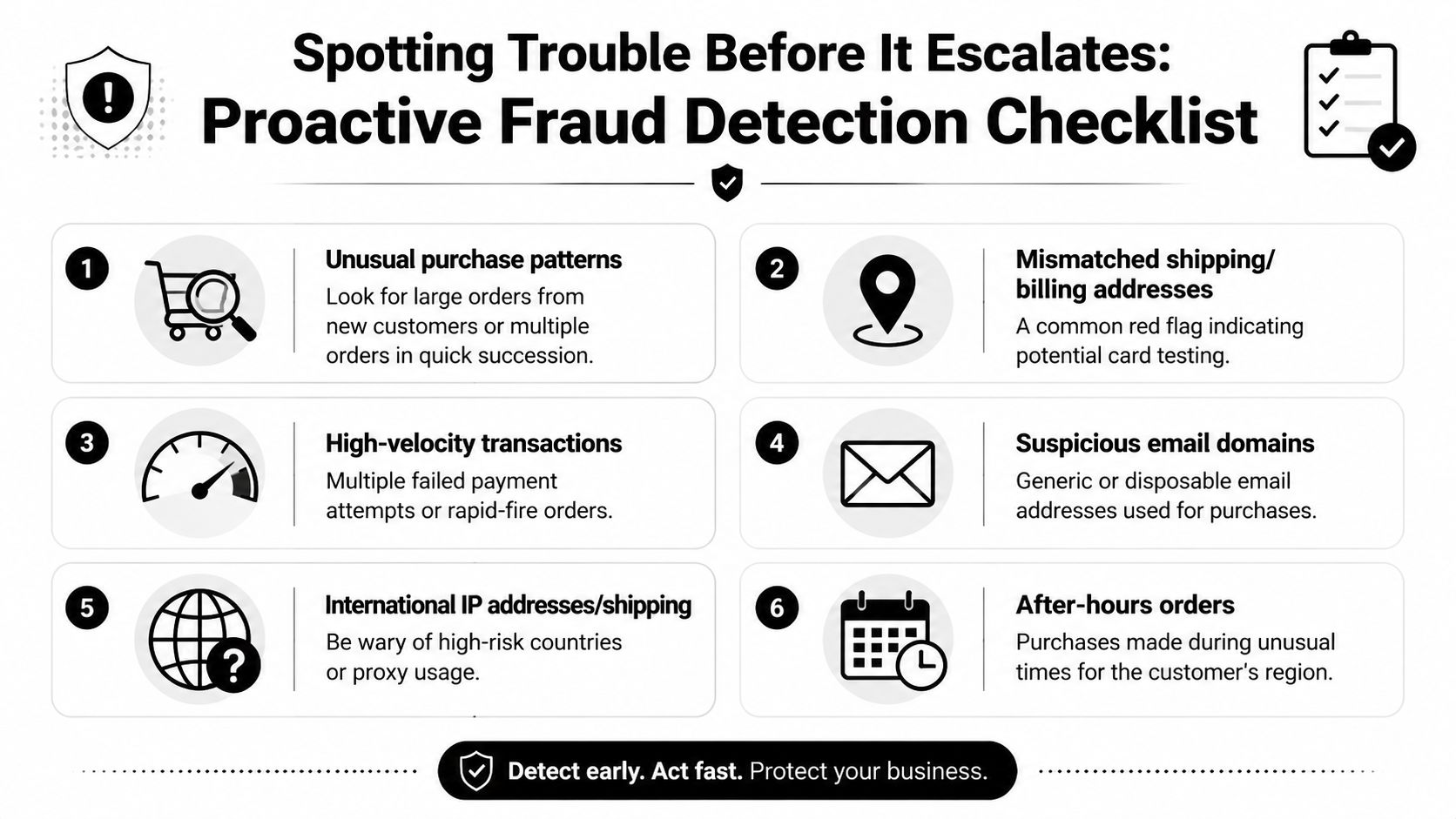
Watch for these patterns:
- Big first order: A brand-new customer places a much larger order than your normal basket size, especially if they choose rush shipping.
- Address mismatch: Billing and shipping details don't line up, or the order is going to a freight forwarder, reshipper, hotel, or storage location.
- Payment velocity: You see several failed attempts before one approved transaction. That's often testing behavior.
- Disposable-feeling contact info: The email looks random, generic, or inconsistent with the customer name.
- Geographic mismatch: The IP region, billing details, and shipping destination don't tell one clean story.
- Odd timing: Orders arrive at unusual hours for the buyer's stated location, then demand immediate shipment.
What familiar bad orders look like
A few examples most Shopify owners will recognize:
Example 1. A new customer buys multiple units of your most resellable SKU, uses express shipping, and never responds to your confirmation email. That's not proof of fraud, but it's enough to pause fulfillment and review.
Example 2. The card clears, but the customer fails payment several times first. Then the successful attempt uses slightly different details. That often means someone was trying combinations until one worked.
Example 3. A buyer emails support aggressively to push same-day shipment, then later claims the transaction was unauthorized. Fast pressure up front often becomes a problem later.
If an order makes you uncomfortable, don't talk yourself out of it just because the payment captured.
How to read the situation
Don't rely on one signal. Fraud investigations start with clusters.
Use this quick decision filter:
One weak signal only
Hold for light review. Maybe verify with a simple customer contact.Several signals together
Pause shipment. Pull evidence now. Decide whether to cancel, refund, or monitor.Signal plus post-purchase pressure
Treat it as high risk. Preserve everything before the buyer changes the story.
Your instinct matters, but it should trigger documentation, not guesswork. The stores that keep losses down don't just "spot fraud." They recognize a suspicious pattern and move into a structured fraud investigation process immediately.
Your First 24 Hours Triage and Evidence Gathering
The first day matters more than most merchants realize.
Fraud investigations get expensive fast. Industry guidance cited by Valid8 Financial puts small cases at $5,000 to $20,000, medium cases at $20,000 to $75,000, and large or complex cases at $75,000+, which is exactly why early scoping and evidence preservation matter, as outlined in Valid8 Financial's breakdown of fraud investigation costs and stages. Even if your store isn't hiring outside investigators, the same logic applies. Delay creates mess, and mess costs money.
What to pull immediately
If an order looks fraudulent or a dispute lands, collect evidence before you do anything else.
Download or screenshot:
- Shopify order timeline: Include timestamps, risk flags, order edits, customer profile details, and any internal notes.
- Fraud analysis details: Save the assessment shown in Shopify for that order.
- Customer communication: Export emails, chat logs, support tickets, contact form messages, and any replies about shipping or the product.
- Tracking evidence: Keep the carrier tracking page, delivery status, proof of delivery, and shipping address used.
- PayPal records: If the transaction ran through PayPal, save transaction details, seller protection info if available, and all dispute messages.
- Fulfillment records: Warehouse confirmation, packing notes, shipping label creation, and any signature requirement used.
- Product details: SKU list, quantity, item descriptions, and whether the goods were digital, physical, subscription, or pre-order.
How to triage without wasting time
Not every case deserves the same effort.
Use a simple triage model:
| Priority | What it usually means | What to do |
|---|---|---|
| High | High-value order, multiple risk signals, or active dispute deadline | Freeze changes, gather full evidence, assign owner |
| Medium | Questionable order but no formal dispute yet | Verify customer, document signals, decide fast |
| Low | Isolated odd signal with clean history | Monitor and log |
The sequence matters
Good merchants don't gather evidence in random order. They preserve first, analyze second.
A practical workflow:
Lock the record
Save screenshots and exports before data changes or team members overwrite notes.Define the allegation
Is this "unauthorized," "item not received," "not as described," or a PayPal claim that doesn't clearly fit?Check deadlines
Banks and processors don't care that your ops team is busy. If you're dealing with an early-stage inquiry, this guide to retrieval requests vs chargebacks helps you respond correctly before a weaker issue becomes a formal loss.Assign one owner
One person should control the case file. Shared ownership creates missing pieces.
Preserve first. Interpret second. Merchants lose winnable disputes because they start arguing before they start documenting.
What not to do in the first day
Three mistakes show up constantly:
- Don't contact the customer with accusations. You may push a confused buyer into a formal dispute.
- Don't issue a refund before reviewing the evidence. Sometimes a refund is smart. Sometimes it's just surrender.
- Don't rely on memory. Pull the records while they're easy to access.
The first 24 hours decide whether you're building a usable case file or just collecting excuses.
Building an Unbeatable Case File
Winning a dispute isn't about dumping screenshots into a PDF. It's about making the reviewer's job easy.
Banks and payment processors don't know your store, your products, or your normal customer behavior. They see a claim and a stack of documents. Your job is to turn that stack into a clear story with dates, records, and logic.

Expert guidance on fraud investigations stresses that the highest-value work happens when you validate evidence, map records, analyze transactions, and maintain chain-of-custody documentation, as explained in this six-step fraud investigation overview. That sounds formal, but for a Shopify merchant it means one thing. Every piece of evidence must connect cleanly to the claim you're trying to defeat.
Build a timeline, not a pile
Your file should read like this:
- Order placed on a specific date and time
- Customer details recorded at checkout
- Payment approved
- Merchant fulfilled the exact items purchased
- Carrier accepted and delivered the package
- Customer communicated before or after delivery
- Dispute filed later, despite that record
That order matters. A dispute analyst should be able to understand the case in under a minute.
Match evidence to the claim type
Different allegations need different proof.
| Dispute type | Evidence that matters most |
|---|---|
| Unauthorized transaction | Order details, customer identity indicators, device or account consistency, communication trail |
| Item not received | Full tracking history, delivery confirmation, correct address, signature if available |
| Not as described | Product page copy, variant selected, photos, customer messages, return policy acknowledgment |
If you're writing your own response, don't write like a lawyer. Write like a disciplined operator. State what happened, attach proof, and keep each claim tied to a document. If you need a structure, this chargeback rebuttal letter template gives you a practical format.
Strong evidence isn't just collected. It's organized so the reviewer can verify it without guessing.
Chain of custody for merchants
You don't need courtroom language, but you do need record discipline.
That means:
- Use dated filenames: Keep exports and screenshots clearly labeled.
- Store originals: Don't overwrite raw files after annotation.
- Track who handled the case: One owner, one folder, one source of truth.
- Note when you pulled each record: Especially for tracking pages and account logs that may update.
This matters outside e-commerce too. Teams working on regulated support operations think the same way about documentation and controls, which is why guidance on ensuring BPO compliance for healthcare clients is a useful parallel. Different industry, same principle. If your records aren't organized, they're harder to trust.
What a persuasive file sounds like
A good rebuttal isn't emotional.
It says, in effect: the customer placed the order, the payment was processed, the order was fulfilled to the provided address, delivery was confirmed, and the supporting records are attached in chronological order. That's what a defensible fraud investigation process produces. Not noise. Proof.
Friendly Fraud vs Criminal Fraud Deciphering Intent
Shopify merchants lose a lot of money because they treat all fraud the same. That's a mistake.
Friendly fraud and criminal fraud may both end in a chargeback, but the facts behind them are different. Your evidence, tone, and next move should be different too.
For e-commerce merchants, this distinction matters even more because public guidance notes that investigations in this environment are shaped by payment dispute deadlines and the high prevalence of friendly fraud, unlike bank-led investigations into larger criminal activity, as described by Medius in its overview of unauthorized transaction investigations.
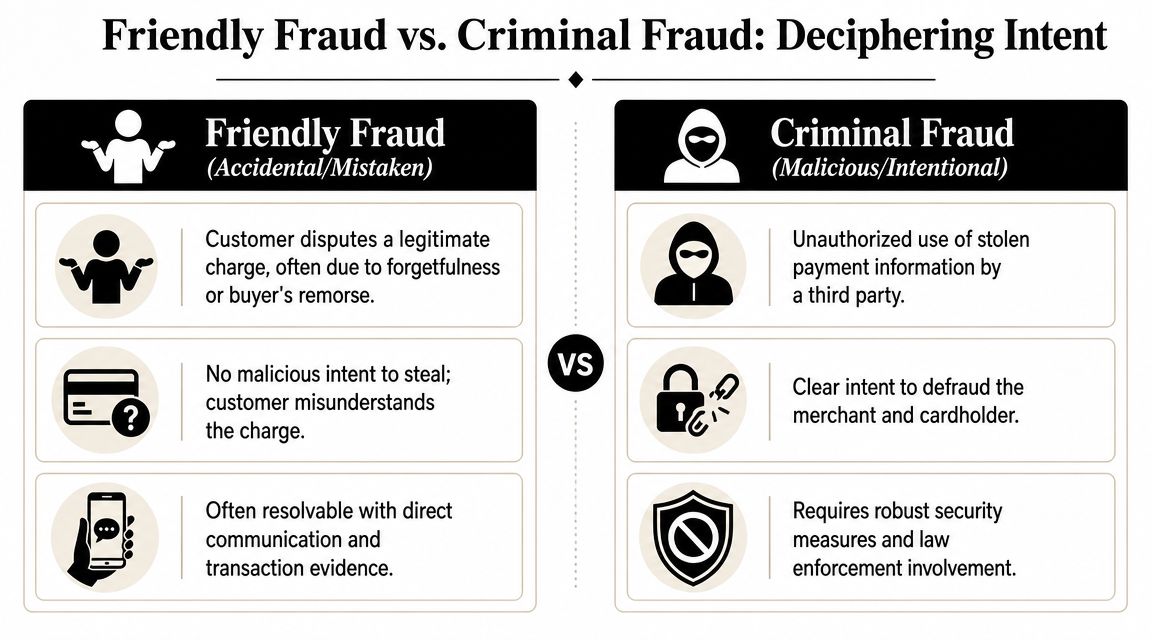
Friendly fraud usually looks familiar
This is the customer who made the purchase, received the goods, then disputes the charge anyway.
Common patterns:
- They say they don't recognize the transaction, but the order shipped to their address.
- They claim non-delivery after the carrier shows delivery.
- They forget a subscription renewal or family member purchase.
- They regret the purchase and use the bank instead of your return policy.
The tone here should stay factual and calm. You are often dealing with a legitimate cardholder, not a stolen identity ring.
Criminal fraud leaves a different trail
Criminal fraud usually involves unauthorized use of payment credentials by someone other than the authorized cardholder.
Signs are often sharper:
- New customer with no history
- Strange email naming patterns
- Mismatch across identity, location, and delivery details
- Rush shipping to a high-risk destination
- Little or no normal post-purchase communication
Order screening, cancellation, and internal fraud controls matter most. If the order hasn't shipped yet, prevention beats representment every time.
Use a simple comparison
| Question | Friendly fraud | Criminal fraud |
|---|---|---|
| Did the buyer likely place the order? | Often yes | Usually no |
| Was there intent to deceive from checkout? | Sometimes unclear | Usually yes |
| What helps most? | Communication records and transaction timeline | Risk signals, identity mismatch, fulfillment hold |
| Best immediate move | Build proof and respond precisely | Stop shipment if possible, preserve all records |
For merchants dealing with recurring disputes of the first type, this guide on friendly fraud in e-commerce is worth reviewing.
Don't ask, "Is this fraud?" Ask, "Whose intent am I trying to prove?" That changes the entire case.
Automating Your Defense and Winning Back Revenue
Chargebacks do not just take revenue. They eat hours, slow fulfillment decisions, and pull your team into the same manual work every week.
For Shopify and PayPal merchants, the fix is not "better organization." It is automation built around the evidence banks and processors review. If your team is still hunting through Shopify orders, PayPal dispute records, tracking pages, and support inboxes one case at a time, you are spending skilled time on admin work.
What automation should handle
Your setup should do five jobs without relying on someone to remember every step:
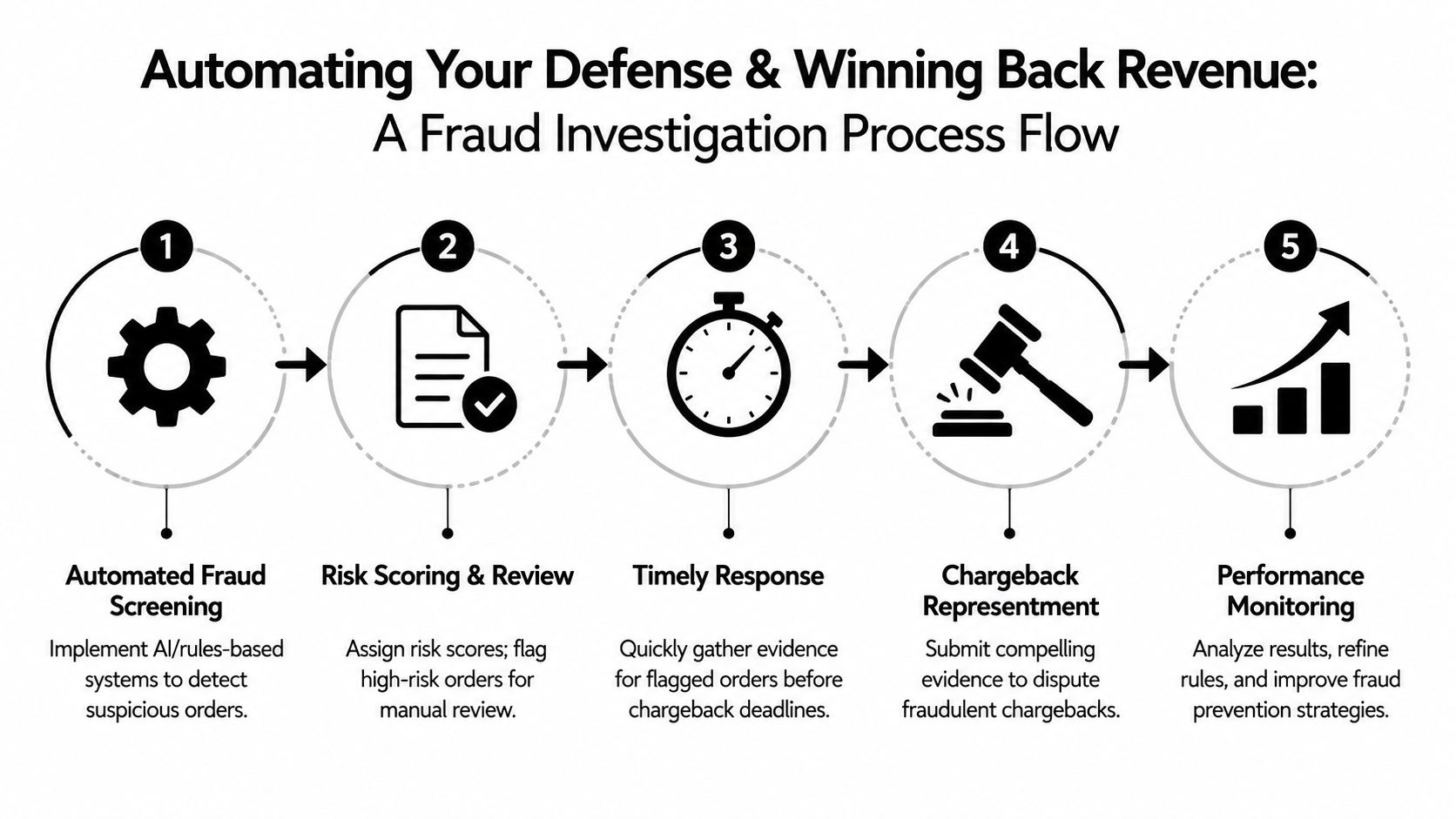
- Collect evidence automatically: Pull order records, tracking, customer communication, and payment details into one case.
- Identify likely dispute reason: Match the evidence package to the cardholder's claim instead of sending the same generic template every time.
- Draft representment fast: Deadlines are short, and late submissions lose before the review starts.
- Submit consistently: A standard format beats a pile of screenshots and mismatched PDFs.
- Learn from results: Use win and loss patterns to tighten order review rules, fulfillment holds, and customer service workflows.
A practical tool stack for Shopify merchants
Shopify stores usually need a simple stack that covers risk signals, transaction proof, customer communication, and dispute execution.
| Need | Practical option |
|---|---|
| Order risk review | Shopify fraud analysis and internal order-hold rules |
| Processor-side evidence | PayPal transaction and dispute center records |
| Support proof | Helpdesk exports from tools like Gorgias or Zendesk |
| Chargeback workflow | A dedicated dispute automation platform |
A good example is ChargePay, an AI-powered chargeback management app for Shopify merchants. It has handled 200K+ cases, recovered $10.8M+ for merchants, and holds a 4.9-star rating plus a Built for Shopify badge on the Shopify App Store. In practice, that means it pulls evidence into one file, drafts the response around the dispute reason, and gets the case submitted before the deadline slips. For a closer look at how that workflow works, see this guide to automated chargeback and dispute management using AI.
A quick walkthrough helps:
What to automate first
Do not automate a messy process end to end. Start where Shopify and PayPal merchants lose money first.
Case creation
Open a structured file the moment a dispute hits or a high-risk order is flagged.Evidence capture
Pull Shopify order data, PayPal transaction details, carrier scans, and support messages before links expire or agents bury the thread.Deadline handling
Put due dates in one queue with clear ownership. A dispute sitting in someone's inbox is a lost case waiting to happen.Outcome review
Check why you won or lost. Then update fraud filters, shipping rules, and customer service scripts so the same pattern stops repeating.
Here is the practical rule. Automate collection, formatting, and submission. Keep human judgment for cancellations, escalation calls, and edge cases where intent is unclear.
If you are still handling disputes by hand, you are paying for fraud twice. Once in lost revenue. Again in staff time.
If chargebacks and fraud are cutting into margin, install ChargePay from the Shopify App Store. It automates the evidence gathering, case building, and dispute submission work that usually drains your team.


.svg)



.svg)


.svg)
.svg)
.svg)