


Let's talk about one of the most frustrating problems you face as a Shopify store owner—something called friendly fraud. It happens when a customer buys a product, receives it, and then tells their bank the charge was a mistake. They get their money back, and you're left holding the bag.
It’s not some elaborate scheme with stolen credit cards. This is your actual customer gaming the system, leaving you without your product, without the revenue, and with a nasty chargeback fee to boot. It’s a quiet but serious drain on your profits. At ChargePay, our AI has handled over 100,000 disputes, recovering $2.8 million for merchants, so we know exactly how to fight back and win.
What Friendly Fraud Is Costing Your Shopify Store

Unlike criminal fraud, where a thief uses stolen card details, friendly fraud is when the real cardholder disputes a purchase they actually made. They might claim they don't recognize the charge, or that it was unauthorized, even though they have the product sitting in their home. For you, it turns a successful sale into a net loss.
Here at ChargePay, our AI has crunched the numbers on over 100,000 disputes, and we’ve seen the damage firsthand. The customer gets a full refund, you lose the product you shipped, and you get slapped with a painful chargeback fee for your trouble. These costs pile up fast, turning what should have been profitable orders into money pits.
The True Financial Damage
The hit to your bottom line goes way beyond just the lost sale. Every time friendly fraud happens, it chips away at your business in several ways:
- Lost Revenue: The entire transaction amount is yanked right out of your account.
- Lost Inventory: The customer almost always keeps the item, so there's no chance to resell it.
- Chargeback Fees: Your payment processor will penalize you with a fee, usually between $15 and $100 for each dispute.
- Increased Processing Rates: If your chargeback ratio gets too high, payment processors might raise your transaction fees or, in the worst-case scenario, shut down your merchant account entirely.
The total cost of a single friendly fraud case often ends up being 2-3 times the original transaction amount. This is the hidden threat that quietly eats away at your store’s profitability.
Friendly Fraud vs Other Dispute Types
To fight back effectively, you first have to know what you’re up against. Is it a genuine mistake, a scammer, or something in between? This quick comparison helps clear things up.
Criminal fraud is clear-cut—it's theft. A legitimate dispute usually points to a real issue in your fulfillment or customer service process. But friendly fraud lives in that tricky gray area.
Sometimes it's an honest mistake, like a customer not recognizing your store's billing name on their bank statement. Other times, it's straight-up digital shoplifting. This ambiguity makes these disputes tough to win, but it’s far from impossible. By learning to spot the patterns and pulling together the right evidence, you can absolutely defend your revenue. It’s exactly what our AI does, recovering over $2.8 million for Shopify stores with a 92.4% win rate.
The Real Reasons Honest Customers Commit Fraud
It's a tough pill to swallow, but most people committing friendly fraud don't see themselves as thieves. This is exactly what makes it so confusing and expensive for you. They aren't professional scammers; they're often your everyday customers who genuinely believe they're making the right choice. The real reasons usually boil down to two simple things: convenience and confusion.
Imagine a customer scrolling through their bank statement. They see a charge from "SP *YourBrandName" and have no clue it was from your store. Instead of digging for a support email, it's just faster to tap the "dispute charge" button in their banking app.
In their mind, it's an easy undo button for a transaction they don't recognize—not an act of fraud.
The Psychology of a "Convenient" Chargeback
When a customer feels even a little bit unhappy with a purchase, their first thought is often to reverse the payment as fast as possible. Today's online shoppers expect instant solutions. A chargeback feels like the quickest way to get their money back, letting them skip what they assume will be a long and complicated return process.
This behavior is usually sparked by a few key psychological triggers:
- Buyer's Remorse: The customer regrets their purchase and sees a chargeback as a "no-questions-asked" escape route, avoiding the hassle of your official return policy.
- Impatience with Shipping: If a package gets delayed or the tracking is unclear, a customer's frustration can build up fast. A chargeback feels like a way to regain control when they feel powerless.
- Unrecognized Family Purchases: A teenager might use a parent's saved card to buy a new pair of shoes. When the parent sees the charge, they assume it's fraud and dispute it, leading to what's often called accidental friendly fraud.
- Minor Product Dissatisfaction: The product isn't quite what they were hoping for, but they don't feel like going through the return process. A dispute feels like fair compensation for their letdown.
From Confusion to Financial Loss
Plain and simple confusion is one of the most common, yet preventable, drivers of friendly fraud. Research shows that as many as 41% of chargebacks happen just because customers don’t recognize the charge on their statement. They aren't trying to scam you; they're trying to protect themselves from what looks like a suspicious transaction.
This is exactly why having a clear and recognizable billing descriptor is so critical. If your official business name is "Global Wares LLC" but your storefront is "Pat's Pet Supplies," a customer is never going to connect the two. That disconnect is a direct path to a chargeback that costs you revenue, your product, and a painful dispute fee.
Understanding and improving these post-purchase touchpoints is a must. In fact, strong customer retention strategies are often built on clear communication, which can stop dissatisfaction long before it turns into a dispute.
The scary truth is that 72% of cardholders admit that convenience is a major driver for filing a chargeback. They aren't being malicious; they're just choosing the path of least resistance.
Ultimately, these "honest" customers have been trained by a system that makes disputing a charge incredibly easy, while filing a return can feel like a chore. They don’t realize this "easy button" costs your business two to three times the original sale price.
Knowing these triggers—convenience, confusion, and frustration—is the first step toward building a solid defense. It helps you shift from just reacting to disputes to proactively preventing them. To delve deeper into how these innocent mistakes happen, you can read our guide on accidental friendly fraud.
How to Spot Friendly Fraud Before It Happens
While you can’t read a customer’s mind, you can absolutely learn to read the signs. Certain transactional and behavioral red flags can tip you off to a high risk of friendly fraud long before it ever hits your account. Spotting these patterns is your first step toward proactively protecting your revenue.
Think of it like being a detective for your own store. Just like a detective looks for clues that don't add up, you can look for order details that feel a bit off. Ignoring these signs is like letting a suspect walk away from the scene of the crime.
Transactional Red Flags to Watch For
The first place to look for trouble is right in the transaction details. An order can often tell a story that just doesn’t make sense. Here at ChargePay, we've analyzed over 100,000 disputes, and we see the same suspicious patterns pop up again and again.
Keep an eye out for these warning signs at checkout:
- Unusually Large First-Time Orders: A brand-new customer dropping a huge amount of money on your most expensive items is a classic red flag. Sure, it’s exciting, but it’s worth a second look. Fraudsters often try to get the biggest prize they can on their first attempt.
- Mismatched Addresses: When the billing address is in one state (or country) and the shipping address is somewhere completely different, it’s time to be cautious. This is a common sign of a stolen card, but it's also a tactic used by people planning friendly fraud.
- Expedited Shipping on a Mismatched Order: This one-two punch is especially risky. A fraudster wants to get their hands on the goods as fast as possible, often before the real cardholder even notices the charge. They couldn't care less about the extra shipping cost.
- A Sudden Flurry of Orders: If a new customer makes several separate purchases in a really short amount of time, they could be testing a stolen card or planning to dispute each transaction one by one.
These signals are your best chance to hit pause and double-check. It's so much easier to ask for a little extra confirmation before you ship than it is to fight a chargeback after the product—and your money—is already gone.
Friendly fraud isn’t always some big, complicated scheme. A lot of the time, it’s just a crime of opportunity. When you spot and question these weird transaction details, you make your store a much harder target.
Concerning Post-Purchase Behaviors
What a customer does after they click "buy" can be just as revealing. A legitimate customer who has a problem will almost always reach out to you for help. Someone planning to commit friendly fraud, on the other hand, usually stays quiet—because contacting your customer service team isn't part of their plan.
Here are the behaviors that should make you suspicious after a purchase:
- Zero Contact Before a Dispute: The customer never sends an email, makes a call, or uses your live chat to report a single issue. They go straight to their bank. This is the #1 behavioral sign of friendly fraud. A genuine customer almost always tries to solve the problem with you first.
- Claims of Non-Delivery Despite Proof: You have a "delivered" status from the courier, maybe even with a timestamp and a photo, but the customer swears the package never showed up. Porch pirates are a real thing, of course, but this is also a classic excuse for friendly fraud.
- Vague or Inconsistent Complaints: If a customer does contact you, but their story keeps changing or they can't give you any specific details, they might just be trying to create a flimsy story for a chargeback they plan to file later.
Understanding these behaviors is crucial for figuring out which disputes are worth your time to fight. When you see a "product not received" chargeback from a customer who never tried to contact you, you’re almost certainly dealing with friendly fraud.
You can also use Shopify's own tools to get ahead of these problems. To learn more, check out our guide on using a fraud filter app for Shopify to automatically flag these kinds of risky orders.
Your Step-By-Step Prevention Playbook
Let’s be honest: preventing a chargeback is always cheaper and easier than fighting one. After handling over 100,000 disputes and clawing back more than $2.8 million for merchants here at ChargePay, we can tell you that the best defense is built on smart, everyday business practices.
This is our playbook. It’s a concrete, four-part strategy to seriously fortify your Shopify store against friendly fraud. Think of these steps as layers of protection, each one making it harder for customer confusion or outright bad faith to escalate into a costly chargeback.
Step 1: Solidify Your Policies
Your store policies are your first line of defense. When a customer can easily find and understand your rules for returns, refunds, and shipping, they’re far less likely to call their bank when a problem crops up. Ambiguity is your absolute enemy here.
Make your return policy impossible to miss and dead simple to read. A customer who has to hunt for your policy is already frustrated, and a frustrated customer is just one click away from disputing a charge.
- Create a Dedicated Policy Page: Use a clear, obvious link in your store’s footer and main menu. Call it something simple like "Returns & Refunds."
- Use Plain Language: Ditch the legal jargon. Write your policy like you’re explaining it to a friend. Instead of, "Merchandise must be returned in its original, unworn condition," try, "Just send it back unworn with the tags still on."
- Set Clear Timelines: Be specific about your return window, like "30 days from delivery." This manages expectations from the start and cuts down on those "buyer's remorse" chargebacks that pop up weeks later.
A transparent and fair return policy is one of your most powerful tools against friendly fraud. It gives customers a clear, easy path to a resolution that doesn't involve their bank.
Step 2: Master Proactive Communication
So much friendly fraud starts with simple confusion. A customer glances at their credit card statement, sees a charge they don’t recognize, and panics. You can eliminate this issue entirely by being proactive and crystal-clear at every stage of their purchase.
Your goal is to keep the customer in the loop from the moment they click "buy" until well after their package lands on their doorstep. This constant contact builds trust and continually reinforces the legitimacy of the transaction in their mind.
This simple flowchart shows some common red flags to watch for. You’ll notice many of them trace back to a breakdown in communication or odd order details that just don’t add up.
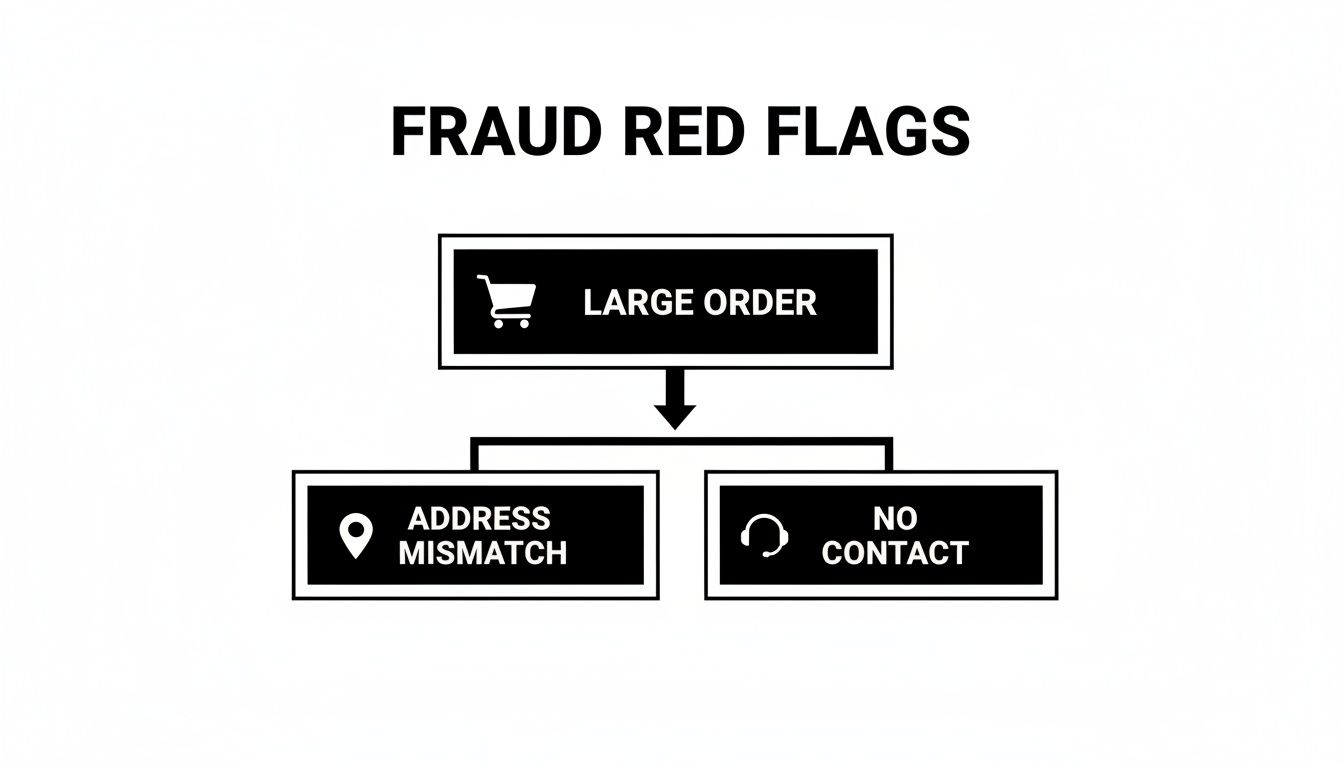
See how it works? One high-risk signal, like an unusually large order, often connects to other warning signs. Maybe the shipping and billing addresses don't match, or worse, the customer is impossible to get in touch with. Together, these paint a high-risk picture for friendly fraud.
Step 3: Optimize Your Fulfillment Process
The shipping and delivery phase is a massive flashpoint for disputes. "Product not received" is one of the most common chargeback reasons out there—and it’s a favorite excuse for people committing friendly fraud. Your fulfillment process needs to be built to prove delivery, period.
Always, always use a shipping service that provides tracking and delivery confirmation. This isn’t just for the customer’s peace of mind; it’s your ironclad evidence when you need to fight back.
- Require a Signature on High-Value Orders: For anything expensive, a signature is undeniable proof that the package got into your customer's hands.
- Use Delivery Confirmation with Photos: Many couriers now offer photo proof of delivery, showing exactly where they left the package. This evidence is gold when fighting a "never received" claim.
- Insure Your Shipments: For high-ticket products, shipping insurance protects you from financial loss if a package genuinely goes missing. This helps you separate real logistical hiccups from fraudulent claims.
Step 4: Implement Smart Payment Setups
Finally, your checkout process itself can act as a powerful gatekeeper. The basic security features included with Shopify Payments can do a lot of the heavy lifting to verify that the person making the purchase is the real cardholder.
These checks add a tiny bit of friction for a potential fraudster but are totally seamless for legitimate customers.
- Address Verification System (AVS): This feature checks if the billing address the customer enters matches what the card issuer has on file. A mismatch is a major red flag.
- Card Verification Value (CVV): Always require the three or four-digit security code from the card. This simple step helps prove that the customer physically has the card in their possession.
By layering these four strategies—clear policies, proactive communication, solid fulfillment, and smart payment checks—you create a truly robust defense. Each step makes your business a harder target for friendly fraud and gives you the rock-solid evidence you need to win disputes when they inevitably happen.
How to Win the Fight When a Dispute Occurs

Even with the best prevention strategies in the world, some friendly fraud disputes are simply going to happen. When that dispute notification lands in your inbox, it’s easy to feel like you’ve already lost. But you’re not out of options. You can—and absolutely should—fight back against bogus claims to protect your hard-earned revenue.
This fight is called the representment process. It’s your chance to present compelling evidence that proves the customer's claim is invalid. Winning isn't just about recovering one sale; it's about sending a clear message that your business won't be an easy target for this kind of behavior. This is exactly what ChargePay’s AI does automatically, hitting a 92.4% win rate for the Shopify merchants we protect.
Gathering Your Essential Evidence
When you decide to fight a chargeback, you're essentially building a legal case. The bank acts as the judge, and they only care about one thing: cold, hard proof. Vague statements or assumptions just won't cut it. You need to assemble a complete evidence package that leaves zero room for doubt.
Your goal is to tell a crystal-clear story of the transaction, from start to finish. You have to prove that the legitimate cardholder authorized the purchase, received their items just as described, and knew exactly what they were buying.
The quality of your data is the bedrock of your defense. A core part of any prevention playbook is mastering data excellence, because high-quality data gives you the undeniable evidence you need and helps spot suspicious patterns before they become a problem.
To build a rock-solid case, you'll need to gather specific pieces of evidence. Think of it like a checklist for every dispute you fight.
Here’s a breakdown of the key evidence you’ll need to pull together for your representment package. Each piece tells a part of the story, and together, they create a powerful narrative that’s hard for banks to ignore.
Essential Evidence for Fighting Friendly Fraud
Having this evidence organized and ready to go is more than half the battle. It gives you the ammunition you need to fight back effectively and protect your bottom line.
Structuring a Winning Rebuttal
Once you have all your evidence, you need to present it in a professional and persuasive rebuttal letter. Don't just dump a folder of screenshots and expect the bank to connect the dots. You need to structure your argument logically to make it effortless for the reviewer to see your side of the story.
Your rebuttal should be a concise summary that directly shoots down the customer's specific claim. For example, if they claim "product not received," you should lead with your delivery confirmation and tracking history.
Here’s a simple way to build a powerful rebuttal:
- Start with a Clear Summary: Briefly introduce the transaction and state plainly why the chargeback is invalid.
- Systematically Refute the Claim: Use your evidence to walk the bank reviewer through the entire transaction, from the moment the order was placed to the moment it was delivered.
- Reference Your Policies: Always include screenshots of your return and shipping policies that the customer had to agree to before completing their purchase.
- Keep it Professional: Avoid using emotional language or getting personal. Just stick to the facts and present your evidence in an organized, easy-to-digest format.
Honestly, this whole process can be a huge time-sink, which is why so many merchants just write it off as a cost of doing business. Fighting a single dispute can take hours you just don’t have.
This is where automation becomes a true game-changer. ChargePay’s AI was built from the ground up to handle this entire messy process for you. It instantly analyzes the dispute, gathers all the necessary evidence from your Shopify data, and builds a custom, winning rebuttal based on the specific reason for the chargeback. It’s how we've recovered over $2.8 million for stores just like yours.
Automate Your Defense and Recover Revenue
Let’s be real. Trying to fight friendly fraud on your own is a nightmare. Manually tracking every dispute, digging through order histories for evidence, and writing custom rebuttals is a full-time job in itself. It’s tedious work that steals time you should be spending on actually growing your Shopify store. You just don't have the hours to fight every single battle.
That’s exactly why we built ChargePay. We saw how much revenue Shopify merchants were losing to this broken system and knew there had to be a better way. So, we created a solution that fights back for you—automatically. Our whole goal is to take the entire headache of dispute management completely off your plate.
Let AI Do the Heavy Lifting
The second a chargeback hits your account, our AI gets right to work. It instantly analyzes the reason for the dispute, whether it's "product not received" or an "unrecognized transaction." From there, it dives straight into your store's data to gather all the proof needed to fight back.
This isn't just surface-level stuff. Our AI pulls all the critical evidence points, including:
- Customer Information: Name, email, and IP address.
- Order Details: What they bought and when.
- Proof of Delivery: All the tracking numbers and delivery confirmation data.
- AVS & CVV Checks: Evidence showing the correct card information was used at checkout.
Our system then pieces all this information together into a professional response specifically built to win. We don't do generic templates. Every single response is generated based on the claim and backed by hard data from your store. It’s how we've successfully handled over 100,000 disputes and recovered more than $2.8 million for Shopify merchants just like you.
With a 92.4% win rate, we turn the endless frustration of friendly fraud into a solved problem. Our system makes sure you never miss a deadline and that every dispute is fought with the strongest possible evidence.
A Trusted Partner Built for Shopify
You need a tool that feels like a natural part of your store, and that’s what ChargePay is all about. We’re proud to be a ‘Built for Shopify’ app, which means we meet Shopify’s highest standards for performance, quality, and user experience. Our 4.9-star rating in the Shopify App Store comes from thousands of merchants who have stopped losing money and started getting it back.
Fighting chargebacks manually is a losing game. The system is stacked against you, and your time is far too valuable to be wasted on it. If you're tired of watching your revenue disappear because of friendly fraud, it's time to automate your defense. For anyone interested in the nitty-gritty details, you can read our complete guide to automated chargeback and dispute management using AI.
Stop letting chargebacks drain your profits. Let our AI handle the fight so you can get back to what you do best: building your business.
Ready to stop losing money? Install ChargePay from the Shopify App Store today and start recovering your revenue.
Got Questions About Friendly Fraud? We’ve Got Answers.
As a store owner, you're bound to have questions about friendly fraud. It's one of those topics that can feel confusing and incredibly frustrating. We hear from merchants all the time who are tired of losing money to these chargebacks, so let’s clear up some of the most common questions.
Is Friendly Fraud Actually Illegal?
Let's get straight to the point: Yes, when a customer intentionally disputes a legitimate charge to get a free product, they are committing a crime. It's a form of wire fraud.
But here's the reality check for a busy merchant—prosecuting someone for a single chargeback is almost never worth the time and effort. Your best, most realistic move is to fight the chargeback through the bank's representment process. That's how you get your money back.
Will Fighting Chargebacks Hurt My Customer Relationships?
Honestly, if it's a true case of friendly fraud, that customer has already damaged the relationship by acting in bad faith. By fighting back with clear, factual evidence, you're just defending your business from a wrongful claim. You aren't ruining a relationship that was already broken.
And what about those accidental disputes? The ones that come from genuine confusion? A professional, evidence-backed response can actually clear the air. Sometimes, it even helps educate the customer on how things work on your side of the counter.
How Long Do I Have to Respond to a Chargeback?
This is where the clock starts ticking, and you need to pay attention. The deadline depends on the card network (like Visa or Mastercard), but you generally have between 20 and 45 days from the day the dispute is filed. This is a non-negotiable deadline.
Miss that window, and you automatically lose the dispute and the money. It's that simple. This tight turnaround is exactly why so many Shopify merchants use an automated solution like ChargePay. Our AI makes sure you never miss a deadline, ever.
Can I Block Customers Who Commit Friendly Fraud?
You absolutely can, and you absolutely should. A customer who gets away with friendly fraud once is far more likely to do it again, either to you or to another store.
Using a fraud prevention tool or even Shopify's built-in features to block the customer’s name, email, shipping address, and IP address is a critical step. It’s one of the simplest and most effective ways to shut the door on repeat offenders and protect your future revenue.
Fighting friendly fraud on your own is a time-suck you don't need. ChargePay puts AI to work for you, automating the entire dispute process and recovering your money with a 92.4% win rate. Our system is trusted by thousands, earning a 4.9-star rating and a Built for Shopify badge while recovering over $2.8 million for merchants just like you.
Stop letting revenue slip through the cracks. Install ChargePay from the Shopify App Store and let our AI make your chargeback problem a thing of the past.


.svg)



.svg)


.svg)
.svg)
.svg)