

When you see that "Dispute Opened" email from PayPal, it’s official: a PayPal fraud investigation has begun. This just means a customer has challenged a transaction, and PayPal is now stepping in to play referee.
It’s their formal process for figuring out if a charge was legitimate. The first thing they do? Freeze the disputed funds until they make a call. From this point on, it's up to you—the merchant—to prove the transaction was valid.
What Happens When PayPal Starts a Fraud Investigation
That initial notification from PayPal can definitely get your heart racing. But once you understand what's happening behind the scenes, you can replace the panic with a clear, confident response.
A fraud investigation isn't an accusation; it's a structured inquiry kicked off by a customer's complaint. The moment a case is opened, a few things happen automatically that set the stage for everything else.
First, the funds from that specific transaction are immediately put on a temporary hold in your PayPal account. This is standard procedure, meant to protect the buyer while the investigation is active. You won’t be able to touch that money until the case is closed. At the same time, the case pops up in your account's Resolution Center, which is now your command center for all communication and evidence.
The Key Players and Their Roles
Knowing who’s who is key to navigating the investigation without stumbling. There are three main parties involved, and each has a specific job to do:
- The Customer (Buyer): This is the person who started the whole thing. Their reason might be a genuine "Unauthorized Transaction" claim—maybe they think their account was hacked. Or, it could be a case of "friendly fraud," where they're trying to get a product for free by gaming the system.
- PayPal (The Mediator): PayPal acts as both judge and jury here. Their fraud investigation team looks at the evidence submitted by you and the customer. Their goal is to make a fair decision based on the documentation and their own terms of service.
- The Merchant (You): Your role is basically that of the defendant. It’s on you to provide clear, compelling evidence that the transaction was legit, the item was delivered as described, and you held up your end of the bargain.
This flowchart breaks down how a fraud investigation gets rolling.

As you can see, it boils down to three immediate actions: the alert, the hold on your funds, and the request for you to respond. This is the starting point for every single case.
Why Fraud Investigations Are on the Rise
No, it's not just your imagination—these disputes are happening more and more. The global eCommerce fraud problem has exploded, with losses from fraudulent payments jumping from $17.5 billion in 2020 to an estimated $48 billion in 2023.
For merchants using PayPal, the numbers are just as stark. On average, 29% of annual online transactions are compromised each year. This trend makes knowing how to manage a PayPal fraud investigation more important than ever before.
Key Takeaway: A PayPal investigation is a structured, evidence-based process. Your immediate goal is not to argue with the customer but to provide clear, organized proof to PayPal's review team.
The entire process plays out inside PayPal’s system, mostly through their online portal. You can get a detailed walkthrough in our guide on the PayPal Dispute Resolution Centre. How well you respond there will directly decide whether those frozen funds are returned to your account.
Gathering Evidence to Build Your Winning Case
A PayPal fraud investigation is won or lost based on the quality of your evidence. Let's be honest, just uploading a shipping confirmation and hoping for the best isn't going to cut it anymore.
To win, you need to present a complete, compelling story that leaves the PayPal investigator with zero doubts about the legitimacy of the transaction. Think of yourself as a detective building an airtight case.

This means you have to go beyond the bare minimum and pull together every piece of digital proof you can find. Your goal is simple: make it incredibly easy for the reviewer to see the full picture and rule in your favor.
The Essential Evidence Checklist
The moment a dispute lands in your Resolution Center, don't just react—get organized. I always recommend creating a dedicated folder for the case right away and start collecting every relevant scrap of information. The more you have, the stronger your defense.
Here’s what you should always be looking for first:
- Proof of Delivery: This is the absolute foundation of your case for "Item Not Received" disputes. You need a tracking number from a major carrier (like FedEx, UPS, or DHL) that clearly shows the item was delivered to the customer's address. Signature confirmation is even better—it’s a powerful piece of proof.
- Customer Communications: Pull all of it. Every email, live chat transcript, and social media DM. These can be pure gold, especially if they show the customer acknowledging the order, asking questions about the product, or even saying they liked it before filing the dispute.
- Order and Transaction Details: This is your basic paperwork: the invoice, a screenshot of the order details from your e-commerce platform, and the PayPal transaction confirmation. This proves the order was officially placed and paid for.
This first batch of documents establishes the core facts. But to really build a winning case, you’ve got to dig a little deeper.
Expert Tip: Don't just dump a bunch of random files into the Resolution Center. I've seen it a thousand times, and it doesn't help. Name your files clearly (e.g., "Shipping_Confirmation_UPS_1Z123.pdf," "Customer_Email_March15.png"). This small step makes the investigator's job so much easier and shows you're on top of your game.
Digital Footprints That Prove Your Case
In a PayPal fraud investigation, the digital evidence is what often tells the real story. Fraudsters can be sloppy, and genuine customers leave a trail that confirms their identity and what they intended to do. This is where you can really turn the tables.
Your focus should be on collecting data that connects the person who paid with the person who ordered and received the goods.
AVS and CVV Results
The Address Verification System (AVS) and Card Verification Value (CVV) are your first line of defense at the point of sale. You should always include screenshots from your payment processor showing that these security checks passed.
- AVS Match: This confirms the billing address the customer typed in matches the address their credit card company has on file.
- CVV Match: This proves the customer had the physical card (or at least access to the number) when they made the purchase.
When you present proof of successful AVS and CVV checks, it makes it much, much harder for someone to claim a transaction was "unauthorized." It shows that key security measures were met, strongly suggesting the legitimate cardholder was the one clicking "buy."
IP Geolocation Data
The IP address used to place the order is another incredibly powerful piece of evidence. Use a free online tool to look up the IP address you captured in the order details.
If the IP address location lines up with the customer’s shipping or billing address, it's a strong indicator that they are the one who placed the order. If it's from a different country or a known proxy server, that could be a red flag, but it's still crucial information to provide as context. Present a screenshot of the IP lookup map and the data—this visual proof is very effective.
Tackling Specific Dispute Types with Evidence
The kind of evidence you prioritize has to match the customer's specific claim. You can't use a one-size-fits-all approach. Tailoring your response is absolutely critical for winning the investigation.
For example, with "Item Not Received" claims, the proof of delivery is everything. You can get a full breakdown of how to handle these in our guide to winning PayPal "Item Not Received" disputes.
But for "Significantly Not as Described" (SNAD) claims, your focus shifts completely. Here’s what you need to gather:
- Detailed Product Photos: Provide high-quality photos from your product listing that clearly show the item. If you have photos of the actual item you packed and shipped, that’s even better.
- Accurate Product Description: Submit a screenshot or a copy-paste of the product description from your website. I recommend highlighting the parts that accurately describe the item's features, condition, and materials that the customer is disputing.
- Customer Communications: If the customer contacted you to complain before filing the dispute, include that conversation. It shows you were engaged and maybe even offered a perfectly reasonable solution that they rejected.
By methodically gathering and organizing this evidence, you transform a stressful dispute into a winnable case. You’re no longer just reacting—you’re presenting a fact-based narrative that demonstrates your professionalism and proves the transaction was valid from start to finish.
How to Write a Clear and Compelling Response
You’ve gathered all your evidence, named your files logically, and you’re about to upload everything. Stop right there. Just dumping a folder of documents into the Resolution Center is a surefire way to lose. You have to connect the dots for the PayPal investigator with a clear, professional, and persuasive response letter.
This letter is your one shot to tell your side of the story. Think of it as a cover sheet and a guide that explains what each piece of evidence means and why it proves the transaction was legitimate. I've seen countless cases where a well-written response made all the difference between winning and losing a PayPal fraud investigation.
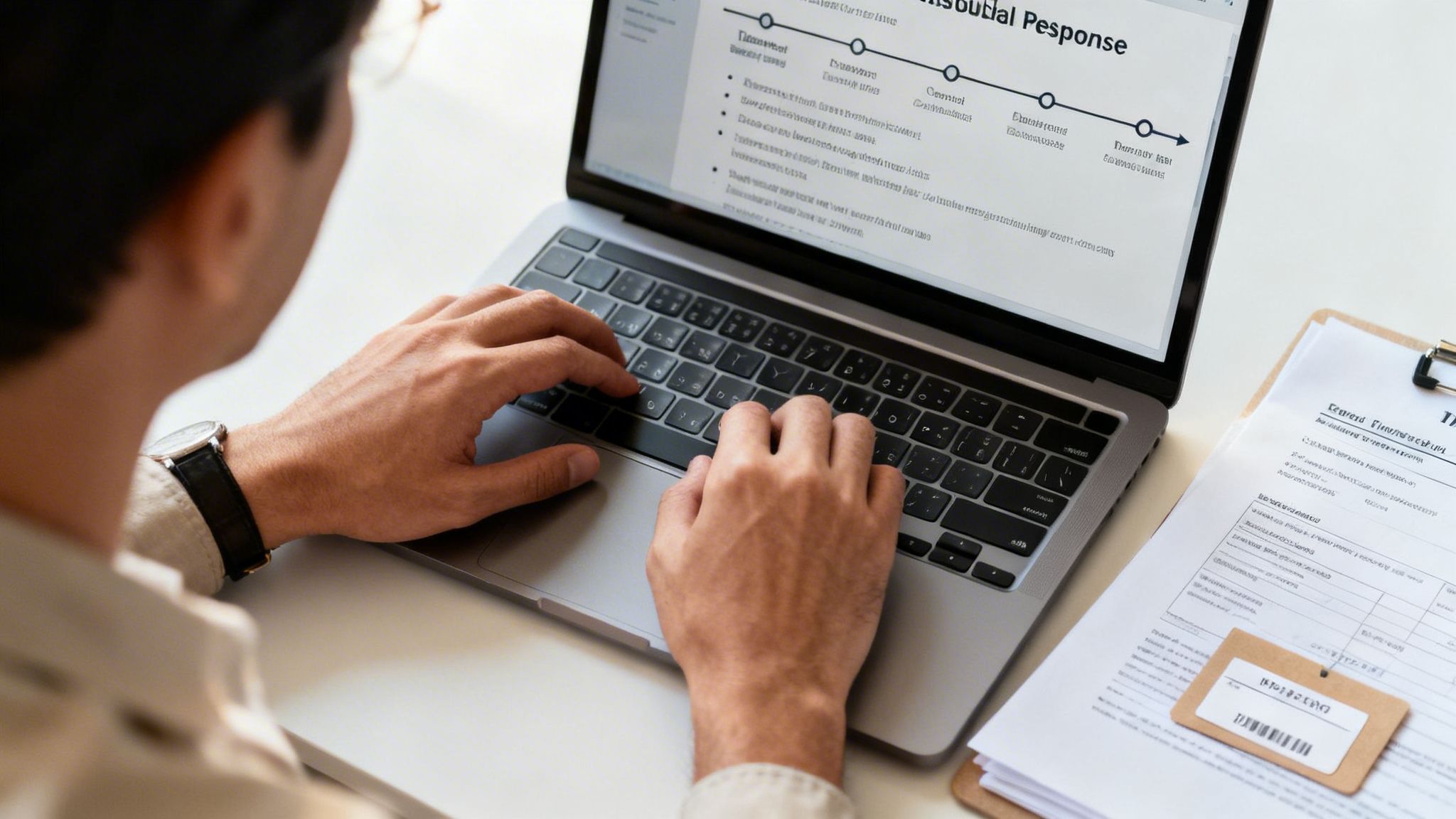
Picture the investigator on the other end: they're swamped with cases and have only a few minutes to grasp your situation. Your job is to make their decision as easy as possible by presenting a rock-solid, organized case that leaves zero room for doubt.
Structure Your Response for Maximum Impact
An emotional, jumbled letter will get you nowhere fast. You absolutely need structure. A logical flow helps the reviewer quickly understand the key facts and follow your argument from start to finish.
This is the structure I always recommend for a winning response letter:
- A Professional Opening: Start politely. State the case and order numbers, then briefly explain that you are responding to the dispute with evidence to validate the transaction. No fluff.
- A Clear Transaction Timeline: This is your secret weapon. Create a simple, bulleted list that walks the investigator through the sequence of events. A good narrative is incredibly powerful.
- Directly Address the Buyer’s Claim: Don't beat around the bush. State the customer’s claim (e.g., "The buyer claims this was an unauthorized transaction") and immediately refute it with your facts.
- Reference Your Evidence: As you make each point, call out the specific files you’ve uploaded. For example, "Proof of delivery is confirmed via tracking number (see attached
shipping_confirmation.pdf)." - A Confident Closing: End the letter by politely restating your position and requesting that the case be closed in your favor.
This framework turns a random collection of files into a cohesive, compelling argument. For a deeper dive, check out our complete guide on how to write a powerful letter of rebuttal.
Key Elements of a Winning Response Letter
Now, let's talk about the content itself. Your tone and clarity are everything. You need to come across as professional, factual, and confident—never angry or accusatory, even if you’re positive it's a case of friendly fraud.
My Two Cents: Stick to the facts. Emotion has no place in a dispute response. The investigator doesn't care if you think the customer is a scammer; they only care about the evidence. A calm, professional tone builds your credibility instantly.
It’s true, fighting disputes takes time, but a well-crafted response is a worthy investment. While PayPal's systems block around $500 million in fraud attempts quarterly, retailers still lose an average of $3.7 million annually to fraud. This translates to roughly 679 chargebacks per merchant each month, with each one demanding an average of 30 hours of work to fight.
A Simple Template to Get You Started
Here’s a basic template you can adapt for your own cases. Just fill in the bracketed information with your specific details.
Subject: Response to Case ID [Your Case ID Number] - Order #[Your Order Number]
Dear PayPal Investigation Team,
We are writing in response to the dispute filed for the transaction associated with the above order number. We have attached comprehensive evidence to demonstrate that this was a legitimate transaction and the order was fulfilled correctly.
Transaction Timeline:
- [Date]: Order placed by [Customer Name] from IP address [Customer IP Address], which geolocates to [City, State].
- [Date]: Payment of $[Amount] was successfully processed. AVS and CVV checks both returned a "match" (see
payment_gateway_screenshot.png). - [Date]: The order was shipped to the address provided by the customer via [Carrier Name] with tracking number [Tracking Number].
- [Date]: The package was successfully delivered and signed for by [Name on Signature] (see attached
proof_of_delivery.pdf).
Addressing the Claim:
The buyer has claimed [state the buyer’s claim, e.g., "this transaction was unauthorized"]. The evidence provided confirms the cardholder's information was verified at checkout and the order was shipped and delivered to their confirmed address.
Thank you for your time and for reviewing this information. We are confident the evidence confirms this was a valid sale. We respectfully request that this case be closed in our favor.
Sincerely,
[Your Name/Business Name]
This clear, concise format makes your argument easy for the investigator to follow and your evidence simple to find. Trust me, it significantly boosts your chances of winning the PayPal fraud investigation.
You've sent off your evidence, dotted your i's, and crossed your t's. Now comes the hard part: waiting for PayPal's decision. This phase of a fraud investigation can feel like a black box, but knowing what's happening behind the scenes helps you prepare for whatever comes next.
Right now, PayPal's review team is looking at everything—all the evidence you sent and whatever the buyer provided. They’re weighing both sides to see whose story holds up best against the facts.
Understanding the Decision Timeline
So, how long does this take? Generally, PayPal tries to wrap things up in about 30 days. Keep an eye on your email and your Resolution Center, as that's where the final word will land.
When that notification finally arrives, it's going to be one of two things. Either you've won, the case is closed, and the funds are released back to you. Or, the buyer wins, and the money is gone for good. If it's the latter, take a breath. It's not necessarily over.
Key Insight: A lost dispute doesn't have to be the end of the line. A surprising number of merchants don't realize that PayPal has an appeals process, giving you one more shot to make your case.
This is your second chance, and it’s a critical one. If you have new, game-changing evidence that you didn't have before, an appeal is your next move.
How to File a Winning Appeal
If you choose to appeal, you need to be quick about it. PayPal typically gives you a 10-day window from the decision date to file. The key here isn't to just resubmit the same old evidence and cross your fingers. You absolutely must bring something new to the table.
What counts as "new" evidence? Think along these lines:
- Updated Tracking Info: Maybe the package was finally marked "delivered" after PayPal made its initial decision.
- Fresh Customer Communication: The buyer might have sent you an email or message admitting they received the item or made a mistake.
- Better Digital Proof: Perhaps you located a clearer screenshot from your payment processor showing a definitive AVS and CVV match.
To get the ball rolling, head back to the closed case in your Resolution Center and find the appeal option. Your new response letter should get straight to the point: "We are appealing the decision on Case [Case ID] and are providing new evidence." From there, spell out exactly what the new proof is and why it flips the original decision on its head. After you submit everything, you'll want to know how to track the progress of your case.
When a Dispute Becomes a Chargeback
It's also essential to know the difference between a standard PayPal dispute and a full-blown credit card chargeback. They might start the same way—with an unhappy customer—but they play out in completely different arenas.
A dispute is handled entirely within PayPal's world. Their internal team is the judge, jury, and executioner, and they make the call based on their own policies.
A chargeback is a different beast altogether. This happens when the customer bypasses PayPal entirely and goes straight to their credit card company (Visa, Mastercard, Amex, etc.) to force a refund.
When it gets to this point, the rules change dramatically. PayPal is no longer in charge; the card-issuing bank is. The stakes are higher, the evidence requirements are often much stricter, and you're now playing by the card network's rules. If you lose, you're not just out the sale amount—you'll get hit with a separate chargeback fee, too. To get a better handle on this, it's worth learning how to escalate a case on PayPal and what that escalation really means for your business.
How to Proactively Prevent Fraudulent Disputes

Winning a PayPal fraud investigation feels good, but you know what’s even better? Avoiding it in the first place. Shifting your focus from reacting to disputes to proactively stopping them saves an incredible amount of time, money, and stress. It’s all about building a stronger defense right at the checkout.
The best part is that many of the most effective tools are already built into your PayPal account. You just need to know how to use them to your advantage.
Fine-Tuning Your Built-In Defenses
PayPal gives you a suite of fraud management tools designed to flag sketchy transactions before they ever become a problem. Think of them as your first line of defense. Turning these on and configuring them properly is a non-negotiable step for any serious merchant.
Two of the most powerful tools at your disposal are the Address Verification System (AVS) and Card Verification Value (CVV) checks.
- AVS (Address Verification System): This tool checks if the billing address entered by the customer matches what their card issuer has on file. A mismatch is a classic red flag for fraud.
- CVV (Card Verification Value): This requires the customer to enter the three or four-digit security code from their card, proving they likely have the physical card in hand.
Making sure both AVS and CVV checks are mandatory is a simple way to weed out a ton of low-effort fraud. Beyond these basics, dig into PayPal’s customizable fraud filters. You can set rules to automatically flag or block orders based on things like transaction amount, IP address location, or how many times a card has been used recently.
Spotting Red Flags in Real-Time
Even with the best filters, some suspicious orders are bound to slip through. This is where a little human oversight becomes invaluable. Training yourself and your team to recognize common fraud patterns can stop a dispute dead in its tracks.
Here are a few telltale signs to watch for:
- Mismatched Addresses: A shipping address in California with a billing address in Florida? It could be a gift, but it’s definitely worth a second look.
- Suspicious Email Accounts: An email like
hsdgfsdhg324@gmail.comjust feels off compared tojohn.smith1985@gmail.com. Trust your gut. - Unusually Large First-Time Orders: A brand-new customer dropping $2,000 on your most expensive items should immediately set off alarm bells.
- Multiple Orders to the Same Address with Different Cards: This is a classic tactic used by fraudsters testing a batch of stolen credit card numbers.
A huge part of guarding against fraudulent claims is implementing robust strategies for phishing attack prevention. Teaching your team how to recognize and report these attempts is essential.
The Game-Changer: Automation and AI
Manually reviewing every order and fighting every dispute is a massive time sink. As we’ve covered, a single dispute can eat up 30 hours of work. This is where automation becomes less of a luxury and more of a necessity for growth.
Solutions like ChargePay are designed to take this entire burden off your shoulders. Instead of you manually digging for evidence and writing responses, an AI-powered system does it for you in real-time. It instantly analyzes the dispute, pulls together the most compelling evidence, and crafts a winning response based on thousands of successful cases.
By automating the dispute process, merchants can reclaim those valuable hours and reinvest them into what actually grows the business—marketing, product development, and customer service. It’s a direct conversion of operational drag into business momentum.
This isn't just about saving time; it's about improving your win rate. AI tools can spot patterns and leverage evidence frameworks that a human might easily miss, which can significantly boost your chances of winning each PayPal fraud investigation.
To give you a clearer picture, let's compare the two approaches side-by-side.
Manual vs. Automated Dispute Management
The difference is stark. While a manual approach can feel like you're constantly playing catch-up, automation puts you in control and positions you to win.
If you're looking for more actionable tips, our guide on how to prevent chargebacks on PayPal offers additional strategies. By combining PayPal's built-in tools with smart manual reviews and the power of automation, you create a multi-layered defense that not only protects your revenue but frees you up to focus on your business's future.
Even after you get the hang of the process, a PayPal fraud investigation can still leave you with some nagging questions. Let's run through a few of the most common ones we see merchants asking. Think of this as your back-pocket guide for those "what if" moments that pop up right in the middle of a dispute.
Getting straight answers helps you keep a level head and make the right moves, so you can get back to business instead of sweating the small stuff.
How Long Does PayPal Hold Your Money?
This is almost always the first thing on a merchant's mind, and for good reason. As soon as a dispute is filed, PayPal puts a temporary hold on the transaction amount. That money is essentially frozen for the entire time the investigation is active.
While a super straightforward case might get sorted out in less than a week, you should plan for most investigations to take around 30 days. If things get complicated or the case gets escalated, it can definitely stretch out longer. The bottom line is, those funds stay locked up until PayPal makes a final call.
Will Winning a Dispute Hurt My Account Standing?
Great question. The short answer is no, not really. Winning a dispute is obviously the goal. It shows PayPal you’re a legitimate seller who ships products and keeps solid records.
But—and this is a big but—having a high rate of disputes filed against you can be a red flag, even if you win every single one. PayPal’s algorithms are always looking for patterns. A high volume of disputes, win or lose, can signal underlying problems with your product listings, shipping estimates, or customer communication.
Key Takeaway: By all means, fight to win the disputes you get. But your real focus should be on preventing them from happening in the first place. A low overall dispute rate is the best sign of a healthy account.
What If the Customer Leaves Negative Feedback After Losing?
It's one of the most frustrating things that can happen. You win the case, the money is safe, and then the customer retaliates with a one-star review or a nasty post on social media. Unfortunately, PayPal’s investigation is completely separate from public feedback on other platforms.
Here’s a simple playbook for handling it:
- Respond Like a Pro: Go to the platform where they left the review and post a calm, professional, and factual public reply. Don't get dragged into the dispute details. Something simple like, "We are sorry you had a negative experience. Our records confirm a successful delivery to the address provided on the order," is perfect.
- Report the Review: If the feedback violates the platform's rules (like using abusive language or containing clearly false information), report it.
- Walk Away: Whatever you do, don't get into a public back-and-forth. Your professional response is for all your future customers to see, not to change the mind of one angry person.
Winning the PayPal fraud investigation is what protects your revenue. While a bad review stings, handling it with grace protects your reputation, which is just as valuable. Keeping these points in mind will help you navigate the aftermath with confidence.
Stop wasting time manually fighting disputes. ChargePay uses AI to automatically generate winning responses for your PayPal fraud investigations, recovering lost revenue while you focus on growing your business. See how it works at ChargePay.ai.


.svg)



.svg)


.svg)
.svg)
.svg)